
And with that slight deviation towards the lower planes, we return to talking about the rest of Mordenkainen's Tome of Foes. This one has a lot of elementals! I remembered the Elementals having so much presence in 4th Edition bestiaries, and that was scaled down a lot in 5th Edition. This is a nice way to give us some 'elite' elementals without going overboard with it.
There are a lot less attempts to try and tie in to the main races/monsters being spotlighted in the first half of the book, I feel, other than the addition of obvious Duergar, Gith and Drow elite variants which we will cover in the appendix at some point. In fact, I actually think that Tome of Foes puts a bit more focus in expanding the fiends, elementals and aspects of the Shadowfell. Pretty neat, that.
Eidolon


Eladrin




Elder Elemental - Elder Tempest

Elder Elemental - Phoenix


Elder Elemental - Zaratan



Giff

Gray Render
____________________________________________________
Howler

- Click here for the first part
- Click here for the next part
- Click here for the index.
[Originally published in May 2020; revised in May 2026]
____________________________________________________
Eidolon
- 5.5E/5E: Medium Undead; Unaligned; CR 12 (Eidolon)
- 5.5E/5E: Large Construct; Unaligned; CR 12 (Sacred Statue)
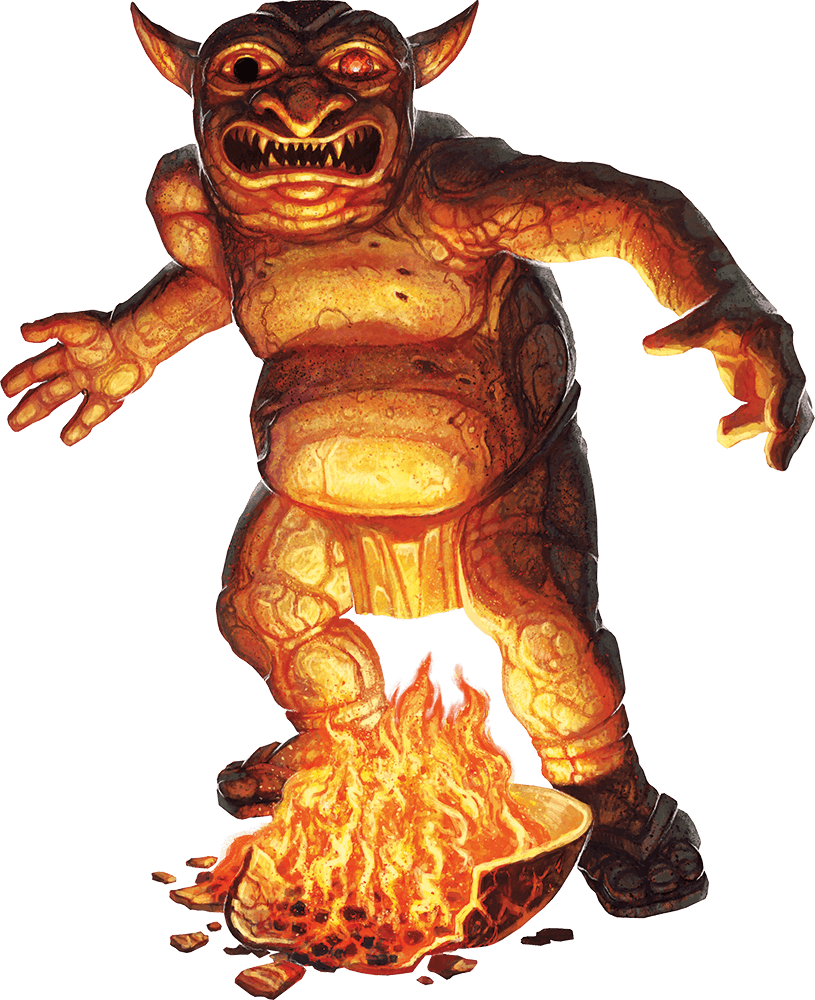
The term 'Eidolon' is a very cool word from Greek mythology that's yet another in a number of words utilized to described a restless, wandering spirit. D&D's definition and depiction of Eidolon has varied wildly over the various editions, but they have more or less settled down on being an 'undead construct' of sorts. In 5th Edition, Eidolons are ghostly spirits bound by a sacred oath to guard something -- usually a site, or perhaps treasure. They would be faithful devotees with unwavering devotion, and are noted to always be fanatics that will never leave their duty.
And if interlopers should come besmirch their gods' sacred location, the Eidolon spirit will inhabit a 'graven vessel', a sacred statue that's specifically prepared to house the souls of the Eidolon spirit. That is the artwork shown, a giant statue that is being possessed by the Eidolon and will attack and crush the intruders. (It also happens to be the statue of demon lord Moloch on the cover of the 1st Edition AD&D Player's Handbook, a cute little easter egg there)
This is a nice variation of the "ancient statues come alive" trope seen in so much fantasy, except instead of mere animated statues or golems, the Eidolon's true form is the spirit. Sure, you might crush the 'Sacred Statue', but the Eidolon spirit remains unharmed and will just keep moving into more and more statues to exhaust the party. This makes for an interesting potential 'multi-phase' boss fight, but one that could also be terminated early by either negotiating with the Eidolon spirit, by dealing with the spirit as it moves from statue to statue, or by somehow separating the spirit from the statue (such as with the Dispel spell).
It is an interesting encounter, since the true form of the Eidolon spirit doesn't even have a way to attack, merely to unleash a sense of 'divine dread' that can frighten but not harm enemies. The Eidolon is truly only able to properly fight while possessing a statue. During my original review, I didn't really care about it and dismissed it as 'a golem with some extra steps', but the gimmick and the roleplay opportunities for the Eidolon are interesting enough that I've gained a much better appreciation of it over the years.
____________________________________________________
Eladrin
- 5.5E/5E: Medium Fey; Chaotic Neutral; CR 10 (Autumn), 10 (Spring), 10 (Summer), 10 (Winter)
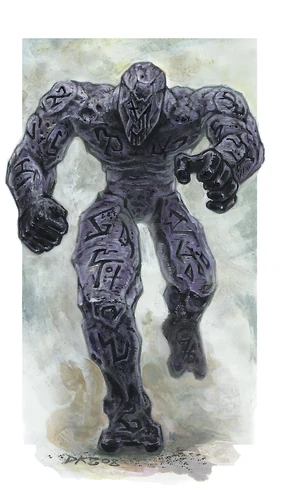
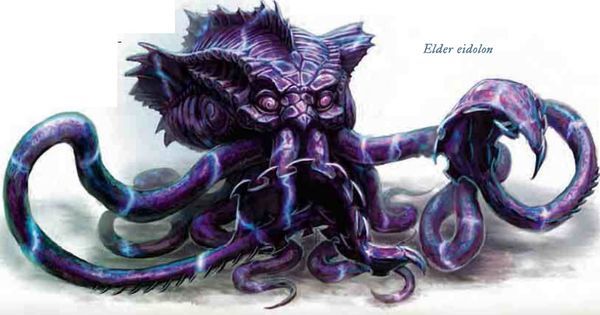
Speaking of confusing changes between editions... here's the Eladrin! The term 'Eladrin' debuted in 2nd Edition's Planescape material, which codified a vast majority of D&D's cosmology and different planes. With the franchise severely toning down anything that could be treated as religious at the time, writers expanded upon the alignment axis to create various analogues to 'heaven' and 'hell'. And the Eladrin were introduced as natural, chaotic good celestials hailing from Arborea that are essentially 'nature angels' of sorts, having powers over natural phenomena. They are always depicted as having the appearance to elves, but are not overtly tied to them. The Eladrin also notably were spotlighted in the first Monster Manuals, making them quite prominent.
4th Edition changed the lore of almost everything, and Eladrin again showed up in the very first books... but with a radically different vibe. The Eladrin were introduced as essentially the equivalents to 'High Elves', with a bit more of a nature leaning, being the term for the subrace of elves most tied to the debuting-in-4E Feywild.
5th Edition changes this again, and while I did grow up on the 3.5E lore, I must admit that this redefinition does help to make the Eladrin a lot more distinct. The 5th Edition Eladrin draws a lot from the 4th Edition concept of being a type of elves that stayed in the Feywild... but instead of 'merely' having more arcane powers, they are actually Fey, displaying aspects of nature not dissimilar to the Ghaeles and Bralanis of older editions. The 5E Eladrin have a fun but memorable theming in that the four Eladrin subtypes are based on the four seasons. And being capricious and ephemeral does help to retain the vibe of the 'holy outsiders' of 3E lore and 'fey-steeped elves' of 4E lore.
Each individual Eladrin can transform from one to the next after moments of great emotion (though it's not something they can do mid-battle), and with the Feywild being so tied to emotions, it definitely makes a fair bit of thematic sense. Tome of Foes also includes these fey Eladrin as a playable sub-race option for elves, which is very cool. It is noted that Eladrins can change form as often as every day of the week, or remain in a particular 'aspect' for years. Regardless of the form they are expressing, Eladrin tend to love beauty, both natural and created... and sometimes this leads to impressing or even spiriting away people whose appearances or 'spirit' they find beautiful.
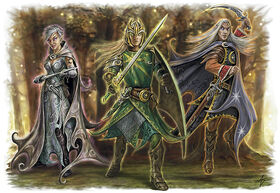
Going in order of the seasons, the Spring Eladrin represent joy, cavorting through the forests while laughing and dancing. Their spell list are filled with charming spells and illusion spells, and they have a 'Joyful Presence' trait that charms those around them to join in cavorting. The artwork is pretty neat, bright greens and leafy, thorny hair and clothes.
The Summer Eladrin represents anger, a burning state of wrath where they are the most aggressive. They radiate fear ('Frightening Presence!'), and their fighting abilities are enhanced that they are move with much more powerful force and speed. I like the artwork for this one the most, I think, with the great shading of oranges and yellows, and the cool curved sword.
The Autumn Eladrin also has really nice colours of darker orange, and they represent the feelings of... goodwill? Not what a 'core' emotion, but I'm not sure what emotion I would associate with autumn. This is the calmest Eladrin state, and in this form they focus on defusing conflict, healing and are focused on maintaining peace. Mechanically, this means that the Autumn Eladrin is the 'healer', with healing spells, an 'Enchanting Presence' and an ability called 'Foster Peace' that forces attacks to miss in her presence.
And finally, the Winter Eladrin is what you'd expect. Blue colours, an icy cloak, and representing the emotions of sorrow. Melancholy and bitterness grip the Eladrin's heart as tears -- frozen tears, obviously -- drip down their cheeks. They radiate a 'Sorrowful Presence', and have several ice-themed spells to do combat.
I do really like the Eladrin. Both as NPCs or player characters, they really bring a lot of options to ramp up the drama, and having these powerful emotions be the catalyst for plot are quite interesting hooks as well!
____________________________________________________
Elder Elemental - Elder Tempest
- 5.5E/5E: Gargantuan Elemental; Neutral; CR 23
And now, we have a set of four Elemental 'bosses', CR 16-22 beings called the Elder Elementals. Tome of Foes also gives us a bunch of stats for Demon Lords and Archdevils at around that CR bracket, trying its best to give more end-game boss stats after a common complaint of the previous 5E bestiaries being that there's just not enough of them. Now, the actual Elemental Princes, the ultimate authority in the Elemental Planes -- Imix, Olhydra, Ogremoch, and the painfully-named Yan-C-Bin -- were statted in Princes of the Apocalypse. But we're not talking about specific named entities in this review series, whereas these Elder Elementals are 'just' the greatest of the Elementals.
The writeup in Tome of Foes notes that Elder Elementals are those that are, well, older and more powerful, feeding on their lesser kin and accumulating the essence of these creatures to their own until they become something far, far larger. When encountered, or worse, summoned, they are beings of apocalyptic devastation, the sheer force of nature itself wiping off civilizations off the map.
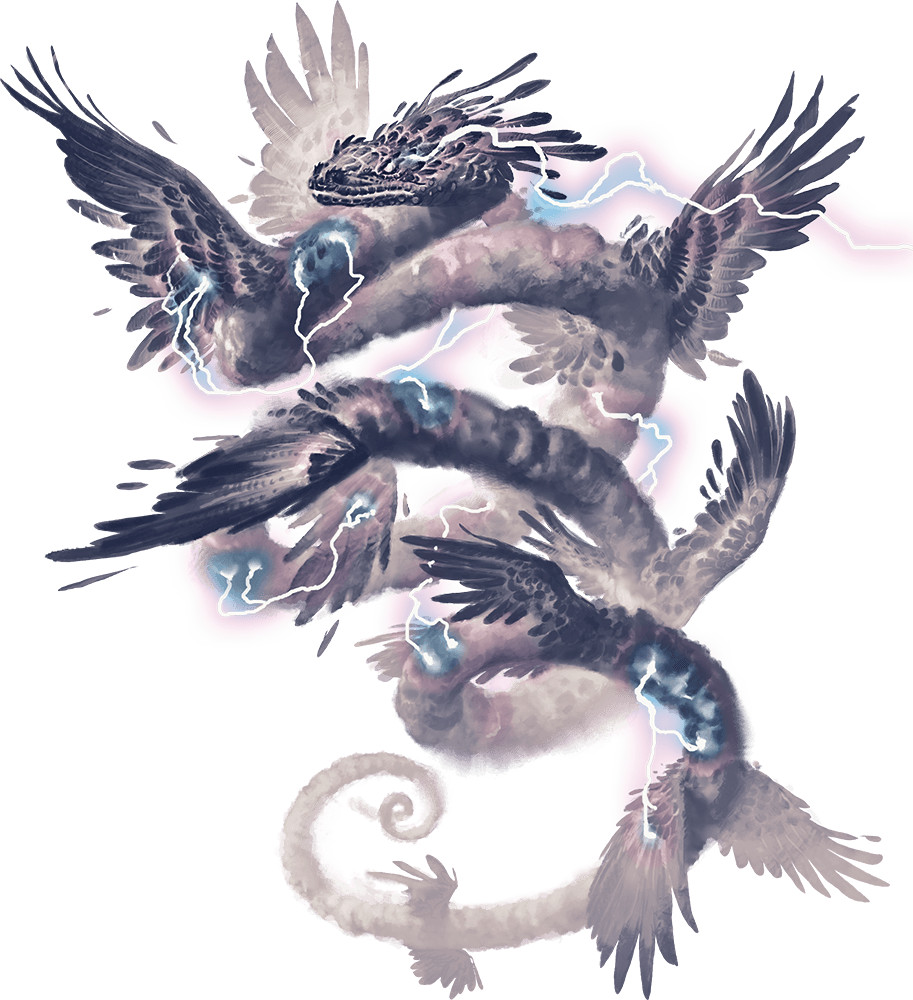
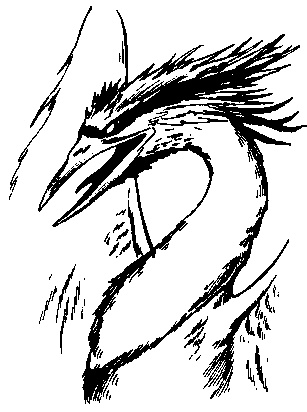
Representing the element of Air is the Elder Tempest, a brand-new creation of 5th Edition. It resembles a giant Asian Dragon, only with multiple wings running down its body and thunderbolts crackling across its body. Elder Tempests are formed out of clouds, wind and lightning, coiling across the sky and drowning the land beneath it with storm. The Elder Tempest has the power to unleash powerful lightning and thunder attacks upon the puny adventurers, damaging people with lances of lightning and knocking them away with thunderclaps and wind. All four Elder Elementals are considered 'siege monsters', meaning they deal extra damage to buildings. Understandable, considering that they are primal manifestations of natural disasters that can demolish buildings.
Its special trait, 'Living Storm', causes a massive storm to appear with the Elder Tempest at the center. This limits visibility, reduces open flames, and imposes disadvantage on anything that involves having to hear. I like that emphasis on the debilitating nature of a howling storm. Despite looking like a giant multi-winged serpent, the Elder Tempest is still an air elemental and can disperse to just a mass of air. Howling, stormy air, but air nonetheless. I like that in elementals -- a huge sentient cyclone is cool, but it's also something that all the more mundane Air Elementals turn into. Having all four Elder Elementals receive great artwork that defines their form as animalistic titans makes them a lot more memorable! The Elder Tempest is a very cool art piece for sure.
Its special trait, 'Living Storm', causes a massive storm to appear with the Elder Tempest at the center. This limits visibility, reduces open flames, and imposes disadvantage on anything that involves having to hear. I like that emphasis on the debilitating nature of a howling storm. Despite looking like a giant multi-winged serpent, the Elder Tempest is still an air elemental and can disperse to just a mass of air. Howling, stormy air, but air nonetheless. I like that in elementals -- a huge sentient cyclone is cool, but it's also something that all the more mundane Air Elementals turn into. Having all four Elder Elementals receive great artwork that defines their form as animalistic titans makes them a lot more memorable! The Elder Tempest is a very cool art piece for sure.
____________________________________________________
Elder Elemental - Leviathan
- 5.5E/5E: Gargantuan Elemental; Neutral; CR 20
It is quite interesting that D&D seems to really want to push some underwater monsters, but it's not really until 5th Edition that Krakens graduated from being a footnote in the 'Giant Squid' entry into a proper unique monster; Sea Serpents are rarely represented; and Leviathans don't really get much love either. The term was used in some older material as a type of Giant Whale, which is cool enough, but again these giant sea monsters remain surprisingly obscure in D&D.
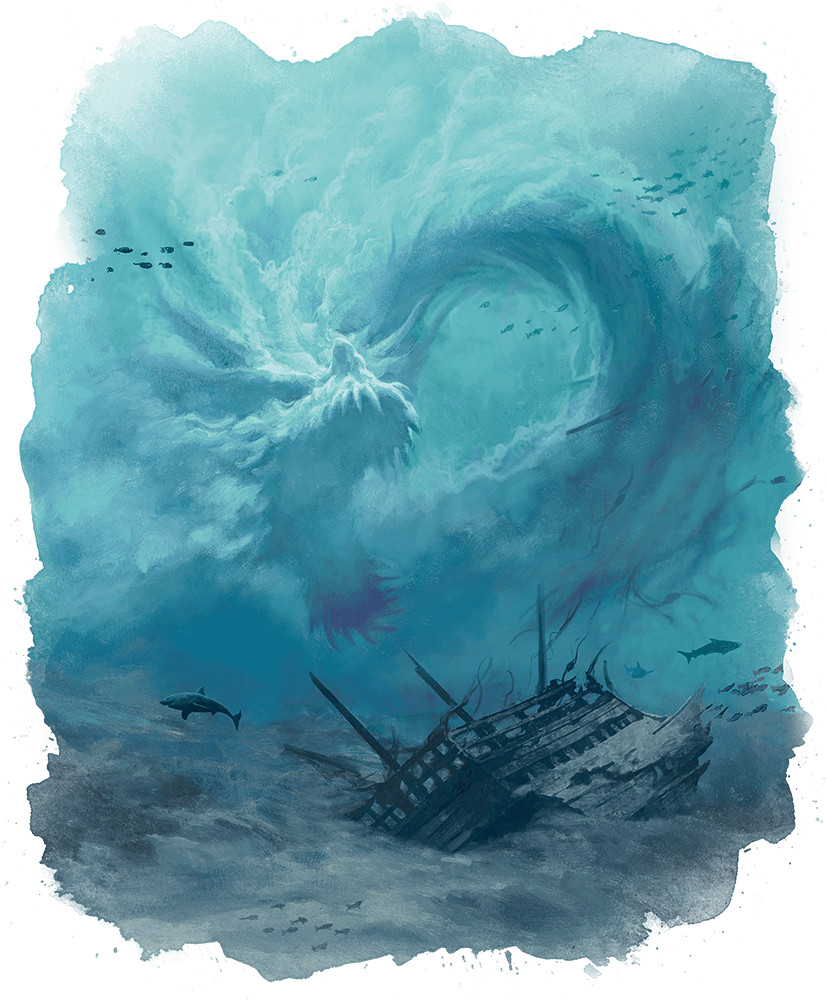
5E's Leviathan is a gigantic, towering sea serpent made up of nothing but pure, flowing water. I really love the artwork of it just blending into the ocean water around it, with its fangs open and clearly large enough to consume that ship. Using the term Leviathan for one of the mightiest water elementals out there. Floods, tsunamis and monsoons are horrifying, and the Leviathan is that given the form of a titanic water serpent.
Despite being a mighty CR 20 creature, the Leviathan is mostly a one-trick pony, using its 'Tidal Wave' ability to sweep everything in its path and knocking them around. It also has some rudimentary melee attacks other than that, but I feel like the Leviathan is meant to be a setpiece more than anything. I also like that they included a fun trait called 'partial freeze', and the Leviathan gets stuck in its tracks when it gets hit with a particularly powerful frost attack.
____________________________________________________
Elder Elemental - Phoenix
- 5.5E/5E: Gargantuan Elemental; Neutral; CR 16
Out of the four Elder Elementals, only two have had any kind of consistent relative prominence in D&D editions. The Phoenix, being an iconic mythological creature, has appeared in every single edition to date, and even in the first bestiaries for 2E and 4E. And it is quite interesting that 5th Edition doesn't spotlight it in the first Monster Manual, but waited for quite some time to include the Phoenix... and as part of a set of elemental beings, too!
In previous editions, the Phoenix has had... an ever-changing lore. 1E's Monster Manual II has its Phoenix be a powerful spellcasting bird that native to the Upper Planes of Elysium, with the ability to erupt in a massive fire spell that leaves behind its egg. 2E expands on this lore, although notes that the Phoenix can travel between planes, and are so reclusive that many different legends about the Phoenix's desires and motivations change from in-universe culture to culture. 3E keeps the Phoenix's powers, but seems to imply that it's merely a magical bird. 4E has the Phoenix as a subspecies of Roc, able to immolate itself to instantly heal itself to full health. Combat tactics over lore, 4th Edition.
Notably, while there is a constant focus on the 'death and rebirth' themes of the Phoenix, and the many different spellcasting abilities that the Phoenix has... the Phoenix's various appearances have all focused so much on describing the abilities and rebirth symbolism that we don't really get to learn all that much about what the Phoenix does.
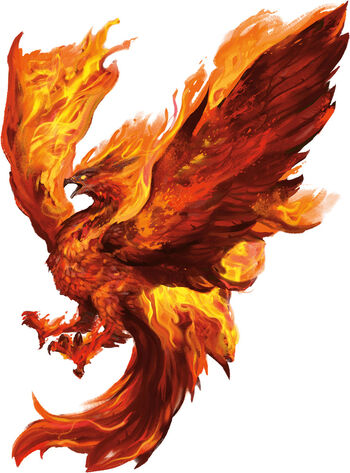
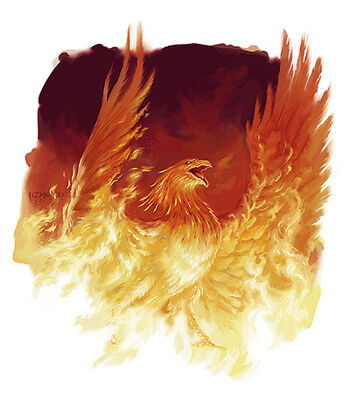
5th Edition... doesn't to it particularly well either. Being an 'elder' fire elemental, Phoenixes are just masses of fire in the form of a bird, and is motivated simply with the desire of burning everything into ash, and 'strives to transform the world into an inferno'. That is indeed in line with the portrayal of most other Elder Elementals, or Elementals in general... but it feels so simple for the Phoenix, especially compared to how much the 2E material wrote about it. So while I like the addition of the lore of the Phoenix being tied to the Elder Elementals, I felt like there's something so overly simplified from the original Egyptian / Grecian myths.
The abilities are greatly simplified, too. Thankfully the Phoenix's iconic 'death and rebirth' ability remains, although it only happens if the Phoenix itself takes enough damage to die instead of being something that the Phoenix is able to trigger. The Phoenix will leave behind an 'egg-shaped cinder', which will hatch into a new Phoenix within a week. All the other abilities are variations of fiery attacks flavoured as bird melee attacks... which, feels very dumbed-down. Again, it fits a 'Fire Elder Elemental', but for a Phoenix? The Phoenix, after all, isn't just a simple firebird, but also a bird of death and rebirth. 1E to 3E have different details, but generally Phoenixes have a some combination of healing spells in addition to its fiery abilities.
So yeah, I'm actually not the biggest fan of this incarnation of the Phoenix. I tend to be neutral to positive about a lot of the 5E reinventions, like how I have discussed the Eladrin above, but I feel like we lost so much with the Phoenix by reducing it to basically just 'Fire Rodan'.
____________________________________________________
Elder Elemental - Zaratan
- 5.5E/5E: Gargantuan Elemental; Neutral; CR 22
The other pre-existing D&D creature that is 'retooled' into an Elder Elemental is the Zaratan, based on the mythological creature from Arabic myths -- a giant crab the size of an island, which mutated by retellings of the story into a giant turtle. D&D's 2nd Edition adapted the more well-known turtle version as a 'turtle island' version of the creature. I suppose the idea of a titanic aquatic turtle large enough to be an island does double up with the Dragon Turtle.
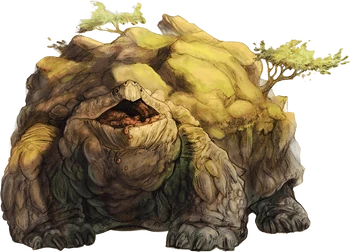
5th Edition takes the basics of this and converts it into its Elder Elemental, making the Zaratan a gigantic tortoise made entirely of dirt and rock, with chunks of foliage and terrain on its back. It reminds me of the Pokemon Torterra for sure. As a standalone creature, I do like the concept that a massive piece of the terrain just sprouted turtle legs and began to walk around. I also like that the artwork does not include eyes, which marks this creature as being more elemental than beast.
5E Zaratans are noted to be dim-witted destructive kaiju like the rest of the Elder Elementals, and its main gimmick is its 'earth-shaking movement'. Each step that a Zaratan takes unleashes shockwaves that damages people, knocks them over and sometimes even shatter buildings. In addition to regular melee attacks, the Zaratan can also spew rocky debris from its mouth.
Unique among the Elder Elementals, the Zaratan has a recovery ability, retracting its 'limbs' into its rocky body, regenerating itself (presumably by absorbing more earth matter?) and then emerging out to resume its march. It's cute, and I approve! I wonder why the other Elder Elementals don't have similar recovery abilities? The Phoenix has the egg ability, but surely a Leviathan and Elder Tempest, both of which seem to be in their elements, should be able to 'absorb' their own elements?
Anyway, while I'm not as miffled about the Zaratan compared to the Phoenix, I still feel like it's an unnecessary transformation of a pre-existing creature into a dumb monstrous elemental kaiju for the sake of completing a set. I feel like they put in more effort into the Zaratan in the art and mechanics department, but I still feel that the Elder Elementals probably needed a bit more lore and flavour to them.
____________________________________________________
Elemental Myrmidons



Frost Salamander

- 5.5E/5E: Medium Elemental; Neutral; CR 7 (Air Myrmidon), 7 (Earth Myrmidon), 7 (Fire Myrmidon), 7 (Water Myrmidon)
Whereas the Elder Elementals form the end-game bosses, the Elemental Myrmidons are a bit of a step-up in terms of challenge compared to the regular Elementals from the Monster Manual. The Elemental Myrmidons debuted in 4th Edition as 'Elemental Archons', stealing the term from a type of celestial... and I don't think you can convince me that the Myrmidons/Archons didn't debut as part of 4th Edition trying to mimic the feel of World of Warcraft, which features a lot of these armoured 'genie-body-layout' elementals in their game.
There were a lot of Archons in 4th Edition, but 5E streamlines the Myrmidons to just be one per element. They are all CR 7, a bit of a step-up from the CR 5 base Elementals, but are also Medium-sized, being roughly the size of a human. All of them also have armour and a helmet, and wield weapons. The end result is a more formidable, 'intelligent' looking Elemental as opposed to the unruly, unbridled chaotic forms of the base elementals.
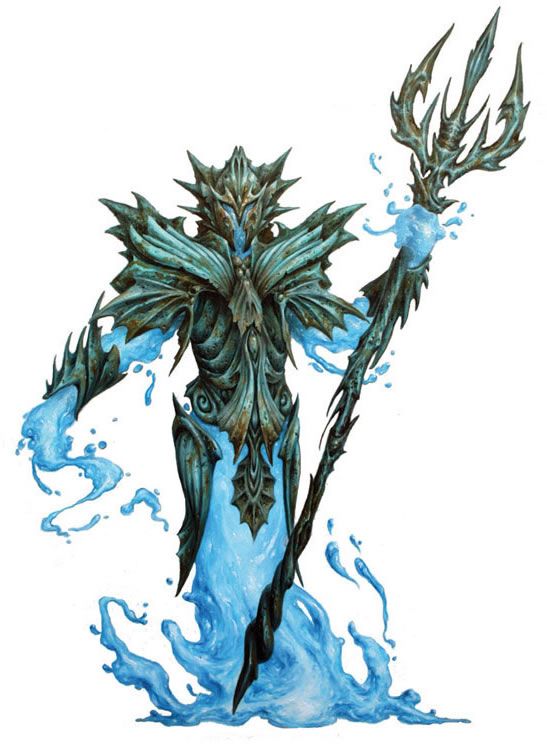
Pretty nice artwork for the four Myrmidons as well. The Earth Myrmidon probably looks the most boring because he actually has legs, and just looks like a giant rock golem holding a rock hammer. The Air Myrmidon has a nice, flowing, ghostly 'genie body' with a flail, too. But I particularly like the artwork of the Fire and Water Myrmidons, both of who have the coolest helmet and have the coolest effect of their respective elements roiling to form facsimiles of limbs and lower bodies. The Fire one dual-wields scimitars, and the Water one has a trident.
The short blurb that Tome of Foes gives to the Myrmidons are that they are elemental spirits caught and bound into suits of magically-created armour specifically to house them, where they have no memory of being elementals and mindlessly serve their creators. This allows them, flavour-wise, to appear just anywhere with a wizard, or as part of a greater Elemental Cult sub-plot. Having Myrmidons and Myrmidon variants would certainly be far, far more interesting than the fifteen different cultists in the Elemental Cult adventure!
All the Myrmidons are simple melee fights that fight with their own weapon, with special effects for their attacks -- the Air Myrmidon launches a lightning strike, the Earth Myrmidon does a 'thunderous' knockdown strike, the Fire Myrmidon does fire damage, and the Water Myrmidon does cold damage. All four Myrmidons also lose their ability to squeeze through locations by turning into a mass of their element, which makes sense since they have armour now.
I know 4th Edition suffers from having way too many variants for each and every sub-type of monster, but I actually wish that the Myrmidons have a bit more to differentiate them. Nice to get more elementals, though.
____________________________________________________
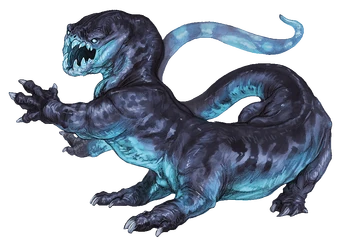
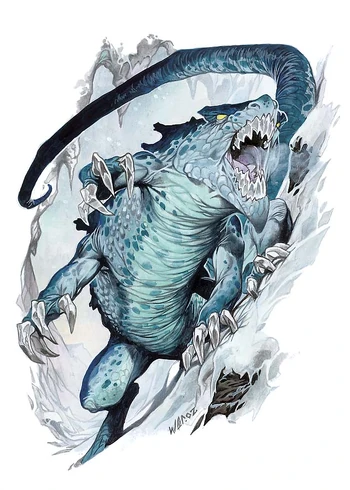
Frost Salamander
- 5.5E/5E: Huge Elemental; Unaligned; CR 9
Originally printed as 'Salamander, Frost' in Tome of Foes and just considered 'Frost Salamander' in Monsters of the Multiverse, these beings don't actually have anything to do with the base, Fire-element Salamanders that are more prominent in the Monster Manual. The Frost Salamanders are huge elementals with reptilian bodies that hail from the Frostfell, the Elemental Plane of Ice. The other 'composite' elemental planes don't really figure as much into monsters, but ice has always been a major fantasy element trope and unsurprisingly, we get a bunch of ice-specific monsters appearing throughout D&D's history.
Frost Salamanders are one of those creatures that live in the elemental planes that have a clear animal-like body and a rudimentary intellect. They particularly like to hunt warm-blooded creatures, and sometimes find themselves in frigid locations in the Material Plane. It's crucial to note that while the end goal is to feed, Frost Salamanders zero in on heat moreso than actual edible prey, willing to attack and prioritize campfires or blacksmith forges instead of tasty humans.
When not going around wreaking havoc in snowside settlements, Frost Salamanders burrow through ice, creating extensive tunnels underneath snowy mountains, with their lairs being 'large enough to allow a small army to camp within'... and said army, or adventuring party, often becomes the Frost Salamander's prey. They also have a freezing breath, being a large reptilian monster. They are also sometimes associated and tamed by Frost Giants.
Design-wise, the Frost Salamander actually just looks like a stouter, ice-themed version of the Behir. With six legs instead of a Behir's eight, but still, it's not hard to draw comparisons. With their similar association to giants (or at least one very specific type of giant), I wonder if the Frost Salamanders might have inspired the magical experimentation that the giants did to eventually create the Behir? Anyway, Frost Salamanders aren't the most interesting creature in the book, although I appreciate the attempt to expand a bit more on the elemental realms' denizens.
____________________________________________________
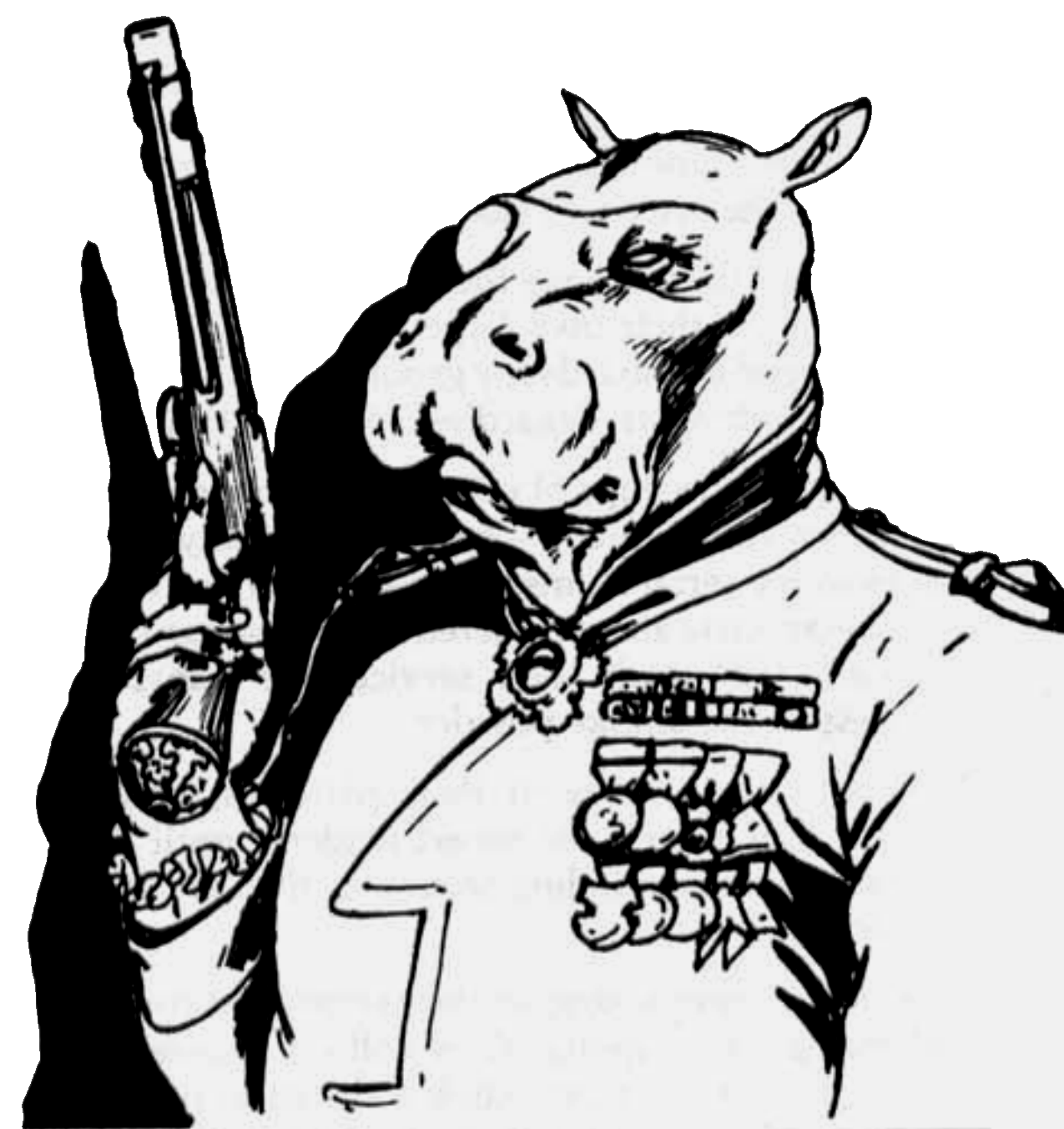
Giff
- 5.5E/5E: Medium Humanoid; Lawful Neutral; CR 3
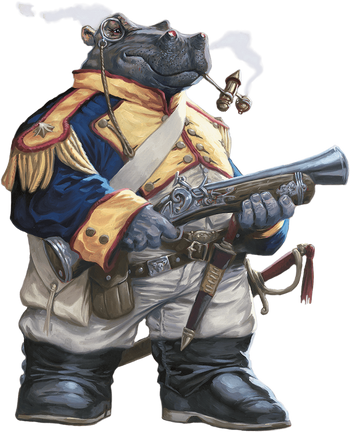
It's the Giff! The hippo-people! Now that I've had more of an appreciation for Spelljammer, I am a lot happier to see these crazy alien hippo-people show up surprisingly early in Mordenkainen's Tome of Foes. Giff are a race of hippo-men who have a culture that revolves around being a parody of military structure. All Giffs dress in gaudy military uniform, take rank and duty very seriously, and are extremely talented with muskets and cannons. I guess that's why they made it into the 'less-sci-fi' mainstream D&D, since even in their home setting of balls-to-the-walls-crazy Spelljammer, the Giff are way more interested in more mundane explosives. The Giff do straddle the line between fantasy and sci-fi quite well, I think, being just different enough without feeling too out of place.
Even before Spelljammer fleshes them out as they become a playable race there, Mordenkainen's Tome of Foes gives us a fair amount of flavour for the Giff. Which is just as well, since their stat block is... simple, simply a tanky brute with a preference for explosive artillery. Giffs organize every aspect of their society along military lines. From birth to death, each Giff has a military rank, and this is absolutely respected. A Giff goes up and down rank based on valour, and all of their education revolves around warfare... and this focus makes them unintentionally appear dull. It's less because they are dumb, but simply because of their upbringing that makes them not as verbose in matters that don't involve warfare.
They travel through the cosmos and behave as warriors for hire, but work best (and sometimes exclusively) in units consisting only of Giff. Not out of racism, but simply because realistically only other Giff can match the HUT HUT HUT!!! energy of the Giff people. In an interesting twist for a mercenary society, All Giff will refuse to fight other Giff, and all their contracts will have a stipulation that allows them to sit out conflict that might involve hurting other Giff. That's a fun little detail.
Giff are also extremely talented with gunpowder. The bigger the boom, the better! Whether it's from a musket, a grenade, or just explosives to bring down a fortification, Giff like the explosions. This trait is so prevalent that it becomes one of its passive abilities when the Giff got promoted to playable in Spelljammer. So much is this love for explosives that some Giff regiments prefer to be paid with kegs of gunpowder instead of just gold. Lastly, Giff culture seem to discourage spellcasters, although they're not hatred outright (at least not in 5E).
The Giff aren't as easily transplanted to 'default' D&D as something like the Neogi, who despite also a Spelljammer-associated creature ends up feeling right at home as 'just' another aberrant monster. But the Giff wouldn't be the Giff without all the love for the bombs, the explosions, and the wacky military hijinks.
____________________________________________________
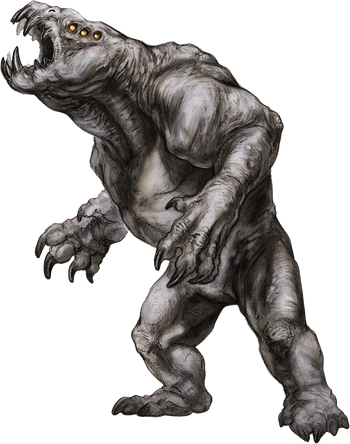
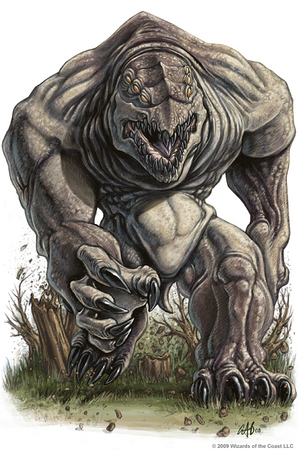
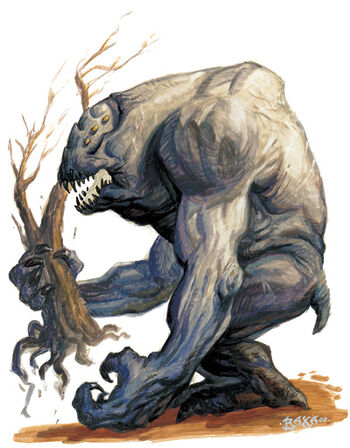
Gray Render
- 5.5E/5E: Large Monstrosity; Chaotic Neutral; CR 12
Debuting in 3rd Edition, the Gray Render is a rather simple monster design. It's got a bipedal, vaguely dinosaurian body, with a massive head with large fangs and six eyes. It is really good in one thing and one thing only, and that is physical combat. It deals heavy blows with its claws and fangs, and it gets even more enraged the more it is hurt. On the surface, it feels like just a boring melee monster.
But this is where the flavour works to make what's otherwise an Ogre-with-teeth fun. Gray Renders, despite being brutish hulks, wants most of all to bond with an intelligent creature. It has this almost dog-like instinct to want to look for a friend, and once they have bonded, they will do anything to fight for that bonded creature. Unfortunately, unlike dogs, a Gray Render is the size of a dinosaur and have absolutely no cunning.
Described as 'inherently chaotic', Gray Renders looks for intelligent creatures and sing to them. They will sing a weird, warbling cry that's accompanied by 'scratching the earth and a show of reverence'. And then it will just keep following and serving its bonded master! How... how can you not love this thing? Gray Renders, unfortunately, often ends up causing problems like accidentally killing people in town, destroying its master's house, burrow holes on the side of a ship, and attack horses out of jealousy. That is just everything that a typical dog or cat would do if understimulated, though. Silly adventurers, don't blame your incompetence as the human (or humanoid, I suppose) in not giving your Gray Render enough stimulation! 'Inherently chaotic', what nonsense! That's excuses, excuses from an irresponsible pet owner.
The Gray Renders reproduce by forming nodules on their back that break off into little baby Gray Renders, who all immediately scamper off to look for smarter beings to bond with. Speaking of which, I would like to highlight the table of Gray Render quirks, which includes 'likes to snuggle', 'chews on trees', 'hates horses', 'whines piteously in the dark', 'chases birds', 'brings offerings of meat to its master' and 'has terrific, eye-watering flatulence'. How... how can you not love them? They're big, monstrous dogs!
Sadly, as a CR 12 Monstrosity it feels like almost hard for the GM to justify actually giving one of these monsters as a proper ally to the team Ranger. I feel like there really should be more avenues for a player to tame one of these things! I really do like the juxtaposition from a simple, brutish look with the puppy-like behaviour, and the hijinks that it would undoubtedly ensue... but I really wish that there are ways for a table to do this without unbalancing the party!
Howler
- 5.5E/5E: Large Fiend; Chaotic Evil; CR 8
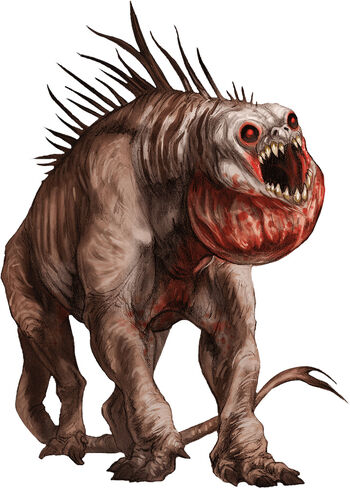
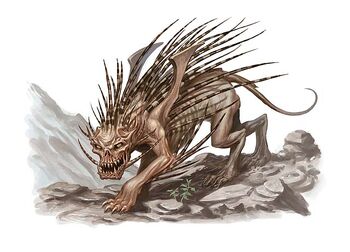
Oh, yes, Howlers. I loved these guys the moment I laid eyes on the Howler in 3.5E's Monster Manual. Look at that grisly, emaciated, hideous monster-dog covered with zebra-striped quills! What a horrifyingly monstrous beast! That head, in particular. And we had a similar design in 4E. 5th Edition did a redesign for the Howler and... while I appreciate the attempt to make it a bit more evocative of its 'howling' gimmick, I found the skull head, beady red eyes and the throat sac to be a lot less memorable. Their body shape is also a lot less interesting, being less starved-looking and with less dramatic spines. It's just personal taste, I suppose, but I just really liked the 3.5E Howler design.
Howlers are classified as fiends in 5th Edition, arriving from the plane of Pandemonium -- or are captured by fiends from other Lower Planes and trained as warhounds. They announce their arrival with dreadful wails and noises, slowly getting closer and closer. Their howls cause the minds of their prey to slowly degenerate and be unable to form complex thoughts, forcing them to shamble about uselessly as the pack tears them apart. In-game, unfortunately, this is reduced to the rather bland 'frightened' condition.
Howlers are noted to often be domesticated by both sides of the Blood War as war-hounds, but this domestication requires the leader to truly prove itself more powerful than the rest of the pack. Howlers hunt in packs, of course, relying on their mind-breaking howls to corner and disable prey. And in the Blood War, they are used specifically just for their ability to disable enemy spellcasters and tacticians in crucial moments.
I don't have as much to say about the 5E Howler, really. It's a pretty simple 'hellhound', although it's more of a baboon-dog with a frog throat-sac, isn't it? It's still a really cool monster, I just find its previous incarnations a lot sleeker and more threatening.

Your regularly scheduled re-release of Mordenkainen's Tome of Foes will be interrupted next week for a surprise issue of a different 'reviewing monsters' series.
ReplyDeleteI broke the formatting of the next D&D reviewing monsters segment, and don't have time to fix it, but I think some readers will be very pleased with next week's monster review.
Excited to see it!
Delete