Wednesday, 28 February 2018

Superman TAS S03E10 Review: The Shadow Over Smallville

Superman: The Animated Series, Season 3, Episode 10: Unity

Unity
Ia! Ia! Cthulhu fhtagn!

"Unity" is a bit of a strange beast. Or, rather, the handling of Supergirl throughout Superman: The Animated Series is a bit strange. After introducing Supergirl at the end of the second season, the third season promptly forgot about her apart from a single cameo in Mxyzptlk's fake TV show that he showed Bizarro... only for her to show up in the last episode of the third season, and later in the last episode of the fourth season. I'm sensing a pattern. Considering all the hoopla we went to introduce her as a supporting cast, the fact that her appearances in Superman: TAS could be counted on one hand is a bit unfortunate (especially compared to Nightwing, Robin and Batgirl from Batman:  TAS), and I'm glad that we actually have her role expanded as one of the main characters in Justice League Unlimited. 

And, well, we did get some Supergirl-centric episodes such as Unity, where Supergirl goes on a bit of a trip from Smallville to Metropolis (after milking some cows at superspeed... poor cows) and beat up Volcana a bit, she returns to Smallville to find out that the entire city has fallen under an Elder Thing from beyond the stars, an eldritch abomination called Unity, who sends out tentacles to assimilate everyone and everything under its hive-mind, led by the very creepy Reverend Howell. 

And then it goes from 'fun Supergirl adventures' to some genuinely creepy scenes, because among the afflicted are Pa and Ma Kent, and seeing X-rays of Ma Kent's brain wrapped by a tentacle tendril, or Pa Kent acting like a zombie is pretty dang disturbing. Also disturbing is just the noises they make, and the tentacles that shoot out of their mouths. Supergirl ends up calling Superman for help, and together they destroy Cthulhu's crazy cousins. It's a level of weird creepiness that I don't expect from Superman: TAS, and that scene where Supergirl gets wrapped up by mouth tentacles while struggling and moaning sounds like it came out of a PG-rated hentai. 

The Unity stuff is creepy and all, but while I didn't really think much of the episode beyond 'hey, Lovecraftian horrors!', sitting down to type a review made me realize how well-done it is in showcasing Supergirl's frustrations at being cooped up in a small town and not really allowed to do much. Sure, she blames herself for not realizing that Reverend Howell is creepy as all hell when she boarded the train, but the show makes her frustrations at being cooped up in Smallville while her cousin goes around whacking Luthors and Brainiacs and Metallos and Darkseids in the head very well, especially that conversation in the bus. The episode doesn't really go much with it because status quo needs to be maintained, but I did think that it's actually a neat episode that balances the exploration of Supergirl's story with an unbelievably creepy villain. 


DC  Easter Eggs Corner:
  • Supergirl makes a reference to 'Barbara', referencing Batgirl and their team-up that they had in the TNBA episode "Girl's Night Out".  
  • Volcana was last seen reformed in "Where There's Smoke", but shows up here as a villain, and her subsequent appearances would have her as a simple villain. 
  • Pa and Ma Kent mentions that the Langs own the farm next to theirs.

Monday, 26 February 2018

Black Lightning S01E02 Review: Finding A Purpose

Black Lightning, Season 1, Episode 2: Lawanda - The Book of Hope


Okay, going to try to catch up with multiple superhero shows this time around. These reviews are going to be fairly shorter, to allow me to work through my backlog a lot faster. This second episode of Black Lightning might not have particularly expensive special effects or fight scenes or an intricate backstory. Black Lightning himself has an okay costume, but the special effects are... acceptable. I guess I've just been spoiled by those fancy-schmancy big-movie shows? But what Black Lightning lacks in visual spectacle, it really makes up in storytelling. This episode feels slightly like a rehash of the first one, but here Pierce's big moment isn't whether to save his daughters or not. It's the hard question of whether he's ready to take up the mantle of Black Lightning to save other people and the community, with the knowledge that it might self-destruct his family. It's really, really easy to just paint Lynn as a whiny, nagging little anti-fun family member, but the acting and arguments given are stellar. Is it selfish? Yes. Would I do the same thing if it was someone I care about going out to play superhero and likely to get killed? Probably yes. It helps that Lynn herself is given some agency in her own acceptance of how necessary Black Lightning is to the community with a particularly great scene with Gambi. 

The titular Lawanda is one of Pierce's old students, now a single mother, who is hell-bent to save her daughter from the clutches of the brothel where she's brainwashed to work for. She wants to do it the 'right' way, and Pierce tries to help her by going to the authorities, by confronting Lala in his civilian persona, but nothing works. Lawanda ends up getting herself killed at the hands of an increasingly violent Lala (who himself is pressured by Tobias Whale to spread fear), which in turn finally breaks Black Lightning and has him go on a one-man rampage through a hotel to bring down Lala into justice. 

Jefferson Pierce, Lynn Stewart and the audience ends up getting to see just why Freeland needs a proper superhero, and how Black Lightning's entire existence gives the people hope. While some of the dialogue is a bit too on-the-nose, the execution ends up making Black Lightning a very believable symbol of hope, and his struggles with Lynn and whether to take up the mantle or not ends up feeling genuine, something that some of the other CW shows didn't manage to do that well. It's a different sort of origin story -- one that isn't the transformation of civilian Jefferson Pierce into superhero Black Lightning, but rather the realization of retired superhero Jefferson Pierce that sometimes, being the "Black Jesus" of the community isn't enough when faced with a corrupt police force and a gang that's set its roots way too deep into the community. "Black Lightning is back", Pierce announces to Lynn with confidence, but it's an announcement made after mourning the death of his student Lawanda -- a very preventable death -- and arguing with his ex-wife about whether to suit up or not. It's not a triumphant, orchestral-music-blazing moment of a superhero on a rooftop, because the camera focuses on Lynn's distraught face, at the same time realizing how much Freeland needs Black Lightning, but at the same time horrified that her beloved Jefferson is willingly putting himself in front of bullets. 

There are other sub-threads with the other characters. Tobias continues to be awesome and ends up killing Lala in prison at the end of this. Jennifer is struggling with her life, but ends up finding a boyfriend in Khalil. Anissa's struggling with her newfound superpowers, but her girlfriend is dismissive and somewhat cold, and ends up stopping a robbery at the end of the episode. Gambi's supportive, and even manages to get a nice scene with Lynn telling her that the 'addiction' argument works both ways. Nice stuff, but it's clear that these characters are shoved aside somewhat with Lynn and Jeffreson being the main characters of the episode. 

The scene where Black Lighting arrests Lala gets some special props for being insanely funny. From the hotel doorman going "Black Lightning, my man!" and opening the door and giving helpful directions, to some random dude holding open the elevator door and Black Lightning just wanting to take the stairs to get some exercise are comedic beats in an otherwise emotionally heavy episode.

Overall, it could've been really generic, but the writing and acting on both Jefferson and Lynn's parts are simply well-done that I was engaged throughout this episode, which, on a less-competent team's hands, could've easily been a bore. Good stuff. 

Superman TAS S03E09 Review: So I Heard You Talk To Fish

Superman: The Animated Series, Season 3, Episode 9: A Fish Story

A Fish Story
Death will rise! From the tides!

I didn't realize (or forgot) that Aquaman had an episode in Superman: TAS before his debut in Justice League. I rgew up during the 2000's era of comics, so Aquaman for me has always been the shirtless, bearded, long-haired viking-Poseidon warrior holding a trident with a hook arm (and am immensely pleased that they actually went with that vesrion of Aquaman for the live-action movies). Meanwhile, Challenge of the Super Friends have kind of turned the orange-and-green suited Golden Age portrayal of Aquaman as kind of a dunce and not a viking badass.  

But, you see, Aquaman was always a badass, Viking getup or not. It's just that Cartoon Network's Challenge of the Super Friends (which I probably have to get to reviewing sometime) ends up portraying Aquaman's sole feature as someone who can only talk to fish as his superpower, and since they aren't allowed to throw punches... it makes Aquaman easily the most stupid and useless member of the Super Friends. Add that to his honestly quite unflattering name, and poor Aquaman just can't catch a break. 

Come Superman: TAS, and it attempts to bring Aquaman back in all his comic-book glory. He's not just some dude in an orange shirt that can talk to fish. He's the goddamn king of Atlantis, ruler of the seven seas, able to summon killer whales and great white sharks alongside literal armies of underwater warriors.

Which gets me back to this episode. It debuts Aquaman, and while it's definitely unfortunate that he shows up as a hero in distress, being stuck by Luthor's minions into a little test tube for experimentation, we quickly learn -- via the eyes of Lois Lane -- that Aquaman's a certified badass. Like the Green Lantern episode a while back, it's not an exact science as we try to balance introdump with actually telling an interesting standalone story, and thankfully, Lex Luthor is happy to return as a villain this time around to menace Superman and Aquaman, acting as an eco-terrorist who just can't be bothered to bother about the urban legend that is Aquaman or Atlantis, because profit and science are far more important. I did like how Aquaman is quickly introduced as an urban legend so we don't have to waste time dealing with an origin story -- later episodes in the DCAU would alternate between introducing already-established superheroes or devoting entire episodes for an origin story. 

I did like how the episode acts a bit like a throwback to the older Golden Age stories, and indeed, Aquaman spends a good chunk of the episode just talking to fish, being friendly, being an ecological hero, and all that jazz... up until the finale, where he summons Atlantean battlecruiser, which neatly bridges together the older and newer versions of Aquaman. Suddenly he's not just an environment-friendly hero. He's a king of the ocean, with enough army to actually tell both Superman and Luthor to piss off. It's a neat way to still make Aquaman sympathetic, while still portraying his 'staunch defender of the ocean' trope very well. 

Of course, sadly, I also felt that this robbed a good chunk of the earlier parts of the episode from the badassery that Aquaman can and should be, since we're so concerned with trying to depict and/or deconstruct the Golden Age era Aquaman, and the action scenes that Superman and Aquaman get into -- or the interactions between the two heroes, for that matter -- ended up being sidelined. Overall I feel that this is an episode that tried to do too much than it pprobably should. Still, not a bad one in my opinion. 

DC Easter Eggs Corner:
  • Aquaman, a.k.a. King Arthur Curry, a.k.a. Orin, is the son of a human lighthouse keeper and an Atlantanean princess, and is one of the longest-running superheroes in the DC comics as well as a founding member of the Justice League (and even led it for a while). The Aquaman seen here is him in his Golden Age (and post-New-52) appearance, with the orange-and-green suit. We'll meet Aquaman in a subsequent DCAU episode, where he would use the post-revamped Viking underwater king Aquaman look. 

Sunday, 25 February 2018

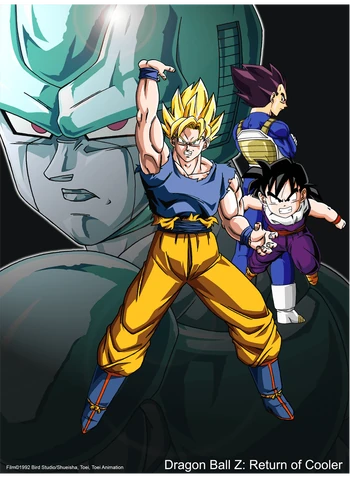
Movie Review: Dragon Ball Z - The Return of Cooler

Dragon Ball Z: The Return of Cooler [1992]


So I've been working through old Dragon Ball Z movies relatively slowly, and this one (in Japan, it's called the far more unwieldy "Clash! Ten Thousand Million Powerful Warriors") is the sixth DBZ movie, as well as being a sequel to the fifth one, Cooler's Revenge.

So the plotline of this movie is a sequel to Cooler's Revenge, where at the end of that movie, Freeza's brother Cooler, surprise surprise, gets killed, as we see briefly in a flashback shown in this movie. Cooler ends up being the first movie villain to get a second appearance, and only one of two alongside Broly, who gets three movies to himself as Wikipedia tells me.

And the concept of Cooler is neat enough -- connecting him and establishing him as Freeza's brother is a neat way to instantly have a yardstick to measure him while at the same time making us care about him, something that Fusion Reborn's Janemba didn't have. Plus, it allows Freeza's voice actor to voice more Dragon Ball Z characters after Freeza's untimely demise without bringing him back. I know of Cooler from playing Dragon Ball fighting games -- which I did even before I picked up the Cell and Buu sagas of DBZ, and Cooler and Broly, without fail, is in every Dragon Ball fighting game I've seen. 

Vlcsnap-2009-12-04-12h56m55s77And for the most part, I thought Return of Cooler was a pretty neat movie, it just kind of self-destructed in the final stretch. And I thought I'll recap it with a neat little rapid-fire summary of the 45-minute movie. You see, New Namek (which is a location that I don't think we ever see in the manga or Super) gets taken over by a giant metallic spider-planet that pulls a Unicron called the Big Spaghetti Gete Star, which clamps down upon New Namek and unleashes an army of one-eyed robots that capture and enslave all the Namekians. Oh no, the Namekians! We care about them!

So Dende and Popo ask Goku and his buddies to go off to space to help out, and the cast for this movie includes Gohan, Krillin, Piccolo... plus the cheerleader squad of Roshi, Yajirobe and Oolong. Yajirobe's mostly just there for comic relief, including a bit in the final act where he is put at the mercy of a robot hacksaw, while the first three get to fight. Roshi doesn't, because throughout DBZ he is completely useless, something that kind of took me out of sorts after watching Super relatively recently. Krillin also honestly ends up being the comic relief that gets batted around by even the simple one-eyed drones, with an actual sequence showing Gohan and Piccolo overwhelming their assailants, and then Krillin psyching himself... only to fail. I mean, he eventually gets one, but poor Krillin really makes it easy to make jokes about him being a chronic loser, yeah? And apparently it's even a running joke where he gets beaten up the worst in these movies. 

Cooler then shows up in a brand-new shiny metal body (essentially a metal version of the final-form Freeza) and calls himself Meta-Cooler. Or Metal Cooler. Whatever your preferred romanization is. He recaps the previous movie, which is nice since I've never watched that -- and claims he was burned in the fires of the Sun... but has survived and placed in a metal body... which... um... how did he do that? He went from the sun, and even if the alien race's biology is different enough to be integrated into a computer, how did he float all the way to the Big Gete Star and then to Namek? From our Sun?

In either case, we get a fight scene against Cooler's robots. Goku fights Cooler himself and while the animation is pretty suspect (even by the standards of the era -- I pulled up the anime around that time, which would be the later Freeza Saga and the Cell Saga, and they look a fair bit better than these) it's enjoyable enough. Shame that the background music is wholly underwhelming, we cut away to senseless generic comedy with Krillin and the cheerleader squad a bit too often... and I'll point out some col scenes: Goku and Cooler engage in an Instant Transmission battle (why didn't Goku Instant Transmission to New Namek?), and Piccolo's arm-stretching impalement of the robots is cool, and the robots shooting their own arms at Piccolo followed with cannons are cool.... 

But they are kind of wasted. Gohan and Krillin are quickly overwhelmed, captured and reduced into one pulp of comedic relief with Roshi's gang, and Piccolo just flies around until he guides the comic relief gang out. And Piccolo being this weak isn't really justified since Dende is already Kami, implying that this takes place after the Cell Saga, but then Goku is alive and Gohan is super-weak and Vegeta is super-hostile and okay I'm not trying to fit this movie in continuity, because it simply doesn't.

Also also, wouldn't it be cool if Piccolo showed any emotion at the enslavement of his race and potential destruction of their new home planet? Hm. 

But Cooler turns out to be able to regenerate his body by shooting out wires and reconnecting with his broken forms, and even Goku's Super Saiyan is only enough to slow him down. Vegeta comes in out of nowhere (he literally pops out of the sky -- the final scene shows Vegeta leaving in a saiyan pod, but the presence of that raises more questions than anything else), and the two go Super Saiyan together and then fight Metal Cooler together. And Cooler even punches Vegeta in the dick at one point, which is a bit hilarious... and then the two blow up Cooler! And then, an army of Metal Coolers show up, and beats Goku and Vegeta... offscreen.

Goku and Vegeta wake up within the Big Gete Star itself, and this is where the movie kind of self-destructs. Why bother with the lesser robots and not send the army of Metal Coolers immediately? It's not like they're doing anything important, right? What is the end-game here, and why are they draining New Namek with a giant drill, and how does evisceration of Namekians and Yajirobe via hacksaw power a giant robot planet? How does Cooler survive and get turned into a brain chip? And as Goku and Vegeta lay unconscious in Super Saiyan form (???) and Cooler drains their energy... apparently that energy is enough to literally blow up Cooler's entire Big Gete Star system, causing the whole thing to self-destruct? Yeah, this whole sequence ruins all the build-up that admittedly was pretty cool with a revelation that raises more questions than answers them, the Big Gete Star ends up really not amounting to much, and Vegeta and Goku get back up after being overwhelmed for... no real reason. Cooler transforms into a giant version of himself made entirely out of wires, but Goku and Vegeta just beat him with a beam. And then they win, and everything is fine, roll credits. 

And, yeah, what a weirdly bland ending. Honestly, the setup and the first two acts of this movie isn't even half bad. Enslaving the Namekians is a very neat little plotline, and the concept of a robotic, self-regenerating Cooler combines aspects of Cell and the Androids, plus this might theoretically be the Metal Freeza arc that we never got. But it's all ruined by a sub-par animation, side characters that do nothing (to be fair, that's a criticism for Dragon Ball Z as a whole) and plot holes bigger than the Big Gete Star itself. It's at least somewhat entertaining, but for all the buildup and badassery that Cooler supposedly has by being Freeza's brother, this second outing, at least, has him be an absolutely generic doomsday villain with jack shit personality, a plot that barely makes sense and a plot with more holes than swiss cheese. 

Saturday, 24 February 2018

Superman TAS S03E08 Review: Worst Episode?

Jimmy runs Superman: The Animated Series, Season 3, Episode 8: Superman's Pal


Okay, I'm definitely not a big fan of this episode. I'm not opposed to giving Jimmy Olsen some spotlight. In fact, watching Superman: The Animated Series I'm honestly a bit sad how little the supporting cast like Lois Lane, Jimmy Olsen and Lana Lang actually have any sort of spotlight given to them. Jimmy is probably the worst of it, with very few spotlight episodes beyond Supergirl's debut at the end of the second season. So giving Jimmy Olsen an entire episode to himself is definitely a welcome prospect.

Except, well, he gets kind of a shitty one in 'Superman's Pal'. Bruce Timm, one of the great minds behind the DCAU, has even gone to saying that this particular episode, more than anything else in his long tenure, is the lowest point... and it's no real coinidence. The episode tries to tell a fable about fame, about how Jimmy Olsen, by claiming that he's Superman's best pal, ends up being hounded by the media and other random citizens of Metropolis trying to curry favour out of Jimmy and by virtue of that, Superman. Because, um, people are all dumb sheep, I guess. All the while this random hot intern Tina basically goes from dismissive to wanting to get into Jimmy's pants.

Except Tina is working for Metallo all along! And is his lover. Poor Metallo, always gets himself stuck with the shittiest episodes in this series. Tina apparently is a "sucker for metal",  which, now that I'm older, brings... a lot of uncomfortable implications as to their relationship. Metallo is, by the way, if we forgot, completely incapable of emotion or actually feeling senses, so... yeah. The fight between Metallo and Superman is not horrible but far from Superman: TAS's best, but Jimmy ends up being useful by... throwing battery acid on Metallo's body, causing the kryptonite to fall off and deactgivating Metallo.

Remember how metallo-the-metal is supposed to be this indestructible alloy that can even withstand Superman's punches, the pressures of the deep sea and lava? Yeah, apparently its weakness is humble old battery acid found in a junkyard. God damn this episode is dumb. 

Tina is also a very, very unlikable character. Remember how I was m'eh with Darci from the Toyman episode and didn't even remember the names of the alien freedom fighters from the Jax-Ur/Mala episode? At least they were inoffensive. Tina is given the most annoying, vapid voice and lines ever, and that doesn't do the episode any favours.

My favourite moment has to be the fact that this episode gives Angela Chen, the background reporter that has been on the literal background for a majority of the series, is finally given a personality as a news hound -- causing an accident when she's overzealous with chasing down the story (with a helicopter!), and later editing Jimmy Olsen's interview to frame it so that she's just interviewed Superman's best pal. Angela's probably the sole redeeming factor of this episode, but she shows up for like all of fifteen seconds. 

I dunno. This episode is so haphazard -- it's clearly meant to be a more light-hearted and zanier adventure, but even then the TAS series have always managed to tell stories that are both zany and still good. So yeah. This episode, if anything, made poor Jimmy Olsen more annoying in my eyes (the voice acting is still excellent, thankfully), did a gigantic disservice to Metallo, and probably deserves its title as the worst episode of the DCAU.

DC Easter Eggs Corner: 
  • At the end of the episode, Jimmy gets his famous signal watch from Superman, given to him just like his pre-Crisis comic book counterpart. Jimmy having the signal watch was one of the trademarks of Superman stories in the Silver Age.
  • 'Superman's Pal', the title of the episode and oft-repeated catchphrase, is actually Jimmy Olsen's Golden Age and Silver Age title, and the title of his solo comic book series during the Silver Age.

Friday, 23 February 2018

Superman TAS S03E07 Review: No Evil Shall Escape My Sight

Superman: The Animated Series, Season 3, Episode 7: In Brightest Day


Lantern vs Sinestro"In Brightest Day" is one of the few episodes in Superman's third season that tries to introduce other big-name superheroes as guest stars, and this one in particular acts as an origin story to Green Lantern. And it's a pretty neat backdoor pilot, had it been meant to be one -- Green Lantern would become a major player in the DCAU, but that'd be John Stewart instead of Kyle Rayner. Regardless, the episode does a pretty decent job of introducing the concept of the Green Lantern Corps, a group of intergalactic space policemen who fight with jewelry that can create whatever their mind can imagine. A weapon powered by imagination, which is absolutely perfect for fledgling newspaper artist Kyle Rayner. 

We get to briefly see Kyle in action before he gets the ring, helping to beat up a thug and recover Jimmy Olsen's stolen camera, as well as see him make some neat wisecracks with Jimmy (small wonder the two get along quite well). We then get to see Superman encounter the crash-landed ship of the fallen Green Lantern Abin Sur, who sent out his ring to select a new champion... all familiar story beats to anyone who's the least bit familiar with the emerald knight's backstory. 

Sinestro shows up without much explanation beyond being a hunter of Lanterns, while Superman gets pulled into Oa for some exposition. It is a bit strange just why Sinestro ended up being somewhat incompetent and unable to straight-up kill Kyle (who isn't even aware how to use his ring for the first couple of minutes of the fight) one-on-one when the Guardians have built up just how dangerous Sinestro is in combat. But eh. We do get some really neat visual flair between the two -- nothing too impressive compared to what Sinestro would do in Justice League Unlimited, but compared to just how dry and mechanical John Stewart's lantern ring constructs tend to be, it's a pretty cool bit to actually see the ring be used creatively.

Overall the episode's just okay, I think. It's not a huge, huge bombastic debut or anything, but it's certainly watcheable and fun enough. I'm not sure what else to say about it... it's a decent origin story episode, it's got a neatly-told story for Kyle and Sinestro both, and Superman... sort of... hangs around? It's kind of like Steel (and, honestly, up until the last three episodes of Superman: TAS, Supergirl) earlier in the series where they get elaborate origin stories but never actually end up doing much for the rest of the series.


DC Easter Eggs Corner:
  • Kyle Rayner is the fifth person on Earth to have taken up the mantle of Green Lantern in the comics, after Alan Scott, Hal Jordan, Guy Gardner and John Stewart. In the comics, his day job as a freelance artist is accurately represented here, but being selected by a dying Abin Sur to get the ring is the backstory of the most famous Green Lantern of all, Hal Jordan. 
  • Thaal Sinestro's backstory isn't really delved to here, but he is a disgraced Green Lantern who once trained Hal Jordan and many others, but his usage of the ring ended up turning him into a despotic ruler of his home planet, causing the Guardians to strip him of his power. In his anger, he crafted a yellow ring powered by fear instead of willpower, and would prove one of the Green Lanterns' mightiest foes.
  • Kyle's rejection letter in this episode came from DC comics. 
  • Hal Jordan's name is briefly seen written on the plane that Sinestro throws Kyle into during the final battle. Hal, of course, was a pilot.
  • The restaurant that Kyle and Jimmy were eating at is called 'Gil's Ristorante', whereas the air base that the final battle takes place in is called 'Broome Lake', which are references to the creator of the Silver Age Green Lantern mythos, Gil Kane and John Broome.
  • The unspeaking army of Green Lanterns that are shown by the Guardians to Superman include Arisia, Katma Tui, Kilowog, Salakk, Tomar Re, Xax, Arkkis Chummuck and Larvox.

Thursday, 22 February 2018

Movie Review: Black Panther

http://static.tvtropes.org/pmwiki/pub/images/black_panther_3.jpg Black Panther [2017]


Black Panther, Marvel's first black superhero introduced into live-action form back in Civil War, finally gets his own solo movie as Marvel's 18th movie and it's... it's a massive success. It's not the first black-led superhero movie, of course, with other movies like Blade, Spawn and TV shows like Luke Cage and Black Lightning all preceding Black Panther by a huge margin, but it's one that's undoubtedly one of the most successful. What's there to talk about Black Panther that hasn't already been said? It's a great movie. It's got the same flaws that most Marvel movies have, but it's still one of the better ones that Marvel's pumped out, and that means something. I know that I'm not qualified, really, to talk about any of the more race-centric bits of this movie, but while I think they didn't quite delve deeply into the racial stuff, there's enough in it that it informs the motivations of the main villain. 

But best of all is the world-building in Black Panther. Wakanda is gorgeous, the scenes between King T'Challa and his subjects felt genuinely built on a pre-existing history, and it's something that some of the other Marvel movies set in space didn't quite manage to do. They manage to meld in exposition with scenes that didn't feel like they're awkwardly talking to exposit to us other than the opening backstory (told in literal story from a father to a child), and the sheer beauty of Wakanda's aesthetics, which is simultaneously technologically advanced yet still very much respectful of its roots... something that could really be said about the themes of this entire movie. To look to the future while still respecting your roots. 

I'm not going to go into too deep of a breakdown because I'm too tired and the two drafts I did for reviewing this movie ended up being way too rambly, so I'll just keep things relatively quick. It's a movie that follows the plot threads of past movies -- most prominent being T'Challa's character arc in Civil War as well as to a lesser extend Ulysses Klaue being a Vibranium trafficker, but otherwise the movie stands on its own, with the big beats from T'Challa's story arc in Civil War being revisited in a brief flashback. 

It's a very fun movie that tones down the comedic beats from the two preceeding Marvel movies before it -- Thor - Ragnarok and Guardians of the Galaxy 2. There are some fun moments, mostly delivered through the adorably energetic Shuri, the scenery-chewing Klaue and the boisterous chieftain M'Baku, but most of the comedy here is delivered through snarky comebacks. And that's fine. It's not entirely joyless, and I like it. Action-wise... it's okay. There are some points where the CGI felt a bit wonky, but giving Black Panther the additional ability to store kinetic energy and unleash it in a blast is an unapologetically comic-book/video-game-y gimmick and I love it. 

The movie itself is flashy, and I really love how it blends in the fantastical bits of Wakanda like the nanotechnology that allows T'Challa to suit up via his necklace (!) or the underground vibranium mine-trains or the super-technological beads and, best of all, the goddamn armoured rhinos which, I won't lie, got me cheering due to how fucking awesome they are, but at the same time the motivations of the main characters felt absolutely human. T'Challa is struggling with the responsibilities of a leader and a ruler. Does he keep Wakanda hidden like all the previous kings, or does he dare to forge  a path into opening Wakanda up to the world, at the risk of destroying his own country? Throw in some extra bits of mind-fraying failure as he failed to bring down Ulysses Klaue, and the revelation that his father hid a particularly grisly bit of his past from everyone, and T'Challa ends up going on a story of self-discovery throughout the story even while he's doing backflips on car chases. It helps that Chadwick Boseman is a very likable actor, and while T'Challa is a serious no-nonsense king most of the time, Boseman ends up portraying the few moments T'Challa is allowed to emote -- via trippy mind-journeys to meet the spirit of his father -- really, really work, most impressively the "YOU ARE ALL WRONG!" heart-rending scream after confronting his father for having abandoned N'Jadaka.

Meanwhile, the villain Erik "Killmonger" Stevens, is a boy not from Oakland, but from the outside world. He was born in Wakanda, but grew up in the slums of Oakland, America, where he saw the world from the eyes of an oppressed people, and saw the Wakandan culture, not entirely unfairly, as a bunch of outdated reclusive selfish bastards that did nothing while their people are oppressed all around the world. Erik (or Prince N'Jadaka) ends up calling himself Killmonger, killing and hacking his way through the world to find his way into the secretive nation of Wakanda. There's definitely a huge layer of complexity in Killmonger's character, where he simultaneously wants to experience the culture of his people and see the beautiful sunsets of Wakanda, but he's also perverting it for his own selfish ambitions by burning part of Wakanda's culture and scoffing at the idea of even having successors, and in the heat of battle against T'Challa, screams about how he doesn't care about the Wakandan people. It's interesting, as Killmonger could easily be described as a hypocrite (with a few underlying bits of sentiment) that's trying to wage revenge on a people he saw as abandoned him, or a well-intentioned extremist whose motivations ended up being tainted by a zeal and a bloodlust that instead of wanting to free the subjugated, leads him to wanting to be the subjugator. Killmonger's most telling moment is perhaps the moment he spends with his girlfriend. The love there is genuine, but when push comes to shove, Erik shoots her in the head without a second thought and sheds no tears. Killmonger's characterization and motivation, and Michael B. Jordan's performance, might just be the best thing about this movie, really, and it's already a movie with a lot of good stuff. 

The supporting cast is also very much great. Killmonger's the main villain, but the movie wouldn't feel the same without Andy Serkis's Klaue, and the man really is having the time of his life just hamming it up and chewing the scenery, blasting people with his arm-cannon. And besides, Klaue's whole vibranium-smuggler deal gives T'Challa an excuse to get out of his country, and for Killmonger to get in. The women of Wakanda also get a really large amount of screentime. My favourite of these new characters is definitely T'Challa's energetic little sister Shuri, acting as the support-character-in-a-chair. Not all of Shuri's comedy beats hit, but her "sneakers" bit and her brother's "delete that footage!" exchange are definitely well-appreciated, and she even gets to fight with the big girls at the climax with the aid of a pair of sonic-boom glove things. Shuri's awesome, and her chemistry with T'Challa really makes me believe that the two are siblings. 

Nakia and Okoye, played by Star Wars' Lupita Nyong'o and Walking Dead's Danai Gurira, end up being the two big ones in the movie, with Nakia being a Wakandan War Dog who's a lot more sympathetic towards helping other Africans outside of Wakanda, and ends up being T'Challa's love interest. Okoye's part of the Dora Milaje, an army of private bodyguards to the current king of Wakanda, and Danai Gurira ends up delivering one of perhaps the most heartfelt scenes in the movie as she, in tears, tells Nakia that, no, despite clearly being good friends with T'Challa, her duty is to the rightful king of Wakanda at that moment. Okoye's also got an awesome moment in the climax where she confronts her husband, W'Kabi, who has thrown in the Border Tribe's lot with Killmonger, and that confrontation is pretty awesome. Equally awesome is stopping their pet war rhino with a single glare. 

Rounding up the supporting cast is Martin Freeman's Watson Everett Ross, returning from Civil War. He's... he's great because Freeman's great, but other than the badass moment where he gets to pilot Shuri's remote-controlled ship, Ross doesn't get to do much other than be cool and a neat supporting character. Forest Whitaker plays Zuri, the shaman of the Wakandan people who is closely tied into the backstory of T'Chaka and how he ended up killing his brother N'Jobu (Killmonger's father) in self-defense... and while it's a bit cliche at this point that the older mentor character dies, Zuri's actually allowed to go through a fair amount of character development in his screen time, clearly regretting keeping T'Chaka's secret throughout all of this. M'Baku's role as a challenger from the exiled Jabari Tribe is a bit less nuanced, but it's still a lot of great fun and ends up leading to a pretty badass fight with a depowered T'Challa, and some really fun gags with both T'Challa and Ross. Oh, and M'Baku arriving with the hoo-hoo chants mimicking gorillas at the climax is pretty awesome too. 

Overall, the story is pretty solid, with T'Challa and especially Killmonger's journey being engaging in both a narrative and emotional level. Wakanda itself is pretty gorgeous and the action scenes, while not particularly innovative, are thrilling enough. It falters into a generic climax in the third act after all the deceptions are revealed to us and T'Challa's character arc comes to a conclusion, but the movie itself is done pretty well regardless. It's not a perfect movie, but it's a pretty good one and definitely one of the stronger ones that Marvel has to offer.

Marvel (Cinematic Universe) Easter Eggs:

  • Civil War and the events that happened there is referenced multiple times in here. T'Challa meets Ross for the first time there, and T'Chaka also dies there. Klaue's role in being a vibranium smuggler and his ties to Wakanda is established in Age of Ultron. 
  • In addition to Bucky showing up in the post-credits scene (and apparently now called "White Wolf"?), Shuri sarcastically notes about  "another broken white boy" to heal when T'Challa brings Ross about.
  • Stan Lee makes a cameo yet again, as is customary in these Marvel movies.