So this was a bit of an interesting article. A while back one of the commenters in this blog sort of had a bit of a conversation with me that sparked the seed of this article. I've always wanted to do more about Pokemon, but I went through reviewing all 800+ creatures and even went through an unofficial game. And after going through the titular pocket monsters themselves, I wasn't really sure what to review. Attacks, items, locations, trainers and characters seem to be the obvious picks, and... and I really am not feeling attacks, y'know? Mostly because it's kind of going to be repetitive. Sure, there are some attacks that I'm going to have a lot of time talking about, but there are some that's just going to be like "oh, this is just like Flamethrower, but for [X] type" or "this is relevant in the meta-game because of the change in accuracy and base power but
reeeaaallly it's just another zappy-zap electric attack" or "gee this one specific ability makes this move broken, huh?" And items... there's just not too much to talk about items, and locations are frankly kind of too much work since I'm going to have to talk about the real-world equivalents. And trainers... I dunno, too many of Pokemon's trainers basically boil down to [insert occupation here]. And while there's something to be said about trainer classes, I don't think it's interesting enough to carry a whole article on their own.
That leaves the characters, and... a good part of why I've been putting this off is that I'm a huge, huge lover of the
Pokemon Adventures (a.k.a.
Pokemon Special) manga, where a lot of the personalities of these characters are ingrained in my head. Equally, the Pokemon anime was also a huge impact on me as a kid, so the anime's take on some characters like Misty and Brock are
also hugely ingrained in my head. The problem, though, is that the depiction of characters in the various media are very different, particularly in the
Adventures manga, who livens things up by having all of the gym leaders be recurring characters and even villains of their own -- Lt. Surge, Sabrina and Koga were the Team Rocket executives in the manga! But trying to track down and note the varying depictions of these characters in like the manga and the anime (particularly since I've never watched a season post-Hoenn, and the last manga volume I read was the Unova one) is going to be extremely difficult to do.
So I'm going to do something that's going to allow me to review these human characters without having to research how well said character is written in the anime and manga... and just talk about them in the games -- not just visually, because lord knows I'm a terrible excuse for a fashion police, but also when they actually show up in their respective home games as, well, for the most part, 'bosses'. I'm going to be briefly mentioning parts of how I feel about their anime/manga counterpart should they be particularly relevant, but for the most part? I'm going to mostly talk about their video game versions, about how they're presented to us as (again, for the most part) bosses in a video game, and talk about their team compositions and such. Anyway, let's see how far I can get.

This is going to be me reviewing all of the characters introduced in Generation I, as a bit of a trial run. And I do mean Generation I, so that's
Red, Blue, Green and
Yellow... but there are some extra characters introduced in other Kanto-adjacent games, like Janine debuted in Generation II but is a Kanto gym leader; there are some extraneous characters that are Hoenn characters but are introduced in the Generation VI remakes; there's the
Let's Go protagonists, which are from Kanto but are technically Generation VII characters... so I'm splitting things up by region, which is also going to give me an excuse to include all versions of a character. Kanto is a bit long since a lot of their characters show up in multiple games, so bear with me!
I'm going to go through the protagonists, rivals, gym leaders, Elite Four trainers, villains, professors and any important NPC's with official full Sugimori artwork (
everyone has TCG/manga/anime artwork if you look hard enough), but if they don't have any official artwork or unique sprite, well, you're out of luck! If you're only prominent in the anime, manga or a side-game, you're
also out of luck! This isn't meant to be an exhaustive guide to all of the NPC's in the games, after all, just me going through the depictions of these characters in the games.
______________________________________


 Red
- Position: Player Character (R/B/G/Y, FR/LG); Secret Boss (G/S/C, HG/SS; S/M, US/UM; Let's Go)
- Japanese Name: Red
So we're going to start off with the player character for the original games, and... and it's interesting to note that for the most part, I don't think I'll have a whole ton to talk about the player characters. They're meant to be avatars of
you, walking around in the game as a young, ten-year-old Pokemon trainer who ends up fighting a criminal organization, beat up a bunch of gym leaders, encounter a legendary creature or two and become the champion of the region. For the most part, most player characters really don't have much personality about them, and it depends on things like the anime, manga, and supplementary games like
Pokemon Masters to really give them any sort of personality at all. He is the first main character of the
Pokemon Adventures manga and the various other Pokemon-themed manga that appeared at that time, and the main character of the long-running Pokemon anime, Ash Ketchum (a.k.a. Satoshi) is him with a different jacket and hat. There's really not much to say about him, he's got a neat red jacket and jeans and a red hat and stuff... it's classic protagonist getup, distinctive enough to inspire a dozen different variations of his look (most of the male protagonists will look very, very similar) but it's also something that a young boy would conceivably dress up in when he walks around town. There's really not much to say here without going straight into his anime or manga counterparts; game Red is kind of faceless and personality-less for a reason in his debut game. And that's the fate of most protagonists.
Red, though, is a special case. Maybe it's because the original set of Kanto games of Red, Blue, Green and Yellow are the first, and maybe it's because the second-generation games are meant to be direct sequels to the first, but ever since Generation II, Red has became sort of a recurring character whose defining trait is that he speaks with a Link-esque ". . ." whenever you encounter him. He first shows up as the ultimate final boss in the sequel games, standing atop Mt. Silver after you defeat two regions' worth of gym leaders, waiting with a team comprised of the previous game's starters, the ever-iconic Pikachu and two 'event' Pokemon (Snorlax and either Lapras or Espeon depending on the version). It's such a surprise to find out that the ultimate most powerful Pokemon trainer in the Gold/Silver/Crystal games is... you. You from the previous game. That's such an awesome feeling.
Red would make several appearances as bonus bosses in several other games -- the recent Let's Go remakes of the Kanto games, as well as returning alongside everyone else pre-Gen-V in Black 2/White 2's world tournament. But his most relevant return is in the Generation VII games in Alola, where Red has grown up a fair bit... and I really do like that while Red is basically in his casuals, his T-shirt is still basically colour-coded to his original appearances. Not much to say here, he's a pretty cool presence if nothing else.


 Blue
- Position: Rival/Indigo League Champion (R/B/G/Y, FR/LG); Viridian City Gym Leader (G/S/C, HG/SS); Bonus Boss (S/M, US/UM)
- Japanese Name: Green
- Type Specialization: None
On the other hand, Blue here is a huge, huge presence in the original Kanto games, mostly because unlike Red, he's actually allowed to talk, and hoo boy, what a large amount of dialogue he's allowed to have. Known as "Blue" in official Pokemon canon, "Green" in the Japanese versions, "Gary" or "Shigeru" in the anime and "FUCKER" or "Dickwad" in many a save file in the '90's, Blue is an archetype that's going to define so much of the Pokemon franchise, and something that makes your journey through the Pokemon games so much more fun. He's a gigantic dick, going all "smell you later!" and constantly bragging about how much better he is than you. You encounter him many, many times in your journey, beginning from when he purposefully picks out the Pokemon with a type advantage to your own starter, and then keeps showing up one step in front of you at various points in the games. The fandom, the manga and the anime plays up Blue's jackassness to a higher degree than he is in the actual games, but a combination of him actually being pretty tough for a ten-year-old me and the absolutely perfect smarmy 8-bit theme that heralds his arrival makes him such a great presence.
And one thing that really ended up surprising me is that, well, Blue is the final boss of the original Red/Blue/Green/Yellow games! It's a bit of common knowledge nowadays, but back in the late 90's it was a genuine surprise that I went through the league and the 'Elite Four', the four super-tough bosses at the end of the game... and turns out that Blue, massive asshat that he is, has actually beaten you to beating the game, and you have to fight him to truly prove your supremacy as the best Pokemon trainer. Another thing I appreciate? Practically every single notable trainer in the game has their team based on a single type, but Blue is one of the very few trainers in the first game (and the franchise in general) to actually have a 'well balanced' team that's not a single type. Also, unless I'm remembering wrong, he's also the only trainer in the Kanto games to have a full team of six, and depending on the starter he picks, he's actually going to swap his final team to shore up his weakness. As a kid, that's pretty damn awesome to realize that.
Blue is also prominently featured in the sequel games, Gold/Silver/Crystal. Those games are set a couple of years after the events of the original Generation I games, and things have changed by the time you return to Kanto as part of the post-game, and one of the huge changes? The gym leader of Viridian City. It used to be the Rocket boss Giovanni (another one that used to be a Huge Thing back in the day) but the sudden surprise of finding out that, hey, your old rival Blue turns out to have taken over that gym and is still running it with a team that isn't weak to any particular type? That's pretty awesome. Blue also has a bigger role in the other games compared to Red, being a brief mid-point NPC in the Let's Go remakes where he is basically the more experienced adventurer helping out the newbies in Let's Go, and being the dude that bears the brunt of dialogue when he and Red shows up in the Alola games. He basically mellows out a lot after the original Kanto games, but he's still a bit more cocky and confident than he otherwise would be.
Appearance-wise, Blue tends to be colour coded with the 'harder' colours of purple or black, making him look more traditionally cool. Between that necklace he's got in his original Generation I artwork, and those bangles in his Generation III artwork, I also have a feeling that they're going more for the look of someone that's more... fashionable compared to the frumpier-looking Red, which is certainly something you can relate with in regards to your rival. Unlike Red, too, Blue received a bit of an overhaul in the Johto games, having a more formal-looking black bomber jacket. He's also a lot more relaxed with those shorts and sunglasses when he goes off on holiday to Alola. He's a cool dude, really, as much as he gives us shit

 Leaf & Green
- Position: Player Character (FR/LG); Bonus Boss (Let's Go)
- Japanese Name: Leaf, Blue
The original
Red, Blue and
Green only had a single protagonist, the male one. However, there were sketches of
an abandoned female avatar, which would not see any sort of formal inclusion into the game, and we wouldn't get a female player character until Generation II's
Crystal. However, the
Adventures manga used the design as one of its main characters during the Kanto arc, giving her then name
Green (or Blue in Japan -- the second Generation I game that was released in Japan and international markets are different). When the Kanto games was remade in the third generation, we get the female character with a set of brand-new clothes to replace the single black dress she had in the original concept art. And I do like how "Leaf" ends up looking a lot like a female version of Red without making it too obvious. Again, her design, like most player characters, is pretty pleasant-looking, looking very much like the sort of casual wear you'd see people walking around with. Unfortunately, she's not Red, and all player characters that's not Red basically don't have much of a personality in the games.
A character named Green (whose personality of a snarky, greedy Pokemon hunter is pretty spot on for the manga's Green,
and she uses a Blastoise) does show up as a bonus boss in the
Let's Go Pikachu/Eevee games released recently, basically having an updated version of the original Green concept art, albeit with an extra pair of blue shorts under that dress. Again, I really don't have a whole ton to say about this, but I do really like the character Green from the manga, so seeing her show up in canon games gets a thumbs-up from me.


 Brock
- Position: Pewter City Gym Leader
- Japanese Name: Takeshi
- Type Specialization: Rock
Yeah, I'm not going to have a whole ton to say about most of the protagonists, but the actual people you fight in the game? We're going to talk about the gym leaders first, the eight people that you meet in every single city as you travel through Kanto, and you have to beat them all to get a badge to enter the final challenge. Each gym leader also has a specific type they specialize in, which in practice is an interesting thing -- it gives each gym a theme, and allows you to build up your team accordingly to fight them... but it also does make them feel kind of like chumps at times because depending on the game, sometimes you can just utterly hose down a single gym with a single Pokemon.
As the very first gym leader in the Pokemon games, Brock is... he's not very impressive, clearly never intended to be more than just some dude that you fight early on in your journey. He's a typical case of a boss's bark being worse than his bite, with his extremely impressive-looking Onix actually falling very easily to two of the three possible starters you are able to choose from. Brock's gym is basic, with none of the tricks and puzzles that other gyms would have, and his original sprite (pictured here) is just some shirtless dude doing the Wakanda pose. However, in the anime? In the anime, Brock ends up growing far, far more than just being "that dude who uses an Onix you fight early on". The anime makes Brock into the 'team dad' for the group, as well as later on giving him the quirk of him being horny-on-main all the time... but it's a lot more charming since he's just
really making a fool out of himself instead of actually being too lecherous. That's not quite true to his game counterpart, where he just comes off as a serious dude. He does put a shirt on in basically every appearance after
Red/Blue/Green, and his combination of orange, dark green and black is definitely based on the anime's colours for him.
While the original games had him with a pitiful team of a Geodude and an Onix (depending on the specific canon, gym leaders are noted to have different teams depending on the trainer they're facing), his subsequent appearances in other games (particularly when he's one of the post-game rematches in the Johto games) would associate him with fossil Pokemon, which fits the fact that all the fossil Pokemon are Rock-type, and Pewter City has a museum in it. Neat! Brock's basically a character defined by his anime appearance, though, so his game counterpart always did feel a bit bland.


 Misty
- Position: Cerulean City Gym Leader
- Japanese Name: Kasumi
- Type Specialization: Water
Misty is, in the games, the second gym leader you fight, and she's been pretty popular among the fandom for also being the main female protagonist of the anime. Again, in the games, she really doesn't have much actual personality -- basically just a girl who likes swimming (her entire gym is fashioned after a swimming pool) and also uses water Pokemon. She's also got a Starmie able to use Bubblebeam, which was significantly more powerful than most of the easier enemies you've fought prior to her. Being a very prominent character in the anime, her subsequent appearances end up being more or less inspired by it to some degree. Whether it's the composition of her team (which rotates a
lot, with the only constant being that it has Starmie most of the time) or the fact that she went from a redhead in the original Generation I artwork to having orange hair in every subsequent appearance, to her not-a-swimsuit look in the
Let's Go games, Misty is another one that's such a huge presence in early Pokemon anime that it basically defined her character going onwards.
Her biggest role in the actual games, though, is probably when you meet her in the Johto games, where you interrupt her on a date. Which... eh? She basically has differing versions of a swimsuit in all but her latest incarnation. I genuinely thought that I would have more to say about Misty, but she's honestly just kind of there, a tomboy girl who pairs up an occupation (a swimmer) with a type. A lot of the Pokemon gym leaders are essentially just that, it really depends whether the characterization given to them is going to rise above it or not.


 Lt. Surge
- Position: Vermilion City
- Japanese Name: Mathis
- Type Specialization: Electric
Basically, all the gym leaders are visualized as a certain occupation, right? And Lt. Surge is a soldier. He's also introduced as the "Lightning American", meant to specifically be one of those action movie, super-muscly blonde dudes that towers over Asians. And while subsequent releases of the games have dropped the 'American' sobriquet and just call him the 'Lightning Lieutenant', Lt. Surge still remains one of the more fascinating gym leaders in Kanto. Sure, just being a foreigner soldier isn't super-interesting on its own, but I've always found it really fascinating that Surge's whole deal is that he is a veteran of a war, which has led into
many a headcanon and fanfiction about the mysterious war that took place in Kanto's backstory. Personally, I've always loved Surge explicitly for the reason that despite being this super-macho soldier man, Lt. Surge's signature Pokemon in the games and anime is the adorable fat rat Raichu. (In the manga, he's one of the most prolific Team Rocket leaders, and is associated with the meaner-looking Electabuzz)
His gym is also the first with an actual puzzle... and anyone who played any version of the Kanto games knows what a gigantic piece of shit his gym puzzle is, with the rows of trash cans and the switches that randomly change around.


 Erika
- Position: Celadon City Gym Leader
- Japanese Name: Erika
- Type Specialization: Grass
Erika is the Grass-type gym leader, and she's a demure, kind girl in a kimono. That's... that's really all there is to her in the games, really. She does have a pretty neat selection of kimonos from her various appearances in different games, but she doesn't have much of a personality, does she? Her gym is infamous for being comprised of all female trainers, but she's really kind of just there. She uses grass-types, and she tends to be associated with things like flower-arrangement and (in the anime) perfume-making. I do like that her otherwise high-class look is contrasted with her selection of Pokemon... her original team in the games consists of Vileplume (a corpse flower), Victreebel (a predatory screeching pitcher plant) and Tangela (a mass of vines). Granted, the first generation didn't really have any sort of equivalent to more stereotypically cute or pretty grass Pokemon like Bellossom or Roselia or Liligant, but this does end up giving a young me the impression that Erika's one of those characters that looks all sweet and kind, but is really a fierce battler.


 Koga
- Position: Fuschia City Gym Leader (R/B/G/Y, FR/LG); Indigo League Elite Four (G/S/C, HG/SS)
- Japanese Name: Kyo
- Type Specialization: Poison
The gym leader of Fuschia City, Koga, is a ninja! He also uses Poison-types to befuddle you. He's a
NINJA. That's basically all that amounts to his characterization in most media. He's Ninja Koga, the Ninja, and he uses poison-types because ninjas use poison, and also has invisible walls in his gym because ninjas use trickery. In the manga (and I promise this is the last time I'll go the character is cooler in the manga) Koga joins Sabrina and Surge as one of the main Team Rocket leaders, making it a lot more interesting because the three of them go through a redemption arc later on. In the games, though, he's a ninjaaaa. That said, though, there's nothing wrong with that. Koga's a pretty cool ninja design, particularly in Generation III onwards which added that fancy red muffler scarf to his design. I do like Koga, he takes being a ninja seriously and apparently the move Toxic is a secret ninja art passed down over 400 years. I love that. Also, his ace Pokemon tends to be Muk, Weezing or Venomoth depending on the game, and as a fan of all of them, I approve.
What's most interesting about Koga, though, is that between the two years between the Kanto and Johto games, he has actually graduated from being a gym leader to a member of the Elite Four, which I thought is awesome and extremely unexpected when I actually entered the Elite Four in the Johto games. We never quite get as close of a continuity tie-in like that. Also, I remembered that as part of the Elite Four, Koga has a Forretress, a Bug/Steel Pokemon whose only business of being in Koga's team is that Forretress kind of looks like one of the fancy ninja trick devices or something, and I've always liked the fact that Generation II Koga's team is less governed by a specific type and more by the theme of 'sinister ninja Pokemon'.


 Sabrina
- Position: Saffron City Gym Leader
- Japanese Name: Natsume
- Type Specialization: Psychic
Of course, 'psychics' are a huge thing in the original development team's mind, what with 'psychic' actually being an elemental type in the games. It's interesting how wildly different Sabrina has been throughout the different generations and media, though. In the game's actual dialogue, she's a straight-up psychic that foresaw your arrival, and also she uses psychic Pokemon. Nothing too special, but I've always found it interesting that her original sprite actually showed her wielding a whip. Later revisions in Yellow would give her the red-and-black bodysuit that her game counterpart would always be shown in, and that's sure a fancy-looking suit! Her Generation IV HG/SS artwork gives her a more casual-looking outfit that makes her look less like a superhero, although I'm not sure what those gigantic arm-bangles are supposed to be.
Sabrina's depictions in other media is wildly different, though! Her anime counterpart is basically a horror movie villain, and her manga counterpart is a straight-up supervillain. And, sure, she looks like a hard-ass that brooks no business, but that's a far, far cry from how she's actually depicted in the games. She's just a psychic lady in the games, and by game canon, she actually ended up becoming a movie star in Black 2/White 2, showing up in a cameo in a delightfully over-the-top witch costume. She probably stars in like a Super Sentai production.


 Blaine
- Position: Cinnabar Island Gym Leader
- Japanese Name: Katsura
- Type Specialization: Fire
Blaine's also another one that's kind of inconsistent over the games. Hell, not even the generation I games are consistent on what they wanted him to look like, with the mugshots supplied in the original
Red/Blue/Green artwork (and also the reference for the anime) showing him as a balding man with no beard and a safari shirt, but the actual game sprites (and subsequent artwork in
Yellow) showing him as a bald scientist with a mustache. When he shows up in the Johto games, he looks like a gentleman tourist with a hat and a cane, opening his gym in a different island because his old town, Cinnabar Island, was destroyed in a volcanic eruption. He uses Fire-types, but other than looking at his tie, you wouldn't be able to tell.
None of this has anything to do with the gimmick of Blaine's gym (or, honestly, his chosen type of Fire), which has the gimmick of having you answer Pokemon-related questions to progress. Which I suppose vaguely ties into his whole 'scientist' bit of also being an educator... but the
Let's Go remakes ends up scrapping this and making Blaine into an over-the-top super-hammy quiz show host. Okay, then. Blaine is a man of many, many interests and phases, and I can respect that. Some people theorized that Blaine was meant to be one of the scientists working in the now-defunct Pokemon Mansion on Cinnabar Island, which used to be Team Rocket's site of cloning Mewtwo in the Generation I games' meta-plot, but it's clearly dropped in the final product of the game. The manga does take this and run with it, though.


 Giovanni
- Position: Viridian City Gym Leader / Team Rocket Leader
- Japanese Name: Sakaki
- Type Specialization: Ground
In the original Generation I games, when you click on the trainer card, you get to see a Mega Man style grid of the portraits of the eight gym leaders, with the final portrait being blacked out with a question mark. Also, one of the cities you enter, Viridian City, clearly has a gym but you can't actually enter it because the gym leader is missing. And as you progress through the story, you keep fighting this mafia organization Team Rocket, who runs around smuggling Pokemon and stealing things from people, and you get to fight and shut down their operation, facing off against Giovanni, a dude in a black business suit. And you get to see Team Rocket's whole operations. They hide out underneath casinos, they are involved in some creepy genetic experimentation that created Mewtwo and destroyed a lab in Cinnabar Island, they tried to take over a huge company in Saffron... And then you nearly complete the game, returning to Viridian City once more in the hopes that, hey, maybe with all the other badges in hand, the gym leader of Viridian City is back, right? And then you navigate through the gym... and find out that... wait, what? What's the boss of Team Rocket doing here? Turns out that Giovanni is the gym leader of Viridian City all along, and it's such a huge, huge moment for a young me to realize this.
Giovanni is an interesting character. He's so vanilla as far as villains go, just being a combination of mafia and yakuza boss tropes. He's a guy in a business suit, the English localization team gives him a stereotypical Italian name, the anime gives him the Blofeld thing of constantly being shown with a cat... but he's such a huge presence in the Kanto games, in the early anime, and in the manga. It's interesting how the games themselves have portrayed Giovanni, though. He shows up only as a bonus DLC boss in HeartGold/SoulSilver, with a fancy hat and a cool trenchcoat, and he finally properly returns in a main series game in Ultra Sun and Ultra Moon, as the final boss and leader of Team Rainbow Rocket, where Giovanni has plucked all the previous evil team leaders and gathered them together. Also, he's got Mewtwo at last in this game, that's neat.
Giovanni is also nominally a Ground-type gym leader, and frankly, in the very original Generation I games he's a huge pushover and a disappointing fight. I did really do like that his signature Pokemon (Persian notwithstanding) are Nidoking and Nidoqueen, though, which feels like kind of an odd choice, but combines both Giovanni's expertise in Ground-type and Team Rocket's usage of Poison types. Neat.


 Lorelei
- Position: Indigo League Elite Four
- Japanese Name: Kanna
- Type Specialization: Ice
The Elite Four were kind of just there in the original games, not going to lie -- they build up that you need to get eight badges and then go into the championship in the Indigo Plateau, but they never really told you what is waiting there until you actually get there, and you are told to beat the Elite Four (or, well, "Four Heavenly Kings" in Japanese) to get the championship. And it does feel epic, going through a round of four powerful trainers back to back, and I'm never going to forget the first time that I entered a "there's no coming back from this" Elite Four room... but the actual Elite Four members? They're kind of just there, talk up how badass they are and then they're just a boss fight without much of a personality. Most of them don't even show up in the anime, and I suppose you can't blame the manga writer for making the Elite Four basically a group of eco-terrorists intent on using an army of Pokemon to blow up Kanto... because there is so little to actually go on about them.
Lorelei, for one, is just a lady in a long dress with glasses. Sure, the intricacies of her dress does get a bit more detailed over the years, but for a long time, Lorelei is just that. The badass chick among the Elite Four. She is an expert in Ice-types,... but almost all of her team (bar Jynx) is weak to Electric-types, thanks to being part-Water. Slowbro isn't even an Ice-type! The games, surprisingly, actually are pretty good at trying to give the Elite Four members some additional personality. The Generation III remakes, FireRed/LeafGreen, establishes Lorelei as hailing from Four Island, a new area introduced there, and she ends up participating and helping your character out in taking out the Team Rocket incursion in that island. Also, she has a lot of plushies in her house, which I thought is adorable for what's otherwise a character you'd think to be super-serious all the time. In Let's Go, she ends up showing up early on in your adventure to help out against some Team Rocket goons, and is a neat little foreshadowing for the Elite Four later on.


 Bruno
- Position: Indigo League Elite Four
- Japanese Name: Siba
- Type Specialization: Fighting
The second dude in the Elite Four is Bruno, who is... a martial arts guy. He is ripped and also shirtless. And also has those giant bangles on his wrists, although unlike HGSS Sabrina, at least on a martial arts dude it makes sense. Bruno shows up not just as part of the Elite Four in the Kanto games, but also in the Johto games, being the only member of the Indigo Elite Four to remain the same between the four-year gap between RBGY and GSC. He's a muscle man, hoo hah.
Bruno's team is always kind of interesting, where he's nominally a Fighting-type trainer and most of his team is Fighting type (Machamp, Hitmonlee, Hitmonchan) but he also carries two Onix with him. Even when he returns in the second generation, he still has a single Onix among his army of Fighting-types. And it's not like there's a huge shortage of Fighting-types in the first generation, unlike Agatha and Lance. I do really like this -- I just kinda wished that Bruno didn't just carry Onixes, y'know? I really do like it that these Elite Four members don't exclusively use a single type.


 Agatha
- Position: Indigo League Elite Four
- Japanese Name: Kikuko
- Type Specialization: Ghost (also, Poison)
Agatha is an interesting character, being a creepy tiny old lady who introduces herself in the games as being a former compatriot to your mentor Professor Oak, but is disappointed that Oak ended up going off to 'fiddle with his Pokedex', because Pokemon are for fighting, dang-nabbit. That alone, I feel, has always been a pretty interesting little detail. She's also supposedly a Ghost-type trainer, but because there is only a single Ghost-type evolutionary line in the first Generation, she ends up supplementing her team with Poison-types, Arbok and Golbat... and, well, turns out that she ends up being more of a Poison-type trainer considering that Gengar is a dual-type Ghost/Poison. I really do like her outfit in her Let's Go redesign, with that little green cloak and the Gengar staff and the little skull markings on her apron.


 Lance
- Position: Indigo League Elite Four
- Japanese Name: Wataru
- Type Specialization: Dragon
Original Lance was... kind of bland? He's a Dragon trainer, talking up how badass dragons are, and his original design is basically a dude in a jacket with a cape, which doesn't look
quite that good. Subsequent redesigns in Generation III onwards gave him a far better-looking blue and orange suit that fits his caped look a lot better, making him look more like an anime character, y'know? It fits a lot better compared to his eye-searing orange jacket. Like Agatha, Lance doesn't have a lot of Dragon-types to choose from in the original first Generation, so the fight against him is actually an interesting one since he supplements his Dragonite and two Dragonair with a Gyarados and an Aerodactyl, which are 'dragon-esque' Pokemon. I thought that was pretty cool! But Lance, as cool of a caped dude as he is, turns out to be the fake final boss because, well, as I've mentioned above, the real final boss is actually your rival. Still, I really do like Lance as a boss fight in these games, the fact that he uses Dragon-types means jack-shit since half of his creatures aren't even Dragon-typed.
Lance ends up getting a far larger role in the Generation II games, though! In the couple of years that have passed, Lance ends up becoming the Indigo League champion with his
mostly-dragon team (it's three Dragonites, his old Gyarados and Aerodactyl, plus a Charizard) but you don't know that. You meet Lance first when you're investigating Team Rocket activity, and Lance ends up basically helping you out in flushing out Team Rocket at various points in your journey through the Lake of Rage base, even telling his Dragonite to use Hyper Beam...
on a person. Lance is hard-core. We also learn that Lance hails from the Johto city of Blackthorn, and you face off against his cousin (and the rest of his clan), all of whom use Dragon-types. This really ends up helping to hype Lance a lot. He's a pretty cool guy, I like him.

 Janine
- Position: Fuschia City Gym Leader
- Japanese Name: Anzu
- Type Specialization: Poison
Turns out that when Koga became a member of the Elite Four in
Gold/Silver/Crystal, he didn't just abandon Fuschia City's gym, but left it to his daughter Janine. Who is
also a ninja, and also uses Poison-type Pokemon. There's really not a whole ton to Janine as a character, though -- her version of the gym has all of her minions disguise themselves as her, and you have to figure out the real Janine among them. Her personality is basically "Koga's kid", though, and she doesn't even get an official artwork until the Generation IV remakes (which gave her really baggy pants).
HeartGold/SoulSilver gave her a lot more dialogue, but all of them basically involve her talking about her dad and surpassing her dad and stuff. One of the more humorous bit I remember is that you can meet Janine in a random event when she shows up to the Indigo League to bring her dad lunch. Ninjas also need lunch!


 Professor Oak
- Position: The Pokemon Professor
- Japanese Name: Okido
So after the player character, the rival, the gym leaders and the Elite Four, the other very important recurring trope in Pokemon games is the presence of a Pokemon professor, and that, of course, is thanks to the one and only Professor Samuel Oak (Yukinari Okido), who starts off your Pokemon journey by telling you about the great world of Pokemon and the creatures living in it, but is also scatterbrained enough that he forgot the name of his own grandson. The trope of an older mentor that sets you off on a journey has been around since forever, but Oak sort of defines the trope as far as the Pokemon franchise goes. And he's pretty memorable, isn't he? He's kind of scatterbrained, but clearly competent enough, and he sets you and your rival off on your journey to collect all the Pokemon out there. Oak's also one of the most consistent recurring characters with a very distinctive personality, appearing as a major character in the anime and manga. Granted, that personality is 'old mentor-type', but eh, sometimes tropes aren't bad, I suppose?
Oak is also the only pokemon professor to actually show up a lot. He shows up and basically sort of took the spotlight away from Generation II's Professor Elm, and he would show up as a minor role in Generation IV, and his cousin Samson Oak shows up in Generation VII.


 Team Rocket
Next up is the evil team, which... well, Team Rocket is the first, being the evil team for both the first and second Generations. And in the first generation games, Team Rocket is... they're pretty simple, just a bunch of men in full black outfit with a huge 'R' emblazoned on their chest, those, uh, caps, and also they carry whips. You know people with whips are evil! As of the
FireRed/LeafGreen remakes, Team Rocket has became less gender-restrictive and female Rocket grunts with miniskirts and super-long boots also show up. They're... they're all right. Team Rocket have always been generically evil, and most of the personality they have come from Giovanni (as well as the leaders that show up in the anime and games), but a group of Pokemon smugglers are pretty decent as debut villains.
The Generation II version of Team Rocket is a bit more interesting, where they basically show up to do unrelated crimes specifically because they are directionless after Giovanni disappeared after Red (or Leaf) beat him, and they got so desperate that their ultimate end-game is to try and cause such a huge ruckus to get Giovanni back. It's an interesting motivation, but until
HeartGold/SoulSilver actually gave this 'neo' Team Rocket some actual characters as leaders, they end up feeling kind of forgettable.
 Jessie & James
- Position: Team Rocket (Yellow, Let's Go)
- Japanese Name: Musashi & Kojiro
- Type Specialization: N/A
"Wait, you said you aren't doing anime-exclusive characters!" Well, I'm not, but Jessie and James have actually made appearances in the games, being a recurring miniboss fight in
Pokemon Yellow and in
Let's Go Pikachu/Eevee. So yeah. And I suppose this will be my short talk about just how much the Team Rocket trio of Jessie, James and their talking Meowth buddy really have shaped the thousand-episode Pokemon anime and the franchise in general. I don't think the anime would ever be quite as successful and memorable if not for the constant bumbling of Team Rocket and their antics. Sure, they get irritating at some parts of the series' long run, but Jessie and James are episodic villains that are... predictable but ultimately likable. And that's a formula that I don't think is quite easy to replicate. They end up being villains that are still likable, because for all of their plans to steal Pokemon to impress their boss and do cartoonishly evil plots, there are so many aspects of their characters that are likable. They really love their Pokemon, despite their
modus operandi, they act more like a group of bickering siblings that ultimately love each other underneath all the insults, all they want is to perform well for their boss, and every now and then we get a Team-Rocket-centric episode where they turn out to be Not So Bad after all when they team up with our heroes or even do something heroic without the knowledge of anyone. They're easily a good reason why the anime, with its bland, generically-heroic leads (sorry, Ash) is still pretty fun to watch through its roughest patches. Their dialogue in the games they show up in are basically based on what they do in the anime, so yeah, I feel comfortable making this segment talking mostly about their anime appearances.


 Bill
- Position: Pokemon Box Maintainer
- Japanese Name: Masaki Sonezaki
Bill is another character trope that will show up in every subsequent game, but... none really are memorable and none of them really end up getting official artwork. Bill is the first Pokemon Storage System/Box developer and maintainer, and you memorably meet Bill when you arrive on his sea cottage and found him... transformed into a Pokemon. This never happens to anyone else (Detective Pikachu aside), but it's such a bizarre, wacky 'mad scientist' feel that it's even more surprising when you realize Bill is such... a regular guy. He's literally just some dude, and he doesn't have a huge role in either the games or the anime, although he's a neat recurring character in the manga. All that happens is changing the "Someone's PC" into "Bill's PC" in the Pokemon Center.
I really don't have much to say about Bill, he's kind of there. None of the other Storage System developers ever came close into being as memorable as Bill (who himself isn't all that), and I'm not sure if I'll cover them when I reach to the other regions. There's Lanette and Brigette in Hoenn (a bunch of scatterbrained scientists), Celio in Sevii Islands (Bill's buddy), Bebe in Sinnoh (I don't remember her), Amanita in Unova (also unmemorable), Cassius in Kalos (he's a PUNK scientist), and... oh, Molayne in Alola is pretty neat.

 Chase & Elaine
- Position: Player Character (Let's Go)
- Japanese Name: Kakeru & Ayumi
- Type Specialization: N/A
When they did a remake of the Kanto games for Nintendo Switch in Generation VII, they decided to swap the protagonists with new ones, allowing Blue and Red to appear in the game as NPC's. Which is... a
bizarre decision. Blue and Oak refers to a previous adventure, so, uh, does that mean that Team Rocket does the exact same plot of taking over Silph Co and stuff twice? It's bizarre. Design-wise, though, Chase in particular isn't impressive, he's... he's basically Red, yeah? With shorts instead of jeans, and with the jacket zipped up and with a different bag. I get that they want to preserve the iconic look of the original Generation I protagonist, but at that point why not just let us use Red again? It's weird. Elaine looks more like a 'female Red' than Leaf does, having a bit of a more similar colour scheme distribution, albeit with black being the main colour of her shirt instead of red. They're kind of there.
 Trace
- Position: Rival (Let's Go)
- Japanese Name: Shin
Blue's replacement in the Let's Go reboots is... he's obviously meant to draw on Blue's original appearance, yeah? Dude with spiky brown hair, just nowhere as cool as Blue's full head of anime goodness. He wears black and has green pants. Ultimately, though, Trace falls under the same morass of blandness that so many of the newer 'rival' characters fall into... he's just a nice guy, but unlike some of the other 'nice guy' rivals, Trace doesn't really have much of a character arc to even supplement that. Ultimately, he's just super forgettable, being a more panicky version of Blue. At least he's involved in the Marowak-ghost questline, that was a nice touch. His ultimate final team is also different from Blue's, which, again, is also a nice touch.
_______________________
And... that's it for our first 'reviewing human characters' segment for Pokemon. It's been an interesting experience writing this up, because I've never really thought of some of these game characters' designs. I'm not willing to go any more obscure than Bill, though, because while I could talk about Mr. Fuji or the S.S. Anne captain or Mom or Daisy Oak or the gym guide or the Safari warden, that'd basically amount to me going "oh, so-and-so has a very minor role in the game, but is pretty cool in the manga or anime".
I tried various versions of this, like listing the original teams and making the discussion more about their teams than the characters. Ultimately, I'm kind of happy with this. As a little bonus, let me talk about the trainer classes introduced in Generation I. I'm not sure if I'll continue this as we go through the other generations:
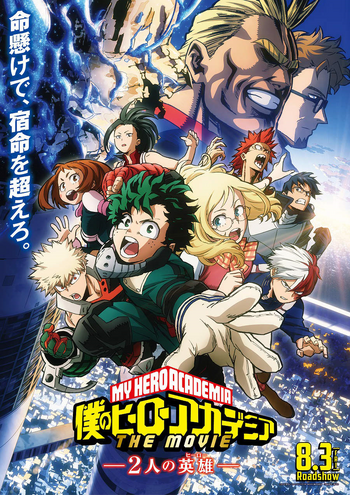 I'm not sure at what point feature films that tie in to long-running anime series (or even cartoon series) ended up going from one-off random non-canon stuff with a higher animation budget into actually trying to be sort of like a side-chapter, a non-required-viewing tie-in to the main storyline that fits snugly as a filler chapter at some point in the main series. I guess One Piece: Strong World and Naruto: Road to Ninja would be the first ones that actually did this, before franchises like Dragon Ball Z and Naruto used movies as a way to do epilogues and sequels to the manga after it has long ended.
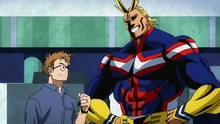 After a brief and very fast-paced prologue of a young All Might in his prime in America (seeing Prime All Might with actual eyes instead of the shadows is unsettling) with his buddy David "Dave" Shield and his wacky sci-fi flying car, we quickly cut to a moment in Midoriya's summer vacation, where All Might brings him as his plus-one to the man-made I-Island that serves as a combination of a Quirk research facility as well as a tourist resort. And this first act does take a bit of a time as Midoriya freaks out regarding just about everything, and as we meet with both Dave and his daughter Melissa, a person who, like Midoriya, is quirk-less but also wants to still try her best to be a hero. As the two of them wander around through I-Island, turns out that, hey, the movie-makers know that the other characters are also popular and we get to meet at least some of the most popular members of Class 1-A. Uraraka, Jiro, Yaoyorozu, Kaminari, Mineta, Iida, Todoroki, Bakugou and Kirishima show up at various parts of the facility, and they basically do what they do, y'know? It's pretty well-scripted and none of the characters are as flanderized as they would be in like, an old One Piece movie. The interactions aren't much and they don't add anything particularly new to long-time manga readers or anime watchers, but they're still pretty fun to see. It's a lot of slow set-up. Also, Midoriya gets introduced to his movie-exclusive power-up, the 'Full Gauntlet', which will allow him to unleash his 100% power at least three times.
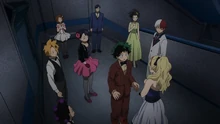 And not to knock on the movie or anything, because all of the animation sequences are great, but at no point in this movie do I really feel that our heroes are really in danger, y'know? None of the villains, not even the main big bad Wolfram, have any sort of personality. All the thugs basically exist for cool action scenes, with the highlight, of course, being Todoroki and Bakugou teaming up against that one giant-muscle goon and the one that creates holes in stuff, but is actually 'ripping' things from space or whatever. But ultimately a lot of this second act is just causing the rest of the 1-A students to be a dwindling cast as they slowly, one by one, stop and 'hold the line' against the legions of robots to send Midoriya and Melissa (who's the only one there that can hack the system) to the control room. I'm not going to do a scene-by-scene description because it's mostly moving pretty quickly with characters moving from one point to the next, but you honestly get the idea, y'know? We get a bunch of those "do your best, protect people is the priority" themes that is so prevalent in My Hero Academia stories. S'cool.