Tuesday, 21 July 2020

Reviewing Monsters: The Witcher 2 - Assassins of Kings


The Witcher franchise is one that is near and dear to my heart. A lot of my friends played the game and I was very swiftly taken into the world of the Witcher, which is... grittier and darker than most of its contemporaries at the time, but without going over-the-top like some other series I could name. I loved it, read the first anthology novel and played through the second game, finally completing it prior to the release of the Netflix TV series. I'm currently going through the third game at my own pace, but rest assured that I'll be talking about that game's bestiary eventually.

The Witcher 2: Assassins of Kings is a game that, on its heart, doesn't actually show Geralt beating up monsters a whole ton. I mean, the underlying concept of Geralt of Rivia is still a monster-hunter shunned by the world thanks to his mutated magic abilities, but the monster-hunting takes a significant back-seat in Witcher 2 because as the subtitle implies, the significant focus of the main plot is a mysterious man going around killing kings and destabilizing the country. It's actually pretty well done and I was extremely invested in the storyline of the game. There are varied opinions about this game and I think it's often viewed as the weakest game among the Witcher trilogy... but I dunno, I really enjoyed my time with Witcher 2. Sure, the sequel game perfected the gameplay and stuff, but I did really had a good time playing through Witcher 2. 

It's a neat jumping-in point for me to talk about the monsters of the Witcher series, though, because Assassins of Kings, while not without its monsters, definitely had them take a back-seat and end up being more obstacles and side-quests instead of being part of the main story.


Drowner
We'll start off with the 'common' enemies first, ones that are pretty weak and respawn after a while. The Witcher 2 has a pretty extensive amount of words written for its bestiaries, but the only way to unlock those is by finding specific in-game books and reading them, which is a bit of a rather convoluted way to do it. Realistic, perhaps, but considering the fact that the game automatically updates everything like quests and character bios as you progress in the game, I'm so happy that Witcher 3 did away with it and basically have you unlock the monster bestiary entry after killing a representative of the species. Thank goodness for online wikis and stuff, which archive all of the bestiary entries for the monsters.

Drowners are one of the staples of the video game series, appearing in all three games and loosely based on the Utopiec in the novels, itself based on a monster of the same name from Slavic mythology. Both the myhtological utopiec (from what I can find online, anyway) and the Drowner are basically restless spirits of the dead who drowned, rising up from their graves to haunt the living and basically drag them down to drown with them. The Drowners are not that overly complex as enemies in terms of lore or design, and in the Witcher series, they are classified as a 'Necrophage', which... basically means zombies that eat the dead, I guess. As their name implies, Drowners are always found near rivers, lakes and swamps. They're pretty simple to wrap your heads around, rising from a specific brutal death and being basically gaunt blue-skinned ambulatory corpses. In the first Witcher game they had fishmen gills, but I suppose they did away with it in the second and third games to match the actual mythological creature a bit better. Most of these monsters are absolutely no threat to Geralt (since he's a mutant with enhanced strength, magical items and spellcasting abilities) when it's a one-on-one battle, but they can be more than a nuisance when there are a lot of them. As you progress in the game, stronger Drowners, called "Drowned Dead", will show up with them as elite enemies. Not a whole ton to say here, but they do set the basic mood of most of the monsters in the Witcher series, which really have a lot of classic folklore vibe to them.


Nekker
Not being drawn from any creature in the novels specifically, the Nekker seems to draw its inspiration or name from a Germanic/Scandinavian mythological creature called the Neck, known in various different cultures as the Näck, Nøkken, Nixie, Nekker, Nikker or various different variations depending on the culture. But in all versions of the mythological Neck, they have always been water spirits or mermaid/mermen of a sort, so the Witcher games' Nekker seems to just draw nothing but the name. The Nekkers make their debut in Witcher 2 and are basically the game's most common monsters, although they show up mostly in caves and forests, or in little anthill-like cave-mounds that the game asks you to blow up with makeshift grenades. They're... they're just ugly ghoul-like humanoids with glowing red eyes and sharp claws. Looking closely at the model, they have a huge, bulging 'neck' that is where their names come from, but most of the time you fight Nekkers in Witcher 2 and Witcher 3, they move so quickly and in the dark that you just see vague angry humanoids with spooky red eyes.

The Nekkers' origins are never explained, and in Witcher 2 are classified as 'other'. Witcher 3 would reclassify them as 'ogroids', meaning that they're just humanoid monsters akin to trolls and ogres, so I guess they're the Witcher-world's equivalent to goblins? The Nekker is always found moving around in small tribes, and Geralt never really encounters one. They burst out of the ground and basically try to overwhelm Geralt with numbers. They're very basic enemies, just mostly threatening thanks to their number and habitat. Like the Drowners, you eventually meet stronger Nekker variants -- the Nekker Warrior -- as you progress through the game. You do get the feeling that while Geralt of Rivia is a mighty mutant spellcaster that can slash through a nest of them if he's doing all the Witcher skills properly, they're still enough of a threat if he's sloppy and definitely a threat to just some random peasant without a silver sword.


Rotfiend
The Drowners are kinda-zombies, but the Rotfiends are definitely a bit of a stereotypical video game zombie. Flayed body, a mutated head, and they explode upon death? Yep, this wouldn't look out of place in Left For Dead or Resident Evil or something. I do like the design of the Rotfiend, though, with their huge, bulbous heads that seemingly have covered all its features other than its angry zombie mouth. Their names are pretty descriptive, too, and apparently they multiplied a lot after all of the wars that have ravaged the lands. They're also classified as Necrophages, which means that they feed on corpses and will happily turn humans into corpses for them to feed on. I do like the detail that the game goes into talking about how Rotfiends can dig into graves and munch on the dead bodies there (and presumably multiply?) and the only sure way to cut off a Rotfiend infestation is to burn dead bodies. They're ultimately not that dangerous, though, although I've always held them to be a bit more impressive than the Drowners and Nekkers.


Wraith
There are a bit more of these intangible ghosts and specters in the first and third game, but in Witcher 2, the primary spooky incorporeal enemy is the Wraith. Three different models exist, but they're always consistent in that they're floating spirits with covered faces, tattered clothes, and two of the three models have what I think is their own gravestone lashed onto their backs -- which I thought is such a cool little addition that doesn't look like much, but makes Witcher's wraiths feel a fair bit more unique than the many, many spooky ghosts that are basically obligatory enemies in a fantasy setting.

In Witcher lore, the wraiths are created from people who die suddenly, leaving the world with a lot of tasks left unfinished and become ghosts obsessed with fulfilling their own aims but are basically stuck near the place of their demise. Most of the Wraiths in the game are unable to communicate with the living, but Chapter 2 of Witcher 2 has this huge event where the site of a particularly bloody battlefield ends up having all of its dead reanimated into wraiths who are basically reliving the battle that led to their deaths over and over again, and Geralt has to figure out how to appease some of these spirits. Like most video game ghosts, Wraiths alternate between being tangible and intangible and you need to time your attacks, although Geralt's Signs (essentially his magic spells) can usually stun them regardless of whether they're in the intangible phase or not. Ultimately kind of boring, but it's at least not another zombie.


Endrega
Easily hands-down my favourite creature in these games, although anyone who's read my monster reviews know that I have a soft spot for anything vaguely insect-based. The Witcher wiki tells us that the Endrega are apparently based on the Endriago, a monster from the Spanish novel Amadis de Gaula, which is described as a chimera-esque creature born out of incest. Witcher's endrega, viewed through that lens, makes a bit more sense. It's really a bug monster, with six chitinous legs and living in forests and working in giant hives, but its head looks more like a crocodile (if a crocodile's body is covered with chitin) but it opens sideways like an insect; and its tail is structured more like a lizard's but the Endrega will rear it up like a scorpion's. Realizing what their inspiration was gives me a bit more insight to what the logic behind this creature's design is, although whatever the case I'm sure I still really like the endrega as these creepy lizard-bugs.

Tw2 screenshot Endrega queenUnlike the Nekker or the Drowner, the Endrega's various forms receive unique models. The regular Endrega looks more like some sort of mutant giant spider, having the body structure but is a lot more colourful and has a bunch of wacky extra spikes and colours slapped onto it. The Endrega Guard (the most common type) is the one that looks most like a crocodile-spider. The Endrega Warrior looks basically identical to the Guard, save for the fact that it's got two extra tusk-like protrusions. And their big boss monster, the Endrega Queen, has the typical ballooned abdomen that fictional bug queens are basically obligated to have. Those giant termite queens are really seeped into the public consciousness, huh?

Again, while very loosely based on the hive structure of an ant or something, I really do appreciate that the Endrega's various members look so different. The Guard and the Warrior are easily my favourite since they are the ones that look completely unique unlike the weakest Endrega or the Queen, who are merely cool-looking bug monsters. And I do say 'merely', but bug monsters are really cool. It's just that the twist they took with the Endrega Guard by making it a reptile-arhtropod fusion really ends up working quite well. Also, if they're not weird enough, they lay their egg sacs in giant venus flytrap structures. Very weird, and very cool. For the most part, you only ever fight the weaker Endregas, but it's only when these egg sacs are threatened or defaced that the Endrega Queen will emerge from her lair to fight you. Not a whole ton to say here, as more common enemies you basically have to hack'n'slash, dodge and not die when you fight them.


Arachas
The Arachas is the first of the... 'mini-bosses', I guess? There's a finite amount of these in the overworld, and I don't think they re-spawn, but they're not the focal part of any main quest. In the storyline of Witcher 2, you only really have to fight one of this if you're basically blazing through just the main quest, although they do show up as potential encounters later on. Another one that to my knowledge is completely original ('Arachas' seems to just be a twist on 'arachnid') to the games, the Arachas is less of a giant bug like the Endrega, and more of a... bizarre bug-like monster. I've fought and killed a bunch of these in the game, looked at the concept arts and even then every time I look at this thing I find something cool about it. Sure, it probably shares a lot of the same assets as the Endrega Queen with its bent spider legs and the way it moves, but man, the fact that for some reason the Aracahas scuttles around with what's essentially a giant hermit crab shell? The versions we fight in Witcher 2 never quite got as varied as the concept art, but there's like a fun, very specific style they were going for. Some of the Arachas have like bagworm-style giant pinecones on their back, some have huge fungus ball like growths... and they also have spider-like faces that open up into a giant flower-like mouth. It's a giant crab-spider-flower creature, and I love it. The game still classifies this as an 'insectoid' like the Endrega, but I do like that the insect monsters in Witcher have this bizarre fusion animal vibe to them.

The first time you actually see one is in a cutscene when one of the main characters, Iorveth, lobs a poor hapless Nekker to feed an Arachas he's basically tamed to guard one of his bases. I thought that was cool as hell. The Arachas is described by Geralt's bestiary as a massive creature that essentially lone hunters that rule over a segment of the forest that is its territory, and it's noted that the Arachas's armour is so strong that attacking it from the front is folly, and you have to side-step its charges to strike it from the sides or back. Of course, most of the time you fight the Arachas in pretty narrow quarters, making this a bit problematic. Pretty cool bug monster.


Harpy
Appearing in the second chapter, which takes place in a bit of a combination of a mountainous region with some foresty parts, the harpies are the common enemies there, giving an extra layer of complication because unlike all of the other enemies you've faced before, these bird-women can fly. They're pretty nasty looking, and the team behind Witcher really like to take gross, flabby, half-flayed human bodies to add to the grossness factor of their monsters if the Nekker, Drowner and Harpy are anything to go by. Harpies are pretty standard fantasy monster fare, they're bird-women that attack, maim and steal from humans. These are the 'wings sprout out from the back' variant as opposed to some depictions of the harpy that have wings instead of hands. In practice, being common enemies, the Harpy's ability to fly doesn't really matter since they need to come close to you to attack anyway, and sometimes they land and scuttle on the ground like a bat.

I really don't have a whole ton to say here, although I really do like the fact that they gave the harpy a very creepy-looking skeletal bird-face. The stronger Harpy variant, the Erynia, has weird glowing bracelets, but I didn't notice until looking at screenshots that the Erynia, instead of having beady bird eyes, had just a mass of scars atop her beak. Spooky! She also has Harpy-skull boots, which is a lot more goofy than scary. Apparently, according to the bestiary,  those crystals are apparently 'stolen dreams', which I don't think comes into play in the actual game's story, but still neat.


Troll
Oh man, I love the trolls. In essence they are still the archetypal European-style trolls. Huge, brutish, ugly humanoid beings that are dumb and destructive. At least one of the trolls you encounter in Witcher 2 is also a huge creature that guards a bridge (which I know for a fact is a nod to a fun line in The Last Wish novel). And yet... and yet in a game whose whole concept is that of a monster-hunter, at least in the novels there is a clear line that Geralt draws where, unless it's impossible otherwise, he's not going to assume that any sentient monster is the sort of 'kill or be killed'. And in Witcher 2, it's the trolls that end up making the player really explore this. And hoo boy, the trolls are ugly. They really succeeded in making the trolls look like utterly grotesque caricatures of humans, having absolutely fucked-up face that's missing flesh, particularly around the mouth, making those visible gums and teeth look extra creepy.

But the trolls in the game? They are brutish, they are dumb, they are perhaps easy to threaten violence... but three of the four trolls you meet in Witcher 2 are actually just trolls who want to be left alone, or are willing to negotiate payment or simply just... well, talking to them to pass through their territory. One of them is even just rampaging because he was drunk after losing his mate. That is really great! One of my pet peeves in any sort of fantasy setting is the existence of "always evil" sentient races. According to Geralt's bestiary, apparently the trolls in-universe are thought to be a lot more impressive than they actually are, with many legends thinking that they're born of earth and made of rock and get petrified into stone under sunlight. But they're just, well, huge people of flesh that simply are perhaps just a bit too primitive. It's interesting to note that trolls are also noted to be particularly susceptible to poisons, because they have such a fast metabolism that the poison is quickly spread across its body. That's a very interesting explanation, game, I love it.


Bruxa
The Bruxa (taken from a type of Portuguese vampire) is an interesting enemy in that, at least in the path I took, I only met her at the conclusion of a particularly interesting little side-quest, and for the longest time I thought that the Bruxa is kind of this special, super-powerful enemy. A Bruxa also feature prominently in one of the stories in The Last Wish anthology, and a significant part of that story is Geralt mistaking her as a similar but less dangerous creature. Turns out that I just missed the other appearances of the Bruxa in the game, or maybe passed them off as wraiths. The Bruxa is described by the game's bestiary as a 'post-Conjunction creature', which means that, to put it in D&D terms, she's an extra-planar creature from another plane of existence. Normally appearing as a beautiful woman, her true form is a demonic vampire, and she fills in that vampire trope of seducing and manipulating her victim to essentially be her source of sustenance.

In this game, in the 'Last Sisters' sidequest, the Bruxa is portrayed a bit differently, although I think it's purposely left ambiguous whether the Bruxa you fought is merely a particularly powerful wraith, or a much more terrible being masquerading as the ghost of the NPC's dead sister. I felt like that was pretty awesome, and I do like the huge moment where Geralt realizes he's not just dealing with a boring old wraith. In the Bruxa's other appearances in the game series, they're basically just powerful undead women with some sense-debilitating screeches. Particularly in the first and third games, they run around as naked, blood-covered monster-women.


Bullvore
Classified as a Necrophage and probably the largest and most badass of them in Witcher 2, the Bullvore shows up a couple of times in the game summoned by evil sorcerers and the like to fight you. I personally never had too much trouble with them, although they sure look gross as hell. The head of a demonic bull, giant muscles and the whole 'zombie minotaur' bit is neat, although huge zombie monsters aren't especially novel in fantasy RPG video games. Those two teeny-tiny creepy hands jutting out of the Bullvore's belly is creepy, though!

It's interesting that the bestiary then describes the Bullvore as 'like a poet in that it is an individualist', because these Bullvores will only live as the only Bullvore in its lair, although it rules over Rotfiends and Nekkers, and often kills one of them in like a show of strength... but in a fanciful manner. Which makes it interesting. Sure, the Nekkers are implied to be a bit more intelligent than mere beasts, so them following a Bullvore's commands makes sense, but aren't the Rotfiends just mindless zombies? Eh. The Bullvore itself is ultimately not that interesting to fight. It is tough, hits pretty hard and has a gross acid attack, but ultimately is just a HP tank.


Draugir
The huge part of Chapter 2 involves you going through a battlefield where its dead has been turned into undead wraiths forced to fight each other for eternity, which isn't good for whichever side Geralt found himself in. And among the regular wraiths we have these Draugirs, taken, of course, from Norse's Draugr. These Draugir are less undead spirits and more a representations of war and the general violence inherent in war itself, being a bunch of remnants of corpses, armour and weapons that pull itself together into a vague resemblance of a humanoid shape to shamble into battle, usually summoned by their Draug master (who is a boss, and we'll cover that below). That's a very cool concept, and I've always liked monsters that are essentially just walking junkyards. The Draugir are essentially mindless following only their master's will.

Geralt fights through a bunch of these and I did remember them being more dangerous because there's a lot of them more than anything. I did like that they apparently retain their skill from when they were alive (or, I suppose, the parts of them that are made out of corpses) which allows them to actually strike and parry relatively effectively.


Golems / Elementals
There are two types of elementals in the game, but they are referred to as 'golems' in-game, and it's not until you read the bestiary entries for them that we get any sort of confirmation as to what they are. The first one, the Earth Elemental, is easily the more boring of the two, just being some dude made up of rock. Only one shows up in the game, guarding a bunch of treasure. Apparently the Earth Elemental is 'more mischievous', but rarely has a chance to show this side because it's summoned and bound to the will of its sorcerer master. And in the case of the earth elemental that Geralt meets, the order was to protect the treasure. Not much to say here, they're kind of boring.

The Fire Elemental, also know as the 'Golem' in game, is far more visually interesting. The Fire Elemental is a humanoid body seemingly made out of random chunks of wood bound together in a slipshod manner, giant spikes for a head, giant spikes for an arm, and, hell, even one of the legs is just a stump. I really love how unfinished this guy looks, with holes in its stomach. These show up a bit more often in Chapter 2 and 3, and the bindings around its 'head' sometimes glow depending on the location. These Fire Elementals are summoned by mages from its plane, and due to its alien mind, all it knows is to obey the orders its master calls it. It's really interesting that in this case the fire elemental isn't made out of fire, and I think it's implied that the sorcerer is binding the spirit of the elemental in this weird wooden golem bound by spell runes and stuff. Very cool-looking, I think the Fire Elemental/Golem is another one of my favourite enemies.


Gargoyle
The main monsters in Chapter 3 and briefly encountered in Chapter 2, the Gargoyles are... well, stone monster-men with long claws and wings. There's nothing particularly interesting about them, I feel, from a visual standpoint. They're what you expect a gargoyle to be, and while I do like that they have such a lumpy face, the most interesting thing about them is that the Gargoyles are, like Golems, bound to a sorcerer's spell. See, the gargoyles in the Witcher world are beings of stone brought to life, who are bound to certain rune-rooms in the abandoned mage city of Loc Muinne, guarding the abandoned chambers of their long-gone masters, and while Geralt can dispatch of the gargoyles relatively easily, he needs to get into the rune rooms and shut down the runes in the right order. It's a pretty interesting way to make the fight between Witcher and his prey a bit more complicated. Interestingly, while they are described as 'maybe a golem', Witcher 3 would classify them as an elemental (or, sorry, elementa) creature and in Witcher 2, they are able to teleport short distances and, well, as mentioned before, regenerate after death.  Not a whole ton to say here.


Kayran
The first act partially takes place in the swampy town of Flotsam, and you're quickly introduced to one of its largest threats, the Kayran. You first just see the giant tentacles and assume that it's this universe's answer to krakens, a giant boat-sinking octopus or squid. And... you're only half right. Sure, the anatomy of the Kayran resembles an octopus... kind of. When you finally manage to lure the Kayran out of the water, it's got the face of a giant octopus with ridges and stuff, but a massive maw that the Sarlacc would be proud off, and a bunch of powerful crab-like legs that allow it to scuttle around. The boss fight against him is essentially similar to a Zelda boss fight -- memorize attack pattern, trick it and slowly get rid of its tentacles one at a time. It's a pretty impressive giant boss fight and, obviously, I'm a huge fan!

It's got a bit of an interesting backstory, too, where not even Geralt's bestiary is quite sure of where the Kayran came from, only that it's a monstrous creature that somehow took up residence in the Pontar Valley's waters, and no one is quite sure if all of the tales of the Kayran attacking ship and shipyards are describing the same creature moving from shore to shore, or if it's just a seldom-seen species. It also dives underwater, where the technology of the time simply didn't have a way to deal with, and even when Geralt manages to draw it out of its lair with the aid of some lightning magic, he still has to craft a potion that makes him immune to the Kayran's poisonous membrane. A very cool giant boss.


Draug
The second act's unique 'boss', so to speak, is the Draug, the boss of the Draugir. As mentioned above, Chapter 2 of Witcher 2 takes place on a reanimated battlefield, and one of the commanders of the battlefield is this massive walking furnace-demon made out of nothing but metal and flames called a Draug. It's hard to see from here, but its face is basically just a bunch of wood tied together and set ablaze, a very cool visual image. Apparently this is not the Draug's true form, but rather, what the spirit of one of the generals of Kaedwen manifests as the mighty Draug, reliving his final days in the battlefield. The bestiary notes how tales of the Draug are shrouded in myth, and all that's known about this 'Arch-Wraith' is that it's terrible, scary and undead. And normal mortals can't come to fight the Draug without 'getting on its level', which is to say to pass a bunch of trials or something to make the Draug susceptible to damage. In Geralt's case, he ends up having to figure out the circumstances behind the seeming betrayal of the sorceress Sabrina Glevissig that caused her to rain down death upon both her allies and enemies. The Draug itself isn't actually a powerful fight, but its design sure is neat.


Dragon
The technical final boss of the game is Letho the Witcher of the Viper school, but since we're not going to review humans, the fight before him is Saesenthessis, the mind-controlled dragon.
You actually fight the dragon in the prologue segment of the game, although it's more of trying to escape being killed by the dragon more than fighting it. By the time you reach the end of the game, Saesenthessis is actually not that hard to fight. I picked Roche's path in my playthrough, but apparently you find out a lot more backstory about the dragon if you picked Iorveth's path (which is great and I won't spoil for anyone who hasn't played Witcher 2). Either way, a very cool fight scene and final boss even if design-wise Saesenthessis is... just a regular ol' dragon, and while certainly impressive it's not as unique as the Kayran, Arachas or Draug felt.

I do like the attempt to make Witcher 2's dragon feel unique, though, particularly with those weird little skin-flaps or mini-wings on Saesenthessis' neck, and the fact that this dragon has a body that's a bit shorter. I guess it's the game's way to try and make it look like an animal that can viably fly around. In Witcher-era, as told by the novels (and the Netflix show, which adapts the first two novels), the dragons are almost extinct. True dragons, that is, as Witcher 3 would show off a bunch of 'draconids'. The huge difference, of course, is that true dragons are sentient, intelligent and immortal, whereas draconids are just angry beasts that look like dragons.

I do like how the bestiary strikes a neat balance by portraying the dragons as this tragic sentient species that are hunted down to near extinction by humans as part of their reprisal and to claim trophies and alchemical ingredients... but they also note just how destructive most dragons are, being compared to cats that lounge about and don't care about what they destroys. Witcher 2's bestiary notes that there are five main types of dragons (white, black, red, green, rock) and a mythical golden one that's apparently able to shapeshift into humans and talk to them (this one shows up in the novels and the TV show). It's noted that most non-golden dragons are kind of like cats, who like to toy with their food. We really only meet Saesenthessis in Witcher 2, though, and at least for me, since I picked a different pathway, I didn't really see the full story and she's just a cool boss fight to me.
____________________

...And that's it for Witcher 2! I still have a long way to go before I finish the actual game of Witcher 3, and there's surprisingly a lot less monsters in this game than I thought there were. Still, the point of the game is less about showing the monster hunting parts and more about telling a story about Geralt and the politics of the land, so it really can't be helped. I do like the selection that we got for sure, though!

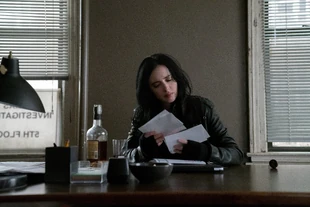
Monday, 20 July 2020

Marvel's Jessica Jones S03E10-11 Review: One Bad Day

Marvel's Jessica Jones, Season 3, Episode 10: Hero Pants; Episode 11: Hellcat


Episode 10: AKA Hero Pants
So it's interesting that the past 9 episodes of Jessica Jones can technically be broken up into little arcs, without any of them really standing alone. There's the 'Hellcat Rises' arc that just basically establishes the new Jessica/Trish dynamic. There's the initial Sallinger arc (where he gets captured at the end after holding Erik hostage) and the second Sallinger arc (where he outsmarts Jessica and Trish). And so it seems like after the relative downer ending of the ninth episode, this is basically starting the final arc where everything sort of comes to a head. And while I do see a lot of complaints about Gregory Salinger as a villain... at least they're trying to give him screentime, y'know? The actor is actually allowed to deliver an interesting psychopath that does exude a sense of menace, and comparing him to someone like the Pilgrim from the final season of The Punisher, or Jessica's mom in the previous season of Jessica Jones, Sallinger is at least an interesting love-to-hate antagonist. (And Sallinger, interestingly, is more or less absent in these two episodes, which is a nice breather) Sure, he's no Kingpin or Killgrave, but he's at least pretty interesting. Episode 9's big cliffhanger is that after Jessica wraps up the whole mess around Sallinger's blackmail, she ends up being accosted by a bunch of police officers investigating the death of Officer Nussbaumer, the asshole cop that Jessica and Erik blackmailed into letting them enter the police precinct. And, unfortunately, Jessica was the last person that Nussbaumer met before he switched of his police body-cam thing.

And "AKA Hero Pants" itself serves as a belated send-off to Dorothy Walker, and it's a very, very interesting episode. Dorothy's death was sudden and brutal, and I would still argue that it's done essentially just as shock value, but I do like that we basically spend the entire episode sort of seeing Jessica and Trish mourn Dorothy in their own way. Sure, Jessica's investigation over who actually killed Nussbaumer does take place in the background, and both Malcolm and Hogarth's respective storylines get more room to breathe beyond being irritating footnotes in previous episodes, but I feel like at least until the final parts of the episode, a good chunk of the episode ends up being an interesting character study about grief and mourning.

See, here's the thing. Dorothy Walker, as a person, has certainly improved in this season. She's clearly worried for her daughter Trish despite her control freak attitude. She's willing to 'scrub down' and tolerate the hero stuff, and even helped out with the whole publicity thing to help Trish and Jessica flush out Sallinger's victim. Hell, even in her own passive-aggressive "your costume sucks" marketing mentality, Dorothy is helping out in Trish's new career. And she most certainly didn't deserve to die scared, alone and butchered in her own house. But at the same time, it doesn't excuse all the terrible shit that Dorothy did in her life. "AKA Hellcat", the next episode, fleshes this out a lot better by actually showing us the scenes of Dorothy and young Trish, but Jessica describes Dorothy as the first villain that she ever faced, and I really love it that this abusive control freak of a parent isn't actually just 100% easy-to-hate. It would've been so easy to turn Dorothy into a card-carrying evil parent, and there's certainly no excusing the emotional and physical abuse she did to Trish. But the fact is, Dorothy still loved Trish and vice versa, and I do really like that the episode highlights what a gigantic control freak Dorothy Walker is (she has her own funeral arrangements all set up, right down to the playlist and that memory board), what a nice person Dorothy was to her other clients (abusers can appear very friendly to the world outside their own families) while also showing how hard the death has hit Trish and even Jessica.

The moment that I felt was the most effective was Jessica pinning a random terrible shot of their feet from an old camera because the camera accidentally took a shot of a particularly ruined thanksgiving parade where they missed the parade and ended up hanging out at a terrible theater or something, and yet it's the sort of poignant memory about your family that you'll end up remembering. As Erik and Jessica discuss, death is a final chapter that definitively shuts out any attempt at reconciliation, and while people like Dorothy or Erik's incest-pedophile dad are pretty terrible, it doesn't make it any easier for the children to bury them. Hell, we even get to see a bunch of nice moments from Dorothy post-mortem, when Jessica realizes that Dorothy leaves behind not only her liquor (which could be taken as a jab) but also an armchair that Jessica always sat in as a kid -- and when Dorothy moved the armchair into Jessica's room, she had always taken it as a sign that Dorothy is banishing her from the rest of the house, not realizing that it's an act of kindness.

And then there's also Jessica trying to power through the police investigation around Nussbaumer's death throughout the funerary arrangements. And we've seen that Jessica's the sort of person who's able to compartmentalize things and leave most of the emotional stuff until later (or dull it with alcohol), showcased particularly well last episode where she tells Trish to grieve while she took care of everything. And not being as close to Dorothy, it doesn't make it too hard for Jessica to multi-task and try to figure out if Erik has somehow ended up going off and killing Officer Nussbaumer. And throughout the episode, I did suspect that Erik was actually a villain all along, because that's honestly the sort of twist that these sort of shows would pull; Erik himself has been drifting in and out of the cast -- plus Erik has been suspiciously nice to Jessica. And there's the misleading bit of the files that Jessica found in Erik's apartment after canoodling with him. But I just fully thought that Erik was essentially Kilgrave Mark II. Maybe Jessica's cynicism and paranoia has rubbed off on me a little. Either Erik was the villain, or Sallinger's somehow done some wacky super-smart Hannibal Lecter thing to somehow frame Jessica for the murder of the officer (which wouldn't make sense, and thankfully wasn't the case).

Turns out, though, it was Trish that killed Nussbaumer, and unlike Dorothy's shocking death in episode 8, this one is a twist that felt earned. Trish wasn't conspicuously absent throughout the episode, but you would totally believe that she's basically secluded and emotionally shut down after both her mother's death and the loss of letting Sallinger escape. And throughout the episode we learn that Nussbaumer was beaten to death with knuckles (something that made Jessica suspicious to the cops in the first place), which ends up actually fitting with Trish also being a super-powered metahuman. The gears in Jessica's head as she figures it out is great, and the episode ends with Jessica stalking Trish but she ends up getting arrested by the detectives investigating Nussbaumer's death.

And when I watched this episode, a lot of it clicked into place even before booting up "AKA Hellcat", the next episode that is basically a recap of the events of episodes 9 and 10 from Trish's point of view, similar to the second episode of this season. Erik being morose and wracked by guilt makes sense from what we know about him, and Trish was already emotionally unstable throughout the season and she's always the sister that's more prone to impulsive, drastic actions. We don't quite get the huge scene of the speech set alongside the context, but Trish's speech about how Dorothy always valued talent and always feared that Trish would waste talent does encapsulate the sort of mentality that Trish had unfortunately gotten from Dorothy -- and while that sort of go-for-it attitude might be great in something like the show business, when applied to its extremes it can get ugly and result in a mother that emotionally abuses her daughter so she can be a superstar, or a vigilante that ends up resorting to beating a corrupt cop to his death.

The Hogarth storyline is something that I've expressed a lot of frustration about... mostly because it isn't anywhere as compelling as the show think it is, and this episode brings it back up in full force as Kith is desperate for anyone to help her out with one of her donors, Dmitri Patseras, who wants to sue her. Hogarth's clearly back in her manipulating game, showing a friendly face while also offering to help out pro bono, but we all know Hogarth's a scheming snake and despite all of her seemingly-nice things that she does here, she's got her own interests (i.e. 'getting' Kith as her woman) in mind. Also, being the lawyer that represents Trish, she's also trying to patch things up with Trish and it's tricky because Trish absolutely loathes Hogarth right now, and Jessica isn't fond of her either. And, sure, Hogarth finally made the decision to stop representing Sallinger, and she claims she's trying to fix her mistakes, but honestly Hogarth has became so unlikable that it's kind of interesting if this was the point that the show was trying to actually make -- that sometimes people do terrible things, like Dorothy and Hogarth (and even to a less obvious extent, Erik, Malcolm and Briana), and only when they are alive that they can actually try and change -- someone playing executioner would deny that chance. Or something along those lines. They don't at least try and justify that this is a reason to spare Sallinger, but at least the show is trying to argue for the fact that less-psychotically-villainous people can do change for the better. Or try to.

Malcolm... is kind of interesting? In the past couple of episodes he's sort of drifting in and out of focus, eventually settling in his own moral dilemma by deciding that, hey, the side that doesn't try to help a psychotic serial killer is the actual good guys. This episode has him break up with Zaya and, uh, basically sort of had to lie to her a bunch to not give up just how deep he is in with the vigilante stuff. I really don't care about Malcolm and Zaya's relationship, though it's nice that this didn't really take up a whole lot of time and it does give Malcolm's character some extra weight. Erik's sister Brianna also shows up and tries to basically start a new life, and tries to get a place to crash. Malcolm and Brianna end up fucking before the episode is over, but I honestly really don't give two shits about Malcolm's love life, so.

Anyway, a fantastic episode. The strongest part of Marvel's Jessica Jones has always been its mood and the powerfully subdued emotional acting that its cast members are able to do, which this episode and the next really explore in spades. The Sallinger stuff, while I did like parts of it, really does feel a lot rockier compared to this pair of very solid episodes.
_____________________________________________

Episode 11: AKA Hellcat
This episode, as mentioned above, plays off similarly to "AKA You're Welcome", but where that episode is just essentially the reintroduction of Trish as a vigilante in this new season, "AKA Hellcat" does the double duty of explaining the behaviours of Trish, Erik and a bunch of other characters that ended up with Nussbaumer's murder between episode 9 and 10, as well as Trish and Erik's attempts at cover-up in episode 10. And while I do think that this season might've overdone it a bit with two 'what happened behind the scenes, boys and girls?' episodes, I feel like it's pretty effective, particularly with the duality between Jessica and Trish as one of the biggest themes of the season.

Just telling us how Trish went on a careless vigilante rampage isn't really enough weight for the episode, though, and I do appreciate the follow up from episode 10 of the episode showing just how actually terrible and demanding of a mother Dorothy is, since some of the scenes in this episode show a younger, aspiring-child-actor Jessica being emotionally abused with guilt-trips and being taught to manipulate adults around her and betray her friend to get the starring role of the show. Just because you're mourning her, doesn't mean that all of her past sins are automatically forgotten -- and as someone who has to write and give a speech about Dorothy at her funeral, I can totally see how Trish ends up remembering some of these terrible memories. And, again, I feel like, back-to-back, "AKA Hero Pants" and "AKA Hellcat" is a far, far better sendoff to Dorothy Walker as a character that sort of helps to end up giving the character a far, far better sendoff as far as the audience is concerned. Rebecca de Mornay is also absolutely fantastic in these scenes playing a terrible person doing terrible things 'for the good of my child'. And in-between moments of pressure telling her daughter about how she must perform perfectly or people working on the show will starve or cutting her off in her brutal tutoring of how to act, we get moments of genuine pride and love that a mother has for her daughter and it really ends up capturing the complex relationship between abusive mother and child.

And this mentality, from the aforementioned "don't waste your talent" and Dorothy telling young Trish that she needs to feel that "(she) got this" ends up being reflected in the night that Trish, seeing Dorothy's mangled body, decides that she 'got this' and ends up maiming Sallinger. We get some repeats of scenes we've seen in episode 9 -- but framed from Trish's point of view after seeing her mother die, we get to see just how much things are starting to pile on her from Hogarth's witch-hunt for Hellcat, the conversation with Malcolm, and how after Malcolm left, the seemingly-random detail of a dude arguing with his wife/girlfriend next door ended up with Trish going vigilante once more and beating the shit out of the abusive dude.

Apparently at some point during the timeline of episode 9, Trish even went into the hospital room where Sallinger is in, and we get to see some smarmy manipulation from Sallinger, who is protected by the police and also mocks Trish how if he killed Sallinger then and there, all the agonizing sacrifices Jessica had to made would be in vain. Sallinger then goes on a rant about how Trish killing is just a power trip, but Sallinger's own killing is a byproduct of his bizarre 'show the truth' nonsense. Yeah, dude's a lunatic. Interestingly, though, while the show doesn't really bring it up, Dorothy's own philosophy and motto about how she wants to share those with great talents (even if said talent had to be forced) needs to share the with the world does end up as an interesting foil to Sallinger's own philosophies.

And all it takes is just a little push, and I actually do like it that the push came from the random doorman in Dorothy's apartment, who gives one of those "evil wins when those of good heart stand idly by" quotes, which galvanizes Trish to do something. She ends up showing up at Erik's apartment and I do like that some of Trish's speech to Erik in trying to get him to help out ends up mirroring some of Dorothy's own speeches in the past about how those with talent have a duty and whatnot, which is an interesting way of showcasing just how much Dorothy's upbringing, for better or for worse, really ended up molding Trish Walker into the woman she ended up becoming. And as she ends up brutalizing Montero later in the episode, Trish repeats her mom's words almost as a mantra, that she could "make the world better with her talents".

And with Erik's connections and his files on the people he blackmailed before, Trish decides to go full-on vigilante on Officer Nussbaumer. Trish's plan, however, as most of her solo Hellcat act, is amateurish -- her plan is basically to vaguely beat up Nussbaumer into a confession, then release the video into public. And Nussbaumer is a scum that killed some troubled teenagers, and it's hard to really feel broken up that a child-killer is dead, but at the same time it's pretty disturbing when the death happened, and unlike Erik's bookie that Trish beat up earlier in the season, this 'accident' ended up with a death. A death that, unfortunately for the cast, implicates Jessica Jones, but something that Trish ends up actually feeling good about since it's a 'win', while Erik, being someone with plot-convenient powers, rants about how euphoric he feels now that his headache is gone... again, something that unintentionally fuels Trish's own ego, and her thinking that this is the exact make-the-world-better that her dead mom told her about.

We get to see the officers interrogating Trish from her POV, and while she's a good enough actor to shake them off, she feels bad that the officers are suspecting Jessica, and engineers the beatdown of a second mark, Jace Montero (he sets fires to buildings to claim insurance money, also a scum), at a time when Jessica's location is public, exonerating her. And I really do like this little argument of "should the superhero kill the villain?" because, well, it's a slippery slope. Sallinger is a scumbag who deserves to die for sure, particularly thanks to what he did to Dorothy. Nussbaumer is a corrupt cop who shot teenagers, he's also pretty scumbag. But Jace Montero claims that his pretty terrible crime of setting fires to buildings is an accident gone wrong, and while he certainly deserves to be arrested, I think the show makes its point very well  that Trish... doesn't know when to stop, and the sight of Montero being absolutely brutalized before Erik stops Trish is pretty horrific.

And what about someone like Jeri Hogarth? I've said throughout these episodes that Hogarth was definitely an unlikable, scummy bastard since around episode 7, and I would go so far that I would agree with Trish's assessment that she's indirectly responsible for escalating the situation and causing Dorothy's death indirectly. She's certainly the unintentional cause of death for Kith's husband for sure. But for Hogarth, we get to see more of her. We get to see that she's dying, that she's desperate to hold on to the few good things she has in life (her law firm, and, as twisted as it is, Kith) and no, that doesn't excuse any of her crimes, but does she deserve to get her throat crushed as Trish threatens to do? Again, it's a gray area, and I do like that "AKA Hellcat" manages to imply this without actually spelling it out.

That said, Trish isn't the most stable of vigilantes, and is apparently very, very easily swayed. Hogarth offers to drop the footage about Hellcat, but also wants Trish to help her out in stealing something from Dmitri Patseras, the man bothering Kith, in order to prove his tax evasion or whatever. And, sure, Kith hates Patseras, but is he really as evil as Kith (and ergo Hogarth) make it out to be? Trish's ever-slippery slope ends up basically being "is he a bad person?" which is a lot harder to quantify since the world is really in shades of grey. Sure, there are some truly bad eggs like Sallinger, but Trish's refusal to see anyone else in anything but black-and-white is actually shown pretty well here.

Ultimately, there are a lot of heavy questions being asked here. But this is less a discussion of morality and the validity of murdering villains or whatnot, and more of a deep character study of the skewed way that Trish Walker views the world after her mother's death. There are some parts of it that I admit felt a bit long and repetitive (Trish beating up Sallinger in full detail; Trish's conversation with Malcolm; the bit with Trish calling the cops on Jessica at the end of episode 10) but ultimately, I feel like episode 10 and 11 might be the highlight of this season. We still have two more episodes to wrap this season (and Netflix Marvel) up, and it's certainly interesting.

Marvel Easter Eggs Corner:

  • Young Trish had to dye her hair red to stand out for a role. Comics!Hellcat is a redhead. 

Reviewing Pokemon's Human Characters - Alola

The last one of these 'reviewing human characters in Pokemon' bits I'll be doing for a while, because, well, not all the Galar DLC is out just yet. It's been fun and frankly I'm surprised I managed to keep this up way past where I thought I would clock out.

The Alola games are... they're interesting. Opinion is divided among them because really, which generation of Pokemon games didn't have its detractors and lovers? And as a piece of fiction, as a story, and as a location, Sun and Moon are great. Sure, the decision to have the whole 'happy Hawaii tropical vacation fun time' cross over with some creepy, bizarre extra-dimensional jellyfish elder being plot is an interesting one, but honestly, I've actually always liked that juxtaposition between the two sides of the Alolan games. The story is easily the strongest among all the main-series Pokemon games, it's just such a shame that the story ends up coming to us at the expense of gameplay experience because of the sheer frequency and length of cutscenes. It's more and more a bit of a problem that I see with the newer generation games, where the routes and places to explore between the cutscenes of the story aren't quite long enough. That's not the point of this review, though, because we're again talking about the characters.


Elio & Selene
  • Position: Protagonist
  • Japanese Name: Yo & Mizuki
Like the XY protagonists, Sun and Moon feature a very customizable protagonist so chances are you're barely going to see 'Elio' and 'Selene' here in their basic forms, whether you're playing Sun and Moon or their Ultra versions. Also, I get it, their names are literally sun and moon. Elio's first look is another boring one, although at least his striped T-shirt looks significantly different from a vast majority of other male protagonists. His Ultra appearance makes him truly look unique and I totally buy him living in Pokemon world's equivalent of Hawaii. Selene, as usual, looks far more unique, although there really isn't much to say about her beyond 'yep she sure does look like she lives in a tropical island'. I really like the goofy glove-hat she has in her first appearance, it looks so wacky.


Hau
  • Position: Rival
  • Japanese Name: Hau
I'm not actually going to go too deep into talking about these characters' stories in-game, because that'd take a bit too much time and I've gone pretty in-depth with two text-based Let's Plays about Alola. Suffice to say that, for the most part, I did find all of Alola's characters to be charming. The main rival, Hau, is probably my least favourite of all the main cast, but... he's just so gosh-darned well-mannered and generally laid-back and happy that it's hard to actively like him. He's just a bit of an utterly happy-go-lucky airhead, and I feel emphasizes around the first half of Sun/Moon exceptionally well, where it's just a happy fun journey in Poke-Hawaii. In the Ultra games, though, he gets a bit more serious and actually trains to be a bit more powerful because he's tired of being useless in times of crisis. Admittedly his story is still a bit overshadowed by everything else that's going on in the main story, but it's something and I do appreciate it. He's basically an equivalent to Shauna or Bianca, but a lot more laid-back and a lot less energetic than those two, and with a much, much bigger appetite for malasadas.

There's a neat backstory here that was a bit lost on me in Sun/Moon, but in the Ultra games where Hau is so introspective sort of leads me to put the pieces of his story together. Hau's laid-back and non-confrontational because as a kid he was traumatized when he saw his grandpa Hala in a massive angry fit, and this childhood trauma led to Hala raising Hau in an extra-soft manner. Which is all well and good for Hau until he ends up falling face-first into the world of street gangs, totem gods and extra-dimensional jellyfish beings.

Design-wise Hau's nothing to really talk home about, he's just some dude with a shirt and shorts. He's probably the first rival since Blue to really look like just your literal next-door neighbour, though. In Sun/Moon he's one of the potential final fights you face in the Pokemon League, because unlike previous games, you are the champion and the final fight you see when you repeat the Elite Four run is taken from a random pool of characters you meet in the game, Hau being one of them. His team is frankly not too impressive in Sun/Moon, picking the starter weaker to you, always having an Alolan Raichu and an Eeveelution and otherwise having a bit of a random selection of Pokemon.


Lillie
  • Position: Get Back In The Bag
  • Japanese Name: Lillie
Lillie is the N equivalent in this game, the NPC who has the story really revolve around her. Unlike N, though, Lillie is much better-written, much more likable, and basically starting off as being one of your friends instead of being a weirdo who spouts nonsense makes Lillie a lot more endearing straight off the bat. In both versions of the games, Lillie initially fills in a very common role in fiction -- a mysterious girl with a mysterious past, and she's always hanging out with the mysterious 'Nebby', a Cosmog that she keeps trying to put into the bag. It's kind of symbolic of what Lillie herself is doing, constantly suppressing herself and wearing the clothes picked out by her mother (who is obsessed with the Ultra Beast Nihilego and dresses Lillie to look similar to it) and generally being extremely unsure of herself and being afraid of Pokemon. As you progress in your journey, Lillie ends up taking matters into her own hands and picking out her own clothes and hairstyle in a pretty well-written scene of 'finding yourself'. It's interesting hwo this is reflected in both her artworks even though that second Lillie piece is released much later, where she's a lot more rigid in the first piece of artwork. Again, I'm not going to really say much because that'd involve recapping the whole story of the Generation VII games, and I already did that twice.

A lot of people complain about Lillie, noting that her rich and long story should've been given to the protagonist instead to make them the focus of the games. And while I can certainly see the reasoning, I'm happy to see a good story wherever it is. She's pretty well-written.


Gladion
  • Position: Rival/Team Skull
  • Japanese Name: Glazio
Gladion is a mysterious member of Team Skull who you meet around halfway through the game and fights you with his own mysterious, unique pokemon, Type: Null. And he sure is edgy-as-hell, wearing ripped-up black hoodies, covering one of his eyes with his hair, obsessed with strength, and he's an over-the-top parody of those edgy, too-cool-for-you bad boy characters you see all the time in anime. He's like a bad parody of Uchiha Sasuke. And turns out... that's what he's actually meant to be. He's joined a gang, he's ran away from home after stealing one of her mother's experimental Pokemon, and he's basically acting like a gigantic emo punk because it's essentially him acting out, and I do adore that Gladion really mellows out a lot later.

He starts off as a right tit, though, and while he shows up a bit later into your journey compared to Hau, he's probably the game makers' response to all the outcries of 'stop making our rivals nice guys'. He's basically Silver done right, because Silver in the original Johto games is just this vaguely nebulous presence that peters out later on, whereas we actually get to see Gladion genuinely realize that his hard-ass attitude really isn't good for much. He's also Lillie's brother, and, well... it's basically different ways of acting out. I won't really spoil too much of the Alola story, but I can easily say that Gladion's my favourite of the three rival/companion characters. Gladion's team over the two games, in addition to his signature Type: Null/Silvally, is a neat combination of 'edgy' Pokemon (Crobat, Weavile, Zoroark, Porygon-Z and pretty hilariously Lucario) and Pokemon that actually are huge softies at heart. Lucario is obviously mostly a heroic archetype, Zoroark is often shown to have a softer side, Silvally and Crobat evolves through friendship... and I can totally see that this kid makes his team up solely because half of his team is 'broken' or 'misunderstood' Pokemon. Again, I do like that he eventually mellows out and his Type: Null buddy, the experimental weapon condemned to being shelved, ends up achieving its true, happier form as a huge chimera-dog.

Also, whether it be the games, anime, trading cards or manga, I am happy that everyone involved in the creative team of Pokemon realizes the utter hilarity of Gladion's absurd arm gestures and represents it in some way.


Professor Kukui
  • Position: Pokemon Professor, Woo; Champion
  • Japanese Name: Kukui-hakase
For the first time in one of these reviews, the Professor gets to be placed right after the rivals because it really doesn't seem right to have Kukui slumming it at the bottom of the review with the rest. See, in most Pokemon games, the Professor is really only relevant at the beginning of the game, giving that 'welcome to the Pokemon World' talk, maybe showing up once or twice more during your journey, and later at the end. Not so for Kukui. He's basically there for almost the entirety of your journey, inviting you to Alola with a video call, and is generally a huge, huge presence as this very cheerful neighbour who is that one guy in the neighbourhood who's too excited to have someone new hang out. His realm of expertise is Pokemon moves, which translates to Kukui allowing his pet Rockruff to attack him and cause all sorts of chaos in his very messy research lab (which has hastily-patched holes on the roof) that's like this large shack in a beach. Also he's shirtless all the time even though he wears a lab coat, a fact that the fandom at the time really appreciates.

And his personality is... oh-so-excited. Everyone in the Pokemon world (except for Lillie) is already excited about Pokemon 24/7, but Kukui ramps it up to a lot higher. And as you journey on through your island trials and later get sucked into the whole Aether/Ultra Beast plot. You also learn that he is a huge celebrity pro wrestler called the Masked Royal, where he is extremely popular. Hilariously, despite using a Rockruff as the Masked Royal and despite the identity being absolutely clear to the players, the (very poorly guarded) kayfabe is apparently good enough to fool not just Hau... but even Kukui's own wife, who is a huge, huge Masked Royal fangirl. I'm not entirely sure if Kukui is that good at maintaining his identity or if everyone is just humouring him.

He's also a dude that has his own goals,  because while you were around completing your island challenge, Kukui looks up at the top of the peak of the highest mountain in Alola and he really wants to establish a pokemon league there to show off Alola's moves to the world. And... and he ends up being the first champion, facing off against you as the final trainer in the Elite Four/Champion challenge of Sun and Moon and using the starter you are weak to! And his team of Lycanroc, Alolan Ninetales, Braviary, Snorlax and Magnezone aren't a pushover either! He doesn't become the first champion challenge in Ultra (that's Hau) but the fact that you have a professor as the final battle of a game's main story is a hilarious call-back to all the rumours that Professor Oak is a secret boss with level 200 starters or whatever back in the day. I like Kukui a lot, he's a cool dude.

Ilima
  • Position: Trial Captain
  • Japanese Name: Ilima
  • Specialization: Normal
Instead of gym leaders, we have trial captains in Alola, who, instead of fighting you at the end of a huge puzzle-covered gym, is just the host for a trial segment where they ask you to do some non-battle related puzzle, and then fight a massive, overly-empowered Totem Pokemon. The actual fights you have with them sure do exist, but they tend to be the Trial Captains themselves being curious about you. Ilima is probably one of the less memorable supporting characters here, although I do like his little vest. Ilima is modeled a bit after a high-class transfer student, coming to Alola from Kalos, living in a mansion and being a bit of a superstar in the nearby Trainer's School. While calm and very polite, Ilima isn't a snob in any way. That does leave him a bit bland and boring, though. Ilima is a Normal-type trainer, and is associated with the local 'regional rodent', Yungoos. Not really much to say here, if we're being honest. 


Hala
  • Position: Kahuna / Elite Four
  • Japanese Name: Hala
  • Specialization: Fighting
Hala is the Kahuna of Melemele Island, which is basically the island leader and one that you actually have to beat in a trainer battle after clearing all of the trials on that island. Hala's also Hau's grandfather. He's honestly nothing particularly special, just a likable old dude dressed in one of those outfits that you see older Japanese men that practice martial arts often do. Hala's a martial arts practitioner himself and is primarily associated with the Crabrawler and Makuhita line. I'm not too knowledgeable about this, but I guess like Makuhita/Hariyama his pose is at least partially based on a sumo fighter as well? I guess the nice-old-grandpa vibe he has here is him after his temper mellowed out because he felt bad that he traumatized his young grandson. He's a nice dude.

You will also see him later on, doot-doo-doo, just a kahuna on a stroll to a laguna, before he straight up fights an extra-dimensional alien bug monster alongside Tapu Koko. That's awesome! Hala, alongside most of the other Kahuna, turn out to be recruited to become this region's version of the Elite Four, which I thought was pretty cool that you actually see these characters being established as badasses before you actually meet them in the Elite Four. 


Lana
  • Position: Trial Captain
  • Japanese Name: Suiren
  • Specialization: Water
Lana is a sweet, shy little girl that's the trial captain of Brooklet Hill, compared to the far, far louder personalities of her fellow Akala Island captains Kiawe and Mallow. Turns out, though, that personality and that very unsure-looking eyes hides the personality of a massive troll, because Lana's whole trial involves her obfuscating stupidity and keeps talking about how she totally caught a shiny red Gyarados or how there's a strapping young swimmer or telling you that you're going to have to fight the embodiment of the sea, the legendary Kyogre. I kinda feel like she's one of those people who has a really sweet-but-deadpan voice and you're not sure when she is joking or not.

I make it a rule not to talk about their anime counterparts a lot, but Lana's anime counterpart plays up the 'shy meek cutie-pie' personality to a tilt, which, coupled with her great voice acting, is amazing. The Adventures manga, though, chooses another interpretation for her. See, Lana's totem Pokemon is either a terrifying Wishiwashi or a horrifying Araquanid... and turns out that manga!Lana, when fighting, basically switches onto a 'battle mode' where she's all fierce and violent. That's neat. Design-wise I feel like between the outfit and the hair, Lana's the perfect middle ground between a design that's believably mundane but also memorable enough.


Kiawe
  • Position: Trial Captain
  • Japanese Name: Kaki
  • Specialization: Fire
The trial captain of the Wela Volcano Park is Kiawe, who you'd think is an angry, boisterous hothead. And he kinda is, and his design certainly communicates it, being a shirtless dude that's constantly yelling and dancing. Kiawe projects like this super-serious vibe in the games, and when you approach him on top of his volcano it looks like his trial is going to, if not a battle, then something a bit more epic. Turns out it's the most goofy 'spot the difference' game ever that is intentionally dumbed-down and is so ridiculously dumb that it really shows what a goof Kiawe really is. While in the original games he partners up with a Totem Salazzle, his personal team and his challenge in the Ultra games has him be associated with the fire-dancing Alolan Marowak, which is basically tailor-made to him. I guess the whole fire-dancing thing is one of the main inspirations for the Z-Move dances? Not too much to say about him, but the fact that he's secretly a doofus makes him a bit more memorable than he otherwise would be.


Mallow
  • Position: Trial Captain
  • Japanese Name: Mao
  • Specialization: Grass
The third and final trial captain of Akala basically rounds up the starter type trio, with Mallow here representing the Grass type in Lush Jungle. Her trial basically has you run around the jungle and trying to scavenge ingredients for her to make a dish to summon the absolutely fun boss battle that is the Totem Lurantis. She's got a very cool design between her hair and her outfit, and if Lana and Kiawe's reactions are anything to go by, she's a terrible cook. She's cooking to summon a giant mantis-flower creature, though, so is it really surprising that it doesn't taste good to humans? She's energetic and otherwise pretty likable, but I don't really think there's much to say about here. There are these little story bits in the post-game where you can discover things about the trial captains, and apparently Mallow's like supposed to take over the family restaurant but she's trying to enjoy her youth by being carefree and whatnot. 

The Sun/Moon anime, by the way, ends up with all of the younger members of the game's cast (basically Kiawe, Lana, Mallow, Sophocles and Lillie) all attending a school together with Ash and this gives it a whole fun, wacky-fun-times vibe that makes the whole Sun/Moon season an interesting, fresh vibe with a far more stylized and over-the-top artwork. 


Olivia
  • Position: Kahuna / Elite Four
  • Japanese Name: Lychee
  • Specialization: Rock
The Kahuna of Akala Island, Olivia is immensely popular in the fandom and I remember that when the Alolan games came out, Olivia is basically everyone's 'waifu'. The 3DS models aren't like, super-detailed and is stylized and all, but even the games do have a couple moments of male gaze when introducing us to Olivia or showing her Z-Move. Olivia herself is the owner of a jewelry store, with her own person covered in all sorts of trinkets and bangles, and that's a neat direction to take a Rock-type trainer. She's a pretty badass lady all in all, and I do appreciate her interestingly wide selection of Rock Pokemon from an aesthetic standpoint. Her 'ace' is the badass werewolf Midnight Lycanroc, but her favourite Pokemon seems to be her Probopass, who she allows out of her Pokeball all the time. Like Hala, she ends up becoming a member of the Elite Four. Not a whole ton to say from me, really. She's a pretty cool character and design.

Sophocles
  • Position: Trial Captain
  • Japanese Name: Mamane
  • Specialization: Electric
Sophocles is a bit of a repeat on Clemont, although he's integrated a bit better to the game. See, Sophocles is the kid genius who creates the 'Festival Plaza', a.k.a. the bottom screen of your 3DS where you can visit and access all of the weird Wi-Fi stuff that the game tries to handwave in-universe. Sophocles himself is kind of a child genius that's a different sort from Clemont, being more of an introverted, socially-awkward tech whiz than a manic inventor, and I do like his cute Game Boy Color shirt. 

Sophocles is the trial captain for the Hokulani Observatory in Ula'ula Island, and is noted to have just succeeded his cousin Molayne, and being socially awkward and an introvert, Sophocles's attempt to 'ping' a Totem Vikavolt ends up kind of causing all sorts of chaos. Unlike the other Trial Captains, apparently the game designers have a soft spot for Sophocles because he ends up being one of the potential final challengers for your Pokemon League, where he's packing a lot of very fearsome-looking Electric-types like Electivire, Alolan Golem and Vikavolt. Bet that Togedemaru threw you off, huh? 


Acerola
  • Position: Trial Captain / Elite Four
  • Japanese Name: Acerola
  • Specialization: Ghost
They tried to fit a lot into Acerola, huh? She's a creepy ghost-themed girl with eeriely serene eyes, she's a Trial Captain, she is an Elite Four member, she's the older kid taking care of kids in an orphanage, and also she's the last living member of the royal family of Alola, which seems to be a random detail that's there to give us an excuse to have Acerola go into an exposition dump. She's likable and the writing's competent enough to make most of these work, but I did feel like the bit about her being the last living member of the royal line comes out of nowhere. 

Acerola's design is pretty charming, with her tattered witch-dress being neat and the kid's personality being charmingly bubbly as she basically nags her 'uncle' Nanu to no end. Her trial involves you going into an abandoned supermarket to take photographs of all the poltergeists wreaking havoc there, which is a fun pastiche on ghost-hunting shows, before you finally fight a monstrous Totem Mimikyu that Acerola claims to have nothing to do with her trial, and the room that you fight the Totem Mimikyu in is empty. Spooky! This seems to actually be true, too, because none of Acerola's teams actually ever featured a Mimikyu at all, and her signature Pokemon is her Pallosand. Because Nanu is tired at the world and generally just done with it all, Acerola ends up taking his place as Ula'ula's representative in the Elite Four. 


Nanu
  • Position: Kahuna
  • Japanese Name: Kuchinasi
  • Specialization: Dark
A lot of the Melemele and Akala characters are honestly kind of a likable but ultimately one-note character trope, but Nanu here is a lot more fleshed out than I thought! He's probably one of my personal favourites, because Nanu is basically your mood when you wake up after a terrible's night's sleep, ran out of coffee but have to go out to work and socialize with people. UGH. Nanu is just so tired to deal with all this Team Skull gangsters running around or all these trial-goers running around with all their cheerfulness and energy and this little chirpy girl who insists on adopting him as an uncle keeps dragging him to do stuff. UGH.

Honestly, Nanu's vibe is great. He is a policeman living in the same island as Po Town, the abandoned town that Team Skull has taken over, and Team Skull is... well, the most nonsensical, loud, rowdy and energetic evil team out there. Poor Nanu. Yet he's also got it to drag himself out of bed and drag his ass to help you and your buddies attack Team Skull and Aether Foundation. The post-game reveals that he's actually a member of the International Police, and he's known as Agent 000, and it's heavily implied that his 'tired' attitude stems from a particularly bad mission where he and Looker failed to protect a 'Faller' from a Guzzlord. He also ends up fighting a Guzzlord off-screen in the Ultra games. In his various teams that you encounter him in, he always has a Sableye, a Krokorok and his ace, Alolan Persian, but you don't really fight him a lot because he doesn't give a shit about his responsibilities and pawns off his Elite Four membership on his kid Acerola.

It'd be enough if he's just a tired old cop who doesn't want to give a fuck but knows he has to, but he's also, like almost everyone on Alola, secretly a goof. In the credits sequence when all the trial captains and kahunas are doing their Z-move dance, we get a hilarious cutaway to see Nanu in the bushes joining in. And at one point later on you can see Nanu trying to give off a starter Pokemon to a young kid on his island, but all he ends up doing is telling the kid to pick out of a selection of... Alolan Meowth, Alolan Meowth and Alolan Meowth. Yep, Nanu's the tired-dude version of a crazy cat lady, because his entire house is filled with Meowths. He's a vibe. I like him.


Mina
  • Position: Trial Captain
  • Japanese Name: Matsurika
  • Specialization: Fairy
In an interesting choice, Poni Island, the final island, doesn't actually have a trial captain and instead you fight the Totem Kommo-o on its own. Turns out, in the post game, it's supposed to have one... it's just that Mina is so eccentric and air-headed that she doesn't really care about her responsibilities. She's a painter, but her paint-splattered design and the general vibe you get from her is that she's kind of a slob, doesn't care about anything but her art and seems to be high on something 24/7. Her dad calls her a 'fey vagabond', which is a very interesting take on a Fairy-type trainer. Apparently this happened because her Snubbull destroyed her painting in trying to show its appreciation, but Mina ends up taking this as a critique? Okay? 

It's noted that her original trial was supposed to be a drawing competition, but by the time you meet her in Ultra it ends up being kind of a battle gauntlet where you have to fight all the other trial captains. In the original Sun/Moon she doesn't even bother, she just wanders around, all confused, dumps the requisite Z-crystal on you before prancing off. She also makes an unexpected cameo in Let's Go Pikachu/Eevee, the Kanto game remakes for the Switch, where she ends up being left behind by the S.S. Anne because she's so forgetful. Not a favourite of mine, but certainly memorable. 


Hapu
  • Position: Kahuna / Elite Four
  • Japanese Name: Hapu'u
  • Specialization: Ground
You meet Hapu very early on in your journey relative to when you fight her, and Hapu's like a cute little farmer girl that I genuinely thought was just someone's small grandma when I first saw her in-game. She's a neat kid, really loves her Mudsdale, and is always seen in the company of her giant mud horse. Despite her being kind of a kid, Hapu is actually one of the most mature, no-nonsense characters, and this is, I think, implied to stem from her trying to become worthy to be selected as the island Kahuna by the island's guardian, Tapu Fini. You actually see her being selected after several years of Poni Island not having a Kahuna (and the pressure that all the islanders basically look for her as the best trainer in her island), which is pretty cool, and her team of Ground Pokemon is also quite an impressive fight. Something that I didn't quite realize is that she's also extremely knowledegable about the legendary Pokemon because the legends take place on her specific island, and she's basically one of Lillie's 'mentors', helping to befriend her and basically letting her assert her independence and stuff. However, despite being a Kahuna, Hapu apparently declines (or isn't invited? It wasn't clear) being part of Alola's Elite Four and is instead one of the potential final challengers for the Alolan league. 


Kahili
  • Position: Elite Four
  • Japanese Name: Kahili
  • Specialization: Flying
While I did like that the Elite Four are all characters we have met before, in both versions of the Alolan games we get this random chick Kahili who shows up out of nowhere. You've met and talked to and fought against Hala, Olivia and Acerola before, and you thought the final member was going to be Hapu... and turns out that it's this random golfer chick Kahili whose only mention in the entire game up to that point is one obscure NPC in a pretty huge hotel area. It's basically like most of other Elite Four members in other games, huh? I do like the stripes on her golfing outfit, the light-blue hair as well as her Toucannon-themed golfing stick. She's a Flying-type trainer and I never would've equated golfing with birds. It honestly feels so random in a game whose all of its NPCs have been pretty prominent, and I actually think it's hilarious. Her official art and all of her in-game models give her this stern, non-smiling look, so I always kind of remembered her as being a bit stuck-up but turns out she's a nice lady, every single line of dialogue from her is friendly .


Molayne
  • Position: Elite Four
  • Japanese Name: Mullein
  • Specialization: Steel
Molayne was the original trial captain of Hokulani Observatory, and he's just this 'aw jeez' dude in a suit. He's Sophocles's older cousin and basically handed down his position to him. Molayne, for the first time in a long while, is also a PC Box manager who's got a unique model and artwork and everything since... since... jeez, not even Lanette from the third generation got artwork. He's also the contemporary of your mentor Professor Kukui, but in the original Sun and Moon he basically just shows up to introduce Sophocles to you like a proud parent, fight you a bit and then make gags about Kukui. He's a satellite character... until you become a champion and Molayne ends up being one of the potential challengers, complete with a decked-out Steel-type team. He just looks like some geeky dude, but then again he also looks like, well, me. So I do have a soft spot for Molayne. In the Ultra games, Hala doesn't want to become an Elite Four member, so Molayne is the one who gets invited in that version. Good on you, Molayne!


Team Skull Grunts
And now we go to the 'evil team' of this game. Or, rather the decoy evil team for this game. Look at these guys. Loud dyed hair, skull caps, mouth-covering mask thing, and an absolutely gangsta look? Both the male and female Team Skull grunts actually do look pretty badass, and I remembered how everyone, myself included, thought that this was probably going to be a pretty badass evil team. Oh boy they sure got us on that one, huh? Team Skull is more of a parody of street punks. Just look at them! And it's not that walking while aggressively gesticulating in a vaguely rapping fashion is non-threatening, no. That music is great, the walk cycle is great, but the dialogue for these guys (Team Skull's rap dialogue is a treasure trove) and their plans (at one point they tried to rob a street sign) just makes it clear that unlike the previous six evil teams, Team Skull isn't really an evil gang, not really. They're a bunch of teenaged punks who thinks they're an evil gang. They think they're these badass rebel terrorists, but really the only members of Team Skull who's even remotely threatening are the three leaders. They can't even do petty crimes right, it's hilarious.

And of course there's their backstory. See, Team Skull hangs out in the abandoned, graffiti-laden and absolutely depressing Po Town, and while they were wacky nutjobs throughout the game, it's clear by that point that, well, Team Skull is for the most part just a gang of poor, mistreated kids who found camaraderie around their pretty strong leader. And then because some rich lady decided to sponsor them, they basically get roped into doing their dirty work while getting all of the bad press. Both are very great story beats, and turns out that their whole goal all along is just to make their big boss happy because he took them in. Aww.


Guzma
  • Position: It's Your Boy; Team Skull Boss
  • Japanese Name: Guzma
  • Specialization: Bug
It's your boy, Guzma! Guzma is a pretty tall, imposing dude, and he shows up and talks a really big game about how he's 'the hated boss that beats you down, and beats you down, and never lets up', and has this vibe of a hammy gang leader about him. And unlike the rest of Team Skull, Guzma is actually somewhat threatening. And he behaves mostly as what you expect the leader of a street punk gang to behave, and later on ends up becoming Lusamine's main henchman. He's hammy, he talks a big game, and he puts up this hostile, badass image as he yells around insults and builds himself up. Any time he gets defeated he just grabs his head and yells "Guzma!!! What is wrong with you??!" And his theme song is pretty great. I also really liked that wacky sunglasses. Honestly, I would've liked him by his hamminess alone.

But Guzma is a bit more complex than that. Guzma's actually a failure multiple times over, having gone on the island trial around the time that Kukui did and failing miserably at it, and clearly feeling a whole lot of resentment and anger at that. He can't be a captain, his previous group was apparently 'struck down' by the Tapus, and we actually get to go into his house and discover that not only did his father beat him (when Guzma got older he beat his dad up) but his entire room is filled with bronze and silver prizes. Honestly, that ends up casting a pretty dark shade on Guzma's behaviour. Why despite all of the Team Skull grunts seemingly looking him as a great big bro, he ends up coming in with lines like he's going to "beat you down and never let up" or screaming "Guzma! What is wrong with you" upon his defeat. He latches on to Lusamine, the first older adult who gives him the time of the day, because he never got that approval as a kid. He hoards all of the Buginium Z in Alola in his room not because he can use it, but because he just wants to deny anyone else in Alola being a stronger Bug-type trainer than he is. Hell, even his main partner Golisopod is basically perfectly made for him -- absolutely terrifying when you see it visually, but beat him out to half his health and he'll wimp out.

So much of Guzma's characterization in this game revolves around fear -- he's trying to be the most feared trainer on the islands out of spite, and he's channeling the person he fears the most. You later see him as he attempts to be a better person, and the genesis for that is when he feels 'true fear' upon being sucked into Nihilego's dimension, and later on he ends up turning a new leaf and trying to forge Team Skull into a group that doesn't cause mayhem. In the Ultra games, he even ends up being one of the potential Pokemon League challenges, trying to prove himself as the strongest the right way, and, shit, even helps you fight Team Rocket. A glorious character.


Plumeria
  • Position: Team Skull Admin
  • Japanese Name: Plumeri
  • Specialization: Poison
That said, though... I really don't have much to say about Plumeria other than to comment on her fashion choices.  She looks absolutely awesome, and that pink-and-yellow hair coming out of skull-shaped ornaments is awesome. Still, she has more personality than all of the admins of the previous two generations combined, and it's a nice way to keep things simple with just reducing Team Skull's infrastructure to just the essentials. While Guzma is more hammy, Plumeria is just the serious, no-nonsense cool big sister whose reason to fight you is more because she's angry that you're beating on her 'cute, dumb' little brothers and sisters. Plumeria's also at least competent when she's a villain, kidnapping Lillie and beating up Hau off-screen while you're distracted. And after Guzma seemingly disappears, challenges you to a fight with the rest of the Skull grunts to see if you're 'worthy' of going off and trying to rescue him. She looks pretty rad, and she's a Poison-type trainer. Plumeria is one of the potential challengers for your title at the League in both versions of games, something that not Guzma can claim to be. Her ace Pokemon is a Salazzle, which is very appropriate. Pretty cool, and easily the most badass of the Team Skull members. 


Aether Foundation Employee
The actual main bad guys is this organization, Aether Foundation, who dresses all its members up in these chic futuristic bodysuits that have way too many pouches. And... they're not quite the main bad guys per se? At least not in the traditional sense. You see these Aether guys all around Alola, helping in restoring Pokemon habitats, letting the Corsola population recover from being snacked upon by Mareanie, and looking for lost Pokemon and the like. Obviously the entire fandom quickly calls out that they look like a typical evil team anyway and that there's something sinister, maybe we're going to have two competing evil factions? And as it turns out, kind of? Team Skull is certainly a rowdy bunch that does evil stuff, but most of Aether Foundation is actually dedicated to all the good Greenpeace stuff they were championing. Their giant sci-fi James Bond movie base in the middle of the ocean is actually meant to be there for habitat restoration purposes. Hell, they even built an orphanage!

It's just that, well, their leader is the only real bad guy among the group. Her and maybe a couple of select employees that run whatever hideous lab they set up to artificially create the tortured super-weapon pokemon Type: Null. And whoever captured Cosmog and did experiments on it. But the vibe is that for the most part, all of the Aether underlings who fight you are just doing their job, fighting a bunch of intruders or protecting their company's secrets without necessarily knowing what they're doing. It's like when Batman has to beat up a bunch of cops to get to where he needs to get to, yeah? I did kind of like that. Also, at least some of the employees in the secret lab sub-levels walk around in these lab-coats with full-on space astronaut masks, it's creepy. I really do like that the Aether goons' Pokemon are extremely varied, pulling from all over the pokedex. It's always what made a lot of the other evil teams such a slog because they only pull from four or five evil-looking Pokemon families. Not actually being a traditional evil team means that Aether's employees can use whatever Pokemon they want!


Lusamine
  • Position: Aether Foundation President
  • Japanese Name: Lusamine
While most of Aether is just doing their jobs and Team Skull is a bunch of punks who, while a nuisance, isn't actually evil, Lusamine here is actually the main villain of the story, and let's just say that Lusamine's glorious Snorunt-shaped hair is the most ridiculous hair in Pokemon. The seemingly-young (she claims to at least be 40 years old) president of Aether Foundation and the mom to Lillie and Gladion, Lusamine initially appears to you as a nice older lady in a neat dress whose facility just happens to get attacked by an inter-dimensional visitor, a floating jellyfish. Her being Lillie's mom isn't really that huge of a twist, but her ambitions turn out to be that she is absolutely obsessed with capturing Ultra Beasts Nihilego. We later (and briefly) learn that this is because Lusamine's husband Mohn was sucked into an Ultra Wormhole in the distant past, and Lusamine became extremely obsessed with hunting down Mohn, eventually forgetting about her main goal and making it just about the Ultra beasts. This turned Lusamine into a terrible mother who keeps putting down Gladion and Lillie, seeing the two as nothing but disappointments and at least in Lillie's case, started dressing her up as Nihilego.


Her obsession with that ends up causing her to channel Aether Foundation's efforts into, well, basically hunting down Nihilego, who she views as utterly beautiful and the pinnacle of beauty, and despite her foundation being built on protecting all Pokemon, when you actually do fight her you see that she's frozen everything she considers 'beautiful', to 'protect' them for all eternity. Her team is made up of Pokemon that are traditionally cute (Bewear, Lopunny, Clefable) or pretty (Liligant, Milotic, Mismagius). She manages to tear holes between dimensions, get sucked into Nihilego's dimension and fused with a Nihilego to turn into a giant jellyfish-monster thing, which, of course, I absolutely adore. We've covered Lusamine-Nihilego before, though.

It's just such a shame that we later learn that all of Lusamine's jackassery as a villain and a terrible mom comes from... Nihilego's psycho-active toxin. Which sets her up for redemption and stuff, but I kind of don't like it? It feels like a bit of a cheap cop-out, but eh, her story is still pretty fascinating and a great part of the Alolan games. At least Sun and Moon -- she basically gets shafted in the Ultra games. She does get to reunite with Mohn there, but Mohn's amnesiac and it's ultimately treated as an afterthought. Heck, Mohn himself does feel like an afterthought, barely memorable in the Poke Pelago mini-game. Lusamine's cool, though.


Faba
  • Position: Aether Foundation
  • Japanese Name: Sauboh
  • Specialization: Psychic
Aether Foundation has two more named characters, with Faba here being a gigantic prick. His bizarre lab-coat-meets-posh-clothing vibe and the lime green accents he has, added with those stupid-looking goggles and that smirk, basically tells you all you need to know about him. He's a giant asshole, he looks down on everyone, and next to Lusamine he's the most assholish member of Aether. And he doesn't even have the fallback excuse of being mind-controlled by a space jellyfish. His personality is an ass, although I did remember him constantly ranting about those meddling kids messing with the adults' plans and stuff. I did remember him being an absolute pushover with his Hypno and his team of frankly underwhelming Psychic-types. In Sun/Moon he ends up being a potential league challenger, but in Ultra, he turns out to be the bad guy who works with Giovanni and the other members of Team Rainbow Rocket to take over Aether. Design wise, though, Faba's pretty memorable even if there's nothing I particularly like about him. 


Wicke
  • Position: Aether Foundation
  • Japanese Name: Wicke
Oh boy, I'm really not making good on my promise of not talking too much about the characters, huh? Sorry. Team Skull and Aether Foundation just got me talking. Wicke is the face of all the other non-evil members of Aether Foundation, acting as an absolutely kind lady who gives us TM's and malasadas and sends us on along our way, and basically brings in some stability to Aether after Lusamine causes a whole lot of havoc. She's got a fun pink tweed-shirt thing going on. I've honestly never found her that memorable, but I know a lot of people out there like her a lot. She looks neat aesthetically if nothing else.


Professor Burnet
  • Position: Pokemon Professor
  • Japanese Name: Burnet-hakase
Surprising everyone, Professor Burnet actually debuted all the way back in Generation 5, in the very gimmicky Dream Radar side-series that's meant to tie into the Black 2 and White 2 games. There she's this lady in a black bodysuit, with goggles and a lab-coat, but is otherwise unremarkable. Most of the side-game characters have kind of been, which is why I didn't do characters like Hayley or Brigette or Snap or maybe of the other characters that show up in other side-games. But hey, Burnet makes her glorious return with a tan as Professor Kukui's wife! I do like that her old skin-tight bodysuit is still there, just wrapped around her waist.

Burnet being involved in the Dream Radar and its 'inter-dream space' actually gives a neat little justification to bring her back, not that you really need justifications to bring back older characters if you're asking me. She helps Kukui to research Ultra Space in a much more refined laboratory. She would honestly be a bit forgettable beyond being Kukui's wife if not for the hilarious character trait of her being a really big fan of the Masked Royal, and, as far as the game implies, it seems like she has absolutely no idea who that is. Or is just that good at hiding that she knows. 

Professor Samson Oak
  • Position: Pokemon Professor
  • Japanese Name: Nariya Okido
Generation V had two professors, so clearly we needed more! We have Professor Samson Oak here, who doesn't actually have official Sugimori artwork... but does have official anime artwork, so we'll be borrowing that. Samson Oak here is the cousin of the Japanese Professor Oak we know, who is Samuel Oak. Initially joking that he is "Professor Oak's Alolan Form", Samson Oak is basically a darker-skinned Professor Oak with longer hair and a kitschy tropical outfit. And, of course, he's there to study regional variants. What else could it be? Samson Oak is a goofball even if in the games he doesn't really do much other than send you on a bit of a fetch quest to hunt down all of the Kanto regional variants. Not really much to say here.


Ryuki
  • Position: League Challenger
  • Japanese Name: Ryuki
  • Specialization: Dragon
We're almost done here! I did mention multiple times that instead of a regular champion waiting at the end of the Pokemon League all the time, Alola features you as the champion, waiting for some potential challenger to fight you. And you've got a small smattering of random characters you've met across your journey. Hau, Gladion, Professor Kukui, Hapu, Faba, Molayne, Plumeria, Sophocles, Guzma... Youngster Tristan... and then there's this dude,  with a very loud hairdo and an even louder outfit that would look ridiculous in a shonen battle manga, and looks even more ridiculous in this setting where everyone dresses otherwise sensibly. Look at that thing. Look at the amount of spikes on that outfit. He's also a fucking rock-star for some reason, and I didn't even realize until now that his chest-part is supposed to be patterned after Turtonator. I love him, I love that he has no pupils in his eyes. Gladion wishes he could be this edgy. Ryuki claims to be from a 'faraway region', has no real personality beyond 'excited challenger' and as of the time of writing we have no idea where he came from, but I do like him. He's a Dragon trainer, because of course he is.

I am proud of myself for doing that without inserting a Kamen Rider Ryuki joke.


Phyco, Soliera, Dulse & Zossie
  • Position: Ultra Recon Squad
  • Japanese Name: Shionira, Mirin, Dulse, Amamo
In the Ultra series of games, Aether Foundation (and Colress) is working with these wackos, who are... blue-skinned space-men who arrived from another dimension, from Ultra Megalopolis or something. For as much as I defend Alola's storytelling, I must admit that the Ultra Recon Squad always felt like they were shoehorned into an already-existing plot, and they kind of are. While I feel like the tropical island theme and the Ultra Beasts worked relatively well in conjunction with each other, shoehorning in these extra-dimensional maybe-humans is perhaps one step into wacky-sci-fi that doesn't fit with the game. 

They also really don't have much of a personality beyond being enigmatic, robotic and inquisitive, and... their aesthetic is great, I suppose, and I really would've liked to see them be a bit more memorable, but they're just kind of forgettable. You meet Phyco and Soliera in Ultra Sun, where Phyco is the hmm-hmm-yes smart one twirling his mustache while Soliera is the brute that fights with a Poipole. In Ultra Moon, you get Zossie, the overly-excited little girl, and Dulse, the aggressive brute. They are here to see our world because Necrozma ate the light in theirs, but ultimately the game tries to sell on their mystery so hard that when it turns out that they're not entirely evil or whatever they've sort of fizzled into the background. A huge thumbs-up on looking distinctive, but the Alola games have been pushing actual characterization to us that these guys sort of fall by the wayside. 


Team Rainbow Rocket Grunts
Oh yeah, right, in the Ultra games you have this plotline of Faba working together with Giovanni, who used Ultra Space technology to bring together all of the evil team leaders from the timelines where they won, and they call themselves the 'Team Rainbow Rocket' grunts. It's basically identical to the regular Team Rocket grunt suits, they just swapped the red 'R' sign and some accents with the rainbow. It sounds like something out of a fanfic in all of the most charming ways, and I do like fighting against all of the evil team leaders in this funky evil team base. It's kind of disappointing but extremely on brand that the grunts all just use Kanto's repertoire of evil-looking Pokemon, although at least they did branch out and adopted a bunch of extra new faces like Fearow, Hypno and Primeape.