Thursday, 13 February 2025

What If S03E02 Review: Return of the Gods

What If, Season 3, Episode 2: What If... Agatha Went to Hollywood?


A question asked no one, ever.

In isolation, some of these concepts of what made this episode up are legitimately interesting 'What If's. Despite the lack of popularity of Eternals in the general MCU fandom, I've always felt like it could've been a nice hotbed to launch some stories of -- and even if the restructuring in Marvel isn't interested in doing much with it, having a What If episode showcasing what happens if the slumbering Tiamut awakens would've been interesting. The idea of a world where the Celestials intervened early and fought a batch of Marvel heroes would've been fun, if nothing else. I think I'm of the minority in that I wanted more to be done with the Eternals concept, except that they just simply don't have enough star power amongst Marvel's gigantic library of characters for them to ever compete. 

I've admittedly a bit Agatha'd out at the moment after her titular show, but having a villain show up and do something else in a different time period is also a plot thread that promises to at least deliver something new. While having this very magical villain try and siphon off the powers of the very sci-fi Celestial, done well, it might've led to something interesting. 

And... they tried for something unique here, something that brings to mind the Hela episode from season 2. Two completely unrelated corners of the MCU brought together -- Shang-Chi's Chinese-inspired wuxia genre with Hela's Nordic myth in that episode; Agatha's coven of witchiness and the cosmic sci-fi of the Eternals here. Except... we also force in a whole Hollywood pastiche around the whole thing, and have Howard Stark and Edwin Jarvis be the vessel of Agatha and Kingo trying to out-perform each other in a Hollywood dance-off, with backup dancers, in a bid to control the magical runes that lead to Tiamut slumbering deep beneath the Earth.

It's... it's a joke that goes on for way too long. The animation style, I don't think, is fluid enough to work with the elaborate choreography that such an episode would demand, and the dance number just feels like a long, winding 'why am I here watching this' distraction. This would, perhaps, be something that I enjoy more had it been in live-action since I would actually be impressed by the actors strutting their stuff, but as it is, I was just mind-numbingly bored throughout the first half of the episode, which isn't something that a dance-off should elicit.

There is almost a fun integration of a plot here, with Kingo being the last Eternal to be in a position to do anything... while Agatha is trying to rather understandably fight for mankind and stop all of these pesky giant alien god-robots from playing god with us. Of course, if this also means that Agatha drains the power of a slumbering god-robot herself, and that she also drains Kingo's powers, that's just the price to pay, right? 

And that's the majority of the episode, where after the super-long dance number, we get a drawn-out negotiation, leading to Agatha drawing up runes and sucking up Tiamut's power and becoming a giant star-studded cosmic deity. There is the cool sequence of Arishem -- who's only been an ominous background presence in the live-action material -- actually showing up and trying to fight, but the actual combat isn't particularly interesting aside from the final attack where Agatha uses the Wanda trick of making runes to hold Arishem in a crucified position and crush him. 

And... and if they had done something similar to Wandavision and Agatha All Along, and actually go all-in on having Agatha be villainous, I would've probably liked it more. As it is, this is an Agatha that feels like she's been declawed, with none of her 'villainous' threats sounding convincing at all. Sure, there are some token lines about Agatha going "bwa ha ha, I played the reluctant hero!" but unlike Hela in What If's episode 2 (and even that episode I didn't find the most convincing) the way that Kingo essentially friendship-talks a now-cosmic Agatha into just... hanging out and making movies, and maybe fighting a Celestial or two down the line? That is just really unconvincing and felt phoned in. 

Oh, and you'd think that Cosmic Agatha is set-up for something grand down the road, but just like the second season, this rather interesting variant is just not involved in the final episodes at all. 

I don't know. The concept itself is already weird, even with the handwaves that Howard's overacting is him already knowing what's going on and is just playing along. Again, it's a bit of a shame because both Kathryn Hahn and Kumail Nanjiani give the performances that make their live-action characters likable... the lines themselves aren't the problem. It's the fact that both Kingo and Agatha are reduced to one-dimensional caricatures to deliver a straightforward plot. 

For example, how did Kingo learn of the nature of Tiamut and the Eternals' mission? Finding that out was a revelation to the Eternals in their movie. And Kingo was notably the one that was super-conflicted between the Ikaris and Sersi factions, eventually deciding to remove himself from the final battle entirely. That also went unexplored. Having character focus on Kingo out of the cluttered Eternals movie to explore why he does what he does? That would've been fun. Instead, he just feels like a putz in this movie, the butt of finger-gun jokes and only there to give an impassioned speech at the end that borders on parody.

This goes double for Agatha. In Agatha All Along in particular, Agatha is deceptive and goes all-in on her card-carrying villainy and betrayal. Yes, there is a heart of goodness buried deep beneath a lot of treachery, but the show has to earn the right by actually displaying Agatha both being cruel and being merciful to certain people in that show. When they did the Hela episode in What If season two, they showed Hela interacting with Wenwu, with Jiayi, with Odin, in ways that are consistent with what we learned about her in Thor: Ragnarok. That is not what we get from this variant of Agatha Harkness, and thus when she betrays Kingo and then decides to not betray Earth, it feels unearned. 

At the end of the day, the episode wants to end with some moral of how stories (and Hollywood included) isn't just about the flashy lights and choreography, and that it's the stories that grab people's hearts... and I felt like this episode in and of its own actually does that very thing, with way more focus put into the dance number and cosmic fighting to actually tell Kingo and Agatha's stories properly. 

Marvel Easter Eggs Corner:
  • A lot of the plot of this episode is, of course, a riff on Eternals and Agatha All Along, but taking place in the '40s with the characters from that time period participating. 
    • Speaking of which, this episode has a 100% attendance rate from their MCU counterparts, with Kathryn Hahn, Kumail Nanjiani, Dominic Cooper, James D'Arcy and David Kaye all reprising their roles as Agatha Harkness, Kingo, Howard Stark, Edwin Jarvis and Arishem the Judge.
  • While not seen, Thena, Makkari and Gilgamesh are name-dropped by Agatha. She off-handedly claims that she's siphoned their powers and is keeping the other Eternals elsewhere, but considering her sacred timeline's track record of killing witches and lying to people, I wouldn't be surprised if Kingo was the last surviving Eternal in this universe. 
  • Agatha defeats Arishem by essentially doing what Wanda did to defeat her in WandaVision's climax, shooting and apparently missing when she's actually setting up magical runes in specific positions. 
  • A very obscure easter egg is the quick appearance of Bernard Stark, Howard's flamingo and a recurring joke in the short-lived Agent Carter TV show (where live-action Edwin Jarvis debuted). 
  • The three Celestials that show up at the end are not named, but they bear the resemblances to Jemiah the Analyzer, Nezarr the Calculator and Ziran the Tester. It's a bit hard to tell, really. 

Monday, 10 February 2025

What If S03E01 Review: Monsters Unleashed

What If, Season 3, Episode 1: What If... The Hulk Fought the Mech Avengers?


I was debating on whether to do Your Friendly Neighborhood Spider-Man first or What If's third season first. Some of these reviews have been floating around as half-completed drafts in late January, but I thought that pushing out the Spider-Man reviews would be much more timely compared to What If which, to be honest, is something I'm a bit more lukewarm towards. But turns out that I'm lukewarm towards both projects, so I suppose it's best for me to do the two Marvel animated projects chronologically. 
___________________________

So What If is given a third season to close the series out... which is a bit of a shame, since I've always thought that if there was a MCU concept that could run indefinitely and rotate in various underutilized actors and characters, it would be What If. But I suppose with the streamlining of Marvel's bloated output post-Deadpool-and-Wolverine, it is inevitable. And I was a rather outspoken critic towards What If's second season, particularly how the last couple of episodes were handled. 

And... while I did watch some of the season 3 episodes when they aired at the end of 2024, it took me a while to actually sit down and talk about them due to how they are such a mixed bag. 

"What If... the Hulk Fought the Mech Avengers" is a premise that no one has ever asked. And, by the way, the Hulk did not fight the Mech Avengers in this episode, it was an evil split personality gamma clone. Get your what ifs right, people! Unlike most previous What Ifs, this one isn't really a proper spin on any specific moment in the MCU timeline, but just an excuse to give us a Pacific Rim homage. Giant gamma monsters take the place of the kaiju, and we get a bunch of mechs based on a bunch of the 'modern' roster of Marvel superheroes. The artwork and designs for the mechs were interesting, and... I'm going to say that for the most part, the episode doesn't really actually deliver on the mecha-vs-monster action that it promised. 

Oh, sure, we get some cool shots of the mechas. A bunch of them do a lot of interesting things, too, with my favourite being how they attached a bunch of Gundam-sized magnetic Ten Rings to Shang-Chi's mech. But the combining scene into an Avenger-Voltron was a letdown because the episode kept cutting to the characters talking; while the actual action scenes aren't particularly interesting as the robots mostly just fired missiles and maybe swung a giant spear once or twice. Compared to season 2's Wacky Races in Space episode, I felt like this one dropped the ball. 

Another complaint is that a lot of the secondary characters -- who never interacted together in the 'main' MCU -- felt, more than ever, like glorified cameos. It's also a bit hard to tell who is who with the limited screentime. Sure, it's easy to identify Red Guardian and Moon Knight since they were suited up, but it took me having to look at credits to figure out that it was Melina Vostokoff and Nakia who were part of the ensemble, with how little they actually contributed to the plot. As much as the geek in me really love seeing the return of characters like Shang-Chi and Moon Knight, at the end of the day... did it really matter when they barely did anything or said anything true to their character? 

But that's the bitching part done. What did I like about this episode? The actual core of the story, however basic it is, is actually a nice one. We get a theoretical deeper friendship between Bruce Banner and Sam Wilson, and as a character that the MCU had utterly made into a joke, I really liked that this episode delved a lot more into Bruce Banner's self-loathing about how much the Hulk made him a liability and a danger to his friends. Sam Wilson is a great choice to have here, with his oft-forgotten role in Captain America: The Winter Soldier as a counselor to soldiers. 

Sam helps Bruce out with a lot of his anger issues, until a fateful day on a boat when an accident causes Bruce to Hulk out and nearly harm Sam and his family. This is something that I really wished the MCU explored a bit more. Age of Ultron, Thor: Ragnarok and even Infinity War did a fair bit of good character work with the Hulk, but when Endgame just refused to give any proper payoff beyond a handwave... it's hard not to get frustrated for the 'main MCU' Hulk when a story similar to this could've been explored. 

Driven into desperation, Bruce Banner tried experimenting and ended up creating this universe's threat -- the Apex, a spiky gamma monster separated from Bruce Banner, who quickly grows to kaiju-size and began creating a whole lot of gamma babies that ravaged the world, forcing the original Avengers to swoop in and essentially sacrifice themselves to wipe out the gamma monsters. This leads to the status quo where Sam Wilson is Captain America, leading a group of newer Avengers.

Well, I say that, but realistically it's mostly Sam Wilson and Monica Rambeau that gets any kind of screentime. Bucky gets a bit of off-panel work as Monica sends him to look for Bruce's location behind Sam's back, but it's mostly Sam being stubborn about not wanting to talk to Bruce, and Monica being the sane sidekick to him. 

And lo and behold, just like any kaiju movie, turns out the monster isn't quite dead and they find thousands of them in the Arctic. We get a bunch of action scenes where the mechas are defeated, and Sam ends up meeting Bruce in his hideaway. And, again, these confrontations between Sam and Bruce are better-done than the actual kaiju/mecha stuff. Bruce is reluctant to undo all the help that his hermitage has done for him, but is willing to give Sam some help... while Sam realizes that he should've talked to Bruce earlier. 

Bruce gives the Avenger mechas a combination protocol, which leads to the aforementioned 'they tried, but it's not as cool as it could've been' action scene. Ultimately, Bruce proves himself a hero and drops himself with a gamma bomb on the Apex, and merges with it to transform into a kaiju-sized Mega Hulk himself. Kaiju-Hulk beats down the Apex, and everyone else is ready to fight against the out-of-control monster... but Sam ends up taking Monica's advice and talks to the monstrous Mega-Hulk. While most of Bruce's mind seems to be gone, in true Godzilla fashion, Mega-Hulk recognizes his friend and wades off into the sunset, not causing any more harm. 

That said, it's still an okay episode to start off this season, and I think they're just trying to do this to clean the slate after the primarily negative reception to how What If's second season diverged too far off from MCU content with Kahhori and a significant Captain Carter focus. I'm not the most impressed by the frankly random Pacific Rim homage, but I did appreciate the Hulk/Falcon story we got here. 

Marvel Easter Eggs Corner:
  • Season 3 has a lot less live-action actors reprising their roles, particularly for side-characters. Returning actors are Anthony Mackie (Captain America/Falcon), Mark Ruffalo (Hulk), Sebastian Stan (Winter Soldier), Teyonah Parris (Photon), David Harbour (Red Guardian), Simu Liu (Shang-Chi) and Oscar Isaac (Moon Knight).
    • Meanwhile, Nakia is voiced by Brittany Adebumola instead of Lupita Nyong'o; while Melina Vostokoff is voiced by Kari Wahlgren instead of Rachel Weisz; and while Sarah Wilson is credited under 'additional voices', she definitely isn't voiced by her live-action actress Adepero Oduye.
  • The plotline of this episode is more inspired by the kaiju/mecha genre of movies (particularly Pacific Rim) than any specific Marvel run, though various runs have featured kaiju-sized monsters, and while less commonly, giant mechanical suits.
  • While the term 'Apex Hulk' is original to this episode, he seems to be inspired by the villainous 'Devil Hulk' or 'Titan Hulk' personalities from the comics, who have also been separated from the main Bruce Banner body. The idea that the Hulk can grow to a gigantic, potentially world-ending threat is also explored in some Hulk comic runs, most recently and famously in Immortal Hulk. 
  • The scene of Sam Wilson and Bruce Banner becoming friends is a spin on the 'on your left' meeting of Sam Wilson and Steve Rogers from Captain America: The Winter Soldier, albeit with Sam taking the place of Steve. 
  • The idea of Hulk taking the Hulk monsters to a secluded island is a reference to the location Monster Isle in the comics, where a group of giant monsters created by a supervillain was allowed to live in peace. 
  • The in-universe cartoon Tony Stark is a homage to the 90's cartoon show Iron Man: The Animated Series. 

Sunday, 9 February 2025

One Piece 1139 Review: Sanji, If He Got Old

One Piece, Chapter 1139: Mountain Eater


This is a much more simpler chapter compared to 1138. No joke, if I had the time and energy and bandwidth, I could've written up several additional articles for 1138's huge mural. We don't, unfortunately, pick up on anything that has anything to do with the mural, we instead focus the entire chapter on Luffy's group and their encounter with the Mysterious Hat Figure. 

Turns out that it's not Shiki, it's Scopper Gaban. Which... okay, that was the other big guess, and made rather obvious with the foreshadowing in 1138. I personally would've really liked Shiki for the rather selfish reason that I would like to see the 'canon versions' of the movie villains, but also because I really didn't care for Gaban. Now that he's an actual character in the story and not just a recurring background decoration, hopefully I'll get to like him, though. 

What little we see of Gaban's personality is definitely promising! So far he looks like a fun, devil-may-care lunatic, and he seems to be a bit of a hammy pervert. A lawfully wedded pervert whose perversions mostly revolves around "hey, I'm the Missionary of Love and I got it on with a giant!", which makes him way less problematic to a modern audience than a character like Master Roshi. 

The chapter starts off with Luffy, Zoro, Nami and Rodo entering the throne room in their search for the key to Loki's shackles. They discuss the gigantic magic circle mark, and Nami recognizes it as something she's seen once in a book as something that people in certain countries use in dark rituals to summon demons. Subverting ALL of everyone's expectations, it is Monkey D. Luffy himself that realizes that he's seen the magic circle recently... as in, in Egghead! Good on you, Luffy! That is a feat of observation and critical thinking that I did not expect from our lovable protagonist. 

On another level, since we now confirm that these magic circles are known in other places and not just to the Gorosei, it does solve the little speculation that Kuma sent Brook to Hungaria Island explicitly for the reason that it's a location where such magic circles are common and Brook could have maybe learned a thing or two about their ultimate antagonists, the Gorosei. 

...except Brook got kidnapped by some slave traders and kickstarted his career as a rock star. Not all of Kuma's gambits worked out, sadly. 

Rodo panics at the sound of a voice, tries to escape and gets interrupted by an axe that's flung in his way. The mysterious hat figure -- who we've glimpsed in the chapters leading up to Elbaf and we saw all the way back in the cover stories of the 'From the Decks of the World' series sharing a drink with Crocus -- sits there in all his glory. Rodo identifies him as 'Ya-san', but his sunglasses and his axe make his identity quite obvious to anyone who's in the speculation game. 

Gaban shows up to look for the mysterious surge of Haki that came from the castle. Tellingly, I don't think even Luffy and company made any note of it. With the Sanji parallels we have in this chapter, this might mean Gaban's specialty lies in Observation Haki. We get a reminder and some exposition about Gaban's marriage to the giant Ripley. Gaban hams it up, continually emphasizing that 'love knows no bounds', that more 'flexible' people have been interbreeding with races outside of their won in every era.

Luffy blurts out that they want to free Loki, and Gaban finds this interesting as a sign of his troublemaking. Luffy's response to the question of what will happen if Loki is evil? "Beat him into a pulp and lock him back up again". Regardless of the fact that Loki was only previously subdued with the might of someone like Red-Haired Shanks. Luffy is a bit cocky now; I like it. Also like the comedy moment where Luffy and Zoro were fully willing to leave Gaban behind as he yaps because "he's going to take some time, let's go elsewhere". 

We get a flashback on Gaban's part of him and Rayleigh trying to stop Roger and his impulsive tendencies, while in the village Oimo, Kasshi and the rest of the crew talk about the badass Left Hand of the Pirate King, someone as strong as Rayleigh. During a moment where Roger was bed-bound due to being sick, Scopper Gaban fought off against hundreds of pirates to protect him, armed with two axes. So powerful was he that the entire forested mountain had every single tree slashed down and destroyed, earning him the nickname 'Mountain Eater'.

...which I don't know if Japanese has the same innuendo, but he is certainly a 'Mountain Eater' in more ways than one. 

And in the castle, Gaban reveals a secret room to Luffy and the gang. It's the treasure chest room, but to Nami's disappointment it has been left empty due to looters... except for the key. But then Gaban zips in and jumps in front of the key, telling Luffy that if he really wants the key, he'll have to make it through him... Scopper Gaban.

So next chapter we'll have Luffy, Zoro and maybe Nami fighting against Gaban. Which is interesting, since I guess this will mean that Luffy gets some instruction from both of the wings of the previous Pirate King. We'll see how Gaban will be in subsequent chapters. Elbaf is getting busier and busier. Interested to see how it'll continue building up!

Random Notes:
  • Yamato and the Holy Inari Pilgrimage Cover Story: Who's Who gloats over two horned silhouettes that are seemingly tied up and tossed in front of him. I thought Yamato and maybe one of Yamato's allies have infiltrated and gotten caught, but the fact that both of the silhouettes had horns was weird. The general consensus is now that these are Ulti and Page One. 
  • Gaban initially disguises himself as 'Ya-san', because the technical katakana used for Gaban's name transliterates to 'Gyaban'. Unless it's actually relevant for anything beyond this nickname, though, I will continue to call him Gaban. 
  • Luffy briefly discusses asking Elder Jarl about the key, which gets instantly shot down by Rodo. One of the theories about the mystery of King Harald is that Jarl might be the villain of the story, assassinating Harald and framing Loki for it. I don't think that's quite a One Piece style twist, but I would definitely welcome it. 
  • I like the continual Rodo disrespect as he freaks the shit out at the sound of Gaban's voice, and even drops the humans! 
  • Gaban did show awareness that Kaido is in Wano, leading some people to ask why he hasn't gone to try and liberate it for the sake of his ex-crewmate Oden. But it's also a combination, I think, of respecting Oden's wishes, not knowing if anyone related to Oden has survived, and the fact that a lot of these people aren't exactly superheroes. Luffy is a bit different, but as Shanks has shown us recently... 'good' and 'nice' and 'always does the right thing' aren't the same. 
  • Ripley is identified as being 80 years old, putting her in the age category of Hajrudin's generation of warriors instead of Dorry and Brogy. 
  • I like the little detail that it's Oimo and Kasshi that gives the huge story about Roger and Gaban -- Brogy and Dorry wouldn't know, since they're stuck on Little Garden without news during the time that Roger was active. 
  • Gaban rattles off a bunch of other mixed-races, like Buccaneers (we know they have giant heritage), Wotans (half-fishman, half-giants, like Big Pan! Anyone remember Big Pan? I do!), Long-Limbed (we saw a long-arm/long-leg hybrid in Big Mom's collection) and an enigmatic one called 'Dosundada'.
  • Man, those guards were useless, huh? Didn't clean up the corpses, didn't guard the treasure room, and the castle's even supposed to be completely locked down? Why even station guards there?

Saturday, 8 February 2025

Reviewing Monsters: Elden Ring, Part 7

So yeah, all the feeling of being powerful after beating down Godrick and his castle full of soldiers and knights rather expectedly disappeared once I entered Liurnia of the Lakes, the next 'proper' area for me to go through. 

At the time of writing, I've been into the dungeon itself and went through a couple of rooms, but I've hit a bit of a soft-block due to my build. This was bound to happen sooner or later, since I'm sure the game is designed to punish and reward different playstyles at different points of the game, but it honestly does make sense that my mage-like Astrologer build has hit a wall on the Academy of Raya Lucaria. 

I haven't really read up too much on the lore of the Academy, and I'll probably have to return to this article to make addendums at some point, but the Academy of Raya Lucaria is this huge castle-academy of wizards that study glintstone magic... but the whole academy has been sealed with magical spells, and their mages are hostile towards outsiders lewhile their creations run amuck. We've seen a couple of their creations in other regions -- most notably the Marionette Soldiers. The area around Raya Lucaria are rich with blue crystals -- the same Glintstones that I've been using to kill almost everything in this game, and I wonder if the concentration of Glintstones in Liurnia is because of the mages being there, or if it's the other way around. Basically, expect "glintstone" to come up a lot in Liurnia's bestiary. 

Anyway, I'll probably spend next part running around gathering runes and leveling up while I clear dungeons in Liurnia and Caelid. 
___________________________________________


Giant Crayfish
We covered some of the wildlife around Liurnia before, most notably the Wraith Callers and their annoying bells, but these guys were the bane of my life. The giant crayfishes are a step up from the giant crabs -- for the simple reason that they picked up on their Pokemon counterpart, Clawitzer, and can actually launch high-pressured streams of water that have a pretty good range. Presumably, just like the Pokemon, this is an adaptation of a real-life shrimp that does use high-pressurized jets of water to hunt, the pistol shrimp. They only do it underwater, though, and they're not the size of a dinosaur.  

(Also, yes, crayfish, not lobster. The two are quite different.)

One notable thing is that while the giant crayfish's left claw is a regular crayfish claw, the right claw is actually mutated into something with a very sharp stabbing limb. To my knowledge there isn't a specific crustacean that has adapted their claws to look like they're designed to shishkebab you, but punching-glove mantis shrimps exist so I'm happy to be proven wrong. I love the animation where they do this, too, where they grab you with their regular crayfish claw, and then stab you many times with the spike-nail-claw. 

I really do love the texturing and the details they do on this thing. The overgrown of moss and algae and barnacles on the crayfish's upper exoskeleton is very nice and atmospheric, but the crayfish will actually hide under the waters of the lake; whether partially or completely. And I know I've been fooled into thinking that the moss-covered part of their dorsal segment is actually a log or something!

As a side-note, there are several variants that are very hard to tell apart especially if you're dodging claws and hydro pumps -- this youtube video shows them off very well. One cosmetic variant just has a mass of crayfish eggs underneath the abdomen... but the other, the ones visible in the overworld as red-eyed ones, actually has giant parasitic lungworms bursting out of their abdomen, potentially explaining why they're more aggressive compared to other crayfishes. 

Love this little detail. They didn't need to do and model a whole separate writhing, wriggling worm-parasite that 99% of players won't even get to see, but they wanted to. The red eyes would be enough to signal that these crayfishes are more aggressive and drop something nice, but they had to tie in something biological to it. Glorious. 


Raya Lucaria Foot Soldier & Cuckoo Knight
I think we covered the tabarded Raya Lucaria Soldiers in a previous segment, but essentially reskins of the same Limgrave enemies also show here, except that they've got slightly different armour. I really do like that they put a lot of thought into this, but slight differences in armour really isn't as exciting as discovering that the game developers modelled a whole-ass crustacean parasite to denote an enemy variant, yeah? 

The knights, at least, are a fair bit more interesting than their Limgrave Kaidan Sellswords. They're actually part of a proper knighthood, so they certainly look more impressive, and these 'Cuckoo Knights' (named after their cuckoo feathers on the helmets instead of anything cool involving the cuckoo bird, unfortunately) use Faux Sorceries -- basically artificial items that mimic the usage of real magic. That's a nice little detail! 


Night's Cavalry
They technically also show up in some locations in Liurnia and Weeping Peninsula, but this is the first time I've felled one of them properly. The Night's Cavalry, as their name indicates, only show up at night. And they are big, dark-armoured horsemen! Their horses are covered entirely in a cloak! They can re-summon their horses if you kill them, and the item description from the flail of the one I killed note that these are 'funeral steeds'. I guess they used to be knights related in some way to funerals and burials. I mean, they sure are knights! They're a fun little overworld miniboss, and I do commend the little additional things they did to make him feel just a bit more different, I guess. 

Vulgar Militia
Yeah, these guys exist. Despite their rather cool name, they're just... some dudes? They're short people, apparently. A whole militia made out of short people, which is... interesting? It does make them a little bit hard to fight and see in the terrain, and I guess they are 'vulgar' becuase they do hit-and-run tactics? That's the whole idea of them, I think, that they're the 'savage' militia that use unconventional weapons. They have a lot of weird weapons -- some of them use a sick-looking kusarigana, and some have this... spear-with-a-saw-instead-of-a-blade weapon. 

They also have very phallic headgear? Apparently, according to item descriptions, they wear it to look a bit taller and more intimidating... hard to break it to you, vulgar friends, the hat doesn't make you intimidating.

They sure are little dudes. They also show up in Caelid, and the ones there drop a surprisingly large amount of runes proportionate to their difficulty, so I guess they get paid a lot. 

Magic Miranda Sprout
Some enemies show up with different variations, and I'm not about to do every single one, but I like the Magic Miranda Sprouts. They're blue now, and they can still summon massive solarbeams to rain devastation from the heavens. But they now have a huge resistance to magic, and congregate and flourish in locations where the glintstone crystals are plentiful. Not much to say in terms of mechanic other than forcing the very magic-reliant me to finally diversify and invest some points in melee weaponry, but I really do like the idea that some of the wildlife have adapted based on the nature of the land. In Liurnia's lake, the high concentration of magic caused by the mage academy (or perhaps that drew the mage academy there) made them resistant to their 'predators'... or to their 'prey'. 


Albinauric
Huh, okay, okay! I've spoiled myself a bit with the lore for these guys, but I'll just say what's needed to understand what they are. these guys are weird, lumpy Gray-alien frog-people that just... wander around with their crude weaponry. These guys are called Albinaurics, and they wander around with equipment that seem like they're made out of the nearby plants. And from their shape and behaviour, it's tempting to handwave them as another set of 'swamp people', maybe meant to be a more humanoid version of frog-people or a lumpy lizard-people or something. Not every lizard-men have to look like a dinosaur, they can look like sad geckos. 

And I didn't really think too much of them when I battled them. Runes are runes, after all, and there's nothing that distinguishes the Albinaurics from the visually more striking crayfishes or wraith-callers. Sure, the Albinaurics can actually do somersaults to dodge your attacks, which is just hilarious to see these plumper guys do. 

Albinauric (albus = white; aurum = gold) or their Japanese names, shirogane, means 'white gold' in both languages, a term that could also be used for silver or platinum. Turns out that these are homonculi, lifeforms created by human hands, and live outside the 'normal' cycle of what's designed by the Erdtree. If there's any such thing anymore, with the sheer amount of abominations that prowl the land. 

The fact that there are so many of these Albinaurics raises some questions, mainly if there's still someone making them, or if they've been able to reproduce on their own. Also note that these are second-generation Albinaurics, and I'll go in more depth once we meet the other generations. For now, they're just hanging around the swamp, wandering around and whacking any foolish Tarnished who comes close enough to them with their big wood clubs.
 

Glintstone Sorcerer
So these are the guys that are behind so much of the nonsense going on in Liurnia! At the very least, we know they're behind the Marionettes that travel all over the land to act as guards in sites of interest, and I'm going to hazard a guess that they're also behind the creation of the Albinaurics. They sure are magicians in robes... but they wear giant helms made entirely out of stone, carved out of the side of an ornate building or a statue. I love it. It's ridiculous and memorable in the same breath -- we've been fighting 'generic' knights and mercenaries all game long, I like that another staple fantasy humanoid enemy, the sorcerer/wizard/mage, is given a little flair, and a fun one at that. 

I have to admit, it makes them look distinctive and weird -- but since they're technically stone sorcerers, I guess they really want to be stone? Or to embody stone or something like that? Each of the stone masks actually come from a different 'school', which I haven't really encountered and I'll only really talk about if it becomes relevant in the story or to understand some other monsters. But there definitely are several variants here, with different-coloured crystals and expressions... but I like that the giant stone masks are essentially their Hogwarts' House. 

In a hilarious bit of animation, while they mostly rely on spamming Glintstone spells, get close enough and they have two types of hand-to-hand combat... the first is to headbutt you with their big rock helmet-masks. Cute enough! The second? Use the spine of their super-thick textbooks to whack you in the head. That deals more damage than the swords of the Godrick soldiers, but then have you ever seen like, a medicine or law textbooks? Being hit by those can kill you. 

School of Graven Mages
Oh ha ha ha! What the fuck are you? I met the 'School of Graven Mages' in a location in Limgrave, but decided to talk about it (them?) here. The School of Graven Mages show up in Limgrave's Witchbane Ruins, which is populated by Marionettes and held a sorceress with the same statue-head as the Glintstone Sorcerers prisoner, so clearly it's Academia shady business, and clearly I'm going to meet ehese Schools as I explore Raya Lucaria Academy. 

And it's... how do I even describe it? It's a giant ball made up of the same stone-masks/helmets that the Raya Lucaria mages use, all smooshed together into a giant wacky ball. The thing just attacks like a goddamn mortar machine, launching magical missiles into the air to bombard the land. 

And you could, I guess, handwave this as another golem, another automaton, similar to the Marionettes. Maybe it's those gemstone eyes (which always looked a bit too alive even on the living mages) and I haven't really read all the lore yet because it's apparently going to spoil huge chunks of the Academia storyline... but this 'School of Graven Mages' used to be people, aren't they? Or a bunch of people? Whether enemies, or rival groups, or failed experiments or something, I have no doubt that with Elden Ring's penchant for body horror that I'll find out that the School of Graven Mages are actually a bunch of sorcerers merged together, and somehow turned into a giant head meatball missile-shoooting machine. Okay! I really like this one. It skirts the line between creepy and hilarious. 

Magic Putrid Corpse
And these motherfuckers are the reason I need to grind. I don't really even have anything interesting to say about it. It's not even a cool variant of the Putrid Corpse enemy I talked a while back, and it's not like a cool miniboss like Margit or whoever. No, a whole-ass graveyard courtyard filled with these guys are stopping me. They have high magical resistance, which nullifies my entire playstyle, and they have this grab-and-bite attack that drains my FP (this game's mana). And there's a lot of them, and they also show up with Rotten Hounds and Marionettes sometimes, and sometimes multiples of them rise from the ground. 

Again, thematic for the whole 'magic academy' thing, and if these were the reanimated bodies of mages (since they're in a graveyard within academy grounds) it kind of makes sense that they have high magic resistance... but man, that sure isn't any comfort to me!

Monday, 3 February 2025

Reviewing Magic The Gathering #1 - Alpha Pt.1 [Black, Blue, Green]

So I did a batch of Magic: The Gathering card reviews all the way back in 2019 to 2020. And as the grandfather of all trading card games, I was quite pumped to talk about it... especially since at the original time of writing these articles, I had never actually sat down and took a long look at MTG. I played a lot of Hearthstone, Pokemon TCG and early Yu-Gi-Oh, but while I was familiar with MTG as a concept, I've never really seriously played the games and made decks for play until after writing these articles. 

And at that time, my MTG reviews just kind of went into a bit of a hiatus due to a combination of broken image links and a bit of a rush to get to later, 'new card format' expansions like Mirrodin, Kamigawa, Amonkhet, and especially Innistrad and Zendikar. But now that I've played a lot more MTG, I went back to take a closer look at these older articles and decided that they needed a bit of a revamp. Some of the content were a bit repetitive, a bit dismissive in other points, and I was clearly rushing through things in others. And there's a lot to talk about in MTG, or at least until we hit the wall of cash-grab crossovers that have been clogging up the card pools recently.

So welcome, once more, to my coverage of Magic: The Gathering. I've always been about the art and flavour of TCG's, and as you can see from the contents of this blog, the fact that a huge chunk of MTG has been about monsters and creatures meant that there was plenty of content for me to talk about. 
____________________________________________

So here's some bookkeeping. The cards in Magic: The Gathering -- and indeed most TCGs -- come out in huge sets and expansions. And we are going to cover through the very first iteration of MTG, which is either called 'Alpha', 'Beta' or 'Unlimited'. There were multiple print runs of this first set, some with minor changes... and some reprinted versions of this first set like 'Revised' and whatnot. I'll use the terms interchangeably in future reviews, but in the first two articles I'll lean toward 'Alpha' since that's the one most recognizable as being 'the first set'. I'll use it interchangeably with 'Unlimited', which is the finalized version of this first set .

Of course, there are a lot of cards in any given expansion, and I don't always have something interesting to talk about every single one of them. So here's what I'm going to do with all Magic reviews. I'm going to cherry-pick whichever cards I have a lot to talk about, and talk about them in the main body of the article with larger images. And later on, I'll talk more about the rest at the end of the page. 

Now being the very first expansion, Alpha is going to take a bit more for me to go through, particularly since I plan to go through all the Creatures, while also explaining a bunch of stuff about the gameplay itself in hopefully a better way than I did a half-decade ago!

[originally published on May 2019 as 'Unlimited Pt. 1'; edited in October 2024]
  • Click here for the next part.
  • Click here for the index.
SwampIslandForestMountainPlains
Before we start with talking about the monsters, let us talk about Lands and Colours, the core concept in Magic: The Gathering. The earliest set didn't exactly have story or lore tied to it, but the idea, the general fantasy, is that you and your opponent are magicians or sorcerers or wizards who draw power (or mana) from the lands. You use the mana to cast sorceries, summon creatures, and empower artifacts to do your bidding as you fight against the opponent.

And these Land cards are the five primary 'factions' in Magic. Any given deck has around half of its card number be made up of lands, and each player can play a land card each turn, and these lands serve as your resource -- allowing for the game to have some pacing as both players accumulate their mana pools. 

The five colours, in addition to characterizing specific terrains and specific fantasy types, would also correspond to the strategies of certain colours from a gameplay mechanic -- the type of ways they would win, the types of counter-abilities they could do, and the flavour of the characters associated with them. 


The five mana colours are:
  • Black: Represented by Swamps, Black tends to be the home of evil, power-hungry, selfish and ruthless creatures. Flavour-wise, in early expansions they revolve around demons, the undead, villainous assassins and necromancers. They tend to do underhanded and nasty techniques to gain a one-up over their enemies.
  • Blue: Represented by Islands, Blue was initially associated with aquatic creatures like merfolk and krakens, but would later be associated very heavily with intelligence, knowledge, illusions and manipulations. They tend to gain the upper hand by outsmarting and countering all of the spells that the enemy does, or to deny certain elements of their enemy's arsenal. 
  • Green: Represented by Forests, Green is associated strongly with the wildlife. Treefolks, beasts, elves, and would be associated with the interconnectedness with nature and tradition. They tend to gain the upper hand by having the ability to 'ramp' up mana faster than their opponents, and then summon large creatures from the depths of the forest to crush their enemies.
  • Red: Represented by Mountains, Red is associated with warfare and recklessness. Red tends to be associated with creatures like orcs, goblins and dwarves, who are berserking warriors intent on crushing the enemy with full martial might or summoning giant fireball and lightning storms. In  combat, they tend to deal with enemies in a direct and simple way -- overwhelming power.
  • White: Represented by Plains, White is associated with holiness, law and order. They are associated with knights, angels and the forces of good. In combat, they tend to favour methods of punishment and judgement that represent uncompromising justice.
For something made decades ago, the system holds up quite well!  Click here, here and especially here for a more thorough explanation of each colour! Although earlier expansions would go through some growing pains (particularly 'Legends') in trying to figure out colour identity, a lot of the cards printed have been very good at trying to match the colour identity both flavour-wise (what the card art and name depicts) and mechanically (what the card does in the gameplay. Of course, originally the cards tend to lean with Black and sometimes Red as being always evil and reprehensible, while White tends to be good. As Magic grew as a franchise, this has thankfully been blurred a fair bit, particularly with over 25,000 cards in circulation and so many stories written about them. 

Anyway, in all of these reviews I'll tend to talk about cards from a single colour before moving on to the next. Once we get to multi-coloured cards, or expansions that have multi-coloured factions fighting each other, expect this rule to be relaxed a lot.
____________________________________________

BLACK:

We're going to start off with Black. Most checklists start off with White, then Blue, Black, Red and Green. I personally have been arranging my MTG cards in alphabetical colours for a while; and Black tends to be where I have the most to say anyway (and White the least), so my reviews will tend to go Black-Blue-Green-Red-White.

Again, being the first M:TG review I'm doing, I'll be a bit slower and more methodical in explaining the different types of cards. The main purview of these reviews are still the flavour, but I do think explaining how the cards play in a game does lead to a lot of important context. There has been a lot of changes over the evolution of the franchise and card game, which I thought would be interesting to highlight. 

Black Knight
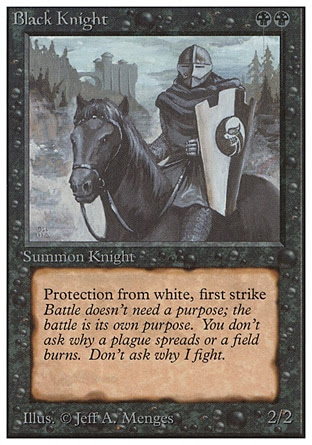
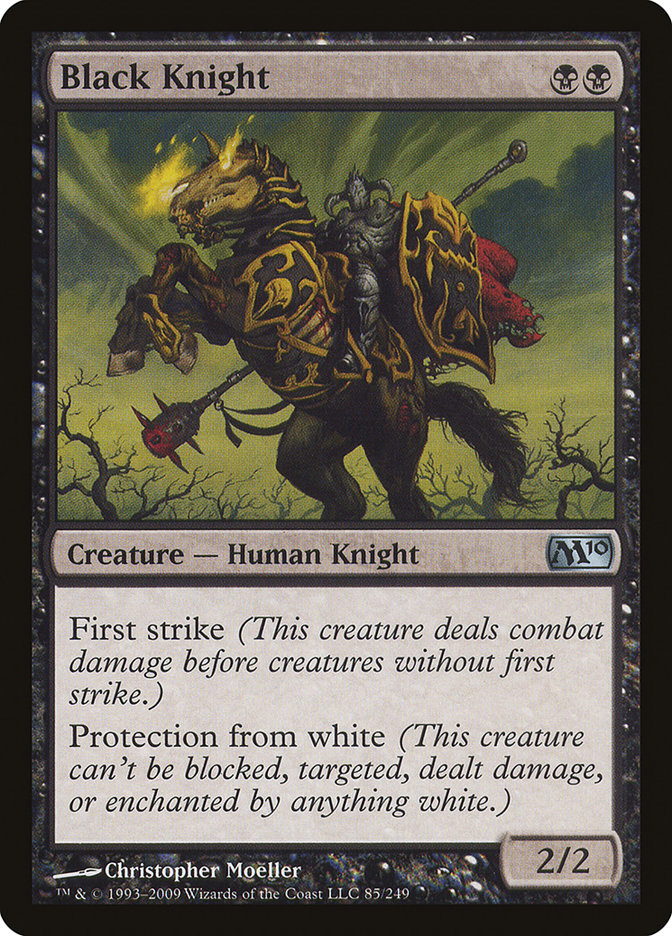
And here is our first type of card, and the focus of a vast majority of this review series -- Creature cards. The idea is that the players in a Magic game are spellcasters summoning creatures to fight on their behalf. On the left is the original version, and on the right is a 'Modern' Magic card layout. I say Modern, but the change happened in like 2003 or something. Cards often get reprinted in subsequent sets as long as the name makes sense, and they tend to get brand-new art when they are reprinted. The Black Knight on the left is from the original Alpha set in 1993, and the one on the right is from Magic 2010 from, well, 2010. 

But yeah, I picked the Black Knight as the first creature we start of as because flavour-wise, it's relatively simple. It's a knightly dude riding a horse, which is extremely easy to understand. The top right corner is the 'cost' that a player would need to spend to summon a Black Knight (two black mana from Swamps, in this case). The text below the picture is "Summon Knight" in the original, which is just mostly weird flavour until later sets placed more emphasis on types and tribal synergies, leading a lot of old creatures to be retconned in subsequent printing. The base set 2010 version on the right, for example, has "Human Knight" as the creature type. 

Below it is what the card does. Some creatures have keywords ("First Strike" and "Protection From White" in this case), and some cards also have flavour text in italics, which on the original printing of the card describes just what a emo badass wandering knight the Black Knight is. Pretty neat! And on the bottom right you see the stats of the creature, 'power' being equivalent to attack and 'toughness' being equivalent to HP. 

I don't have a whole ton to say about Black Knight, which is why I picked it as the card to introduce Creature types to readers who need a primer on MTG. But I have no complaints about it -- as a creature in the Black colour, it fits quite well as a regular badass evil knight. 

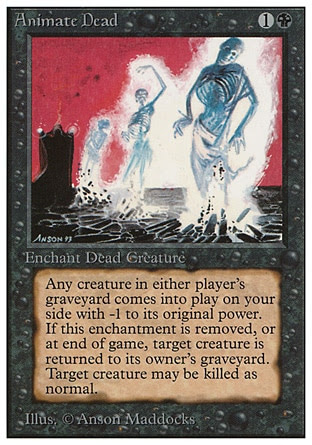
Raise DeadAnimate Dead
While we're at it, let us talk about some other card types before we delve into the many Black-mana creatures in Alpha. The second type of card type is the Sorcery, which we're representing here with Raise Dead. Sorceries are played once, its effect happens, and then the Sorcery is discarded. It's a pretty simple spell that works with Black's "necromancer" vibe, allowing them to dredge up the dead bodies to reuse them again. 

Animate Dead, meanwhile, is a card-type called an 'Enchantment', or specifically an 'Enchantment - Aura'. In this earlier set, however, it is just called 'Enchant X'. The wording isn't exactly streamlined like modern MTG would be, either. The idea of Enchantment spells is that they are attached to something, whether that be the battlefield, the creature (like this enchantment), the player or anything in the field. Animate Dead basically allows the summoner to summon a slightly weakened creature on the battlefield as long as the aura is 'haunting' it, and if the aura should be countered in any way the creature goes back to the graveyard. Pretty cool artwork on Animate Dead, I really like the ground cracking beneath it like glass. 
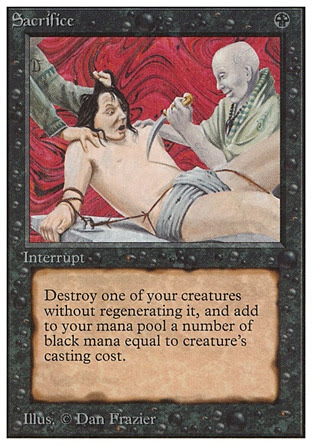
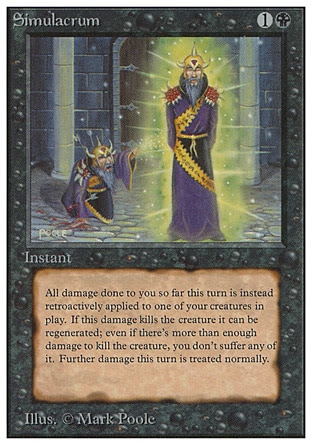
SacrificeSimulacrum
In addition to necromancy, Black also has the flavour of really not giving a shit about its creatures. Spells like Sacrifice essentially has the effect of betraying your own creatures, killing them in a profane act just to gain a little bit of advantage over your enemy. Don't worry, though, the Black player would probably just resurrect them from the dead later on. 

Simulacrum is an interesting one, where this purple-robed wizard seems to create a duplicate of himself that's glowing brilliantly. Reading the effect gives us the flavour of the wizard creating a simulacrum of himself... around one of his creature minions, allowing them to take the damage in stead of the player. Nasty!

You could see that these two cards are even more different types of cards, by the way, 'Interrupts' and 'Instants'. Later Magic sets would streamline both card types into 'Instants', which are essentially sorceries that can be played at any time... including your opponent's turn. This basically allows some interactivity and some mind-games as both players have options to counter each other. 
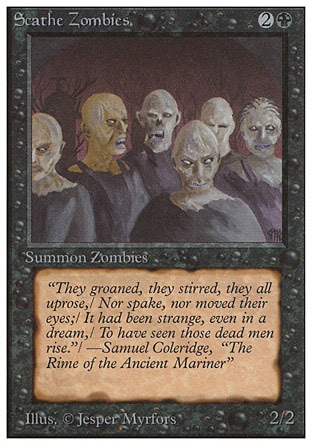
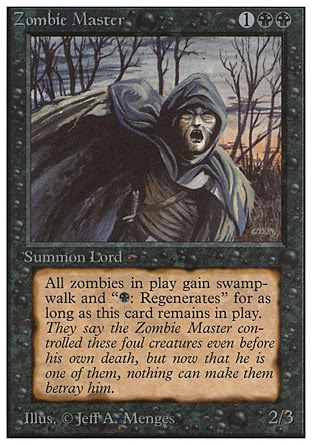
Scathe ZombiesZombie Master
Let's go with creatures now, starting with the Scathe Zombies. (Scathe is an archaic word that means 'injuring', and the root word for the more common 'scathing') They are what we call a 'vanilla' monster in TCG terms -- a creature with no effect, just showing up in the battlefield as a body. A 2/2 that can attack and block, but not much else. Scathe Zombies here are just a bunch of pretty nasty looking zombies. The flavour text for Scathe Zombies is actually taken from a real-world poem, The Rime of the Ancient Mariner. While later expansions would retcon most of MTG to happen in a fantasy plane called Dominaria, clearly the older sets are still not really sure about the identity of the game in general, leading to the designers to just put in what they thought looked cool. 

Zombie Master is a creature that empowers a specific type of creature, in this case Zombies. He's only considered a 'Lord' in the first printings, but subsequent reprintings would make him just a 'Zombie'. Zombie Master essentially makes all other zombies a bit more powerful. Visually he's not super-interesting, and that's going to be a common thread across a lot of these early expansions since the novelty of this card game even existing is the whole point of the game. But I do like the flavour text here, telling us implicitly that the Zombie Master used to be a necromancer who controlled zombies and was betrayed and probably consumed by his zombie minions... before he rose as a zombie himself.

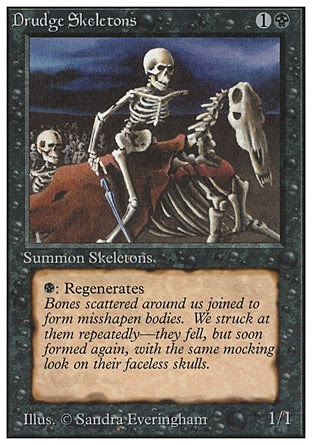
Scavenging GhoulDrudge Skeletons
Scavenging Ghoul doesn't have much in terms of flavour text, and the artwork is just a starving, flesh-and-bones dude. Through its effect, Scavenging Ghoul does sell the fantasy of a cannibalistic ghoul that gains power by 'eating' recently-deceased corpses. At some point, M:TG did a huge 'standardization' of older monsters called the Grand Creature Type Update, and in that update the 'ghoul' type was retconned into 'zombie' for Scavenging Ghoul. It's consistent throughout their website and subsequent reprintings of this card, although it does require some internet work to figure out what changed. 

Another classic 'evil undead' trope is the walking skeletons, and we've got the Drudge Skeleton here! I love that where the zombies are pretty basic depictions of the walking dead, the Drudge Skeleton is led by someone riding a skeleton horse. A skeleton with a cape! I really like this artwork. The flavour text describes someone fighting the Drudge Skeletons watching in despair as the skeleton is bashed repeatedly into pieces, but they keep reforming. 

You can do that in the game, too, with the 'Regenerate' keyword -- by paying the mana cost, the skeleton can survive fatal damage in combat, representing the skeleton putting themselves back together after seemingly being destroyed. For the longest time, most Skeleton cards tend to have this Regenerate keyword!
Sengir VampireLord of the Pit
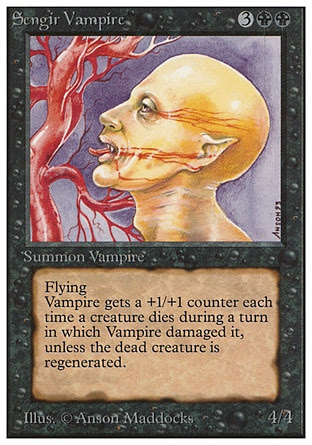
Another classic horror movie monster is the vampire, and you've got to have one of those in the starting set! Sengir Vampire here opts to go for the more animalistic trope, as opposed to the posh, aristocratic Count Dracula. A naked vampire with blood streaking from his eyes and mouth, licking a gigantic artery. Where did that giant artery come from? The later artwork which I'm more familiar with used in reprints marries the 'brutal beast' and 'well-dressed noble' archetypes, but I'm trying not to talk too much about later printings. There's a lot, and I might do an episode of this series that's basically just "new artworks of Alpha creatures".

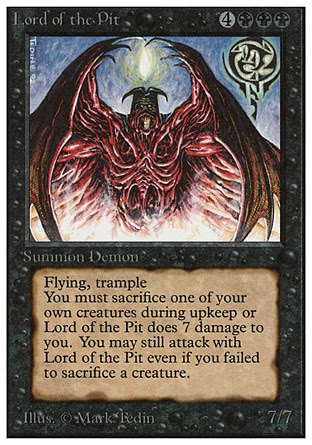
The other iconic Black creature from the original set is Lord of the Pit, representing the Demon race. As a 7/7, he sure is mighty! Keen-eyed TCG enthusiasts would recognize Lord of the Pit as being the big demon that summoned Yu-Gi-Oh's Summoned Skull, whose name is a roundabout reference to 'Summon Demon' in the original version of this card. Lord of the Pit is a pretty fun take on a demon, with most of his body being fleshy and looking like a flayed body. A pair of muscular hands seem to just merge with those bat-wings, and his torso has a lot of anatomically-impossible-in-living-things holes. I do really like the ":o" expression that the Lord of the Pit has, though. 90% of him is a terrifying horror of flesh, but his expression looks a wee bit comedic.  

Both the Sengir Vampire and the Lord of the Pit has the 'Flying' keyword, which is a little bonus given to creatures with wings that meant that they can only be blocked with other creatures with 'Flying', or 'Reach'. This gives a cute little dynamic to winged creatures that gave them air superiority in the battlefield. Lord of the Pit also had 'Trample'. Normally, when creatures do combat and they kill each other, combat just resolved. Really large creatures like this big demon here, however, will trample over the creature assigned to battle him, and deal the remainder of the damage to the opposing player. Oh, and the Lord of the Pit also has the very Black-mana flavour of demanding a sacrifice or it'll punch you, the summoner, in the face. 

Demonic HordesNettling Imp
The other Demon in this set is Demonic Hordes, who has the ability to destroy lands. It also demands that you pay 3 black mana every turn, or they will do the bidding of the enemy to destroy your lands. I like the artwork being a bit more abstract and silhouette-y in early MTG. For better or for worse, artwork will be a lot more standardized later on, but I do find this early variation to be quite a bit charming. We also get the first mention of the setting of the first decade or so, Dominaria -- or 'Dominia', an alternate spelling used here. 

I would also like to point out that thanks to all the religious hullaballoo and censorship in the late '90s and early '00s, the Demon creature type would actually be soft-retired for a while and replaced with 'Horror', which is... it's going to be interesting to eventually discuss the differences in flavour and style of a 'Demon' versus a 'Horror'. 

Imps in most fantasy tends to be depicted or look like little demons, but are treated as a different race here. Nettling Imp is just curled up on top of some wizard's spellbook and is grinning quite devilishly as it clearly schemes something. And that something is a mechanic that the game would later on call 'goading', forcing one of your opponent's creatures to attack. I do like the artwork -- design-wise it's the most basic imp demon you could think up of, but that expression really does sell the flavour of the creature.
Royal AssassinBog Wraith
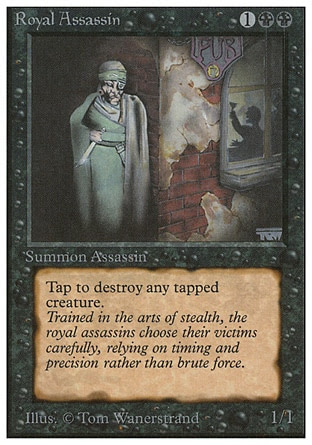
We take a break from all those cool undead and demons to bring you... Royal Assassin, who's just a dude. He's lurking outside someone's window, about to kill that wine-drinking fellow behind the window. It's meant to represent a specific profession that often shows up in fantasy or fantasy-adjacent fiction. In the future, of course, a lot of these 'human' enemies won't really give me a ton to say about.

The Bog Wraith is a bit of bog-standard (heh) wraith monster, a creepy cloaked figure hanging out ominously in a place that doesn't look like a bog. I like the artwork making him looking like a statue, though. There is a lot of these "hooded ghostly figure" monsters in early Magic, and I also don't tend to have a whole ton to say about them. Bog Wraith has 'Swampwalk', which is a bit of a rarer keyword nowadays, but the idea is that the Bog Wraith has such power over bogs swamps and can move freely through them. So if your opponent controls a swamp, Bog Wraith can't be blocked. 

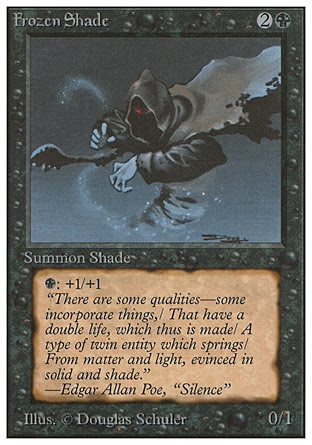
Nether ShadowFrozen Shade
Told you there's going to be a lot of spooky ghosts! Nether Shadow is a ghostly, sentient shadow-creature (later retconned to a 'Spirit') with relatively more stylized artwork -- a simple cloak body, and a very simplified jack-o-lantern skull, but that makes the detailing of the quasi-reflection of anatomically accurate bone structure work so much better here. Nether Shadow is a creature that can pop out back from the graveyard once most creatures have died, and it has an ability that would be keyworded to 'Haste' -- almost all creatures need to take a turn after being summoned before they can attack, but Nether Shadow can just do it the moment it pops in the battlefield. 

The Frozen Shade, who keeps her (yes, later artwork establishes the Frozen Shade as a her; I really should do a 'comparison' for the Alpha creatures and modern printing) creature type of Shade in subsequent reprintings. I like how her lower body trails off into a small whirling tornado of snow. She also has a Edgar Allan Poe poem as her flavour text. Despite all the talk about 'freezing', Frozen Shade's effect has nothing to do with freezing. 

Will-O'-The-WispHypnotic Specter
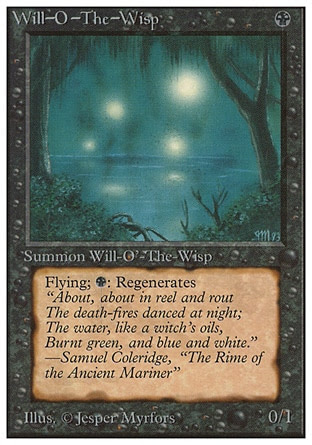
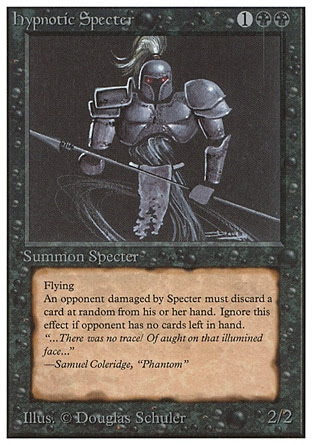
Among all the zombies, ghosts and demons, are these Will-o-the-Wisp. They feature another quote from "The Rime of the Ancient Mariner". Interesting to see that Will-o-Wisps are considered evil, though I suppose they are considered a form of undead, and real will-o-the-wisps are a phenomenon that happens in swamps. 

Our last 'ghostly enemy' here is the Hypnotic Specter. It always is hard for fantasy settings to really differentiate between ghosts, specters, spirits, shadows, shades, banshees, revenants, wisps, etc, etc. Magic is particularly bad with some of them, particularly throughout different settings and artists, but at least the card effects is a nice flavourful way to tie things together. Hypnotic Specter here is a suit of armour with the gaps filled with wispy treads, and the end result looks a bit more goofy than hypnotic. But Specters in MTG would be associated with a mind-numbing effect that forces enemies to discard cards upon contact.
Plague RatsNightmare
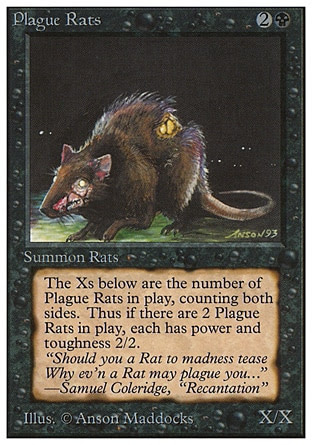
Plague Rats starts off a fun recurring theme that we'll see in future sets, many times among 'Rat' cards. Plague Rats has '*/*' as stats, and the *'s will increase depending on the amount of cards called 'Plague Rats' in battle. This is meant to simulate an ever-growing (or ever-shrinking) swarm, and this is back before the '4 cards limit' to any type of card in a deck was established. Very fun and flavourful effect! I also really like the artwork here showcasing these plague-infected rats, with a face that's half sloughed off, showing a bloody skull beneath; and even part of its back is torn off and revealing a somewhat cyst-looking yellow organ beneath. 

Nightmare is also a creature whose stats are */*, which changes depending on the Swamps you control. I never realized, I think, until I was doing these monster reviews, that Nightmare as mares. As in a female horse! Ha! I don't think I've ever gotten the pun on the 'Nightmare' monster before! This Nightmare, in addition to being a jet-black demon horse, is also partially on fire. You run, demon Rapidash. You run! 
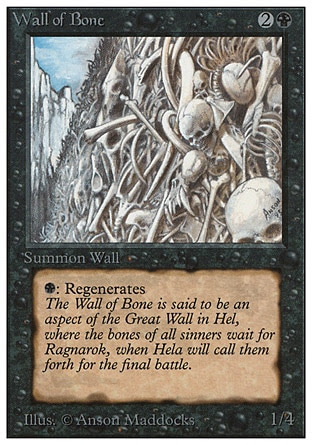
Wall of BoneDeathgrip
Our last Black creature in Alpha is the Wall of Bones. They have essentially been all but phased out of modern Magic, but the Walls are a subtype of monsters that are essentially giant walls with much higher toughness and very little, if any, power. They're intended to defend you and stop attackers from coming through, and the Wall of Bones, just like the Drudge Skeletons above, can regenerate with a small injection of mana. The Wall of Bones has pretty great art, and I just really like the fantasy flavour of a necromancer just creating a giant castle wall of femurs and skulls and ribcages that constantly regenerates as armies of orcs and dwarves try to break through it.

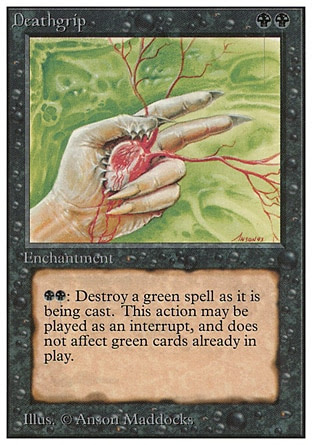
And now we'll move to non-creature cards! The original 'Magic: The Gathering' as it was conceived really wanted players to become any kind of magician or sorcerer they want. And in addition to summoning monsters, they could do some really cool stuff like Deathgrip here. I really like the artwork here, with fingers squishing a heart. I like that the palm and thumb seems to have grown some extra spikes to pierce the heart more. Is this the Sengir Vampire's hand? The artist for both pieces of artwork is the same guy! It's a haunting picture, and even if it's probably more symbolic than literal, I really like the art here. 

Demonic TutorDemonic Tutor
On the other side of the spectrum from Lord of the Pit, we have Demonic Tutor, who's the goofiest, doofiest looking demon man you've ever seen. Look at him! He's just pissed off that he has to tutor... somebody, and he's like holding a textbook that probably says "Arithmetic 101" in infernal. Demonic Tutor isn't actually a creature, but a sorcery (magic/spell/action cards for those who are more familiar with other TCG's), and... and, come on, this dude is so fun! He's a fucking demon dude that apparently gives lessons or some shit. The sheer concept of this dude is just utterly fun in a set that otherwise takes itself pretty seriously.

Of course, this is apparently where the TCG lingo "Tutoring" comes from, which is a handy word for "drawing a specific card from your deck", which is easily one of the most powerful effects in any given card game. Could you imagine if Demonic Tutor has been given a more serious name like "Demonic Artificer" or "Demonic Sorcerer" or something along those lines? Nope, we get Tutor instead, which is just... just pretty hilarious. I truly am glad they chose to do this. 

Of course, the Demonic Tutor didn't stay a dork for too long, and later printings (like this Ultimate Masters reprint in 2018) reinterprets the Demonic Tutor as this lurking shadow-demon with massive wings that give the impression of large tapering claws, apparently tutoring that one sailor dude on a boat on where to go. "That is the way to get your combo piece, ooooo!" One thing that I've learned from going through these older cards is that at some point, it would really be fun to see what happened to the reprints of these older creatures and how they have changed over the years. 

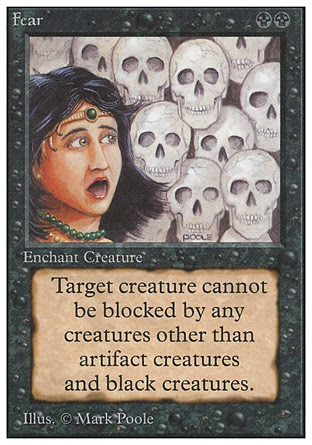
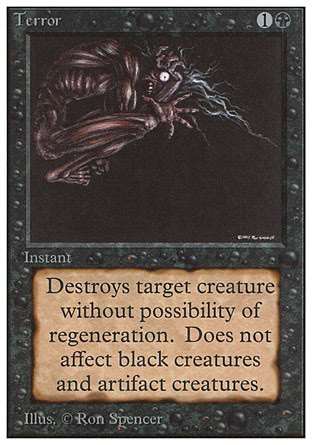
FearTerror
Yeah, the enchantment is called Fear! But, honestly, what other reaction would you have other than "OH GOD, A WALL OF FLOATING SKULLS! AND THEY ARE SMILING!" 

With all the more whimsical pieces of art in early MTG, Terror is a pretty great art. Ron Spencer's illustration here is someone so wretched, so vulnerable, twisted upon himself. A lot of these earlier art skim on the background for budgetary purposes, but with Terror here it's really effective in the usage of negative space, which makes it ambiguous what this person is afraid of. Are they afraid of the darkness? Something lurking in the darkness? Or is he scared of nothing at all? It's honestly a great representation of terror in general. 

DarkpactDemonic Attorney
Magic is a game that's gone for almost three decades, and many mechanics have risen and been forgotten thanks to the fluctuating power levels of the cards printed by the developers. Some, however, have been actively banned -- in particular a set of cards that revolve around an 'ante' rule, where you bet several cards in your collection with your opponent. it's generally unfun, and gives a whole sense of pressure to a game that should've in theory be a nice, competitive bit of game between friends. Also, y'know, gambling. 

It's also worse with cards like Darkpact, where, despite its pretty artwork, has the pretty assholish effect of swapping the card you're ante-ing with something you might not even want to bet at the same time. The effects of Demonic Attorney essentially also forces your opponent to concede, or else another card gets ante'd up. It does reflect the general early days of MTG and how they really are treading uncharted waters here with how they are handling a lot of these mechanics and what would stick and what wouldn't. 

Demonic Attorney is really fun as a concept, though. Probably graduating from the same Demonic University as the Demonic Tutor, Demonic Attorney is making a case to a Demonic Judge. The end result is so surreal for a game that, for the most part in this stage of its lifetime, wanted to be a fair bit more super-serious in terms of tone. It's the Victorian-era formal court wigs that do it for me. Ante's a weird thing that MTG swept under the rug as soon as they could, but I adore the artwork for this one. It's so silly. 

PestilenceLich
The original versions of these reviews didn't really talk too much about the actual things the cards did, but I'll try to include some of the cooler ones. Like Pestilence here. The artwork in Pestilence is cool enough, being a rather nasty, pockmarked person with every inch of his skin filled with sores. He's dribbling some spittle and his clothes are marked with blood. A nice showcase of a nonspecific plague infecting someone. But the effect just has Pestilence potentially spread throughout the battlefield every turn if mana is paid to keep up the plague... but as an enchantment, it itself gets destroyed when there are no creatures left to spread the disease. That's a cool extra bit that tries to replicate the fantasy of a magical plague!

And we'll end this coverage of Black cards with another cool enchantment, Lich. Lich isn't actually a way to summon a mere lich monster into the battlefield, no. The wording of these old cards are kind of badly formatted, but basically the spell Lich turns all the permanents you have in play into your life total, making you immortal since your life points can't be damaged by conventional means. The idea is to duplicate how fantasy liches tend to have their souls tied to an unholy tether called the phylactery, which is all the cards you have on the battlefield, including the 'Lich' card itself. And once these are destroyed, or the spell itself is broken, the lich-ified player dies. That's cool!

And with that cool card, we're done with Black in the first set. There are some twenty-odd cards that I don't have much to talk about that I'll leave for after the break, and I'll briefly say some words about them. This is going to be the format of all MTG reviews in the future, which would really help when we get to some sets where I don't find a lot of interesting creatures to talk about!
___________________________________________________________

BLUE 

We're going to Blue now, and I think it's a bit clear that early on in development, we didn't really have the 'colour pie' be fully defined just yet -- at least in terms of flavour. I would also like to point out the love-hate relationship I have with the classic Blue border, where I like the texture a lot... but it makes the text a bit hard to read sometimes. 
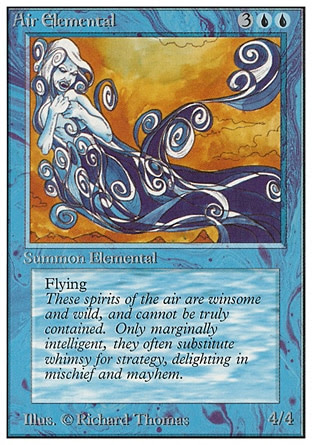
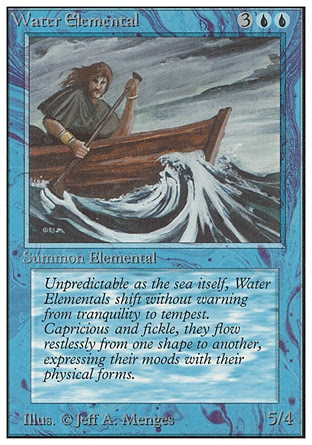
Air ElementalWater Elemental
We'll start off, as I often do, with creatures. And we'll start off with Elementals, which would later on lean much more towards Green and Red, but Blue gets its share of elementals! Anyone who's done anything in RPGs knows elementals -- manifestations of natural elements that take the form of mostly vaguely-human forms. Air Elemental is a pretty basic take on this, being a womanly figure made up of... well, it's supposed to be air, but the artwork does admittedly make it look more like watery waves. Air Elemental also has the 'Flying' keyword I described above, which originally was a keyword that's quite associated with Blue. 

Water Elemental, in contrast, looks so much cooler.  Instead of just portraying the congealing of water into a semi-humanoid form, the Water Elemental manifests into an old man's face made up of the roiling waves, surprising that sailor. It's a lot more... mythical, I think, to have these features be baked into actual parts of nature instead of "this guy is made up of wind/flame/mud".

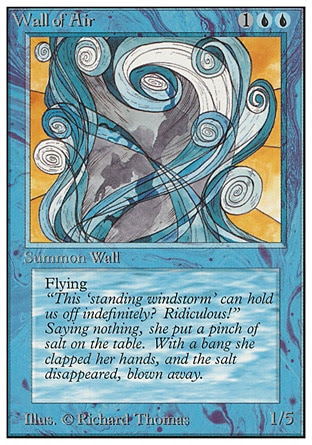
Wall of WaterWall of Air
Every single colour gets walls in Alpha, and will continue getting more walls throughout the early expansions. Again, this plays nicely into the mentality of a defensive magical spell, and just like the elements above, Blue played a fair bit with the element of water and air -- which, coincidentally, are blue-coloured in art. The fantasy is neat, and the art is nice enough for how stylized they are. Wall of Water has the ability to become a bit stronger temporarily with a surge of mana (and potentially drown a weaker attacker) and Wall of Air can fly and block flying creatures. 

Part of the original rules noted that creatures with the 'Wall' type can't attack, which is a bit unintuitive with both Blue walls having power (or some ability to gain power), and retroactively MTG would add the keyword 'Defender' (i.e. 'can't attack') on all walls to emphasize this. 

Phantom MonsterPhantasmal Forces
Wah-hoo, what is this meant to be? Phantom Monster is a creature with Flying, and has a Poe poem as its flavour text. "Phantasm", as I discussed in Black, is ambiguous enough that it could mean anything. Later retcons in the great creature update would reclassify Phantom Monster as an "Illusion", which tends to mean that the Blue Mage is creating an artificial flying thing. I'm not sure if there is more to the Phantom Monster other than the eyeball-covered irregular maw that we're seeing here. Is it just this horrid Cthulhu-y maw that's the whole thing, or is there some larger body beyond it? Pretty creepy!

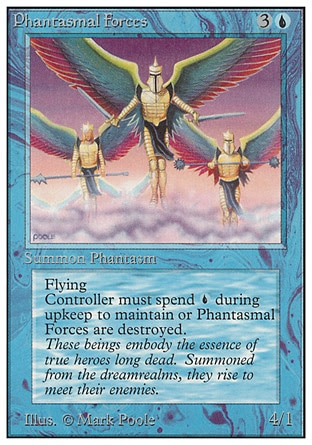
The other 'Phantasm' (and later on 'Illusion') in this original set are the Phantasmal Forces, who is a squadron of knights with parrot wings. The flavour text explain a bit more about these specific beings, who are essences of dead heroes 'summoned from the dreamrealms'. The effect, later on keyworded as 'Cumulative Upkeep', forces the caster to pay a certain cost every turn to maintain the Phantasmal Forces in the battlefield or else it's destroyed. It's a nice fantasy of the caster presumably having to exert some force to remember the form of these beings, like a channeling magic in video games. Unfortunately, cumulative upkeep as a game mechanic is probably one of the most unpopular ones, even when attached to stronger cards down the line. 

Prodigal SorcererMahamoti Djinn
Let's go for the more boring cards. Prodigal Sorcerer is our obligatory 'generic human' that sets the tone of the colour. In this case, Blue is your more traditional magicians who studies in arcane institutions, are researchers and have formal titles like 'sorcerer' and 'wizard'. This guy reminds me of Ra's al Ghul from Batman. He's... quite boring. He's not even doing anything particularly sorcerous. Cast a spell or something, Prodigal Sorcerer! 

Probably the best candidate for an 'iconic' Blue creature from Alpha is Mahamoti Djinn. Again, he's a bit of a simpler creature that combines the fantasy of 'djinn coming out of the lamp' from the myths of the 1001 Arabian Nights stories (which, incidentally, will be relevant in the next expansion) and the 'djinns are air elementals' from Dungeons & Dragons. Not a whole ton to really say here, it's a rather basic interpretation of a genie.
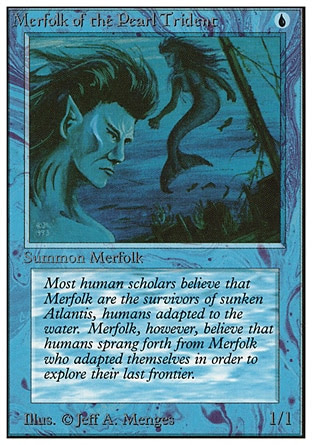
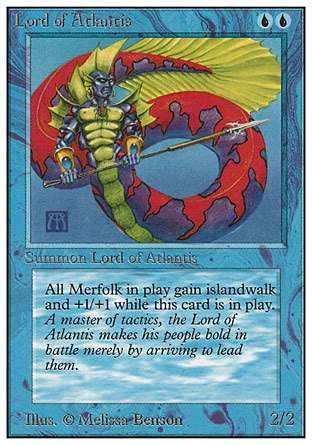
Merfolk of the Pearl TridentLord of Atlantis
The other iconic Blue creature would be the Merfolk, who would expand to one of MTG's earliest tribal strategies in these early set. The original Merfolk card is the very humble vanilla card, the Merfolk of Pearl Trident. It's not the most interesting of mer-person design, just a couple of pointy-eared guys with a fishy lower body. I am actually surprised, if we're talking about game design, that they didn't make a similar 'terrain-based' ability equivalent of Flying for aquatic creatures, like 'Swimming' or something. 

The Lord of Atlantis gets his own race in this first printing, but would later be retconned to just be a regular merfolk. Again, as you can see by the name 'Atlantis' being thrown around on both of their flavour texts, the actual fantasy setting of Magic hasn't been solidified yet, and wouldn't be for quite some time. This does imply that an underwater merfolk city called Atlantis does exist in Dominaria, though. Again, it is early artwork, but I do appreciate the amount of effort they make in the Lord of Atlantis's design, with a much more regal purple-and-red colouration and a much more impressive eel-tail and a lot of fins and ridges on his upper body compared to his Pearl Trident peasant friends. The flavour text also describes the 'lord' mechanic quite nicely -- when one of these leaders arrive, they bolster their troops and this increase in morale translates to +1/+1 stat boosts and Islandwalk! 
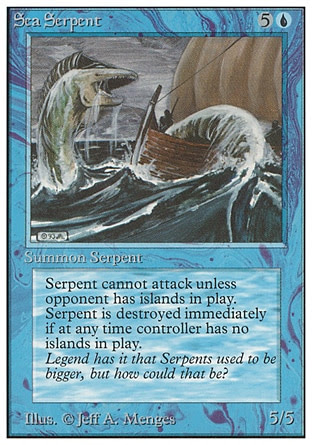
Sea SerpentPirate Ship
Sea Serpents are another pretty cool creature to put in Blue, and... well, it really does show that while a vast majority of the original cards received by Blue used to be 'smart, tricksy stuff', they also added a whole bunch of creatures just because they are aquatic, and the sea is blue. The Sea Serpent is quite a simple depiction of one, being a giant coiling eel-serpent crushing a ship. It has a mechanic later on called "Islandhome", which tends to be put on creatures that can only exist if the summoner controls Islands (where the giant serpent can swim), and can only attack the enemy if they control Islands (so they can swim there). It is a cute mechanic, but the Serpent's stats are nowhere powerful enough to justify a crippling mechanism, and it does highlight how the flavour of the fantasy sometimes needs to be balanced with actual playability. 

Likewise, the Pirate Ship has a version of Islandhome, although unlike the Serpent it has the ability to launch 1 damage blasts even when the enemy doesn't have an Island for the Pirate Ship to sail through. Those are the cannons, yeah? Shooting cannonballs on a coastal village or something? 

Years later, they would actually add vehicles as a separate card type with its own interactions, leading the 'ship' race to be retconned away and this old card is now considered a 'Human Pirate', cheekily representing the crew instead of the ship.

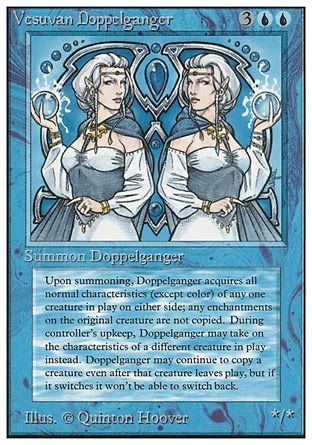
CloneVesuvan Doppelganger
As mentioned above, Blue is all about smart stuff. And smart stuff includes illusions. Both Clone and Vesuvan Doppelganger take this to a fun degree, being */* creatures that switch and transform into other creatures on the battlefield, just like the Pokemon Ditto. The artwork for both cards are pretty fun, with the two soldiers in 'Clone' looking bamboozled, though the two elves depicted in Vesuvian Doppelgangers seem pretty chill with each other. 

Both of these guys would be retconned to have the 'Shapeshifter' tribe. The Clone can just enter the battlefield as a straight-up clone of any creature on the battlefield. Vesuvan Doppelganger, being a bit more expensive, continues to have the ability to transform into another target creature -- whereas the Clone is just stuck with whatever it turns into the first time. 

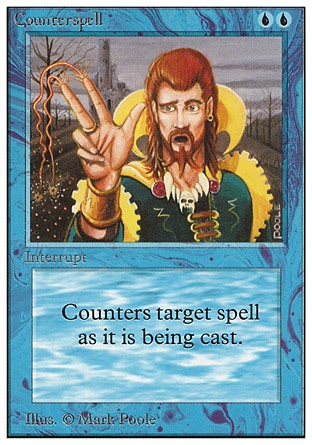
CounterspellAncestral Recall
We'll go into the spells of Blue now, and I'm going to pick some of their more iconic ones. Counterspell and its many variations are still being played. Love the artwork of this magician subjected to Counterspell having his magical lightning bolts just... uh... yeah, that effect happens to men over a certain age, I'm afraid. The fantasy of Blue is that they're the smartest magician, and so they can find loopholes in all magical spells and they are able to chant the exact counter-magic to stop Black from resurrecting the dead or for Red to cast their lightning bolts. 

With the deck meant to represent the Mage's spellbook or memory, a spell like Ancestral Recall has the fantasy of the Blue Mage being able to use the power of good memory to remember ancient magic spells. Like this King Nebuchadnezzar guy being able to remember some things by proximity to those ziggurats!

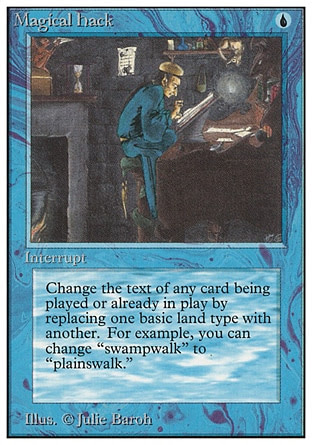
Sleight of MindMagical Hack
Another flavour of Blue is to play 'mind games' on the opponent, which tends to be reflected in-game to screwing around with stealing cards from their deck or their card effects. However, flavour-wise and in art, they get represented by brains, like Sleight of Mind here. It's just a brain! But you're rooting around in any card on the battlefield and changing the effect of certain colours affected by spells in play. Neat!

Magical Hack does something similar but with land types, but I also like the fantasy here that unlike the other colours, Blue gains all of its power from rigorous studying. He's not a hack, but he's learning how to hack. Even if it takes him lots and lots of caffeine and lonely nights in his laboratory. 
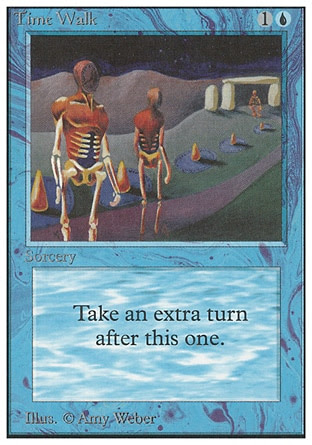
TimetwisterTime Walk
Some of the more badass spells given to Blue are time manipulation. Timetwister has the great artwork of the Blue Mage standing in front of an hourglass, and casting a spell that immediately rusts that warrior's metallic equipment. It really looks quite neat! In gameplay, it reverses time more than accelerates it, twisting the hand, graveyard and deck into a brand-new deck and resetting those fields for both you and the opponent. 

Time Walk just very casually lets you take another turn. For two mana. It is, very obviously, banned in almost all formats because of the sheer power of taking a bonus turn. Nowadays, Blue still has some ways to cheat out an extra turn but they would involve absurdly complex combos. I love just how little they valued an extra turn at this point in the game's development. 

And beyond that, I just utterly love how absurdly surreal the artwork in Time Walk is. What are those? Skeletons with... no faces? Some musculature on their upper body? Traffic cones? They're walking to some kind of stone structure under the starry sky? It's so abstract, so bizarre. I love it. It barely has anything to do with time. 

StasisTwiddle
Speaking of some fun artwork, have Stasis! Stasis is an almost cartoonish looking piece of art with a guy and a blindfolded beast-person standing on a see-saw. There's a palette floating in-between them. I'm not sure what's going on here, but Stasis kind of follows the time manipulation theme of the previous cards in that it 'freezes' time and prevents the untapping of cards (which includes your resources, the Land cards)... but only for as long as Stasis's caster can keep paying its cost.

The artwork's still really strange, and apparently there is some anecdotal explanation that Stasis's art was commissioned last minute from someone's relative that they slapped onto the card last-minute. 

"Twiddle" is another one that isn't particularly descriptive of what it does. It juts sounds so abstract! You usually twiddle your thumbs or something, but I'm not sure what's going on in that artwork. Is that piece of island jutting out of the water... twiddling with those... tendrils that lead to a stony fist? Is that what's going on? Or did a wizard walk past this island and 'twiddle' it, resulting in this strange phenomenon? I'm not sure what this card is about, honestly, but I kind of like it. 

The original version of this article had me talk about a lot more cards in Blue, but they're... quite repetitive. Again, the main point of these articles are flavour, and while that involves some mechanistic and thematic flavour, I don't think having multiple lines in the main body of the article describing the various elemental blasts are particularly interesting to read about. I did expand on a bit more of what I thought after the break, though!
___________________________________________________________

Green

And we're going to finally go into Green, the third colour we are covering in this article. Red, White and the handful of colourless and land cards in Alpha will go to a second article. Green fills in the 'druid' or 'shaman' class of traditional RPG games, as well as a place where a lot of nature-related spells reside.
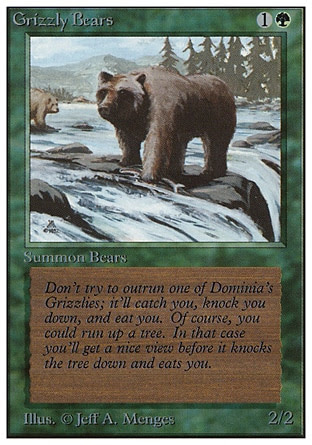
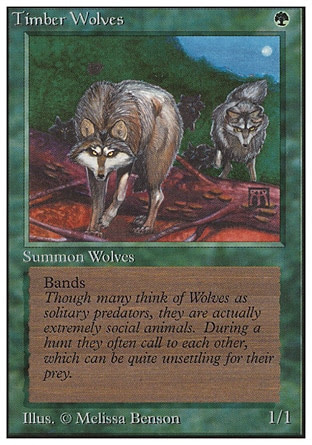
Grizzly BearsTimber Wolves
And there are some always very prominent creatures in all of fantasy settings. Throughout all of my monster-reviewing in this blog, it's always boars, wolves and bears. We've got two of them here! Grizzly Bears is a vanilla 2/2, but it's a very iconic card that has became a bit of a measuring stick among the MTG community, and is one of the few creatures that has had multiple variations of its statline printed over the years. 

Timber Wolves is a pair of wolves, and it's got the 'Banding' mechanic, which is a primarily White keyword that allows a bunch of smaller soldiers to attack and combine their stats to, in theory, take down a big monster. It's flavourful for a pack of wolves, too! It's just kind of a shame that the way Banding worked was utterly confusing, unintuitive and often not that interesting and is one of the few original mechanics to be essentially abandoned by the designers. 

War MammothGiant Spider
The War Mammoth is a big elephant with "Trample". I've discussed Trample a bit before, but it's something found on larger creatures. The idea is that after dealing combat damage to an opponent creature it killed, something as powerful as a mammoth tramples over the defender and deals the rest of its power to you, the player. It... it's a lot more flavourful when the mammoths are bigger than 3/3, though.

And we now have probably one of my favourite cards in the original Green, Giant Spider. It is one of the most-reprinted cards in the various base sets in the future. The Giant Spider grandfathered the keyword that would later be known as 'Reach'. This is a truly big spider, as you can see in comparison to the buildings it's next to. And it's spinning a massive web to catch all of those pesky flying eagles and angels and thopters and what-have-you. Creatures with Reach essentially can block flying creatures, but are themselves not able to fly. 

I just love this. I love that even the flavour text lampshades that they could focus on a more common ability associated with fantasy spiders, which is the venom... but no. Intercepting flying creatures with their web, that's what they associate giant spiders with. Glorious. 

Elvish ArchersLlanowar Elves
Elves are very prominent in Green. I would be very dismissive of them if they didn't show up so much, and if they weren't so damn good. Elvish Archers is a rather boring take on one, just being a regular pretty-boy elf with bows. He's got 'First Strike', a keyword that allows it to deal damage first before the enemy, potentially killing an enemy while surviving himself. Neat, but kinda boring. 

Llanowar Elves, meanwhile, will set the tone for most of the memorable elves in MTG history, with the ability to tap for green mana. Mana-ramping is insanely powerful, and having a creature -- with all the benefits of the creature -- also double as a way to generate resources is really good! The flavour text explains that this ties to a whole 'respect the nature' vibe from the elves of Llanowar, allowing the lands to continue flourishing even as they survive from nature's boons. I actually really like the 90's-Xtreem look that the Llanowar Elf here has, with fangs, tattoos, and a headgear that screams more Dune or Warhammer than what you expect the very first elf in a fantasy expansion would have. That's amazing! I didn't appreciate it enough at the time, but as the glut of 'regular' elves start showing up, I appreciate the slight edge that the Llanowar Elf has.

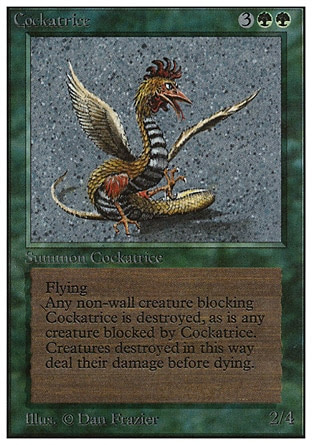
Thicket BasiliskCockatrice
Two 'mythological' creatures now. The first is the Thicket Basilisk, which is a multi-legged iguana creature. A fun interpretation of 'basilisk' for sure, and one that feels a bit more grounded in real-world animals... though of course, MTG would have a lot of different kinds of basilisks. Thicket Basilisk has an ability that a lot of MTG players would recognize to now be 'Deathtouch', or at least an early variation thereof. To represent the Basilisk having the petrification stare of mythological lore, any creature that fights the Basilisk directly gets instantly killed. 

Strictly better than the basilisk is the Cockatrice, who has the quasi-Deathtouch ability but is also able to fly. That is a very charming iteration of a cockatrice, by the way -- a lot of Cockatrice interpretations, if they even remember that the creature's supposed to be a chicken, go all-in on making a creepy scary bird. And that's fine! Creepy cockatrices are fine! But this one is also great. It plays up the goofiness of a cartoon chicken for all it's worth, and I love that the body is still the body of a serpent with a bunch of chicken anatomy stuck onto it.
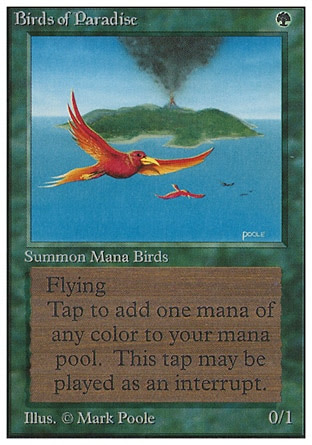
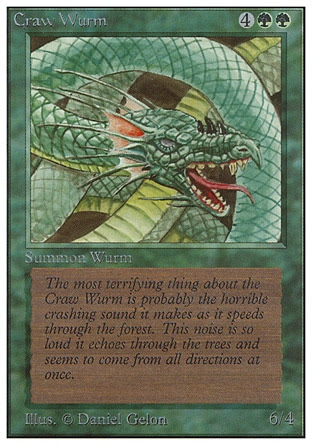
Birds of ParadiseCraw Wurm
We go from a fantastical bird to a regular one, in the Birds of Paradise. Urban legend has it that this was actually an artwork commissioned for a land card, but the designers liked Mark Poole's brightly-coloured birds so much that they created this creature card. And thus was born the gloriously-memorable Birds of Paradise, who, like the Llanowar Elves above, is a creature that can be tapped for mana. I am nowhere close to knowing the ins and outs of MTG meta, but I do know that Birds of Paradise is one of the most enduring cards that hasn't been banned (like Time Walk above) but is still powerful enough to see gameplay even now. You rock, bird friends. 

The 'big stick' for Green in this game is the Craw Wurm. Wurms would be a staple creature in Green eventually, representing big, serpentine worms or snakes or dragons that coil around forests and underground terrain. 'Wurm' is technically a variant spelling of 'wyrm', which modern fantasy players would associate heavily with dragons and dragonkin. While Craw Wurm is quite draconic, I like that later on MTG would be able to carve a bit of thematic fun with them. Also, note the three regular humans on the tip of the Wurm's snout. I have a feeling they won't survive for too long. 

FungusaurIronroot Treefolk
Haha, Fungusaur! I love this guy. It's a bizarre, puffy-looking dinosaur that's presumably made up entirely by fungi. It's got such a weird head that's like a veiny, squished hammerhead shark's head, but with a maw from a creature out of Berserk or something. Where most of Green's monsters in this starter set has been quite mundane in terms of just adapting regular animals or fantasy tropes, Fungusar is a nice breath of fresh air. It grows stronger as it survives damage, and the flavour text even notes that Fungusaur parents would even injure their own young to ensure their growth. Brutal! Love this modernized take on the Fungusaur as well, which keeps a lot of the funky proportions of the original artwork. 

And of course, you can't have Green in fantasy without adapting Ents. Or as the trademark-friendly version in MTG, Treefolk. Ironroot Treefolk is kind of a dorky introduction to the race, though. It literally is just a bored cartoon face painted onto a tree, and the most basic branch-arms. The Ironroot Treefolk's expression is honestly hilarious on all fronts, especially when you read that mini-paragraph of flavour text that describes... the truly absurd mating habits of these things. That is not a mental image I want, Ironroot Treefolk!

Ley DruidVerduran Enchantress
Let's go with the obligatory regular people here. Ley Druid is just a Gandalf-lookalike who's looking at some leaves. Not the most interesting, but appropriate for Green. 

Likewise, the Verduran Enchantress is just some lady who goes full-on Poison Ivy, with her fingernails extending to form a series of thorny vines. Pretty neat artwork, all around, I like the focus on the rose.

Shanodin DryadsScryb Sprites
Another common trope is faeries and the fair folk that live in the forests. We're going to have a couple of expansions that revolves all around them, but in the meantime we have Shanodin Dryads. Dryads as wood spirits are pretty common in fantasy, and Shanodin Dryad here is a much nicer (if more anthropomorphized) 'human plant' than goofy ol' Ironroot Treefolk up above. I like the flavour text describing juts how stealthily the Shanodin Dryads move, which you can totally believe with the artwork, yeah? The pose that the dryad is having, and how her arms is mimicking a tree, really makes you believe that the Shanodin Dryad can sneak around like a stealth game, freezing up into a tree when spotted. It even fits her 'Forestwalk' ability!

The Scryb Sprites are a bit of a typical take on fairies, making them little humanoids with bug wings. The scale on this art to the berries around them is also nice. But as the flavour text implies, the Scryb Sprites aren't here to frolic, but to furiously defend their realm. And I like that this translates to a more badass-looking fairy design, with pale purple skin, red war-tattoos and insect antennae. 

Force of NatureGaea's Liege
We've got another big creature here, the Force of Nature, who's a mighty 8/8 with Trample -- a much more deserving statline than the mammoth! The Force of Nature is essentially Swamp Thing from DC comics (or Man-Thing if you prefer Marvel), being a giant muscular humanoid made up of swampy muck. Later retcons would classify Force of Nature as an 'Elemental', which... makes perfect sense. I like that the Force of Nature isn't something that could be controlled wily-nily, and you need to keep feeding him forest mana or it turns around and punches you in the face before facing the enemy. That's normally a Black creature thing, but I feel like the flavour here makes sense. 

Gaea's Liege reminds me of the elf druid Malfurion from World of Warcraft. He's a bearded guy with antlers, and while this card doesn't give much of a context to what he is, he's essentially a creature that grows stronger and stronger the more forests you have played, and it itself can transform other lands into forests with its ability. The Great Creature Type Update would give Gaea's Liege the classification of an 'Avatar', making Gaea's Liege a manifestation of some greater being called Gaea. 

Wall of WoodWall of Brambles
We're almost done with Green creatures, with only the three walls to talk about. We've got Wall of Wood and Wall of Brambles here, and... pretty self-explanatory, aren't they? After explaining the wall cycle and the Defender mechanic, there's not much for me to really say other than to acknowledge that it fits the whole 'nature's wrath' flavour that Green has. I like the flavour that Brambles has some power value since it's got a bunch of spiky thorns. 

Wall of IceTsunami
It's a bit less obvious with most of its cards, but Green -- at least initially -- also represents more natural phenomenon than just forests. Wall of Ice is our third Green wall, and alongside the sorcery Tsunami here, show that Green does have some flavour of other types of nature's wrath beyond just plants and animals. I think most expansions would lean more towards the biological aspects of nature's wrath, but Green does have a lot of weather and climate manipulation in the initial sets.

LureLiving Artifact
I am not sure what's going on with Lure here, and I'm really trying to figure out what's going on here. Is it like a worm-dragon thing pretending and camouflaging itself to be an apple, to... lure something bigger? But then does the apple-dragon have a way to kill the bigger opponent? I like the artwork, whatever it's supposed to be. It reminds me of the Pokemon Applin.

Speaking of cool art, how's Living Artifact there, huh? That's a card art I'd expect to see in Black, and even then in one of those Phyrexian sets with horrors and stuff. What an art! What a hideous monster! The idea, I think, is to animate your artifacts with temporary life that you can consume to heal yourself, but juts look at this thing. It's got two eyes arranged vertically, a tongue, multiple misshapen tentacles, bug legs, wings, tails... it's an abomination is what it is. And why is it suspended in a cage in the sky? Explain!
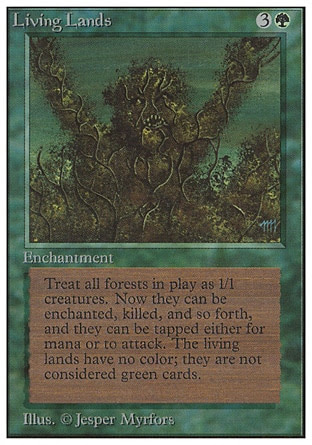
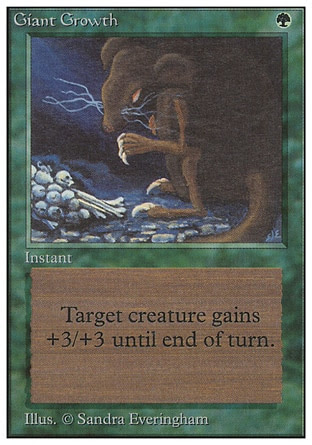
Living LandsGiant Growth
Another flavourful Green spell thing is to manipulate the lands themselves, since they commune so well with nature. A bunch of the spells after the break reinforce this, but the coolest of them all has to be Living Lands, which animates all forests in play as 1/1 creatures -- something that would be very muhc played upon in the Zendikar blocks. I really like the wretched face of that mass of plant matter that's suddenly alive, too! Pretty appropriately nasty-looking stuff. 

Giant Growth has a rat that's been transformed into a massive size and has been apparently snacking on a bunch of humans. Look at that pile of bones next to it! I like how wretched and slightly malformed the rat is, with an overly-skinny arm and jagged, angular whiskers. Green is also the colour of buffing spells, and a lot of them involves expanding animals to ridiculous sizes. 
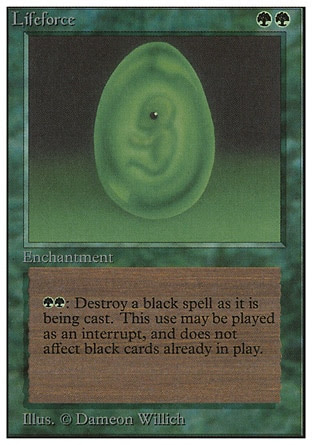
LifeforceNatural Selection
I am not sure why Lifeforce shows an embryo with open eyes in a green orb. It's such a haunting but slightly creepy piece of art. I'm not sure why the embryo enchantment can destroy Black spells as they are cast, but there you go. 

And I want to end this segment before we go to the break with my favourite, most silly card art. 'Natural Selection' is a pretty common theme in any fantasy work with wildlife and animals and whatnot, but look at this guy. he's got a bird head and a tiger-human body. He's holding a peach. This is apparently Dominaria's natural selection, and... you know what? That explains so much of the weird animals and beasts we'll see in the future. And on that guy's blank expression, you can almost see him squawk "I select this. Naturally."

Anyway, this has been fun! Click the break for a bunch of cards that I really don't have much to say about, with a couple of brief commentaries for some of them. But ultimately, I did have fun. If I ever decide to do the other pre-Mirrodin sets, I probably would be far, far more concise, it's just that as the first M:TG set, I feel like I'm sort of obliged to talk a bit more.
___________________________________________________________