ARABIAN NIGHTS:
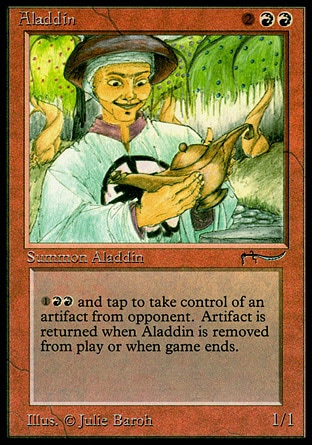
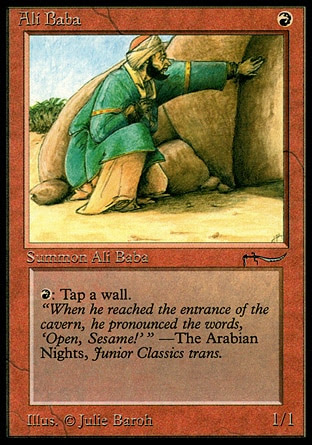
As usual, we'll start off with creatures, though I will not be as exhaustive as I was with Alpha. Aladdin and Ali Baba are two of the most famous characters from the 1001 Nights, and... they sure are represented here! In a nice bit of acknowledging the literary origins, Aladdin is even drawn as a Chinese man with Chinese garb, reflecting how it wasn't actually part of the 1001 Nights collection and was added by Chinese merchants.
In this set, the term 'Legendary Creature' (or just 'Legend' in older sets) haven't actually been invented, which creates a bit of an anomaly where Aladdin and Ali Baba are meant to represent actual characters instead of a type of creature like a Sengir Vampire or a Grey Ogre. This led to the hilarious implication that two Planeswalker fighting each other can summon four dudes, all of whom are named Aladdin, and all of them come from Rabiah... which the lore of MTG handwaved aside with noting that the plane of Rabiah was replicated a thousand times during one of the events, leading to 1001 identical copies of every single thing in Rabiah. Okay, at least they committed to that theme.
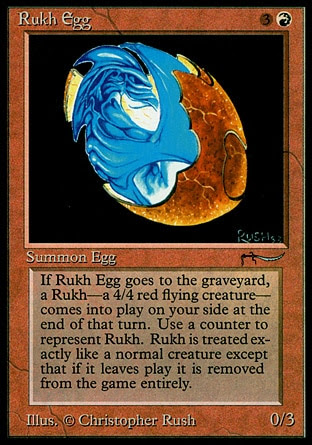
I like the flavour of Rukh Egg here, where it's a 0/3 creature that, once destroyed, the egg hatches and a 4/4 flying Rukh comes into play. This is another 'token creature' generator! 'Rukh' is the original Arabian spelling for what would be more commonly translated in English as 'Roc'. I like the artwork, too, of the slumbering, quasi-embryonic Rukh nestled within its egg.
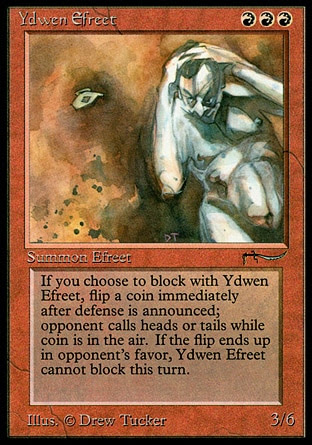
Ydwen Efreet is one of the many genies/djinns in this set, because you need to have some genies in a 1001 Nights expansion. That's fair enough, though Efreet is still retained as a separate type to flavour more 'evil' djinns, which is true to their mythological basis. It's represented here by Ydwen Efreet of having a literal coin's flip chance of refusing to block, making it a bit of a liability.
All this inclusion of Efreets and Djinns and Marids are nice and good... until you realize that a lot of the descriptors were anagrams of the designers' friends that 'sounded Arabic enough'. Ydwen, for example, is an anagram of 'Wendy'. I don't have the energy to go through every single one, but something that probably sounded like a funny in-joke back in the day isn't quite so funny now.
Bird Maiden seems quite happy to be around! I like her very colourful set of wings and tail, which explode behind her as a hang-glider. Her outfit is also quite colourful, which I really appreciate. I believe the story she is referencing is specifically about Hassan of Basra, which has the protagonist fall in love with a shapeshifting bird that can take the form of a beautiful woman.
We're going to get a couple of 'just an animal' in these early sets, but I do like the artwork on Kird Ape here, particularly the beady, glowing eyes. It's also an early card that rewards playing a multi-coloured deck, and it makes somewhat sense -- it's an ape, so it's aggressive like Red creatures tend to be, but it lives in the jungle and gains bonuses from Forests.

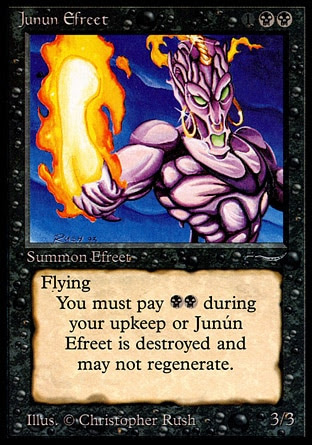
Black gets a lot of the 'evil' monsters, with a couple extra ghouls and sorceresses after the break. These two are probably my favourite, with Juzam Djinn being a massive, horned green-skinned demon holding a little human with his fingers. 'Juzam' is an actual attempt at using Arabic terms here, with juzaam being a term for leprosy... even though the wiki and other official sources claim it's 'evil'. Not quite, but at least it was an effort.
I like the artwork for Junun Efreet, which looks pretty stylied with his weird mutant-horse face, and his hair and fists being lit on fire. Reminds you of a JoJo Stand in a way, yes? The Arabic word junuun means 'madness'. Both the Junun Efreet and Juzam Djinn are examples of 'price of power' flavouring, with the Djinn dealing damage to the summoner every turn, while the Efreet demands a price just to maintain it on the field.
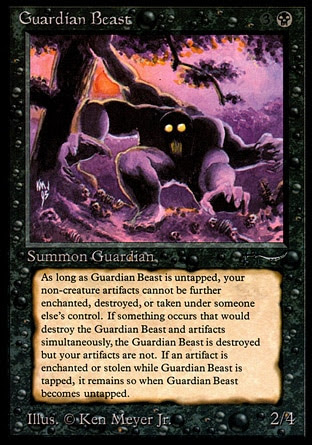
Guardian Beasts is a pretty cool artwork, with two glowing eyes of a massive, four-armed muscular creature lurking in the shadows with skeletons scattered all around his feet. The creature type update would make him a 'Beast', which is kind of a wastepaper basket for any vaguely-animalistic creature that doesn't fit into any other classification. The flavour of his effect is a being that guards all of your artifacts from being stolen or destroyed by evil thieves.
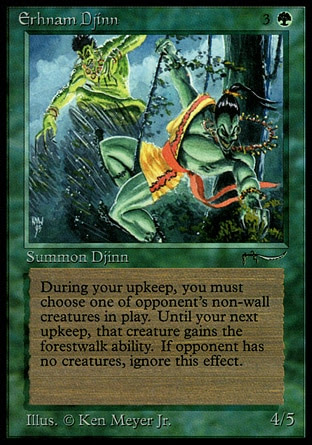
We've got a pretty cool art with Ernham Djinn, though I'm not sure which of the two dudes here are the real Ernham Djinn. Is it the guy in the foreground swinging on vines, or the guy in the background with a tornado around him? It's the strongest creature in the entire expansion (and even has a weakness! It buffs your opponent's creatures!), which speaks to the relatively low power level in this set. Ernham, by the way, is an anagram of Herman. Yeah.
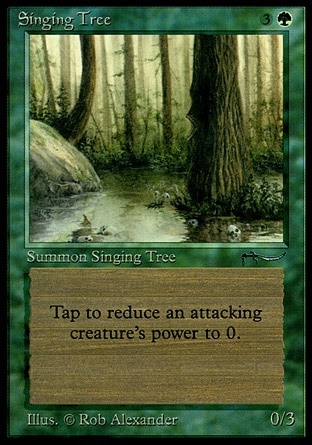

Ah, the Singing Tree! The artwork is a bit peaceful and soft that it takes a while yo realize that one of the trees has the profile of a singing face on the trunk. This is taken from the 1001 Nights story of the Persian King Kosrouschah, although in that story it's the leaves of the Singing Tree that has mouths. This Plant creature is able to reduce an attacking creature's power to zero, presumably because it becomes so transfixed by the Singing Tree that it forgets to attack.
Nafs Asp is a snake coiled around a vase. Again, a pretty simple animal that fits the theme of the set. I like the depiction of poison here, where the turn after the Nafs Asp bites your opponent, they have to suffer an extra damage from the poison unless they pay some mana to purge the effects.
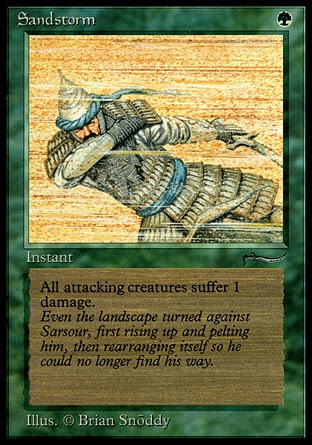
Being the 'force of nature' colour, Green gets a couple of spells representing the harshness of deserts, like Sandstorm here and both Desert Twister and Cyclone below.
I really like the card art for Metamorphosis here, which just looks painful as the man is transformed into a snake... or is it the other way around? It's not a one-to-one transformation, too, as there seems to be a third eye-socket with a red orb within that's neither man nor serpent. It just looks so wretched as the human's flesh is stretched out into tendrils, and the two beings' tongues are intertwined. The flavour is similar to some Black spells, but I guess if it's transforming instead of doing a ritualistic sacrifice to Griselbrand the Arch-Devil, it's totally about life and nature.
I was once a man! A MAN!
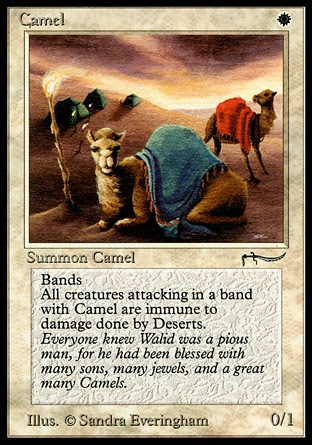
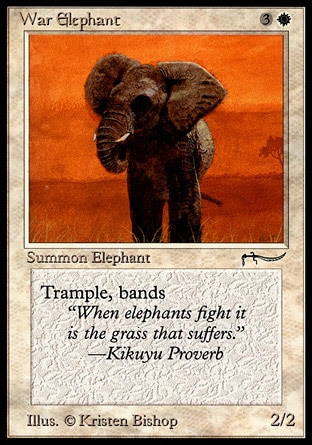
More animals that fit with the whole desert theme, and I suppose these are 'mounted' animals, which is why they're associated with White instead of green? Camel is a pretty simple creature, and while itself is a weak creature, is theoretically able to Band with other creatures to make them stronger and immune to Desert damage. Not... not very useful.
And War Elephant has Trample and Banding. Which also isn't super useful when you're a mere 2/2. I like the consistency that the elephant is smaller than a Mammoth from the base set!


Shahrazad is the alternate spelling of Scheherazade , main character of the 1001 Tales of the Arabian Nights. The main story of the 1001 Nights is that Shahrazad tells a thousand and one stories to the king she is married to in order to delay an execution, and at the end of so much time spent with the king, he has fallen in love with her. Shahrazad is a sorcery that is extremely high on Magic's ban-list not because she's a powerful card, but because her effect is just so needlessly convoluted and time-consuming.
To wit, upon casting Shahrazad, the two players leave the 'main' MTG game they are playing, and then play a MTG sub-game with their hands as their decks and the loser having his/her life total cut in half. Gimmicky, and in larger formats with multiple players and much more things to track of, a logistical nightmare.
We're going to blue now with Dandân, the largest fish in the sea that is able to swallow entire ships and fish swarms in a single gulp. I really love the artwork here, which focuses more on the ship that contrast the murky sea... but the Dandân is lurking beneath, ready to chomp down on the boats. Love that it's just a big fish instead of like, a leviathan or something. And yet it's got a rather pathetic 4/1 statline, and the debilitating Islandhome ability. Great flavour, but all around too restrictive of a card.

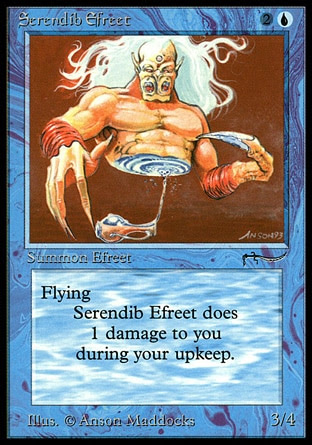
"Serendib" is the old name for Sri Lanka. The more you know! They're represented in two creatures in Blue, both of which demand a bit of a price from the user. The Serendib Djinn has a pretty typical 'modernized by Disney' genie appearance, right down to the bracers and facial hair. I really like his lightning-bolt horns that he's got.
The Serendib Efreet is probably one of the more interesting djinni/efreeti, with his body half-manifested from the lamp he is being summoned out of. It's like the magic is half-3D-printing his body, which is an interesting way to handle this kind of visual effect... and the Efreet himself is a very atypical design as well! I love it. I love the left hand ending in a crooked little sword, and how the lower half of his face splits into two mouths.
I mean, you've got to have a flying carpet in an Arabian Nights inspired set, right? There is an actual Flying Carpet artifact, but we've got Flying Men! Or well, just one man, based on the art and the 1/1 statline. The flavour text even actually quotes the actual 1001 Nights story -- which, by the way, has nothing to do with Aladdin.
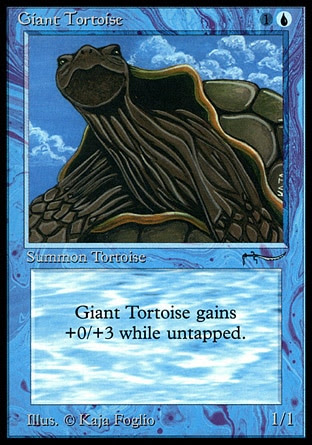
Yeah, a Giant Tortoise! Interestingly, this one isn't an 'islandwalk' or 'islandhome' creature, but a defensive creature that has more toughness than usual. Presumably this represents its shell somehow. It's neat. I like tortoise.
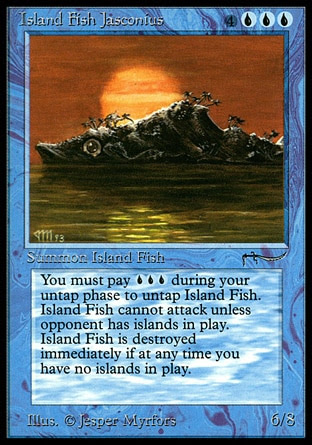

The Island Fish Jasconius is named after Jasconius, a legend taken from Irish myth of the Legend of Saint Brenda. There is a giant island fish in the Arabian Nights stories -- specifically in Sinbad's first voyage -- but they randomly decided to conflate it with another giant fish legend. Eh? I still really like the artwork despite the randomness of the two myths being fused together, particularly the fish-eyes and mouth poking out from the left side of the island while the plants and foliage cover its body.
What a terrible effect, though. The upkeep-to-untap and islandhome are bad enough, but the fact that it's an island fish that has nothing to do with the Islands that Blue uses to generate Mana? What the heck, game designers?
We've got a bunch of artifacts, albeit not as much as Antiquities will have. Some of them are items from the 1001 Nights stories, like a flying carpet or Aladdin's lamp. One of the artifacts (and it isn't a creature) is Ebony Horse, which is a magical artificial horse that's able to move at inhuman speeds created by a Persian magician to help a prince elope. The effect here basically allows the Ebony Horse to help one of your attacking creatures 'elope' and escape combat. That's neat.


City in a Bottle is a nod to what probably inspired this expansion -- DC/Vertigo comics' The Sandman, issue #50, which features a similar concept within a dreamlike metaphysical plane where all stories exist. Mechanically, it's an 'expansion hoser' that forces all Arabian Nights cards to be discarded from play as they are sealed within a bottle. It's... it's something that's cute when there's only a couple of expansions to keep track of, but can you imagine this in modern magic, where so many cards have been reprinted in various different forms?
Library of Alexandria! It's a real location, and we also have references to Baghdad, Iraq, in another card. This is also an insanely powerful card that is banned is pretty much all formats, being able to add a mana or draw a card. Thanks to some policies that Wizards of the Coast has about reprinting certain cards, some early-expansion cards have never been reprinted... and Library of Alexandria is one of those. Being a card that can be fitted into almost any deck, this is one of those cards that can reach the thousands of dollars in price!
Anyway, that's it for Arabian Nights, with some of my commentary about the rest of the expansion after the break. It's a bit of a smaller expansion, but not that small.
_________________________________________________________

ANTIQUITIES:
And now we move into Antiquities, the second expansion for MTG and the start of the entire storyline of MTG involving the brothers Urza and Mishra, as well as the Phyrexian Invasion saga. The game designers at this point hasn't really mastered the art of balancing storytelling and the set itself, but it's also very early in the franchise's history and in retrospect the original version of this article was rather unfair to them.
Also, I would like to reiterate that the main body of the article will mostly contain cards that I find interesting to talk with. I think my original version of the Antiquities article was rather hard to read because I was trying too much to have equal representation from each colour, which led to a lot of cards that I really didn't have much to say about!
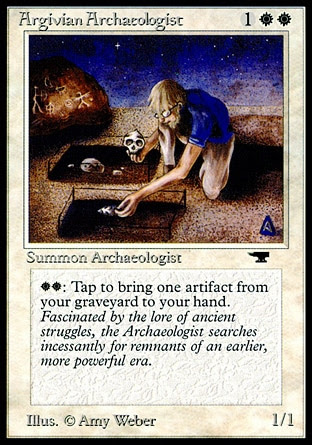
There isn't really a whole lot of story that goes on that isn't about main characters Urza and Mishra, but we still get a bunch of capital-letter descriptors, like Argivian Archaeologist. The kingdom of Argive is the homeland of the two artificers, and I do find the idea of archaeologists being involved in an expansion all about ancient artifacts being recovered to be fitting! ...even if this guy looks like he should be an extra in Tomb Raider or Indiana Jones instead of a more middle-ages fantasy setting.
That's the only White card we'll talk about here, since Antiquities doesn't actually have that many representations of colours, and most of its card pool are neutral artifacts.
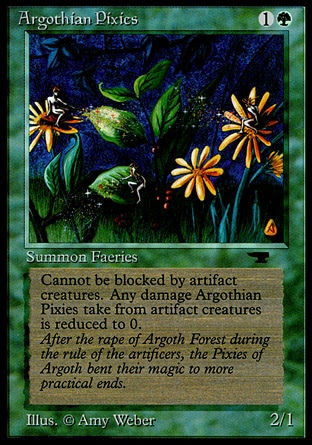
Green's got a pretty cool flavour in representing a "nature rejects the artificial" theme, with Argothian Pixies, from Argoth Forest, being a creature that's more powerful in fighting against Artifact creatures. The r-word usage in flavour text aside, it's nice to have more faeries hanging around, and you can just imagine these little guys sneaking and breaking the magical artifacts used by the mages, yeah?
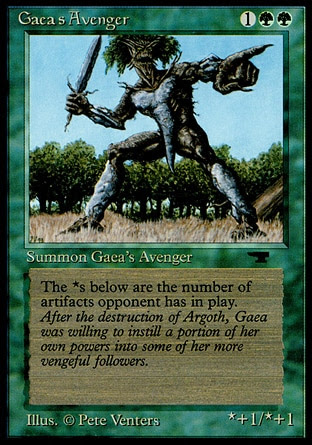
Gaea's Avenger here getting 'angrier' and stronger the more artifacts your opponents control. The flavour text hints that the land spirit/goddess Gaea was quite angry that the land of Argoth was utterly destroyed. Later errata would identify this guy as a Treefolk, and I like that the white-ish hard bark serves as 'armour' and weapons for the tree guy. His face also reminds me a bit of like a lizard or something.
Whereas Green is angry about artifacts, Blue wants to study artifacts and have a lot of ways of drwaing or reconstructing artifacts. Sage of Lat-Nam here has a comically long beard, which I found to be quite fun! Other flavour text in cards I put after the break describe a bit about the College of Lat-Nam, one of the many magical colleges that'll crop up in MTG lore. Of course, they do it FOR SCIENCE! Or FOR KNOWLEDGE, I suppose, considering the game's called Magic, not Science.
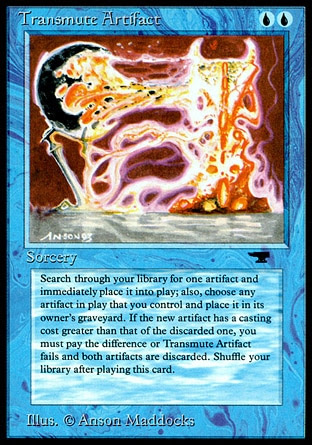

Transmute Artifact doesn't have a cool flavour text, but I really do like the artwork and the usage of colours here. The idea here is you're melting down (or whatever action is equivalent for a magical sphere) an artifact and reforming it into a brand-new one, paying the 'difference in power' with mana.
Reconstruction shows a skeleton in armour being put together, representing the effect of 'bringing an artifact from the graveyard back'. On closer inspection, you can see that the skeleton isn't even a real skeleton, but likely to be an artifact creature of some sort with all the magical runes and/or mechanical circuitry on the skull. Love the visual of magical threads sewing plates of the skull together.

Sadly, they don't really have much in lieu of flavour text, but the Goblin Artisans have one of the most hilariously charming artwork! They do wear anachronistic outfit with hardhats and clocks and some typical factory paraphernalia, which modern MTG is a lot better at. Love this artwork! The flavour for Red is, of course, destroying Artifacts. But not out of any kind of desire to protect nature, but just to blow them the heck up.
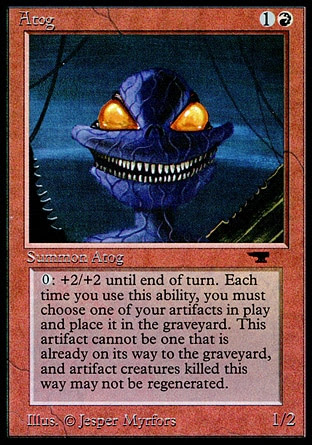
Oh, hey, it's the Atog! Like most fantasy settings, MTG would create a bunch of original creatures, and the Atog is the first, being this grinning humanoid figure with veins all over its blue skin, with huge glowing orange eyes, and a gigantic grin. While this artwork just shows us the profile shot, subsequent artwork and expansions would establish Atogs as being the setting's equivalents to gremlins or something. But Atogs actively destroy artifacts and get stronger after 'eating' them, reflected nicely in its card effect.
Originally, 'Atog' was just an anagram of 'goat', because goats are famous for being able to eat anything.

I really like the name Artifact Blast, and the card art of what appears to be some kind of rune-covered wall or a vase or something being shattered into a hundred pieces... and each other piece has an eyeball on it? Interesting effect to match its flavour (it can't destroy artifacts that already exist) even if countering an artifact as it's being cast is rather highly specific, at least in modern days .
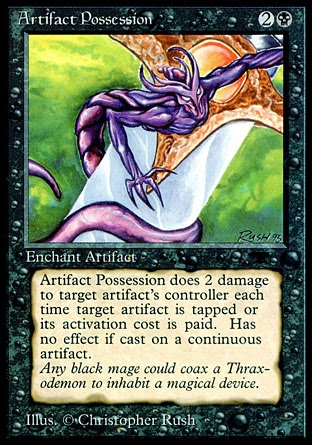
Black doesn't quite destroy artifacts like Red or Green do, but does more wackier stuff like Artifact Possession, where this enchantment just 'corrupts' an artifact and deals damage to its owner any time it's used. And the flavour is done by this little purple... imp-demon thing. I do like the design here, he's got a wormy, snakey lower body that coils around the magical sword, and a face with solid white eyes, no mouth and a lot of horns.
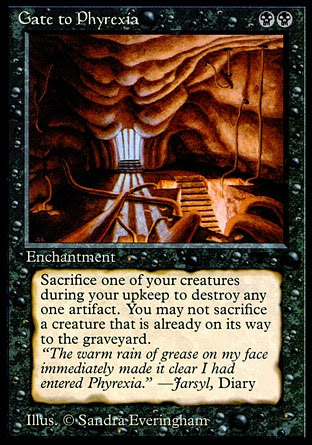

Big lore time! The biggest enemies, and the unambiguous 'Big Bad' of the Magic: The Gathering storyline, are the Phyrexians. I am surprised and pleased to realize that they were mentioned this early on! Phyrexia is an extradimensional plane filled with horrorifying monstrosities, and while the interpretation would vary over different art teams, they always have some degree of body horror and varying levels of grafting or being turned into cyborgs. All this artifact fighting between Urza and Mishra end up attracting the horrors of Phyrexia, opening this Gate to Phyrexia. We see walls made up of... flesh? Wires and/or tentacles come in from the foreground and crevasses all over. It's a bit of a more generic hellscape, I guess, since a lot of the identity of Phyrexia hasn't been solidified just yet, but it's a nice preview!
We'll start off with the comical monster first, with Phyrexian Gremlins. Who are gremlins! Which I suppose make sense as monsters that would destroy artifacts. Love Amy Weber's artwork here, where it isn't immediately clear where the gremlins are and it just briefly looks like a pile of shields and scrap pillars until you see the figures peeking in and out of what I assume is a disassembled version of the Armaggedon Clock below.
Notable that Wizards was very resistant at adding 'Phyrexian' as a creature type, only finally relenting and adding it as late as 2022, almost 30 years since the race's introduction. Hell, the original version of this article (which bitched a bit about the ambiguity of what counts as a Phyrexian) even predates that change!

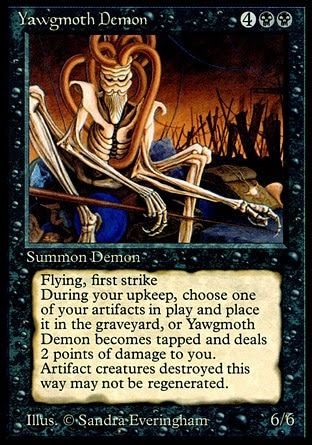
We have two cards here referencing the original 'big bad' of Phyrexia, Yawgmoth, who is treated as this immense, untouchable demon-overlord of this plane of unlife.
And the first one, the Priest of Yawgmoth, does something that's going to be infamously replicated by some of the most game-breaking Yawgmoth-related cards, which is cheating out chunks of mana by sacrificing something. Look at the design of this guy, though! He looks like he's based on the 'intelligent artificial skeleton robot' Terminator mixed with the body horror of something like Hellraiser. You can see the very human eyes in the sunken skull -- which itself has a bunch of extra metallic parts. And those jointed fingers, and the strange red pipe (does it contain blood or something else?) coming from his wrist to his palm... Very cool, very creepy. Adding to the creep factor that the Priest of Yawgmoth is a "Phyrexian Human Cleric", meaning that this was once human, who ended up being transformed and turned into a robot thing by the Phyrexians.
The Yawgmoth Demon is more straightforward, being a Phyrexian Demon... which means that it is both a demon and a Phyrexian. He's a cyborg demon! He is a bit of a more comical-looking design, especially compared to how badass the 2000s comic-book archenemy vibe of his Priest buddy. Most of his body is pretty all right, being a gangly skeleton, and those tentacle-hair might even be kind of threatening, but the mouthless face just doesn't work. The head looks like a weird tube with eyes, and I'm not sure if that's a bill, or his neck, or his beard, or a long faceplate... he looks weird, but perhaps not as threatening as a demon from the dark corrupt realm of Phyrexia should've been.


And we're going to go into the artifacts, which... again, I try my best to find something to say about the ones I find interesting, but I'm not gonna force myself to. Golgothian Sylex (named after the Biblical Golgotha) is a plot-relevant item that Urza utilized and caused the Antiquities War to end, causing the gateway to Phyrexia to be sealed and Mishra to seemingly be killed... and leading to the events of the next couple of expansions. Its effect is quite damning, if ultimately not something that's ever going to be printed ever again, targeting and exiling all the cards that come from this expansion.
I do like the Armageddon Clock, mostly for its name, but I also like the artwork of a jukebox-looking item with a huge clock, skeletons within it, and two angel wings that are easy to miss as they blend into the map behind it. (It's also seemingly the artifact that was ravaged to nothingness by the Phyrexian Goblins above). Its effect is nowhere as useful as its name implies, however, being a measly counter-based damage.


A bit too important for me to leave to the end, the Mightstone and Weakstone are two of the artifacts found by Urza and Mishra in the Caves of Koilos (that is a card I use a lot in actual magic) and they fought over these for a good chunk of the conflict. Not much to say, Mightstone is just a boring clenched fist. Weakstone is cute in that presumably it's causing this bizarre skinny crocodile-dog to get reduced to a weaker state.
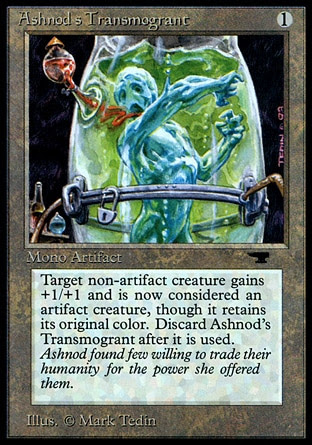

Ashnod is Mishra's apprentice, and a bit of a villain if Ashnod's Transmogrant is anything to go by. The effect turns a regular creature into an Artifact Creature, which in this case involves being locked in a huge jar filled with green sci-fi fluid, only receiving nourishnment from that flask of red fluid that's stuck straight into its mouth. Presumably this person used to be a human but is now an eyeless humanoid figure with green skin. Outside of game mechanics, why would someone want to be an artifact creature? I guess for more power, to become a Clay Golem or something?
Love that this very disturbing contraption is held together with the power of one padlock.
Among the many, many magical staves and amulets and swords in this set, one of the artifacts is a MOTHERFUCKING ROCKET LAUNCHER which I just find to be utterly hilarious! Look at that goblin guy. He's so happy! I like that it actually looks like something that feels like it belongs in a setting like this, where artifacts are quasi-magical technology and they're not just one-to-one replications of a modern-day rocket launcher.
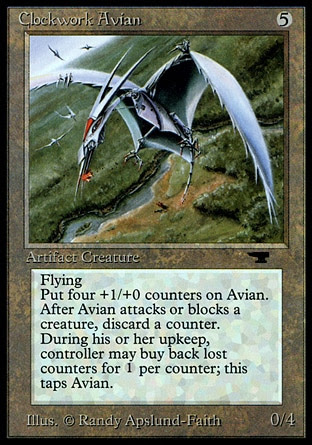

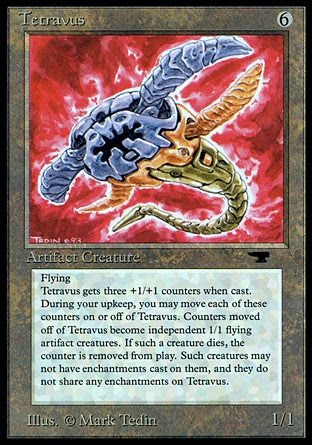
I really do like robots, and while MTG would perhaps go a bit too far with the robots later on, in an artifact-themed set I really do like them. Clockwork Avian looks less like an 'avian', and more like a monstrous pterosaur. Really like the elongated head and the kite-like wings. It follows the gimmick of Clockwork Beast from Alpha, where it slowly 'falls apart' as it attacks and defends, but the caster can spend mana to repair it.