Showing posts with label Justice League Unlimited. Show all posts

Wednesday, 12 July 2017

Justice League Unlimited S03E13 Review: The End of All

Justice League Unlimited, Season 3, Episode 13: Destroyer


All good things must come to an end, and this episode was the final episode not only of Justice League Unlimited, but the juggernaut that is the DC Animated Universe, the house that was built by Batman: The Animated Series. Yet at the same time, it went out with a bang and not a whimper, and to this day I still really like the final episode of Justice League Unlimited. Yes, the Darkseid conflict kind of came out of nowhere last episode. And yes, a good chunk of the episode is just pure-on superhero action. But man if it isn't awesome.

Nowadays the plotline of an alien invasion invading Earth and superheroes having to band together isn't something new. The Avengers did it. The (at the moment of writing) Justice League movie did it, and to boot it's an army of Parademons, just like this one. Hell, even this cartoon has done aliens-invade-Earth twice. Three times if you count Superman: The Animated Series. But it's still pretty awesome simply because of the fact that, lack of buildup aside,  Darkseid is still a pretty awesome and terrifying adversary in the context of the show's rich history.

And yes, the main characters of this episode boils down to Superman, Lex Luthor and Batman fighting Darkseid at the center of Metropolis, but the episode is amazing enough to give many side-characters a chance to shine, even if they don't necessarily do much. We do get a brief recap at the beginning of the episode, as well as the darkly hilarious revelation that Luthor's group beat the fuck out of New Genesis's Lightray (remembered within the DCAU as 'that douche who slapped Wonder Woman's ass') and stole his Mother Box, explaining how they got to Earth so fast.

The Leaguers agree to have the villains fight alongside them (Atomic Skull is very excitable about this) and Wonder Woman shows some savviness by splitting the villains up. And it's an awesome scene as Mr. Terrific orders an 'Omega-Level Alert' and we get the montage of superheroes suiting up and being teleported into various places on Earth. That's just an awesome scene.

Darkseid and Superman fight and trash the Daily Planet in the process, while Batman and Luthor try their best to help with batarangs and laser pistols. There's a nice moment when Batman refuses to take Luthor's gun, there's the awesome moment of Darkseid echoing Superman's "let's go" line from their last stand-off, there is Batman buying Superman time to get up by distracting Darkseid and evading his Omega Beams. Metron, the plot device man, is a little strangely incorporated and I really would've liked to have an earlier episode foreshadow this, by having Metron appear to someone or something. It's one of the weaker parts of the episode, certainly, and the sudden introdump about the Source Wall, while making a lot of sense for DC fans familiar with the comics, is probably very weird for cartoon-only watchers. Metron introdumps, of course, but it's a little inelegant in an otherwise seamless episode.

And, yes, it's a bit dickish for them to leave out Wonder Woman from the final conflict, but the DCAU's backbone has always been Batman and Superman. From when they graced our televisions in their own respective series, to their first team-up in "World's Finest" (an episode I can rewatch any time, any where) to their founding of the Justice League, in terms of the DCAU Batman and Superman are the heart and soul. And as much as I adore the DCAU's version of Wonder Woman, she isn't any more prominent than Hawkgirl or Green Lantern as far as the DCAU universe is concerned. (Which is a shame -- I would totally love a Wonder Woman cartoon in the DCAU style, alas that is not to be)

Superman then unleashes a can of pain on Darkseid, delivering an epic "world of cardboard" speech that's delivered spectacularly by voice actor George Newbern, talking about how none of his fellow teammates will quit, not even when faced against insurmountable odds, transitioning smoothly into how he's always guarded his strength while on Earth, always exercised restrained every single time, even when fighting criminals, but right here, right now, Darkseid is going to feel the full fury of motherfucking Superman, and it is such an epic beatdown of Darkseid as Superman unleashes the full force of his speed and strength. Darkseid only wins by cheating, activating a pain field and a kryptonite blade at the same time... and then Luthor shows up with the thing that Darkseid wants. I feel like it's important to note that Luthor shows up in his business suit instead of any of his supervillain costumes -- he makes Darkseid a deal he cannot refuse, the Anti-Life Equation, and after Darkseid takes it, the two disappear.

Is it a satisfying end? Maybe not. Superman and Batman both get their kickass moments, but it was Luthor that saved the day, bringing his character arc somewhat full circle. Darkseid is dealt with, though the manner that he is leaves things open for a possible sequel (which didn't happen).

One thing I know, though, the best line in the episode goes to Luthor. Metron tells Luthor that to comprehend the Anti-Life Equation, one must be a 12th level intellect to have the slightest hope of surviving... to which Luthor gives a cocky "then I'm overqualified."

But as badass as the world of cardboard speech is, the true appeal of the episode is the huge, huge brawl between superheroes, supervillains and Darkseid's Parademons. I really wished we could've had even more cameos, with the absence of the New Gods (despite Orion appearing in the background of last episode!) and Huntress being particularly noticeable, and the fact that Darkseid's named generals like Kalibak, Granny Goodness, Kanto and the rest didn't really end up making an appearance in this episode -- despite them theoretically being more epic enemies for Wonder Woman, Green Lantern etc to take out instead of just the siege engines.

The battle against the forces of Apokolips is decidedly epic, though, and I'll try to go through the montage of awesome action scenes and briefly touch upon their significance, because, hell,  it's the last episode and I'd be remiss not to at least be more comprehensive. From the awesome teleportation montage, as well as the montage of the Parademons assaulting every single city in the world, we then cut to Hawkgirl, Atomic Skull and Commander Steel defending the white house, a scene that has Hawkgirl kick an ungodly number of Parademon ass, Hawkgirl using Atomic Skull as a portable flamethrower (and later actually pull off a heroic rescue, good job!) and Commander Steel finding his inner Steve Rogers.

We cut to great action pieces as we have Giganta swatting Parademons off the Eiffel Tower, Vigilante and Shining Knight running across the Great Wall of China like the bros they are, Green Arrow and Black Canary fighting back-to-back, Bizarro finally embracing his inner Superman as he fights Parademons in a way similar to how Superman does it usually... we've got an Apokoliptan dragon-headed war engine marching through a city, and then a bigger dragon swoops in and it's revealed to be Sinestro's construct, we've got motherfucking Question charging a swarm of Parademons on a car, and then punching one nonchalantly as it tries to grab him, we have the Toyman shooting Parademons with a Nerf gun  seemingly harmlessly before the bullets blow them up as they hit the ground, Killer Frost sliding around on an ice slide in Venice, Hawkman armouring up and then joining the fight alongside Stargirl and STRIPE, Luthor machinegunning Parademons without flinching, Batman using electrocuted gloves to kung-fu punch Parademons, Zatanna turning Parademons into birds and sucking them into her hat, before turning them into fireworks, Steel whacking Parademons with his hammer and discovering how to destroy the doomsday devices...

Green Lantern and Flash take out one of the doomsday devices by Flash creating a trench and Green Lantern making a catapult, which I thought was actually one of the low-key bits for the original seven considering how epic Hawkgirl's awesome-warrior-leader bit was. Wonder Woman proves unstoppable, literally tearing her way through warships where other superheroes deal with mere soldiers. But in one of the best moments of the episode, a random old Chinese man tells his wife that he needs to do this, walks up into the chaos as Wonder Woman, Star Sapphire and Shining Knight are fighting a gigantic swarm... before kung-fu-punching one of the Parademons, turning into a gigantic Chinese dragon, and revealing himself to be J'onn J'onzz. That is, no lie, a moment that got me absolutely cheering when I saw it as a kid, showing how much J'onn has apparently developed off-screen to be more caring. Note that he returns Wonder Woman's hug immediately and smiles more.

And yes, while the action of the final episode is still focused on the DC universe's big boys, it doesn't mean that the lesser characters are left out of the action as well. But the central Superman story in this finale is definitely told well, despite the rather deus ex machina-y solution to the problem of Darkseid. The ending is awesomely bittersweet as Batman, with a cocky grin, lets the villains have a five minute running head-start, and Wonder Woman notes about how the adventure continues, getting the last line in the DCAU.

And, of course, the adventure does. Justice League Unlimited, or the DCAU as a whole, is hardly the only good DC comic series out there. But the adventure does continue, be it in comic books, newer iterations of the cartoons, live-action movies, live-action TV shows or video games, and the DCAU itself has stayed with me for more than a decade, and has by large shaped the definite portrayal of many of these characters for me. The DCAU carved a new niche, the fact that a superhero cartoon can be fun for children while being equally thrilling for both long-time fans and adult sensibilities, a balance that I absolutely appreciate.

God, it has been so long since I last watched the Justice League Unlimited finale on a hotel room during a vacation, on a special screening by Cartoon Network as they aired 'Alive!' and 'Destroyer' back-to-back, as I sat glued onto the television screen while my parents complained about how I should get to sleep because tomorrow's a big day or whatever... but it's the conclusion of so many episodes and so many hours of superheroing, the big, epic, final conclusion. And seeing it now in HD on my laptop screen as I boot it up on my DVD, it's just an absolute blast to see that, yes, this is actually pretty fucking awesome even more than a decade down the line.

That's it, folks, for the Justice League Unlimited reviews. I may continue doing DCAU material in either finally finishing Superman: The Animated Series or Batman Beyond, having recently being super-invigorated by reviewing this series, or maybe I'll do Young Justice, an equally tantalizing prospect. As Wonder Woman says in the final line of this episode, the adventure does continue indeed.


Justice League/Secret Society Roll Call:
  • Speaking Superheroes: Superman, Batman, Wonder Woman, Green Lantern, Mr. Terrific, Vixen, Blue Devil, Hawkgirl, Flash, Martian Manhunter, Steel, Metron
  • Non-Speaking Superheroes: Lightray, Red Tornado, Atom Smasher, Captain Atom, Metamorpho, Dr. Light, Green Arrow, Aztek, Booster Gold, Gypsy, Crimson Fox, Crimson Avenger, Vigilante, Dr. Mid-Nite, Starman, the Atom, STRIPE, Stargirl, Question, Ice, Fire, Hawkman, Commander Steel, Shining Knight, Black Canary, Hawk, Dove, Creeper, Zatanna, Thunderbolt, B'wana Beast, Elongated Man, Hourman, Wildcat, Dr. Fate, Vibe
  • Speaking Supervillains: Darkseid, Lex Luthor, Atomic Skull, Giganta
  • Non-Speaking Supervillains: Bizarro, Evil Star, Volcana, Cheetah, Heatwave, Killer Frost, Toyman, Sinestro, Star Sapphire

DC Easter Eggs Corner:

  • Discounting 'guest members' like Speedy, Captain Marvel or Deadman, there are a couple of JLU members that didn't show up for the finale: Etrigan the demon, Mr. Miracle, Big Barada, Orion, Waverider, the Ray, Rocket Red, Sand, Nemesis and Obsidian. Huntress, too, but she's technically not a member, and Aquaman, due to the odd embargo on Aquaman-related characters in season three.
  • Superman and Darkseid refer to their previous encounter in "Twilight", paraphrasing the lines they said to each other before they fought in that episode. J'onn has been absent since "To Another Shore".
  • Commander Steel launching a spinning shield (stolen from a Parademon) is, of course, a nod to the Marvel superhero Captain America, who, like Commander Steel, is dressed up in a full-body costume with a cowl based on a flag.
  • Bit of a dark comedy bit, but Darkseid's comment about how Batman is the first being to avoid the Omega Beams becomes hilarious when you consider a couple years later, the comics version of Batman would be killed by said Omega Beams (well, kinda) in the Final Crisis mega-arc. Cartoon Batman > Comics Batman, apparently.
  • That "why don't you just throw it into the sun" line is definitely a rib at Superman IV: The Quest for Peace, isn't it?
  • The 12th Level Intellect bit is a reference to how Brainiac often refers himself to (the average Coluan is an 8th Level Intellecct) in the earlier Golden/Silver Age comics, and perhaps Luthor's brief bond with Brainiac is what elevates him into such an intelligence state and explains his survival beyond main character syndrome.
  • Several groups and team-ups in the battle and the final 'run down the stairs' sequence is a nod to various affiliations of the characters in the comics:
    • B'wana Beast and Metamorpho are created by Bob Haney
    • The Question, Captain Atom, Creeper, Hawk and Dove are created by Steve Ditko.
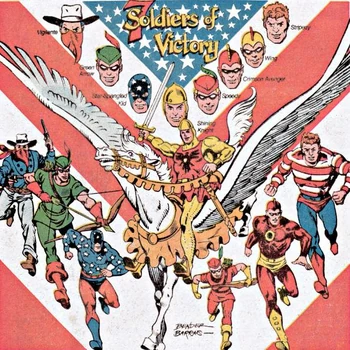
    • Stargirl, STRIPE, Crimson Avenger, Vigilante and Shining Knight are five members of the Seven Soldiers of Victory.
    • Hourman, Dr. Mid-Nite, Wildcat and Dr. Fate are all prominent members of the Justice Society of America (though why is Sand absent here?)
    • Vibe, Vixen, Gypsy and Commander Steel are introduced in the Justice League Detroit era.
    • Booster Gold, Fire, Ice and Elongated Man are prominent characters in the Justice League International era.
    • Zatanna, Atom, Red Tornado, Green Arrow and Black Canary represent the Justice League Satellite era, but these five are also very common side-members of various incarnations of the Justice League 
    • The final seven members are, of course, the seven that founded the DCAU's Justice League, with the last three heroes being DC's trinity of Wonder Woman, Superman and Batman, with Batman's symbol being the last thing to grace the camera as a reference to how the DCAU begun with Batman: the Animated Series.
  • J'onn's transformation into a dragon during the fight is, of course, a reference to the opening credits of Justice League where he transforms into an oriental dragon, something he's never done until this episode. 

Tuesday, 11 July 2017

Justice League Unlimited S03E12 Review: Secret Society - Civil War

Justice League Unlimited, Season 3, Episode 12: Alive!


Oh man. Justice League Unlimited's second season, in no uncertain terms, is the epitome of superhero cartoon serialization, with very few, at least from the DC side of things, to ever come close to it. Young Justice, maybe. And while season three of Justice League Unlimited has less overt serialization beyond the themes that every crime in the season has been related to the Secret Society.

But god damn did season three go out with a bang.

Cover"Alive" is the first episode in Justice League Unlimited's final two-parter episodes, and it's an amazing one. Sure, the sudden reintroduction of Darkseid into things is a little iffy, but it's one that made relative sense for long-time watchers of the series, harkening back not just to plot threads from Justice League, but also Superman: the Animated Series. And in any case, Darkseid, as always, is more plot device than actual character, the ominous, single-minded ultimate threat in the DC universe that can't be reasoned with. So we'll talk about him later.

Because, man, there's so much ground to cover here. Luthor and Grodd have both been built up throughout the episode (and, really, throughout all five seasons of Justice League) as the major players in the villains' side, and Tala has been this relatively major side-character with the hilarious gimmick of sucking up to whoever's in charge, and that ends up being important here.

Luthor has always been a more effective leader than Grodd, the questionable bit of that Roulette episode aside. It's not that Grodd is stupid, it's just that Luthor is just so much more effective and has so many contingency plans in action to prevent treachery that the other villains follow him... but Luthor has always been more stick than carrot, and and his huge, overbearing ego has always been his downfall. Even when he was the leader of the original Injustice League, the fact that everyone was only sticking around for money and didn't really care for Luthor's goals (his one-track revenge then, his one-track Revive Brainiac now) and any excuse is about good enough to toss Luthor out of his throne.

Which is where we go back to Tala. Tala has always been happy to suck up to people more powerful than her, and loyalty is something she doesn't really care about. Amanda Waller and Felix Faust when she worked as a member of Cadmus, and now she easily goes back and forth between Luthor and Grodd. While Grodd isn't the nicest of people, he knows how to be polite, how to make deals, while Luthor is openly derisive of Tala, being way, way too obsessed with Brainiac. (There's a love triangle joke there somewhere) So as the Legion of Doom flies off into space in their skull-base-starship, and Luthor's open mockery of Tala reaches a climax, she decides to spring Grodd out. And, well, a lot of people -- especially crappy ol' Goldface, who got the brunt of Luthor's "anyone else wants to try to talk back to me?" speech earlier in the episode -- are happy to stand behind Grodd.

And my god, just as how the JLU fighting the Ultimen were thrilling as we jump from one power to the next, seeing the Secret Society (I use the terms Secret Society and the Legion of Doom interchangeably, bear with me) just collapse and unleash all sorts of superpowers is just amazing. We have major recurring villains like Killer Frost and Parasite fighting alongside characters who never even got a single line of dialogue like Merlyn and Hellgrammite, and it's amazing. There are, obviously, some stand-outs as we jump from one character to the next, as some of the villains aren't even sure that there's a fucking coup d'etat going on on the top floor.

We have characters just launching all sorts of awesome powers. Heatwave shoots fire blasts. Rampage and Bizarro go on a full-on super-powered beatdown. Electrocutioner blasts electricity. Giganta goes full-on giant and unleashes the fury that which hell hath no upon Grodd, and Tala knocks her down with a simple shot to the face. KGBeast shooting guns. Silver Banshee screaming. Evil Star doing some weird energy absorbing thing. Fastball throwing explosive blasts. Toyman hides from the conflict, gets chased around by scary ol' Killer Frost and her huge ice slides and stuff, before showing that, holy fuck, this dude has some really scary yo-yo skills. (Also, how wince-inducing was that crack on Toyman's face?)

Which DC Villain Are You?Actually, can we talk about how awesome that Killer Frost/Toyman fight was? Between the scary, creepy music, to Toyman's switch from hiding into just calmly walking and doing yo-yo tricks, turning Killer Frost from the confident ice psychopath to someone desperate to make just one more ice wall to stop Toyman?

And in it all, Luthor and Grodd just rampage around and try to beat each other. Obviously, Grodd being a gigantic gorilla with a huge space cannon he has the advantage, but Luthor's a lot faster, jumping around and using Fastball as a hostage, then relying on his loyalists as a distraction while he goes around trying to do something. Though he did try to whack Electrocutioner in the head with a fire extinguisher, and causes Tala's magic to backfire onto herself with his contingencies.

But while the supervillain fight climaxes pretty quickly with A takes out B, then C takes out A, then D takes out C and I will never get tired of rewatching that because I have the mentality of an eight-year-old, the final confrontation between Grodd and Luthor is amazingly crafted. It's a fight a long time coming, and both Clancy Brown and Powers Booth are just amazing voice actors that brings so much gravitas into these two characters. Luthor attempts to put up a fight with some fancy as metal glove things, but Grodd overpowers Luthor and could've easily snapped the bald man's neck, but Luthor knows how to goad Grodd, and tries to get him to use his mind-control powers on him...

Upon which Luthor activates a contingency that turns Grodd's mind control powers back on himself, forcing him to walk into an airlock and flushing him out. And as Luthor regains control of the Secret Society, Killer Frost decides to cut her losses and join the winning team, freezing a large chunk of the Grodd loyalists solid -- and it's not shown on-screen, but the implication is definitely there. These people are dead, and it's shocking, too, because while you may not care about KGBeast or Hellgrammite, the ranks of the people frozen by Killer Frost includes long-runners like Parasite and Shade. Yes, it's the finale two-parter and it's rather wise to clean up the slate of unnecessary characters before we move into the finale.

To make long story short, in his relative desperation to get Brainiac back, Luthor uses Tala and it's this desperation that probably fucks him over. We also get a brief bit of warning when a mysterious dude in a chair, the enigmatic Metron (I squeed when I saw him -- always liked Metron) and warns Luthor, a warning he very predictably ignored.  Whether Tala intentionally did so, or if it's just a side effect of trying this untested fact, Brainiac was not the only major Superman archenemy that died in this particular plot of space. Darkseid is reborn, and immediately kills everyone on board. Or so we think -- Sinestro, MVP of the Secret Society, manages to save the Luthor loyalist and slowly bubble-float them back to Earth, where they end up showing at Justice League headquarters with Luthor giving the mother of all understatements: "we have a little problem."

But in-between Darkseid swiftly putting an end to the already fractured Secret Society, he's actually a decent contender for a great 'final boss', so to speak.  While part of me is sad that we're never getting a proper Justice League versus Secret Society mega throwdown, the conflict that happened within the Society did make sense -- how else is a supervillain alliance that keeps exchanging one crazy bully for another really going to stand? -- at least we did get to see the entirety of the Secret Society in action, which is something. And Darkseid, within literal seconds of his rebirth, quickly booms his way to Apokolips, puts into halt the on-brewing civil war there (these villains and their civil wars...) and it's an amazing scene to see every single person there, actual characters if you've been following the show's long history, just stop whatever the fuck they're doing and bow down. And Darkseid clearly gives no shits. He has a fancy new armour, he's not going to care about treaties with New Genesis because, well, that's going to be next.

So yeah, it's definitely a thrilling conclusion. A good chunk of the Secret Society is wiped out, including Grodd, and Luthor and the tattered remains has to return to Earth to warn our heroes about the fuck-up that he's made. While some people deride the decision to turn Luthor into a one-note man obsessed with getting Brainiac back, I'd also argue that it's a very in-character moment for Luthor -- he has always wanted knowledge and power, and he has had a track history of being obsessed with Superman to the point of ridiculousness. Thankfully he seems to be back in form by the end of the episode. And in any case, this episode still remains one of my all-time favourites to just boot in and rewatch, because, shit, supervillains fighting!


Secret Society Roll Call:
  • Speaking Superheroes: Metron
  • Non-Speaking Superheroes: Superman, Captain Atom, Red Tornado, Green Lantern, Dr. Fate, Orion, STRIPE, Metamorpho, Atom Smasher, Batman, Wonder Woman
  • Speaking Supervillains: Lex Luthor, Gorilla Grodd, Tala, Darkseid, Atomic Skull, Bizarro, Brainiac, Sinestro, Weather Wizard, Killer Frost, Toyman, Giganta, Bernadeth, Kanto
  • Non-Speaking Supervillains: Cheetah, Blockbuster, Bloodsport, Volcana, Heatwave, Fastball, Rampage, Evil Star, Major Disaster, the Key, Silver Banshee, Angle Man, Parasite, Crowbar, KGBeast, Monocle, Merlyn, Electrocutioner, Lady Lunar, Star Sapphire, Dr. Cyber, Neutron, Hellgramite, Shade, Copperhead, Dr. Destiny, Virman Vundabar, Mantis, Lashina, Mad Harriet, Stompa, Granny Goodness


DC Easter Eggs Corner:

  • Here's a bit of a little list of how the Legion of Doom civil war was split up:
    • Luthor's loyalists include Giganta, Cheetah, Atomic Skull, Toyman, Sinestro, Star Sapphire, Bizarro, Heatwave, Volcana and Evil Star. Oh, and Killer Frost defects to Luthor at the end.
    • Grodd's loyalists include Tala, Blockbuster, Goldface, Fastball, Bloodsport, Rampage, Weather Wizard, Major Disaster, the Key, Silver Banshee, Angle Man, Parasite, Neutron, Shade, Copperhead, Crowbar, KGBeast, Monocle, Merlyn, Electrocutioner, Lady Lunar, Dr. Cyber and Hellgramite. Plus Killer Frost, initially.
  • Among the supervillains that definitely survive we have the 11 Luthor loyalists (bar Evil Star, though he shows up next episode), and while it's pretty unlikely for any supervillain to survive the cold vacuum of space and the explosion of the Legion's base, special mention goes to the ones that are frozen by Killer Frost and are definitely dead. This includes long-running characters like Parasite, Shade, Copperhead and Weather Wizard, but also relative nobodies like Fastball, Rampage, Blockbuster, Goldface, the Key and Hellgramite. Several of the Grodd loyalists for whatever reason stand and interact with Team Luthor during this scene, but other than the 11 who fought alongside Luthor, none of them are shown within Sinestro's safety bubble.
  • Giganta refers to Grodd's betrayal by frying her brain in "To Another Shore", as well as Grodd basically quickly setting up shop with Tala. Luthor's power-nullifying belt is last seen used against Dr. Polaris in "The Great Brain Robbery". Darkseid was killed within Brainiac's main body in "Twilight", all the way back in Justice League's second season, and his death plunged Apokolips into a civil war which we see in "The Ties that Bind".
  • Luthor's quote, "meet your new lord and master", was the same line that was used by Kanto to introduce Darkseid in the final episode of Superman: TAS's season finale.
  • A bit of a more obscure Easter Egg, Luthor's passcode is 06-06-69, which is the reference to the day that Warner Brothers first merged with DC comics, and is one of the reasons the DCAU was made possible.

Justice League Unlimited S03E11 Review: Romeo & Juliet

Justice League Unlimited, Season 3, Episode 11: Ancient History


The third season of Justice League Unlimited didn't quite try to be as serialized as its second season, but it does know that it is the last entry into the DC Animated Universe. (Batman Beyond was produced and concluded way, way earlier before JLU entered play) So while the Legion of Doom plot was running, we still had to conclude a couple of outstanding plotlines, and this one decides to tackle the tricky business of concluding the Hawkman/Hawkgirl reincarnation storyline. And while we didn't quite get much in lieu of a definite conclusion, it's a definition that felt so much more well done than the 'well, I guess I'm going off with my new love interest' that last episode did with Supergirl and Brainiac 5. At the end of this episode, Shayera picks neither Hawkman or Green Lantern, and neither does Green Lantern break up from Vixen. I guess the moral of the story is a big "fuck you" to destiny and let things play out naturally, whether it happens to sync itself with destiny or not? Both Lantern and Shayera are beholden to different kinds of destinies. Lantern knows that in the future he's 'supposed' to get together with Shayera and make Warhawk. Shayera is being told by Carter Hall that she's 'supposed' to get together with him to fulfill the whole reincarnated lovers destiny they have. And the show makes it clear that both couplings have a not insignificant amount of chemistry behind them.
Image result for hawkman hawkgirl cover
Still, though, it's an episode that's a bit bizarre. We've gotten the first part of this flashback in Egypt all the way back in "Shadow of the Hawk", but here we learn that even in ancient Egypt, the Thanagarian pharaohs Katar Hol and Chay-Ara had a bit of a complication in the form of Bashari, a soldier that looks suspiciously like John Stewart. It's an awfully weird plot 'twist' that seems to imply that, what, Shayera/Chay-Ara's destiny is always with Bashari, the man she cheated on her husband with? It makes it so that whoever she chooses it seems awfully muddled that Shayera is always stuck with someone from her past.

Add that to the weird combination that apparently reliving her Chay-Ara days via the plot device called the Absorbicron, Shayera suddenly decides to relive the part of her destiny that she ends up with Bashari/John, and goes all in on wanting a baby -- especially when the future existence of Warhawk is revealed to her, as she tries (though not as upfront as Bashari in the past) to renkindle the romance she used to have with John. Because whatever the case of destiny and true love and whatever, trying to come in the middle of an established relationship is something that still doesn't sit well with me because it'd be a dick move, whether it be Bashari in the past or Shayera in the present. Thankfully, Shayera still understands her boundaries when it comes to John as he's still in a relationship with Vixen, and the sparring session she has with Vixen makes it clear that at the very least, Shayera likes Vixen enough to respect her, and while they both acknowledge that Shayera still has feelings for John, but won't be that huge of a thorn in the current John/Vixen relationship (despite her little joke about how in Thanagar she could assassinate her love rivals)... up until the weird Absorbicron flashback.

Compounding the odd direction the writers chose to take with Shayera is the fact that "Shadow of the Hawk" ended beautifully with Shayera deciding to create her own path in life and rejects any kind of this mystical mumbo-jumbo. And yes, actually reliving her past life via plot device is a different and more significant event compared to Hawkman's words, but will it really change Shayera's personality that much?

Or maybe this is all a commentary on how real-life relationships tend to be absolutely messy with all those pesky feelings getting in the way of the bro code (or sis code, in this case) and you can use anything as a justification for your love? Maybe why Shayera is so affected here is because the new information about Bashari-x-Chay-Ara and Warhawk shows her destiny with John, who she wants to be with, whereas the past talk about destiny involves Carter, who Shayera doesn't want to be with? It's weird, it's messy, but it is in this messiness that the episode actually works to some degree. It's not the worst character change that I've ever seen, but in a show as well-written as Justice League Unlimited it's a bit annoying that Shayera's final journey didn't end in a high note. It's not bad, it's just... oddly underwhelming, that the love life that Shayera finds in John outside her supposed reincarnation cycle ends up actually being part of it, just to slam down the John-x-Shayera thing as being the one true ship.

I suppose I have been bitching a bit too much about the ending of the episode, that I'm ignoring the rest of the episode. It was actually decent, with the episode first being set up to uncover Hawkman's secret, only for the Shadow Thief -- here revealed to be the personification of Carter Hall (or Katar Hol)'s deepest, darkest desires, and has been setting it all up, kidnapping Green Lantern and Carter Hall, and luring Shayera to the place where the three of them could be placed in the Absorbicron together. After defeating Shadow Thief in a bit of a silly 'deny the evil demon's power by not fighting' trick, Carter leaves, acknowledging that he and Shayera are not meant to be together.

And I suppose that John still stays with Vixen, though his note to Shayera that if/when they get together it'll be on their own terms rings a little hollow considering the fact that now destinies both past and present are even clamouring for Shayera-x-John. And while we never actually get to see Shayera and John get together (since the show ends) the final scene of Shayera going to Batman for information about Warhawk that she's going to be a little bit more proactive in nailing down her man.

I dunno. It's a bit muddy, and while it's not necessarily bad -- scripting, action and the beautiful artwork used in the flashbacks are all well done -- it's an episode that left a bit of a strange taste in the mouth. It's not bad, it's just... confusing more than anything and really even ten years after I've watched this episode when it aired, I still don't know whether I like this episode or not.


Justice League Roll Call:
  • Speaking Superheroes: Green Lantern, Hawkman, Hawkgirl, Vixen
  • Non-Speaking Superheroes: Batman
  • Speaking Supervillains: Gentleman Ghost, Shadow Thief

DC Easter Eggs Corner:
  • A fair amount of the flashbacks pay homage to previous episodes. Bashari and Chay-Ara's kiss replicates, frame-for-frame, John and Shayera's first kiss in "Wild Cards", while Hath-Set's interactions with Chay-Ara and Katar mirrors Kragger's role as someone trying to ruin Shayera and Hro Talak's romance by implying that a third party is involved. Hath-Set even shares the same voice actor as Kragger.
  • Shadow Thief paraphases the Green Lantern oath when he says that 'blackest night beats brightest day'.
  • Gentleman Ghost (a.k.a. Jim Craddock), one of my favourite minor villains, actually makes sense as someone to be included in this episode even if he doesn't have much relevance beyond being the villain that Hawkman helps to take out early on. Jim Craddock was killed by two gunslingers in the 19th century, and promises to haunt the Earth until the spirit of his killers has moved on to the afterlife... but his killers happen to be the ever-reincarnating spirits of Khufu and Chay-Ara, which means that he's trapped on this plane of existence as the Gentleman Ghost ever since.
  • Katar briefly mentions Teth-Adam as the leader of a neighbouring country. Teth-Adam is the real name of the anti-hero Black Adam, who is Captain Marvel's biggest archnemesis and his predecessor as the wielder of the powers of the wizard Shazam. 

Monday, 10 July 2017

Justice League Unlimited S03E10 Review: Whirlwind Romance (with Time Travel!)

Justice League Unlimited, Season 3, Episode 10: Far From Home


CoverI have to admit that despite being a huge, huge DC fan... I never cared that much of the Legion of Superheroes. Oh, sure I know who they are. I've read some stories in them, even. I know Saturn Girl, Chameleon Boy, Brainiac 5, Bouncing Boy, Lightning Lad, Proto the weird Ditto creature, and I even cheered when the Fatal Five showed up here (having remembered seeing fascimiles/clones of them when I read the 90's Superman comics). I even recognized who Valor is to get relatively excited when Mon-El revealed his identity in Supergirl's second season. But I've never really cared for them all that much. I'm not sure why I didn't care for them. Maybe it's the insanely large amount of rebots that the Legion has had over the years. Maybe it's because their status as being detached from the 'mainstream' time period makes it hard to think of them as part of the overarching DC universe, despite them being one of DC's more iconic (if less mainstream) parts. I dunno.

Maybe I'll watch that Legion of Super-Heroes cartoon that debuted in 2006, to orient myself to the characters. We'll see.

But it is indeed true that Justice League Unlimited's mission statement would eventually bring them to the Legion in the 31st century, as it explores all of the DC universe. But it honestly gives the Legion itself second billing, because the main character here is Supergirl, co-starring her two makeshift uncles, Green Arrow and Green Lantern. Supergirl is one of those characters,a little  like Huntress last episode, whose character has been built up across all of JLU, yet this is a chapter in her story which I felt was underwhelming, especially since this is Supergirl's last appearance in the series.

Granted, the action sequences is nothing short of amazing. There's the first fight between Supergirl, Green Lantern and Green Arrow against the Fatal Five, a very colourful group of baddies (I always loved Validus's weird looking design), but most epic would be Supergirl single-handedly taking on two dozen Leaguers all at once.

But the episode itself, I feel, fell short. The big thing that the episode tries to do is to give Supergirl an exit on the show as a metaphor for growing up and forming your own identity away from your parents (or larger-than-life cousin, in this case), but it didn't really feel that well-done. Brainiac 5 and Bouncing Boy are just kind of there, with Bouncing Boy just being a hilarious side-character, while Brainiac 5 is just kinda nice. There's the brewing mystery of something that the Legionnaires are not telling the Leaguers, and that mystery is the fact that Supergirl never returns back to the 21st century in the history books. Of course, despite the fake-out and the Crisis homage as Green Lantern cradles Supergirl's seemingly-lifeless body, it's apparently because Supergirl falls in love with Brainiac 5 and decides to stay in the future with him.

It's... a bit weird, really, and while the show does give some mutual flirting between the two ("maybe I was just trying to cop a feel") it never really feels that organic and unlike the show's previous attempts to inject a love-interest-for-the-episode in Hawkman, Brainiac 5 showing up as Prince Charming and charming Supergirl away from her family is just weirdly done. B5 is nice enough, of course, and while there's the underlying current that it's supposed to be a metaphor for falling in love with a nice person that your family doesn't approve of thanks to his backstory, other than a few brief lampshades by Green Lantern and Superman's "does this boy have a name" bit at the end, there's not much really made out of that.

It's not that the episode is completely devoid of any strong moments, mind you. Supergirl seeing how much she can unleash herself in the 30th Century is well-done, as is how Green Lantern notes there's nothing he can teach her anymore, but beyond the lack of Superman I don't feel like the show does enough to really justify having Supergirl  just literally abandon every single friend and family member to stick around with a bunch of kids, of whom she's only met two of for the duration of a day or two. All the talk about not really fitting in doesn't work because Supergirl just exchanges one army of superheroes for another, and her 'growing up' has already been explored with her many solo adventures -- be it teaming up with Green Arrow or Stargirl, or her one-woman fight against Galatea -- it's a bit odd, really.

I dunno. I guess in this setting if Kara wanted to go back and forth between the 21st and 31st century it's just barely any more inconvenient than someone taking an intercontinential flight, but at the same time I can't feel that this felt a little weak. Maybe it's because the Fatal Five, despite their colourful designs, doesn't have much in lieu of a personality beyond being evil. Maybe it's my personal apathy for the Legion. Maybe it's because I felt like the huge plot of the episode didn't entirely make sense and neither did the ending. The Supergirl/GL/GA chemistry works amazingly well, though, with Lantern and Arrow acting like Kara's two surrogate uncles or elder brothers, both supportive and protective at the same time. Yet maybe if I've seen Superman actually being an overbearing parental figure towards Kara, the episode would pack more punch, but as it is, it feels like a huge plot development that didn't feel like it needed to happen.

But hey, after Justice League Unlimited's near-perfect streak of great episodes, it's about time that one or two didn't entirely hit the mark, right?


Justice League Roll Call:
  • Speaking Superheroes: Brainiac 5, Bouncing Boy, Supergirl, Green Lantern, Green Arrow, Superman
  • Non-Speaking Superheroes: Saturn Girl, Lightning Lad, Cosmic Boy, Phantom Girl, Colossal Boy, Chameleon Boy, Blok, Shadow Lass, Ultra Boy, Timberwolf, Wildfire, Steel
  • Speaking Supervillains: Emerald Empress, Mano, Persuader, Tharok, Validus
  • Non-Speaking Supervillains: Robotic holograms of Queen Bee, Dr. Cyber, Atomic Skull, Blockbuster

DC Easter Eggs Corner:

  • The Legion of Super-Heroes are a team of young super-heroes operating in the 31st (sometimes 30th) century, and were most famously featured in Golden/Silver-Age stories when a young Superman (then Superboy) accidentally traveled into the future and became a member of the team. Each member have a Legion Flight Ring, which explains how every single person appears to be able to fly. Over the years, real-life reboots both hard and soft has given many, many variations of the 31st century setting, and I admittedly have never really been interested in the Legion's history enough to research them. The Legion previously appeared in DCAU canon in the Superman: the Animated Series episode "New Kids in Town".
    • Brainiac 5, a.k.a. Querl Dox, is the descendant of the original Brainiac. Which is a bit weird because in DCAU's canon Brainiac is a supercomputer that went wild, but in the original comics Brainiac started life as a Coluan, a different alien species. In the comics, too, Brainiac 5 has had romances with Supergirl, who herself has also became a member of the Legion in some stories.
    • Bouncing Boy,  a.k.a. Chuck Taine, is a superhero with the powers to turn into a giant ball and bounce around, and honestly there's not much else beyond that.
  • The Fatal Five is a group of supervillains that menaced the Legion of Super-Heroes, though I'm sure I've seen them transported into the present day once or twice in the comics. Their ranks consist of the Emerald Empress, Mano, Persuader, Tharok and Validus, and various different versions of each character have appeared in the many, many reboots and revamps that the Legion of Super-Heroes has had, in addition to more traditional successors of a mantle.
  • The shot of Green Lantern cradling a thought-to-be-dead Supergirl is a homage to the iconic cover of Crisis on Infinite Earths #7, where Supergirl was killed by the Anti-Monitor and was picked up by Superman in a similar fashion.
  • The team of Green Lantern, Green Arrow and Supergirl harkens back to their team-up in the first episode of Justice League Unlimited... sans Captain Atom, but he's a bit of a dick.
  • While Green Lantern cuts off Bouncing Boy's talk about how he's the father of someone, it's totally a reference to Warhawk, who Green Lantern met during his last time-travel escapades during JLU's first season finale, which he briefly references. 

Sunday, 9 July 2017

Justice League Unlimited S03E09 Review: Lady Superhero Cage Fight

Justice League Unlimited, Season 3, Episode 9: Grudge Match


It is so, so welcome to have Question, Black Canary and Huntress back in an episode again. Also, Hawkgirl and Vixen. This is an episode filled with relative callbacks to previous episodes, both relationship wise (the rivalry between Hawkgirl and Vixen, Question and Huntress's relationship, Canary and Huntress's old rivalry) and setting wise (Roulette returns!), one that once more demonstrates that you can make a story about girl power without going into ham-fisted strawman feminist rants. Live action Supergirl, take note. For the superhero genre, the depiction of female characters have been... a long and hard road. Sure, it's been a lot better now, in no small part thanks to the internet having a trigger-finger at going batshit angry at any depiction of women that's stereotypical, but perhaps that's a necessary evil. And even then, it's not quite enough -- the Marvel Cinematic Universe has been a decade-old juggernaut, but even their big-name female character, Black Widow, still isn't good enough to get a movie for herself, and Captain Marvel keeps getting pushed back and back even more.

But looking back on the however many decades have passed since superheroes were introduced to children via old comics with simplistic dialogue, to this cartoon released in 2004, and now, as of the time that I'm writing this review, it's 2017 and the first real good female superhero movie has finally graced the silver screen. It's a long and hard path to get there, where back then your typical women are the likes of Lois Lane and Julie Madison alternate between being eye candy, love interests, damsels in distresses... and on their worst, like poor Katma Tui or Kyle's girlfriend, they get killed off to have our male heroes punch the air and declare grief-fueled vengeance. Even Wonder Woman, a rarity among the male-filled superheroes of that time, was reduced to a secretary in the early pages of the Justice Society, and had the embarrassingly sexist weakness of losing all her powers if bound by a man. Yes, things eventually got out of that peahen and strong female characters began to rise up and define themselves, but it's still an uphill battle.

Which is where Justice League shined. Wonder Woman and Hawkgirl are amazing characters, Shayera Hol in particular having one of the most solid story arcs throughout the five season run of the show. But they're not content with just having their two primary female leads be strong characters, and when the cast expansion happened in Unlimited, female characters both old and new get a chance to shine. Supergirl, Huntress, Black Canary, Galatea... the show isn't afraid of putting them in important roles. Important action roles, at that. And I cannot believe how amazing the portrayal of women are in an episode that has scantily-clothed women fight in a cage fight tournament, which sounds like someone's weird fetish fantasy. Yes, there's a degree of fanservice in all this, but that doesn't take away from the fact that all the women involved are powerful warriors in their own right who just happen to be wearing slightly more revealing clothing.

But it definitely delivers. Yes, some of the women are dressed in questionable scantily clad costumes, but the fights are still amazingly crafted and animated, with the great concept that Roulette has mind-controlled some of our female heroes, and the different battle styles that a brawler like Black Canary has, or the more feral, primal animal-based Vixen, or the walking juggernaut that is Wonder Woman, is amazingly done. Mind you, the setup to get there is a bit suspect. If Roulette, and by extension, the Legion of Doom, has fucking Wonder Woman under her control, you'd think that they would do something more productive other than forcing them to fight in a cage fight to earn money from the betting viewers. And if it's money you want you really could be doing something more productive with that, surely?

But after we get past that bit of ridiculousness (and Luthor mocks Grodd for 'turn men into apes' plan?), Roulette sets it up in a rather neat way. We know the Legion has been asking for cuts from their members, and we know that Luthor's main goal is to revive his buddy Brainiac, so Roulette and Tala getting angry at each other gives Roulette an idea -- all-female fight!

This leads to Huntress, who's now independent since her estrangement from the league last season, seeing Black Canary struggling to fight a couple of random pickpockets, and after a brief discussion with the Question, Huntress decides to go off an investigate on her own, finding Canary participating in a cage fight against another female Leaguer, Fire. Which leads to the first of many awesome superhero fighting scenes. It helps, mind you, that Fire's abilities is just so damn well-animated despite it just being her shooting green fire.

Huntress asks Canary what the meaning of this is, and I love how clever the show quickly acknowledges that Huntress doesn't just angrily beat Canary up without questioning her. Is this a sting operation? Is she being blackmailed? Turns out mind-control is the name of the game, and while Huntress manages to break Canary out of her thrall, Roulette's right-hand-man, Sonar, shows up to whack them and incorporate the two into Roulette's latest match.

Again, there's the question as to why Roulette doesn't try to mind-control the two, but I guess Luthor gave her only so many mind-control chips? They fight, as Huntress and Black Canary have to tag-team against Vixen and Shayera. Again, the show does very well at portraying the different fighting styles. Obviously Vixen and Shayera use their powers to their advantage, with Vixen jumping around like an angry animal, while Shayera uses her 'flying charging mace-to-the-face' fighting style. But even Canary and Huntress, the two 'normal' people in the episode, are once more contrasted. Huntress's fighting style is less acrobatic, far more judo and aikido-esque as she makes use of her opponent's faster momentum to whack them around. Canary is far more violent, charging in and using high kicks to barrage her opponents.

And as much as I question the long-term validity of this Metabrawl model as something Roulette is doing to get money, god damn if it isn't really entertaining. And then the score and Roulette's hammy announcement picks up and Wonder Woman is unleashed upon the four other leaguers, and just like Evil Flash last episode, Evil Wonder Woman is a walking force of nature. The 'we are soooo fucked' face on the faces of Canary and her friends is amazing to behold, and she just absolutely destroys everything in her path. Good thing she can be shut down by shutting off the same mind-control device, or Hawkgirl's probably dead in that fight.

Canary and Huntress end up being the ones that take down Roulette and Sonar, and it's amazing to see that Roulette can pull off a pretty cool action scene on her own. Sonar, that loser, ends up losing in a scream-to-scream fight against Black Canary. The villains are down, and that final scene where Canary and Huntress decide to have one last match is as awesomely shown as that first Green Arrow vs Flash crossover -- two powerful characters we've grown and love, who's just mucking around with each other and sparring just for the hell of it.

Add that to the amazing scripting in the episode, and it's easily one that's very fun to watch once you get over the ridiculousness of Roulette's master plan. And the Question might have only shown up for like two minutes, but he makes the most of it. Between his absolutely shitty attempts at phone sex ("What are you wearing?" "Blue overcoat. Fedora." "You really stink at this." -beat- "Orange... socks?") and the sheer ridiculousness that they snuck in a phone sex joke into a cartoon, to Question suddenly interrupting Huntress's introdump about Canary with the hilarious line of "Ah ha! 32 flavours, as I suspected!" because Baskin Robins is totally part of some giant conspiracy, to Shayera's deadpan lines when she's freed of the mind control, to the pants-shittingly hilarious lines that everyone has when Wonder Woman enters the field, the episode's just so fun and action-packed that I can overlook its shortcomings.


Justice League Roll Call:
  • Speaking Superheroes: Black Canary, Huntress, Question, Fire, Vixen, Hawkgirl, Wonder Woman
  • Non-Speaking Superheroes: NIGHTWING!
  • Speaking Supervillains: Roulette, Lex Luthor, Tala, Brainiac, Sonar
  • Non-Speaking Supervillains: Shatterfist, Hellhound

DC Easter Eggs Corner:

  • The events of "Double Date", where the Question and Huntress fought Black Canary and Green Arrow, as well as Huntress's expulsion from the League in that episode, are brought up by various characters in this episode. Shayera and Vixen also take note of their brief passive-aggressive quarrel in "Hunter's Moon" and how they have gotten along since then. Black Canary also notes of how she last tangled with Roulette's underground arena in "The Cat and the Canary".
  • The team-up of Black Canary and Huntress is an allusion to their role in the then-running Birds of Prey series, a team of female superheroes that primarily stars Huntress, Black Canary and Oracle (a.k.a. Barbara Gordon/the first Batgirl).
  • Nightwing! The city that Huntress and Canary investigates is explicitly called Bludhaven, which, in the comics, is where Nightwing operated out of in his solo miniseries after he quit the Teen Titans. In the DCAU canon, Nightwing showed up after the ambiguous timeskip between Batman: the Animated Series and The New Batman Adventures and the show keeps it relatively ambiguous what Nightwing has been doing, although hints at a superheroing career outside of Gotham City. As always, the Batman Embargo has kept all Batman-related characters other than Batman himself from appearing in Justice League Unlimited, so it's a neat bit for them to sneak Nightwing in, mullet and all.
  • Sonar, a.k.a. Bito Wladon, is seriously one of the more pathetic villains I've seen in DC comics lore. He's nominally a Green Lantern enemy, and he waves around a magic tuning fork that absorbs and unleashes sound waves, whose big motivation for his crimes is to make his small country of Modora be famous in the media. He would later have his technology stolen by a second villain called Sonar who wears a skintight orange-and-blue outfit under a lab coat.
  • The two pathetic fighters in Roulette's first brawl are Hellhound & Shatterfist. Hellhound is a Catwoman antagonist, who trained under the same martial arts master as Selina did and adopted the Hellhound mantle as a silly 'dog-beats-cat' metaphor. We briefly saw Shatterfist before in "Clash" as a member of the Cadre, a supervillain team that Batman and Superman didn't even care enough to acknowledge properly as they discuss Captain Marvel while beating them up.

Saturday, 8 July 2017

Justice League Unlimited S03E08 Review: Flashor? Lexsh?

Justice League Unlimited, Season 3, Episode 8: The Great Brain Robbery


One of the biggest strengths of Justice League Unlimited is that it's not afraid to embrace humour, something that modern DC endeavours seem to forget. By its definition, superheroes and comic books should be fun and enjoyable, not just high-tension darkness and grimness all the time. Even in Justice League's darker episodes (Starcrossed and the season two's Cadmus storylines, respectively) episodes still have time to work in some comedic one-liners or awesome rousing moments. And this episode is another example of that kind of humour extrapolated well into an episode that still felt like it had an insane amount of tension and plot relevance going on.

So I can't believe Justice League went so long without doing the Freaky Friday body swap episode, which is among the list of many, many 'obligatory episodes' in a sci-fi/fantasy setting. It's been some time since I watched Superman, Batman or Batman Beyond, though I can't on the top of my head remember an episode where this particular plot point is used. So of course one of the more plot-relevant episodes for the Legion of Doom storyline involves this. But at the same time, it doesn't fully embrace comedy and reducing the show into nothing but slapstick ha-ha jokes for all comedy, but rather still has a genuinely engaging plot.

So, basically, Luthor's takeover of the Legion ends up not really satisfying anyone. Luthor's still obsessed with bringing back Brainiac and the ultimate enlightenment he received from their bond, but none of the Legion really cared, leading to Dr. Polaris making vocal disagreements towards Luthor. Luthor decides to probe Grodd's mind for answers, right at the same time that Mr. Terrific attempts to track Grodd by hijacking the psychic link that Grodd used to mind-control Flash way back in Justice League. Of course, this ends up causing them to switch their minds, with both characters finding themselves within each other's bases, trapped in each other's bodies. It's also the exact opposite spectrum of characters to choose from, as far as personality goes. Luthor is all business, whereas Flash is all about making a fool out of himself.

And things get absolutely better from there on as we hear Michael Rosenbaum's chipper Flash voice vocalize Luthor's clinical, dry thoughts and dialogue, whereas Clancy Brown's scary baritone has to deal with a panicking young kid who's improvising and attempting to bluff his way through an entire secret base full of villains. I would obviously be doing the episode a disservice if I tried to clinically go through why this is funny, but both voice actors and the script are just so amazingly well done that it's just a riot to watch.

At the same time, the League's investigation towards the existence of a new version of the Secret Society -- a far, far larger conglomeration of villains than they ever suspected -- is confirmed at the end of the episode, both by Luthor's presence hijacking Flash's body and what Flash himself saw. Meanwhile, the Legion itself gets to see that Luthor himself is a threat and it's a nice, amazing display of just the sheer raw power of a speedster, something the DCAU canon never got a chance to do since they never introduced Reverse-Flash. Seeing Luthor-in-Flash unleash insane amounts of power -- breaking down doors, taking down entire squadrons of superheroes, threatening to use Reverse Flash's iconic vibrating-hand trick... all set to Green Lantern telling the others that, no, it's not that Flash is an idiot that he can't do any of these. Rather, everything that Luthor-in-Flash is unleashing upon the superheroes are dangerous things that will hurt those on the receiving end, which, as we saw a couple of episodes back, is the exact opposite of a superhero like Flash will do.

Flash-as-Luthor is also amazingly awkward, trying to figure out who he is and trying to maintain his cover to avoid being lynched by three dozen supervillains. Going from hilariously mundane situations like talking to Dr. Polaris in the bathroom ("Are you going to wash your hands?" "No. Cause I'm evil.") to the hilarious and disastrous way that Flash-in-Luthor tries to give a leadership speech in front of the entire Legion (and ends up actually discovering the Legion's plan when he pulls off a 'well, can anyone in the class tell me what we're going to learn today?' trick)... and, in one of the DCAU's most overt innuendo scenes, Tala, the resident seductress, pulls Flash-in-Luthor into her room and it's all but directly stated that they fuck in which apparently Flash is so much more 'attentive' than Luthor ever was.

Grodd, meanwhile, knows what's going on, but pissed off at the Legion for betraying him and pissed off at Flash for being, y;know, his arch nemesis, he's just going to sit back and watch the show. Oh, Grodd.

Luthor-in-Flash is a lot more action-oriented, of course, and is more awesome than funny, although it does give us the hilarious treat of Luthor attempting to discover Flash's identity in the bathroom (always the bathroom with these switcheroos) and takes off Flash's cowl... only to find out that he has no idea who the fuck Wally West is. It's one of the high points of the episode, with Rosenbaum delivering the deadpan Luthor method of speaking, neatly filling a plot hole of what a supervillain would do if he entered a hero's body, and a nice rib at superhero secret identities in general.

The plan that Luthor made (and Flash-in-Luthor has to go through to avoid blowing his cover) is stealing a shipment of money, making the 'greatest single robbery' in history according to Polaris, who takes up the role of the most prominent voice in the Legion's forces. A combination of Flash-in-Luthor attempting to sabotage the operation and Luthor-in-Flash's rampage in the Watchtower allowing him to send out a message. We get a pretty awesome fight scene in which Dr. Polaris makes use of his magnetism to fuck up poor Steel, whereas concurrently in the Watchtower Mr. Terrific makes a pretty great use of gravitation tricks and Luthor-in-Flash's lack of restraint to whack him onto the ground. Dr. Fate (who previously had his bell-helmet rattled with vibrations in another hilarious bit) gets to reverse the mind-switch.

Luthor, back in his own body, sees that Dr. Polaris is attempting to take over with the excuse that, shit, maybe Luthor's still mind-hijacked, and either way he's bound now so Polaris is pulling a Luthor, basically. But Luthor shows that, well, he's really Luthor, because with a press of a button he quickly reverses Dr. Polaris's power, causing him to fuck himself up and puts him in the brig. Unlike Grodd, Luthor has contingencies for every single supposed-ally, and his whole 'augment my fellow villains' powers' thing that Grodd had him doing throughout the season has allowed Luthor to have contingencies... for all the villains. So yeah, Luthor's reign is settled.

It's a fun story filled with action and comedy bits, and even minor characters get their bit, be it awesome or funny. There's Grodd not giving two shits about the whole thing. There's Polaris being an awesome Starscream-esque character throughout it all. There's Mr. Terrific outsmarting Luthor. There's Green Lantern, who makes his close friendship with Flash very evident in various scenes. There's Bizarro's hilarious "am you Bizarro's mommy?" line. There's Tala's constant gravitating towards whoever's the strongest leader, as well as her visible disappointment that the actual Luthor (who's not as good in bed) is back. There's Sinestro using his ring in an actually creative way... and that's not to mention the large amount of villain cameos... I so love Legion of Doom centric episodes.
It manages to be funny, epic and awesome all at the same time, and also actually move the plotlines forward. Luthor solidifies his reign over the Legion of Doom, while our heroes know some measure of the Legion's power if not the specific locations of their base.


Justice League Roll Call:
  • Speaking Superheroes: The Flash, Green Lantern, Mr. Terrific, Dr. Fate, Red Tornado, Dr. Light, Steel
  • Non-Speaking Superheroes: Booster Gold, Ice, Elongated Man, Stargirl, Captain Atom, Starman
  • Speaking Supervillains: Lex Luthor, Tala, Gorilla Grodd, Dr. Polaris, Sinestro, Rampage, Angle Man, Bizarro, Evil Star
  • Non-Speaking Supervillains: Brainiac, Lady Lunar, Giganta, Copperhead, Puzzler, Mirror Master, Parasite, Silver Banshee, Star Sapphire, Livewire, Psycho-Pirate, Cheetah, Shark, Neutron, Queen Bee, Black Mass, Shade, Atomic Skull, Dr. Destiny, Merlyn, Dr Cyber, The Key, Toyman, Dummy, Puppeteer, Gentleman Ghost, Sportsmaster, Thinker, The Top, KGBeast, Goldface, Nightfall, Shark, Weather Wizard, Dr. Spectro, Sonar, Monocle, Tattooed Man, Crowbar, Electrocutioner, Bloodsport, Blockbuster, Javelin, Heatwave

DC Easter Egg Corner:

  • The episode's title is a homage to The Great Train Robbery, a Michael Crichton novel, and the Legion actually does a great train robbery themselves, hijacking a train.
  • Michael Rosenbaum, Flash's voice actor, is also the live-action actor for Lex Luthor in the then-airing TV show Smallville, which was apparently the genesis of this particular plot point.
  • Mr. Terrific refers to how Grodd took over Flash's mind in "The Brave and the Bold", which left a psychic resonance between them. In addition to that, events of the previous episode, "Dead Reckoning", is mentioned by various members of the Legion of Doom.
  • Grodd makes a brief reference to Charlton Heston, who's an actor that starred in Planet of the Apes.
  • Luthor-in-Flash at one point threatens to vibrate his hands, posed as a gun, through someone's head, which is the signature move of Flash's iconic archnemesis, Reverse-Flash.
  • While in the DCAU Green Lantern's ring doesn't display its comic counterpart's weakness to the colour yellow, here Luthor-in-Flash makes use of yellow jelly to get past Lantern's shield.

Friday, 7 July 2017

Justice League Unlimited S03E06 Review: Gorillas and Possessions and Manta Rays

Justice League Unlimited, Season 3, Episode 6: Dead Reckoning


(Bit of a mixup between uploading dates for episodes 6 and 7, sorry)

One of the biggest problems of expanding a show's cast to include... well, five times the amount of characters means that the show needs to strike a delicate balance between starring returning characters and giving those lesser characters in the background a chance. It's a tricky balance, because star the old characters too much and you kind of lose the whole point of the 'Unlimited' tagline and just turn this into Justice League, season three. But star the new characters exclusively and you run to the same problem that Brave and the Bold arguably runs into in the later seasons -- DC fanboys will squee when X obscure character gets featured, but at one point, who cares about all these characters you introduced when they're not going to matter in the long run? Like, we had an episode that featured Hawk and Dove early in JLU's first season, but they never mattered after that episode. JLU has been relatively good with this, particularly in season two, focusing on a group of recurring characters as a secondary set of main characters (Question, Huntress, Green Arrow, Supergirl) but there's some cracks to the formula, because, like the oft-criticized Captain Atom's heel-face-turns in season two's finale, some of the characters just aren't developed all that well.

So, yeah, this episode focuses on the original trinity of Superman, Batman and Wonder Woman, and throws in Deadman -- a classic C-lister -- into the mix. Yes, a team-up of the DC trinity might not seem an exciting prospect since this is the fifth season of Justice League and we've spent nearly every episode of the original series with most of all three of them hanging out. But at the same time, it's also important to show that these three still exist as characters, and are still ultimately important to the storyline despite their drastically reduced roles.

Also, we're building up Grodd's Legion of Doom's plans, and we see a full-on invasion of the immortal, mystical temple-city of Nanda Parbat. The DCAU doesn't often embrace the mystical elements of the universe, generally relegating it to Wonder Woman or Dr. Fate centric episodes (and even then the magic tends to be more magical blast and less metaphysical personifications of karma) but here it's embraced wholeheartedly. In a rather strange plot thread, Grodd's master plan for this episode is... to use the mystical energy from Nanda Parbat to fuel his devolution ray that will turn every human being on earth into an ape.

Which, while a hilarious plotline, is one that probably would've made more sense to be told earlier in Grodd's career as a supervillain instead of here when he's supposedly the card-carrying big bad equitable to Luthor last season. But hey.

A good chunk of the episode's earlier parts is devoted to giving us a crash course to Deadman's history and powers. Helpless to do anything when the sorceress Tala counters his possession ability, and seeing his master gunned down by the evil Black Manta Devil Ray, Deadman shows up in the JLU watchtower and recruits the trinity's help. (Of course, Batman is also one of Deadman's master's pupils, because the dude trains with all of the kung fu masters).

The episode also has the Justice League finally uncover the truth behind the Legion of Doom -- that they're actually organized under the heels of Grodd. Previous episodes all had hints that our heroes, like Supergirl and J'onn, discover about how the villains are all strangely coordinated and protected from telepathic scans. but here is where the League finally discovers their existence. In a storyline that involves ghostly possession and having the trinity get turned into gorillas. It's weirdly hilarious, and one that might be more appropriate on a throwback-to-the-Silver-Age cartoon like Batman: the Brave and the Bold, but even with JLU's more grounded style of storytelling the plotline still works to some degree.

It's an episode that's more concerned with wacky superheroing and action scenes than having strong emotional moments, which might fool you into thinking it's a filler episode, but it also has one of my favourite moments in the DCAU. Earlier during the League's clash against the Legion, Deadman decides to not kill Devil Ray and pay for his master's death with blood, because, shit, that's not what heroes do. But during the climax, Devil Ray is about to kill Wonder Woman and Deadman is forced to jump into Batman's body to protect Diana... by having Batman pick up a gun and shoot Devil Ray dead. Yes, it was mostly accidental, and Devil Ray's death was caused by falling into the doomsday device more than the show that Dead-Batman fired, but still.

It's just such a shocking moment because of how utterly insane it is. Batman with a gun? Batman killing? Batman's absolutely outraged face as he mentally forces Deadman out and tosses the gun away. Deadman's punished by Rama Kushna for his act of murder, and while Deadman doesn't mean it, he doesn't actually feel sorry about it and it's implied that somewhere in Deadman's subconscious, he actually does want to kill Devil Ray for what he did to his master.

It's such a refreshing bit to return to the 'Batman does not kill, ever' after so many modern superhero vigilantism ends up subscribing to the Punisher/Rorschach edginess by having vigilantes murder villains as the rule rather than the exception. Nolan's Batman skirts the line with "I won't kill you but I don't have to save you", but the DCEU's version of Batman -- as much as it's arguably a deconstruction of the character -- goes around slaughtering people with a high-speed tank and as awesome as those action scenes are, there's always a nagging feeling at the back of my mind that wished that Batman is returned to something more... traditional, like DCAU's version of Batman.

Maybe this is the reason why, between JLU and Batman Beyond, Batman quits the Justice League and prefers to run solo?

Deadman's not the only one who's punished for this, because Grodd has to pay for his Silver Age plot. Turning every human being into an ape? Lex Luthor is disgusted that the plan is so ridiculous, but more importantly -- that Grodd failed. He had so many resources, a literal army of supervillains, but his plan failed, and Luthor decides to do just exactly what Grodd did earlier in this season. Show him who's boss. Luthor takes Grodd down in front of the entire Legion, and even Grodd's staunch supporters like Tala quickly change their loyalty to Luthor, which shows, again, the nice balance between the grounded tones of JLU and the willingness to embrace the more esoteric parts of DC's culture.

And while the episode is pretty standard beat-em-up storytelling until the Deadman and Luthor bits at the end, you can't deny that the action sequences are just fun. Seeing colourful characters like Tala, Atomic Skull, Rampage and all sorts of other weird villains just try their best to handle the full might of DC's three most iconic and powerful superheroes is just amazingly fun to watch. The dialogue is still smart, with the trinity bickering around like a couple of old friends, both Luthor and Grodd having great monologues, and even lesser characters like Tala and Bizarro getting some nice lines too.

Also can I just say how utterly hilarious the visual gag of Luthor being turned into a bald gorilla is?


Justice League Roll Call:
  • Speaking Superheroes: Deadman, Superman, Batman, Wonder Woman, Mr. Terrific, King Solovar
  • Speaking Supervillains: Lex Luthor, Tala, Devil Ray, Atomic Skull, Rampage, Bizarro, Gorilla Grodd
  • Non-Speaking Supervillains: Circe, Star Sapphire, Major Disaster, Goldface, Blockbuster, Dr Polaris, Volcana, Puzzler, Sonar, Copperhead, Dr Cyber, Tattooed Man, Cheetah, Lady Lunar, Nightfall, Sinestro, Monocle, Merlyn, Dummy, Livewire, Queen Bee, Angle Man, Javelin, Fastball, Crowbar, Black Mass, Evil Star, Bloodsport, Tsukuri, Psycho-Pirate, Weather Wizard, KGBeast, Dr. Spectro, The Key, Shark

DC Easter Eggs Corner:

  • Deadman, a.k.a. Boston Brand, is, as he retells his origin story here, a circus trapeze artist who was murdered during a circus performance. His spirit was summoned by Rama Kushna, the Hindu personification of karma, and tasks him to become a spirit of justice, because he cannot truly pass otherwise. He adopts the identity of 'Deadman', based on his stage name and persona, and uses his ability to possess anyone to fight crime. He operates initially in Gotham City, and later from Nanda Parbat, featured here.
  • Batman refers to the fact that he has history with Deadman, and has worked with him before... which never actually took place in any previous episode, but in a tie-in comic book to the Batman: the Animated Series cartoon.
  • We have a brief mention of how Tala is released from a mirror prison, which happened to her courtesy of Felix Faust in 'the Balance'. She has apparently completely renounced Cadmus since then, embracing proper supervillainy.
  • Giganta's arrest in 'To Another Shore' is also mentioned by Devil Ray (who escaped off-screen after that episode) and Tala, and Giganta's... unusual relationship with Grodd, first alluded to in 'Secret Society', is mentioned by Tala. The events of 'To Another Shore', where J'onn managed to extract some information from Giganta's mind, is also mentioned by Mr. Terrific. More continuity goodness is also mentioned when Diana notes that Grodd built a Secret Society in the episode of the same name.
  • Batman also references Luthor's last known activity, which is raiding Blackhawk Island in 'I Am Legion'. 
  • Deadman makes a reference to Star Trek's transporters when he notes that 'when they beam down on that TV show they never miss'.

Thursday, 6 July 2017

Justice League Unlimited S03E07 Review: Pawn Takes Rook

Justice League Unlimited, Season 3, Episode 7: Patriot Act


So, yeah, this episode... is a bit political, that's for sure. I'm not an expert in American politics, not being an American myself, but Justice League Unlimited was produced during the Bush presidency and this episode in particular is meant to be a little criticism of America's foreign policies at that time. It also served as a pretty awesome episode that both served as not only a great follow-up to the loose ends of JLU's amazing second season, but also tell an amazingly optimistic superhero story in the process.


Two of the main stars for this episode are the two most vocal (and non-Luthor) members of Project: Cadmus, Amanda Waller and Wade Eiling. Waller has always been depicted as harsh and sometimes takes things a little too far, but always willing to compromise as long as it meant the protection of the general public. Eiling, on the other hand, is your stereotypical super-racist bastard who puts the destruction of a potential enemy as the main priority as opposed to safeguarding the main public. They butted heads before in 'the Doomsday Sanction', but here, after the war is over, Waller is willing to work alongside the superheroes (and control them if necessary) whereas Eiling is more determined than ever to settle his grudges. It's partly misguided motivations, but also partly ego, which causes Eiling to transform into the very thing he hates.

And it's very, very poignant that the seven superheroes used in this episode (as much as the Seven Soldiers of Victory homage excites me) are all, well, just normal humans. None of them are gods like Wonder Woman, none of them are aliens like Superman or Martian Manhunter, and none of them even have superpowers like Flash. Shining Knight and Stargirl have a magic sword and an energy-shooting spear respectively, but that's the extent of the superpowers in their team. Oh, and STRIPE walking around in a mecha works too, I guess... but they're all human. Green Arrow and Speedy are just athletic men with bows and arrows. Crimson Avenger and the Vigilante are people with guns. Yet they are fighting to defend the people, not because of some misguided hatred, but because they know what is right. Protect the weak, protect the innocent, all that jazz.

Whereas Wade Eiling is a man whose intentions might seem noble to himself, but not in practice. He wants to defend himself from superhuman threats, transforming himself into a hulking, indestructible brute with outlawed Nazi science, but he attacks a group of superheroes on a parade, (humans to boot, not aliens or gods or metahumans) and doesn't give a shit about the collateral damage he's causing to the civilians, all in the name of his misguided 'greater good',  despite the League not posing any sort of threat other than, y'know, 'potential threat', the same criticism the showmakers are making towards America during the War on Terror. Yes, it's not subtle, showing the ugly transformation of warmongering general Eiling into a hulking ogre, swatting around patriotic men and women, two of which are actually garbed in America's flag... but it's superheroes.

When questioned about harming the innocents around them by Stargirl -- a teenage girl that Eiling has no problem whacking to the ground -- Eiling talks about acceptable losses.

The selection of heroes chosen here is also interesting, because it tells a different story. The Seven Soldiers are superheroes that are, well, obscure, for the most part. Out of them, only Green Arrow is anywhere recognizable to non-diehard DC fans, and even someone steeped in DC lore like me had some trouble remembering who Crimson Avenger is. And, as I like to point out, Shining Knight and Vigilante are both remnants of genres that have kind of... lost its luster, one being the hero of Arthurian stories and the other being a cowboy. Both are out of their time here in a modern superhero setting (and really, really like hanging out next to each other) and it's confusing to see them when the people who pop up into your head when you say 'Justice League' are colourful superheroes and vigilantes like Superman and Wonder Woman and Batman and the Flash.

And the episode is aware of it. The people of Metropolis are disappointed when Superman's appearance in the parade is replaced with random nobodies, but shit, man, these random nobodies are still heroes, and whatever the public thinks of them, when the General attacks, they fight back to defend the weak. And it's honestly a match that they cannot hope to win -- in the comics, the General is so powerful that the traditional Justice League -- a lineup with Superman on speed dial -- barely defeated him. Here, half of the heroes are just regular dudes that are great with guns or a bow and arrow. Yet they fight anyway, because that's what heroes do. You can't help but cheer on as Vigilante -- a motherfucking cowboy in the twentieth century -- tries his darndest to put a dent in the General's hide, riding a motorbike to slam it on General's face.

And the action scene is amazing and brutal. From the Arrow team's quantum arrows (side-note: how cool was the stealth tie-in with Teen Titans was with Speedy's arrival?), STRIPE's awesome aerial battle against General, Stargirl's attempt to battle Eiling with both cosmic rod and appealing to reason... And Shining Knight's absolutely epic last stand, as he stands entirely outmatched against this hulking brute, intent to fighting to his last, might be folly, but dammit, he's a hero and he's going to fight to his last breath if it means taking down this monster. It's inspiring stuff, and I just absolutely love this episode to bits for giving the lesser-known characters the time of the day. Shining Knight's the indisputable MVP of this particular fight. Go, Sir Justin!

Also, I would like to point out that Shining Knight and Vigilante have the best bickering. It's not just the voices and funny cowboy/knight accents either, it's the scripting. "Sir Justin, if y'want to be watching stuff on my big Tee-Vee with the five-point-one surround sound, you had best watch what you say about mister Clint Eastwood."

In the end, it's the rejection from the same people that Eiling claims to be fighting for that ends up halting the mad soldier's rampage. Ironically voiced by C.C. Pounder (a.k.a. Amanda Waller), the old woman that stops Eiling asks him this question: "How many of us do you have to kill to keep us safe?" It's amazing stuff, showing that even when the heroes lose the battle, they still manage to inspire the good people of Metropolis, inspiring them to pick up the same torch that they did and to do the right thing. No, the Seven Soldiers of Victory barely manage to drive the General away from the city, but they inspired the people to stand up and the sight of the Newsboy Legion kids playing Shining Knight and Vigilante when fifteen minutes ago they were dissing them off for not being Superman is just so heartwarming.

What else? There's so much goodness about this episode, and I'm not even a patriot! It's the values that the heroes represent that matter, but there's just so much goodness contained in this one episode. I haven't even spoken about the hilarious dialogue that Green Arrow spouts, or the amazingly crafted Spy Smasher/Captain Nazi black and white flashbacks... yeah, I think this is my favourite episode in season three, if nothing else because of Sir Justin's epic last stand against the General.


Justice League Roll Call:
  • Speaking Superheroes: Spy Smasher, Mr. Terrific, Green Lantern, Vigilante, Shining Knight, STRIPE, Green Arrow, Stargirl, Speedy, Crimson Avenger
  • Non-Speaking Superheroes: Hawkgirl
  • Speaking Supervillains: The General, Amanda Waller
  • Non-Speaking Supervillains: Captain Nazi

DC Easter Eggs Corner:

  • The General: In the comics, General Wade Eiling, himself a long-running antagonist of Captain Atom, was transformed into the villain known as the General in the pages of Grant Morrison's JLA comic, transferring his brain from his dying body into the body of a supervillain named Shaggy Man, a gigantic humanoid brute with an indestructible, instantly-regenerating body. 
    • The Captain Nazi Project, which stands in for the Shaggy Man here to explain Eiling's transformation, is a reference to the Captain Marvel enemy, Captain Nazi (a.k.a. Albrecht Krieger) who was modified with serums to become powerful enough to fight Captain Marvel. 
    • Spy Smasher, the superhero who foiled the Captain Nazi Project, is a vigilante superhero from Fawcett comics, the publishing company responsible for publishing Captain Marvel comics before it was bought by DC. He's not appeared much in mainstream DC comics. 
  • The seven JLU members seen here are a homage to the Golden Age superhero team, the Seven Soldiers of Victory, whose lineup included Shining Knight, Vigilante, Crimson Avenger, Star-Spangled Kid and his sidekick Stripesy (who became S.T.R.I.P.E. in his adulthood), and Green Arrow and his sidekick Speedy. Here, Star-Spangled Kid is represented by his successor, Stargirl, who started off her comic-book career as the second Star-Spangled Kid.
  • Speedy! Hoh, boy, where to begin? Speedy, a.k.a. Roy Harper (later known as Arsenal and Red Arrow), is Green Arrow's sidekick. Now, Justice League Unlimited is a show produced concurrently with Teen Titans, which also starred Speedy. This episode tends to be what fans point to when they want to argue that Teen Titans is part of the DCAU, because nothing else contradicts that fact, and the fact that Speedy uses the exact same design and voice actor as his appearances in Teen Titans counterpart (albeit changed to fit the DCAU aesthetic) has led many to speculate that Teen Titans takes place in the DCAU, fitting in the timeskip period in Batman: the Animated Series before Robin adopted the Nightwing persona. Which I guess you can do. 
  • The group of kids who help out the reserve Justice Leaguers are not named, but are visually based on the Newsboy Legion, a group of (yep, you guessed it) newsboys who are supporting characters in Superman comics.
  • The Shining Knight makes reference to fighting Blunderbore, who was Morgaine le Fay in disguise. Morgaine has appeared previously in Etrigan-centric episodes of Justice League, whereas Blunderbore was a powerful ogre that Sir Justin fought, and ultimately caused the avalanche that buried the knight and preserved him until modern day.
  • Eiling and Waller both refer to various events of the Cadmus arc that ran throughout the second season, although we did get some details that Cadmus is otherwise disbanded with its members all reassigned. Eiling refers to the events of 'Question Authority' when he talks about how Superman broke into Cadmus's HQ to rescue the Question.
  • The Nazi scientist's line about how 'nothing less than an artillery shell can break his skin' is a reference about how Superman's invulnerability is traditionally described with in the Golden Age comics.

Wednesday, 5 July 2017

Justice League Unlimited S03E05 Review: Rogues' Revenge

Justice League Unlimited, Season 3, Episode 5: Flash and Substance


This is probably one of my favourite episodes of Justice League Unlimited, and would probably rank pretty highly among the favourite episodes of superhero fiction ever. It's the episode that really shows why I love this incarnation of the Flash, and why I threw a little hissy fit that it's boring old Silver Age Barry Allen that would be the star of the TV show. I grew to love Barry Allen all the same, of course, but still, rewatching this episode rekindles my love for my definitive Flash, Wally West.

See, Wally's just... a young kid. Sure, he's grown up somewhat over the years, but both in the original source comics (where he's a sidekick that succeeded the dead Barry Allen) he's a fair bit younger than the rest of the league. And where the rest of the league are larger-than-life figures, with Diana being a literal goddess among men, Flash is just... such a regular guy. Even someone like Superman with a boring reporter day job is still the last survivor of his planet. The only other person that feels like an everyday dude is John Stewart, and he's part of an intergalactic space cop army and has a military background. We didn't really know much about Flash as a person, with the character even sitting out almost an entire season. He had several great episodes over the years, of course, and his status as the heart of the team is unquestionable, but we never really got to see Wally West, the person.

And he's... so delightfully just identical to Flash the person. He's just a kid with superspeed! He's absolutely beloved in Central City, because having superspeed means he has the time in-between saving people from telepathic gorillas to make nice with the hot dog sellers, fishermen, taxi drivers and the old ladies in his town. He's just so nice! And he's just so absolutely proud of his very humble home, being genuinely excited that his apartment is on the same floor with a laundry. Is it not appropriate that Central City hnours him with a museum dedicated to him?

Yet at the same time, Flash does, pretty innocently, act like a complete buffoon. Batman, who's worked with Flash for so long (and also is BFFs with another red-suited beacon of hope and justice) understands why Flash is so effective as a hero, and despite being, y'know, fucking Batman, agrees to Flash's invitation to show up at the unveiling of the Flash Museum despite Wally himself not thinking that Batman would even consider doing it. Orion, on the other hand, is the God of War of Apokolis. He doesn't understand why the hell someone would act like a complete moron. And it's these two different viewpoints that we see the life of Wally West.

Another lens we see the Flash from is that of his villains. Apparently they have a bar! Flash's villains are easily the most colourful Rogues' Gallery ever out there, and I'm sad that not many of them are represented in the JLU, or even the actual Flash TV show. This episode focuses on the Rogues, whose roster has Captain Cold, the Trickster, Mirror Master and Captain Boomerang (who apparently left the Suicide Squad). It's basically the traditional roster, minus Weather Wizard (associated more with Superman in the DCAU), Heat Wave (busy as one of the members of the Legion of Doom) and Abra Kadabra.

And seeing these four villains in a bar being grouches and talking about how the Flash ruins their lives is just a highlight. Yes, it's very light-hearted, but seeing Captain Cold talk about mortgage payments and how his wife will force him to bag groceries for a living, or Mirror Master being sad because he's reduced to 'merely' stealing sports car shipments, or the hilarious montage of the Rogues ordering non-alcholic drinks (cherry cola! Decaf soy lattte!) to end with Captain Cold asking for milk, and when everyone looks at him he just gives the very lame excuse of his ulcer acting up.

It's all light-hearted stuff without being too cheesy, and fits in perfectly with the rest of the DCAU. The Flash (regardless of whether it's Jay, Barry, Wally or Bart) is a breed of superhero that's fast vanishing from current comics. Just an optimistic nice guy. Every single story seems intent on turning their superheroes into the next brooding Batman clone, or into an angry psychotic extreme Wolverine/Punisher clone. Characters like Captain America get turned into a Hydra agent for no reason, Superman spends more time brooding about his place in the world than actually saving people, and even live-action adaptations of Green Arrow turn him into a grim, dour vigilante instead of an ultra-liberal Robin Hood figure. Hell, even Flash's own live-action series has gone through a fair amount of grimness as well. The thing is, anti-heroes is such the norm of the current superhero genre, being viewed as the cool, modern ones, that these more traditional heroes are being waved off as being too kiddy and immature and not at all engaging.

Which isn't true, of course. 'Fun' stories is honestly intrinsic to the superhero genre in general. And while some movies do go overboard to the point of stupidity (Batman and Robin, I'm looking at you) I really, really appreciate superhero material like Legends of Tomorrow, Flash or Guardians of the Galaxy that isn't afraid to be fun while still telling engaging stories.

And by god, this episode is fun. It helps that Flash's enemies are very colourful, too. There's a disco ball laser fight sequence against Mirror Master. Captain Boomerang unleashes a literal giant jet-powered boomerang upon Central City. We get the requisite mirror-world fight. Batman and Orion join the madness halfway through, too, which is just entertaining not in the action scenes they bring into the table, but also the unspoken respect Batman has towards Flash (while still acting like an exasperated daddy sometimes) while Orion himself begins to see that Flash's well, flashiness is backed up with substance. He genuinely is a nice, bubbly guy, and means all of what he says. Yes, people erect monuments in his honour, but when half of the museum is wrecked in the fight, Flash's response is a happy shrug because no one got hurt. And hey, he got on TV!

One of the best scenes in the episode is when Flash, Batman and Orion break into the villain bar, to find the Trickster drowning his sorrows in non-alcoholic drinks. See, the Trickster is the friend no one likes. He's clearly a bit off his rocker, and is a bit too loony even for the other Rogues' tastes. And he's just moping around due to the lack of respect he gets. See, good guys break into a bar to get information, and if it was 24 or James Bond, Trickster would be beaten up at the end of the scene. Hell, Batman himself would've broken a finger or two, slammed Trickster's face on the table, or hung him from the roof with a zipline. Orion certainly seems quite eager to break some bad guy bone.

But Flash? Flash's different. He doesn't threaten force, but he just sits down next to James (not Trickster, mind you), and talks in the nice, friendly tone that he uses for the taxi driver or the fishermen in Central City. He just speaks to his enemy like a friend, telling James that, yeah, he needs to take his meds, he needs to return to the mental hospital, because they can help him. Flash knows that the Trickster is honestly just a dude that's really sick, and mostly harmless, and Batman, being someone who deals with maniacs regularly, understands this intimately.

It harkens back to episodes in Batman: TAS where Batman tries to take a lighter tone with more harmless villains like Harley Quinn or Ventriloquist, earning their respect and their brief retirement from crime. Not all our villains are complete monsters like the Joker or Darkseid, after all. Flash won't hesitate to throw down with the likes of Mirror Master or Captain Boomerang, though at the same time he also makes it clear that he wants to avoid actually hurting them too much.

Orion, meanwhile, is confused. Why the hell is Flash wasting so much time on a pathetic loser like Trickster? Batman notes that, yes, Orion doesn't quite get it, at least not until the final part of the episode. Orion only really understands at the end of the episode, apologizing to Flash for being demeaning about him and his jokey attitude. He posits the theory that while Flash is a very capable and powerful hero adored by the masses, he 'plays the part of the fool to hide a warrior's pain'. And, well, that may be partially true, but Flash just shrugs it off, because that truly is the essence of what he is -- he just wants to take the bad guys down without anyone else getting hurt, and he's happy enough.

We also get some cool scenes courtesy of Orion and Batman, and I am so glad that despite the setup being done with the two Captains being scared of Batman as he stalks towards them with the theme music it's takes Batman summoning Flash from the mirror dimension that allows the takedown of the Rogues.

Special mention goes to the Rogues. Captain Boomerang aside, this is the first time we've actually seen them outside of a brief cameo in 'Eclipsed', yet the episode showing them hanging out in a bar quickly establishes their status as long-running enemies of the Flash, and the voicework and dialogue given to them is amazingly well-done and establishes their personalities well. Trickster's crazy and unpredictable, and later ends up just being kind of pathetic. Mirror Master is just full of anger and kind of the 'brute' of the team. Captain Boomerang is cocky and confident. Captain Cold is kind of pathetic as well, but in a way that's more like 'man, I'm a failure' instead of Trickster's 'god, shut the fuck up, James'.

Sadly, they don't appear again in JLU, and I'm sad that the TV version of the Flash fails to explore this side of Flash as a character, instead spending way too much time being tied up in mysteries about Zoom and Savitar no one cares about.

As a final bonus? A crap-ton of love is just spread for the Flash mythos with an inordinate amount of Easter Eggs. That still work.

"Dude, soon as you finish your drink, turn yourself in!"

Man, Flash is just such a bro.


Justice League Roll Call:
  • Speaking Superheroes: Flash, Batman, Orion
  • Non-Speaking Superheroes: Rocket Red, Hawkgirl, Superman, Green Lantern, Vixen, Ice, Red Tornado, Wonder Woman
  • Speaking Supervillains: Mirror Master, Trickster, Captain Cold, Captain Boomerang
  • Non-Speaking Supervillains: The Top, Weather Wizard, Thinker, Dr. Alchemy, Mr. Element, Turtle Man, Abra Kadabra, Fiddler

DC Easter Eggs Corner:

  • Captain Boomerang mentions his tenure for Task Force X has ended, though he was apparently let out after five years due to good behaviour. 
  • The Rogues:
    • Captain Cold: Leonard "Lenny" Snart is one of the few villains that could call himself Flash's arch-enemy, and considering he's just a man with a cold gun and his competition is a psychotic vengeful speedster from the future and a super-intelligent telepathic gorilla, that's saying something. Snart was raised by an abusive father, and while experimenting with methods to stop the Flash, Snart developed the cold gun, and later was one of the most important and founding member of the Rogues, as he grew obsessed in his desire to defeat the Flash. Captain Cold maintains a code of conduct for the Rogues, mainly revolving around inheriting the mantle of another Rogue upon the death of one of them, as well as swearing off drug usage. They also have a code about not killing unless if it's absolutely necessary.
    • Mirror Master: There have been two Mirror Masters over the years, the first, Sam Scudder, used a simple mirror gun to get into mirrors and fought Barry Allen, but died during the Crisis on Infinite Earths. He was replaced with the Scottish Evan McCulloch, who had more powerful powers than Scudder, with the ability to enter mirror dimensions and even transform into mirrors himself. McCulloch was associated strongly with Wally West's Flash and the Rogues. The DCAU version of Mirror Master seems to be a combination of Scudder (he doesn't have a Scottish accent) and McCulloch (Wally's enemy, as well as having mirror dimension abilities).
    • Trickster: James Jesse was a circus acrobat who invented shoes that allowed him to walk on air, and engaged the Flash when he committed a series of crimes across Central City. He wasn't as unhinged in the comics, and was instrumental in the Underworld Unleashed storylines, where he conned his way through the most powerful beings of the world such as the demon Neron, and later converted into good and worked for the FBI, before being caught up in an absolutely complex storyline where everyone is hunting for him and Pied Piper (chained together with explosive cuffs for good measure) and Trickster ultimately dies protecting his friend. 
    • Other than those, other prominent Rogues like the Top, Weather Wizard, Abra Kadabra, Fiddler, Dr. Alchemy, Mr. Element, Thinker and poor, poor Turtle Man show up at the bar and as statues on the Flash museum. Dr. Alchemy and Mr. Element are actually different personas that Albert Desmond has adopted, though there has been other impostors and successors for both supervillain names. So.
  • Linda Park, the reporter, is also a reporter in the comics and would rather be Wally West's love interest and eventual wife. 
  • Easter Eggs in the Flash Museum:
    • Gorilla Grodd holding the mind-control helmet from his first appearance in Justice League. 
    • A globe that depicts the race Superman and Flash had in the Superman: TAS episode 'Speed Demons', itself harkening back to multiple times that Superman raced various Flashes. 
    • Jay Garrick's helmet on a baby,
    • Reverse-Flash's symbol.
    • The Kid Flash costume, which is another point that people like to make that Teen Titans is canon to the DCAU. 
  • Flash's apartment has a treadmill, which is almost assuredly a reference to the Cosmic Treadmill, a time travel device in the comics powered by Flash's super-speed.
  • Flash keeping his suit compressed into a golden lightning-bolt ring is identical to how Barry Allen keeps his costume.
  • Flash's day job as a forensics scientist is actually that of Barry Allen's. In the comics, Wally is a mechanic. 
  • Early in the episode Flash mentions that his uncle is coming for the coronation, which is, of course, a reference to his famous uncle, Barry Allen. The Flash Museum in the comics was actually built in Barry Allen's honour as well. 
  • Trickster is voiced by Mark Hamill (famous for his DCAU role as the Joker), who has played Trickster in live-action form in both the 1990 and 2014 Flash TV series. Trickster's appearance here harkens back to the live-action version played by Hamill more than the traditional version of the character. 
  • The Flash standee that Orion punches for 'startling' him is from the Lightspeed Energy Bars advertisement Flash does in 'Eclipsed'.