Saturday, 31 May 2025

Reviewing Magic: The Gathering #8 - Homelands

So... the 'worst set in Magic: The Gathering!" Back in the day, I did not realize just how poorly Homelands was regarded by the community, but while some other blocks like Fallen Empires or The Dark have not been regarded well due to its low power level, the more I realize that the worst-regarded set in Magic: the Gathering is its seventh expansion, Homelands. 

Homelands was developed by a different team, and did not really go through a quality and balance control. The set was 'rushed out' regardless due to internal promises being made towards the set designers -- despite Magic's primary team warning against it -- and was predictably lambasted by the fandom due to its disconnect ot its adjacent expansions as well as the abysmally low power levels. Years later, Wizards of the Coast even released a 'replacement' set as the second expansion of the Ice Age block, 'Coldsnap'. 

Homelands was designed as a 'top-down' expansion, where the flavour of the setting is designed first before the mechanics and balance. I love top-down expansions, and that's why I have a huge soft spot for Fallen Empires and the original Kamigawa set. But Homelands... failed on a lot of metrics, and unlike Fallen Empires, did not have the excuse of logistics to fall back on. So... yeah. At the end of the day, I do have a little soft spot for Homelands, still. I don't like it as much as Fallen Empires among the older sets, but I do think it's a fascinating little expansion.

Homelands' story is also quite standalone and divorced from everything going onin the main plane of Dominaria. To Homelands' credit, this is a very respectable way of the franchise actually showing these 'planeswalkers' moving to other dimensions since we've only seen Dominaria and some Phyrexian invaders previously. The setting is the plane of Ulgrotha, which is segmented from the rest of the universe with a powerful spell called Feroz's Ban. However, the powerful planeswalkers Feroz and Serra (of Serra's Angel fame) died and disappeared respectively,  causing the plane to fall into chaos as the evil vampire lord Baron Sengir tries to take over the plane .

For all the hype of being a 'flavour-first' story, it feels quite similar to so many other early MTG sets. I don't want to bully the expansion even more since the fandom has already done it, but I felt like it was still worth pointing out regardless. 
  • Click here for the previous part, Ice Age
  • Click here for the next part, Alliances.
  • Click here for the index.
[Originally released as 'Homelands' in August 2019; rewritten in March 2025]
________________________________________
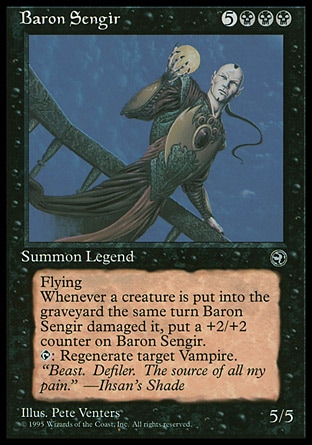
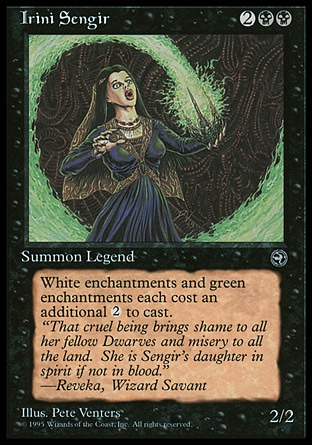
Baron SengirIrini Sengir
One thing that Homelands has going for it? Finally, after multiple expansions of the flavour text talking about Urza and Mishra and Lim-Dul and whatnot, we actually see the main characters of the lore represented in card form, as a Legendary card to boot. Baron Sengir is a Vampire Noble, and he is the guy that the Sengir Vampires from Alpha are named after. Design-wise, Baron Sengir is all right. He's got a vaguely-East-Asian look to his outfit, albeit with a golden Batman symbol snuck in -- again, he definitely looks like a proper 'legend' compared to half of the legendaries in Legends

In addition to the traditional flying ability that most vampires have, Baron Sengir gets more powerful if he kills an enemy personally. He also has the ability to regenerate other vampires. Which sounds good... until you realize that there are only two other vampires in existence at this point of MTG's history, and due to the 'Summon Legend' wording, none of the three Sengir family members are considered vampires at the time of release. That's why we needed the creature type retcons!

Irini Sengir is Baron Sengir's adopted daughter. Happily adopted, because she's also cruel and evil. She's also a dwarf, and she gets her type updated to 'Vampire Dwarf'. I'm not sure what she's doing in this art. Is she unleashing an evil magic spell, or is she absorbing magic? She seems surprised by it, whatever she's doing. Irini has the ability to make Green and White enchantments more expensive to cast, and those two would count as the most traditionally heroic colours. 
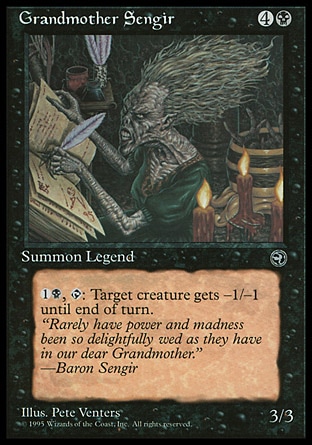
Grandmother SengirIhsan's Shade
Grandmother Sengir is Baron Sengir's crazy grandmother, which I suppose makes some nice thematic sense with the 'old noble family' vibes that many vampire fiction has. She's a very grisly-looking old woman, with terribly-wrinkled skin and an insane head of hair. Her ability isn't quite the 'delightfully wed power and madness' that the flavour text implies, mreely manifesting in -1/-1 counters. 

While Homelands was turned into persona-non-grata by Wizards for decades, the relatively recent multiverse crossover where the Phyrexians attack all the planes have Grandmother Sengir represent Ulgrotha... like this. Riding a hcariot pulled by bats, using a whip to strangle cyborg alien invaders, cackling all the time. Good job, grandma!

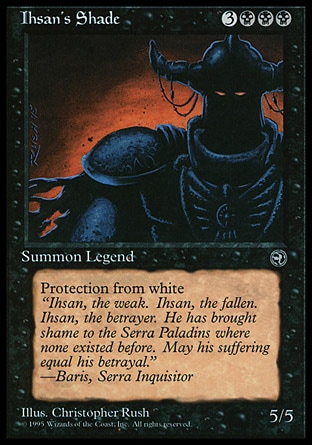
Ihsan's Shade is a pretty cool character if you read his lore, a fallen paladin corrupted and turned into a shade by Baron Sengir. He's another one of the many flavourful legendary creatures, and that flavour text is cool! The card itself? A 6-mana 5/5 with a measly protection from white. That scales so poorly compared to cards like Black Knight from Alpha, let alone comparable cards from the last couple of expansions like Knight of Stromgald or Order of the Ebon Hand. I think getting a cool character with a terrible card is worse than not receiving a card at all. 
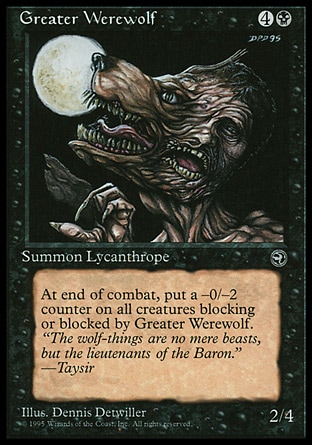
Greater WerewolfTimmerian Fiends
Greater Werewolf is a pretty horrifying card art! The actual creature itself isn't quite as interesting as what werewolves would become in Innistrad, but look at that artwork. Very grotesque, and not what I expect from a regular werewolf transformation in our common pop culture. The wolf head sprouts from the side of the humans' face, with two separate mouths howling. Most uncomfortable is the fact that the human's eye is being integrated into the 'profile' of the wolf face. Now my question is that... is this poor wretched soul mid-transformation, or is this a type of monstrous werewolf who has a screaming half-transformed human face on the side of his head at all times? 

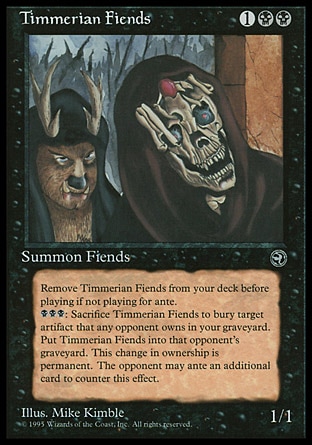
Timmerian Fiends is classified as a Horror, and it's a weird removal that also interacts with the 'gambling' ante stuff... except Timmerian Fiends gives itself to the opponent. Weird! I guess they really don't like you. Not sure about the artwork. One of the guys is a skeleton in a robe with a bunch of growths around his forehead; the other guy is a wombat-person. I'm really not sure what's going on here. 
Cemetery GateBlack Carriage
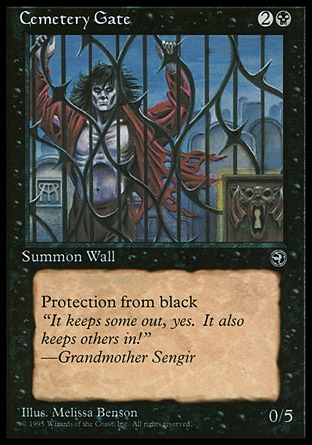
Cemetery Gate is quite hilarious. It's this expansion's Wall creature for Black, and that vampire being kept at bay by the gate is extremely pissed off. He's not furious, he's not terrified, he's not raging or begging or showing any kind of huge emotion. He's just... there. With a 'are you effing kidding me' expression on his face. Like Fallen Empires, Homelands actually features alternate artwork for some cards, although only two variations of any given card exist in the expansion. 

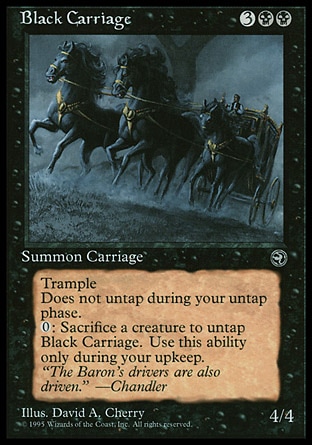
Black Carriage is another example of the design team attempting to simulate what would become the Vehicle card type much, much later. The Black Carriage itself can't untap on its own, and you need to 'sacrifice' a creature for the Black Carriage to be untapped and ready to move around. It's been errata'd from a 'carriage' (which implies the creature represents the whole unit) to 'Horse', so I guess the flavour of the mechanic is the horses just being lazy until they are 'fed' with a creature? 
Feast of the UnicornSea Troll
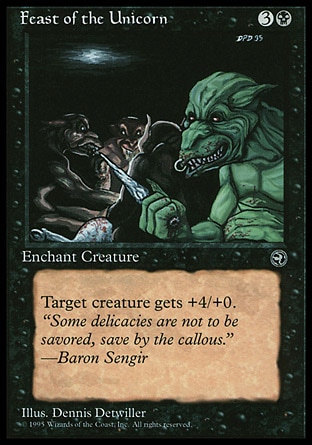
Feast of the Unicorn is a particularly morbid enchantment, isn't it? We don't see anything too graphic, but the bloodied leg of the once-holy beast and the grinning demons surrounding it do paint a pretty grisly picture. 90's-era fantasy tends to be a bit more mature and not quite as all-ages as the genre would later be, but MTG would notably shy away from a lot of these more... brutal card art. 

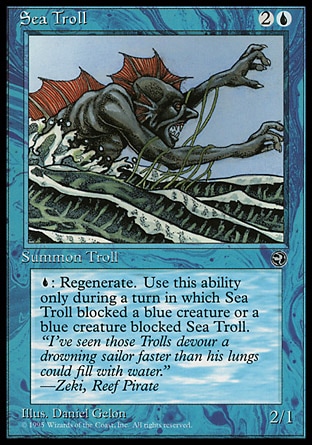
I like the Sea Troll! I don't think MTG ever had 'proper' troll tribal mechanics, did they? And even then, I feel like most of the troll cards I've seen have been in Green or Black. Sea Troll is an aquatic creature, and therefore he's blue. He's got typical sea-monster fins and the 'Regeneration' keyword. Trolls sometimes are flavoured to have a 'healing factor' in the fantasy genre, which is fine... but the Sea Troll can only regenerate if it fights a Blue creature, making it way too specific to justify it being played. I would definitely give it points for being inventive, for sure!
MarjhanGiant Albatross
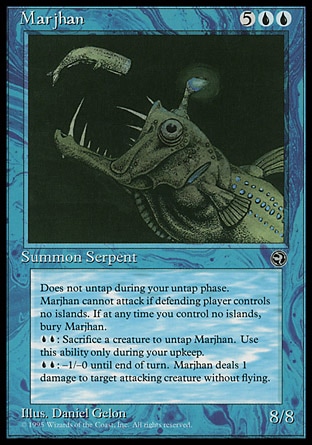
The Majhan is a big fish! Or Serpent, rather. It looks like one of those deep-sea anglerfishes that traumatized a generation of children in 2003 with Finding Nemo, except its body clearly trails off into something longer than a portly anglerfish. And he's not menacing clownfishes, no. The Marjhan's mouth is huge enough to swallow what appears to be a sperm whale whole! Unfortunately, the Marjhan is everything about 'large Blue sea monsters' that are impractical in early MTG. It's got 'Islandhome', which means it can't even attack unless your opponent controls and Island, and it'll die if you don't have any Islands, and it can't untap unless you sacrifice a creature to it. And all that for a 8/8 with an ability to... deal 1 measly damage for 2 mana. That is not worth all of the insane drawbacks that this dude has!

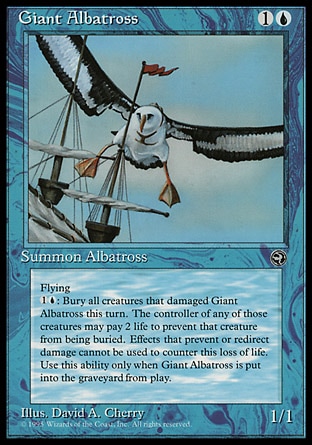
I normally won't talk too much about 'animals as cards' now that we're eight expansions in, but Giant Albatross just tickles my fancy. There's just something hilarious about a non-threatening animal that's so large that it's looming over the ship below it! Not sure what the flavour is, but this giant bird dying can also cause other creatures that damaged it to die. Some costs are involved, but for a set that's been heavy on flavour over functionality, this one is just confusing to me. 
NarwhalGiant Oyster
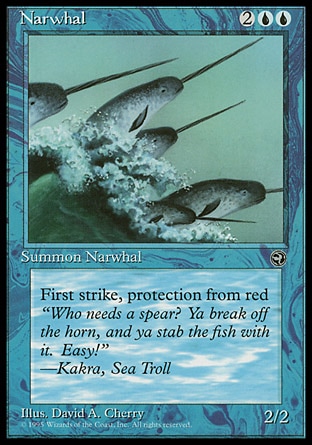
I just really like that the Narwhal is a card. Not a 'Ulgorthan Sea Narwhal', or 'Giant Narwhal', or 'Narwhal Pod'. No, just a Narwhal. Which, to be fair, is a pretty fantastical creature itself. It's got First Strike and Protection from Red for some reason, and apparently those nasty Sea Trolls hunt the Narwhals! 

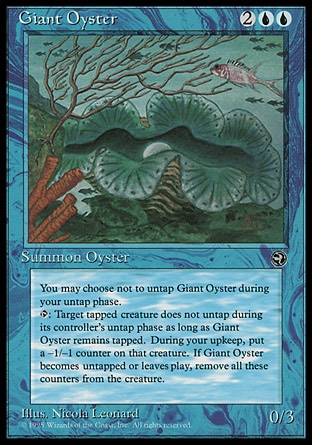
Ey, Giant Oyster! Its got a fun, flavourful effect of tapping and staying tapped, but also trapping an enemy creature with it. And if you pump mana, they slowly get -1/-1 counters until they drown and die. It's a nice representation of them being trapped by an oyster as you drown to death or something. I like it. 

A lot of these early creature types have been errata'd over the years, like alligator being subsumed into 'crocodile', or tiger being subsumed into 'cat', or narwhal becoming a 'whale'. But a lot of aquatic creatures retain their creature type even until modern day, even though there are only a single-digit number of representatives in the thousands of cards in the game. In Giant Oyster's case, a single representative. I love this kookiness, and in the time of how modern MTG has been going back and forth on whether to streamline or go wide with creature types, I really do enjoy some silliness like this. Despite its name, however, the Giant Oyster's artwork actually depicts a giant clam. Clams and oysters are, admittedly, in the same taxonomic class of bivalves, but so are you, dear human reader, and a raccoon.
Dark MazeDark Maze
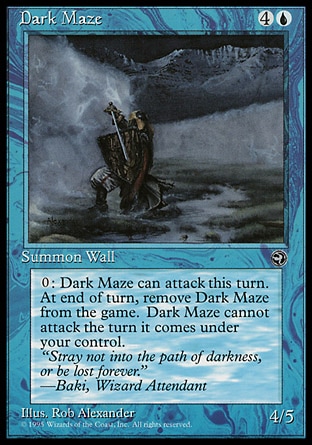
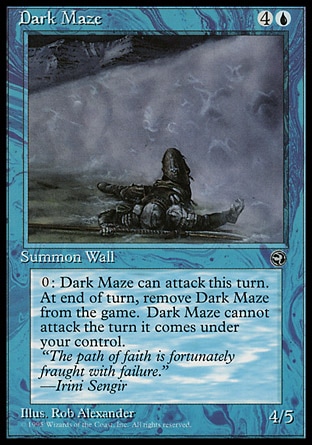
I was originally going to put this at the bottom, but I felt like the interconnected art for the two Dark Maze variants are cool enough. There's not as many cards in these smaller expansions, which gives me a bit more breathing room! The Dark maze depicts a corridor made up of shadowy, foggy walls with screaming ghostly faces fading in and out. We get to see two hapless adventurers falling prey to the dark maze, with one still fighting and the other one having fallen. It definitely is quite flavourful, and the effect has the Dark Maze attack exactly once (Walls can't attack, remember) before being exiled from the game entirely, representing the shadows fading away. Cool! 
Memory LapseHungry Mist
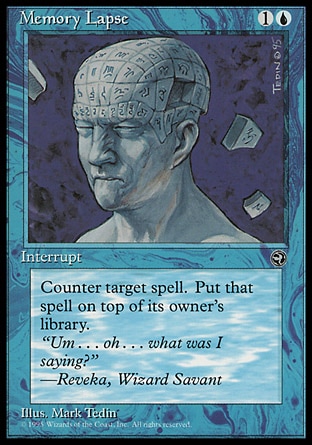
I like Memory Lapse. Okay, part of why I like it is because the artwork reminds me of what would later become the logo for Wikipedia (which this card definitely predates), and it's a nice little way to show little pieces of puzzle falling off someone's memory. But the effect of the spell is literally a memory lapse. The opponent doesn't forget the spell entirely (like what sending it to the graveyard would represent), they just forget it for a brief moment. Like, a turn's worth of time. It's like when you enter a room and forget what you're going to do, and you walk out and then you remember you went back to get your keys. 

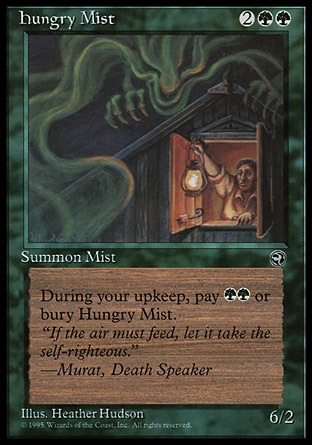
We are into Green now, and we have a pretty cool Hungry Mist! It's a green, noxious mist that's taken a wraith-like form. I like that it doesn't actually have a 'proper' face, but it's actually made up of the wispy trails of the mist. Subsequent errata would turn 'mist' into 'Elemental', which makes sense! This is a kind of a wind elemental!
Willow FaerieFaerie Noble
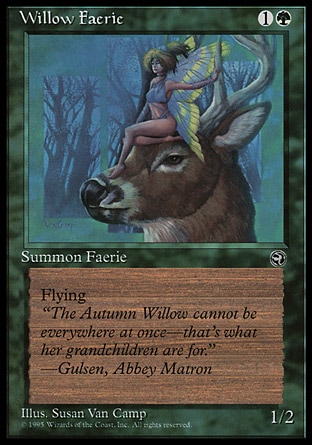
A nice running theme in Green in Homelands are some Faeries. In general I do think that the definitions between things like faeries, ouphes and dryads can be a bit blurry, but I think it's quite consistent that most faeries would be little 'Tinkerbell' style people with bug wings. Willow Faerie is a pretty simple concept, just a lady with butterfly wings, but the fact that she's sitting on top of a deer head is neat enough to illustrate the whole 'fey spirit attuned with nature' fantasy.

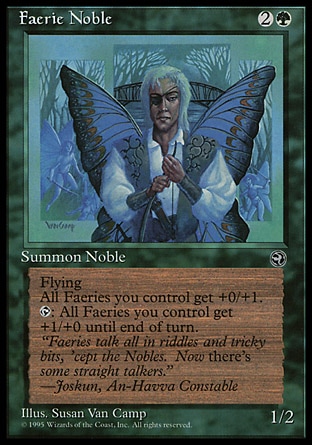
Faerie Noble looks pretty stern, and he has the 'Lord' effect of buffing other faeries on the field. Unfortunately, just buffing the toughness and needing an additional cost to give a temporary buff to power isn't the best effect! I do like the art in general, though, and the eyepatch gives this noble a bit of an oomph that makes these particular 'Willow' faeries a mite more badass. 
Joven's FerretsRysorian Badger
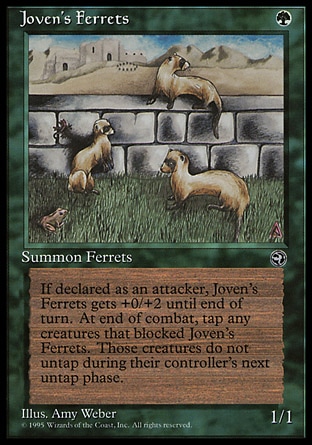
If this was a larger expansion, I'd relegate these two cards at the end. But I don't actually have all that much to talk about the Green cards in Homelands, so Joven's Ferrets and Rysorian Badger get to hang out here and be shown off. I always appreciate it when a TCG (or even tabletop RPG sourcebooks) take the time to detail the smaller, more mundane creatures in real life. Joven's Ferrets are apparently even named after the pet of one of the people who worked on this set. 

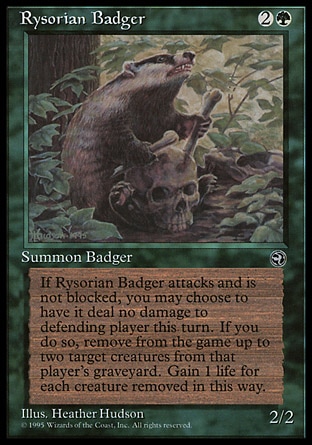
I like the badger card. It is a weak if potentially useful effect, where it removes cards from your opponent's graveyard if it manages to hit the enemy face. The idea is that the badger is scavenging and 'eating' those corpses, which I thought is quite flavourful. I like the art, too, where that skull actually has a second badger that has burrowed up right underneath it, and its little paws are showing up under the skull. 

Amazingly, despite Joven's Ferret currently being the only Ferret in the game, the type still exists! We saw a lot of badgers in the recent 'animal people plane' expansion of Bloomburrow, as well as a bunch of other woodland animals, but not ferrets.
CarapaceCarapace
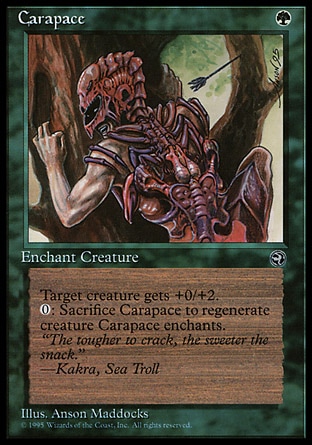
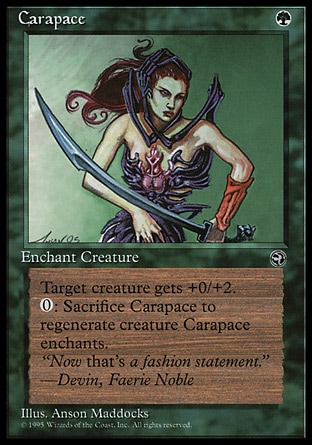
Carapace isn't the best enchantment effects-wise, but actually not a bad card. The toughness boost isn't the best (even if it makes sense for an armour) but the cheap cost and the sacrifice effect for regeneration is pretty neat. Both art variants are very nice, and Anson Maddocks seem to have H.R. Giger's work on his mind while designing this. The first one, featuring the woman, has the strange, chitin-skeleton carapace around her torso and abdomen like a strange dress, and part of it wraps around her neck like a funky neck piece. There seems to be a 'head' with a bug face pointing upwards, which, yes, does also look like a ball-sack a bit. 

The alternate art shows a different Carapace armour, this one wrapping around the wielder's head like a helmet and giving him a very cool -- if creepy -- bug-like helmet. There is a very Facehugger-esque design on his back, a spidery, pelvis-bone-like mass with something that also looks similar to the 'head' on the lady's Carapace's sternum part. It's a lot more consistent than the scavenged Armor Thrull we saw a couple of expansions ago, and I wonder if these Carapace creatures actually do have a symbiotic relationship with their hosts. Or perhaps they're even just natural aspects of the biology?
Root SpiderOrcish Mine
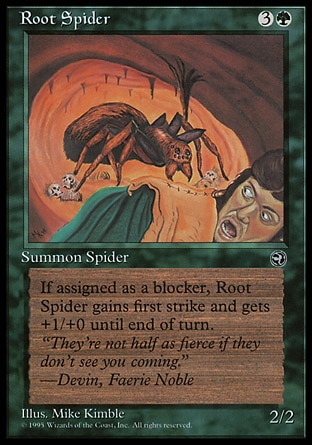
I am contractually obligated to feature every single spider that shows up in this series, so Root Spider gets a writeup. It's just a giant spider in an underground cavern, with skulls littering its little warren. An elf (?) is running away from him. The effect isn't worth anywhere the 4 mana that the card demands, since it's juts getting some bonus effects if the Root Spider blocks. It is, admittedly, flavourful if it represents the Root Spider being more powerful if it is given the chance to ambush you (like a trap-door spider, which we saw in the previous expansion). Also, since this is an underground spider, this is one of the few MTG spiders to not have Reach.

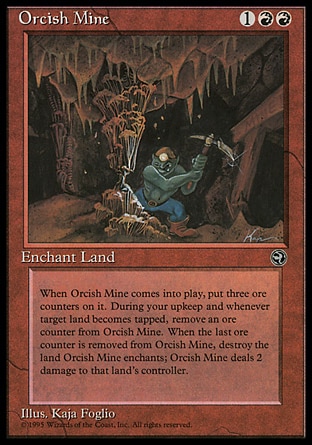
We are starting off Red with an enchantment. Orcish Mine! It is quite a bad card, costing 3 mana and slowly, over multiple turns as the land it enchants gets tapped, Orcish Mine counts down to the destruction of that card. To illustrate how bad this is, Stone Rain from Alpha also costs 3 mana and just says "destroy target land". I like the art and the flavour, though, of this orc just happily chipping away at a giant stalactite/stalagmite pillar, the only thing holding the land up, and it's just getting more and more precarious until the land ultimately collapses. I appreciate the flavour, but this is admittedly one of the many cards from Homelands that is just bad. 
Anaba BodyguardAnaba Shaman
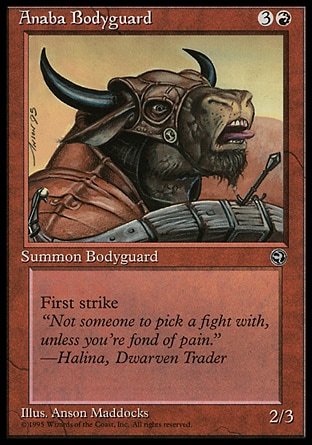
Red has two major creature types being highlighted in Homelands, the first and the more interesting one being minotaurs... though unlike Fallen Empires and Ice Age, a lot of these minotaurs aren't even identified as minotaurs in their creature type text. The art style is quite trying to emulate Hurloon Minotaur from the original Alpha, which I thought was neat. 

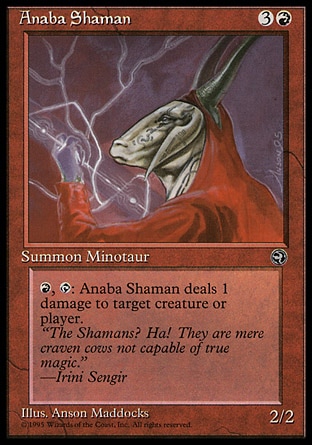
Anaba Bodyguard as a very photo-realistic cow head, while the Anaba Shaman has much softer features with a less boxy snout, longer (and almost rabbit-like) ears and horns that point straight upwards. My knowledge of ungulates isn't the best, but the Anaba Shaman actually looks a bit more like he's an antelope-person, isn't he? He's also got ritual tattoos around his face, similar to the original Hurloon Minotaur. 
Anaba AncestorDwarven Trader
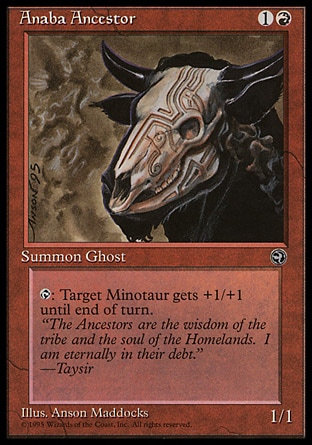
Anaba Ancestor is very cool, featuring a black silhouette of a minotaur's head, with a floating cow skull carved wit the same runes or tattoos that Hurloon Minotaur and Anaba Shaman are. It's a nice and slightly creepy way to represent the ancestral spirits watching over the living tribe. Anaba Ancestor is one of the two cards in this set that buffs other minotaurs, which, thanks to the wording in this set, isn't very good! Anaba Ancestor, as originally printed, is a 'Ghost' and Anaba Bodyguard is a 'Bodyguard'. It'd take some creature type retconning to fix this. Baron Sengir has the same vampire-tribal problem as well. Coming off of Ice Age and Fallen Empires, which did tribal synergy well, it is another unfortunate strike against Homelands

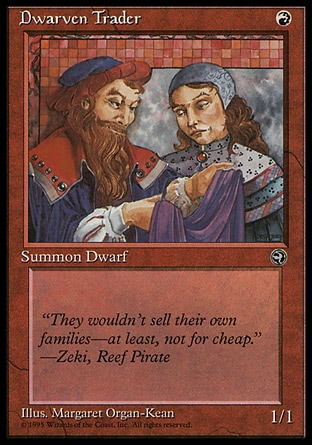
The other half of Red's catalogue in Homelands are dwarves, which, for its credit, tries a bit to diverge from the Tolkien tropes of being blacksmiths and Viking-y warriors... but Dwarven Trader just looks like just some dude. He's a vanilla 1/1, and is just subjected to a rather eye-rolling 'selling family' joke. 
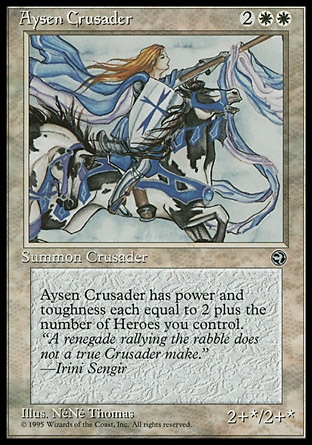
Aysen CrusaderSoraya the Falconer
I've always liked Aysen Crusader's artwork, with the combination of colours and hte many pieces of flowing cloths from her lance and horse barding. Aysen Crusader, just like Baron Sengir, tries to do another typal-tribal synergy by being buffed by 'Hero'. Aysen Crusader herself is not a Hero, and whereas Baron Sengir would have a lot of vampire friends to choose from, there is a grand total of... three Hero cards printed, and the last one is in Homelands

The 'Hero' type would be obsoleted, and Aysen Crusader was errata'd to receive buffs from the much more numerous Soldier and Warrior creature type. Which would've been the end of it if recently, in 2024's (sigh) crossover lines with Marvel comics, MTG resurrected the 'Hero' creature type specifically for superheroes, with lots of superheroes being printed in the subsequent Marvel sets. I guess Aysen Crusader is just like, three decades ahead of the curve. 

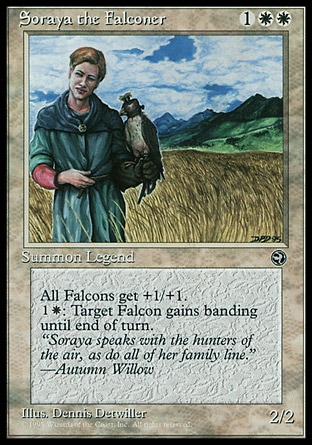
I just really like the specificity in the legendary card Soraya the Falconer. She just really, really likes falcons, and even has the ability to give falcons the infamously bad Banding. How does a falcon even 'band' in formation? But okay. WOTC would decide that they didn't want to be as specific with birds as with woodland mammals, so all birds are rolled into "Bird" and Soraya now buffs all kinds of birds from owls to canaries to whipporwills.
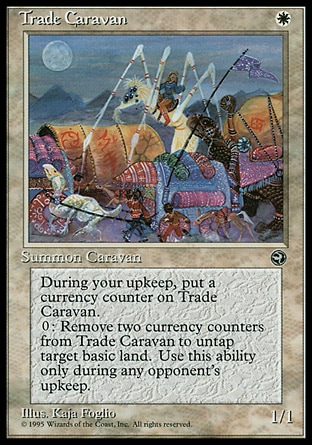
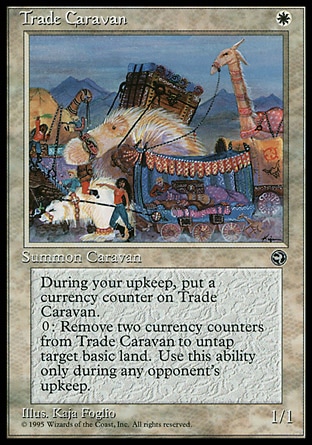
Trade CaravanTrade Caravan
Trade Caravan is amazing with its interconnected art. I love it. Look at everything going on in this art! The giant long-legged white spider! The dinosaur on a chain! The bizare hedgehog-creature with a massive snout! It's very whimsical and adorable all around. I guess whoever was doing the great creature type update just gave up and shrugged and went "Human Nomad, why not" with this. Keep the caravan creature type, cowards! 
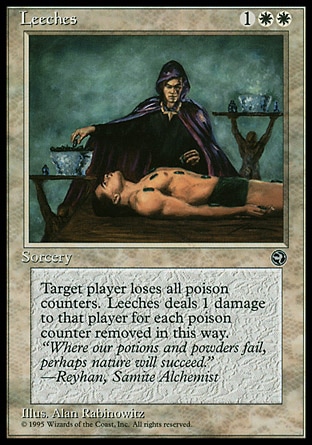
LeechesSerra Bestiary
Continuing Homelands printing cards that doesn't work within its own set, Leeches! Leeches is adorable as a card concept, going back to the time-tried medical bloodletting of the Dark Ages. I miss Assassin's Creed II and its plague doctors insisting that leeching is good for the liver! But Leeches-the-MTG-card removes poison counters (and damages the person that the poison is removed from) which is such a niche alternate-win condition at the time that this is printed. A grand total of zero cards deal poison counters in Homelands, and at the time of the expansion's release, only three cards dealt poison counter damage. Much later, in the Phyrexian expansions in the 2020's, poison counters would make a huge return... which makes Leeches, previously unique for being a terrible and overly-situational tech card, suddenly the only tech card to actually heal poison counters. It doesn't make Leeches suddenly playable, sadly. 

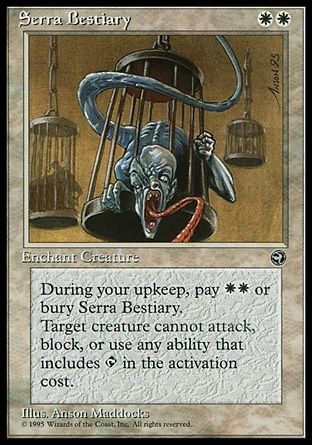
Holy shit, what the fuck is that creature in Serra Bestiary? That sure is a surprisingly deformed face I didn't expect to see on a White card. It's a mutated humanoid (or just a human?) with blue skin and a tail. Serra herself is associated with the iconic Serra Angel from Alpha, a holy planeswalker who's involved in the backstory of Ulgortha. She, uh, apparently keeps some real weirdos in her bestiary!
Feroz's BanRoterothopter
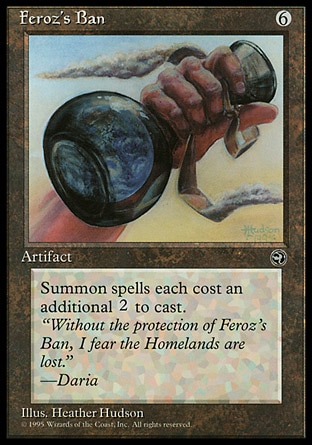
Feroz's Ban is the in-universe reason that Ulgortha is separated from the rest of the Multiverse, trapping Baron Sengir in the plane. The actual spell causes creature cards to cost 2 more to cast (yours, too), and I like the art showing a planet trapped in a flask. 

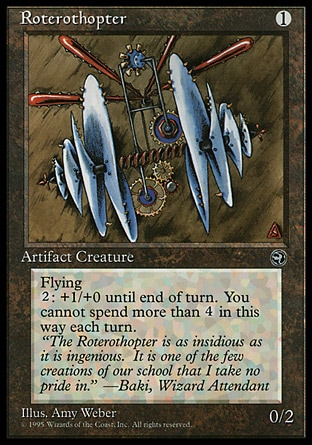
Roterothopter is a variation on the Ornithopter (and I think the second 'Thopter' artifact creature?). The effect of the card is quite bad, and even the guy in the flavour text doens't like it, but I like the Roterothoper having those Da Vinci spinning-turbine things as wings instead of, like, plane wings or helicopter rotos. That's actually adorable. 
Clockwork Gnomes
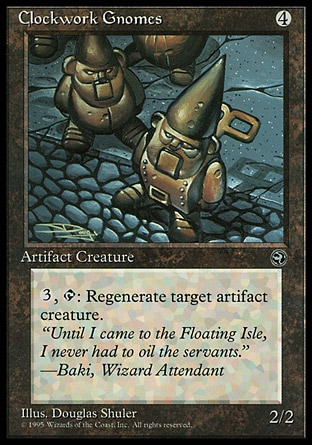
Clockwork Gnomes! One of the few 'Clockwork' creatures to not have the token gimmick in play (and instead has an overcosted regenerate effect), and it's the start of almost all gnomes in MTG being some kind of artifact creature... at least until the Dungeons & Dragons crossover brought regular flesh-and-blood gnomes back. These ones look like clockwork versions of the garden gnomes. 

And with that, let's go to the rest of the cards!
______________________________________________________

Thursday, 29 May 2025

Reviewing Monsters - Starcraft Zerg

So this was originally going to be a three-part talk about me reviewing the three Starcraft factions -- the Terrans, the Protoss and the Zerg. I recently played through the first Starcraft game, which is now free on Battle.net. And to wrap up my trilogy of covering Blizzard's classic games with Warcraft III and Diablo 2, I thought I'd do Starcraft... but then I realized I don't actually have much to say about the Terrans (who are just space humans) or the Protoss (who are space elves, I mean hyper-advanced aliens). The Zerg, though? A combination of popular depictions of aliens as a monstrous hive, like in Aliens or Starship Troopers? Yeah. I have quite a bit to say about them. 

Do note that at the time of writing, I've only played Starcraft I, and most of the lore here is going to be taken from what's given to me in the first game as well as its manual, which, of course, I read. Remember when games used to come with cool manuals detailing the lore and stuff? Man, I miss those.

So, the Zerg. The monstrous giant death-alien swarms intent on turning everything in the world into part of the Brood. Here is the excellent opening cutscene to Starcraft II, and I'll let you enjoy how badass the Zerg swarm truly is!
___________________________


About the Zerg...
So I think I'll make do like the original Starcraft manual, and actually talk about the Zerg and what they are. Summarizing down the five-page backstory given to us in the manual (which really does read like an RPG sourcebook, something I appreciate), the Zerg were originally created by a 'precursor' race called the Xel'Naga. Having previously created the highly-advanced psionic race of the Protoss (one of the three main factions in the game), the Xel'Naga decided to go off and create their polar opposite -- genetically engineering some alien insects to be able to continually evolve by consuming the genetic material of other species. Very Xenomorph-y, and you can just tell that this isn't going to end well. To 'control' the Zerg, the Xel'Naga modified them to have a hive-mind called the Overmind, which you can also tell isn't going to end well. The Zerg stated mutating, slaughtering the local species and assimilating their genetic strains. Real DNA doesn't work this way, but the Zerg are able to 'copy' and integrate genetic material into their subsequent broods, allowing it to adapt and take the forms of the species they slaughter. And they begin to select what species they want to fill their genetic pool, like a bug-lizard-monster version of Star Trek's Borg. You can probably tell, this isn't going to end well. 

Long story short, the Overmind and the assimilated Zerg ended up evolving too much, beyond the control of the Xel'Naga. The Overmind managed to sever the psychic link with its precursors, split up control of his army across 'Cerebrates' (each Cerebrate has a specific function), assimilate some space-faring aliens into its hive, and utterly slaughter the Xel'Naga. As I keep saying, it's a sci-fi horror monster story waiting to happen, and it for sure did not end well. 

With a giant stockpile of genetic material and information from their precursors, and the ability to transverse space, the Zerg now turn their attention to the other two factions in that region of space. Their fellow genetically-engineered Protoss (which the Overmind is cautious about because of their psionic powers) and the humans, or Terrans (which the Overmind hopes to assimilate because they are at the cusp of developing psionic abilities themselves).

And I think it's around this point that I have to say that Starcraft is a "real-time strategy" game, and probably one of the most famous. You play as either the Terran, the Zerg or the Protoss, with each faction harvesting resources and building up different buildings, which in turn train different combat units. It's very similar to Starcraft's fantasy-themed sister game Warcraft, but even across the other -craft games, I feel like the Zerg is probably the one where the flavour of the species and the gameplay is the most intrinsically combined. 


I'm not going to go through every single building, since we're focusing on the unit, but not mentioning them at all feels like a disservice. Whereas the Terrans and Protoss just, y'know, build buildings, the Zerg grow them. They might look like weird coral-like or fungal-like masses of random spikes, tentacles, sphincters and chitinous carapace parts, but they're technically highly-specialized Zerg. They're just unable to fight and are rooted to the spot, focused on doing whatever their function is. You can even "upgrade" these living buildings, probably one of the few times in these games where it makes the most sense. 

This extends to an interesting mechanic called the Creep, where Zerg can't grow all but one of their buildings on just any location. A Hatchery needs to be placed, which causes 'Creep' to cover a set location. The Creep is a nasty, purplish moss-like film that extends out of the main Zerg building, and the Zerg can only grow other buildings on this Creep. It's established to essentially be a network of tissue, similar to bacterial biofilm or a hyphae network in a fungal colony. Very cool and flavourful, and it adds a nice little wrinkle to the Zerg strategy as well... their bases are a bit harder to set up, but to compensate, because of all of that pesky 'buildings are living things' thing we mentioned above, Zerg buildings just automatically regenerate health without cost. Again, it's very cool. 

But not as cool as the actual Zerg units themselves! 
___________________________


Larva
Described by the manual as the 'closest to the original Zerg insectoids' before the Xel'Naga came in and started all the genetic engineering, a set amount of Larvae are spawned over time automatically by structures like Hatcheries and Lairs. They can't fight and just scuttle around your base, ready to be ordered to metamorphosize to any of its 'adult' forms, which has them turn into little cocoons before 'hatching'. It's the representation of the Zerg Larva accessing the collected genetic material of all of the species the Zerg has assimilated into itself, picking and choosing whichever 'adult' form is required by that part of the Hive. Its genetic library gets a bit more robust depending on the amount of structures around it, which is the excuse the game has to have you build certain buildings to access certain units. 

The Larva are generated periodically from 'Hatchery' structures, which actually does put a bit of time-based realism into the whole 'everything grows from our young' thing. Most other races tend to just 'train' their troops, or teleport them in, whereas the Zerg are single-minded in having Larva turn into a final form. 

Design-wise, I'm showing the unit models as they are in Starcraft: Remastered, a graphical update to the original game that is remarkably faithful. Each unit has a model and a 'portrait'. The Larva is neat enough, looking like a weird cross between a centipede and a pillbug, with all the chitin plates and jagged parts that's common among all the Zerg units. The head reminds me of a hellgrammite or something. Official artwork opts for a much more slimy-looking creature, with a less-angular 'head', squiddy tentacles at the rear and less obvious eyes. I think I like the artwork version a bit more, which looks a lot less 'defined', so to speak. 

Zerg Egg
When ordered to mature into one of its various adult forms, Zerg Larvae will turn into an 'egg' form, though it's more biologically accurate to call it a 'cocoon', isn't it? Very nasty-looking thing, too. Segmented bulbs on top of a strange limpet-like organ. 


Drone
So here is one of the possible 'adult stages' of a Zerg Larva... the humble Drone. The Drone is the 'builder' unit for the Zerg, which is a common running theme in these 'Craft games. They gather materials, and they ubild buildings. Peasants, Peons, SCVs... except the Drone doesn't just build the structures! As mentioned above, Zerg structures are themselves Zerg organisms, and Drones mature into these structures when ordered to, essentially consuming it. Very cool! The mass difference is noted to be made up by the Creep. Oh! So that's why we need Creep to build buildings. Very cool! This also makes the Zerg kind of unique in that their worker unit is 'spent' when they transform into a building. 

The design of the Drone is also surprisingly quite threatening-looking, despite having a relatively non-hostile role. It looks like a monster crab-thing, with massive pincers and a body made up of ridges. A strange webbing runs across its spidery/crabby legs. It's quite cool, and official artwork makes it look even more threatening!

The original manual notes all of the species that were 'consumed' by the Zerg, whose DNA and likenesses are utilized to create the different strains. The Drone is based on the "Gashyrr Wasps of Eldersthine". They're wasps! Huh! I guess it's more of the 'worker drone' behaviour instead of the actual visual design... though the Zerg presumably also severely mutates the visual look of the Gashyrr Wasps, if the Zerg-ified humans are anything to go by!


Zergling
And after the two basic worker units, I think we should start with the Zergling. The 'base footsoldier' troop of the Zerg, the Zergling gave rise to the term 'Zerg Rush', which is a strategy in Starcraft where instead of upgrading and building more and more powerful units; you just make use of the Zergling's cheap production price to build a giant horde quickly and send them to crush the enemy before they can get their footing. The Zerglings move fast, attack fast... and die fast. But it doesn't matter when there are so many of them! Most Larva turn into a single larger adult, but each Larva turn into two Zerglings. 

The design of Zergling would change a bit from Starcraft to Starcraft 2 (which is pictured in the art on the right), but the essence is quite the same. Vaguely velociraptor-like beasts that show that they're not just nimble and fast, but threatening. There's a stark difference with the SC2 design, where there are some insect wings and more 'giant pokey bone protrusion' on both of the Zergling's pairs of limbs. Cool carnivorous-dinosaur-with-chitin-plating head, too, which is shared between both Zergling designs. The original design, while having the same vague raptor body plan, has claws with fingers as the upper pair of limbs, and webbed feet. It's still got bony pokey-scythes as arms, though. I like the dorkiness of the Starcraft I Zergling, but I also like that the Zerg improving their assimilation allows for a graphical and in-universe functional update between the two games! At some point the Overmind realizes that the upper pair of 'hands' is useless and Zerglings are better served with stabbers instead!

The manual identifies the Zergling as drawing its genetic strains from Zz'gashi Dune Runners. I'm not sure what kind of animals Dune Runners are supposed to be, but being able to run on desert dunes does make some of the body plan make sense. Like the webbed feet! Apparently it's the simplicity of the Zergling's genetic design that allows the larva to split into two Zergling individuals. Their simplicity also allows the hiveminds to coordinate multiple Zerglings at once. Pretty cool base unit! 


Hydralisk
THE poster boy for the Zerg, or Starcraft in general, is the Hydralisk. This is the big badass monster featured in all the cutscenes and the cover. And just look at that face! It's a face that's not quite a skull, not quite an insect, not quite a reptile. Very monstrous, very Aliens-inspired... but with a fun little twist! Those extra lower mandibles that just out from either side of its head? Which are detached? Surely those don't serve any real practical purpose, but they look badass nonetheless. The Hydralisk's design is most roughly described as being a 'cobra monster', but that does the design a bit of a disservice, doesn't it? Sure, the Hydralisk has a serpentine body and a 'hood', but that hood is a ridged, armoured design that looks like it belongs in some kind of dinosaur instead of a serpent. Or, well, since the Zerg borrows a lot from Alien, it's likely meant to homage the xenomorph's own elongated, ridged cranium. And it's got two giant meat-hooks for arms. Very badass! It looks very cool and honestly, a very badass 'poster' monster for the Zerg. I like it! 

And most interestingly, while they most certainly use those scythe-arms in cutscenes, in-game the Hydralisk is a ranged unit. Those panels on its 'hood' open up and it launches 'needle spines' at the enemy, being able to hit both flying and ground units. Very cool! I like the idea of the Hydralisk as it's presented quite well in the games as well -- whenever the Zerg send a little swarm to harass your bases, it's always a bunch of disposable Zerglings and a couple of Hydralisks. The other units are a bit too specialized to waste in these harassment tactics, and the Hydralisk straddle the line between being 'good enough' and 'not too expensive' to send at you. 

Most interestingly, the Hydralisk's base genus that the Zerg assimilated to borrow this form? A species called the 'Slothien', which the game manual describes as being peaceful herbivores that are caterpillar-like. Again, it's very cool that despite being very selective at what species that they assimilate and somehow the Zerg Overmind saw the potential behind the peaceful herbivores and turned them into nightmarish shock-troopers. 


Lurker
Introduced in the Brood War expansion is the Lurker, which is an 'evolved' form of the Hydralisk. As the war continues, the Zerg apparently found the idea of evolving some of its units to take on hyper-specialized tasks. It's a nice flavour for a 'unit upgrade'! For the Hydralisk, when it evolves into a Lurker, it goes full-on to look like a mutant crab. It still keeps the Hydralisk head and distinctive Xenomorph-like cobra hood, though. Most importantly, he keeps that distinctive extra pair of disconnected mandibles. The two extra mandible pieces are disconnected from each other! That's probably the creepiest part. 

Oh, I don't think I mention that a majority of Zerg units are able to burrow beneath the ground. This causes them to be hidden from view (and survive air strikes) but also allow them to burst out and ambush foolish enemies! While almost all Zerg units can do this, the Lurker takes things further by only being able to attack while buried, making it not as mobile to use in 'rushing' attacks that the Zerg are fond of... but opening new avenues of tactics. In this case, defending their base or doing stealth attacks. I like it! I like that encounters and repeated battles against Terrans and Protoss have caused the Zerg to adapt even more. 


Ultralisk
The big Zerg monster body-checking tanks you see in that cutscene is an Ultralisk, the heavy Zerg ground unit and one of my favourite designs. Another one that the Zerg converted from a peaceful herbivore, this time a species called the 'Brontolith', the Ultralisk is a giant, four-legged bug-monster with a gigantic, distinctive head that reminds me of a Triceratops hood... if a Triceratops hood is made up of bug carapace shaped vaguely like human bone. But the most memorable part of the Ultralisk are its two gigantic fuck-off cleaver blades that serve for its arms, which are called the Kaiser Blades. A bit cheesy for an alien bug monster, but are you going to argue with a scythe-armed dino-bug larger than a tank? 

The Ultralisk is super-badass, but it's also a hyper-specialized unit. Very powerful as a tank and a ground unit, but it has absolutely no way to attack air units, making it the Ultralisk's only unit. It's a very cool-looking giant bug-dinosaur. Very cool!


Overlord
Going away from the combative unit, we're going to talk about the Overlord now. One of the most essential units to the Zerg, the Overlords are the Zergs' equivalent to the buildings that dictate the amount of troops you can have on the battlefield. For most other races in Warcraft and Starcraft, this tend to mean food of some sort. For the Zerg, it's psychic control to ensure all of the units are properly connected to the hive mind. That's so cool! And the larvae mutate into Overlords, who essentially function as living routers for the hive minds, allowing the Overmind or its Cerebrates (a.k.a. you, the player) to control all of the troops in the field. 

You could've fooled me with that design, though. The Overlord's model looks like it could give the Ultralisk a run for its money in terms of looking badass! How creepy is this thing? A giant ominous floating balloon with glowing eyes, six bug legs that hang below it, two chunky crab/scorpion claws, and stag-beetle claws around its mouth? And that portrait just looks sinister!

And the Overlord... is a non-combative unit. It does a lot more than just act as living routers, though. It doubles as a 'radar tower' to sense invisible units, which kind of makes sense since the whole point of why they serve as a supply counter is their advanced/psychic-esque senses. But they also serve as, well, essentially dropships! Which you need a 'Ventral Sacs' upgrade to do, but they can utilize the 'hollows of their reinforced carapace hides' to carry your little horde of Hydralisks and Zerglings and drop them off at the enemy base! Shame they're so slow...

The Overlords are transformed from the 'Gargantis Proximae' race, which is the space-faring race that is mentioned in the Zergs' backstory in the manual. Subsuming the Gargantis Proximae is what allowed the Zerg to access interplanetary travel! 


Mutalisk
Oh, a weirdo! The Mutalisk is the Zergs' primary air-attack unit, and what a weirdo he is! We could've gotten a typical hornet or mosquito or something, but no! This guy is weird. We've got a body plan that could charitably be called "a scorpion's tail with bat wings stuck on it". Look at that triangle-shaped design at the bottom of the Mutalisk. That's the thing's mouth, which also forms its portraitt. On the top part is a structure that kind of looks like a bug's head, making this a two-headed creature. It looks like a weirdo! Later redesigns like this artwork from Starcraft II make the Mutalisk look a bit less weird and a bit more 'mundane', which I thought does lose some of the utterly goofy 'flying prawn' charm of the original. 

The Mutalisks are actually two species in one. The main bat-monster body used to be a "Mantis Screamer" from the Dinares Sector. But that triangle-shaped orifice shoots out tiny little "Glaive Wurms". You can see the tip of it poke out from the Mutalisk's portrait, and in animation they slither in and out like a twisted tongue. Canonically, the Mutalisks launch these worms, which age into adulthood into a whirling glaive like body (so it's like a weird sharp starfish?) and then explode on the enemy! Oh, and they can also travel through space, doubling as the Zergs' spaceships. As if this thing isn't weird enough already!

Guardian
But wait, that's not all! Mutalisks can further metamorphosize into another form, the Guardian. This is apparently based on the 'nesting form' of the Mantis Screamer, turning the Mutalisk into... well, a flying tick. With a very creepy mouth, but design-wise I feel the Guardian is probably the most boring of the Zerg by dint of "merely" being a weirdly-drawn bug instead of the strange hybridization they do for most of the other Zergs. 

The Guardian is harder to kill, as its name implies, and shoots out globs of acid instead of glaive-shaped parasites, but while the acid has greater range, the Guardian can only attack ground targets. They're quite slow and unable to attack airborne units, but are terrifying siege-bombers otherwise. I don't really have much to say about the Guardian, but this "upgraded adult form" proved to be so popular that almost every single Zerg unit would receive one in Starcraft II (and in this game, would lead to the Lurker above in a DLC). Which I will probably cover at some point if I ever start playing that game!


Devourer
The Starcraft: Brood War expansion adds two more units to the Zerg, and the first one is the Devourer. The Devourer is an alternate evolution of the Mutalisk, keeping the Mutalisk body structure but becoming a bit more hornet-like in appearance... if hornets had an engorged thorax, that is, and was covered in spikes all over its underbelly. The idea is for the folded-up form to resemble a giant, floating pair of jaws, I think? 

Where Guardians are focused on destroying ground units, Devourers are specialized to wipe out air units. But instead of shooting glaive wurms, Devourers unleash corrosive acid spores that deal extra damage to flying units, slow them down, ruin cloaking, and damage them over time the more spores are attached to them, making them far more vulnerable to other anti-air attacks like, say, your Mutalisks!

Scourge
Ah, the Scourge. the undead forces of the Lich King, formed by Ghouls, Crypt Fiends, Banshees, Necromancers, Frost Wyrms... what? Wrong Blizzard game? Bah, fine. 

The Zerg's Scourge is the a high-speed airborne unit. They look like a much simpler form of the Mutalisk --  a worm-like body with a mass of teeth pointing outwards, and upside-down bat wings. The Scourges are blind and function very simply -- they're suicide bombers, seeking out enemy starships, slamming into them and exploding as a 'living plasma bomb'. This was featured in one of the earlier cutscenes in the game, where a swarm of these things slam onto a Terran Battleship and forced it to crash-land. To make up for this, two Scourges hatch from a single larva. It does really highlight the Zerg as a massive hivemind, as the Scourges take up roles that some termites or ants do -- killing themselves for the good of the colony. 


Defiler
Our final Zerg unit from the base game is the Defiler, which is a "viral shock trooper". The Defiler looks like a weird silverfish or something, with a very insectoid body but a nasty mass of long bug limbs and a face that reminds you that it's not just a bug. Later depictions would make its thorax a fair bit more bulbous and tumorous. In the actual game, the Defiler's got a demonic reptile-like mouth. In official artwork, that fanged grin extends partway down its long body. Creepy!

The Defiler is one of the few Zerg strains that has a core genus of 'unknown', and it's likely that it's not actually transformed from anything. It's like the Larvae in that it carries the genetic code of every other Zerg breed... but only the 'waste genetic code'. Described as a 'cancer soup', the Defiler uses these to create biochemical toxins. Which I'm not sure how exactly one translates to the other now that I type it out, but the Defiler is essentially one of the Zergs' "spellcaster" units, to borrow a jargon from Warcraft, flavoured as biochemical toxins it unleashes upon its enemy. 

Its "Dark Swarm" ability has the Defiler unleash a horde of smaller parasites to create a swarm to cover its allies and prevent certain types of damage from affecting them. Its "Plague" ability has it launch corrosive spores in a cloud that breaks down anything. But creepiest is its "Consume" ability. The Defiler is noted as the only breed in the Swarm to practice cannibalism, and can eat one of your other Zergs to replenish its stockpile of mana plagues. Nasty!


Queen
Oh yeah, that Queen's face is... definitely not what I expected. I first saw the Queen as a unit, and she looks pretty badass! Six crab-like legs with armoured carapace, and an octopus-like set of fleshy layers forming a 'skirt', and two giant serrated claws on either side of what seemed like a Hydralisk-esque head? And then you look at the portrait and... that... sure is a face. I'm not sure what is the weirdest thing about it. The hammerhead-shark-like eyes jutting on either side, the reverse-T mouth covered with a disturbingly lip-like flesh, or the elephant tusks jutting out of it. It's sure not what I'd expect from a primarily insect-themed alien race. It is really weird, too, because the concept artwork and the various Queens' appearance in Starcraft II (there are a lot of Queen variants in SCII) all have a more 'monstrous' fanged, buggy mouth.

Despite its name, the Queen doesn't actually function like an "Alien Queen" in that it isn't involved in the creation of the larva or Zerglings. Even the manual lampshades this, noting that the name is a bit of a misnomer. She's still a huge shout-out to Aliens, though! The Zerg Queen is functionally a 'spellcaster' unit in this game, with various abilities meant to disable and harass enemies. She is originally an 'Arachnis Brood-Keeper', and she fosters different types of parasites within her body that she launches at the enemy. That's cool! Where the Zerglings and Hydralisks take Aliens' 'unstoppable perfect predator' tropes, the Zerg Queen gets to play around with the body horror part. The four parasites the Queen carries are: Parasite, Ensnare, Spawn Broodlings and Infestation. Two of them are kind of 'units 'of their own!

Ensnare is a goop of biological film that the Queen sprays to slow down forces. Probably the simplest of the Queen's four abilities, and one that is a bit ambiguous whether the Ensnare is just the Queen's own gunk or if it's a minor parasite.

Parasite, described as a 'remora-like' parasite that allows the Overmind (i.e. you) to spy on the enemy it's latched on. The Parasite isn't represented by an in-game unit, but it allows you to spy on enemies via that infected unit. It can only be removed by killing its host -- which is more of a game mechanic thing, but it is really interesting that apparently this creature doesn't kill the host like you'd think an alien parasite would do, but it's constantly turning its host into a spy for a much greater alien swarm to arrive.

Broodlings
The Broodlings are summoned by the Queen's "Spawn Broodlings" ability, where she unleashes a glob of spores at an enemy. The spores eat through and 'fertilize' the organic matter, and can even burn through armoured vehicles to reach the tasty humans within. The spores will then get used to feed Facehuggers, er, I mean Broodlings, which explode out of the host. They only live for a short while, but they've at least killed the life of an enemy. 

Pretty weird design, too, with what appears to be a bird-like fleshy beak and two sets of eyes on the facial portrait, while the in-game model looks a bit like a weird hermit crab creature. 


Infested Terran
The most iconic of the Queen's abilities is Infestation, allowing the Queen to infest a Terran Command Center by saturating it with "parasitic bio-toxins". This causes the Command Center's human civilians to be turned into "Infested Terrans". The model is pretty simple, with a chunky Marine sprouting spikes, having their arms and legs replaced with chunky meaty Zerg-flesh, and hey, it's got the Zergling's cute extra scythe-limbs!

The portrait is quite a bit scarier, though, with the Marine's fishbowl-like glass helmet being shattered, and the face being desiccated with glowing eyes and a giant tentacle replacing its mouth and nose. The Infested Terrans are basically Zergified humans, which gives you an idea of how much the Zerg changed the Zz'gashi Dune Runners or the Arachnis Brood-Keepers or whatever when they assimilate them! The Infested Terrans, by the way, are essentially suicide bombers, their bodies used as little factories that produce unstable chemicals. They are also the only non-character Zerg unit that talk, saying things like "live for the swarm" and "let me serve". All Starcraft units have a gag line or two or five if you click them to much, but not the Infested Terran, who insists that he is Zerg.

Sarah Kerrigan, Queen of Blades
And during the course of the first game's campaign, the Zerg actually do capture -- and obsessively protect -- one of the main human characters. It's probably the most well-known plot twist nowadays, but Sarah Kerrigan, one of the humans with psionic abilities, was captured and transformed into a Zerg-hybrid by the Overmind. Her original Zergified portrait wasn't the most unflattering, and her in-game model is a humanoid with four spiky wings. But artwork for the tie-in material would make her far more... well, humanoid. In a 'still-attractive goth lady' vibe. Her body seemed like it was originally meant to be more grotesque like the Infested Terrans (though it's really hard to tell), whereas all modern portrayals of Kerrigan tends to have her basically be a musculature-meatsuit. Or, well, bug-chitin-in-the-shape-of-human-musculature. Which... it certainly made her popular, if nothing else. I do like her tendril-like hair and her wings made up of what looks like they're bones. 

Of course, you can't keep a good named character down. While she was initially a powerful asset to the Overmind, when it's busy fighting with the Protoss, Sarah Kerrigan began to gain her independence and begin what's essentially a civil war within the supposedly-unified minds of the Zerg. A lot of her story and her ultimate fate is told throughout the first expansion, Brood War, as well as throughout the entirety of StarCraft II, which I haven't played yet. But again, it's a really cool way to bring in the whole 'corruption' angle for our parasitic aliens. 
________________________________

And with that, we finish our Zerg coverage! I could go and talk about other characters, but I find that I don't have much to say about the Protoss and especially the Terrans, as much as I did enjoy playing through their campaigns.