
Well, we don't get too much of an extension of my little coverage of Volo's Guide to Monsters. I did have to push some entries from the previous part to this one, which ended up ballooning this part ever so slightly, which is why it's split into two. Compared to my revision of the Monster Manual, I thought I did a decent job not ending up being too verbose. But then again, that's the whole point of doing these reviews, right? To talk about the monsters.
I really do find writing about fresher, newer monsters to be a lot easier than a lot of the classics, though. There's generally less lore and 'in other settings' baggage to them and I can talk about them a lot more easily as a standalone monster design. This is something that really does make it a bit harder for me to go to the edition-opening bestiaries for other editions of D&D.
- Click here for the previous part.
- Click here for the next part.
- Click here for the index.
[Originally published in April 2020, revised in March 2026]
____________________________________________________
Morkoth
- 5.5E/5E: Medium Aberration; Chaotic Evil; CR 11
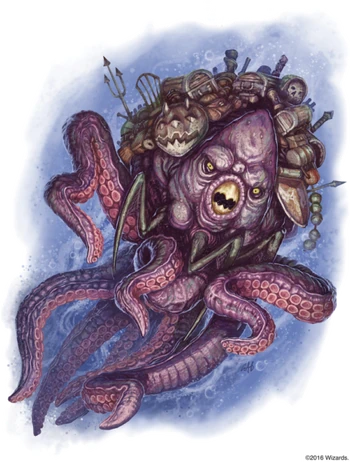
A personal favourite monster from Dungeons & Dragons' history is the Morkoth, which has a fair bit written about them. Standing at a respectable CR 11, the Morkoths in 5E are given a new identity as aberrations that focus a lot on collection. The artwork shown of the Morkoth has its body filled with a mass of random clutter of civilization... which also functions as the Morkoth's treasure. 5E Morkoths are described as being formed from fragments of a dead deity of greed and strife, whose body was transformed into floating extraplanar islands. And in each of these islands, a Morkoth was born out of the flesh of the dead forgotten god.
The Morkoths in 5E are actually rather simply-designed, with a design that's basically a monster octopus. Sure, it's got some extra insect-like legs, and a beak and eye that protrudes and gives it a less bestial face, but it's still quite distinctly 'just' an alien octopus. Which is a bit disappointing considering how weird 5E makes them... 5E did a great 'reboot' for the Morkoth in everything but its visual design, I feel. Morkoths are highly intelligent, but are driven by greed and selfishness. They desire anything and everything, and collect everything from the multiverse. They're like collectors who only wish to acquire more and more and more and more, and this goes from anything to ancient civilization to treasure to captives to knowledge. Critical Role did a particularly awesome depiction of this monster in Vokodo, who essentially 'collected' an entire civilization with its powers, rendering them all amnesiac members of a civilization on the remote island it claimed as its lair.
A Morkoth itself is a powerful spellcaster, being treated as the equivalent to an 11th-level spellcaster with abilities like Dimension Door, Chain Lightning, Geas and Evard's Black Tentacles. They also innately have the ability to hypnotize people and charm them to run towards the Morkoth. They are also able to reflect and redirect spells, causing your party's Fireballs to bounce off its body and hit your friends. That's neat!
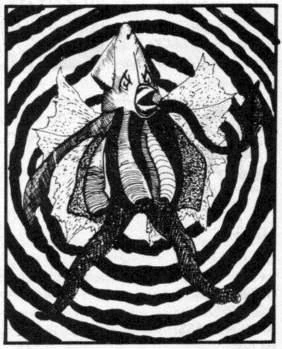
But the coolest part of the Morkoth is its lair, something that the 5E Morkoth shares with its predecessors. A Morkoth's extraplanar island is noted to be particularly dream-like and chaotic, being a jumble of the Morkoth's collection and unstable darkness. The only real constant is the environment's wetness and warmness, which the Morkoth finds comfortable. This 'pearl-like' island could be found anywhere from the Astral Plane, floating above the Lower Planes, or the bottom of the ocean; the latter being a nod to the traditional Morkoths which we'll briefly talk about below.
Within their little bubbles, Morkoths maintain a collection that is often as ageless as the Morkoths themselves, which could contain even civilizations that worship the Morkoths as a god. Morkoths are also not unreasonable, willing to trade information or even their treasures in exchange for something that they are missing in their hoard. And of course, the focus on a Morkoth's mobile pearl lair is ripe for regional effects. Morkoths always know the location of people that have entered their domain, as well as every item within. Anyone who enters will slowly lose items as they get supernaturally taken and incorporated into a Morkoth's collection, and Morkoths have an enchantment on their lairs that compel creatures to move towards its lair and beeline towards it.
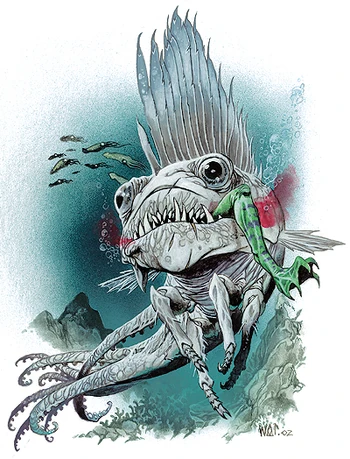
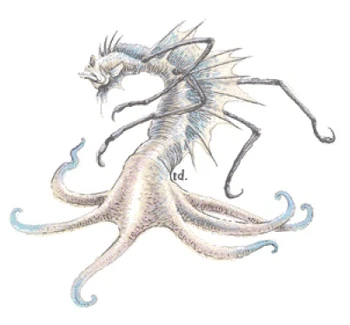
And let's talk about the Morkoth's previous incarnations. The Morkoth debuted in 1E's Monster Manual, rather surprisingly, and looked like a weird 'tokusatsu villain' with a fish-squid head, and a body like a man with noodly arms. Almost the entire focus is on the Morkoth's strange hypnotic lair. 2E gives me probably my favourite Morkoth design, giving the Morkoth a fish-head on an eel-like body; long insectoid (crustacean?) 'hands' and a body that tapers off into octopus limbs. It looks the most like a weird undersea creature, and focuses still on their strange lairs, although it also characterizes the Morkoths as being malicious and cruel. The 3E version plays on the 2E design but emphasizes the 'monster fish' part so much that it just looks like a weird fish with tentacle-tails and some prawn hands. A lot of the 3E lore is a repeat of the previous one... and while I don't like the 'fragments of the dead god' bit, I do like giving the 5E Morkoths the motivation and characterization of obsessive collectors, and using their hypnotism to charm those who wander into their lair.
____________________________________________________
Neogi
- 5.5E/5E: Tiny Aberration; Lawful Evil; CR 1/8 (Hatchling)
- 5.5E/5E: Small Aberration; Lawful Evil; CR 3 (Neogi)
- 5.5E/5E: Medium Aberration; Lawful Evil; CR 4 (Neogi Master)
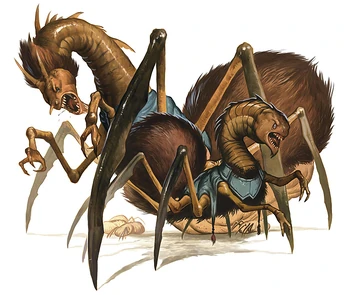
The Neogi are best described as 'eel-spider' monsters that are sentient, with the main thing about their culture is that they're slavers. I am actually surprised to learn that they were introduced in 1st Edition's Fiend Folio instead of what I associate them the most of, Spelljammer. The Neogi were very strongly featured in Spelljammer content, and they really do have this pulpy 'space' vibe to them. Even their 5th Edition art really leaned into this, giving them space-esque armour. I am not the biggest fan of their 4E/5E artwork, though, finding them a bit too mundane as a 'fusion' monster. Notably, Volo's Guide to Monster reuses Neogi artwork from 4th Edition, and this artwork was used not only in Multiverse, but when new Neogi stats were introduced in 5E's take on Spelljammer. Odd. Both the 3E and 2E artwork really made for far weirder-looking and alien-looking designs, I feel.
Again, a Neogi's culture is all about slavery, and they consider all other creatures that are weaker to be only good for slavery. This sentiment extends even to other Neogi, as long as they are weaker. A Neogi wants to subjugate and enslave their prey both physically and mentally, and in fact adult Neogi innately have an 'enslave' ability as well as a mental fortitude, keeping with their space-y psionic theme. The stronger 'Neogi Master' has access to a bunch of spells, which they have obtained from warlock-like pacts with dark elder-god star beings.
Volo's Guide to Monsters presents the Neogi as not only being exclusive to the Astral Sea (i.e. space) but also in locations like the Feywild and Shadowfell, although they retain their older edition lore of being invaders from 'a remote location on the Material Plane' (i.e. another planet). This bit of being aliens with psionic abilities is probably why they are classified as aberrations. The Neogi are particularly associated with the Umber Hulks, subjugating them and using them as a slave race. They're not fussy about who they claim as slaves, marking them with dyes, magic and tattoos.
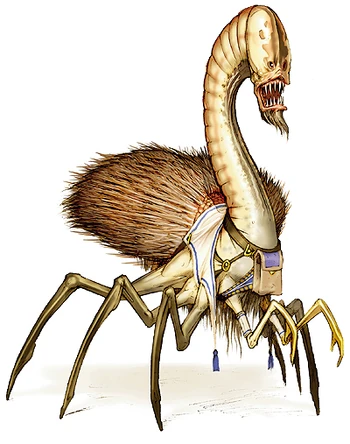

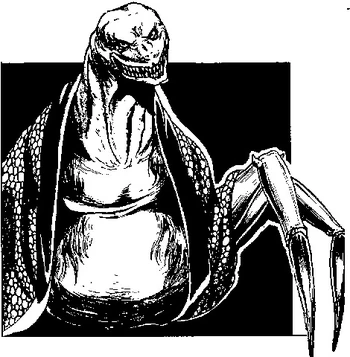
A Neogi's mentality is that slavery and subjugation is just normal to them, because their mind-control powers are natural. This leads to their strange culture where individuality isn't really a thing other than a hierarchy where 'naturally' whoever is stronger becomes a master. Somehow, despite all of this, Neogi are also devious profiteers, engaging in many shady mercantile activities, while at the same time planning to enslave any customers or patrons that are weaker than them. Due to their penchant of treachery, however, Volo's does note that most other species tend to band together to drive away the Neogi caravan; and only powerful or desperate individuals really try to barter with Neogi seriously.
In addition to all this, Neogi have a weird life cycle. As the elder ones among the Neogi grow old and weak, the younger ones will swarm it, inject it with venom, and transform the old Neogi into a mass of flesh called the 'Great Old Master' which becomes a repository for younger Neogi to lay eggs on it. When the eggs hatch, they devour each other and the Great Old Master until only the strongest ones are left, and then they get immediately subjugated by adult Neogi.
Around halfway through its 5E lifespan, Dungeons & Dragons is noticeably moving away from having slavery be part of a species's culture... which I don't think is the right way to tackle this sensitive topic. The Monsters of the Multiverse book removes mentions of slavery from a bunch of species like the Grung, but notably not the Neogi. The descriptions are cut down slightly, but it's still there and the abilities are still called 'Enslave'. Considering how the flavour of the Neogi is meant to be the most repulsive and reprehensive species out there, however, I think it's okay to have it be the defining feature of a species that was written to be hated.
____________________________________________________
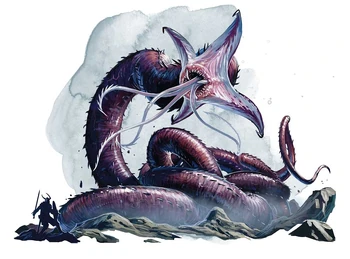
Neothelid
- 5.5E/5E: Gargantuan Aberration; Chaotic Evil; CR 13
A huge fan of this one, particularly with the 5th Edition artwork. The Neothelid is a gigantic worm with a starfish-shaped mouth, and a mass of tentacles bursting out of a lamprey-like maw. Despite its appearance, however, the Neothelid has nothing to do with a Purple Worm! That was my first instinct when I saw it for the first time. Instead, the Neothelid is the result of a Mind Flayer's reproductive cycle gone wrong. As mentioned in the previous bit when we were talking about Elder Brains, Mind Flayers use little larval stages called 'tadpoles' and inject them into humanoids to transform them into adult Illithids. Normally, a given colony has a clutch of these tadpoles.
Sometimes, however, a colony and its Elder Brain is wiped out and the tadpoles, with no one to care for, and the tadpoles grow wild, cannibalizing the other tadpoles in the little pool. The disconnection from their hivemind probably has something to do with it as well. Only one will survive out of a thousands that a normal Mind Flayer pool... and this survivor will mutate into a massive Neothelid.
The Neothelid mutates into a gigantic, gargantuan size and this is due to the lack of the structure of a donor (heh) brain. Normally, Illithids kill any tadpole that grows too big before ceremorphosis, and feed it to the other tadpoles... specifically to prevent the creation of the Neothelid. It's really an interesting facet of Mind Flayer culture, especially since they normally don't care much about anything but world domination.
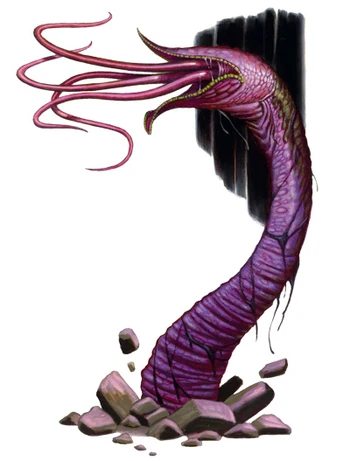
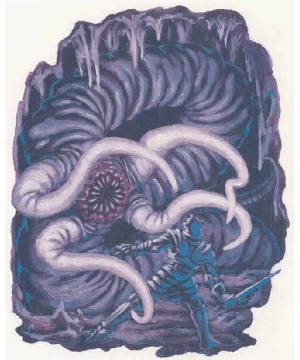
The Neothelid is particularly terrifying to the Elder Brain because of its extremely low intelligence of 3, essentially making them invisible to the Elder Brain's intelligence-dependent psionics or other Mind Flayer minions like Intellect Devourers or Mindwitnesses. The Neothelid itself simply rampages through whatever it can, constantly hungry and constantly slaying everything in its path. In addition to being a giant worm, Neothelids have the Illithids' "Creature Sense" that allows them to sense intelligent creatures (including Illithids), plus a scattering of psionic powers. Interestingly, the Neothelid possesses a blast of tissue-dissolving enzymes that rather cutely melts all flesh... except for brain tissue. That's very specific, but very on-brand for these creatures.
I find the existence of these things to be quite interesting and frankly refreshing. Neothelids are anathema to the Mind Flayer culture and they will organize raiding bands to get rid of them, meaning these giant worms are alien even to the alien species. Creatures like the Neothelid really do increase the possibility of your party being caught between two adversaries that are mutually attempting to destroy each other, and it is also nice to see an 'elite' Mind Flayer boss that isn't just part of the 'Mind Flayer did experiments on their captives' genre.
____________________________________________________
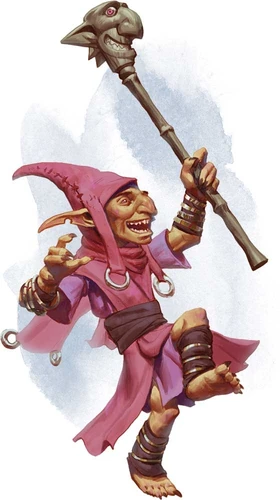
- 5.5E/5E: Small Humanoid; Chaotic Evil; CR 1
To my genuine surprise, we don't get any new Goblin statblocks in Volo's Guide to Monsters despite a huge chunk of the goblinoid culture coming from there. We do get two new Hobgoblins, but it wouldn't be until the 2024 Monster Manual that we really get new goblin statblocks. Considering we got like a half-dozen for each variant of giantkin, just saying...
Anyway, Volo's Guide to Monsters emphasizes how the goblin god called Maglubiyet conquered and 'made' the races of the hobgoblins, goblins and bugbears under his own, subjugating all their gods and forcing them to all be 'goblinoids'. This explains why the three goblinoid races are so different visually and thematically. I don't really like answers to how a species behaves to be 'because the cosmic war in the backstory says so', but in this case I feel like they did some nice things with it. This explains why the goblins and hobgoblins in particular work together despite theoretically not liking each other: the base fantasy for goblins are sneaky, cowardly little scrappers that utilize traps and sneaky tactics to fight enemies; while hobgoblins are essentially a disciplined army.
In this backstory, after Maglubiyet conquered the goblin pantheon, the essence of one of their gods, a trickster god, somehow survives in the form of powerful spirits that arrive whenever goblinoids create a marching host. When such a host is formed, the hobgoblins would subjugate the goblins and force them into regimented minions, cannon fodder for the more powerful hobgoblins and bugbears. But this possessing spirit will arrive and cause chaos for the goblins' sake.
This spirit, this fragment of a god, is called a Nilbog. Nilbog, if you haven't gotten it, is 'Goblin' spelled backwards. A Nilbog arises particularly when Goblins are mistreated by their more powerful cousins, and the Nilbog is transformed into a powerful force of nature, The Mask style, that forces others to do the opposite of what they desire. They've got a trait called 'Nilbogism' that forces creatures that attack it to praise the Nilbog, and they have a 'Reversal of Fortune' ability that transforms damage dealt to it into healing. Not reflected in the statblock is that if a Nilbog is killed (since all those abilities are just checks in-game), the spirit just possesses a new Goblin. I like the fact that this led to a practice that Hobgoblins and Bugbears would appoint a Goblin as a jester, and even if they aren't a Nilbog, the presence of one Goblin Jester that's allowed to go around and be a dick to everyone wards off the Nilbog spirit, supposedly.
The lore is a bit too tied to the specific way that the Forgotten Realms goblinoids work, but I do like it. This is a fun little gimmick and the potential social encounters that you may present your party with this. Of note is that Nilbogs appeared all the way back in the 1st Edition's Fiend Folio, regrettably one of the creatures there that did not receive artwork. The Nilbogism lore, sans the hogboblin/goblin dynamic, was all there even from the original Fiend Folio! Even the contrarian effects, which is described multiple times as a 'spatio-temporal reversal'. Notably, the Fiend Folio notes that the Nilbog can't be harmed normally, and only curative actions (like 'force-feeding it healing potions') can harm it. Interesting!
____________________________________________________
Quickling
- 5.5E/5E: Tiny Fey; Chaotic Evil; CR 1
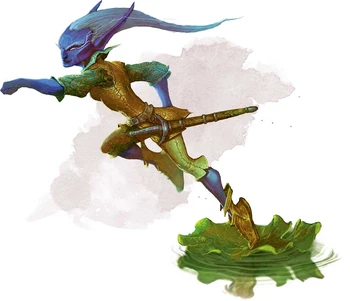
We've got another violent fey, which is a nice addition considering so much of the fey in the original Monster Manual tend to lean on the non-hostile or neutral side. Quicklings look like little elves with exaggerated features and super-long hair, and the whole gimmick that they have is their insanely fast speed. Quicklings move at a highly accelerated rate compared to what most beings would consider normal, and they appear mostly like a blur moving through the air. Translating this to statblocks, this means that the Quicklings can far more easily dodge attacks, and any attack towards a non-incapacitated Quickling is always on a disadvantage. They're just bouncing and zipping around the place all the time.
However, this also translates to their extremely short life. Due to their nature, the Quicklings' "internal clock" is sped up. Their lifespan, therefore, is vastly reduced to what they originally would have had, and Volo's notes that Quicklings only live up to fifteen years. This is a nice contrast to how so many other beings in D&D tend to have their long, immortal lives emphasized (elves, giants, dragons, treants...) and the Quicklings are an interesting subversion of that. They view the world similarly to how fiction depicts super-speed (particularly in superhero movie): everything in the world moves super-slowly to the Quickling, and even lightning bolts and rain look lazy to them.
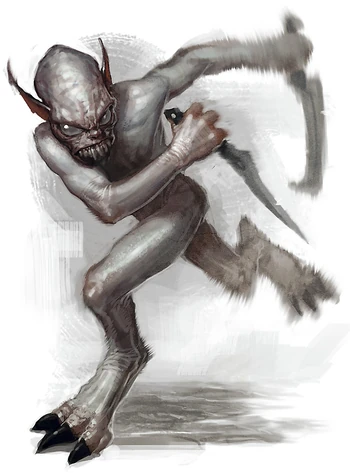

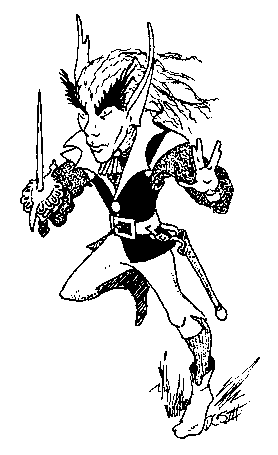
There is a backstory to these guys. At one point, the race that would be the Quickling were lazy and arrogant, and they make the mistake of answering the summons of a powerful Unseelie archfey called the Queen of Air and Darkness. This constant lateness caused the Queen to cast a curse on the entire Quickling race, shrinking them and speeding their time up. I would also like to note that 4E Quickling, which looks positively demonic. I get the idea of wanting to make the evil little fey look most threatening, but that one goes a bit too far from the concept, I feel.
Quicklings are also noted to find it difficult to speak to other beings since they actually need to deliberately speak slowly... much much more slowly, and they would rather not do that. And due to how differently they view the world, their 'mischief' tends to often be laced with just a bit of malice. The line they won't cross seem to be murder and maybe maiming, but it is noted that Quicklings 'enjoy causing suffering that transcends mere mischief', making use of their small size and fast speed to steal important letters, planting stolen items here and there, and generally wrecking havoc in discord's name.
These guys are interesting little buggers, if a little one-note. I know I used them a fair amount of times as quick, simple Fey-themed enemies, and the other nice option for a simple Feywild hostile encounter is the following entry...
____________________________________________________
Redcap
Redcap
- 5.5E/5E: Small Fey; Chaotic Evil; CR 3
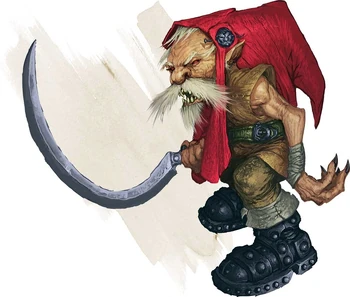
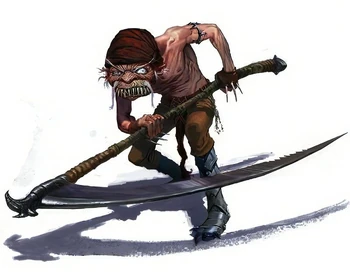
I've always been a fan of the Redcap, even if they are a rather obvious 'look at this conveniently always violent enemy' for the Fey. Creatures like the Redcap and Meenlock do fill in a gap in the original Monster Manual where there really aren't a lot of openly antagonistic Fey other than the Hags, and they are more of a scheming type of villain. Redcaps are simple villains, looking like angry, mean old men with giant sickles and massive iron boots.
Redcaps are born out of specifically blood lust, which ties to the pseudo-throughline in 5E Fey where most of them are associated with some kind of powerful emotion. Similar to the origins offered to the Boggles and Meenlocks in Volo's, the Redcap is born out of a Fey-touched location where someone acts on an intense desire for bloodshed, and the Redcap are born from where the blood of a slain person soaks the ground. In a whimsical bit of detail that's a nice contrast to the rest of the creature, Redcaps appear as tiny bloodstained mushrooms, before moonlight causes them to properly 'pop' out and attack.
Redcaps just go for instant violence and mayhem, and they are simply incapable of doing anything subtly or stealthily. The iron boots that are part of their anatomy force them to take massive thunderous steps... but they aren't actually slow all the time. One of their abilities is 'Ironbound Pursuit', where they suddenly charge in a burst of speed and does a kick with their iron boots. They are also deceptively strong despite their wizened looks, counting as a 'medium' creature instead of a 'small' creature in grappling checks.
In Volo's, the Redcap is described to always need to soak their hat in the fresh blood of its victims, and they need to replenish every three days or they will vanish. This doesn't seem particularly sustainable, especially with the descriptions in the subsequent passages noting that Redcaps find employment with Hags and dark mages... although I suppose they could just keep spilling blood and not killing their targets? Redcaps doesn't seem to be the type to show restraint. Redcaps can also supernaturally sense the being whose murder led to their birth... and depending on how bloodthirsty their 'parent' is, the Redcaps will either pick their creator as a victim, or as a potential kindred spirit and master.
Always liked the vibe of the Redcap as a simple enemy, and even if you don't want to deal with all the origin story about the Redcap, simply having it be a violent Fey employed by other more powerful creatures (one of the Hag villains in Witchlight grows Redcaps in her garden) works quite well.
____________________________________________________

Rot Grub


- 5.5E/5E: Medium Swarm of Tiny Beasts; Unaligned; CR 1/2
In Volo's Guide to Monsters, the Rot Grub (or rather, 'Swarm of Rot Grubs') is just a little monster in the appendix of the book, and is essentially an accompanying stat block for the Kobold Inventor. One of the Kobold Inventor's abilities is to launch one such swarm of Rot Grubs at you. How fun! In Monsters of the Multiverse, the Swarm of Rot Grubs got their own entry and a brand new art piece, featuring a half-dead unfortunate soul screaming alive as grubs burrow out of his bloody flesh and drop out of his arms and face.
The trope isn't that far off in real life, where myiasis happens with regular maggots. Rot Grubs, being part of a fantasy setting, takes all the horrors associated with maggots parasitizing your flesh and takes it up to eleven. Rot Grubs burrow into a creature when disturbed, and chew their way into vital organs. The grubs, being inside the poor soul, are essentially immune to most abilities to get them out. Even magic that stops poison only slows down the infection but would not remove the grubs. Per the flavour text and the ability box, the host needs to take fire damage (i.e. be set on fire) for the Rot Grubs to panic and move out of the body.
Rather interestingly, while Rot Grubs prefer to infest corpses and carrion, they can also survive on vegetation, meaning that they don't even have to do all this nasty mess about burrowing into flesh and killing their host. This isn't even an obligate part of their parasitic life cycle, nor is it like real-world flies that opportunistically lay their eggs on what it thinks is rotten flesh. No, these Rot Grubs just casually attack whoever disturbs them while they're munching on carrion.
One last note is that the Rot Grub is one of the monsters introduced all the way in the original 1st Edition Monster Manual, and I'm happy to see them make their way to 5th Edition. Just like many other 'gotcha' monsters in 1E, they can cause instant death the moment they burrow to your heart.
____________________________________________________
Sea Spawn
- 5.5E/5E: Medium Humanoid (5E), Monstrosity (5.5E0; Neutral Evil; CR 1
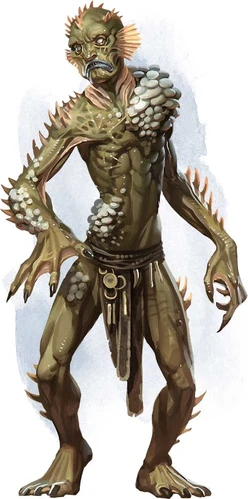
Where the Deep Scion is a more intelligent infiltrator and one with a monstrous but still 'workable' design, the Sea Spawn is a bit more wretched looking. It's got a stilted gait, and random features of underwater animals growing out asymmetrically from its body. He's got webbed hands, fish fins growing out of his cheeks, gills on his necks, and random clumps of barnacles on his torso and arms. That asymmetry is what really sells it.
The visual vibe of the Sea Spawn reminds me the most of Davy Jones's cursed crew from Pirates of the Caribbean, who were transformed by the curse and slowly merge with undersea creatures over time. Volo's also includes a short blurb about a location called the Purple Rocks, where the community sacrifices all babies to a local Kraken, who transforms all the children into beings that resemble humans, but transform into Sea Spawn when they reach old age and rejoin their master in the depths... very much based on Lovecraft's Shadow Over Innsmouth, including some with more advanced transformations that have to hide themselves from outsiders.
The origin of the Sea Spawn can be anything related to the ocean, as the flavour text notes that even in-universe there are many tales on where these beings come from. There are many in-universe stories like 'be wary of falling in love with a merfolk' or 'honour the sea gods, but never give them your heart', while above the table the book lists Krakens, Sea Hags, Marids, Morkoths, Dragon Turtles and even Storm Giants as all being powerful underwater beings that can 'mark' mortals to claim them as their minions. Whether by a bargain or a curse, once warped into a Sea Spawn, they are bound to the sea, unable to leave the ocean for more than a day before suffocating to death.
The prose mentions that Sea Spawn comes in a wide variety of horns, which is carte blanche for the DM to get creative. This also extends to their abilities, with the statblock having a random 'piscine anatomy' to select from one of three features: 'bite' (sharks or other bite-y fish), 'poison quills' (sea urchins, stingrays, etc) or 'tentacles' (octopi, squid, etc). It's a simple statblock since the Sea Spawn are just CR 1 minions, but I do wish that we got just a bit more out of them. This is one monster where I wouldn't mind having multiple variations of, just saying. I do appreciate them, though. Along with the Deep Scion introduced in this same book, that's two brand-new 'aquatic Lovecraftian horror' monster that 5th Edition gave to us.
____________________________________________________
Shadow Mastiff
- 5.5E/5E: Medium Monstrosity; Neutral Evil; CR 2 (regular), 3 (Alpha)
The Shadow Mastiff is another 'evil dog', thrown into a monster trope that D&D has an abundance of. By my quick count, the Monster Manual has around six of these monster dogs/wolves. These Shadow Mastiffs are associated with the Shadowfell, and they cross over to the Material Plane where the veil between planes are thin. They are pack hunters, so the moment one of these Mastiffs find a breach, it is likely to bring in the rest of its pack. This behaviour is honestly not particularly special; it's just that normally it's fiends that try to breach the veil between dimensions. That's honestly the whole plot of Stranger Things season one, except some shadow dogs aren't exactly as memorable as the Demogorgon from that show.
As you'd expect from a Shadow Mastiff, they can meld into shadows, and are sensitive to sunlight (but are okay with regular light). They are also incredibly good hunters, having the keen senses of a hunting dog while also having the bonus ability to see ethereal creatures. Volo's Guide to Monsters make a lot of mention about the 'Alpha' of the pack, which was just a tiny sidebar in the original entry but graduated into a full, proper statblock in Monsters of the Multiverse. These Alphas have a terrifying howl that strikes fear into their prey, and also summons the rest of the pack.

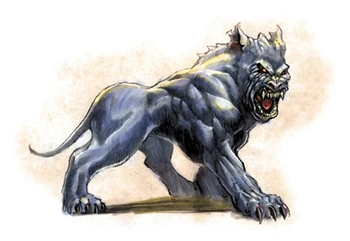

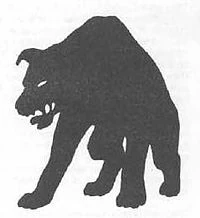
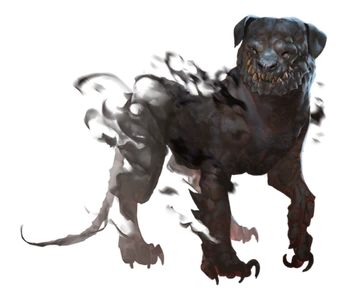
I do like the look in the 5th Edition artwork, which really emphasizes the Shadow Mastiff's body flickering off into the shadow. That face still doesn't look like a proper mastiff, something only the 2E art really got right, but at least it looks like a monstrous dog now instead of the weirder faces that 3E and 4E gave it.
When not randomly roaming the Shadowfell or sneaking into the Material Plane, it is noted that some faiths devoted to deities of the night will perform rituals to summon Shadow Mastiffs as guards. That last bit really does seem like a last-minute detail to give us a little plot hook, because ultimately there's nothing particularly interesting about this critter. It is notable that this entry is one of the few that Multiverse cuts down a lot on, but we really don't lose much information from the original printing. It's just a basic monster from the Shadowfell, and that's fine, but with the lack of many other Shadowfell creatures introduced in Volo's it feels a bit of a random addition.
____________________________________________________

- 5.5E/5E: Medium Ooze; Chaotic Evil; CR 3
The Slithering Tracker is another monster that debuted in the 1st Edition Monster Manual, and I do get the feeling that one of the stated missions of Volo's Guide to Monsters and Mordekainen's Tome of Foes is to update to 5th Edition as many monsters in the original Monster Manual as possible. Which is a task that they mostly managed quite well, I would say. The Slithering Tracker is one of those early-D&D monsters that feels created to fill in a role, not too dissimilar to beings like the Invisible Stalker. Without much artwork given to it other than a lone 2E art and being a lot less iconic compared to other oozes and water elementals, the Slithering Tracker kind of fell into obscurity. So I'm quite happy to see it given new life in a... rather grotesque manner.
The Slithering Tracker is a rather rare ooze monster with a lot of the stealthy abilities of some of the more advanced elementals like the Invisible Stalker and Water Weird, being able to turn essentially invisible in water, and having advantages when it is tracking prey. It has a bunch of other traits that make it great at hiding, ambushing, and transferring damage to its victim when it's grappling it.

The lore behind this thing is one of vengeance, where those who desire vengeance undergoes a ritual where they transform into 'semiliquid sentience'. They die in the process, and the froth and moisture that bubbles out of their body coalesce into a Slithering Tracker. As Slithering Trackers, they can flow and squeeze into places where a normal creature can't go, and kill its prey. As the new 5E artwork shows, their 'Life Leech' ability is flavoured as them latching onto their prey and sucking all the blood and bodily fluids out of those that they are angered towards, which is why the Slithering Tracker is dripping red where it is attached to its victim. Love the screaming face on the end as well.
This monster is a rough tie-in to one of Volo's spotlight monsters, Hags, which is listed as one of the possible beings that have access to the ritual to create a Slithering Tracker. Liches and cultists are also able to do that, but I imagine that when a Hag transforms someone into a Slithering Tracker, it's out of malice and a misinterpreted request. "Please, Hag, give me the ability to track down my enemy and give me the power to kill them!" Only instead of becoming a cool warlock, you become a semi-sentient ooze.
What happens after a Tracker has finished killing its prey? It depends on the DM. Some Trackers just go mad from the desire of blood and attack indiscriminately. Others continue to kill any allies of their targets, regardless of the full awareness of the original mind that became the Tracker, which would be the more interesting plot hook. Perhaps a crime syndicate or police force keeps finding their members killed and drained of blood, but instead of a regular sadistic killer, you have a half-crazed being just slithering around, intelligent enough to know who belongs to the organization but not enough awareness to stop. I like this plot hook quite a bit, and the focus on being obsessed with vengeance is a nice plot hook for this otherwise redundant creature.


