Tuesday, 27 March 2018

Black Lightning S01E09 Review: Family Feud

Black Lightning, Season 1, Episode 9: The Book of Little Black Lies


Huh. This episode's theme is honestly simple. "Sometimes parents keep a secret from you because they want to protect you, and sometimes it goes on for too long". It wraps the two central conflicts here, with Jefferson being absolutely angry at Gambi for keeping the whole secret about his involvement in the metahumans of Freeland and indirectly with the death of Jeff's dad. The theme is also central to Anissa revealing to Jennifer that they're a super-powered family, and Jennifer is absolutely aghast at everything that's going on, least of all her entire family keeping such a big secret from her.


Unlike the recent episode of Arrow I just reviewed, though, the personalities of these characters, and the very human and well-written conflicts that these characters go through, make "the Book of Little Black Lies" a far more engaging 45-minute episode of television than "All for Nothing". Sure, maybe it's because the Pierce family and its dynamic is genuinely fresh, what with them being brand-new characters to us, but it's also because the theme isn't forced or abruptly shoehorned recently, and is given time to grow. Jennifer going from pouting to listening to accepting is paced really well, and Jefferson's frustration and eventual sympathy to Gambi, helped by his interaction with Anissa gently calling him out on his hypocrisy, is also well-done. None of it is blatantly shoehorned in our face, but it's not subtle either, a rare case where the subtlety and obviousness is balanced well.

(Oh, and Anissa gets her brand-new fancy black-and-gold costume, which normally would be the thing I hype about, but is genuinely an afterthought when I was writing this review)

On the down side, there's a very light amount of action in this episode, with what little we get being Black Lightning and Thunder blowing up the Green Light factory, and fighting a bunch of ASA men, but that's honestly quite short. Poor Inspector Hendersen spends the entire episode with such a death-flag over his head, but he actually made it out alive and well. Unlike Arrow's sixth season, which prioritizes plot over well-paced character development, Black Lightning shoves the plot way into the background and focuses a lot more on character interaction and character growth, and it shows in such a more satisfying episode. Time will tell if the lack of focus on the over-arching plot will hurt the series in retrospect, since both Tobias and La-La are absent in this episode... but it does make for one hell of an emotionally satisfying episode.

I do really like what they did with Jennifer. Previously she's been the oddball of the family, being kinda detached from everything because she's just a normal, slightly-bratty teenager. But seeing her thrust into this wacky world of superpowers, added with the burden of the whole "my family's keeping a secret from me" deal, means that Jennifer's understandably freaking out. She doesn't want any of this vigilantism or changing the world nonsense. And considering her attempt to try to 'change' the world ended with Khalil crippled and bitter, who can blame her? Her crying in Lynn's arms as she sobs about just wanting to be normal, wanting to grow old and have kids and not have to deal with any of this great-power-great-responsibility nonsense is definitely well-acted. It contrasts amazingly well the the awkward, goofy, "I am Thunder! Look at me do Thunder stuff!" revelation as Anissa shows off her power to lift Jennifer's bed.

Jefferson sees superpowers as a burden and an addiction -- but it's a burden he'll gladly bear. Anissa sees it as a calling and a way to change her world. Even non-powered Lynn sees it as a necessary evil that may one day fuck them up, but is necessary for the greater good. Jennifer just doesn't want anything to do with it, and it's amazingly well-told. Both Anissa and Jefferson see both their civilian and superhero lives as basically being the same thing -- trying to be visionaries changing the world. Jennifer is just a scared teenage girl wanting a normal life, so she understandably freaks out... and I feel that it's the most human scene in this show.

Gambi doesn't get much to actually do, but his interactions with Anissa, trying desperately to reconnect with a family he genuinely cares and loves, but at the same time understanding what he did is rather unforgiveable... it's a great scene.

There are some weaker moments in this episode, of course, like the Obama mask bit, and the action scene feels somewhat underwhelming... but ultimately, it's a pretty satisfying episode.

DC Easter Eggs Corner:

  • Anissa finally gets her black-and-gold costume, based on her newer costume from the New 52 reboot and how she has looked in the comics ever since.
  • Lynn makes jokes about how she's Vixen and later Supergirl, a reference to two other DC comics superheroes adapted into CW shows. Jury's still out on whether Black Lightning is set in any of those universes, though, or if they are just comic books. I think they're being intentionally vague.

The Flash S04E14 Review: Fiddle Me A Tune

The Flash, Season 4, Episode 14: Subject 9


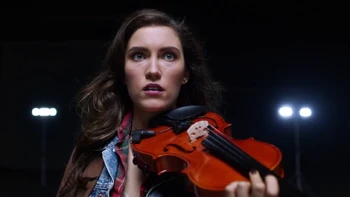
Oh, okay, this one's actually quite a decent episode. Part of it is because the TV adaptation of the Fiddler has so much fun and energy put into her that it genuinely puts every single non-Ralph bus metahuman before her to shame, but the retooling of her character from her source  material to a younger lady country singer is such a well-done update that it's impossible not to like her, honestly. And while I'm not the biggest fan of the previous episode, it does give Team Flash at least something interesting to do.  Prevent the Thinker from capturing all of the other bus metahumans and continue his spree of body-jumping and presumably killing other metahumans to obtain their powers. Jury's still out if Dwarfstar, Bison and Killgore actually died in the previous episode. The fact that Hazard and Fiddler, the only other metas we care about, are under the Thinker's thumb, does probably mean that we're going to have "oh, no, they're alive all along", but it does bring a sense of urgency to the happenings that Team Flash will have to rescue these metahumans from the Thinker's hunt -- if not so for the still-mysterious three metahumans, then because we care for Ralph Dibny.

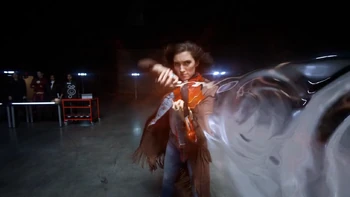
In the short single episode, they manage to inject a huge amount of characterization to Izzy Bowin as an up-and-coming country singer that plays the violin, who ends up being zapped with the metahuman powers to manifest... well, Black Canary powers, basically. Between Fiddler and Purity over in Supergirl, they really manage to milk the sonic scream animation for a lot of characters in the CW-verse, huh? 

Team Flash hunts down Izzy Bowin, and after an altercation with Hazard!Thinker where Fiddler manages to actually hurt Thinker with a violin blast, Barry is very much convinced that his next step is to train the Fiddler as the newest superheroing member of Team Flash... and Barry ends up pushing Fiddler a bit too hard, driving her away because she doesn't have time for any of this shit, getting plates thrown at her and all that jazz. I really wished the show thought that its audience was smart enough to figure this out instead of having characters quite literally stand around saying "you pushed too hard, and pushed her out of the door".

But meanwhile, Ralph plays the other side of the coin on this part, befriending Izzy Bowin not in the whole creepy lecherous way, but because he understands what it feels like to be an up-and-coming metahuman with the asterisk that some insane nutjob in a chair is trying to murder you some time down the line. Ralph's connection with Izzy ends up being enough of an emotional anchor that when the Thinker actually do shows up to murder-steal Izzy, Ralph and Barry banging on Thinker's Plot Device Force Field is genuinely touching. 

Of course, it does really pull me out of the episode that Barry doesn't feel guiltier about indirectly causing Izzy's presumed death. Sure, he's all sad and morose about it, but it feels like he's a bit more sad that he "pushed too hard" as opposed to the fact that, y'know, Izzy's dead. Still, we're only three metahumans left to the finale, and DeVoe's now played by Miranda MacDougall, and apparently he needs to jump bodies a bit more quickly because Hazard's body can't handle the strain of having multiple powers at once? Oookay? 

The thing about the Thinker that really makes me sure that the writers don't really have a proper long-term plan for the character? The fact that this super-genius guy that previous episodes implied that he even set up the coincidence that one of the metahumans is the dude whose Barry's cellmate ends up getting framed for? That uber-smart chessmaster? Yeah, he apparently didn't bother putting trackers or keeping tabs on three of the metahumans that he needs for his grand plan. 

Meanwhile, Barry gets kicked out of his  job due to the bad reputation surrounding him, and also because in a city full of metahumans ("faking someone's death is so easy in this city" was the argument Cecile went with, after all) it's so easy to, y'know, fake someone being alive. I'm geniunely not sure why they didn't do a DNA test because surely Ralph can't fake their DNA, but at the same time I don't care at all about any of the trial subplot... but now Barry's hanging out with Ralph as his PI sidekick. That's actually somewhat neat. 
The Harry/Cecile storyline is hilarious, though, and another great moment for the episode. From how Cecile notes that "Joe keeps me awake at night" and Harry's "umm" face until Cecile clarifies that it's because of her new psychic powers, and Harry's constant attempts to try and be nice and build a big-ass heavy science helmet to block out Cecile's powers, and then thinking that they could use that against DeVoe because of something that Savitar name-dropped in the previous season, was particularly clever... and makes the subversion that, hey, the goobledeygonk was used against DeVoe. it didn't beat DeVoe. Regardless, though, Harry's frustration and Cecile being a perfectly good friend are really well delivered, and I'm a big fan of this wacky friendship. 

Overall, despite the  downer ending and the still-poorly written Barry, it's actually an episode that ends up being pretty decent and well-done, both in the episode-of-the-week portion and as a piece to an overarching serialized story. 

DC Easter Eggs Corner:       
  • The Fiddler in the comics is actually an older man called Isaac Bowin, a thief who learned musical hypnotism powers from an Indian snake charmer (later stories would retcon this to actually being a demon, explaining the Fiddler's borderline-magical powers), and eventually uses a combination of these skills and technology to construct a powerful violin that allowed him to unleash powerful shockwaves and create sonic force bubbles. The Fiddler would go on to menace the first Flash, Jay Garrick, and later his successor Barry Allen. 
  • A blink-and-miss it part in Izzy's website, but Izzy mentions a 'starfish situation', a reference to episode 7 of this season, where Wally mentions off-handedly that he fought an alien starfish (likely Starro) in Blue Valley. 
  • The name "DeVoe" was name-dropped in the third season by Savitar, and the scene where Savitar-Barry notes that this was where they would develop a cerebral inhibitor to use against DeVoe was replayed here. 
  • Ralph suggests the name "Soundwave" for Izzy, before throwing the name out of the window, noting that there's a Transformer with that name -- and in the various times that the Transformers franchise has been rebooted, Soundwave has been one of the more enduring characters. 

Monday, 26 March 2018

Arrow S06E12 Review: Death in the Family

Arrow, Season 6, Episode 12: All For Nothing


Arrow's sixth season is kind of unique. On one hand, the week-by-week writing is definitely some of the best that the show's gotten, especially compared to the trainwrecks that are seasons 3 and 4. On the other hand, the 'big picture' writing and the writing of the individual characters are so inconsistent and all over the place that I have some genuinely mixed feelings about this. It's, on paper, a pretty great episode that explores a couple of recurring side-characters and ends with a shocking twist that I genuinely don't see coming. But when taken into context the characters being utilized and the writing behind them? My reaction is honestly "m'eh". It's not outright bad, but at the same time this episode is so drab and dark for genuinely no real good reason. Yes, Arrow is a lot darker -- by a huge margin -- compared to its CW siblings. At the same time, it's also the most bland.

And while serious storytelling is neat, there's also the sense of them stretching drama for longer than it should... except it really isn't. Sure, it's built up throughout the season, but this is where the Dinah/Vince storyline really comes to the forefront as the A-plot of anything. And the B-plot is Quentin trying to 'redeem' Evil Laurel, something that, again, while hinted at before, has never been given a lot of focus until now. But at the same time it's still very dull. There's nothing objectively wrong with this episode per se, but at the same time the end result really feels bleh.

Let's dissect the B-plot first, shall we? Essentially, Quentin finds out that Evil Laurel has been following him for... some reason, and then he and Thea get convinced that maybe, just maybe, there's a shade of Good Laurel within Evil Laurel somewhere. It's a neat sentiment, and the maybe-maybe-not interaction is well delivered by actors Katie Cassidy and Paul Blackthorne... but at the same time, Quentin's obsession isn't anything particularly fresh, and the downer ending to this story as Quentin is told that his hopes are dashed to the ground is well-acted. It's a neat little storyline, honestly, well-written and well-acted, but again, I can't muster a lot of energy to be excited about it. 

Vigilante's whole "I'm a double-agent" deal feels honestly shoehorned in to try and restore the character into his heroic roots, but it's too little, too late. By this point, Vigilante's been such a recurring villain that his sudden "but I'm actually good, you guys!" storyline ends up feeling like we're discussing a completely different character. Admittedly, Vigilante's big role last season was to "troll" longtime fans by subverting the expected Adrian Chase/Vigilante reveal, but at the same time it also means that Vigilante ends up being an afterthought throughout most of his appearances last season, and here it's clear that they didn't really have that much of a plan surrounding him until these past few episodes. Redemption of a soulless killer is one thing, but Vigilante essentially goes through what Oliver Queen did in five seasons within the space of three episodes, and the result is a really jarring whiplash. Not to mention Dinah and Vince just had a brutal fight not a couple of episodes ago over the fact that Vigilante's in bed with Helix. 

And the flashback this time around centers around Dinah and Vince and... and it's bizarrely a rehash of Dinah's origin story and the events leading up to the disastrous sting operation, and I'm genuinely baffled. It's well acted, sure. It's also well-written. But it adds nothing about Dinah and Vince that we don't already know. 

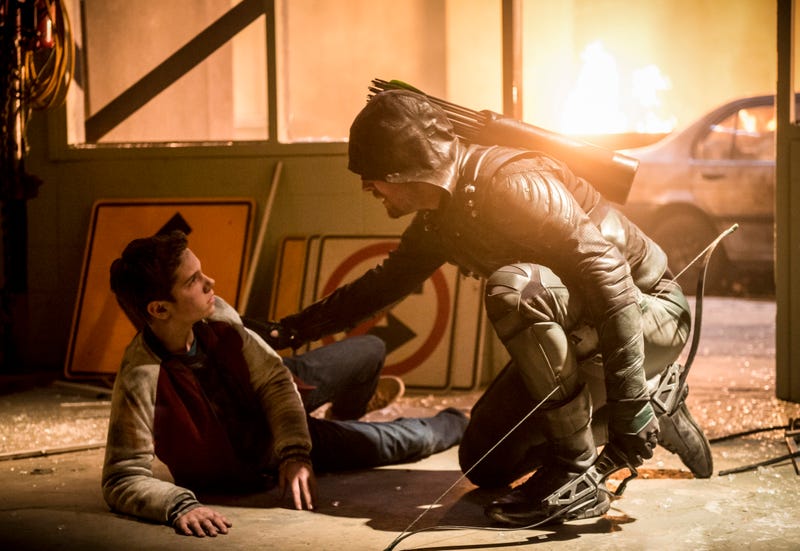
And again, the relationship between present-day Dinah and Vince feel rather poorly executed, even if both actors try their best. It feels more like a "get from point A to point B" storyline as Vigilante ends up working together with Team Arrow and the Outsiders to copy Helix's entire database and send it off to Felicity. We get some great confrontation between Vince and Cayden James, but ultimately Anatoly (proving that he is a "good man" by tasering someone from the back) ends up torturing Vince to draw the Outsiders in, splitting the good guys in twain as Team Arrow is forced to deal with the bomb (and a bunch of hostages) while the Outsiders fail to save Vigilante. Who gets sonic-screamed to death pretty graphically by Evil Laurel. 

And that's the whole point of Vigilante, whose death ends up just being a catalyst for Dinah to essentially become the DC Punisher, vowing to murder everyone in Helix. And also to re-affirm that Black Siren is indeed evil. And yeah. The episode succeeds well in slamming down these two points, and in a nutshell, the episode does get the job done. On the other hand... it has the unenviable task of trying to frame Vigilante's redemption arc in a way that is downright unbelievable in the time-frame provided, and thus Vigilante's death ends up in a resounding "eh, I didn't see that coming" from me. It's what happens when a story prioritizes plot over characterization, and it's not a very compelling story as a result.  

Sunday, 25 March 2018

DC's Legends of Tomorrow S03E14 Review: Hound Dog

DC's Legend of Tomorrow, Season 3, Episode 14: Amazing Grace


Legends of Tomorrow is a show that isn't much for long-time planning. Even moreso than its compatriots Arrow, Supergirl, Flash and Black Lightning, Legends of Tomorrow quite literally doesn't give two shits about the logistics of time travel or really crafting a proper long-term storyline, existing mostly for the laughs and one-off episodes instead of a proper epic superhero sci-fi show. I've learned to accept that, and have enjoyed these episodes a lot more as a result. But sometimes you get an episode like "Amazing Grace" that ends up being so utterly daft that it probably wouldn't get past the editorial team even in the Golden Age. (Who am I kidding? The Golden Age lets you print any stupid story.)

The concept of them hunting down the mysterious sixth totem -- the Death Totem, as it's revealed to be -- and that it's actually embedded in an aspiring Elvis Presley's guitar is an interesting and wacky-zany hook for an episode of Legends of Tomorrow. But the execution is so predictable and honestly quite genuinely piss-poor that I can't really say much about this episode. Apparently Elvis uses this to communicate with his dead twin brother, we get some wacky "ROCK IS SATANISM" angry preacher thrown in (and also the preacher quite literally waffles between "hateful small-minded preacher" and "understanding uncle" like three times in this episode), we get the fact that the death totem causes ghosts to come to life, and there's some half-assed attempt to tell a message about accepting death?

There's some attempt to give a mini character arc for Nate and his love for rock music and getting the 'music moment' with Amaya with Elvis's rendition of the religious song Amazing Grace, but it all fell flat. Even moreso because they didn't even bother to actually showcase some African music and relied on the shortcut of "Nate is listening to it via headphones". There's a long subplot about Mick's emotional shock as his pet rat, Axl, dies and is one of the ghosts brought back to life, but not even Dominic Purcell and Brandon Routh's acting chops can save this plotline, which ran on for way, way for too long and didn't have that interesting of a payoff.

The best part of the episode has to be Wally West's dopey "hay guys am I helpful now?" as he just keeps using his super-speed to instantly do any task asked of him, but I genuinely really think that, hey, that's a plus point for these guys. Zari is immensely irritated by Wally's constant "yep I did that, am I helpful?" puppy-dog-eyed happiness. And Zari's speech about how sometimes zooming in with super-speed might make things would strike a proper chord if the Legends hasn't been so insanely reckless with time travel throughout the entire series. Still, I can't be too mad, since the pairing of Wally and Zari are easily the only actual funny moments in this trainwreck of an episode. 

Black Lightning S01E08 Review: Confrontation

Black Lightning, Season 1, Episode 8: The Book of Revelations


Yep, definitely another great episode. As the title suggests, we get a whole ton of revelations, and it's not just for the audience's benefit either -- Black Lightning himself also gets a fair ton of things revealed to him. Most important of all is the confrontation between Black Lightning and Gambi. As Lynn figures out the fact that Green Light and Black Lightning's DNA are practically identical, she confronts Gambi... who morosely tells Lynn that he and Jefferson should talk it over together. And, yes, there's a whole lot of other things that go on here, but Jefferson and Gambi's confrontation is the most powerful moment in this episode. From Gambi telling Jefferson that he's directly responsible for introducing a version of proto-Green-Light into Freeland, and when he realizes how horrible it is, tried to expose it and thus getting Jefferson's father killed... it's not really that far-fetched for Jefferson to jump into the conclusion that Gambi trained him and groomed him into Black Lightning out of a sense of guilt. That confrontation that ended with Jefferson leaving Gambi behind is a pretty powerful moment that's been built up pretty damn well.

Of course, the episodic plot in this episode isn't bad either. We've got the ever-fickle public turning against Black Lightning over the alleged murder of Lady Eve, who's an upstanding Freeland citizen. We've got Black Lightning training Thunder in a holographic fighting sequence thing. But Black Lightning and Thunder treats clearing Black Lightning's name as a bit of an exercise to train Thunder. This of course goes nowhere,  but between them poking around in the morgue and finding the body of Eve's murderer -- and subsequently witnessing the trapped space gun explode -- are all entertaining enough. Even if they felt procedural in a way, the fact that this is all fresh and new, with both Jefferson and Anissa learning how to teach and how to become a superhero respectively. Another contender for the best scene in the episode has to be Jefferson's conflicted emotion of pride, panic and even more pride when he's talking to Lynn in their home about how Anissa managed to save him and shield him from the explosion.

Oh, and Jennifer's learning that she's got electrical powers, because of course she does. I'm a lot less invested in Jennifer as I am with the rest of her family, since a good chunk of her appearances has been the bratty child, but her confusion at finding out that she has powers, and her immediately confiding in Anissa, is definitely well done.

We've also got Lala, who's all kooky and having conversations with the ghost of Lawanda in his own head, talking about killing the men that left him behind... in the same car with those very men. I'm not sure what force Lala back, and for what purpose, but it does seem that he's gunning for both Black Lightning and Tobias Whale. We've also got scenes of Gambi meeting the leader of the shadowy government organization ASA, who's also hunting Black Lightning, and probably not connected to Lady Eve and her Shadow Council? All the ASA/Gambi/Shadow Council stuff is extremely interesting, and while we get a significant amount of the pieces together in this chapter, we've not quite gotten everything yet, and I'm definitely intrigued.

DC Easter Eggs Corner:

  • The A.S.A. (American Security Agency) does come from the comics, a minor organization that became corrupt and antagonistic in the pages of Batman and the Outsiders. Nothing that they do in the comics matches anything the ASA does here, nor is there any mention of a Shadow Board, so they might just be borrowing the name. 
  • Anissa's finally called by her comic book counterpart's pseudonym, Thunder. 
  • Jennifer Pierce's superpowers are lightning-based, just like her father, which is why in the comics she's called Lightning. Thunder and Lightning? Get it? 

Arrow S06E11 Review: Heel Face Turn

Arrow, Season 6, Episode 11: We Fall


This is a... predictable episode of Arrow, so to speak. Arrow's perhaps gone into one of the least interesting of the CW shows, which is why it's the one that I'm the least caught-up with, for the simple reason that it's so... dreary. And considering that it stars Michael Emerson as a villain, and that every single member of the main cast are great actors, it ends up speaking to the lack of fun that Arrow's had in this season that it sometimes feels like a chore watching the episodes. Of course, there are some 'oh noes conflict' moments in Arrow that are blatantly foreshadowed, causes the audience to roll their eyes, and it just goes on and on forever. Like the newbies splitting off from Team Arrow to form the Outsiders, a plot decision that really feels forced. Or John Diggle taking over from Green Arrow only for the hood to revert back to Oliver within a month. 

And this time around, the 'oh noes conflict' bit comes from the fact that finally William realizes that Oliver's been going around behind his back with the hood and quiver, risking his life, and all his "oh no I'm so out of practice that I can't shoot a can with a toy bow" is just bullshit. Again, the whole concept of William being worried for his father is believable, but definitely not a welcome factor in a show whose entire point is to see Oliver Queen go around shooting fools with arrows. And thankfully, the conflict for this is resolved in one episode instead of dragging it on and on... and it's done with Felicity showing William the good his father's doing. Even if that scene of "yeah, I'm cool. Besides, I have Felicity now" feels hilariously cold and out of place. The setup to this scene is great -- between Oliver's rescue of William and Felicity's well-acted speech to the kid, but the resolution? Yeah, not quite done that well. 

And speaking of out of place... the fact that Cayden James is taking over Star City's electrical system and the internet and all that jazz is as horrifying as it should be. But having Frank Pike, an admittedly minor character -- but still a character -- killed off by an elevator? And then brushed off as a joke? Or having an extended sequence with a random councilman having his car toilet-papered and then killing him off? It feels haphazardly put together. 

The Outsiders (which is what the splinter group is calling themselves) working out their little drama bits are neatly done, but at the same time, their waffling on whether to include Team Arrow in their endeavours, or scenes like Mr. Terrific snarking about Oliver's usage of the word 'us' as a stealth insult and all that end up feeling somewhat out of place. Plus, we get a pretty neat action sequence with Dinah's canary cry stopping a train, and the combined forces of Team Arrow and the Outsiders stopping Mr. Sheck and Vigilante's attempt to kill civilians is pretty cool. 

Oh, and Vigilante's the linchpin of everything, because apparently he tries to drag the Outsiders to a tete-a-tete, as he tells them that he's apparently an undercover agent, and he just happens to never mention this to anyone before. Vigilante's original character is meant to be more of an anti-hero instead of a villain, so the comic book fan in me is happy to see him be restored to what he really should be intended to be... but at the same time, the character of Vigilante has been so problematic that he's so shrouded in mystery and ambiguity thanks to how the show's been handling him that you could reveal pretty much anything and it'd make as much sense. Vigilante ends up shooting Mr. Sheck on the back during the climactic scene, though, which is probably a pretty big showing of where he stands at the end of the day. Overall, though, despite some pretty neat moments, still a pretty inconsistent and dour episode of Arrow. 


DC Easter Eggs Corner:
  • Poor, poor Frank Pike bite the dust. He was last seen last season, attacked by Prometheus and left in a coma after the assault. 
  • The splinter team have decided upon calling themselves the Outsiders, after the DC comics superhero team initially created by Batman after splintering off the Justice League of America, forming it with lesser-known heroes like Black Lightning, Metamorpho, and then-new characters Katana, Halo and Geo-Force. Black Canary implies that the Outsiders are a comic book in Arrow, which it also is in Black Lightning, the maybe-takes-place-in-the-same-universe-but-we-don't-wanna-commit-either-way cousin show to Arrow. 
  • Cayden James uses "Ben" as his fake name. Ben, of course, being Michael Emerson's amazing character from Lost

Saturday, 24 March 2018

The Flash S04E13 Review: Rocks Fall Everyone Dies

The Flash, Season 4, Episode 13: True Colors


Well, at least a couple of good things came from this rather messy episode -- the first being the fact that the dreary, ill-conceived and goes-nowhere Barry in prison subplot is over. As someone who watched this episodes in bulk as opposed to weekly like how it was initially broadcasted, I'm already sick of the silly koan-filled prison stuff, so I'm definitely happy to leave it behind. The second part is that the Thinker main plot, as tiresome as it is, is progressing forwards. We get to see a glimpse of the Thinker's master plan, which is to use the bus metahumans, which presumably  he put there "for a reason", to body-jump and suck all their powers and become the ultimate metahuman or something. 

Of course, as much as the show likes to tell us that the Thinker is oh-so-awesome, this episode also has the Thinker and the Mechanic be flabbergasted that they totally didn't anticipate Warden Wolfe figuring out Barry's identity and try to sell the metahumans to metahuman trafficker Amunet Black. And apparently he doesn't think it's important to keep an eye on Iron Heights Prison prior to this episode? What? 

The episode ends up with Amunet Black and Warden Wolfe teaming up to basically sell off previous supervillains Black Bison, Dwarfstar, Killg%re and Hazard off to the highest bidder, and Barry ends up befriending them and leading their escape. It's... it's very slow-paced, and none of the other villains extend more beyond "grr angry jackass", and the whole plotline of Barry teaming up with his villains never really extends to its full potential. Also, how the hell did no one realize that this cop speedster is the Flash until Wolfe tells them that?

Hazard's the only one to get a proper storyline, because she's the only one there who's not at all evil and just wants to live her life normally, so of course Barry befriends her. I mean, we have to care when Thinker swoops in to apparently kill everyone present, after all. Which is exactly what happens. Warden Wolfe reveals Barry's identity to the four villains, but the Thinker swoops in, kills Bison, Dwarfstar, Killg%re and Warden Wolfe, drains their powers (somehow?) and then body jumps from Brainstorm's body into Hazard. And Marlise thinks that Thinker killing Warden Wolfe is some huge deal? Causing her to not be as receptive to DeVoe's speeches about how he's still the same person and everything, causing DeVoe to slip her... a love drug or whatever to cause her to be jubilant and dance around with DeVoe-in-Hazard's-body? What? 

The body-jumping aspect of the Thinker, and the ability for him to jump from one body to the next is interesting, as we get to see Sugar Lyn Beard show off some acting chops as she has to quite literally transform from the plucky, perky happy Becky Sharpe into, well, Thinker, and presumably once Thinker eventually obtains Ralph's stretchy powers, he's going to transform into the original body played by Neil Sandilands. 

Which brings us to the other good part of this episode... Ralph. One thing that makes me not care about Barry all that much is that he's re-treading old character arcs, or going through some new ones that doesn't really gel with what we already know about Barry. It's the problem when a show's been running for a significant amount of time and you still want to keep the original main protagonist, something that Oliver Queen over at Arrow is suffering from, but Ralph? Ralph's problems is fresh, and him being confronted by some Irish jackass friend who tells Ralph that everyone will eventually abandon him since he's a shitty friend throws in a bunch of new doubts in Ralph's mind, something that, y'know what? I definitely buy. And having Killer Frost, the #1 poster girl for disappointing Team Flash, give a pep talk to Ralph, is actually not a bad idea. I'm still pissed off at everything surrounding how they handle Killer Frost, though. 

And apparently Ralph ends up getting new shapeshifting powers (something that his comic-book counterpart doesn't actually have... although the short, funny-speaking sidekick seems to imply that this is part of CW!Ralph's role as being a composite character of Plastic Man and Elongated Man) that allows him to impersonate Warden Wolfe here, leading to an insanely fun scene as Wolfe's actor Richard Brooke gets to try and mimic Ralph Dibny's wacky mannerisms.

And at the end of the episode, Ralph mimics DeVoe's original body to show up in the trial and handwave everything away with "metahuman stuff, your honour". It's a stupid ass conclusion to this particular storyline, but at the same time Barry's original trial episode arc was particularly stupid, so it's not like we're losing anything by reverting everything back to status quo. Oh, and let's throw "Ralph shows up disguised as DeVoe" as yet another thing that the supposedly infallible Thinker fails to predict, yeah?  

DC Easter Eggs Corner:
  • Because I've never really paid attention to Gregory Wolfe before this episode... Warden Wolfe  is also the warden at Iron Heights, and is evil from a different standpoint -- using his own powers of inducing muscle spasms, Wolfe delights in torturing the villains that is imprisoned under his care. 
  • Ralph orders Gingold on the bar, which,  of course, is the magical serum that gives comic-book Ralph Dibny his powers.