
This is part three of my coverage of Dungeons & Dragon’s 5th Edition Monster Manual… both of them! I’ve spoken more in-length about the principles on how I’m tackling the 2024 ‘5.5E’ revision of the original Monster Manual, and it’s basically given me a nice excuse to take the articles I wrote about the 5th Edition Monster Manual all the way back in 2019 and revise them with new content.
The previous two parts have actually added a bunch of new entries from the new monsters introduced in 2024, as well as those from the appendix moved to the main book status, that we’re significantly pushing some creatures around. Which is nice, actually, since it means this review gets to snap up a bunch of creatures that were previously attached to the gigantic ‘Demons/Devils’ and ‘Dragons’ pages. Again, as noted before, I do like the original 5E Monster Manual categorizing monsters of a similar type together, and that’s what I’m still doing here. I still really like doing the Demons and Devils on one segment, and all the Dragons on another segment, so this page technically takes up the alphabetical chunk slightly before and after those two major parts of the Monster Manual.
Also as a brief note, 'Dinosaurs' were their own entry in 5E, but are relegated with the rest of the animals into the appendix in 5.5E. I honestly don't have much to say about what's essentially real-world animals, so they'll be covered there as well.
[originally published in September-October 2019; revised in August 2025]
____________________________________________________


Cockatrice
- 5.5E/5E: Small Monstrosity; Unaligned; CR 1/2 (regular)
- 5.5E: Large Monstrosity; Unaligned; CR 8 (Cockatrice Regent)
In most myths and fantasy worlds, the Cockatrice tends to have a fair amount of overlap with the Basilisk, being petrification-causing monsters that tend to be depicted as some sort of fusion animal of a serpent (or dragon) and a bird. D&D has been extremely consistent at depicting a basilisk as a reptile, whereas the Cockatrice gets to be always a chicken monster. Which is a fun design! The Cockatrice in 5th Edition is a chicken with some extra parts, notably a particularly snaggly set of bat-like wings and a serpent’s tail.
Cockatrices are most well known, of course, for their petrification abilities, interpreted by a petrifying bite (or more like ‘peck’, I suppose). I do like the original 5E description noting that they shouldn’t be threats, not really, but they are such aggressive animals and go apeshit (or chickenshit, I guess) at the slightest provocation. They’re more like geese than chicken, actually, in that case.


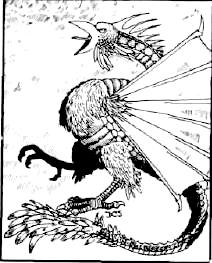
I do really like both interpretations of the Cockatrice across the two 5E bestiaries – both taking essentially the same creature design prompt – draw a monster chicken with a snake tail and bat wings. The original 5E artwork goes for a very wretched looking creature, making the Cockatrice look positively haggard and feral. The grayish colours and the dead dot-like eyes really help, too. Meanwhile, 5.5E goes full-in with the ‘chicken’ theme, giving us a Cockatrice that looks manic and channels the inherent goofiness of a chicken, while putting bright green and blue colours on the ‘fused animal’ parts. Both look particularly great in my opinion, and you could assume that one of them is the new, stronger ‘Regent’ variant introduced in 5.5E – it’s just up to you as a DM to decide whether the stronger variant is the more threatening-looking 5E one or the more regal 5.5E one.
The Regent has a couple of fun extra attacks, including the ability to use the unstable magical energies within itself to knock its opponents away with force damage. Which does raise some questions as to where this magical energy comes from… although I suppose the Cockatrice could very well be another ‘a wizard did it’ creation similar to the Owlbear or the Bulette.
____________________________________________________

Colossus
- 5.5E: Gargantuan Construct (Titan); Unaligned; CR 25
We now have a 5.5E addition, although the Colossus has appeared previously in the base Monster Manual for the 4th Edition, specifically as a 'Godforged Colossus'. I actually didn’t realize the Colossus wasn’t in the original 5th Edition manual until I compared the two side-by-side. Which honestly does speak to how I, personally, think about this thing. It’s a giant statue the size of a kaiju, like a medieval magic Gundam or something. And that’s a cool setpiece and whatnot. The artwork is nice, too, this imposing giant statue of stone with glowing eyes and no mouth. But at the end of the day it’s just a really big statue and that isn’t really what comes to mind when you say “Dungeons & Dragons” to me.

5th Edition’s take on the Colossus has them be constructs specifically created to reflect a deity, allowing them to be good or evil depending on the needs of your campaign. The Colossus is created by adherents and artisans to the deity, and when the creation is finished, if the deity is pleased then the Colossus will come to life to either protect or destroy. The Manual also gives a little prompt about many Colossi being created in ages past, who now lie buried and unused. Very Breath of the Wild, very Studio Ghibli. I like that.
In Doylist terms, the Colossus is added into the 5.5E Monster Manual as yet another attempt for them to inject higher-CR monsters into the base set, and the Colossus does make for an interesting boss. I do really like that it has ‘immutable form’, preventing you from shapeshifting the giant titan into a raccoon. Being a creation of the gods, it can also unleash BEAM WEAPONS- I mean, sorry, divine beams and radiant rays, which does make it a bit more interesting than just being a really big stone dude. If nothing else, the obvious mecha wink-wink-nudges make me like the Colossus a bit more.
____________________________________________________

Couatl
- 5.5E/5E: Medium Celestial; Lawful Good; CR 4
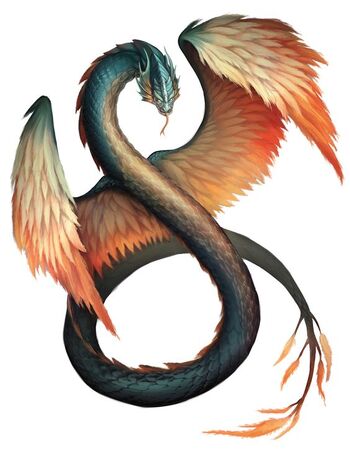
Very loosely based on the Meso-American deity Quetzacoatl, D&D’s Couatls are feathered-serpent celestials whose interpretation are surprisingly mostly original to D&D. They’re quite interesting, and I do enjoy the fact that there are more interesting celestials out there than ‘winged human’. Couatls are shown in 5E as snakes with massive feathered wings, and a tail that forks off into more feathers. 5.5E plays up their ‘celestial’ aspect by making the wings glow with energy and look a lot more majestic. In combat they are basically holy-themed spellcasters, also with the ability to change shape being quite prominent in their repertoire.
Couatls’ backstories vary but they’re mostly depicted as being lawful good. 5.5E makes them embodiments of prophecy and divinity that enforces fate unfolding as they should, and are created by the ‘righteous edict that a god decrees must be true for all time. 5E makes them servitors of a forgotten god. A lot of the divine mandates given to the Couatls have been done, but the Couatls still remain to watch over ancient powers, safeguard the heirs of their god’s worshippers (none of whom remember this), or to simply wait for a prophecy to be fulfilled. The 5.5E one in particular seems to be built more towards unwitting conflict with adventurers due to their uncompromising, divine directives; while the 5E one seem to be more tailor-made for NPC allies.
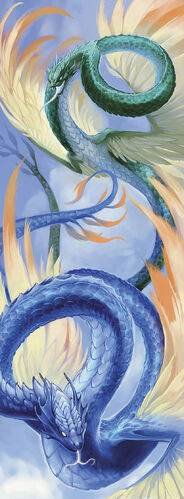

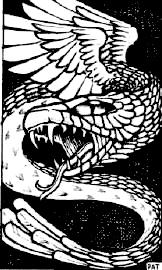
Both Monster Manuals talk about Couatl reproduction a bunch, which is a bit odd. They’re also quite different – 5E’s Couatls can sense when (but not how) they are going to die, and if their goals aren’t done yet, they will find a mate to produce an offspring that they’ll raise to continue doing their duty. Meanwhile, 5.5E’s Couatls have a far more majestic reproductive method, where during end-points of cycles, they’ll lay a rainbow-coloured egg… and die. There will be a brief time when the decree or duty of the Couatl is unattended (which seems to be another plot hook) before the egg hatches and out emerges a fully-grown Couatl, ready to take over its parent’s duty. It’s an interesting twist on a Phoenix-esque life cycle – and notably, the Phoenix is still somehow not in the base Monster Manual – and I find it a bit more interesting.
Overall, I don’t think I’ve ever really paid that much attention to Couatls, if we’re being honest. But both 5th Edition bestiaries give a pretty fun if slightly different takes. I find myself having a fair bit more appreciation for these winged serpent heralds.
____________________________________________________

Crawling Claw
- 5.5E/5E: Tiny Undead; Neutral Evil; CR 0
- 5.5E: Medium Swarm of Tiny Undead; Neutral Evil; CR 3 (Swarm of Crawling Claws)
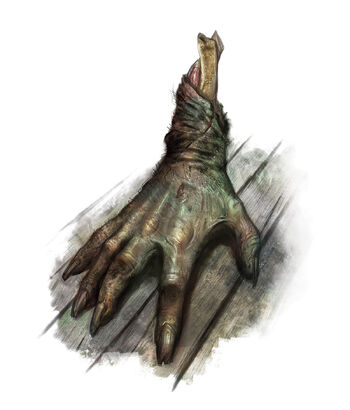
Another classic monster is the Crawling Claw, which is… just a teeny-tiny dismembered hand. That’s alive, a zombie, and is scuttling around like a spider. Whether it’s the Wallmasters from Zelda or the Thing from Addams Family, there’s just something that just captures your attention about a disembodied body piece, isn’t it? It’s a lot more disturbing than ‘just’ a walking dead dude, and a lot more unnatural. Swarms, by the way, is a very common method for D&D to make a bunch of smaller, normally non-threatening creatures be more terrifying.
In D&D lore they are traditionally created from the sliced-off hands of thieves and murderers – older sourcebooks tend to have pretty specific ways for undead creatures to spring to existence. But they can just arise from any old necromancer or undead-themed villain who just wants smaller minions. They’re also very dumb, owing to the fact that they’re a hand, not a brain. And these things can be both creepy or funny! There’s an inherent comedy in a tiny little (and mostly harmless) hand jumping around trying to strangle you… but the 5.5E artwork showing a literal horde of these disembodied hands converging and swarming over a person looks positively nightmarish. Where do you even get that many hands? ‘Mass graves or other tragedies’, according to the Manual, and sometimes they’ll even attack the one that committed the atrocity. Not so evil after all!


I do like the description about Crawling Claws sometimes being driven by the evil impulses of the person it used to be, continuing the killing sprees independently of the person. Sometimes the original owner of these sinister hands don’t even need to be dead, and the Monster Manual notes the hilarious scenario of “sometimes a crawling claw wreaks mayhem, with the original creature potentially unaware of its severed hand’s crimes”. That sounds like the solution for a D&D Sherlock Holmes mystery!
The original 5E describes a variant called a ‘Living Claw’, made explicitly from the severed hand of a living person. These Living Claws can reattach themselves to the hand of the murderer and fuse back together… but the base body falls into a coma, and the soul-link between the two means that if the Claw gets destroyed, the person dies. That sounds kind of shitty for the person to be honest, and the only conceivable reason seems to be using the Living Claw to kill stealthily. But maybe there’s a story here where the party needs to find a way to save the person but also neutralize the Living Claw!
___________________________________________________

Cyclops
- 5.5E/5E: Huge Giant; Chaotic Neutral; CR 6 (regular/Sentry)
- 5.5E: Huge Giant; Chaotic Neutral; CR 10 (Oracle)
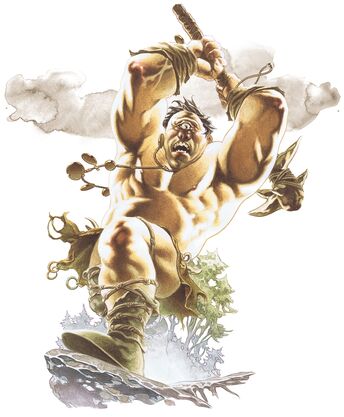
I’ve always found Cyclopes to be boring. They’re giants with one eye, and… and that’s it. D&D already has a stable of many, many giants. And that’s not counting ogres and trolls, or D&D-original enemies like fomorians and ettins and the like. And all of them either have some lore or gimmick to them. The Cyclops’ gimmick is that they have one eye, and that they… wander around and herd animals, the latter being a nod to the original Greek myth version of the Cyclops that they don’t really do anything with. And that’s a shame. There’s no real explanation why they are giants that don’t have anything to do with the Ordning (a very serious thing for other giants), and any gimmick in their original 5E statblock revolves around their, and I quote, ‘poor depth perception’, making them suck at attacks against creatures more than 30 feet away. Honestly, while the 5E MM wrote a lot about them, it’s just to note how primitive and angry they are. We have a lot of those, but other monsters like orcs and ogres and goblins and troglodytes and grimlocks tend to have some gimmick or some plot hook to them. The Cyclops might honestly be one of the most boring creatures in the original Monster Manual – the original version of this entry was maybe 3 sentences long.
Until 5.5E, which gave them something new! 5.5E describes the Cyclopes as being ‘descendants of the gods’, which is, by the way, true to the original Greek mythology about these guys. And with their giant eyeballs, 5.5E gave them the gimmick of having a limited amount of oracular foresight. Which is awesome. The ‘basic’ Cyclops is revamped into the Cyclops Sentry, and gains the Limited Foresight ability that allows it to see into the future and get advantage in combat. The stronger Cyclops variant, the Oracle, is a straight-up spellcaster with a stronger version of the ‘reroll a dice’ mechanical ability.
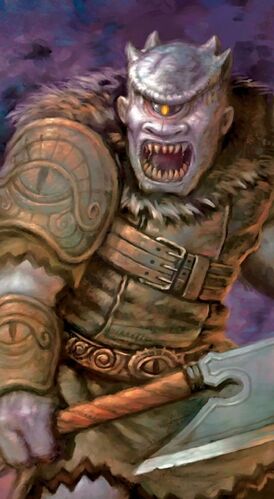
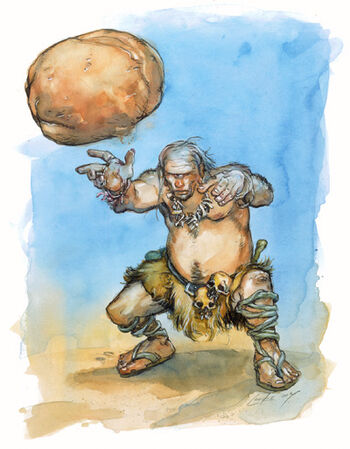

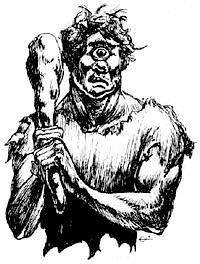
That’s a lot cooler, isn’t it? Instead of just another wandering giant monster, you can now have a bit more to do with the Cyclopes in your setting. They might be guardians of a temple, or might be advisors to a certain faction. There’s an actual reason for them to interact with your characters without having to resort immediately to combat, and best of all, it even draws a fair bit on the Cyclopes’ mythological inspirations for this. What a way to go for a pretty boring monster that even the giant book didn't do anything with! I don’t agree with everything the 2024 5.5E Monster Manual does, but the Cyclops update is definitely a good one.
____________________________________________________

Darkmantle
- 5.5E/5E: Small Aberration; Unaligned; CR 1/2
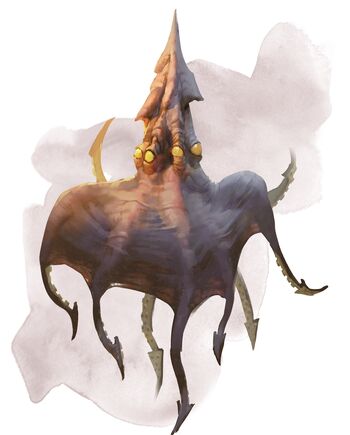
The Darkmantle has always been one of my favourite monsters ever since I saw the artwork for it in the 3.5E Monster Manual, and I love these things. In a way, the Darkmantle is a ‘spiritual successor’ to older monsters like the Lurker, Trapper, Cloaker and several others that are meant to drop down and engulf an adventurer. We’ve seen the Cloaker’s reinvention in a previous entry and 5E would re-introduce the Lurker anyway… but the Darkmantle remains! And it’s a pretty cool critter, isn’t it?
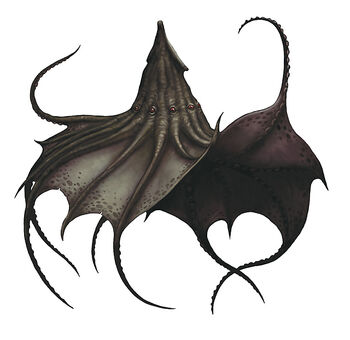

The Darkmantle looks like a mutated vampire squid, complete with the protrusion between the squid’s tentacles. But you see the beady little eyes running around its body and you know it’s not a ‘normal’ creature. Not in the way that we define normal in real life, anyhow. The Darkmantles are inhabitants of the Underdark (subterranean caves) or Shadowfell (a parallel shadow realm), and they are apparently ambush predators that cling to ceilings and pretend to be a stalactite. You can see that, right? Real-world octopi and squid do have the ability to change their colour and texture, and I can totally buy that the Darkmantles would be able to make their outermost skin a bit ‘rockier’. 5.5E notes how Darkmantles seem to have a similar hunting niche like Ropers and Piercers, but no one’s been able to established a shared origin or life cycle due to these creatures being so hostile and aberrant. But it’s okay, in-universe xenobiologists, it’s okay! Convergent evolution is a thing in real life, which is why various adaptations appear on completely unrelated creatures in real life. Stalactite ambushing and engulfing humanoids must clearly be a successful adaptive feature in the Undedark if so many creatures do it!
They are described as ‘filling the ecological role of bats’, except unlike bats, when a Darkmantle descends to hunt, they drop down and unleash a field of magical darkness before they wrap their body around the prey. That aura of magical darkness is probably a wink-wink nod to a cephalopod’s ink ability, isn’t it? Except it’s used offensively instead of a way to escape. The 5.5E art shows off the underside of the Darkmantle, which has a lot of spikes on the tentacles.
____________________________________________________


Death Dog
- 5.5E/5E: Medium Monstrosity; Neutral Evil; CR 1
Another one that graduated from ‘appendix’ to ‘full page entry’ is the Death Dog. It’s actually quite surprising that none of the basic D&D Monster Manuals ever included the Cerberus – despite having so many monsters based on Greco-Roman mythology, good ol’ Cerberus was apparently not considered interesting or ‘classic’ enough. That’s honestly a bit odd. But the Death Dogs do keep showing up! They’re two-headed dogs, with both 5E and 5.5E artworks playing on different art tropes to make them look as rabid and feral as possible. I particularly like how underfed and thin the 5.5E Death Dog looks.
In addition to being two-headed monster dogs, Death Dogs also inflict diseases on their victims through their jaws. 5.5E giving them a writeup really does make them stand out more than just ‘oh right, a two-headed dog’. Describes as ‘plagues on the arid lands they inhabit’, Death Dogs single out and attack creatures that look weak and even if driven off will stalk their prey, knowing that there’s a chance that the disease from the bite will do their work for them.


There is a slight nod to Cerberus, with a single line mentioning how the Death Dogs tend to be tied by legends to death-gods, but it’s just because of the death and disease spread by these mangy curs. I do like that the bites actually cause a ‘Death Dog’s Malady’, which is a completely cosmetic effect that plagues a victim after they’ve been afflicted by the Death Dog’s bite. Some of them do sound like exaggerated diseases, like ‘flesh rots like a corpse’ and ‘itch as if they had sand or fleas beneath the skin’… but some of them actually do feel supernatural, like the victim being distracted by distant howling only they can hear, or marks from canine jaws appearing on the victim’s body as if they’re still being mauled.
____________________________________________________

Death Knight
- 5.5E/5E: Medium or Small Undead; Chaotic Evil; CR 17 (regular)
- 5.5E: Medium or Small Undead; Chaotic Evil; CR 11 (Aspirant)
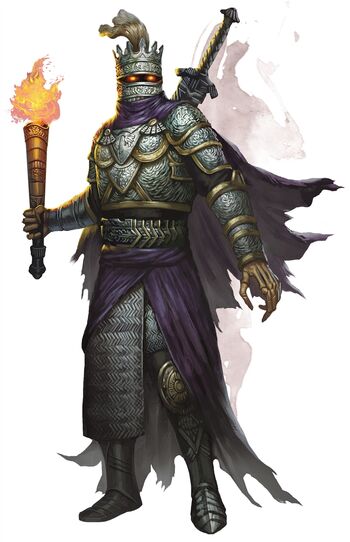
Oh yeah, these guys. I love the Death Knight, and I will freely admit that a good chunk of it has to do with Blizzard trying multiple times to get ‘Death Knight’ as a prominent feature in their Warcraft universe. D&D’s Death Knights are also powerful undead, but not by far the strongest. They’re still pretty cool, though! There is just something super cool that appeals to the child within me when I see two glowing eyes peer out of an obviously-evil armoured figure on an undead horse leading a legion of the restless dead. Older editions tended to just make the Death Knight 'just' a skeleton knight, which, while accurate, doesn't quite have the same vibe that the name Death Knight really brings to mind. And this is the whole point of the Death Knight, being a commander that brings intelligence and tactics to a horde of disposable and potentially constantly-resurrecting undying minions.
In 5th Edition, Death Knights are described to be fallen paladins who, upon death, is transformed by dark forces into a Death Knight. 5.5E gives us a less-specific origin story, simply describing Death Knights as ‘undying tyrants’ and ‘domineering commanders with grim histories’. There is still a hint of a fallen hero to some of the descriptions, but they can just be any evil sort who became a powerful undead after their passing. In addition to just being a standard undead enemy, 5.5E gives several other plot hooks, noting that some Death Knights are happy to brood in ruins for centuries (very video game boss-y) while some try to end the curse that doom them to undeath but keep getting shackled due to their own selfish desires.
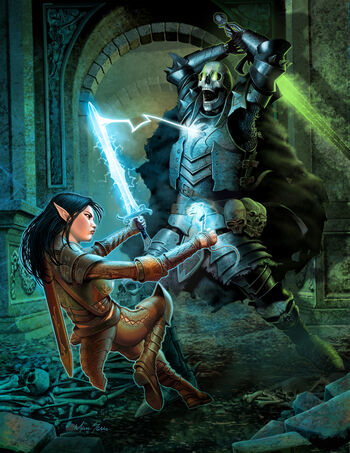
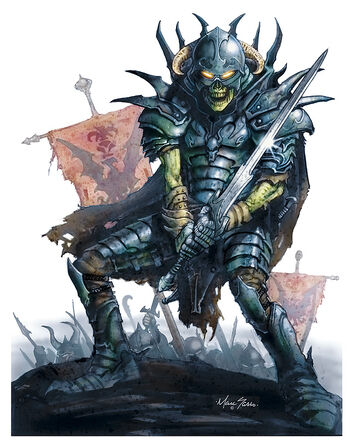

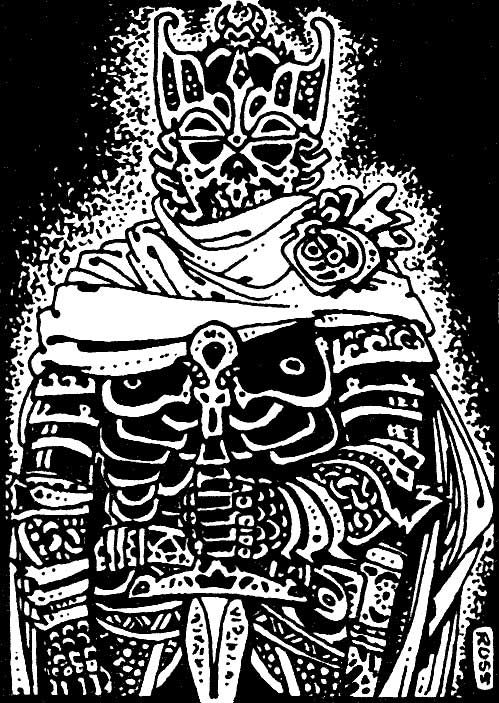
Death Knights are powerful spellcasters and warriors, and are also able to ‘Marshal Undead’, empowering all undead creatures around him like a commander. Interestingly, 5E and 5.5E gave them different features. 5E gives the Death Knight a lot of spells due to the whole ‘fallen paladin’ background, except for healing spells. That book also talks a lot about Lord Soth, a rather important character in older D&D material that I must confess I don't know anything about.
5.5E swaps these with generic ‘evil undead’ spells, which I suppose fits a bit more with the direction they're taking with the creature, making it more of a 'boss' of lesser undead. They even included a 'Death Knight Aspirant' stat block, characterized as essentially a huge fan of the main Death Knight who wants to be like their boss! 5.5E also gives the Death Knight the ability to resurrect itself within a couple of weeks in a location significant to him/her, as long as they are not atoned. This ability for a powerful undead to return back to life is something that liches, vampires and mummies have, and it’s nice to see the Death Knight be counted as cool enough to join those ranks.
____________________________________________________

Demilich
- 5.5E/5E: Tiny Undead; Neutral Evil; CR 18
- 5E: Tiny Undead; Neutral Evil; CR 21-23 (Demilich of Acererak)
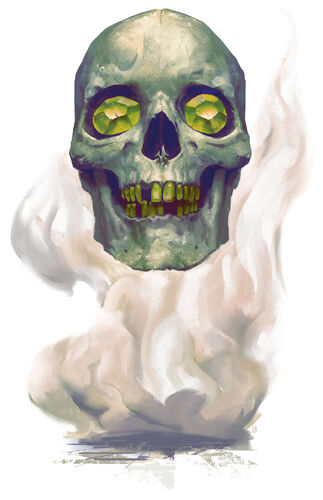
Speaking of super-powerful undead, the lich is probably D&D's superstar in terms of being the Big Bad Evil Guy of undead. But, again, sometimes you can't toss a lich at a lower-leveled party. And so you have a Demilich instead! The various editions have waffled on whether a Demilich is a weaker or a stronger version of a regular Lich, and in 5E we're going with the latter. Essentially, the backstory given here is that a Demilich is a Lich whose body has withered away due to the 'burden of immortality' or if they fail to feed enough souls to their phylactery. And thus the former Lich is reduced to a skull with soul-gems as eyeballs (and sometimes teeth, look at that fancy 5.5E Demilich) as its "consciousness turns inwards". It's sort of a hibernation phase, yeah? The Demilich just stays there in its crypt or tomb or ziggurat... until some adventurers disturb it and cause it to rise back up.
The original 5E Monster Manual goes into much more in-depth about the Demlich, explaining that Liches don't actively seek to become Demliches, and it's usually caused by circumstance. Liches are powered by feeding souls into their phylactery, and sometimes the lack of soul infusion causes memory to just get eroded away. Which... fair enough, some living people forget to feed or bathe themselves. Who are we to judge the undead who forget to keep a healthy diet of screaming souls?
In combat, a Demilich mostly just has a couple of simple tricks revolving around its necrotic blasts, energy drains and its ability to unleash howls of terror. But like a regular Lich, a Demillich will regenerate from its phylactery upon destruction unless your adventurers have access to the Wish spell, or have destroyed the phylactery beforehand.

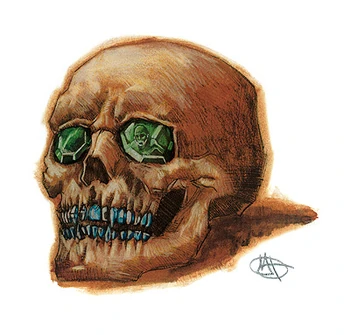
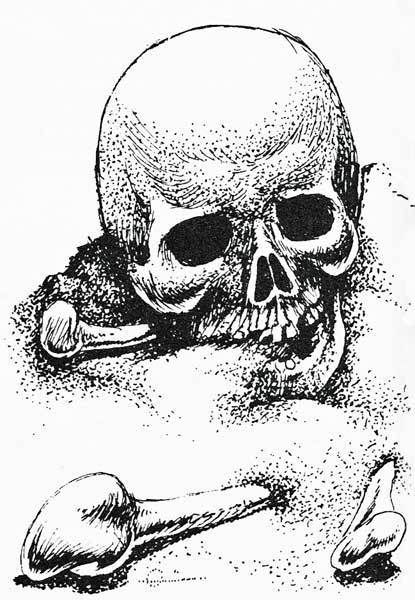
We mentioned the 'Lair Actions' before, with the Demilich's lair in particular preventing teleportation magic from functioning. A significant reason for a Demilich being so beloved by the design team is due to a very specific Demilich – Acererak, from the 1st Edition module Tomb of Horrors. Tomb of Horrors is a famous (or infamous, depending on who you ask) for being a nightmare of a dungeon to go through due to a lot of deathtraps that can insta-kill your characters. It's meant to be a 'meat grinder' dungeon back in the day, and would be considered one of the classic D&D modules for a long, long time. And at the end of the titular Tomb of Horrors is the Demilich called Acererak. Which is why the Demlich as a creature ends up becoming elevated into something threatening in its own right, and have a fair amount of focus to lair actions.
The original 5E even describes how Acererak became more powerful as a Demilich due to preparation, embedding soul gems as eyes and teeth, and using his skull as a trap within his Tomb of Horrors while his spirit 'traveled the planes', continuing his quest of power beyond the world. These Demiliches that follow Acererak's path have some additional abilities to literally trap enemies within its soul gems, equipment and all. It is implied that after the Demilich has won, they would feast on the souls and might even regenerate into a full lich. It is interesting that this is one of the few variant statblocks to not get imported to 5.5E, although with Acererak himself getting a whole book and statblock to himself, I suppose it doesn't really matter.
____________________________________________________

Displacer Beast
- 5.5E/5E: Large Monstrosity; Lawful Evil; CR 3
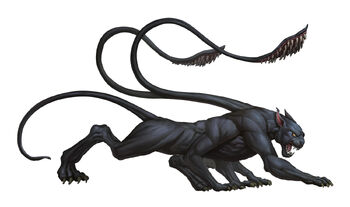
I love these things. Another instant classic, the Displacer Beast takes a familiar animal, a panther, and exaggerates the heck out of it. It's got six legs, a whip-like tail, and two tentacle-arms sprouting from its shoulders that end in squid-like pads with bristles. Tentacles aside, the physical design takes everything cool and threatening about a panther and amplifies it – with some editions, like the 3E art below, even making the Displacer Beast look even more gaunt.
What makes the Displacer Beast scary isn't its whip-tentacles, however, but the ability to innately displace light. It doesn't actually teleport, but it creates an illusion that makes it appear just off from where it is. The relatively recent Honor Among Thieves movie features an interpretation where it's literally like a projector lamp. And that does feel a bit more mundane than what my mental image is of the Displacer Beast's ability, which I've always interpreted as warping and blinking in out of existence. Artwork tends to depict them in forests or dark caves, though, which means that the real body is probably a lot more camouflaged than the one seen in a man-made labyrinth.
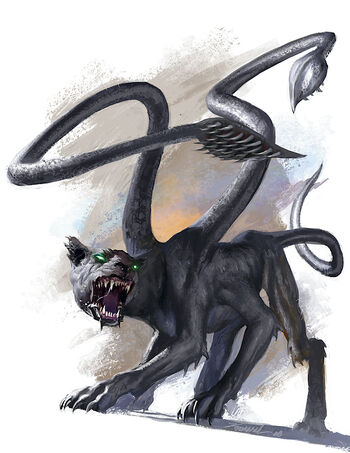
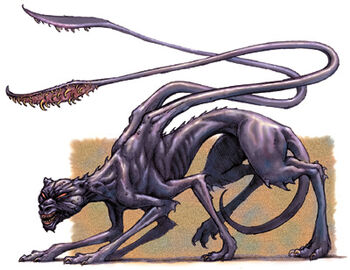
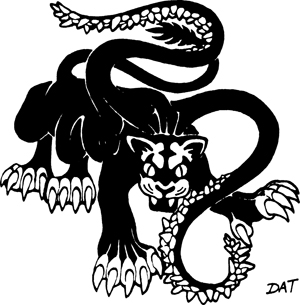
5.5E describes that the Displacer Beasts are extremely cruel hunters, not just hunting merely for food but also for sport. They aren't sentient, but are intelligent enough to hold a grudge and hunt their prey down... even across dimensions. Apparently these things are like the fantasy equivalent to an invasive species, moving through realms and causing ecological disasters as they slaughter creatures unprepared to deal with a stealthy teleporting kitty. Druid circles in particular hate these things, which I thought is a nice nod to how the balance of nature and 'all life is precious' are two completely different concepts.
The original 5E manual actually gives the Displacer Beasts an origin story, noting that they originate from the Feywild, but were selectively bred by the fey of the Unseelie Court as their equivalent of a hunting dog until they grew smart enough to break free from their masters. A different faction, the Seelie Court, rounded up Blink Dogs (cats and dogs, get it?) and began hunting the Displacer Beasts and drove many of them to the Material Plane. Thanks, I guess, Seelie Court, for this infestation of super-smart projector cats! It's kind of weird that the Displacer Beasts aren't also considered fey, though.
Lastly, the Displacer Beast is actually based on a very specific creature from the sci-fi story Black Destroyer by A. E. van Vogt, a creature called the Coeurl. There are a bunch of creatures like these that the early D&D teams just adapted and gave a fantasy paintjob simply because they 'looked cool', and to be honest I can't blame them! I would've done exactly the same in their position.
____________________________________________________

Doppelganger
- 5.5E/5E: Medium Monstrosity; Neutral; CR 3
Oh yeah, these guys! I have a strong fondness for Doppelgangers, or shapeshifters in general. In mythology Doppelgangers are 'evil twins' that is a supernatural omen of bad luck, but in D&D Doppelgangers are shapeshifters who are able to take the form of other humanoids. The only real 'bad luck' is that a Doppelganger using your face as its cover is likely to be doing something that you probably don't want to be caught doing. Or it might get rid of you to keep its cover.
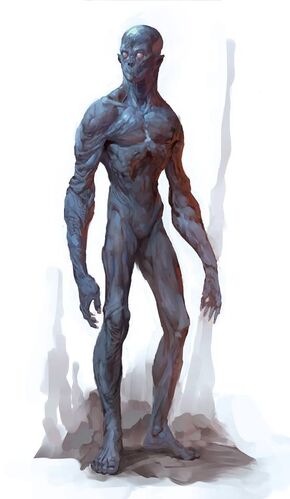
The doppelganger is always depicted to have a 'true form' of differing appearances... just starved-looking pale elves in older editions, and a very disappointing 'ghostly albino person' in 4E. But 3E and 5E went for a very cool true form by having the Doppelgangers' true selves be lanky, mouthless, gray humanoids that look like the most basic 'canvas' before you put in features on a humanoid.
They are, of course, able to shapeshift into any humanoid that's around the same size as itself, but more terrifyingly, Doppelgangers can read thoughts. This is how they manage to mimic their masks' mannerisms and say things that only they would know, and 5E describes how Doppelgangers would have to stalk their mark to absorb their desires, fears and memories. Even in a plot where they want to replace someone, they need to probably keep the person alive to use his or her mind to learn how to best act like them.

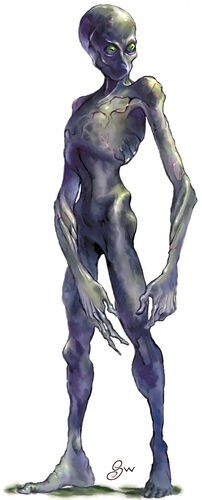

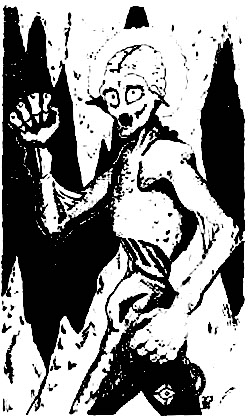
The Doppelganger is inherently a more 'roleplay' heavy creature, although 5.5E gives the Doppelgangers a bit of a combat utility. They can unleash an 'Unsettling Visage' attack, described as it transforming into an unsettling form to scare foes, which could be a jump-scare, but could also just be some uncanny-valley trope.
But why are the Doppelgangers doing what they're doing? 5E describes some plots or cons, and also tosses in the 'changeling baby' trope where they would seduce mortals and have them bear their children, who grow up and realize their 'true forms' as adults. Quite creepy, yeah. 5.5E gave us a bunch of more adventure-friendly plots for players to uncover, like a Doppelganger who's a sleeper agent of a vast conspiracy; a Doppelganger who wants to replace a rich noble just to live like a king; or it's trying to get revenge on the temple of the deity that cursed it to become a Doppelganger in the first place.
Shapeshifters are really fun to work into a story, and that's probably why Changelings (who are fey with a toned-down version of a Doppelganger's ability) became a rather popular playable race in subsequent additions to 5E.
____________________________________________________


Drider
- 5.5E/5E: Large Monstrosity; Chaotic Evil; CR 6
The Driders are another one that is a pretty iconic enemy in D&D, being giant spider-centaurs. Spiders are super-cool in general, and the Drow – or Dark Elves – are one of the most popular races in D&D, for the simple reason that they're the cool, dark and brooding choice back in the day for those who want to create emo rogues and anti-heroes. We'll talk a bit about the Drow later on, but the very simplified version of them is that they're a banished race of elves that live in the Underdark. They worship the Spider-Queen Lolth, a demon-goddess that takes the form of a spider.
And Drow are transformed into Driders as either 'a blessing or a curse'. Lolth herself tends to be portrayed as a bit of an asshole, so sometimes transforms the most obedient and fanatical worshippers of her into these 'favoured forms', and sometimes she puts them through a trial in the Demonweb Pits, and those that fail are turned into Driders. Whatever the case, the Driders are described to either be fanatically loyal to Lolth, or be driven to madness by simple spidery instincts. The Drow themselves tend to shun the Driders, even those that have regained their senses, but also can't kill them because they're representatives of Lolth's will.
In combat, they can do what you expect from a giant spider with a person jutting out of it. Spider-climbing, poison attacks, and sometimes the ability to cast spells or use tools. 5E seems to be far more intent on using the 'drow' part of the Drider, devoting a small sidebar to explain what spells Drider spellcasters can use.
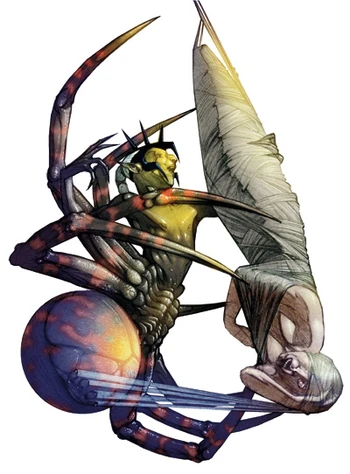

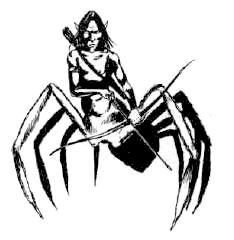
5.5E, meanwhile... goes on a bit of a tangent. See, the Drow (and to a lesser extent, the Orcs) has came under a lot of scrutiny lately in D&D for sensitivity reasons, some of which are valid. We'll discuss as much as I feel I'm qualified to in the Drow segment before, but while orcs got a pretty nice reinvention in the Player's Handbook, the Drow ends up reduced to essentially a footnote despite being one of the facets of D&D. The Drider, being a monster, still gets to make it into the 5.5E Monster Manual, but was it necessary to spend more than half of the writeup to the Drider telling us that "Driders don't always have to come from Drow"? Again, it's all at the discretion of the DM. They can be a wizard experiment or something, sure, I don't mind! But giving a whole table and dedicating more to talk about this instead of explaining the cool things that a Drider can do seems very counterintuitive to me.
____________________________________________________

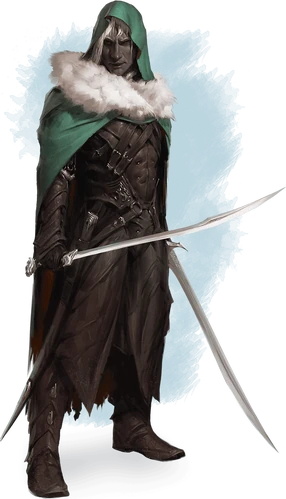
Drow
- 5E: Medium Humanoid; Neutral Evil; CR 1/4 (regular), CR 5 (Elite Warrior), CR 7 (Mage), CR 8 (Priestess of Lolth)
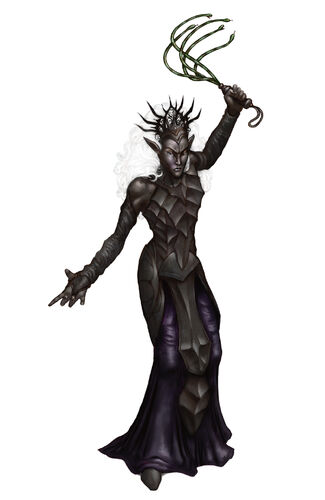
So yeah, the Drow. The iconic 'Dark Elves' of the Underdark from D&D. I feel it's best to describe what the Drow are, before I go to talking about recent events around them and why there's a bit of a fuss about them. So the Drow are introduced as an 'Underdark' version of the elves, a society that lives deep underground. They've developed a far darker skin and white hair, the ability to see in the dark and navigate through tunnels, and were banished into the Underdark by the other elves after a conflict. Whether this conflict happened before or after they worshipped the evil spider-goddess Lolth depends between editions.
Their society is one that's noted to be evil, as they could capture and enslave other humanoids to expand their empire. Their society is a matriarchal one (how much, again, depends on the edition; 5E is a bit better by giving the male drow more rights, but females still lead the noble houses) and there are a lot of politicking going on between the noble houses as they vie for influence within their Underdark cities. Due to worshipping a spider goddess, much of their culture also revolve around this, with spider imagery, the usage of poison, and webs being popular among the Drow elite.
And throughout D&D's history as a franchise, one of the more popular heroes was a series of novels starring Drizzt Do'Urden, a Drow ranger who disagreed with the evil ways of his culture and society, and became a reluctant hero. It is an easy trope, but also one that's understandably popular – someone who disagrees and rebels against their oppressive society? And the 'dark, brooding' type is one that clearly captures a lot of attention. I was around the D&D and fantasy sphere long enough to know that the Drow are extremely popular as a character race.
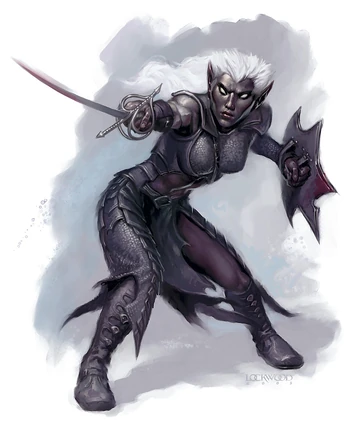
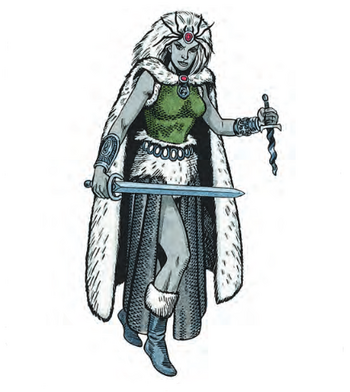
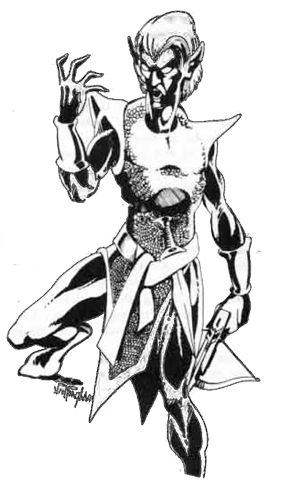
But as D&D exploded in popularity, a lot of scrutiny is made towards the Drow. And again, there are admittedly some aspects that doesn't stand up to scrutiny. There are certainly ways for the Drow to be done better, and one that could have been done with a bit of revision here and there. Maybe downplay the slavery or sexist aspects of the Drow's society, maybe highlight the unfairness of their curse and segregation, or just explore that perhaps these are all stereotypes, and there are different types of Underdark Drow cities that have different cultures. Because at the end of the day, that's what makes the Drow evil, right? Their culture, not what they are born as. Heck, I thought it would just be easy to pass the entire buck to Lolth, the Demon Queen they worship. It would be quite easy to make it so that all these evil aspects of Drow society is all caused by Lolth's influence and oppression. There are ways to have an evil empire and portray it, in-universe, as something unacceptable even by other Drow.
Again, I always maintain that the "always evil" labels applied to sentient races is silly. It's one thing to apply it to demons or devils, but to slap it onto creatures that you go back around and establish that they have a functioning society is very iffy. But that's where good writing comes in. You can have your cake and eat it, and honestly D&D has even done it before. A lot of the older descriptions for so many of the other 'evil' sentient races are as bad as the language they use for drow in terms of depictions of slavery or racism or torture. And they were able to fix it by better writing.


5.5E actually did its best to reinvent the orcs, which we'll talk about when we get to them in the playable characters section. And, heck, the Tieflings in general evolved quite well from being a run-of-the-mill demon-spawn into angsty, independent people finding their way in life in a world that hates them. But the Drow and Orcs are completely removed entirely from the new Monster Manual. Sure, the stat blocks are technically there, shuffled around as sub-entries in 'Priest Acolyte' or 'Assassin' or something, but that feels like a cop-out excuse just so they can say 'nuh-uh, we totally didn't delete them' because no one's attached to the statblocks. And the Drow maybe get three, four sentences in the Player's Handbook, making it very easy to miss that they're even there. It's honestly kind of sad because you'd think an edition update would be the perfect way to actually refresh the more problematic aspects of the story. But to jettison everything and to spend more time saying how 'Driders can appear outside of a Drow society' feels extremely performative in the wrong ways.
Anyway, that was my brief rant about the Drow. The tl;dr is that I agree that some aspects of their portrayal is problematic, but I really want them to be modernized and reinvented instead of just ignored entirely.

I knew about the orcs, but didn't know the same happened to the drow, though my most recent experience 5.5 is the player handbook and that's about it.
ReplyDeleteSpeaking of, where is the web drown and lady knight with the spider from?
Duergar's also gone from the Monster Manual, and reduced to just a subrace of dwarves.
DeleteIt really is a bit annoying -- I do understand that with the changing sensibilities of what is acceptable in an 'all ages' game, sure, some things have to be revised. It's one thing to reduce the amount of gore, you know? It's another to retcon and change certain enemy races to 'playable', which they did with orcs. And, heck, Tieflings got a fair bit of rewrite in 5E.
Drow and Duergar barely get any material in the PHB, and were cut out from the Monster Manual. It's just a bit odd that instead of tackling and rewriting these more sensitive aspects and make them actually be something meaningful, they just kind of pretend they don't exist which I felt is more insulting.
Assuming you mean the drow standing over the two coccoons and the lady drow with the spider staff on the final row, they are the Drow Arachnomancer and Drow Matron Mother artwork from the 'compilation book' of Mordenkainen's Monsters of the Multiverse.
DeleteMonsters of the Multiverse mostly just condenses Volo's and the first Mordenkainen's book together with 5.5E rules, a couple of playable races from other sourcebooks and I think maybe one new monster -- but what it does do is to give new art to a lot of the entries in Mordenkainen's Tome of Foes that never got unique artwork.
This includes a lot of Drow and Duergar, the 'class' enemies (rather cutely taking art from the MTG crossover), Darklings (which previously reused 4E art IIRC), and most crucially finally giving artwork to the Star Spawn.
I'll also be rewriting/revising the Volo's and Mordenkainen's pages after I finish with the Monster Manual, which would probably feature a lot less new commentary but a lot of the older entries do need some tightening up, and when I do those I'll cover the new artwork as well.
Super cool! Sucks that something like that occurred though. I honestly blame Hasbro and WotC current management.
ReplyDeleteIt really is sad. It's one thing to tone down certain outdated themes, which I might even agree for. It's another to completely censor and remove significant portions of the franchise without at least an attempt to fix or replace them with something.
DeleteHopefully they are just saving them for a different book.
DeleteProbably. There is something to be said about WOTC taking out Volo's Guide to Monsters and Mordenkainen's Tome of Foes with its more elaborate lore. A huge chunk is the reducing of themes like slavery, which is why only the monster statblocks and the blurbs attached to them are ported over to the 5.5E-compatible Monsters of the Multiverse.
DeleteThat is an okay way to do it, I feel, where at least some of the lore survives, if toned down. It's different with the new core books leaving us with essentially nothing.