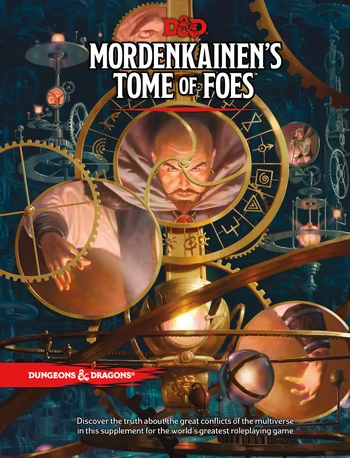

And finally, we enter the final stretch of monsters for Mordenkainen's Tome of Foes, which brings my coverage of Mordenkainen's Monsters of the Multiverse to a close. This has been a really fun ride, going through and rediscovering my love for Dungeons & Dragons all over again as I talk about every single monster in the main bestiaries! I'll also go through all of the non-crossover 5th Edition monsters eventually, as well as the 'appendix' monsters that are just beasts or elite versions of a previously established monster.
This final stretch contains two huge 'sets' of monsters -- the Sorrowsworn and Star Spawn -- always nice to talk about huge sets of monsters, although they also often tend to take more time for me to go through. That's just part of the writing process, I suppose.
I do have a fair bit of newfound appreciation for Tome of Foes, which goes for breadth instead of depth in terms of monster variety compared to Guide to Monsters. I really, really love the segments in Volo's Guide to Monsters that covers the hags and goblins and whatnot, but Tome of Foes does really bring to us a lot more variety, which is much appreciated.
Other than that, my next project is going to be a 'read-through' of the 2nd Edition AD&D Monstrous Manual... although when that will start will depend on how much content I can get written within a timely manner.
Sorrowsworn

____________________________________________________
Star Spawn / Foulspawn


Steeder

Steel Predator

Stone-Cursed
Sword Wraith


Vampiric Mist


- Click here for the previous part.
- Click here for the next part.
- Click here for the index.
[Originally published in June 2020; revised in May 2026]
____________________________________________________
Sorrowsworn
- 5.5E/5E: Medium Monstrosity; Neutral Evil; CR 13 (Angry), 11 (Hungry), 9 (Lonely), 7 (Lost)
- 5.5E/5E: Small Monstrosity; Neutral Evil; CR 1/4 (Wretched)
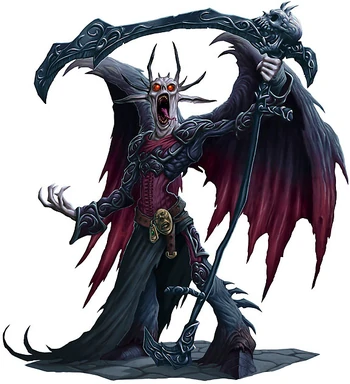
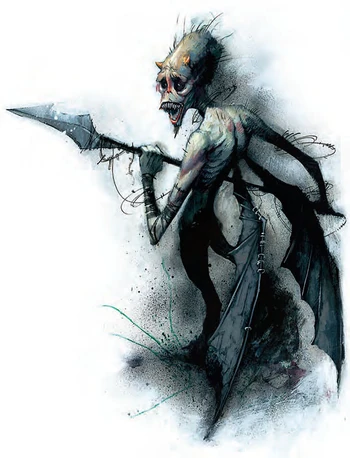
The Sorrowsworn has had a divergent evolution over the different editions. The name was used in 3rd Edition for a type of tanar'ri demon that preyed on emotions. 4th Edition's first Monster Manual then introduced the 'Sorrowsworn' as a type of monster that lived in the Shadowfell, the dark dimension of horrid emotions, shadow and death, and acted as 'fragments of death incarnate', drawn by emotions and grief and acted like a more fiendish-looking grim reaper working for the Raven Queen. 5E interestingly keeps some of this lore... but instead of making its Sorrowsworn part of a more organized hierarchy (that part, seemingly, has been all given to the Shadar-Kai), reinvents the Sorrowsworn as just incarnations of the Shadowfell's bleak nature.
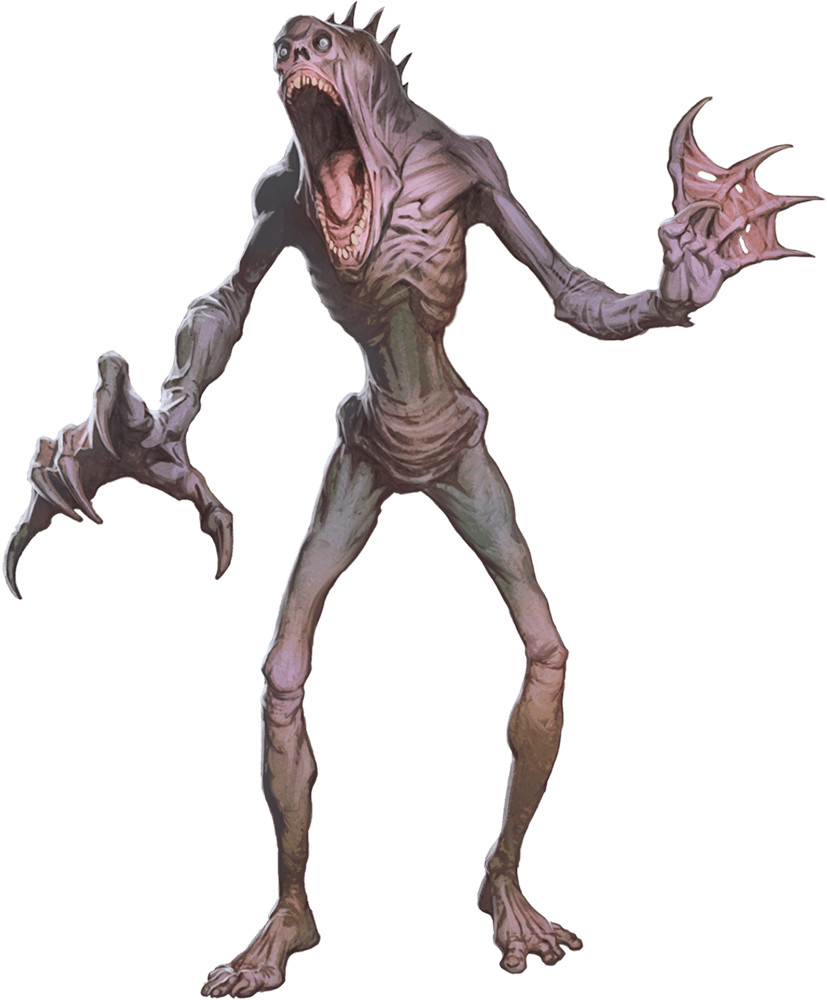
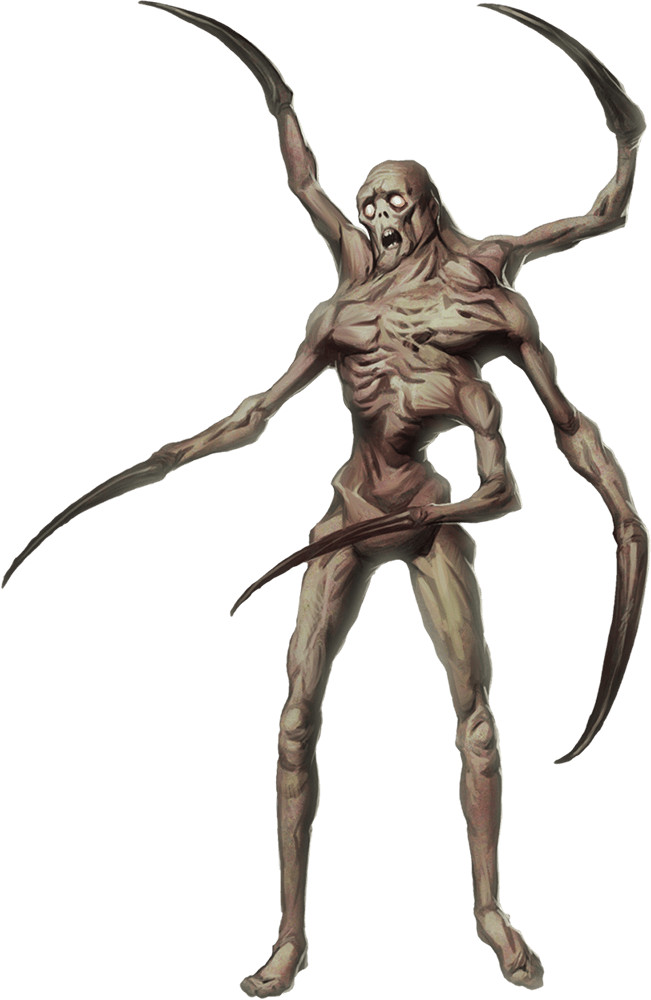
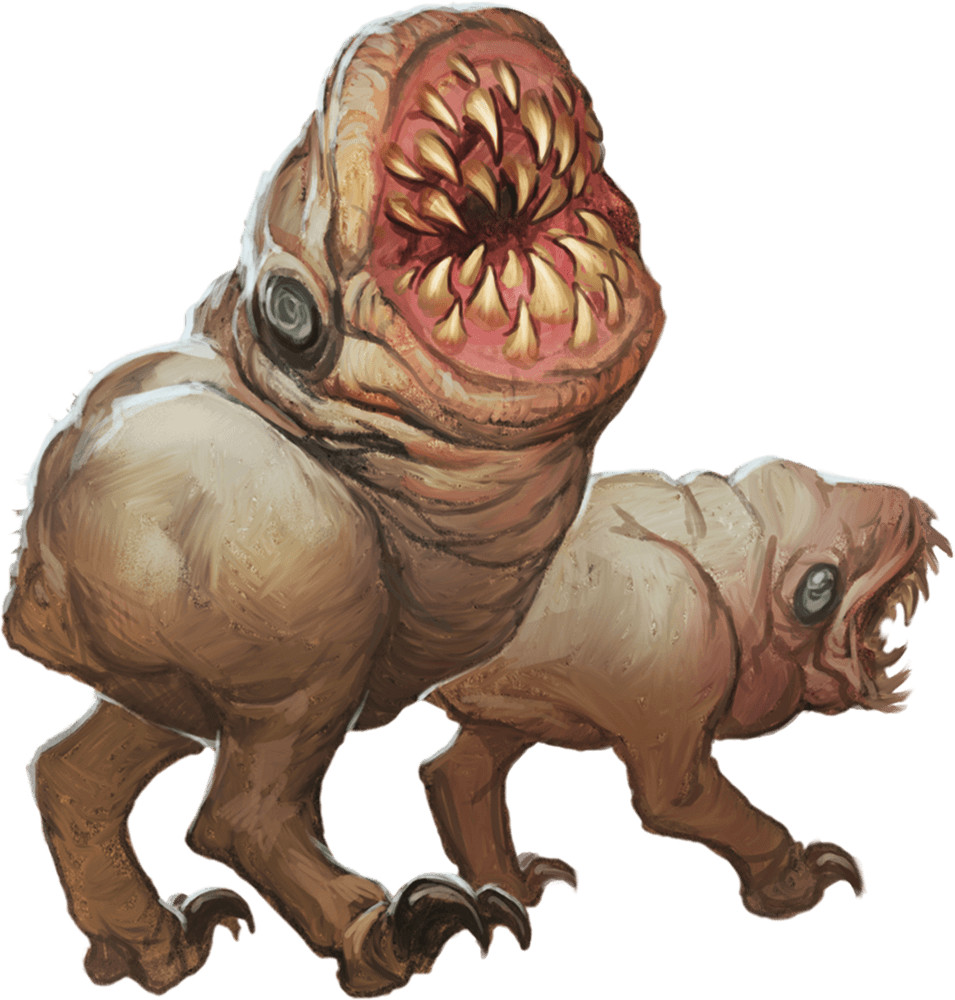
I actually like this a lot. The previous incarnations of the Shadowfell's nature itself has been either undead (which isn't special since they show up in the Material Plane) or the Nightshades, which are shadow-monsters but lack a certain... identity. The Sorrowsworn are reinvented not just as blobs of shadow, but blobs of flesh, bringing to mind enemies from the Silent Hill franchise. They look like mutated humanoids, but are really manifestations of dark emotions of those that get lost in the Shadowfell. I'm putting the 4E and 3E incarnations of the Sorrowsworn first as comparison, and while the art is certainly cool, they are 'just' demons:
And these Sorrowsworn have abilities and behaviour that represent their respective emotion. I like this gimmick, and I like this theming on negative emotions being literally represented by a set of in-your-face monsters. Tome of Foes calls them names like 'The Angry', 'The Lonely' and so on, which I found to be really cool, but Multiverse renames them as the more descriptive 'Angry Sorrowsworn'. Rather coincidentally, the alphabetic order that they are presented is also going down from the most powerful to the least powerful type of Sorrowsworn.
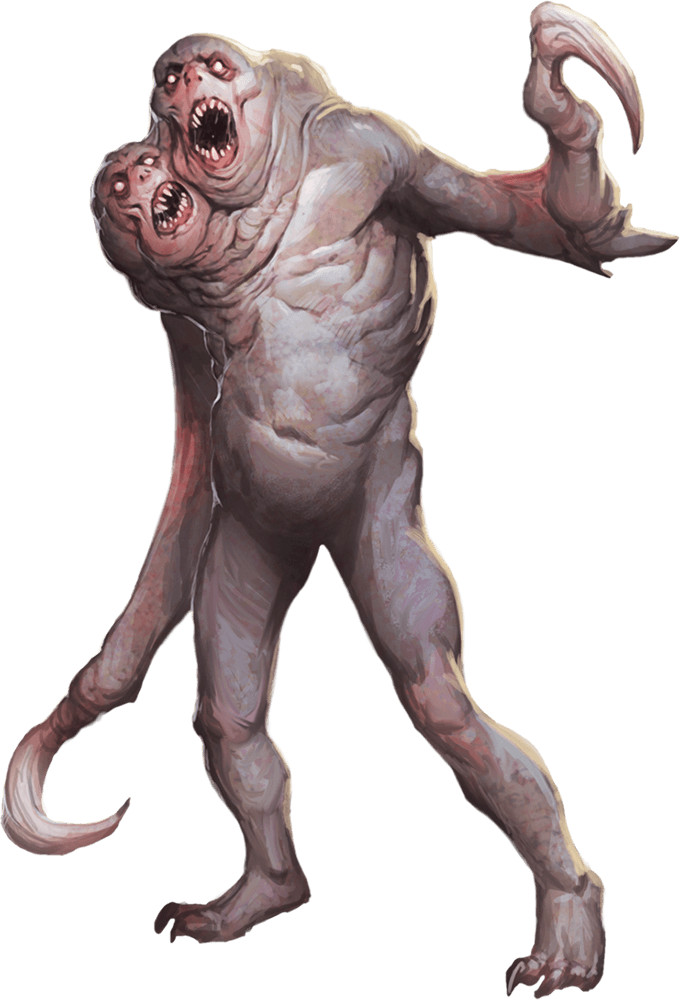
Starting off with the most powerful is the CR 13 Angry Sorrowsworn on the topmost of this segment, who looks like a lumpy, misshapen human with hook-claws for hands, and two heads groaning and attached asymmetrically. The Angry Sorrowsworn, of course, represent anger. They are quite powerful... but if their opponents do not attack it, they gain disadvantage on attack rolls and becomes weakened by its confusion. In contrast, any time the Angry is attacked, they get advantage instead. It's a nice little gimmick of 'anger feeds the monster'. The two heads also bicker at each other, which probably drives it even angrier and angrier!
We then have the CR 11 Hungry Sorrowsworn, who is a long, stretched-out humanoid with a large, yawning mouth. The giant mouth representing hunger is obvious enough, but the Hungry also has webbed hands for some reason. Hunger is a rather obvious emotion for someone lost in the Shadowfell to have. They try to feed on their prey, and of course whatever they eat will never fulfill the hunger they have in their belly. The mechanical gimmick this one has isn't as thematic, I feel, triggering off of healing. I wished that there was something about them being drawn to individuals imbibing food and drinks in the Shadowfell or something, because everyone needs to drink, right?
The CR 9 Lonely Sorrowsworn is born out of the sorrow of isolation. They just want a hug! I like that their mishappen heads are crying black ichor, and all its limbs end in blades. Which double as sinewy harpoon guns. Whenever they see other creatures, they want to interact and launch their harpoon-like arms to draw people closer -- as the art shows, sometimes they pierce limbs and drag them in. The Lonely has an interesting gimmick where the more creatures are around it, it 'thrives on company' and gains advantage if it's surrounded by creatures but disadvantage when it's alone. It translates well to why it's also trying to harpoon your adventurers towards it!
The CR 7 Lost Sorrowsworn probably looks the most intimidating to me, with five claw-tipped arms sprouting out of its body. I like, again, that the arms are asymmetrical and one just grows randomly out of the side of the stomach. The Lost is created out of the anxiety and fear people experience when they get lost in the Shadowfell, and they are always desperate and panicked. They try to grab and embrace those that are nearby and grip them tight, but inflict psychic damage and the frightened condition upon them. The Lost also wants a hug! Thematically, I think this one is a bit less of a direct evolution of the emotion compared to the other three we've covered, and feels like a less-thematic repeat of the Lonely.
And finally, the weakest is the CR 1/4 Wretched Sorrowsworn. The Wretched are smaller, and they look interesting. Just lumps of flesh with chicken feet, eyes and a mouth filled with lamprey teeth. 'Wretchedness' isn't really a thematic emotion or cause of sorrow like being lonely, lost, hungry and angry; but as the weakest member of the group that's just there to swarm around and dogpile the enemy.
I actually didn't care for these guys too much when I first saw them, but the more I look at available 5th Edition Shadowfell monsters, the more I realize that the Sorrowsworn are probably the best 'mascot' to explain what the Shadowfell is. Dark, twisted creatures born out of unpleasant emotions? They serve as a nice contrast to the other Shadowfell examples, the Shadar-Kai, who are devoid of emotions. I do still feel like the concept is better executed for the three stronger Sorrowsworns, but otherwise no real complaints here -- in an edition that is a bit infamous for sanitizing their art direction, I do like that these Sorrowsworn have a bit more 'bite' to them at least.
Star Spawn / Foulspawn
- 5.5E/5E: Small Aberration; Neutral Evil; CR 1/4 (Grue)
- 5.5E/5E: Large Aberration; Chaotic Evil; CR 10 (Hulk)
- 5.5E/5E: Medium Aberration; Chaotic Evil; CR 16 (Larva Mage)
- 5.5E/5E: Medium Aberration; Chaotic Evil; CR 5 (Mangler)
- 5.5E/5E: Medium Aberration; Neutral Evil; CR 13 (Seer)
Oh yes. We have these guys! Now, 4E has monsters called 'Star Spawn' as well, but they are completely different reflections and heralds of Elder Evil that take the form of stars. Hands down, one of my favourite monsters in D&D. These are all tied to specific Elder Evils, each of which are heralds and aspects of the true dread Elder Evil they represent. The Herald of Hadar, the Maw of Acamar, the Scion of Gibbeth and several more powerful aberrations exist to challenge the most powerful warriors, with the most powerful Star Spawn being Allabar, Opener of the Way -- a fully sentient planet made up of writhing eldritch flesh and eyeballs.
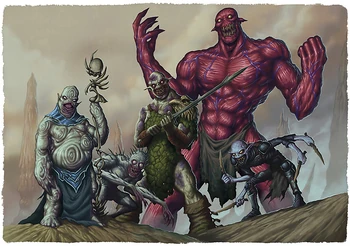
But the 5th Edition 'Star Spawn' is actually an adaptation of previous editions' Foulspawn, which are humanoids that are mutated by the influence of the eldritch energies of the Far Realm; or just smaller heralds or forms taken by entities in the Far Realm. Both the 4E Star Spawn and the 5E Star Spawn/4E Foulspawn are related to the Far Realm, but very differently! For the purposes of this review, I'm going to refer to these creatures as what 5E calls them, but I want to note the difference. The picture above are the artwork for the Foulspawn from 4E.
Also notably, in the original Tome of Foes printing, only the Larva Mage got artwork -- despite five variants (that correspond to all 4E Foulspawn!) being described. Monsters of the Multiverse finally remedied this by giving all the Star Spawn new artwork, probably the most important and biggest graphical upgrade. Frankly, it was kind of silly that it's demons and Star Spawn -- unique creatures -- that were missing artwork, but every single Abishai got brand-new art!
In 5th Edition lore, Star Spawn are named such because they usually appear or are summoned by cults when an ill comet passes through, signalling a breach between the Material and Far Realms. Going in alphabetical order, we first start off with the Star Spawn Grue. Zork jokes aside, the Grue is the weakest of the Star Spawns, a CR 1/4 creature that resembles a humanoid with chalky skin. It actually looks like it might be a cultist that has been driven insane and transformed, since it still has pants. The Grue is grinning, its lips torn apart to reveal fanged teeth, and random spikes of rocks poke out of its body. The Grues just shamble and scuttle around stronger Star Spawn, making chittering and shrieking noises that confounds enemies with its 'aura of shrieks'. This is flavoured with those that hear the shrieking experiencing flashing colours, hallucinations and waves of hopelessness. It's not the most memorable design visually, but it is the weakest variant.
A bit more distinctive aberration is the CR 10 Star Spawn Hulk, a large aberration that resembles a humanoid with translucent purple skin and muscles. You see a jaw lined with way too many teeth; visible skeleton; and internal organs within the body. It's like a sinister version of Glob Herman from X-Men, if you know who that is. The Hulk is noted to mostly just appear alongside Seers, acting like mindless bodyguards. Its thoughts and location can't be discerned by magic, and if it takes psychic damage, it reflects that damage to all creatures around it. This means that in addition to being a massive psychic threat, the Hulk's use in the battlefield is to be a prism to enhance the psychic attacks that its Seer or Larva Mage masters are doing. That's cool.
The CR 16 Star Spawn Larva Mage is kind of interesting. An analogous monster is the 'Worm That Walks' from 3.5E, a creature associated with good old Kyuss. I suppose since Kyuss has ascended to an Elder Evil, this manifestation technically counts as one? The Larva Mage is obviously my favourite of the Star Spawns in 5th Edition, and it was the only one to receive artwork in Mordenkainen's Tome of Foes. The Larva Mage is a massive mass of worms that have a roughly humanoid body shape within a cloak, holding on to a porcelain mask. Love the artwork showing worms dropping and writhing around, and how one hand has worms making 'fingers', while the 'hand' holding the staff is just a clumped mass.
A Larva Mage is created when a warlock or cultist contacts an 'emissary of an Elder Evil', merging and transforming into a wholly new form. Of course, none of the cultist's original personality remains. Only worms. Only worms, the Age of Worms, and the Arrival of Kyuss. The Larva Mage is the 'boss' of the Star Spawn presented here, being a powerful spellcaster, having legendary actions, unleashing swarms of worms and even being able to break apart into a swarm of worms to reform elsewhere.
In addition to the five Star Spawns, Monsters of the Multiverse also gives us five additional spells and abilities to give to cults worshipping the Elder Evils of the Forgotten Realms setting. Atropus, the World Born Dead is one of these Elder Evils that is spotlighted and I always have a soft spot for Atropus. We'll maybe talk about him if we ever delve into 4E monsters!
The Star Spawn Mangler is a very simple fighter, a CR 5 creature with stealthy abilities. Pretty cool artwork, though. It's a blue-skinned humanoid whose upper body is stretched out -- almost like a centipede. In addition to a mass of centipede claws, it's got three pairs of bestial claws, and its head is stretched out as well. The Mangler's number of arms, of course, is variable. They stick to shadows and make use of their strange anatomy, which reminds me of the Chokers we described earlier in the book. Not the most interesting creature and I really wished that it didn't have a bipedal body and could've been something more twisted-looking, but I suppose the Star Spawn's creepiness is how they resemble humans.
The CR 13 Star Spawn Seer is often encountered as the leader of one of these cults worshipping the Elder Evil, being the one in charge of creating the insane dire rites and rituals to breach the planes and summon emissaries of the Elder Evils. The Far Realm entity that would become the Seer usually comes disembodied, then merges with the cultist and ratchets up whatever insane motivations and beliefs the cultist leader has that leads it to worship the Elder Evils. This one is perhaps the closest in adapting the 4E Foulspawn art, although a lot more 'partway-through-mutation' than the straight-up flayed-men of 4E. It makes it a bit creepier!
The Seer has almost natural-looking extremities, but you can see that bulbous tumours and tentacles, with whorled patterns, have taken over his arms, legs, and every part of his torso and abdomen up to the lower jaw. I like how the mass of patterned flesh and writhing tentacles are poking out of the center of his cloak, as if like the Larva Mage, it's just 'trying' to pretend to be a humanoid. The Seer holds a strange staff of 'flesh, bone, and star-staff', and in addition to the aforementioned strategy of using its Hulk minions to amplify its damage, Seers warp reality by existing. They can phase through objects and creatures (and deal psychic damage to them), can teleport, and the coolest ability is to 'collapse distance' and essentially 'delete' space and hurt enemies -- similar to 'The Hand' ability from JoJo's Bizarre Adventure.
I really like the new artwork for these guys, which gives them a lot of personality. Eldritch monsters take the throne of my favourite type of monsters, and while I still do think that these are a bit too humanoid for the liking, I like the artwork and the theme of these guys as once being 'mere' cultists who have been taken over and mutated by the mere essences of the heralds of something even greater. I do like 5E art design compared to the 4E one, though, which could very easily be misconstrued as something like ghouls or demons .
____________________________________________________
Steeder
- 5.5E/5E: Large Monstrosity; Unaligned; CR 1 (Female)
- 5.5E/5E: Medium Monstrosity; Unaligned; CR 1/4 (Male)
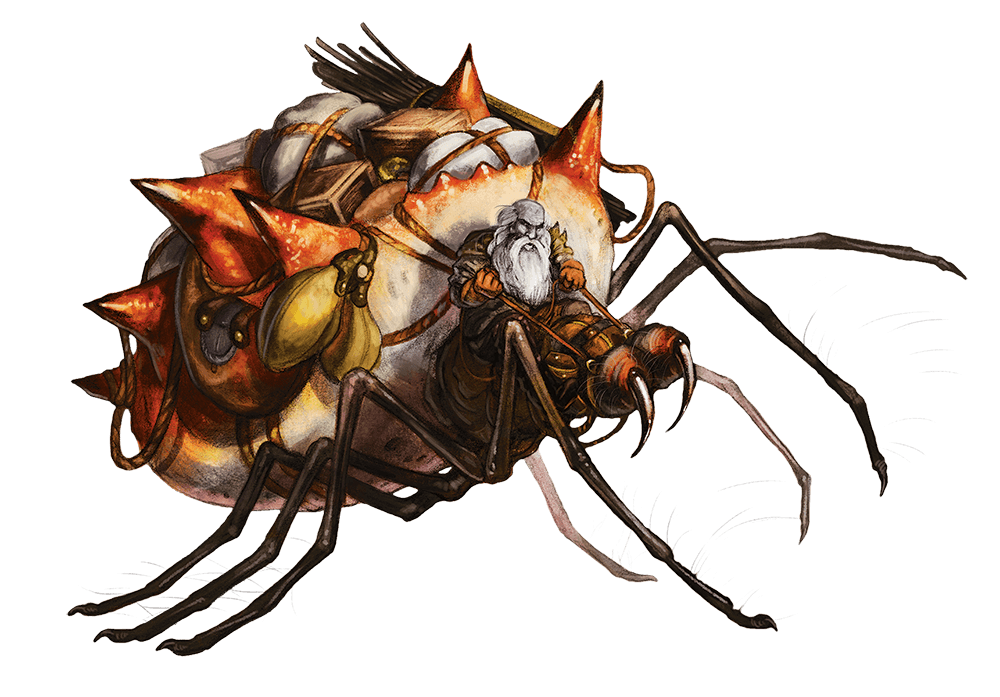
Giant underground spiders! The Steeders are domesticated by the Duergar to act as mounts both for travel and war. Just generic spiders before, 5th Edition's art direction takes one of the prettiest spiders in the world, the Spinybacked Orb Weaver (Gasteracantha cancriformis) with its distinctive, multi-spined orange abdomen as an inspiration. Pretty cool art.
There is a bit that the prose talks about, noting how female Steeders are larger than the males, which is true for many species of real-life spiders. This translates to two different stat blocks! The Duergar thus use the domesticated females as war steeds, while the males are used as draft animals. Steeders are extremely territorial and will even attack other Steeders... something that's quite true for most spider species, actually. This leads to the Duergar needing to keep the Steeders separate from one another, and place blinders on them to keep them from attacking one another. I really like this bit of worldbuilding.
Interestingly, Steeders don't spin webs, which feels like a way to prevent the Duergar from having access to the very useful 'Web' spell. Instead, the Steeders move around by secreting a viscous substance from their legs, using this quasi-web to grapple prey instead. They are also able to leap extraordinary distances, similar to real-life jumping spiders. It's a nice little way to differentiate the Steeders from other regular giant spiders, and one that adapts different types of cool spiders from the real world. I don't have a whole ton to otherwise say about these guys, but I'm happy they exist.
____________________________________________________
Steel Predator
- 5.5E/5E: Large Construct; Lawful Evil; CR 16
I think I would be more impressed with the Steel Predator if it didn't come in the same book as the Marut and the Retriever. Just like 'big monster dogs' were a bit prominent in Volo's Guide to Monsters with the Barghest, Yeth Hound and Shadow Mastiff all showing up, it's a bit strange that we've gotten three extraplanar, relentless robot hunters in Mordenkainen's Tome of Foes. And out of all of those, the Steel Predator is probably the least thematically memorable. The Marut has all the Inevitable lore tied to it, with a great motivation and a stark redesign. The Retriever is tied to the Drow and has cool lore implications with how it's powered by a fiend.
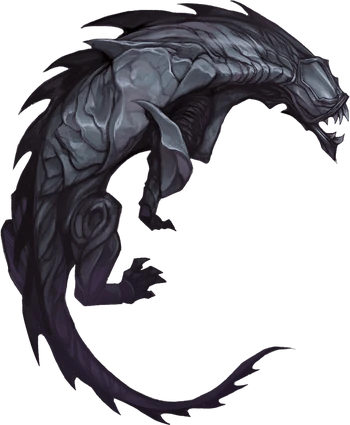
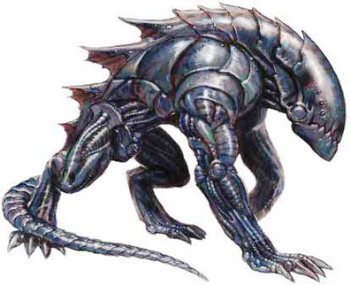
The Steel Predator... it visually is a well-drawn but a bit of a generic steel feline or canine with no eyes and made up of metal. Its 3E art has a Xenomorph-esque gait to it. Not terrible, but it's also not as memorable. The Steel Predator does have a unique bit of lore, where it was created by a rogue Modron that now lives in the multiversal hub-world of Sigil. This Modron created the Steel Predators and turned them against its kin, before being exiled. Now it opens a shop selling these things. It's a neat story, but it's neat because of the pscyho Modron shopkeeper, and less that the Steel Predators are memorable.
Steel Predators can dimension door and plane shift, can track its prey through any small identifier, and can unleash a stunning roar. Again, it's basically the Retriever. After finishing its mission, it returns to Sigil and is recycled for parts for the next Steel Predator. If it malfunctions, is just lingers and kills anything nearby.
Again... there's a feeling that I've seen this exact concept done in a much more interesting way earlier in the book. Sorry, Steely, I am just not too impressed with you. Maybe if you had more ability or visual ties to the Modrons it'd be something, but otherwise, sadly overshadowed.
____________________________________________________
Stone-Cursed
- 5.5E/5E: Medium Construct; Lawful Evil; CR 1
The Stone Cursed are... an interesting creature? As far as I can tell, it's another one that is original to 5th Edition. Stone Cursed are created when a ritual is done on people that are turned to stone -- by the likes of Medusae, Basilisks, Cockatrices, Gorgons and probably a bunch of others that's not coming to mind. The spirit of the trapped victim gets dimly animated, turning the Stone Cursed into a guardian. Essentially, it is a 'golem' style enemy with some extra steps. Their hands turn into claws that ooze gray sludge that also causes petrification.
There are a bit of extra details to the Stone Cursed that makes it a bit more interesting. A fist-sized obsidian skull apparently is formed deep within the Stone Cursed's torso, which can be recovered to extract memories of the original victim. It's something, at least. Again, this does feel more like accessories to a Medusa encounter more than anything. You could imagine some of the statues in her lair turn out to be minions with a variation of the petrification gimmick. I do like that some of the less prominent monsters get a bit of an expansion, but it's not the most interesting thing in the book, nor the most immediately the thing that jumps tom mind when you want to expand a Medusa or Basilisk or Cockatrice encounter.
____________________________________________________
Sword Wraith
- 5.5E/5E: Medium Undead; Lawful Evil; CR 8 (Commander), 3 (Warrior)
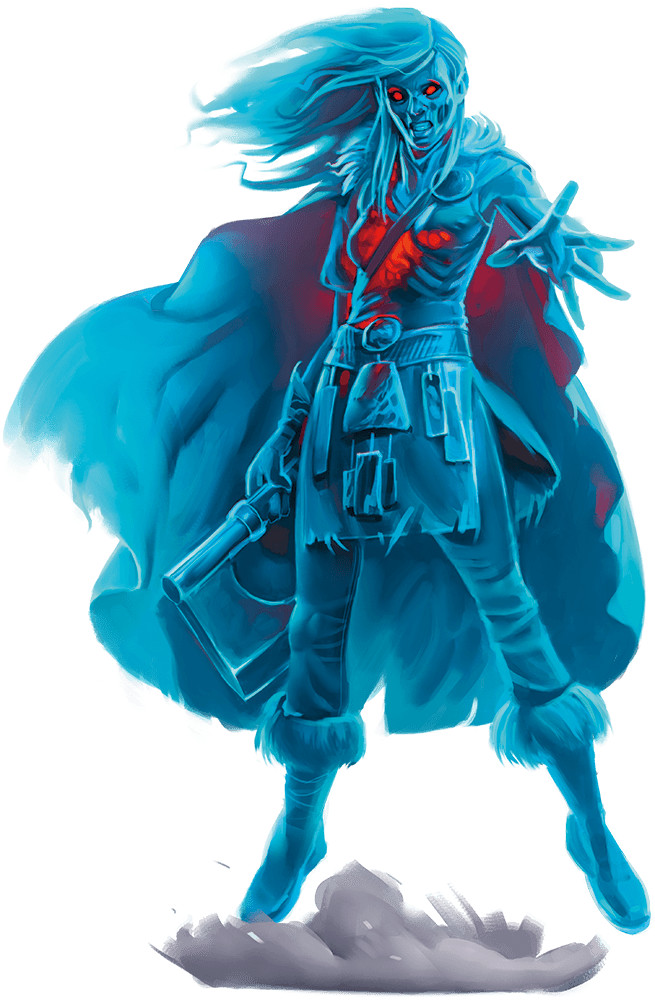
We've had regular Wraiths in the Monster Manual, which are the sentient incorporeal shadowy undead driven by hatred and negative emotions. Sword Wraiths are presumably a sub-type of Wraiths, then? Although you never really know with these undead spirits. The statblocks at least doesn't really have much to do with each other save for being undead. The Sword Wraith's resistances and immunities are a much simpler version of the ones afforded to other incorporeal undead like Wraiths.
The Sword Wraiths are noted to be created when warriors die in battle without honour, causing their spirits to rise up and haunt the site of death as Sword Wraiths. They will haunt battlefields, attacking anyone who questions their valour, but looking kindly at those who sing their praises. This makes it feel more like a weaker version of the Ghost than the Wraith, I suppose, if we want to be pedantic about which incorporeal undead spirit is closest to it. In older editions, Sword Wraiths will bow and follow the orders of those that are ranked higher than it in the military, having a vague sense of still being a soldier.
Combat-wise, the Sword Wraith is a simple warrior with the undead species's resistances. The stronger Sword Wraith Commander has resistance to turning magic, and can summon the lesser Warriors. I really don't have much to say about them. There's just enough of a backstory to contextualize the origin of these undead, but there's not enough of a hook or mechanical difference from the many other types of undead that I feel like they deserve a slot in a mainline bestiary... at least other than to fill in a specific niche in a CR bracket. Not much else to say, really.
____________________________________________________
Tortle
- 5.5E/5E: Medium Humanoid; Lawful Good; CR 1/4 (Tortle), 2 (Druid)
The Tortle is one of the breakout races in 5th Edition. Previously debuting as minor inhabitants of the jungle of Chult -- setting of Tomb of Annihilation -- the 'Tortle Package' introduced the Tortle as one of the first non-traditional non-human race, and became extremely popular among the fanbase. The personality of the kindly old-man turtle artwork, as well as a clear demand for more non-human races, ended up making the Tortle quite popular! While the humans and elves will always be the 'face' of Dungeons & Dragons, I feel like 5th Edition's been really nicely shoring up Tieflings, Dragonborns, Tabaxi and Tortles as a nice batch of secondary playable characters.
The design of the Tortle is quite simple -- a humanoid tortoise! The 5E redesign isn't content on going Teenage Mutant Ninja Turtles like the older incarnations, which isn't bad -- but does make it seem like 'just' a tortoise on legs. The 5E Tortle goes for a more unique feel, more Kung Fu Panda's Master Oogway. With the rugged shell, the longer arms, the large feet and the kindly old-man face really pushes the Tortle over the edge in getting a distinct presonality and identity compared to the other non-traditional playable race.
Tortles are described as being a gentle people that goes around to see how other folk live. They have their 'home' on their back, able to store items within their shell, so they don't really view their original settlements as much of a home and tends to leave for long durations of time. They have a vague sense of being connected mystically to the natural world, and happily wander the world, going through life day by day. It's a really nice combination of wanderlust and an aged perspective. I've seen the Tortles described as 'elf meets tabaxi', having the tabaxi's catlike curiousity but the elf's long life without being jaded.
They are a culture that leans more towards druidism, hence the 'Tortle Druid' statblock being included in Mordenkainen's Tome of Foes. Tortles as playable characters have interesting abilities. They can breathe underwater, they have natural weapons in claws... and uniquely, they have 'natural armour'. A Tortle always has a very reasonable AC (a stat that measures how easy you are to be hit) of 17, at the cost of not being able to wear traditional armour. Tortles can furthermore increase this AC even more by retracting their heads and limbs into the shells... at the cost of not being able to cast spells or attack during the duration that it's hiding.
Very cool set of abilities that really sell the fantasy of wanting to play as a tortoise person. Some of the playable races don't exactly deliver what you want when you select them, but the Tortles manage to deliver both flavour and sensible utility, while giving a drawback that makes sense and doesn't 'feel bad'. And besides... look at these guys! Can you bear to say that you don't like them? They're just old turtle folks!
____________________________________________________
Vampiric Mist
- 5.5E/5E: Medium Undead; Chaotic Evil; CR 3
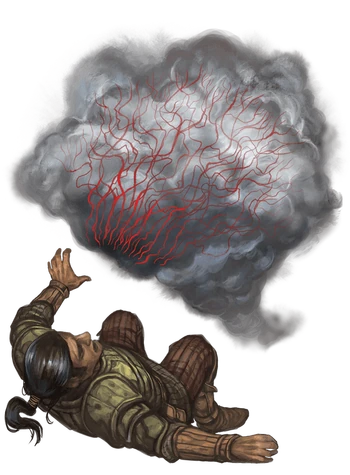
And we close off the unique monsters in Mordenkainen's Tome of Foes with a creature that debuted in the 1st Edition's Monster Manual II -- the Vampiric Mist, also known as the Crimson Death or Crimson Mist in some editions. The Vampiric Mists are the remnants of wretched vampires that are prevented from finding rest. It's an interesting concept -- vampires in D&D are intrinsically tied to their coffins or burial grounds. What happens if these coffins are destroyed while the vampire is escaping in the form of a polymorphed mist? The Vampire isn't exactly dead, but it can't go back to its coffin to regenerate anymore.
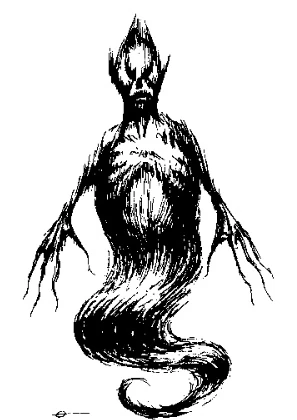
The end result is this Vampiric Mist, depicted in previous editions as a roiling cloud-specter. 5E gives an interesting take of a giant blob of cloud with arteries and veins running through it like spiderwebs. Vampiric Mists are no longer sentient, driven with the sole focus of hunger. They masquerade as part of regular mists, before ambushing prey and causing blood to ooze out of its pores or spill out from its orifices. Even more creepily, this blood extraction doesn't hurt the person during the process, allowing the Mist to strike even when the victim is asleep.
A properly sated Vampiric Mist will turn so red that it rains blood wherever it flies. The prose does compare the Vampiric Mist to sharks; being drawn immediately towards blood. Being able to surreptitiously extract blood also reminds me of ticks or mosquitoes. Interestingly, despite being reduced to such a wretched form, Vampiric Mists still observe forbiddance, unable to enter a house unless expressly invited -- which is quite funny. One can accidentally invite an immortal undead Dracula, sure, but inviting a mass of veiny mist is probably less likely to do without realizing what you are letting in.
But more importantly, I do like that we're getting a nice little monster variation that answers an interesting 'what if' question. With so many magical and wonderful monstrous creatures running around, there inevitably arises questions about 'what will happen if this monster does that when it's using this magical ability?

Always liked the the Wretched and the Tortle
ReplyDeleteThe Wretched because a Shadar-Kai gardener kept it as a pet, where it acted like a curmudgeonly pet.
The Tortle because I got experiment with how newer additions mixed with older stuff. Due to how Tortle raise their kids, I was able to have a Way of the Ascendant Dragon Monk named Snapjaw who was taught by a Dragon Turtle
I just like Tortles and a lot of the 'animal people' races in general! Such fun combinations of race/class to make fun characters and NPCs.
DeleteI could imagine the Wretched as like an angry little Shadowfell version of a chihuahua.