I've personally never been the biggest fan of there being such an insane variety of demons and evils because, in theory, each one of these enemies will end up subscribing to the typical rule of demons/devils/yugoloths reforming in their native plane if they're not killed there or whatever, but there's a huge market for these creatures, and I definitely appreciate that 5th Edition's expansion book for demons really ended up trying to give us a fair amount of diversity among the options.
Mordenkainen's Tome of Foes split these up alphabetically, but I'm going to cover them all in a single page so I don't have all my Reviewing D&D Monsters pages be taken up by random huge chunks of demons and devils. It's more thematically appropriate anyway. Click here for a primer on D&D fiends when I first covered the 'basic' ones introduced in the 5th Edition Monster Manual!.
(Archival purposes)
____________________________________________
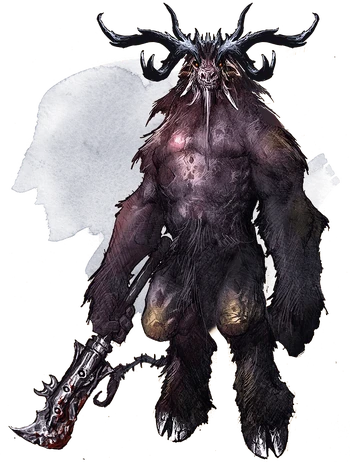
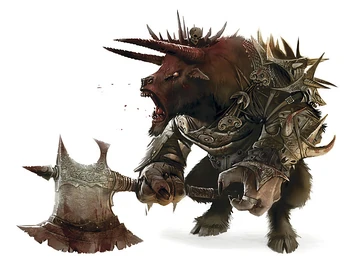
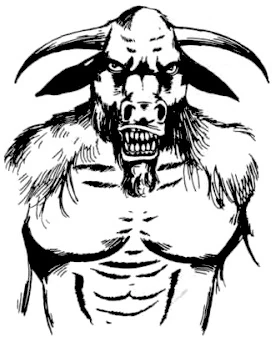
Demon Lord BaphometThroughout all D&D editions, we've hyped up characters like the demon lords and arch-devils and stuff, and, to quote the famous gamer credo: "If it has stats, it can be killed". And at some point, your adventuring party will get strong enough that you can go straight to these creatures' realms and challenge them, with demon lords being pretty suitably epic final dungeon boss type enemies. Even if your campaign doesn't quite get that far, giving demon lords stats would be interesting if for narrative reason or purpose your players end up meeting them, or, hell, even avatars of them. Even if the demon lords themselves don't appear, fighting their cultists is a neat way to involve them as a potential 'big bad' down the line. I don't tend to do 'named NPC's' in these reviewing-monsters segments, and if I ever get to the adventure modules I'll actually be skipping most of what are just NPC enemies, but the demon lords are varied enough in design and scope that they feel more monster-like.
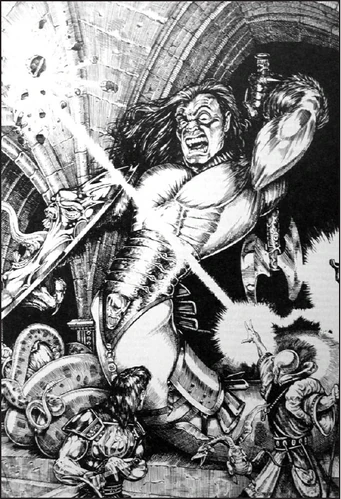
Anyway, Baphomet. I don't think he really ends up doing a whole ton, but he's one of the few Demon Lords to get stats for 5th edition in Mordenkainen's. D&D's Baphomet is more of a bull-man than the traditional real-life depiction of Baphomet as a goat-man. I do like the 5th Edition artwork a lot better, communicating the fact that Baphomet is a hideous bull-man but also emphasizing that he's a demon with that face and horn arrangement. He's got a huge butcher knife called "Heartcleaver", which is a cool name. The 4E artwork is cool and all, but he's just literally a bigger minotaur in armour instead of being a demon lord. Baphomet's called the "Prince of Beasts", rules over minotaurs and people with savage hearts, and his followers are basically the type to want to break down civilization and turn everything into a bestial hellscape of savagery. It's the sort of given for villains in a fantasy setting to have a little different goal to set them apart from the other demon lords. Playing with the minotaur theme, Baphomet and his followers also like to create huge mazes, with his own realm in the Abyss being called the Endless Maze. Mordenkainen's write-up actually emphasizes the behaviour of Baphomet's followers as well, noting their crazy bull-demon-king worshiping quirks, and Baphomet's followers slowly get mutated into minotaurs. Oh, and of course, the Goristros, who are literal giant bull-demons, are heavily associated with Baphomet. Anyway... Baphomet is a neat one to start off with. Simple motivations, with a simple but effective design.
Demon Lord Demogorgon
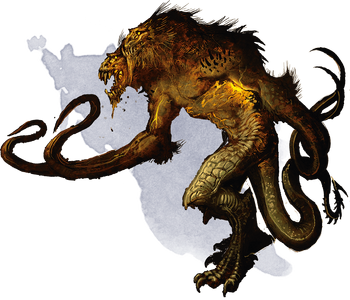
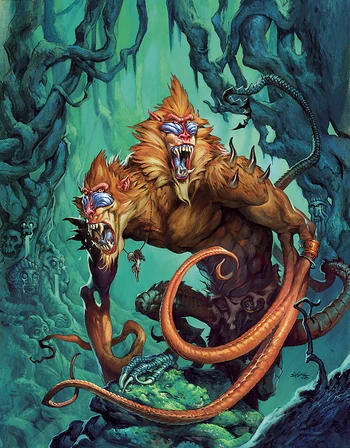
Unquestionably my favourite of all the Demon Lords even before Stranger Things borrowed his name for a completely unrelated monster, we've got the Demogorgon, who also happens to have one of the coolest names ever. Not bad for someone whose mythological basis is literally a typo. Demogorgon has been hanging out since the first edition and alongside Orcus, has been D&D's primary faces for fiends alike. And instead of being just a generic demon monster, Demogorgon takes the form of a kaiju-sized two-headed mandrill with tentacle arms and chicken legs. I love this design so much, particularly the 4E one with the vibrant colours and pose which became the cover page of 4th Edition's second Monster Manual. All the other artworks are great, but they tend to emphasize a grimier, grungier and scarier Demogorgon, which I like a bit less compared to the memorable look of 4E Demogorgon. Oh, and good ol' Demogorgon is also aquatic, despite being a fucking two-headed baboon, with his lair being in a plane called the Gaping Maw, in a half-submerged palace that represents madness, duality and shattered psyche. Mostly, though, he's a huge wacky-looking two-headed baboon, and I love just how differently the different editions have portrayed him. My favourite is still the 4E artwork used for the colourful cover of one of the Monster Manuals, there's just a fun contrast with him looking so bright despite him being a demon lord of hell.
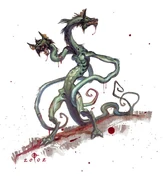
With such self-congratulating titles like the "Prince of Demons" and "Master of the Spiraling Depths", Demogorgon's whole gimmick (his 'sphere of influence', to borrow an Elder Scrolls term) is chaos, duality and madness, becuase, hey, Demogorgon can't even agree with himself half the time. His two giant monkey heads bicker and fight, so despite his immense strength, Demogorgon's own indecision and insanity ends up contributing to the stalemate between the forces that plague the lower planes. His heads are called Aameul and Hathradiah, and Demogorgon and his followers basically aim to spread madness and corruption wherever they go. There's just something whimsical and fun about this scary demon lord who can break minds just by the sight of his Y-shaped sign (some Uzumaki style craziness) being a screeching two-headed baboon with chicken legs and whip arms that keeps arguing with itself. He's even more wacky in older editions, which went back and forth on giving him a huge ape-like body or making him this little noodle-snake with baboon heads and whip arms. And while I do adore 2E Demogorgon's utter daftness -- he looks like a villain in a children's fantasy book -- I have grown really accustomed to the standard giant demon-ape from 3E onwards, and that's something that I didn't think I would say about a primate-themed monster, since I really don't like monkeys a lot. But at the same time, that sheer bizarre whimsy is why I think I like Demogorgon the best out of all of D&D's named enemies. It's threatening as all hell, but it's also fun, y'know? Anyway, I like Demogorgon a lo, and I think we'll cover him more if/when we reach the adventure modules and talk about Out of the Abyss.
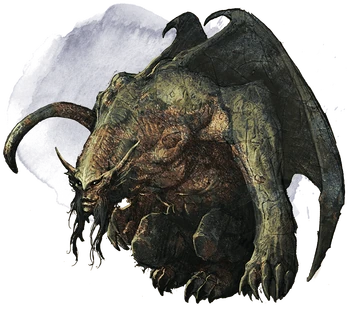
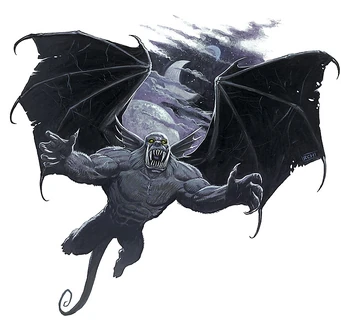
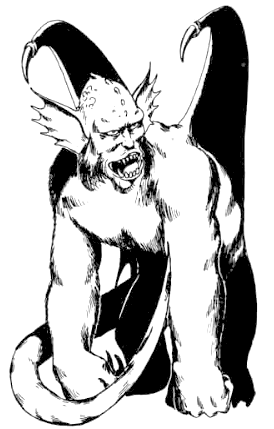
Demon Lord Fraz-Urb'luuDesign-wise, Fraz-Urb'luu isn't really super creative, and he looks kind of just like a generic demon. Like what I've mentioned above while talking about the Nabassu and Bulezau, having a generic gargoyle-style body shape -- a humanoid with bat wings and maybe some horns or a tail -- sure is traditionally demonic, but it also sure is kind of boring. Fraz-Urb'luu, in addition to being the bane of spell-checkers, looks like a very bland bat-winged orc-man in 3E and 4E. 5th Edition gave him a far more memorable an cooler artwork with a mottled green skin and a weird tangled seaweed beard thing going on, but Fraz-Urb'luu is still kind of there. His whole deal is deception, illusions and tricks, resorting to huge dreamscapes of illusions when his sweet words (he apparently likes to masquerade as a benign god to his followers) won't work. He's basically Loki!
He is one of the more iconic villains from D&D's Greyhawk setting, I think, because Mordenkainen's references a very delightfully Legend-of-Zelda-esque backstory where Fraz-Urb'luu was imprisoned beneath a castle and it's a race between his followers and a bunch of adventurers in hunting pieces of a shattered staff across the land to free him. His lair is the demonic city of Zoragmelok in the realm of Hollow's Heart, which, unlike the wide dream-scapes and illusions he's known for, is just a featureless plain of white dust. Anyway, this is kind of an iconic villain, and I respect Fraz for that, but typing his name is a headache.

Demon Lord Graz'zt
Demon Lord Baphomet
- 5.5E/5E: Huge Fiend - Demon; Chaotic Evil; CR 23
Anyway, Baphomet. I don't think he really ends up doing a whole ton, but he's one of the few Demon Lords to get stats for 5th edition in Mordenkainen's. D&D's Baphomet is more of a bull-man than the traditional real-life depiction of Baphomet as a goat-man. I do like the 5th Edition artwork a lot better, communicating the fact that Baphomet is a hideous bull-man but also emphasizing that he's a demon with that face and horn arrangement. He's got a huge butcher knife called "Heartcleaver", which is a cool name. The 4E artwork is cool and all, but he's just literally a bigger minotaur in armour instead of being a demon lord. Baphomet's called the "Prince of Beasts", rules over minotaurs and people with savage hearts, and his followers are basically the type to want to break down civilization and turn everything into a bestial hellscape of savagery. It's the sort of given for villains in a fantasy setting to have a little different goal to set them apart from the other demon lords. Playing with the minotaur theme, Baphomet and his followers also like to create huge mazes, with his own realm in the Abyss being called the Endless Maze. Mordenkainen's write-up actually emphasizes the behaviour of Baphomet's followers as well, noting their crazy bull-demon-king worshiping quirks, and Baphomet's followers slowly get mutated into minotaurs. Oh, and of course, the Goristros, who are literal giant bull-demons, are heavily associated with Baphomet. Anyway... Baphomet is a neat one to start off with. Simple motivations, with a simple but effective design.
Demon Lord Demogorgon
- 5.5E/5E: Huge Fiend - Demon; Chaotic Evil; CR 26
 |
| 1E Demogorgon |
 |
| 2E Demogorgon (!!!) |
Demon Lord Fraz-Urb'luu
- 5.5E/5E: Large Fiend - Demon; Chaotic Evil; CR 23
He is one of the more iconic villains from D&D's Greyhawk setting, I think, because Mordenkainen's references a very delightfully Legend-of-Zelda-esque backstory where Fraz-Urb'luu was imprisoned beneath a castle and it's a race between his followers and a bunch of adventurers in hunting pieces of a shattered staff across the land to free him. His lair is the demonic city of Zoragmelok in the realm of Hollow's Heart, which, unlike the wide dream-scapes and illusions he's known for, is just a featureless plain of white dust. Anyway, this is kind of an iconic villain, and I respect Fraz for that, but typing his name is a headache.
Demon Lord Graz'zt
- 5.5E/5E: Large Fiend - Demon; Chaotic Evil; CR 24
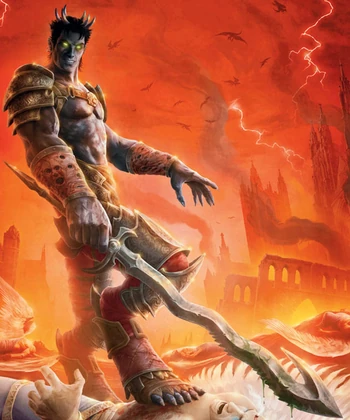
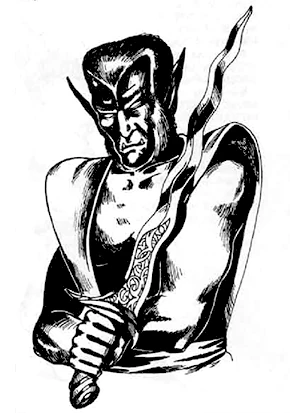
Oh, hey, it's Darth Maul! It's kind of an obligation that in any gathering of supervillains, one of them must be the 'pretty boy' one, and among the demon lords, Graz'zt is that, looking the most humanoid out of his compatriots, being a dark-skinned muscular handsome man with little horns on top. And Graz'zt, of course, is the prince of "untamed desire", with the lore noting that Graz'zt is inhumanely beautiful, but anyone who meets him knows that there's just something wrong with him, something slightly off. He's handsome but his expression's just a bit off; his features are perfect but he's got the wrong number of fingers or something, and I think this whole mixture of beauty and wrongness is Graz'zt whole theme. Anyway, his whole theme is lust and obviously his cultists engage in like, non-kosher BDSM and orgies and whatnot. It's a sex-worshiping demon cult! And while Graz'zt prefers pleasure and manipulation, he's still a demon lord with a CR of 24, and he's going to murder anyone that defies him with his blade Angdrelve (or "Wave of Sorrow"). D&D can't really get away with describing anything too graphic, but we are all adults here, we know that Graz'zt's basically all about pain-and-pleasure BDSM orgies. Not much to say here design-wise, but I recognize that a more pleasure-oriented Demon Lord like Graz'zt is necessary to balance out the others.
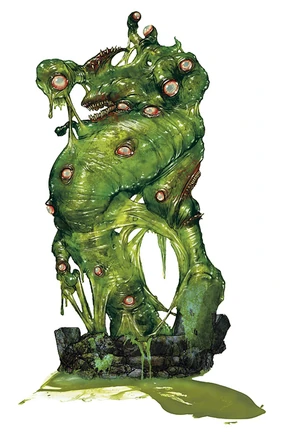
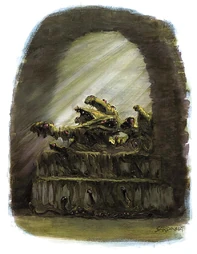
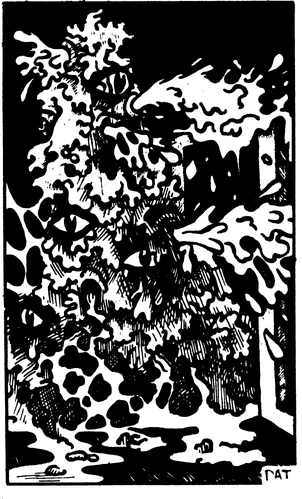
Demon Lord JuiblexJuiblex the Faceless Lord is another one that gives me a bit of a trouble in spelling -- I keep typing his name as the more natural-sounding Jubilex! Juiblex's visual design isn't super duper creative either, just a giant goopy jelly slime with eyeballs and fanged mouths dotting its entire body. It's a neat design, sure, because I like slime monsters and its a nice break from the horns-and-wings humanoids... but I kind of feel that his (pretty cool) artwork could've been a bit cooler for something that's supposed to be the big daddy of all slimes in the multiverse, yeah? Juiblex fills another supervillain niche, this time being the trope of the idiot, mindless being who just wants to end the world. Juiblex wants to end the world, not caring about plots, schemes or power plays, but that's because all it wants is to consume everything, to slake its hunger and turn the entire world into nothing but Juiblex, dissolving everything into slimes.
So this does raise some interesting questions about the slimes in D&D. While we do have explicit demonic slimes that serve Juiblex (the Alkilith we covered earlier) what about the other slimes of the world? The Gelatinous Cubes and Ochre Jellies and all those? Are they still part of Juiblex in some way? Are oozes technically, then, demons? Demon-spawn? Juiblex also has mortal followers, most of whom find themselves transformed into slime-people who end up slowly losing their individuality as Juiblex consumes them and turns them into literal slime... tragically, none of these slime-cultists get any artwork here. Come on. Juiblex, interestingly, has a roommate in the Abyss, hanging out in the realm of Shedaklah with fellow demon lord Zuggtmoy. They fight for territory, but it kind of comes off as the two of them being terrible roommates in a comedy sitcom. Anyway, I like Juiblex, but there really isn't a whole ton to talk about him.
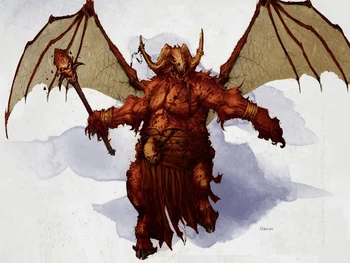
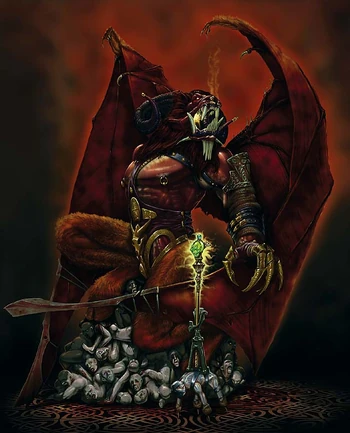
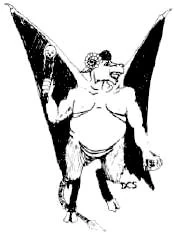
Demon Lord Orcus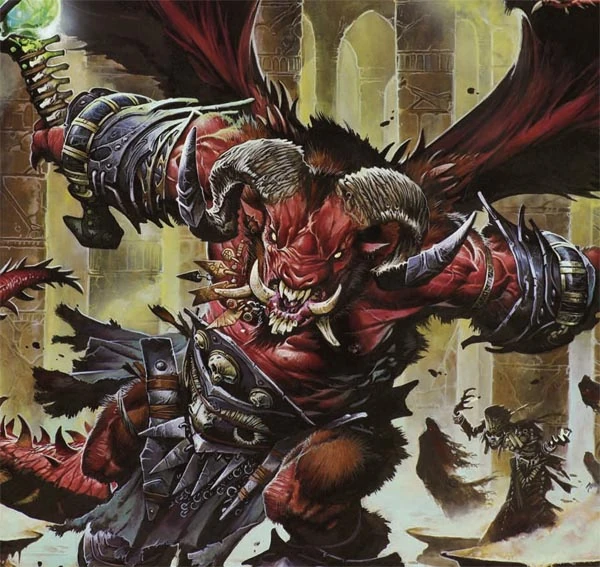 Another one that keeps showing up in every dang edition of D&D is the demon lord Orcus, arguably the definitive D&D villain to some. Portrayed relatively consistently as a heavily-built humanoid with the typical classic 'demon' look, Orcus is a design that we've seen so many times in other depictions of demonic entities -- red skin, horns, fangs, bat wings, tails, hooved feet... yet I suppose it's appropriate that one of the original examples of demon lords looks like the most common pop culture depiction of demons. Orcus is known as the Prince of Undeath, the Blood Lord, and is the being responsible for the presence of undead beings and especially the cannibalistic ghouls. He's your regular evil death-god. Orcus's whole modus operandi is to kill every single goddamn thing in the multiverse and turn them into undead, and his cults are filled with necromancers and warlocks that raise the dead in his name. I do like the little art evolution from the older depictions of Orcus -- particularly 5E's decision to give him a skull for a head, which is a lot more appropriate for the demon lord of undeath. 4E does give him a pretty damn cool art piece which became the cover for that edition's Monster Manual.
Orcus lives in the fortress of Naratyr, located on the layer of Thanotos, and while Mordenkainen's doesn't go into too much detail about his backstory, what I remember from previous editions indicate that Orcus wasn't born a demon lord, but was once a mortal spellcaster who died and was cast into the Abyss, and his soul slowly grew from a lowly Larva all the way up the ranks of demonkind into a Balor before eventually achieving godhood and becoming the only demon lord to challenge the throne of 'Demon Prince' from Demogorgon. Over the various editions of D&D, Orcus has been killed and resurrected multiple times, which I suppose is appropriate for a death-god demon. Without going into the specifics of Orcus's backstory or abilities (which will take us a while) there's really not a whole ton to talk about him, though.
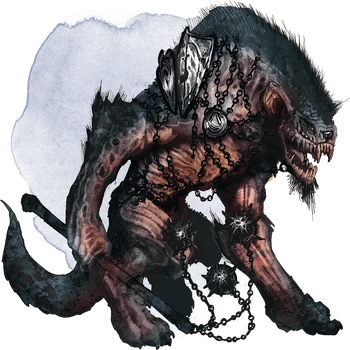
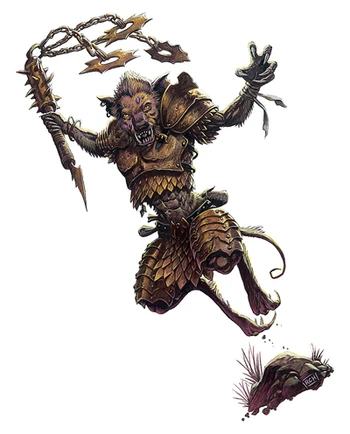

Demon Lord YeenoghuWhile he doesn't quite have as impressive a resume as the likes of Orcus, Demogorgon or Asmodeus, Yeenoghu kind of keeps being fairly prominent in D&D material for the simple reason that his favoured race, the gnolls, are themselves very prominent in D&D material. Yeenoghu isn't super interesting design-wise, just a bigger, more savage gnoll with a triple-tipped flail. 5E does give him an awesome artwork that truly embodies the "Beast of Butchery" and makes him look far more feral and demonic than most gnolls, but in previous editions he's kind of underwhelming. As a Demon Lord, Yeenoghu's just crazy, violent, and all about the senseless slaughter and destruction, and he shows up a lot in the backstories of gnolls and their ilk. Yeenoghu is neat, again, as a springboard of (admittedly simple) backstory for the gnolls, but otherwise I can't really think of much to say about it.
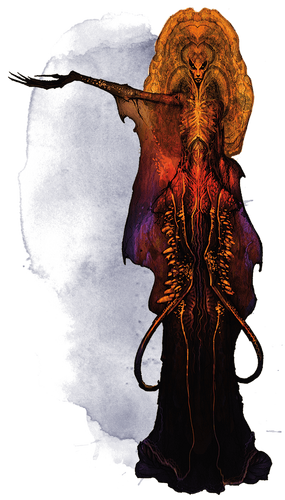
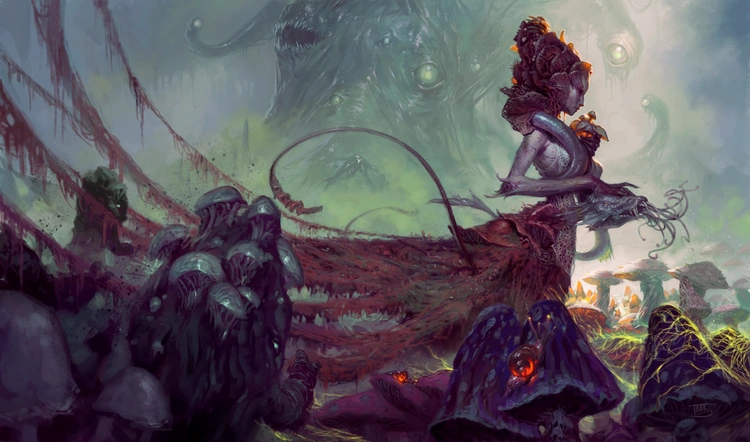
Demon Lord ZuggtmoyI don't think Zuggtmoy has had much of a career outside of 5E, being name-dropped a couple of times in previous editions but never really getting much of a proper role until 5th Edition set her up as one of the primary antagonists of the Out of the Abyss adventure. Zuggtmoy is the Demon-Queen of Fungi and the Lady of Rot and Decay, and I am all about fungus-themed enemies. I guess we know why Zuggtmoy gets along pretty well with Juiblex so much that they're essentially roommates, because Zuggtmoy is detached and has such an alien mind that all she wants to do is to spread her spores to infect the living and turn them into her mushroom minions. It's a neat difference compared to the more brutal mentality of the other Demon Lords.
Despite Zuggtmoy's two artworks depicting her as a slender humanoid woman with a mushroom-themed dress and tendrils and whatnot, this is obviously not her true form, it's just what she chooses to appear as when she mooshes together her fungal form. Zuggtmoy's cultists are also basically slowly being mind-controlled by her fungal spores, after having been promised something relatively innocent like a boost of power after eating a mushroom. Pro tip in D&D, if a suspicious NPC offers you a very cheap Potion of Giant's Strength with a suspicious-looking toadstool floating inside... don't drink it! Your DM isn't that nice. Tragically, though, like Juiblex's slime-cultists, we don't get to see any of the fungi-faced cultists of Zuggtmoy represented in artwork, which I assume will look like those fungus-folk from Darkest Dungeons. I really do like Zuggtmoy, although part of it is admittedly thanks to me really liking fungi as the basis for monster concepts.
That's all the Demon Lords that are statted in Mordenkainen's, with the biggest omission being the Drow's Spider-Queen Lolth which I think is covered in another book, although we do get a chunk of her lore and origin in the 'elf' section. And... and I feel like I ended up not having as much to say about them, really. I do kind of feel like we probably could've had more lore about the Demon Lords themselves, although I'm pretty sure that those are covered in other books and whatnot.
Demon Lord Juiblex
- 5.5E/5E: Huge Fiend - Demon; Chaotic Evil; CR 23
So this does raise some interesting questions about the slimes in D&D. While we do have explicit demonic slimes that serve Juiblex (the Alkilith we covered earlier) what about the other slimes of the world? The Gelatinous Cubes and Ochre Jellies and all those? Are they still part of Juiblex in some way? Are oozes technically, then, demons? Demon-spawn? Juiblex also has mortal followers, most of whom find themselves transformed into slime-people who end up slowly losing their individuality as Juiblex consumes them and turns them into literal slime... tragically, none of these slime-cultists get any artwork here. Come on. Juiblex, interestingly, has a roommate in the Abyss, hanging out in the realm of Shedaklah with fellow demon lord Zuggtmoy. They fight for territory, but it kind of comes off as the two of them being terrible roommates in a comedy sitcom. Anyway, I like Juiblex, but there really isn't a whole ton to talk about him.
Demon Lord Orcus
- 5.5E/5E: Huge Fiend - Demon; Chaotic Evil; CR 26
Another one that keeps showing up in every dang edition of D&D is the demon lord Orcus, arguably the definitive D&D villain to some. Portrayed relatively consistently as a heavily-built humanoid with the typical classic 'demon' look, Orcus is a design that we've seen so many times in other depictions of demonic entities -- red skin, horns, fangs, bat wings, tails, hooved feet... yet I suppose it's appropriate that one of the original examples of demon lords looks like the most common pop culture depiction of demons. Orcus is known as the Prince of Undeath, the Blood Lord, and is the being responsible for the presence of undead beings and especially the cannibalistic ghouls. He's your regular evil death-god. Orcus's whole modus operandi is to kill every single goddamn thing in the multiverse and turn them into undead, and his cults are filled with necromancers and warlocks that raise the dead in his name. I do like the little art evolution from the older depictions of Orcus -- particularly 5E's decision to give him a skull for a head, which is a lot more appropriate for the demon lord of undeath. 4E does give him a pretty damn cool art piece which became the cover for that edition's Monster Manual.Orcus lives in the fortress of Naratyr, located on the layer of Thanotos, and while Mordenkainen's doesn't go into too much detail about his backstory, what I remember from previous editions indicate that Orcus wasn't born a demon lord, but was once a mortal spellcaster who died and was cast into the Abyss, and his soul slowly grew from a lowly Larva all the way up the ranks of demonkind into a Balor before eventually achieving godhood and becoming the only demon lord to challenge the throne of 'Demon Prince' from Demogorgon. Over the various editions of D&D, Orcus has been killed and resurrected multiple times, which I suppose is appropriate for a death-god demon. Without going into the specifics of Orcus's backstory or abilities (which will take us a while) there's really not a whole ton to talk about him, though.
Demon Lord Yeenoghu
- 5.5E/5E: Huge Fiend - Demon; Chaotic Evil; CR 24
Demon Lord Zuggtmoy
- 5.5E/5E: Large Fiend - Demon; Chaotic Evil; CR 23
Despite Zuggtmoy's two artworks depicting her as a slender humanoid woman with a mushroom-themed dress and tendrils and whatnot, this is obviously not her true form, it's just what she chooses to appear as when she mooshes together her fungal form. Zuggtmoy's cultists are also basically slowly being mind-controlled by her fungal spores, after having been promised something relatively innocent like a boost of power after eating a mushroom. Pro tip in D&D, if a suspicious NPC offers you a very cheap Potion of Giant's Strength with a suspicious-looking toadstool floating inside... don't drink it! Your DM isn't that nice. Tragically, though, like Juiblex's slime-cultists, we don't get to see any of the fungi-faced cultists of Zuggtmoy represented in artwork, which I assume will look like those fungus-folk from Darkest Dungeons. I really do like Zuggtmoy, although part of it is admittedly thanks to me really liking fungi as the basis for monster concepts.
That's all the Demon Lords that are statted in Mordenkainen's, with the biggest omission being the Drow's Spider-Queen Lolth which I think is covered in another book, although we do get a chunk of her lore and origin in the 'elf' section. And... and I feel like I ended up not having as much to say about them, really. I do kind of feel like we probably could've had more lore about the Demon Lords themselves, although I'm pretty sure that those are covered in other books and whatnot.
____________________________________________________
Archdevils: Bael
- 5.5E/5E: Large Fiend - Devil; Lawful Evil; CR 19
 Now where the demons have Demon Lords, devils have Archdevils, the mightiest lords and dukes that serve atop the strict hierarchy of the lawful evil empire of the Nine Hells, and just like a real-world corporation, names rise and fall. And while I only have the 3.5E sourcebook on hand to check, I do know that devils tended to receive a fair bit less spotlight than demons, and other than the big honcho Asmodeus himself, the archdevils that tended to be spotlighted differ from edition to edition. Duke Bael (not to be confused with Bel) is a name that's shown up a couple of times, though, and in 5E... he, uh, kind of looks like a generic minotaur? It sure is a cool artwork for Bael, but without the context I would've assumed that this is just a minotaur adventurer. Bael's a vassal to the Archdevil Mammon, Lord of the Third Layer, and leads 66 companies of Barbazus (Barbazi?), and apparently he's so dang effective that he's never lost his job. It's just that he's a simple, loyal soldier in an environment where it's 99% politics, so Bael ends up finding himself out of touch, all he wants to do is to be a good general and go protect Mammon's territory and enslave all his enemies. He's not dumb, but I get the vibe that he just doesn't give a shit about the backstabbing and constant scrabbling for position, all he wants to do is do his job and these damn mortals keep worshiping him and asking to make deals with him. Also, according to 5E, apparently Bael has a cult, but even among members of his cult Bael's appearance and deeds are hotly debated, with some claiming that Bael looks like a toad or a cat. Apparently, though, he's a cow-man.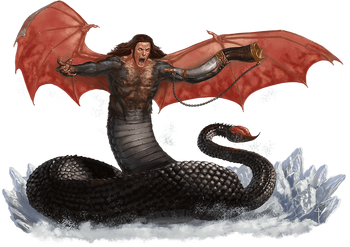
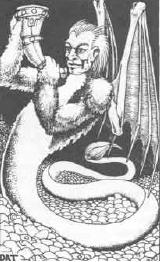
Archdevils: Geryon
- 5.5E/5E: Huge Fiend - Devil; Lawful Evil; CR 22
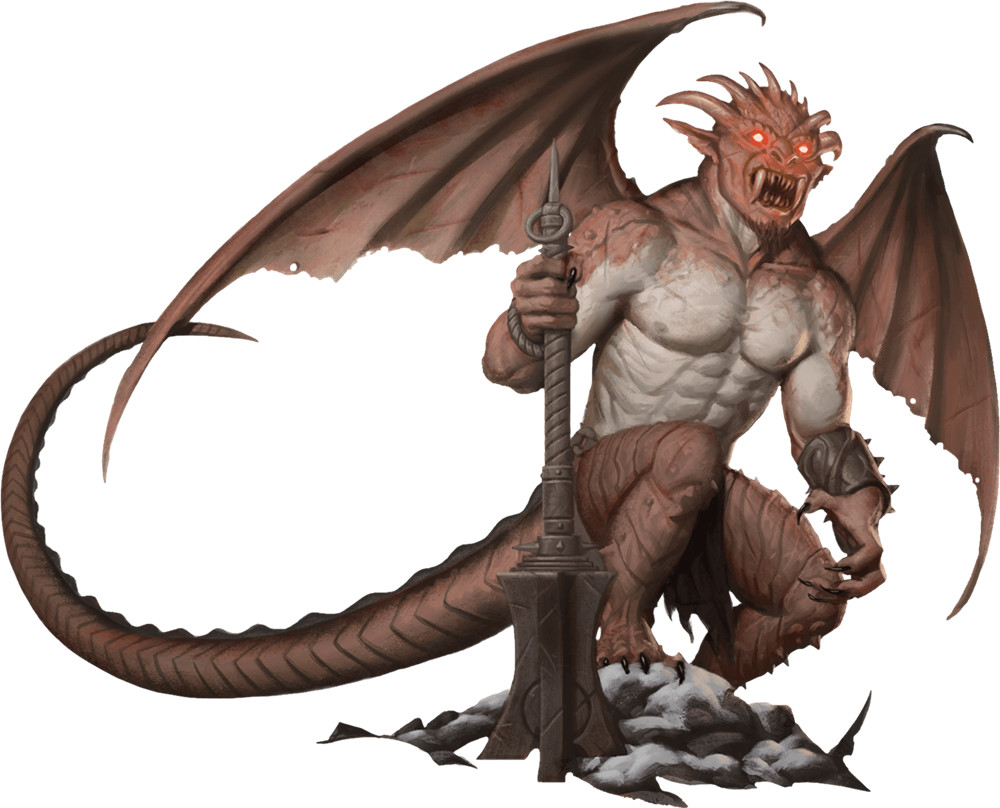

Archdevils: Hutijin
- 5.5E/5E: Large Fiend - Devil; Lawful Evil; CR 21
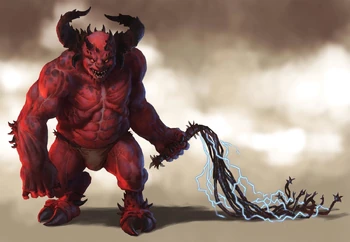
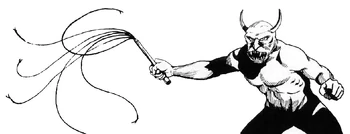
Archdevils: Moloch
- 5.5E/5E: Large Fiend - Devil; Lawful Evil; CR 21

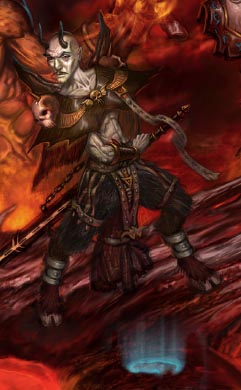
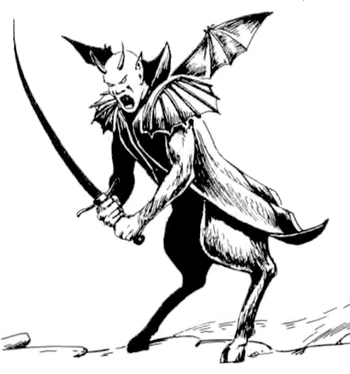
Archdevils: Titivilus
- 5.5E/5E: Large Fiend - Devil; Lawful Evil; CR 16
Titivilus's design is all right. It's a bit less boring than Hutijin and Moloch because of the fancy accessories and being a different shade of colour than just blood red, but it's still just kinda there? I do appreciate how so much of the flavour of devilish villains ended up being mostly revolving around the fact that whenever you deal with a devil, you're basically making their rivals stronger, and it leads to this interesting damned-if-you-do-damned-if-you-don't situation.
Archdevils: Zariel
- 5.5E/5E: Large Fiend - Devil; Lawful Evil; CR 26
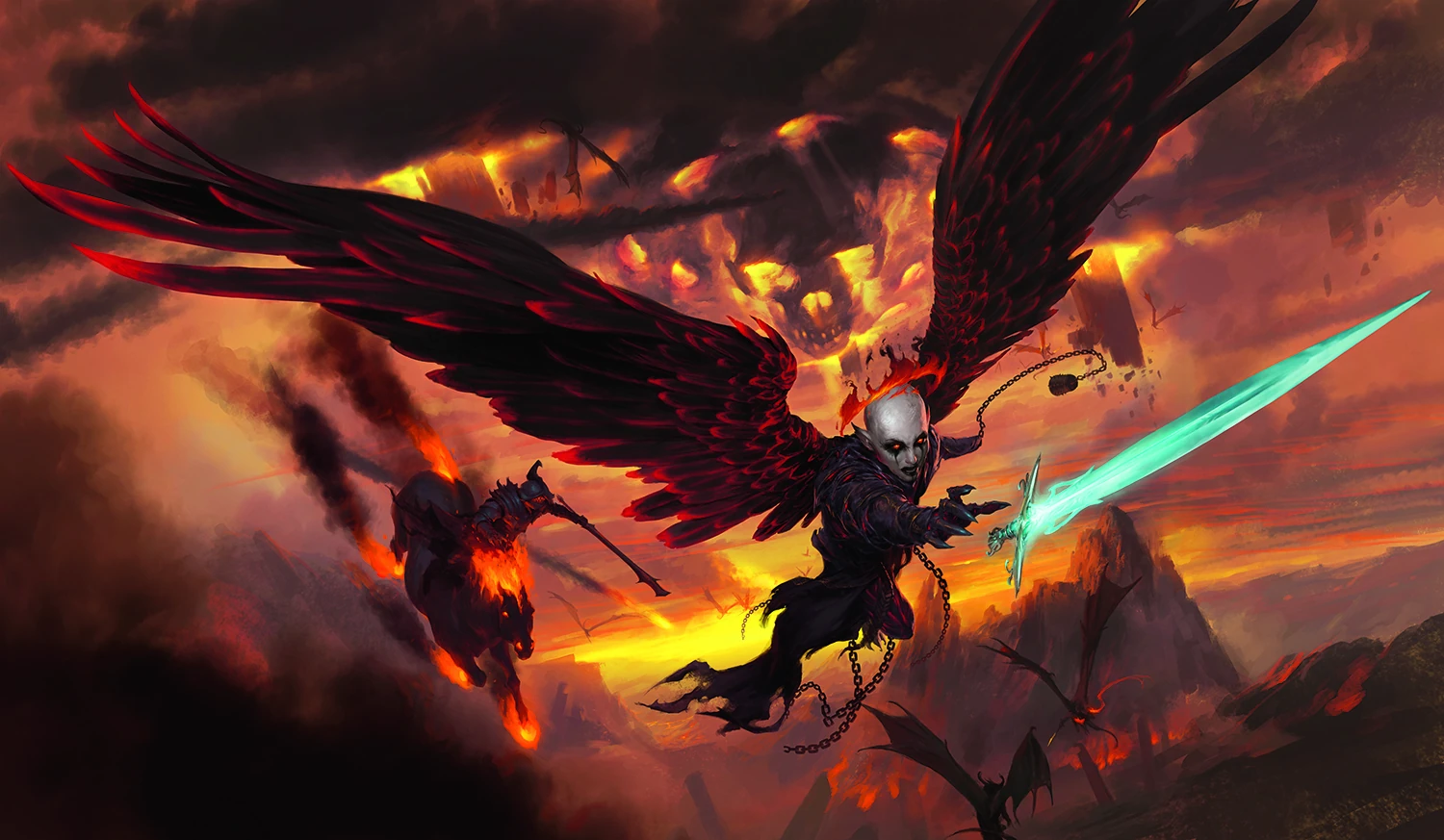
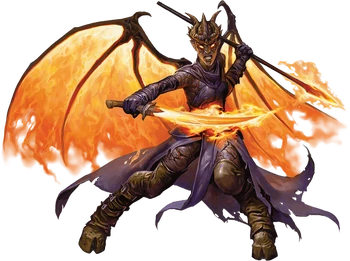 Last among our archdevils is Zariel, who's got a far more interesting bit to talk about because she's actually a long-running character, and the star of one of 5E's newer sourcebooks, Baldur's Gate: Descent into Avernus. And what do you know, Zariel's the archdevil that rules over Avernus, the first layer of the Nine Hells! Her saga is told in the background of various sourcebooks over the past couple of editions... on paper, her backstory is pretty generic but at the same time a classic one, a former angel charged with goodness and purity, but eventually fell from grace after being corrupted and being way too war-hungry in the fight against the fiends. A failed assault to try and wipe out all the fiends ended up with her allies dead and her transformed into the monster she hates so much, and then Zariel became one of the mightiest devils there is. After a bunch of back-and-forth over the sourcebooks in 3E and 4E, Zariel eventually broke free from her imprisonment, ousted the previous Lord of the First, Bel (not to be confused with Bael), and ended up becoming a far more brutal leader of the devils in their fight against the demon hordes... although, of course, what she truly desired is revenge against good ol' Asmodeus. As ruler of the first layer of hell, Zariel basically has final say on who comes and enters the Nine Hells, and is keenly interested in collecting souls to add to her ever-growing army. I'm pretty sure we'll talk about her more if/when we cover the actual campaign sourcebooks, but as it is, Zariel's got a far, far cooler design on the cover of Baldur's Gate: Descent into Avernus, with that pale porcelain corpse-face and halo of flames being far cooler than the generic devil-lady in Mordenkainen's.
No comments:
Post a Comment