

It is honestly quite amazing just how much I rushed the original incarnation of these articles. I piled everything after 'Ooze' all the way to 'Zombie' into maybe three articles, with so much of them just with one or two paragraphs. I really was rushing through those, huh? That final part is easily twice the length of all my other Reviewing D&D articles. Again, the point of the rewrites is to 'do it right', and so I'm going to take time talking about each of these and not bum-rush through the reviews. I am likely to expand the articles by one or two additional pages, but that's fine, I think, and much more preferable than me rushing through the Slaadi and Yugoloths as I had done before. I do think that we'll cap off at a good, even 20 depending on whether I count the appendix or not.
As usual, there is a group of creature types in this one, and we get 'Oozes'. The Oozes were split up as with most other subgroups in the 2024/5.5E Monster Manual, and there was a bit of hesitation on whether I wanted to put the Blob of Annihilation alongside the other Oozes or not, but I decided to let the new monster have its own thing.
Also, the Piercer has always been segregated from the Roper, but just like the Succubus/Incubus debacle, the fact that both 5E Manuals actually establish the Piercer as a Roper larva means that I'll cover the Piercer alongside its Roper adult form.
Click here for the next part
Click here for the index.
[originally published in November-December 2019; revised in November 2025]
___________________________________________________

Ogre
- 5.5E/5E: Large Giant; Chaotic Evil; CR 2
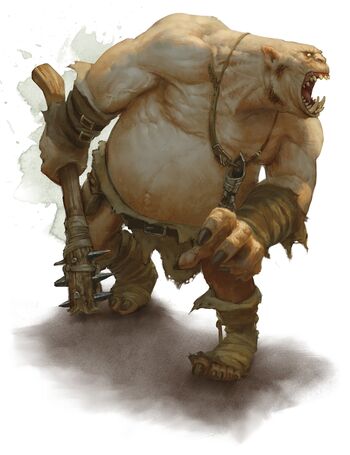
And here we have the Ogre. I think going through these reviews, it’s rather easy for you readers to pick up on the fact that I really don’t think ‘dude, but big’ as a particularly interesting monster concept. And it actually can be, it’s just that there are so many ‘big dudes’ in the Monster Manual. The Ogres don’t have the whole Ordning lore to make them interesting, or any kind of 'twist' to make them anything more than big guys. They are perhaps visually a bit more distinct, being big fat brutes with prominent tusks and fangs, which I would probably account more towards how they tend to be portrayed in other fantasy media, since they started looking like that from the Warcraft-inspired 4E onwards.
Ogres basically embody most of the qualities that these ‘big dumb giants’ have. They are lazy, they are dumb, but they are strong and violent. An actual part of the 5E Monster Manual is even titled ‘legendary stupidity’, noting that they can’t even count to ten even with fingers in front of them. They get easily insulted by anything as mundane as someone making the wrong face at it, and goes into tantrums to smash. They are, however, very easy to trick… as long as you use words simple enough for an Ogre to understand, otherwise they’ll get angry and eat someone a bit too silver-tongued.

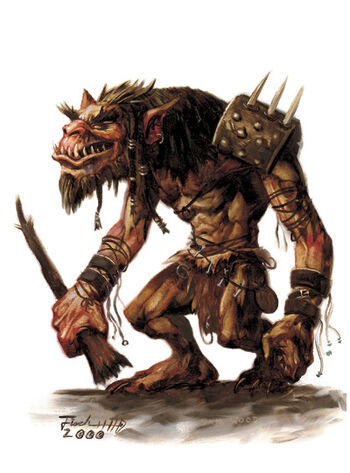

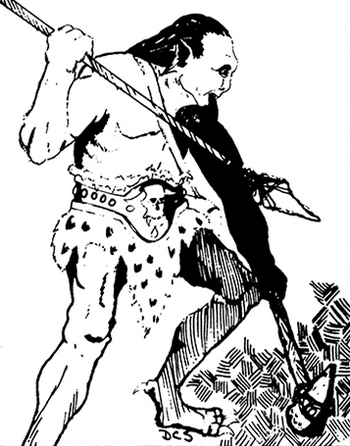
They are also gluttons that particularly enjoy the taste of dwarves, halflings and elves; and they make necklaces and weapon accessories out of the remains of their victims. Ogres are also very greedy collectors, but their definition of ‘treasure’ is a bit skewed since they just want anything that their enemies have, be it actual shiny gold coins or just random mouldy wheels of cheese. 5.5E gives a little bit of a twist, noting that Ogres often spitefully destroy things that the smaller races think are beautiful.
Ogres are still intelligent creatures, and band together in gangs, or are associated with orcs, trolls and goblinoids. In 5E, they also worship giants, although they are placed at the absolute lowest point of the Ordning. It is a bit odd to understand what really separates an Ogre from a Hill Giant, though, other than their visual appearance – Hill Giants, too, are oversized humans with no special powers and an association with gluttony and stupidity. 5.5E does give an origin for the Ogres, noting that they magically emerge from the land corrupted by evil gods like Vaprak or Takhisis, and some bear evidence of the places that spawned them like rocky growths or mossy growths. This does add a little bit of interest to them… but honestly, I really can’t say much about them. I really do feel that compared to the True Giants, the Ettin, the Troll, the Cyclops, and the Goliaths… the Ogres just don’t really have a proper narrative space other than just a more boring version of all these other giants.
Half-Ogre/Ogrillon
- 5.5E/5E: Large Giant; Chaotic Evil; CR 1
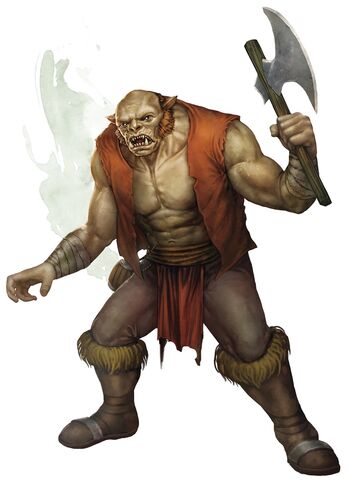
Right, Ogrillons. In the older lore, Ogrillons or Half-Ogres are the result of the mating between an Ogre and another species – usually an Orc, but the Monster Manual also lists Humans, Hobgoblins and Bugbears as other species that Ogres can breed with. Ogrillons are essentially just weaker versions of the Ogre, but a bit more intelligent. It is also noted that if the mother of the parents is the non-Ogre, they rarely survive the birth. The process of mating raises some rather unfortunate implications, of course, which is a bit of a remnant of older versions.
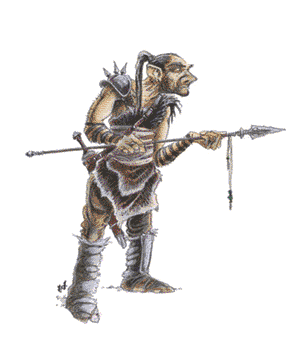
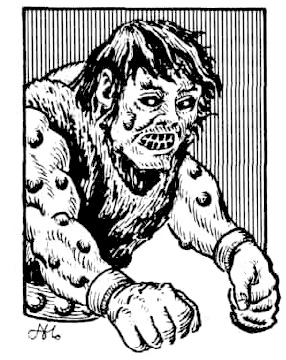
5.5E drops all the ‘interbreeding’ lore and just has Ogrillons be a form of curse – when someone curses a non-Ogre, transforming them into an ‘almost Ogre’. The Ogrillons always seethe with anger, which… okay. This is a nice little handwave to an aspect of the franchise that they have wisely entirely dropped halfway across 5th Edition. I can't really say I care all too much about the Ogrillons; visually they're less-distinct Ogres, and it's not like there's anything mechanically interesting about their stat blocks either.
I do appreciate the attempt at giving the Ogres and Ogrillons slightly newer origin stories to make them a bit more interesting, but... I don't know. It's just not really enough, if we're being honest.
____________________________________________________


Oni
- 5.5E/5E: Large Giant (5E), Fiend (5.5E); Lawful Evil; CR 7
Now we’re talking. Published as “Ogre Mage” for the first three editions of the game, the monster known as the Oni is actually based on the monster from Japanese mythology. “Oni” is often translated into English as ‘demon’, ‘troll’ or ‘ogre’ in a lot of older media that are a bit more skittish at borrowing terms from another culture, but it is such a disservice to call an Oni as a mere ogre with magic! The 5E Manual has a whole paragraph noting the in-universe Ogre Mage nicknames, but within that same paragraph also notes that the only real similarity is their penchant to team up with evil creatures. Not much of a similarity, then!
The Oni in 5th Edition are a bit more specific, drawing only from some aspects of the Oni legends. They are giants in the original 5E Monster Manual (perhaps a remnant of the ‘Ogre Mage’ history in the franchise) but are straight-up fiends in the 5.5th Edition revision. Oni are horned giants with blue or green skin, with unnatural-looking eyes, teeth and claws.
Oni hides their true form with magic, being able to polymorph, and often infiltrates villages and towns with the full intention to betray them. When darkness descends, they assume their full giant forms, having picked out which humans they want to consume. Both the shapeshifting and human-eating are true to Japanese myth. 5.5E gives them a bit more of a motivation, noting that Oni often frequently harass people of faith to test the limit of their piousness… but they will also torment selfish people as punishment.

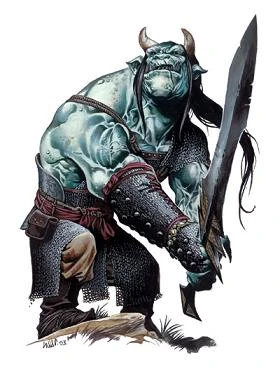

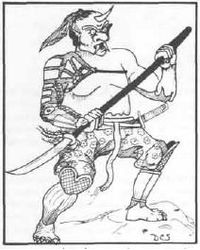
Just like some real-world Japanese festivals like setsubun, the 5.5E Manual notes that some communities often have guardian statues, annual rituals (beans!) and other superstitions that can keep Oni at bay. And in some other locations, an Oni might actually befriend these villages that respect the supernatural forces. The befriending part feels like a more general ‘yokai’ thing than Oni specifically, but that's a fun plot hook! Again, all of these explorations feel like a great way to make an Oni be far more interesting than merely a man-eating giant. Much appreciated, for sure.
As per its older name in the franchise, in combat the 5E Oni is a powerful giant physically, but it can regenerate from wounds, can cause nightmares, and has a small stable of spells like Gaseous Form, Charm Person and Sleep. Overall, I do like that they have embraced the original inspiration of the Oni in the 4th and 5th Edition, although I really do feel like they could've perhaps done a bit more! Credit where credit's due, 4th Edition gives us several different variations of the Oni; and it's the type of monster that really deserves to be explored a bit more.
____________________________________________________
Ooze:
I am genuinely not sure who invented the idea of a ‘living slime’ archetype of enemies in video games. Dragon Quest most definitely popularized the idea of a ‘Slime’ as an essential enemy in most fantasy video games… but D&D is also quite early in utilizing them as enemies. I do love that while 5E tries to scale down on the categories of monsters out there, ‘ooze’ is still a monster type and that these things aren’t just shunted aside as elementals or something.
I could talk about inspiration, I suppose, and I suppose the closest thing that Oozes might have to an inspiration would be something more microscopic, like a slime-mould or an amoeba. They never quite say it outright in a way that makes the Oozes feel sci-fi, but there is a lot of verbiage about them being a ‘primordial’ kind of life that seems to imply that they are the D&D world’s equivalent to something like our own real world’s microscopic origins… albeit, of course, a lot more fantastical.
The Oozes aren’t the only ‘mindless monster’ in D&D, with many undead and elementals qualifying for it, but they are also a being that just… feel a lot more inhuman. The lack of a face really sells it, I think. You can stare into a tiger or a gryphon’s eyes and respect it as another animal that’s working off of a lot of the same instincts that you do, but Oozes just… they just gloop around, emerging out and consuming you just for vague reasons of reproduction… but to what end?
In D&D, Oozes tend to be found in dungeons and extreme locations where normal life can’t really live in, and dissolving and feeding on creatures and objects that can’t be dissolved. This falls under the ‘dungeon ecology’ mentality that I mentioned when I was talking about fungi and mimics, where the Oozes essentially take over the role of a decomposer species in a regular ecosystem. Being liquid, they can also hide in crevices and cracks, or climb walls, making them ideal for ambushing your party. I love the description in the 5E introduction of Oozes: ‘veteran explorers know that an immaculately clean passageway is a likely sign that an ooze lairs nearby’. Again, I really love this! The original 5E Monster Manual gives us four variants:
____________________________________________________

Ooze - Black Pudding
- 5.5E/5E: Large Ooze; Unaligned; CR 4
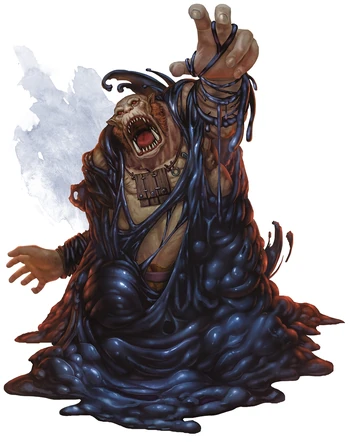
Other than the newly-added Blob of Annihilation, the Black Pudding is actually the strongest ooze in the original Monster Manual. The main cause of this is the Black Pudding’s ability to ‘split’, where the Black Pudding is wounded enough, slashed or, interestingly, subjected to lightning. The Black Pudding will split into two smaller Puddings, each being a smaller size-group than the original, but also weaker. The upside, however, is action economy – two enemies means that they can attack twice in a turn round. And their bodies are corrosive, noted to actually be able to dissolve any non-magical armour… and of course, your flesh is less durable than non-magical armour.
The Black Pudding itself is a blob of black sludge, which the Manual notes to be particularly effective in dungeons where they just look like part of the shadows. I like the description and brief logical shrug that the Black Pudding’s nature allows it to melt wood and metal – common adventurer armour – but not the stone of the dungeon it lives in.
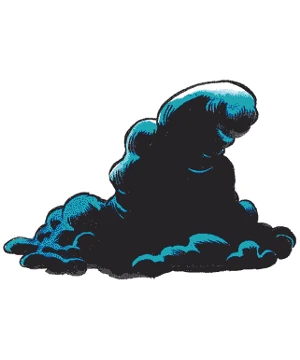
Also, the name ‘Black Pudding’ is 100% the reason that the slimes in Final Fantasy are called ‘Flans’ or ‘Puddings’ in the original Japanese, except thanks to divergent franchise evolution, Final Fantasy’s Flans/Puddings have grown to actually resemble Japanese Puddings.
The 2024 Monster Manual does note several potential origins of the Black Pudding, going from the blood or emotions of a deity; cosmic forces; industrialized magic; spirits possessing viscera; or an ancient black dragon’s saliva. The 2014 Manual and a bunch of other sources would also highlight the Demon Lord Juiblex, who himself is the Faceless Lord of all the slimes and oozes. There is always a demarcation between oozes and demons, though, and this ambiguity honestly fits rather well with the Oozes’ concept as the most primordial of enemies.
____________________________________________________

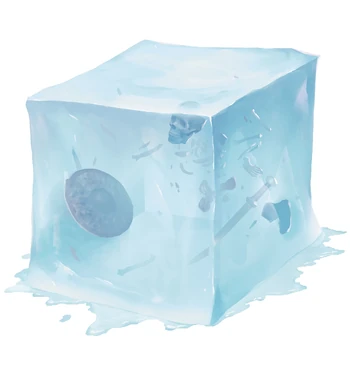
Ooze - Gelatinous Cube
- 5.5E/5E: Large Ooze; Unaligned; CR 2
Probably another one of D&D’s most famous monsters, and one of the few that would instantly cause someone to unmistakably know that a work is referencing Dungeons & Dragons and not any other fantasy RPG media. Gelatinous Cubes, in addition to having a gloriously whimsical name, is just… a big box of bright green jelly. They’s technically oozes, yes, but there’s just something a lot less natural, a lot less attributable to a natural being (like a slime mould or a amoeba) when this thing is just so defined as a cubes. Cubes don’t exactly occur in natural evolution, do they?
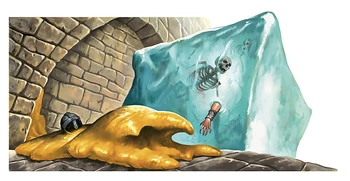
The real-world reason, of course, is that the designers wanted an enemy that could block entire pathways in the grid-paper-based dungeons that original D&D ran on, but the visual image of a bright green jelly cube with half-digested warrior skeletons inside just became iconic. Because that’s an aspect of the Gelatinous Cube – and in theory, most Oozes except for the Black Pudding up above – has. Oozes trap their prey and digest them, but they just digest flesh and bone. Most of the times, they can’t digest the weapons, giving the DM a very convenient in-universe excuse to have a monster literally ‘drop’ weapons for you.

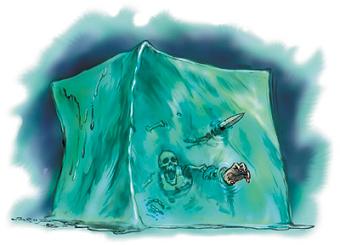
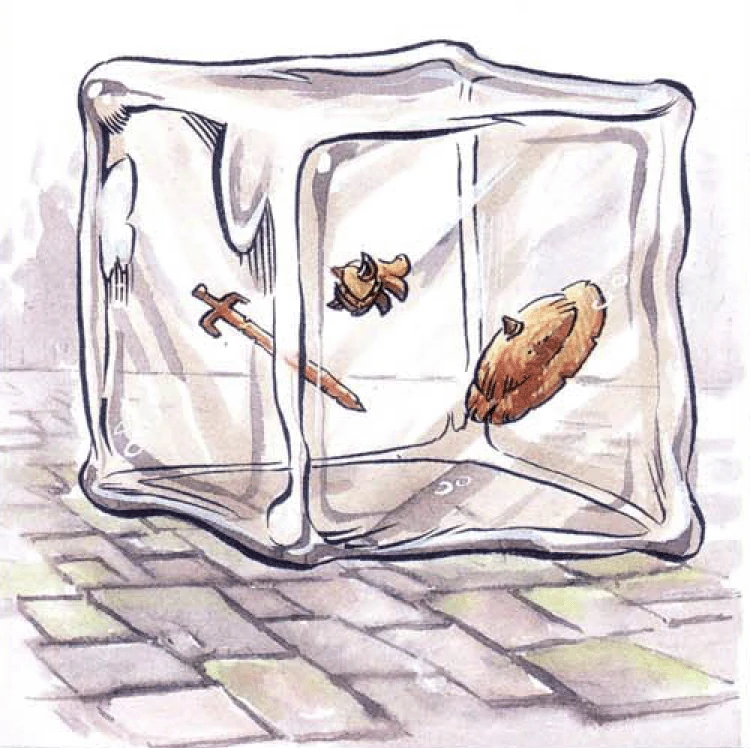

I also love that both 5E Manuals emphasize that the Gelatinous Cube is naturally transparent, allowing them to sneak up on adventurers in a dungeon. The only time they’re not is when they’ve got the remains of previous enemies floating around inside them.
When a Gelatinous Cube or another Ooze engulfs a prey, they actually take time to digest and dissolve the opponent, while they take damage over time and are restrained. This is a nice little dynamic where a fight could very quickly turn into a rescue mission as the Gelatinous Cube with a party member trapped inside just oozes and globs along the dungeon, with the rest of the party in hot pursuit to save Jerry before he gets dissolved by a giant jelly. It doesn’t have to be a rescue mission either; maybe an important plot-related key or weapon is trapped within the Cube! Anyway, I love this thing.
____________________________________________________

Ooze - Gray Ooze
- 5.5E/5E: Medium Ooze; Unaligned; CR 1/2
- 5.5E: Medium Ooze; Unaligned; CR 1 (Psychic Gray Ooze)
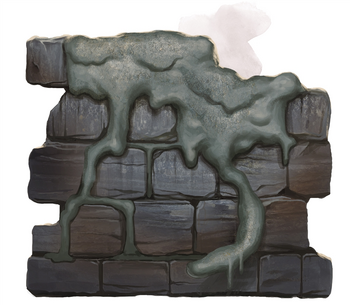
The Gray Ooze is given an origin in the original 5E Manual, being noted as ‘stone turned to liquid by chaos’. 5.5E gives another potential origin as magic-users that fail when they are trying to bind elemental spirits to constructs. The idea is that Gray Oozes blend perfectly well with stone, which… does honestly feel kind of redundant when almost all Oozes tend to camouflage very well against stone, or are transparent. The only weirdly-coloured Ooze, the Green Slime, has been reduced to a mere hazard and not a monster for several editions now.
I feel like the Gray Ooze is the most basic Ooze enemy out there, just being an amorphous enemy that has a corrosive touch. Both Monster Manuals highlight the Psychic Gray Ooze, which corrodes the mind in addition to the body. Psychic Gray Oozes are specifically identified by 5.5E as being linked to failed attempts to summon powerful Earth Elementals like Gargoyles, while 5E has them as Gray Oozes that live around telepathic creatures like Mind Flayers

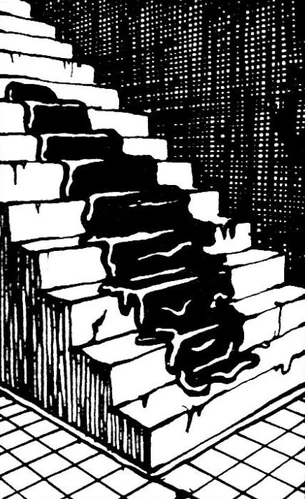
I do like the artwork in 5.5E of the Gray Ooze glorping around a figure on a throne, and I think the idea was that the Ooze was disguised as part of the stony throne. I felt like there really could be a bit more explored about the Gray Ooze’s strange connection to the Elemental Plane of Earth, or oozes and elementals in general… but there really isn’t much written about this one.
____________________________________________________

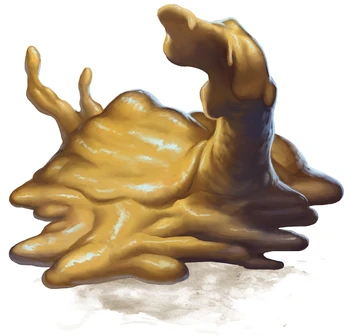
Ooze - Ochre Jelly
- 5.5E/5E: Large Ooze; Unaligned; CR 2
The Ochre Jelly is sort of the mid-way between the Gray Ooze and the Black Pudding. They have the same ‘split’ gimmick as the Black Pudding, but isn’t as powerful as the Black Pudding – only able to dissolve flesh instead of equipment. The Ochre Jelly is the only basic ooze that is identified to have ‘enough bestial cunning’ to avoid large groups of enemies, actually stalking parties from a safe distance until they can strike.


Overall, I do really like the Oozes. They bring something that I feel is a bit uniquely different, and while there aren’t a whole ton of them… I don’t think there really should be. Later editions in 5E would add in the Oblex and Blob of Annihilation as ‘mid-game’ and ‘end-game’ Ooze enemies respectively, both with their own little gimmicks, and I feel that the whole point of the Oozes is their simplicity. They are mindless and driven by instinct, so they can just function as random encounters, as guards in a prison, as naturally-mutated beings that arise out of a magical world, and the 5E Manual even gives a little sidebar talking about how a lot of dungeon denizens lure oozes with torches or food, and essentially keep them as less-cute guard dogs.
____________________________________________________


Orc
- 5E: Medium Humanoid; Chaotic Evil; CR 1/2 (Orc), 4 (War Chief), 2 (Eye of Gruumsh)
And here is another tricky one in D&D 5th Edition. For the entirety of the franchise’s history, ever since Tolkien’s work establishes ‘orcs’ and ‘goblins’ as the go-to evil, intelligent humanoid race in his works, there has been a lot of discussions on what Orcs be. Works like Warhammer 40K leaned in into the zany violence, but Warhammer was always over-the-top with their take on everything. Warcraft, and later on World of Warcraft, really made a name for itself in portraying the ‘humans vs. orcs’ as the core of their conflict. And when it came to making games that have multiple factions, orcs ended up being explored a lot more beyond just being ‘savage, moral-less, soulless barbarians’. Many other fantasy works followed suit. Slowly, people wanted to play as Orcs, to explore Orc towns, to see all of these fantasy lore written about Orcs and to see what makes them tick.
And there is something to say about Orcs that doesn’t necessarily apply to something like the Ogres. Orcs, at their core, tends to be portrayed as intelligent enough and civilized enough. Sure, they have a strong warrior culture, and they raid and pillage. But there’s always been a fascination about playing as the villains, I think. As the franchise and the fantasy fandoms evolved the idea of playing as these traditionally villainous races and exploring the world through them – either finding that their ways are wrong; or perhaps highlighting which aspects of Orcish culture can coexist with the more ‘civilized’ world; or even the fantasy of pushing Orc culture above all else. I don’t want to get political here, but there is always something a bit inherently alienating about the language used to describe an evil, lesser, dumber, more savage not-quite-human race.


And the Orcs have since been removed from the 2024 Monster Manual, but unlike the Drow and Duergar, the Orcs instead made their way into the primary Player’s Handbook as a core player race. I think that’s the way to go, and unlike the Drow, they actually gave the Orcs a new twist. Taking a bit of cues from the most popular parts of Warcraft’s Orcs, 5.5E’s Orcs are now explorers and people who want to ‘tame’ lands, so to speak. They are fantasy cowboys, and I feel that is a nice update for them. The ‘raiding’ and ‘warrior culture’ is still there, just a bit downplayed, and honestly I would feel like it would be far more racist to wipe all reference to them entirely. That’s a neat little update – while the Orc monster statblocks have been retooled into Thug or whatever, I appreciate that they’re still including the Orcs in the D&D core books.
Separate from that, though, I still think Orcs have a space in D&D as enemies – just because I do really love playing as my green boys, I still think it’s just as fun to fight Orcs in combat… just as how human bandits are still evil. Just because we recognize that there are a lot of ‘good orcs’ doesn’t meant that there aren’t antagonistic or evil Orcs. The real-world cultural problem isn't the portrayal of orcs as antagonistic, but rather that their stupidity and penchant to violence is a racial/biological thing instead of a cultural thing. Take that away, and you can have both your marauding orc hordes and your noble anti-heroes.

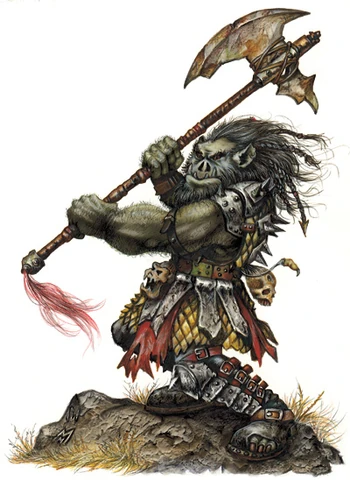
But going back to the actual in-game material now. In D&D, Orcs are relatively simple, drawing mostly from Lord of the Rings minus the eugenics. They are savage raiders, almost beastly in statue, and they have prominent tusk-like canines. Most of the books still use the ‘piggish faces’ description, which in D&D really only applies to the earliest artworks, I feel. Most modern Orcs tend to follow the designs popularized by Warcraft and Warhammer.
D&D Orcs worship Gruumsh One-Eye, their war god who was denied domain over all things. Gruumsh then declared that his children, the Orcs, will always wage war over the children of the other gods that stole the mountains and fields from him, with a particular hatred towards the elves. In some other material, this also leads to a curse (by either Gruumsh or the other gods; unreliable narrator is in full effect) that causes the Orcs to be literally cursed to be incapable of producing anything and they have to depend on raiding to get their resources. I’m not the biggest fan of a lot of the monster or playable race profiles that focuses on very specific backstory, but here is something that I feel would be such an interesting thing for Orc characters to think about, right? Is Gruumsh’s betrayal something that they have to avenge? Or is Gruumsh throwing a huge fit and cursing all of his children and damning them to a war they don’t want for his sake?


Orc culture is built around combat. They raid, pillage what they can take, and burn the rest. They are nomadic and move from one ruin to the next, finding locations that would be convenient for them to hunt for new prey. Everything they do, they do in the name of war and combat, before heading out and looking for more hunting grounds. It is noted that Orcs respect strength and power, and will welcome any non-Orcs into their ranks – again, an interesting hook to play upon. It is part of Orcish culture to actually not care that much about crossbreeding, as long as it produces a powerful young. Obviously 5.5E plays it down, but it is something that could be an interesting avenue when you also pull it the other way and have it portrayed a bit more sympathetically… and indeed, that’s the whole genesis of Warcraft’s Horde faction, isn’t it?
The 5E Monster Manual lists two additional variants; the Orc War Chief (who is stronger and can rally his troops), and the Orc Eye of Gruumsh (the local spellcaster who has plucked out an eye in deference to Gruumsh).
As much as I feel that there is a space for villains out of any species, I feel like the idea of Orc war-bands and raiding parties are just as valid as human or elven or dwarven antagonists. I don't mind the idea that the Orcs are a culture revolving around violence and raiding, and I guess the idea that is racist and bothers most people is that they are evil and dumb to the exclusion of everything else. Still, popular culture has really changed what most people think about fantasy Orcs, so just how violent or brutal the orc party in your fantasy world is something for each table to decide. But I am reasonably happy with the 'retooling' of the Orcs in 5.5E, where instead of pretending that the Drow didn't exist, they simply cherry-picked aspects of the Orcs that are more acceptable and even did a new creative spin on it. I thought that was great.
____________________________________________________
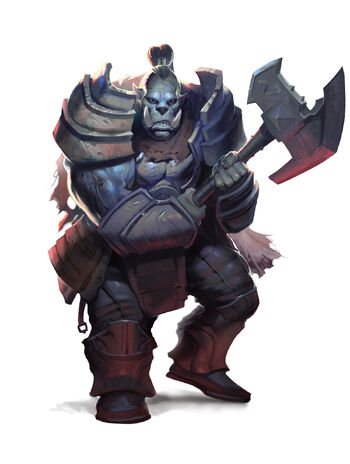
Orog
- 5E: Medium Humanoid; Chaotic Evil; CR 2
Orogs are a specific subtype of Orc that was blessed by one of their gods, Luthic. Orogs are both respected and shunned by Orc tribes, and are a bit less commonly seen. They prefer to live underground, and are far more intelligent and cunning than their Orc brethren. In addition to being more intelligent, 5E's Orogs are utterly unattached to their tribe, only caring about themselves and the gods Gruumsh and Luthic. This heightened intelligence often causes them to fight with more traditional war chiefs, who fear the Orogs taking them over.
The idea in the game was for adventurers (and players) to look at an Orc leader and think that he's a dumb dum-dum, only for Orogs to surprisingly be smart. This... is probably a bit more unfortunate nowadays that it requires a supernatural genetic mutation for an Orc to reach the intelligence of a human. And this part? This part, I agree is problematic.
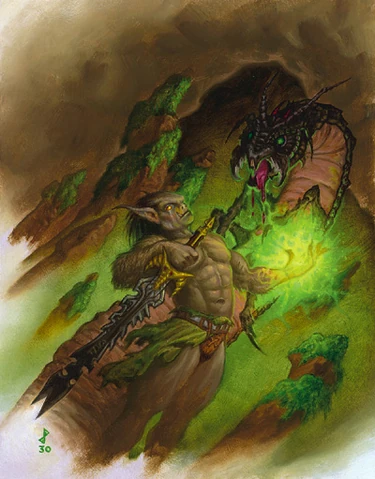

The origin of this, of course, is from Lord of the Rings, and the Orogs are a thinly-veiled reference to the Uruk-Hai – elite mutated super-Orcs created by the wizard Saruman with magic and fantasy-genetic-engineering. I feel like if we are to update the Orogs to the less 'always dumb' Orcs, I would update the Orog to be really that much more physically powerful and stronger; the contrast that the Uruk-Hai had to the lesser 'goblins' in Lord of the Rings.
Again, the trope of a 'super-Orc' is a good one! The trope that 'the super-Orc is the only smart Orc' is perhaps one that 5E is right to scoot away from. Anyway... I do think I'll stop here for the Orcs. There are entire essays that I can write about how these 'fantasy evil races' can be a stand-in for real-world racism, but for the most part, that's not the point of these articles.
____________________________________________________

Otyugh
- 5.5E/5E: Large Aberration; Neutral; CR 5
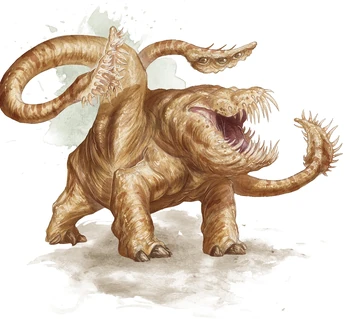
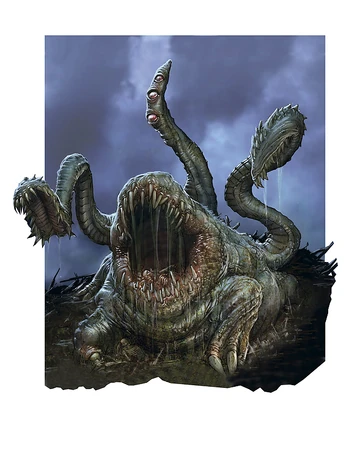
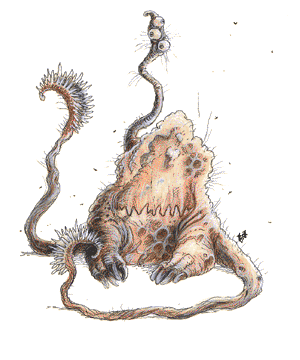
Otyughs are another personal favourite of mine, and I love that this little bugger has shown up in practically every single edition of D&D. Otyughs are essentially ‘trash monsters’, reminding me a lot of the Dianoga of Star Wars’ fame. It is interesting that the Otyugh started off in the first two editions as lumpier affairs, looking like they are made up of the same filth that they reside in, but from 3rd Edition onwards they have gotten a somewhat fleshier body that’s almost reptilian. All the details have remarkably stayed consistent, however – a massive jawed mouth that takes up most of the Otyugh’s bulbous body, four legs that end in claws, and three tentacles whipping around. It might not be immediately apparent – particularly with some of the more monstrous artwork – but two of the Otyugh’s tentacles end in bristles while the main one end in three eyeballs. I absolutely love this goofy detail, and I love that even as the artstyle goes into more ‘serious’ reinventions we still keep the eyeballs-in-a-row.
Otyughs bury themselves under mounds of filth and corpses, leaving only that ‘sensory stalk’ exposed. Again, bringing to mind the Star Wars Dianoga – in that movie, we only ever see the eyestalk. The Otyugh is a nice little display of dungeon ecology that a lot of the earliest monsters have, and they are essentially maggots and cockroaches to the larger denizens of a magical dungeon. Otyughs themselves only concern themselves with food and eating, although they certainly are sentient and even speak their own language.


Of course, they also double as ambush predators, happily chomping down on anyone stupid enough (or unfortunate enough) to investigate a pile of dung. The 5th Edition Monster Manual even notes that Otyughs often live in a kind of symbiosis with other subterranean species, happily acting as a garbage disposal as long as they get a steady supply of food.
I like the description in the 5E Manual that notes that while Otyughs are naturally attracted to civilization (and the filth it brings), Otyughs can survive in the natural world, preferring swamps and damp, dark areas. In addition to having fangs and tentacles, Otyughs are also able to transmit disease to anyone it bites. But an interesting ability that it also has is a limited telepathy, which allows the Otyugh to send simple messages. The 5.5E Manual gives us an adorable table that expands on how an Otyugh can use this ability to lure potential prey. They don’t actually have a good grasp of common, so people wandering around the garbage dumps might get a telepathic messages like “Happy good stuff here! Help now I’m too delicious!” or image of a ‘large gemstone, crooked weapon, or soggy pastry’. Soggy pastries! That’s gonna get the wizards to investigate!
Most adorably, however, is the described mental image of an Otyugh disguising its tentacles with garbage puppets. How adorable is it? No, seriously, I love the amount of goofy personality that this trash-monster is given without taking away from its more monstrous redesign. Love this thing.
____________________________________________________

Owlbear
- 5.5E/5E: Large Monstrosity; Unaligned; CR 3 (Owlbear)
- 5.5E: Huge Monstrosity; Unaligned; CR 7 (Primeval Owlbear)
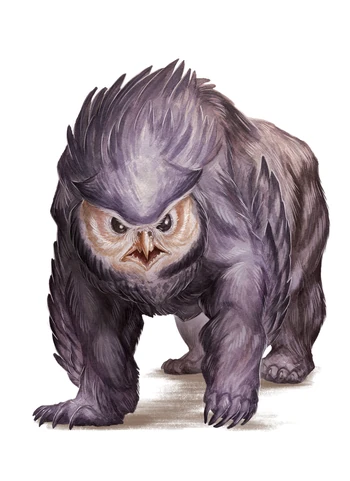
The Owlbear is probably D&D’s poster child for ‘let’s slap two animals together!’ It’s something quite iconic nowadays thanks to the ridiculousness of an owl and a bear fused together into a creature, but there are some wacky fusion-animals in real-world mythology as well. The Owlbear’s real-world genesis apparently came from the D&D development team finding some knockoff kaiju toys, and decided that one of them was a ‘bear with a bird head’.
But in D&D, Owlbears are essentially the results of ‘a mad wizard did it’. Someone decided to fuse an owl and a bear, and the species grew viable and got loose, becoming a fully-developed species of its own. Owlbears have the body of a bear, but the head of an owl, and front limbs that are a combination of an owl’s wings and a bear’s claws. Various editions have gone back and forth on portraying the Owlbear as being on all four haunches or on two, but the two-legged pose (which real bears can do!) really highlights the unnaturalness of the creature instead of just being a bear with a weird face.


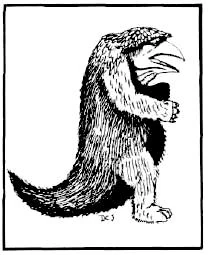
In addition to being a giant ball of muscle, an Owlbear also has an owl’s horrifying screech, which is a nice thing to add to the horror factor. They hoot and hunt in the night, stalking around their territories and feeding on anything that intrudes upon it. The idea, I think, is that the owl half gives the Owlbear much more sensitivity while hunting in the night, but real bears aren’t slouches either if we’re being honest. Owlbears are fierce, aggressive and stubborn hunters, not fearing anything in the wild and very likely to attack without provocation. In real life there aren’t many animals like these (despite some animals’ negative reputation in popular culture) but Owlbears aren’t exactly natural.
Owlbears are noted to be mostly solitary, and only gather with their mates and offspring if prey is plentiful. Owlbears are difficult to domesticate, but not impossible, and there is always the chance of the Owlbear attacking its handlers. Notably, the 5E Manual notes that Elves allow Owlbears to den beneath their treetop villages, Hobgoblins use them as war beasts, and Giants use them as pets.
Normally, Owlbears are too heavy to fly, but 5.5E adds a stronger variant called the ‘Primeval Owlbear’ which have been empowered by Feywild energies to be stronger, hardier and with a limited ability to fly. Overall? Pretty fun creature. It's something that's going to be memorable mostly because of its appearance more than anything, but it sure has became iconic for a reason.
____________________________________________________
Pegasus
- 5.5E/5E: Large Celestial; Chaotic Good; CR 2
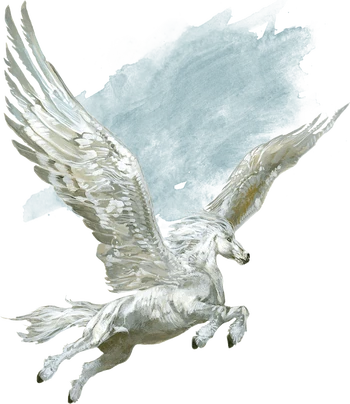
Right, the Pegasus! The 5th Edition Monster Manual is intent on including all of the horse monsters from mythology. The Pegasus is considered a celestial in D&D, and are intelligent, elusive beings. They are winged horses, suspicious of most other creatures and landing to the ground only to drink. Pegasi live in floating islands or remote peaks, or even in the Upper Planes and Feywild. They are often hunted by evil beings, causing them to be suspicious of most other creatures.


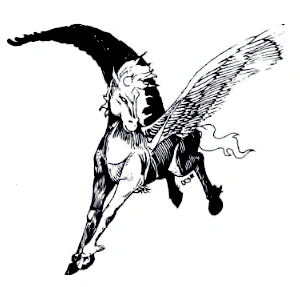
A Pegasus is as intelligent as a humanoid, so they must be persuaded and negotiated to serve a good person as a mount. It is a difficult process, but once the trust is established, they will forge a lifelong bond with its rider. 5.5E gives a table of ways that a specific Pegasus might gain the trust of someone – like being able to sing a song in an ancient tongue; bearing the gear of a hero the Pegasus knows; or offering specific magical fruits.
The Pegasus feels less of a stat block for a monster to fight, but more as something that an adventuring party might need to rescue or a quest they have to complete. And having a flying horse as a mount is pretty cool – something that definitely will fulfill some players’ fantasies. I find them rather bland as far as monsters go (and being stuck between the Owlbear and Peryton, two infinitely interesting 'fusion' monsters) but they are a classical mythological beast. Can't fault them for that.
____________________________________________________

Peryton
- 5.5E/5E: Medium Monstrosity; Chaotic Evil; CR 2
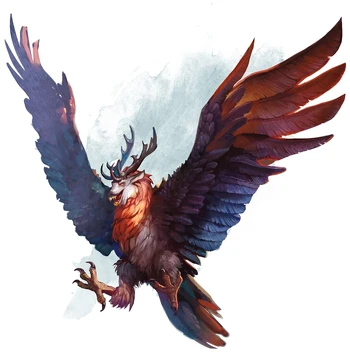
This is a fun one! Drawing from a 50’s Argentinian book, the Peryton is a human-sized bird with the head of a stag. A carnivorous stag, at that! It alone doesn’t really set the Peryton apart from something like the Owlbear, but the 5.5E artwork beautifully showcases a particularly weird aspect of the Peryton… its shadow is that of a humanoid silhouette. How weird is that? I love it when creatures have strange aspects to them that isn’t just easily translated to ‘it shoots acid’. The human shadow is just such a strange aspect that adds a nice layer of mystique to the creature.
The Monster Manual gives several potential origin stories to the Peryton. The easy one is that the original Perytons were humans transformed by a hideous curse. Simple, effective, but not as interesting as the second theory – the first Peryton was caused by a woman who killed and consumed the heart of her husband’s mistress in a ritual to bind her husband to her forever. When she was hanged, the carrion birds that fed on her inherited the curse instead, transforming to Perytons.
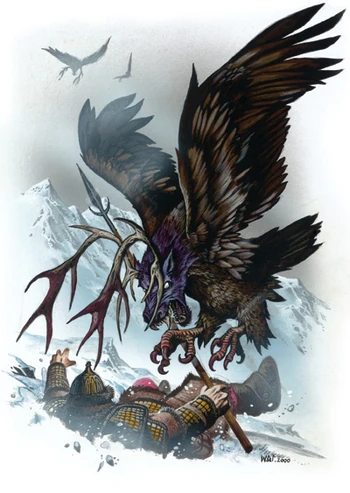

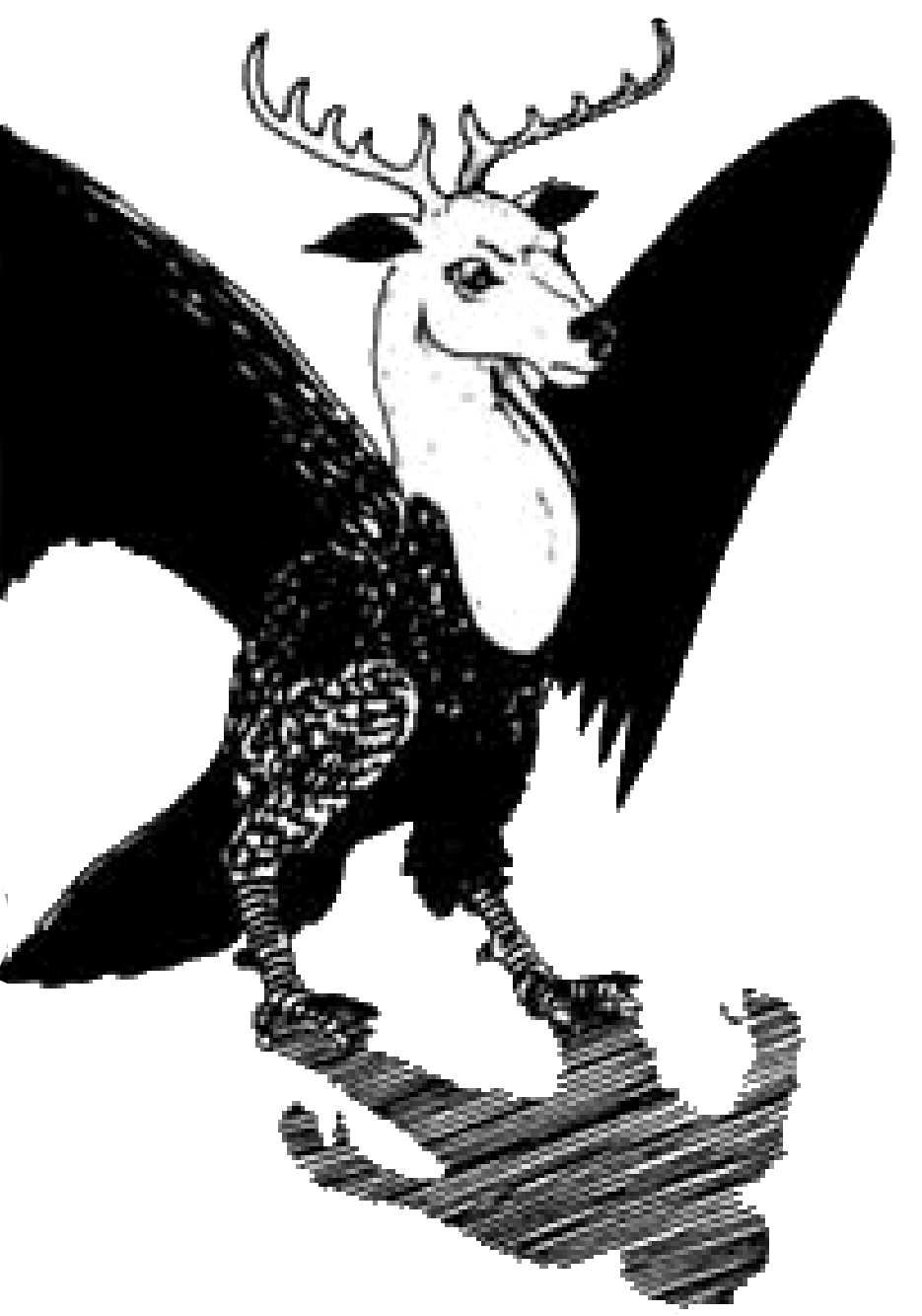
In addition to being a hideous bird monster, Perytons also have a specific fascination with hearts. Whenever it kills a humanoid, a Peryton will rip out its prey’s heart to take it back to its nest. The 5E Manual notes that the human hearts are tied to the Peryton’s reproductive cycle. Female Perytons must consume a humanoid heart before she can reproduce. 5.5E gives several extra potential reasons as to why Perytons collect hearts, including the Perytons using it to grant an evil wish, opening a portal to the Lower Realms, or that it’s used in a ritual for the Perytons to break their curse.
The Perytons have resistances to most normal weapons, which causes local villages to particularly fear them. Perytons are also extremely grudgeful, which might be an extension of the ‘angry love triangle’ origin story – even when they are driven away, a Peryton will hound and stalk the humanoid that evaded them from afar, looking for an opportunity to finish the job them.
I must confess that I didn't really care about the Perytons when I first saw them in the older editions, but the more vibrant colours of the 5E artwork really does contrast well with their rather savage behaviour, and it made me far more interested to read about them and realize how weird these guys really are.
____________________________________________________


Phase Spider
- 5.5E/5E: Medium Monstrosity; Unaligned; CR 3
This is another entry that was merely part of the appendix in the original 5E Monster Manual, but was elevated into a full-on proper entry. Respect to the Phase Spiders! The Phase Spider is... well, a giant horse-sized spider that has been rather consistently depicted as white spiders with unnatural blue highlights on their bodies and the tips of their legs, and just with a bit more unnatural-looking spikes and ridges than what you'd find on a real-world arachnid.
As their name implies, Phase Spiders are able to phase in and out of reality, and are 'endemic' to the Ethereal Plane. The Ethereal Plane is basically one of D&D's many parallel worlds that is not quite the same with the Shadowfell or Feywild, and 5th Edition generally ignores it other than when showcasing beings that phase in and out of reality. Essentially, it's a dimension to justify the use of spells and abilities like 'Blink'. It was a bit more prominent in 3rd Edition, with creatures like Ethereal Marauders and Ethereal Filchers to populate the realm.


Phase Spiders lurk in their 'vaporous' lairs that border the Material Plane, essentially hiding in a parallel dimension displaced from where you are adventuring. When they detect prey (i.e. you) they shift and 'phase' into the Material Plane, phasing in and out of regular reality to attack. That's the whole point, and the Phase Spider otherwise acts like a regular giant spider with your expected webbing, poison bite and wall-crawling abilities.
Phase Spiders are noted to be more intelligent than regular spiders, but are still animalistic enough to choose to escape if overpowered. The only exception, however, are ghosts and other spirits that Phase Spiders can also feed on (because they're also 'phase-y' adjacent, I suppose?) and they will pursue as favoured prey. I find this one last detail particularly cute, that in this strange unexplored ecosystem of the Phase Spiders, somehow Ghosts take place of something like a fly or whatever.
____________________________________________________


Pixie
- 5.5E/5E: Tiny Fey; Neutral Good; CR 1/4 (Pixie)
- 5.5E: Tiny Fey; Neutral Good; CR 5 (Pixie Wonderbringer)
4th Edition notwithstanding, D&D has been quite good at keeping a lot of the classifications of its fiends, celestials and humanoid races consistent… but not the fey. Which I was a bit pissy about when I reviewed the various Monster Manuals the first time, being a bit angry at the inconsistency on what’s a ‘Fairy’, what’s a ‘Pixie’, what’s a ‘Sprite’, and how we should consider all the other little fey creatures like Grixes, Slyphs, Atomies, Brownies, Leprechauns, Nixies… until I realized that it really didn’t matter, did it? I love my monster classification, but Fey and Aberrations in particular should actually defy proper, rational classification.
Older editions, particularly 2E and 3E, had huge tables for different kinds of smaller Fairies, but the 5E Monster Manual streamlines everything down to basically just two – Pixies and Sprites. They represent the trope of little fairies like Tinker Bell or Puck, and the main differences are that Pixies are more spellcasters while Sprites are more physical. In 5th Edition, Pixies are also drawn with butterfly wings and Sprites with dragonfly wings, but subsequent artwork have been quite inconsistent – and rightfully so – with what insect a given Sprite or Pixie might have the wings of… 5.5E even gives the Pixies dragonfly wings!
Pixies are noted to be tiny little fairies that dress themselves like nobility, with fanciful clothing made up of leaves and flowers that sparkle like moonlight in a pond. They are excited little friends that flit from tree to flower to house, curious and very much happy to introduce themselves and make new friends with new travellers to their domain. They are smart enough to be afraid of being captured, so many adventurers’ first forays into a Pixie’s territory would just be hearing strange giggles and gasps coming from the plants. The presence of a Pixie in a glade would be seen when they play harmless tricks on visitors – if they respond amicably to the threats, the Pixies might reveal themselves and aid the adventurers. But if they are hostile, the Pixies would avoid them and might even set some beasts towards them as a way of self-preservation.
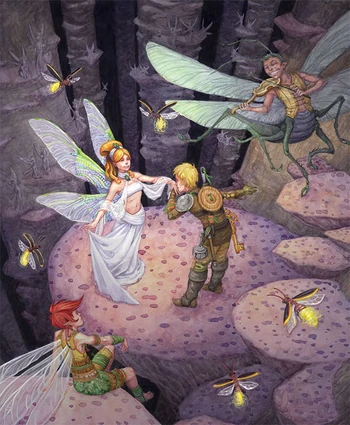


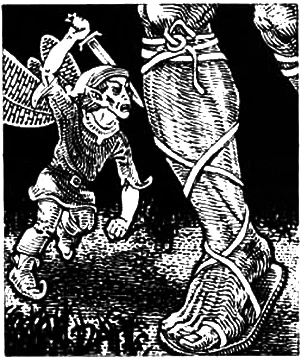
In-game, their fairy magic is represented with spells like invisibility, fly, sleep, dancing lights and polymorph. Likely drawing from Peter Pan, Pixies also scatter ‘pixie dust’, which has a lot of rumours surrounding them (including, of course, the ability to grant flight). Only Pixies are able to use this dust to its full potential, however, and 5.5E turned this into a combative ability that allows a Pixie to poison or charm whoever inhales the dust. 5.5E splits the original 5E Pixie’s spell list into two, giving the regular Pixie only access to the weaker ones, and introducing a ‘Wonderbringer’ variant that has access to the stronger ones.
If you see my monster reviews, you’d know that I normally skew towards the more gothic and body-horror monsters. But I have a special place in my heart towards the Fey and the strange logic and tricks they play. Now the Pixies are honestly not particularly threatening, but I’ve always felt like they’re a nice little distillation of the weakest and most harmless of the different Fey out there. They don’t do anything too divergent from what you’d expect them to do, but it’s a nice introduction of tiny, playful forest friends who will interact with you differently literally depending on ‘vibes’.
____________________________________________________

No comments:
Post a Comment