

Click here for the previous part
Click here for the next part
Click here for the index.
This batch of monsters features aparticularly interesting reinventions in 5.5E. The big thing is the change in the Sphinx. Dropping the gendered species discrimination between the Sphinxes is kind of expected, but they have truly rewritten the lore of the Sphinxes that they might as well as be brand-new monsters. For the purposes of this review series, I will review them one after the other due to the sheer differences between 'classic' D&D Sphinxes and the new ones. This is what I want out of a proper rewrite, not to either quietly reduce the monster to a two-sentence footnote hidden in a subspecies lineage selection.
I think everyone universally loves the Incubus and Succubus for both surprisingly preserving the 'seduction demon' aspect of the Succubus. That was something that wasn't a given considering how much sanitization is happening to 5E (for better and for worse), but the themes they picked for the Incubus is most certainly welcome.
Again... while I do think I am going somewhat slow, I would rather do the Monster Manual right to be a 'point-to-something-I-already-did' when I eventually go and talk about other D&D or D&D-adjacent bestiaries with a lot of overlap in terms of monsters.
[Originally published on December 2019; Updated in December 2025]
____________________________________________________

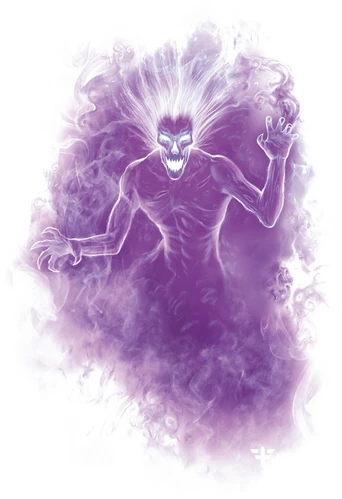
Specter
- 5.5E/5E: Medium Undead; Chaotic Evil; CR 1
Out of the ‘incorporeal ghosts’, Specters are functionally the weakest of them all. They are incorporeal and can move through creatures and objects; have a ton of resistances as befits an intangible spirit; and can drain life (or HP)… but ultimately it doesn’t quite have the possession ability that a Ghost has, or the bag of tricks that a Wraith or a Banshee has. And it definitely isn’t anywhere as mechanically powerful as the deceptively terrifying Shadow.
It always is a pet peeve of me that the much more impressive-sounding ‘Specter’ is actually weaker than the mundane-sounding ‘Ghost’, but that’s just my little hang-up. The primary difference, as far as 5th Edition’s Monster Manual claims, is that Specters are just doomed to be unable to pass to the afterlife. Unlike Ghosts, they do not possess any more connections or memories to their past lives, and no ‘unfinished business’ that would allow it to rest. They are just condemned to haunt the world forever until some adventurers grant it the oblivion of destruction. The only thing left for the Specter is the hatred towards the living, which fills the Specter with sorrow, wrath and jealousy and drives it to destroy life. Of course, no amount of life drained will ever satisfy the Specter, and it just keeps going around looking for more life and happiness to drain.

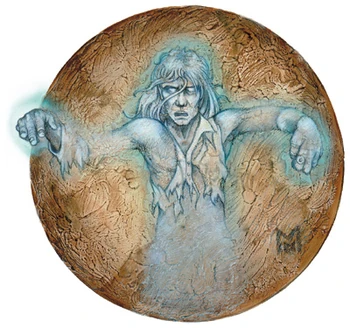

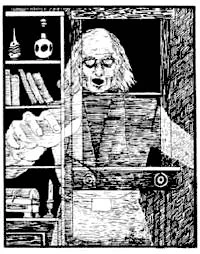
They are repelled by sunlight, and as per 5.5E they are drawn to darkness and negative emotions, feeding on the suffering that evil beings cause – or on the evil beings themselves. The table given by 5.5E gives a bunch of potential locations that Specters would lurk around. There are obvious ones like the lair of a powerful fiend or undead; the gravesite of a villain; a death cult; a Shadowfell portal; but a more interesting one would be sites of disaster or a town that is gripped with many grudges.
The Specter, essentially, serves the same role that a ‘zombie’ or a ‘skeleton’ would have among the corporeal undead – they are feral, they are always hostile, and there is no way to get them back. A simple lower-tier enemy to be destroyed, without much roleplay opportunity beyond 'scary crazed enemy that needs to be put down'. Their art in 5E is just a screaming purple figure, but I think 5.5E showing them as tattered skeleton-ghosts gives them a nice identity that communicates how ‘frayed’ even their identities are. It is notable that the Poltergeist, who got its own entry in 5.5E, started off as a Specter variant in 5E.
____________________________________________________
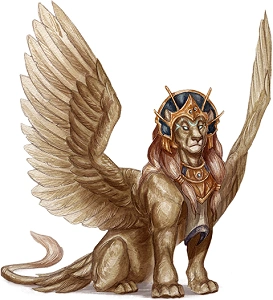
Sphinx - Androsphinx / Gynosphinx
- 5E: Large Monstrosity; Lawful Neutral; CR 11 (Gynosphinx), 17 (Androsphinx)
One particular creature in 5th Edition was given such a gigantic rewrite in 5.5E that I think it’s best that I talk about the ‘traditional D&D’ version of the Sphinx. The original version of the Sphinx from 1st Edition tried to merge Egyptian and Greek mythologies together. The Egyptian Sphinx is a wingless lion with the head of a man, always depicted as regal and protective of the pharaoh. The Greek Sphinx has wings, tended to be female, and the ‘riddle’ thing also came from Greek myth – specifically the myth of Oedipus. Dungeons and Dragons’ earliest versions just tried to adapt the two different Sphinxes as male and female versions of the same species, and merged the different lores together.
Older editions, particularly 1E and 2E, really liked Sphinxes and added a bunch of different variations (including the hieracosphinx and criosphinx, who became notorious for certain writing choices that we won’t get into here) but 5E simplifies the Sphinxs as just a guardian of secrets and treasures of gods, and demands them to pass through tests. They are both the noble guardian of Egyptian mythos, and also the test-giving antagonists of Grecian myths. This does really fit with what D&D wants to do with their monsters, giving an in-universe explanation for whatever dungeon puzzles a DM wants to throw at his/her players. It doesn’t have to be riddles, but the idea is that you present the Sphinx at a level where it would be an unfair fight to the party, forcing them to engage with riddles and puzzles. The Sphinx’s magical powers even gives it an excuse to teleport your party to a temporary game stage, like a giant chess board or something. But even if a fight breaks out, it’s not entirely unwinnable. The Sphinx has a magical, divine bond to whatever it is guarding, causing the path to disappear if the puzzles are not completed properly. This is… interesting narratively, but perhaps a bit problematic if the DM isn’t careful to accidentally lock an important plot device in the care of a Sphinx.

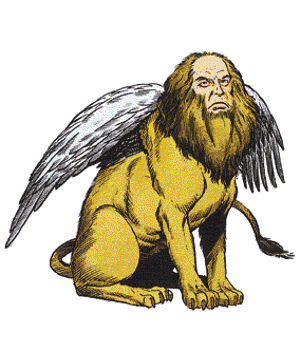
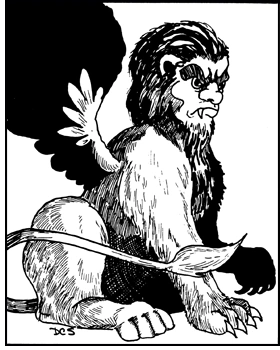
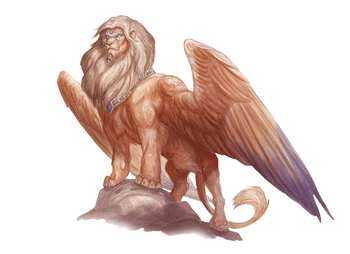
I do find that all artwork of the Sphinxes tended to be on the goofier side in older editions, and it’s not until the 5E Sphinx, particularly the Androsphinx, that looked genuinely majestic. With the Andropshinx and Gynosphinx both sitting at a respective CR 17 and CR 11 respectively, they are probably the strongest of the ‘intelligent lion mutant’ group of mythological monsters. The origins of the Sphinxes are a bit more vague, though, with 5E noting that they could be ‘high priest of gods’ but most are ‘embodied spirits’ that were brought to the mortal world by prayer or divine intervention; or they even arrive from extraplanar realms. This wording was here from 5E, and makes a reinvention in 5.5E make a bit more sense.
Lastly, if you don’t like the ‘servitors of gods, guardians of tombs’ angle, 5E also gives the hook of Fallen Sphinxes, who break free of their divine command whether through weariness, regret from slaughtered supplicants, or just wanting to be worshipped… but they’re still somehow bound to the secrets they protect? That feels a bit off.
The 5E Monster Manual describes two main kinds of Sphinxes – the Androsphinx, who has the head of a man; and the Gynosphinx, who has the head of a woman. Androsphinxes ‘test’ adventurers by being outwardly gruff and downcast, but is actually secretly noble and his attitude is part of his test. Gynoshpinxes are more knowledge and lore oriented, and are even willing to bargain with supplicants.
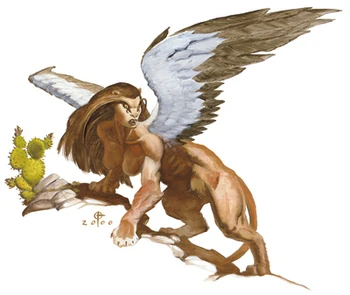


Combat-wise? All Sphinxes have the immunity to mind-reading (no cheating in riddles!) and have a reasonable library of spells, with the Gynosphinx’s spells being a lot more lore and knowledge-oriented. They also have the ability to teleport themselves. In their lair, they have the ability to… reverse time? The Androsphinx is stronger than the Gynosphinx due to old-timey sexism (remember that none of this dimorphism is from real myths!), and is given higher-level spells, and a specific triple-roar effect.
Ultimately, I do think that the trope of the Sphinxes guarding tombs and being so divinely and supremely tied to their puzzles and function to be a very necessary trope. The 'Sphinx' and her riddles are also quite ingrained in pop culture and people will recognize them as much as they would recognize Medusa or the Hydra or Vampires. But while there are a lot of nice stuff about them, design-wise... they're a bit dated. The Andro/Gyno dimorphism is, again, something D&D invented wholesale and probably one of the few blatantly sexist bits in D&D. It's not even a function of societal roles that could be argued for some of the humanoid species, the Gynos are just straight-up weaker. And while I do find the artwork cool in insolation... let's not forget that the Monster Manual alone has Manticores, Chimeras, Gryphons and Lamias as lion-monstrosities. Being a 'naked lion with a head and some crowns' isn't visually as distinct.
____________________________________________________

Sphinx
- 5.5E: Tiny Celestial; Lawful Good; CR 1 (Sphinx of Wonder)
- 5.5E: Large Celestial; Lawful Good; CR 8 (Sphinx of Secrets), 11 (Sphinx of Lore), 17 (Sphinx of Valor)
So now, D&D’s 2024 5.5 Edition update has probably reinvented the Sphinxes the most out of any monster. With their very hyped-up lore from 5th Edition, the Sphinxes being retconned into a type of Celestial makes the most absolute sense to me, particularly with how much emphasis on worshippers and extraplanar abilities that the original 5E writing has. The idea of them being knowledge and secret protectors are emphasized a lot more.
In this edition of the lore, the Sphinxes are ‘formed from spirits of sages and explorers’, and know the full weight of lore. They share the wisdom with those who prove themselves through riddles or tests – a lot of similarities to the older edition. But in this version, the Sphinxes actually gain power and change form as they gain understanding of cosmic enigmas.
And the idea of these knowledge-beings slowly growing up like Digimon gives them a lot more avenue to interact with the fantasy world instead of just being stuck in dungeons waiting to host puzzles. The youngest version, the brand-new CR 1 Sphinx of Wonder, is the size of a regular kitty, and ‘one comes into being every time a new idea is conceived on the Material Plane’. That association with ideas and knowledge is really neat, and these young Sphinxes are fascinated by a particular type of study. Sometimes they even cross over and form a bond with mortal scholars – which feels like a much more built-in roleplay as a Celestial-type familiar. Other than Imps and Quasits, none of the other Familiar options really have a story hook to them. And besides... who doesn't want a colourful, rune-covered flying cat?

Next up is the CR 8 Sphinx of Secrets. They've grown to the 'Large' size, and one thing to perhaps note is that the Sphinxes' faces are all kitty now. Which is a change that I feel I could do without. I do like the colourful fur, and magical runes all over their body. And while they do have human-like hair, I did wish that the faces grew more human as they 'evolved'.
Anyway, Sphinxes of Secrets are CR 8. They are associated with sites of great magic and learning, and do the dual role of protecting those sites while conducting their research. Their abilities are similar to the original Gyno/Androsphinx from 5E, with 'Inscrutable', the regular melee attacks, and a small spellcasting list... but the Sphinx of Secrets has the 'Curse of the Riddle' that turns the riddle into an actual mechanic. The book makes it into just an intelligence roll, but come on, any self-respecting DM needs to have prepared riddles handy for this!


And finally, the original Gynosphinx and Androsphinx are reprinted as the 'Sphinx of Lore' and 'Sphinx of Valor'. They're both just rune-glowy angel cats, with more or less the same abilities as their 5E counterparts. The differences in their power are now tied to the size of the secret and knowledge they are guarding. The Sphinx of Lore have the typical lore that the traditional D&D Sphinx has... ancient artifacts or texts that they guard in remote places. Sphinxes of Valor guard specifically world-changing and dangerous secrets, things that could destroy the world or dangerous knowledge that could doom the world. Instead of seeking for a worthy champion, the Sphinxes of Valor actually are far more dutiful, seeing their charge as paramount to everything else.
Overall? I think this is an okay change. I do feel like visually there might be some arguments of dropping the 'human face', but it's at least a distinct and memorable look. The Sphinxes in D&D have always felt to be a great concept that could be explored and pushed even more. Dropping a lot of the sexist dimorphism (again, not there in the original myths), giving them a more unique visual look, and tying everything about them to the theme of knowledge is a great one. I am a fan of this redesign... again, I don't agree with every aspect of it, but I really loved that they tried instead of deleting the entries or reducing them into one or two lines without context.
____________________________________________________

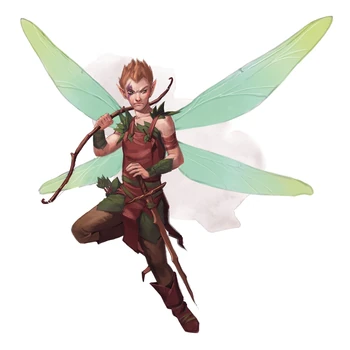
- 5.5E/5E: Tiny Fey; Neutral Good; CR 1/4
5th Edition was pretty great at representing most of the iconic monsters that have appeared in most of the ‘first Monster Manuals’ of previous editions… with the exception of smaller fey. Older editions would have Brownies, Leprechauns, Atomies, Grigs, Pixies, Atomies, Nixies, Sprites… a whole bunch of them, and I can see why they wanted to streamline them into just two – just the Pixie and the Sprite. There is admittedly a bit of a visual identity problem, though, and I am quite sad that neither the Pixie nor Sprite has insectoid features other than the wings. We could’ve had one of them be little humans/elves with insect wings; and the other be little humans/elves with more insect parts! Or maybe just make them be merely lilliputian little humans/elves.
Instead, the main difference between Pixie and Sprite just seem to be their attitude and their ability to do magic. Pixies are more cheerful and use magic a lot. Sprites are cold, lacking in warmth, suspicious, and use mundane (if poison-tipped) swords and bows. Their only real supernatural ability is invisibility and a ‘heart sight’ to understand an interloper’s alignment and intentions.
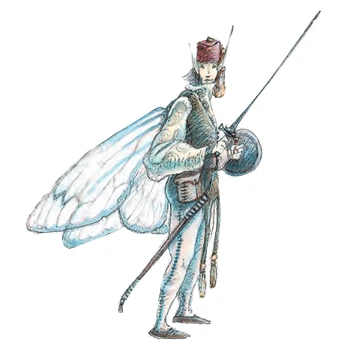
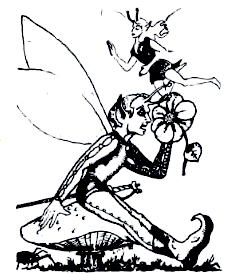
I do like the idea of a group of tiny little forest people that protect nature, judge people who come, then either toss them out either forcefully (via sleeping arrow darts) or by scaring them off via rustling leaves. But all the other descriptions of the Sprites really do make them just feel like more boring, more serious versions of the Pixie. Which… again, really do feel like more of a cultural difference more than anything. We don't put 'Ranger Humans' as a separate species from 'Druid Humans', do we?
I don't know... it's not that the older editions did a particularly good job at distinguishing all of their 'little fairy people' races, but at least there tended to be more differences, culture-wise or visually, beyond 'Tinker Bell' and 'Tinker Bell, but she dresses like Peter Pan'. At least when I was grousing about the various races of fish-people, there is a significant visual difference between the Locathah, Sahuagin and Kuo-toa. I skimmed through the 'small fey' of 2E and I am kind of disappointed that when they picked 'Pixie' and 'Sprite', they really didn't think of differentiating them visually or lore-wise.
____________________________________________________

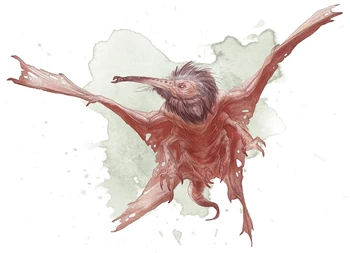
Stirge
- 5.5E/5E: Tiny Beast (5E), Monstrosity (5.5E); Unaligned; CR 1/8
- 5.5E: Swarm of Tiny Monstrosities; Unaligned; CR 2
I find the Stirge to be a nice, underrated monster. Borrowing its name from the vampiric Strigoi of Romanian culture, the Stirge in D&D is patterned as a strange bat-mosquito, with how insectoid or mammalian the Stirge looks varying from edition to edition. I particularly love how they have grown to look much less than just a lumpy bug; gaining a second pair of wings and features that make it look reptilian in 3E and 4E. I really do find that 4E Stirge to be quite charming, looking like an old-school Star Wars alien in a way.
5E’s Stirge goes perhaps a bit too far in deviating from the previous appearances, though, giving it the head that is best described as some kind of a long-snouted possum, and legs that look almost mammalian (although it’s hard to tell). It makes it look a bit too much like a weird bat, like something that would believably be a real-life obscure species from Australia or something. 5.5E goes back into being monstrous, keeping the bat wings but bringing back decidedly insectoid legs, and a head that is just a massive, serrated dagger-piercer. It looks a lot less like a ‘proboscis’, but definitely more like something that would draw blood. It does look more like a serrated nail than the needle imagery that all previous Stirges have been using, though.
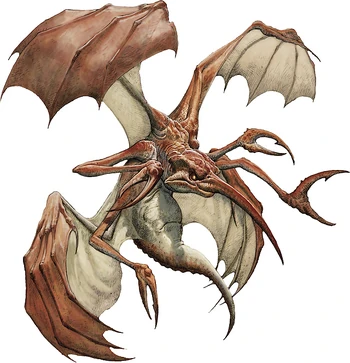


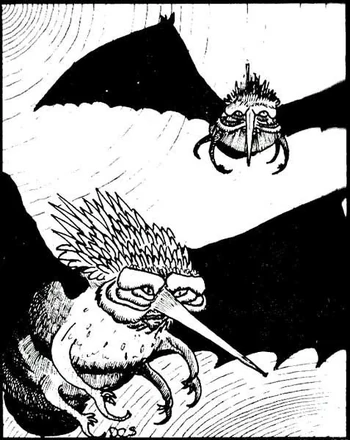
Stirges are relatively simple monsters, being actually classified as ‘beast’ in 5E before there seemed to be a collective decision to just make all animals that aren’t in real life be ‘monstrosities’ instead just to make things simple. I like the idea of them being essentially more dangerous and threatening versions of mosquitoes as you trek through a jungle, actually able to drain someone to death instead of just giving you a nasty itch.
I do like the writeup noting that once a Stirge has drawn blood, they would rather fly away to digest it – which really does make it feel like it’s the behaviour of a real wild creature which is just preying to survive. The problem, of course, if there’s a whole swarm of the things… each member in the swarm wants to feed, after all. 5.5E also highlights the Stirges’ nocturnal behaviour, and how an encounter might just happen due to the accidental disturbance of their hiding spot.
I like the Stirge. In a more boring world they wouldn't have made the Stirge and filled in its role as a pest with 'Giant Mosquitoes' or 'Swarm of Vampire Bats' or something like that. But giving this ecological niche to a make-believe monster and putting in a bit of effort to detail their ecology is one of the reasons why I like world-building so much.
____________________________________________________


Succubus
- 5.5E/5E: Medium Fiend; Neutral Evil; CR 4 (Succubus)
- 5.5E: Medium Fiend; Neutral Evil; CR 4 (Incubus)
I am very, very happy that despite newer editions of D&D going so much into playing it way too safe that the Succubi actually remain as the Monster Manual’s premier seduction-themed monster. They even get an expanded stat block, the Incubus – which previously is just a cosmetic, gender-flipped Succubus but is now something a bit more substantial that we’ll cover below. There is, still, admittedly a bit of PG-13-ifcation by giving us various alternate plans that a Succubus can take without implying sexual attractions (adopting the form of a lost loved one, a flattering underling, taking the form of someone needing protection, an isolating gaslighter) but the artwork and writeup does still keep the essence of the monster.
Drawing from European and Jewish mythology, the Succubus is adapted as a fiend. Previous editions have really flipped-flopped on whether the Succubi are demons, devils, or something else and 5th Edition just gave a gigantic cosmic shrug and characterized them as ‘independent’ fiends that can be in the employ of any greater fiend or work on their own.


Succubi often use their ability to shapeshift, and essentially use a combination of sleeping manipulation, until they become susceptible to temptation. The ‘Succubus’ is the form that the fiend takes when they are physically seducing and tempting their prey, appearing in the guise of a humanoid and through seduction and temptation, corrupts their prey. The 5E Manual notes that Succubi don’t deal in contracts, but causes three betrayals – of thought, word and deed – to claim their prey’s soul. The Succubus has the ability to cast the Charm spell, but do not actually want to use it and wants to lower-case charm people to make them voluntarily lose their own soul.
In combat, a Succubus has an additional attack called a Draining Kiss, which is a very common trope in fiction (albeit not always associated with Succubi) where they inflict the ‘pain and emptiness’ within the Succubus’s soul towards the victim. This is often a mark of the final death that the Succubus grants her victim, after successfully corrupting their soul.
In 5E, Succubi and Incubi are just terms for when the Succubus takes a female or male form. But in 5.5E, the abilities are split into two, and they can freely change between either form while being whichever gender they like. The Succubus is the ‘physical’ temptress, exploiting the waking desires. But when she transforms:
____________________________________________________


Succubus - Incubus
- 5.5E: Medium Fiend; Neutral Evil; CR 4 (Incubus)
Most people forget that the original real-world mythology of Incubi and Succubi isn’t just about ‘sex demons’. It’s about sex demons that visit you in sleep and cause you to think of impure thoughts – essentially ancient people’s explanations of nighttime phenomena like wet dreams or sleep paralysis. The original 5E actually does note this in the writeup, saying that many Succubi stalk their prey and whisper sweet nothings while they are sleeping, making them more susceptible when the Succubus appears in the physical world.
5.5E, however, makes the Incubus a full on alternate form with different abilities, representing the ‘dream demon’ aspect of the source material. Incubi visually look very cool, too, with ‘armour’ made of a porcelain-like material similar to their almost mask-like faces, while their ‘flesh’ glows with the consistency of the night sky filled with stars.
Instead of the ‘dream phase’ merely being a prelude to sexy seduction, an Incubus can now fully feed off dreams and continue feeding them with nightmares until their prey expires, and often haunt family members after they are done killing one. It’s a pretty sadistic demon, and you can really have a neat storyline about a constantly shapeshifting Incubus/Succubus trying to corrupt a whole family and using different methods with different members of the family.
This also actually fills in a nice role of a ‘nightmare monster’ that the original Monster Manual doesn’t actually have, since the name ‘Nightmare’ is given to a demon horse. Incubi have access to a bunch of spells like etherealness (allowing it to phase into bedrooms), and sleep-themed spells like hypnotic pattern and dream. It can also curse enemies to be unable to have a restful short rest, which I thought is a nice, clever mechanic to interact with the resting mechanic of D&D. I just wished they went a bit further with it.
____________________________________________________


Tarrasque
- 5.5E/5E: Gargantuan Monstrosity - Titan; Unaligned; CR 30
The Tarrasque might not be as iconic as the Beholder or the Mimic or the Mind Flayer, but it is another monster that is basically quite iconic as a 'face' of Dungeons & Dragons' monsters. While it borrows from the name of a dragon from French mythology, the Tarrasque has very little in common with its inspiration.
And... let's be frank at what the Tarrasque is. It is basically just 'fantasy Godzilla'. Almost always constantly the most powerful end-game monster in most basic Monster Manuals, the Tarrasque stands at a whopping CR 30. With massively powerful attacks and the ability to shake the world around it as it moves, the Tarrasque is also blessed with a carapace that reflects magic.
The Tarrasque is indeed just a giant monstrous lizard, and has mostly kept a somewhat similar appearance with slight variations. The 2E artwork gives it a much more humanoid, bipedal posture and the 4E artwork in its 'super serious' art-style makes it gray and removes its distinctive carapace. But the Tarrasque is always a giant, titan-sized theropodal lizard with a massive jaw, two prominent horns, and a carapace on its back lined with spines. Again, the vibe really does feel like a love letter to the vibe of Godzilla.
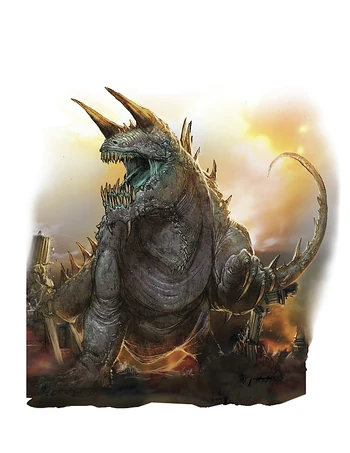


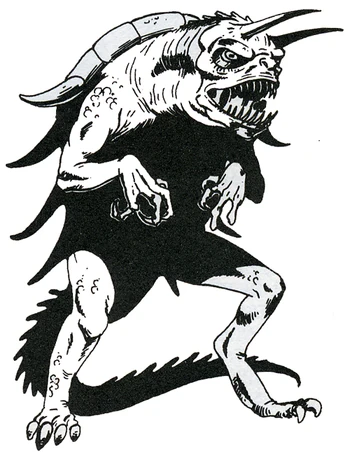
The lore of the Tarrasque differs from setting to setting, but at least in the Forgotten Realms, the 'default' setting, there is only one Tarrasque, and that being retreats back into the depths of the earth to slumber if it is sufficiently injured. It's like Godzilla, who always returns back to the depths of the ocean... or comes back to life in the next movie with an infusion of plot device.
Tarrasques slumber most of the time, but when (and where) it awakens, devastation is sure to follow. They are large enough to wander through entire towns like... well, like Godzilla through Tokyo, and what causes a Tarrasque to awake is unknown. The 5.5E Manual describes it as 'the Shape of Calamity', and where I have criticized the 5.5E for randomly cutting out chunks of monster lore compared to its older sibling, the Tarrasque is one that got an extremely welcome flowery explanation. Whereas the 5E Manual kind of shrugs and handwaves its origin, the 5.5E restores a lot of its old lore, noting that this primeval destroyer is a survival from the earliest epochs of the Material Plane, being a weapon of immortal forces and awakening to usher eras of destruction.
It lashes out at anything and everything, and interestingly, takes particular offense at the 'works of lesser beings', meaning buildings, structures, and ships. The Doylist reason for this is for DM's to go wild with all their Godzilla tropes, of course, but I do like the in-universe reason that the Tarrasque is instinctively drawn to destroy what was not created by the primordial 'immortal ones'. 5.5E also notes that it's not even just one powerful Tarrasques, but apparently Tarrasques are seemingly some kind of a multiversal constant that can only be halted. Even on the off chance that sufficiently powerful adventurers do not drive it away and actually destroy it, another Tarrasque will just spawn or awaken.
____________________________________________________

Thri-kreen
- 5.5E/5E: Medium Humanoid (5E), Monstrosity (5.5E); Chaotic Neutral; CR 1 (Marauder)
- 5.5E: Medium Monstrosity; Neutral; CR 8 (Psion)
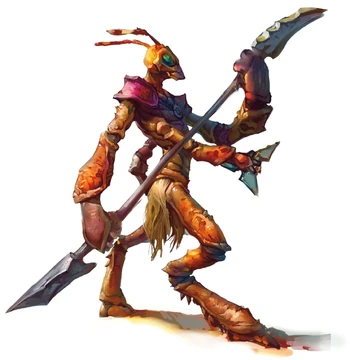
Probably one of my favourite non-human races from D&D is the Thri-Kreen, the resident humanoid ant-mantis-people hailing from the Dark Sun setting. Short of their 2E artwork that showed them with a much more bug-like lower body (which looks cool, admittedly), Thri-Kreen tends to be consistently portrayed as having a four-armed humanoid body covered with buggy carapace. I have no complaints here, it’s a pretty cool design that communicates the idea of hardy, desert-dwelling bug-people. They have decidedly taken a more ‘ant’ based design, losing the serrated forelimb spines of the mantis that its 1E and 2E variants have… which honestly fits the desert-dwelling theme a lot better.
In 5E, Thri-Kreen are noted to live primarily in the deserts, but also savannas. They are, as expected from a species of insect-people, based on a lot of the eusocial ‘hive’ behaviour of ants and termites... but not a hive-mind! They're more nomads! 5E’s Monster Manual describes a lot of the inherent differences of an insect-based intelligent lifeform, noting that Thri-kreens communicate with mandible clicks and antennae gestures, making it particularly difficult for them to be understood by other species. Thri-kreen are still able to write, draw, and as with most creatures hailing from Dark Sun, have psionic abilities… but it does give Thri-kreen a bit of an indecipherable ‘secret language’ of sorts.
Speaking of psionic abilities, yeah, Thri-kreen have them. Not all of them do, but some being born with these abilities does kind of play into the polymorphism that many ant species showcase. I do like the little caveat that while your average Thri-kreen can’t really feel emotions the way that most humanoids understand it, Thri-kreen psions are just inherently a lot more sensitive to it.

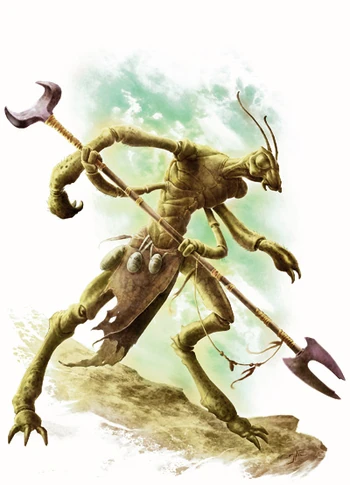

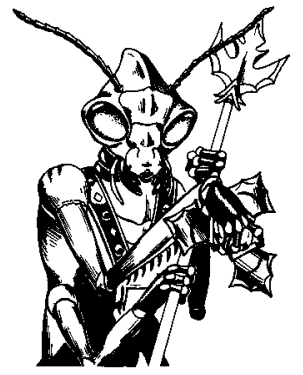
Other aspects of Thri-kreen biology is highlighted in the 5E Manual (but not the 5.5E one), like how Thri-kreen don’t require sleep, have a short lifespan of 30 years, and have a worldview where they only hunt and kill to survive, not for sport. If they kill humanoids (especially elves), it’s without any true malice behind it. As a side-note, though, while 5.5E truncates a lot of this down, like every single Thri-kreen monster entry, they find it important to tell us that Thri-kreen name their two-handed polearms a ‘Gythka’, and their three-bladed shurikens are called ‘Chatkcha’.
While mostly portrayed as being dull brown like real insects, Thri-kreen have camouflage abilities that is translated into their initial monster entries as a bonus in Stealth. When the Thri-kreen were promoted to playable 5E species in Spelljammer (which, by the way, I absolutely love), it’s just handwaved as them being able to be any colour… and the 5.5E Manual just straight-up has them as being able to adapt to whatever biome they have set up their nests in.
____________________________________________________

Treant
- 5.5E/5E: Huge Plant; Chaotic Good; CR 9
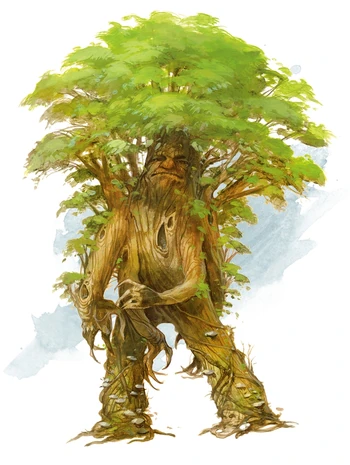
A trope as old as Tolkien’s works, it was through my initial reviews that I realized ‘Treant’ was a word invented by Dungeons & Dragons to refer to the Ents from the Lord of the Rings without actually breaching copyright. Treants are relatively simple enemies from what you expect from a giant tree with a face, with the ability to slam you (with the weight of a tree!) and awaken nearby plantlife to act as ‘lesser’ Treants to fight for them. It’s an always awesome fantasy trope as the helpless forest rises up to wage war against those who would despoil it.
The depictions of Treants have been wildly different between each edition, but that is absolutely fine, isn’t it? Trees all look wildly different, and I love that some Treants are more spindly, some have very human-looking faces with leaf-beards, and some look lumpier and half-formed. It all depends on the specific tree and the specific circumstances that the Treant awakens.
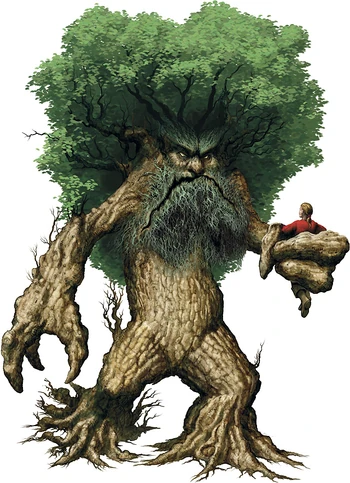


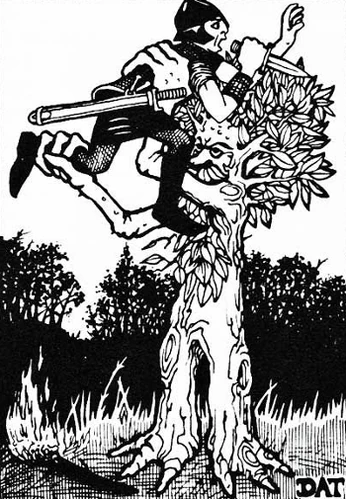
Most Treants awaken from ancient trees in locations that are steeped with natural magic, often helped by other Treants and Druids. Once a Treant has ‘awakened’, it will continue to grow as a tree and can ‘root’ itself to continue growing as a tree. Again, it’s taking on some LOTR inspirations with how Treebeard and the rest of the Ents look indistinguishable from regular trees until they decide to move. And, of course, Treants are particularly hostile towards those who cut down trees and burn down forests indiscriminately.
5.5E adds in another LOTR-inspired tidbit by noting that Treants avoid being embroiled with the conflicts of other shorter-lived species, with the only thing that could rouse them being assaults on their forest homes. 5.5E gives us a nice table showing potential Treant plot hooks – blessed by a god to grow a magical fruit; protecting portals and dungeon entries; protecting ancient druidic lore… pretty simple ‘protector of nature stuff’. But the last two really give some fun nods to what Treants could do at the hands of a DM that’s willing to push beyond the common tropes: “rooted on a hero's burial mound and animates trees that look like questing knights” and “scarred by a fire and holds the bones of the arsonist who started it in a hollow.” Pretty cool stuff, and two Treants that most certainly have some kind of story baked into them.
They might seem a bit more mundane thanks to Lord of the Rings being such a juggernaut in the general minds of fantasy media, but I do really appreciate the Treants a lot.
____________________________________________________

Troglodyte
- 5.5E/5E: Medium Humanoid (5E), Monstrosity (5.5E); Chaotic Evil; CR 1/4
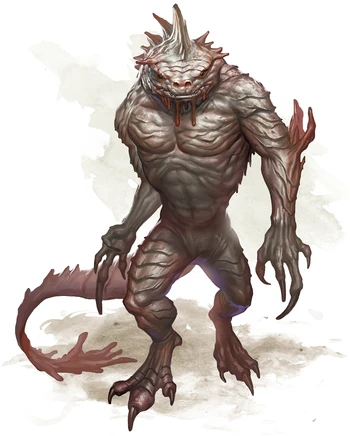
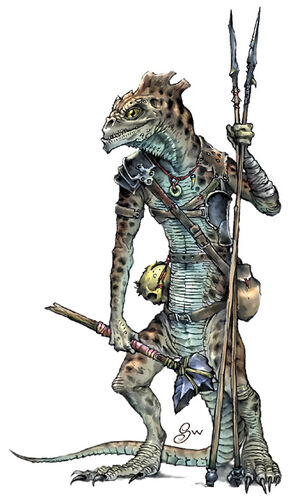
I mentioned in my original review back in 2019 that "I always kind of forget Troglodytes exist". Now, writing this in 2025... I still kind of forget Troglodytes exist. Part of it, I think, is because of their visual identity – visuals aren't everything, but they are a significant part of a monster's memorability. There is a reason why Tieflings are more popular than, say, Gnomes. Troglodytes are essentially 'subterranean Lizardfolk', but where other 'Underdark-flavour' races tended to do something interesting with it, the Troglodytes... really don't. The term 'Troglodyte' refers to a race of savage cave-dwellers from Greco-Roman historic records. Reinterpreting them as lizard-people is neat... if D&D didn't already have several dozen of them. But sure, the twist of them being lizard-people is neat... except, again, if D&D didn't already have several dozen of them. And the Lizardfolk, Kobolds and Yuan-ti have so much more lore written about them.
But sure, let's talk about the Troglodytes as they are presented in the 5E Monster Manual. They are at war against their neighbours in the Underdark all the time... which I think is the rule rather than the exception about any species that grow up in the Underdark. They eat anything they can stomach, they dwell in filth and grime, and this is reflected by their 'stench' ability, powerful enough to stun those around them.


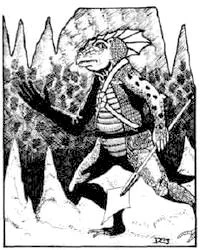
Otherwise, they are simple-minded brutes that can't plan ahead and just raid to get food. They're also sadistic and eat their prey. If their leader shows weakness, they get devoured. They also fight and kill each other over simple things like weapons.
...again, all of these descriptions really lack identity. Being evil raiding brutes that only respect strength applies to so many other evil sentient races in D&D. The whole 'filth' thing could be a twist about it, but being mottled but otherwise clean-looking albino lizard-people really doesn't communicate that thematically or visually. The 'consumes everything' aspect, as well, isn't depicted particularly well. I feel like there really could have been something more around them. Some additional aspect of their culture, or of their biology, or of their battle tactics. Anything to make them more interesting than, like, Grimlocks or Quaggoth, two other Underdark species I've complained about being boring before... but those two at least had their gimmicks. The Troglodytes just exist, and they're angry, and they're smelly... and nothing else.
____________________________________________________


Troll
- 5.5E/5E: Large Giant; Chaotic Evil; CR 5
- 5.5E: Small Giant; Chaotic Evil; CR 1/2 (Troll Limb)
The term ‘troll’ is a term in general fantasy media that just means so many different things from so many different cultures. While each individual setting is always different, you can get a reasonable guess at what a ‘goblin’, ‘orc’ or ‘ogre’ would be in an average setting… or, failing those common tropes, the creators would be trying hard to subvert expectations. But trolls? Running down through various fantasy settings on top of my head, beyond ‘big, dumb and cruel’, perhaps the one common thing that tends to be reflected in fantasy trolls is their ability to regenerate. And that alone really does help to be a hook to really differentiate trolls from the half-dozen other ‘big dumb weird human’ that you find in the Monster Manual.
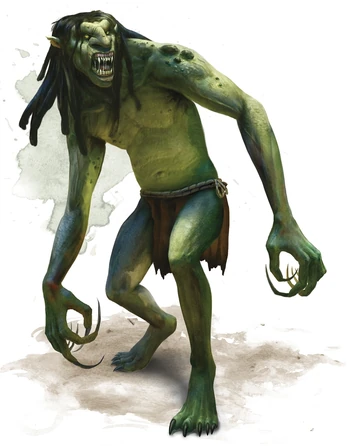
Trolls in D&D have been very variable visually, being a lot bulkier in 4E, lankier in 2E and 3E, with varying degrees of tusks or hair being present. In D&D they have been consistently shown with green skin, although I must say that I really like the 5.5E redesign the most. Restoring the fangs of the 1E-3E versions, the green-skinned Troll is also now covered with a layer of moss and lichen, which does sell them as being stealthy swamp-dwellers. Love the pinpoint-dot singular eye as well.
5E’s writeups on the Trolls just highlights their cruelty, appetites and their work as independent thuggish mercenaries to evil monsters. 5.5E gives us a bit more about ‘natural’ Trolls, describing them living in festering lairs and abduct prey either alone or in small packs. But the most important part highlighted by both Manuals is the regeneration ability. Broken bones and slashed flesh closes off quickly, and even dismemberment is a minor inconvenience. Trolls can reattach severed limbs like it’s an inconvenience, and sometimes these limbs will even scuttle around on its own. However, acid or fire stops the Troll’s regeneration, thus making the Troll highly memorable for being this ‘puzzle boss’ similar to the Hydra.
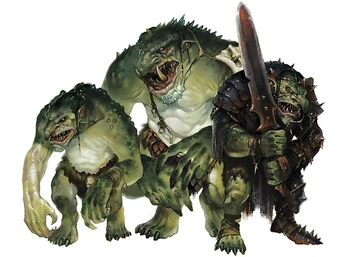


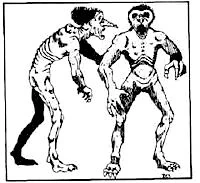
In other 5E material such as Volo’s Guide to Monsters or Glory of the Giants, we get to see this regeneration ability be taken to some really fun conclusions by showcasing utterly hideous mutated trolls that are the result of botched regenerations. Even the original 5E Manual has foreshadowing of this, noting that some Trolls who were beheaded can grow two heads; or Trolls that feed on unconventional flesh (like a fey creature) might gain additional fey powers.
In the original 5E Manual, we get a sidebar for ‘loathsome limbs’ which gets turned into a full, proper monster statblock in 5.5E. I absolutely love this, establishing the limbs as its own monster that the Troll can keep creating as it gets hacked up. Perhaps to be a bit more ‘realistic’, the main Troll body will actually suffer exhaustion the more limbs it loses. Which makes sense – the Troll might be able to regenerate, but it’s still losing blood! Troll limbs will lose their autonomy after the main Troll body regenerates the missing parts. This works for heads, too.
Again, I always find monsters to be a lot more interesting if they have a bit of a ‘hook’ to them. That hook can just as well be mechanical, like the Troll's, instead of flavour-wise! This is what I'm complaining about when I talk about the Hill Giants, Ogres or Troglodytes in the D&D world. There are so many other substitutes for 'giant dumb dude' and 'lizard person' in D&D that merely being that isn't enough. Not all monsters need a new sourcebook's worth of lore to make interesting, or have to be created from scratch to fit a setting. But they have to be memorable and distinct somehow for people to remember them.
___________________________________________________

Umber Hulk
- 5.5E/5E: Large Monstrosity; Chaotic Evil; CR 5
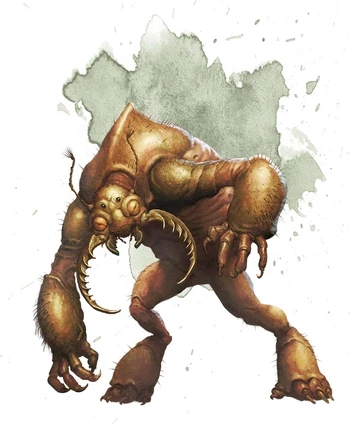
A monster that debuted from the very first Monster Manual, the Umber Hulk is giant bug-man monster! I really do like the name ‘Umber Hulk’ as well, which has that really nice descriptive feel that gives out a ‘vibe’, if that makes sense, despite the actual meaning merely meaning ‘big brown dude’.
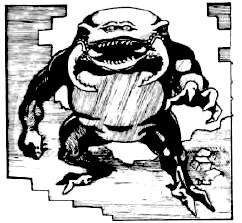
The original 1E Umber Hulk is just a nondescript bipedal monster with some bug mandibles, but from 2E onwards the Umber Hulk has grown more and more insectoid. The Umber Hulk gains a beetle-like carapace in 2E, and loses the somewhat dinosaurian/humanoid face in favour of being a fully insectoid monster from 3E onwards. The most distinctive features of the modern Umber Hulk are the gigantic, chunky forearms and the two massive mandibles that jut out of their buggy faces. They are also covered with bristles all over their hard carapace, which is noted to be what grants them their tremorsense.

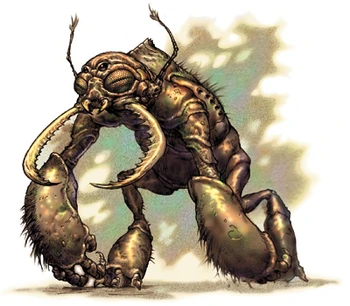

While not represented in the statblocks as anything other than a burrowing speed, Umber Hulks are noted by the writeup to be able to withstand cave-ins thanks to their hard carapace. This allows them to be ambush hunters (similar to Ankhegs), but there’s also the valid tactic of them drawing prey into these tunnels then collapsing the tunnels on them. They are otherwise ambush predators, lying in wait in tunnels adjacent to where prey might travel through, and bursting out of the walls or ceiling or ground of the underground caves to attack.
The Umber Hulk has a little extra bonus to make it a bit more surprising. It has a mind-scrambling gaze that is translated in-game as either being stunned, being confused, or even attacking their own allies. In lore, it can also cause temporary amnesia, leading people to not remember what monster, exactly attacks them. This leads to the Umber Hulk as taking a supernatural, almost boogeyman status in the Underdark. Admittedly, the revelation that it’s ‘merely’ a big bug with just one special attack might be a bit disappointing, but now I really do find the idea and the plot potential of a mysterious underground killer to be quite an exciting story. I’ve always found the Umber Hulk to ‘merely’ be cool because of its visual design, but having it as a in-universe cryptid is a story avenue that gives it just a bit more personality than just being 'bug monster, but mildly psychic'.

No comments:
Post a Comment