

Click here for the previous part
Click here for the next part
Click here for the index
To be frank, this segment is just going to involve three major groups of monsters: Yuan-ti, Yugoloths and Zombies. And Zombies don't really count, right? I love my zombies, but I won't have much to say about them. But while I did have a fair chunk to say about Yuan-ti in my original reviews, I really did the Yugoloths dirty. These Daemons are the third category of fiends in the game after Demons and Devils, and Dungeons & Dragons as a franchise itself is already kind of downplaying them compared to their two more iconic brethren, I can't believe I just gave each Yugoloth a paragraph when I reviewed them back in 2019.
Well, no more! Again, this new review really did balloon out in the second half of the book, but that is also because 2019!me really did compress way too many monsters in the back end of the articles. I wasn't really sure what the reasoning for, I guess I just wanted to get through the Monster Manual and start Volo's and Mordenkainen's as fast as possible? Was I comparing the length of the pages to the Pokemon reviews? I'm not sure, but I am quite happy that I get the chance to do this improved second attempt at reviewing the final monsters in the Manual.
Next up will be a huge chunk just talking about the regular 'beasts and humans' at the end of the Monster Manual, which is just there for my own OCD... and then we'll be back with my 5th Edition updates with Volo's Guide to Monsters and Mordenkainen's Tome of Foes. The production of these bestiaries have actually already begun around the time that I was rewriting the Monster Manual, and frankly require a lot less work on my part due to the '5.5E' update being more mechanical than lore-driven. I just needed to rephrase and expand on some of the entries, is all.
As for playable races/species and classes... I'm thinking of the format to do them. I do think that I'll just sit down and talk about ALL the playable races in the Player's Handbook and Monsters of the Multiverse in one go just so I can save the pain of tracking where Aasimar or Genasi or Goliath or Kenku debuted. And classes will be much later. A bigger project where I actually sit down and talk about the different subclasses over the various editions. 5E is still 'small' enough that I can manage to do that.
[Originally published on December 2019; Updated in January 2026]
____________________________________________________

Xorn
- 5.5E/5E: Medium Elemental; Neutral; CR 5
I think my original coverage of the Monster Manual breezed over how weird the Xorn is. The Xorn is a creature that the D&D team clearly like a lot, since they show up in almost every 'first' Monster Manual for any given edition. And they have done a great job at depicting the Xorn simultaneously consistently and not at all throughout every single iteration.
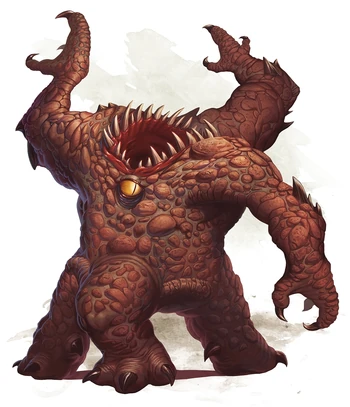
Let's talk about the visuals of the Xorn first — it is a creature of the earth elemental with three long arms, three legs, three eyes all around its body, and a fanged maw in the middle of this bizarre radially-symmetrical form. And now, take a look at the Xorn's depictions throughout all five editions. I don't think any other monster has looked so consistently different from edition to edition, while still keeping the same basic body layout. 3E went for a fleshy look; 1E looked like an animated brick; 4E and 5E went for a rock-man look; and my favourite has to be the 2E artwork which looks like some kind of strange upright fish with shades of a trash-can and those eggs from the Alien franchise.
And I am of the opinion that all of these depictions are just as 'canon' as each other on what a Xorn can look like. They're meant to be weird, and these variations make them weirder. Where most elementals are just vague humanoids or beasts that are made up of the element, the Xorn are bizarre creatures that hail from the Elemental Plane of Earth. They are, despite their appearance, intelligent beings who are driven by one thing — food. And what's food to a Xorn? Gemstones and precious metals. Which is a likely reason why a Xorn comes into conflict with a party of adventurers, when they pop out from the ground to barter or demand they share that nice little diamond they have in their rucksack, and what do you mean you need that snack for resurrection spells?

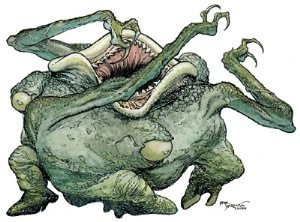

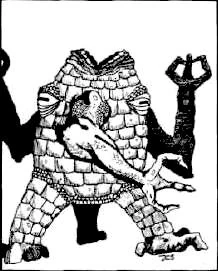
In addition to their massive maw (which, by the way, are filled with teeth that can grind diamonds) Xorn are explicitly noted to be able to move through dirt and rock without disturbing them, because they are technically earth elementals. The expected encounter as the Monster Manual presents is for these Xorns to pop out of a part of the tunnel around an adventurer carrying the most valuable gemstone or precious metal that they can just innately sense, and probably begin to bargain for it.
Again, the strange appearance of the Xorn is likely to freak out your average adventurer (and player) but I really do feel like that is the intended reaction. In a fantasy world, you don't need a bipedal body or a humanoid face to be intelligent and non-hostile. Sometimes a sentient being's face can be a giant grinder-maw of tooth and gums on top of four rocky arms! 5E describes the Xorn as being a being that 'pleads or bargains' with information or aid for gemstones that they can sense and sniff, although they may be irate and angered if they are particularly starved... or if your party is particularly rude to it.
5.5E restores another cute aspect of Xorn culture from older editions, emphasizing that their homeland of the Elemental Plane of Earth is a non-stop gem buffet for the Xorn, and those that are trapped in the Material Plane find our world and our gems to be ''culinary wastelands". They even give a little table on what each individual Xorn might consider to be a craving, with some Xorn liking pieces of fossils, meteors, or even pieces of Galeb Duhrs. I find the Xorns to be supremely weird in all the best ways, and adorable, even.
____________________________________________________


Yeti
- 5.5E/5E: Large Monstrosity; Chaotic Evil; CR 3 (Yeti)
- 5.5E/5E: Huge Monstrosity; Neutral Evil; CR 9 (Abominable Yeti)
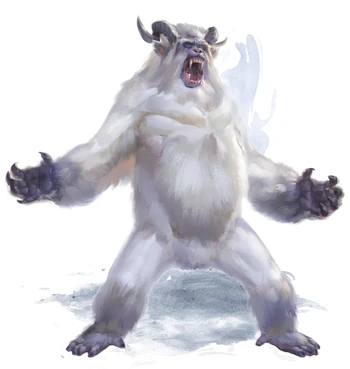
Another monster quite common to pop culture is the Yeti from Himalayan myths; abominable snowmen who stalk the mountains and abduct travelers to consume. D&D's Yeti started off as just a white-furred big monkey-man, before they grow increasingly more monstrous, gaining horns in 4E to make them a bit more impressive than 'just a white-furred ape'. The 5.5E redesign goes a bit further than just making their Yeti a horned, white-furred gorilla and tosses in a bit more 'wendigo', with glowing icy-blue eyes and ghoulish, monstrous fangs that you won't mistake as being used for anything other than rending human flesh.
Yeti in D&D hunt the snowy landscapes, and they are classified as 'large' size with a couple of features. They have stealthiness in the snow, and its eyes has the ability to freeze prey in place. Rather interestingly, Yeti also has a 'fear of fire', which is represented by them being disoriented and having disadvantage on its attacks if they are ever damaged by fire. Yeti stalk their prey through snow and blizzards, harassing their prey with howls that echo through the mountains before attacking to claim its prey. These howls might attract even more Yetis, which would fight over the prey and if any other Yeti are slain in the process, they just become more food for the victorious Yeti. Most Yeti are solitary or hunt in small groups, and while humanoids aren't their primary food source, they are very much happy to snack on any that wander into their hunting grounds.
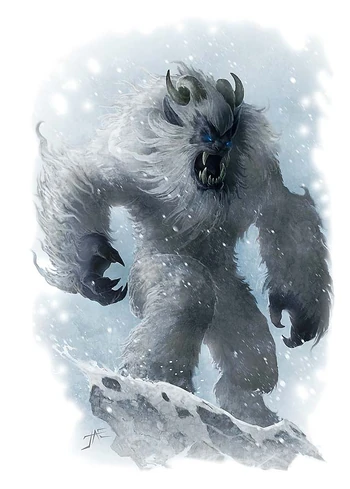


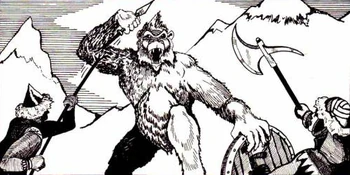
5E highlights a lot about the atmospheric vibes of a Yeti stalking, describing mountain communities as being afraid of the ill omen and voices of victims lost to blizzards within a Yeti's howls; or starving Yetis attacking humanoid settlements when prey are scarce... and mountain settlements that are fighting each other might make use of this behaviour to goad Yetis into attacking other villages. All the 5E material seem to quite nicely adapt real-life mythologies and hearsay about the Yeti in-universe, noting that there are a lot of superstition and tales about the Yeti.
5.5E also plays a bit into the 'snowman' idea, giving the basic Yeti the ability to generate ice from their hands to hurl at foes. Both 5E and 5.5E describe the 'Abominable Yeti', classified as 'huge' — dinosaur or giant sized — that have the ability to unleash a full blast of freezing breath from its mouth. Its 5.5E artwork makes it look very impressive, with an icy glow within its throat and eyes, and icicles growing from its arms.
We don't actually learn if the Yeti has any real connection to beings like the Frost Giants or Ice Elemental Plane or whatever... they're just both simultaneously mundane (they are ultimately just big ice apes) and also mysterious. Which is fine by me. At the end of the day, there's only so much you could do with the Yeti, and I do like that at least one of the more common modern-day cryptids made it into the Monster Manual.
____________________________________________________


Yuan-ti
Snake people? Snake people! The Yuan-ti are one of my favourite D&D-original races, and one that has shown up quite a bit throughout D&D's long history. Unlike most other 'animal-folk' races, the Yuan-ti aren't a naturally-occurring species but are the result of an insane cult who thinks that the most perfect form of life are snakes. In D&D lore, the Yuan-ti were originally an ancient human empire who really, really worshipped snakes. All the qualities of the serpent (like their deadliness and their detachment from emotion) were lauded as the perfect life-form, and they began worshipping snake gods. They would 'shed their humanity like a snake sheds skin'. Worship became obsession, and they started emulating the vile aspects of the Serpent Gods that responded, including cannibalism, human sacrifice and foul sorcery-assisted interbreeding.
Eventually, this empire expanded and grew bigger and bigger, creating massive temples and ziggurats and with the Yuan-ti gathering larger armies and no shortage of slaves and prisoners to sacrifice to their Serpent Gods like Merrrshaulk. Those that failed to transform or ascend become slaves or sacrifices. Their main goals is to emulate and be transformed into divine serpents; while their large-scale goal is to ascend into godhood, to become members of an all-serpent pantheon. They don't worship their gods (and their gods understand this) so much that they want to replace them.
Ultimately, the ancient Yuan-ti empires were crushed in war against other races, but they hold on to this moment in time when they were one of the most powerful forces in history, where they were allegedly so close to the godhood they desire. Now most Yuan-ti civilizations remain in enclaves all over the world, in secluded deep jungles and deserts, hiding in the remnants of their temples and biding their time. A majority of their present-day plots involve infiltration and manipulation, while they await the right time, the right amount of resources, to enact their sinister endgame. They have learned from their original defeat, knowing that brute force can't get them what they want... so a web of influences and insidious infiltration is their modus operandi now. That's cool!
(I would like to note that most of this backstory is gone in 5.5E, although fragments of it remain in part of its multiple-choice past table... which is a shame, since I thought that simply removing the vaguely Aztec/Inca-inspired 'human sacrifices' thing would've been an easy fix.)
And I do really like the Yuan-ti, and their nice blending of what's essentially a horror religious cult with the rather comedic theme of 'we want to be snakes!', a plot that honestly feels a bit more Golden Age comics than the Cthulhu mythos. And I feel the Yuan-ti are an adversary that could be played either way. A DM can use the Yuan-ti as a simple human-sacrificing snake cult, or take a more cerebral approach by playing up their infiltrator-of-society aspects.
Of course, one of my favourite aspects of the Yuan-ti is how utterly varied the race is...
____________________________________________________

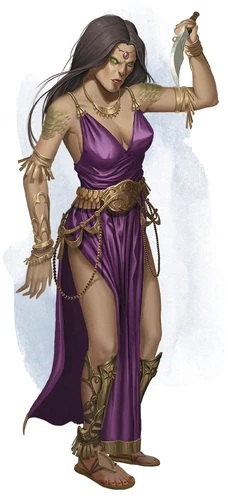
Yuan-ti Pureblood / Infiltrator
- 5.5E/5E: Medium Humanoid (5E), Monstrosity (5.5E) ; Neutral Evil; CR 1 (Infiltrator/Pureblood)
The weakest amongst the Yuan-ti are called the Pureblood, which is a term that never sat right with me. Not out of any sensitivity reasons, but more out of a storytelling one. Yuan-ti value serpentine features more than humanoid ones, while the lowest caste of so-called Purebloods are the most human-looking, the ones who haven't undergone the full serpentine transformation. Why would they be considered the most 'pure'? 5.5E swapped this around to 'Infiltrator', which feels a lot better thematically, even if that probably wasn't the main reason why 5.5E made the change.
Purebloods or Infiltrators basically look like humans with just a slight bit of note to their true nature. Some snake scales here, serpentine eyes, snake fangs, a forked tongue... and depending on the individual, one could look positively ghoulish... or look like just a regular human with maybe some contact lenses. Honestly, in the D&D world, some cute snake fangs and a bit of scales could be handwaved easily, couldn't it?
These Purebloods disguise themselves to infiltrate civilizations to gather information and to gain influence, manipulating others for the good of their society. Again, I really do like the idea of these snake-people slowly infiltrating the cities and towns around its sphere of influence. The Pureblood/Infiltrator herself is a simple warrior with some thematic spells (Animal Friendship to control snakes; Poison Ray; Suggestion) but the most interesting part is to even discover them in the first place.


The Yuan-ti would get a full expanded section to themselves in Volo's Guide to Monsters, that I really do like. It makes the 'Yuan-ti Pureblood' playable, regardless of whether you're playing a Yuan-ti infiltrating humanoid society or a pariah/outcast; and highlights an aspect of the Yuan-ti people that's briefly brought up in the original 5E Monster Manual. Even though they look human, Yuan-ti Purebloods have changed so much that regular emotion is foreign and they can't really comprehend sentiment or attachment.
They just view the world and things like fear, awe and even worship with a cold pragmatism to achieve goals. And they understand the importance of having an army of disposable minions in this aspect. Yuan-ti culture won't throw away Pureblood lives (or dignity) for no good reason (slaves, on the other hand, are fair game), and it's probably one of the few redeeming qualities about the Yuan-ti. And, again, roleplaying an infiltrator for a race with an alien mindset is a very fun concept for me.
____________________________________________________

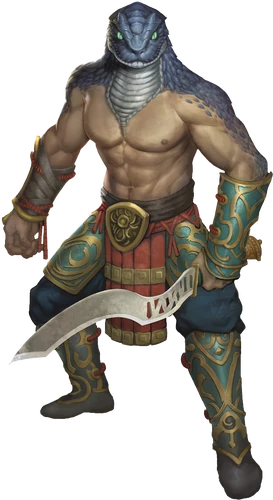
Yuan-ti Malison (Halfblood)
- 5.5E/5E: Medium Monstrosity; Neutral Evil; CR 3 (Malison)
- 5.5E: Medium Monstrosity; Neutral Evil; CR 3 (Malison Types 1-3)
The bulk of the Yuan-ti race, and the most interesting one by far, are the Halfbloods or the 'Malison', as they're more commonly called. Malisons have fully blended human and serpentine aspects, but as both Monster Manuals and Volo's Guide to Monsters show, it's a bit of a glorious crap-shoot on what features get represented on a humanoid body. The 5E Manual's Malison shows off a muscular warrior with the head of a snake and some shoulders running down his arms. Neat, but not weird enough, especially not with what the text describes.
The 5.5E Monster Manual, thankfully, gives us artwork for the three most common types of Malisons: Type 1 Malisons are the one that the 5E Manual also represents, with the body of a human and the head of a snake. 5.5E's artwork gives us a much more snakey head, though, looking a lot more inhuman than the somewhat more intelligent-looking 5E art. I love that 5.5E Type 1 Malison, he reminds me of the Serpents from Elden Ring.


Type 2 Malison are also mostly human, but they've replaced their arms with snakes. Glorious. This is the kind of ridiculous I can get behind, and just look at that dude's face You know he's not all right in the head. I love this. During my original review of 5E, I bemoaned the lack of art for this specific variant. I love that we've got it now, even if one snake for each arm wasn't how I imagined this Malison to be (I thought he had multiple snakes growing out of each arm).
Type 3 Malisons have the 'mermaid' body shape, with the upper body of a human from the waist up; but a serpent's body from the waist down. It's probably one of the more common depictions of a serpent-person in fantasy media, I think, and it does feel somewhat similar to the Abomination that we'll talk about a bit later. As an aside, I do appreciate that the 5th Edition artworks all draw from different variations of snake for their artwork, instead of just the same boring generic green snake that 3E/4E uses. I do really love the customization of my fantasy animal-people with variations of real-world animals.
All Malisons have the shapeshifting ability that allows them to transform into an actual snake for a limited amount of time, which is mostly there for ambush purposes, I think. All Yuan-ti also have magical resistance, and the three types of Malison have slightly different attacks and abilities; with 5.5E giving them a fair bit more poison spells.
____________________________________________________

- 5.5E/5E: Large Monstrosity; Neutral Evil; CR 7 (Abomination)
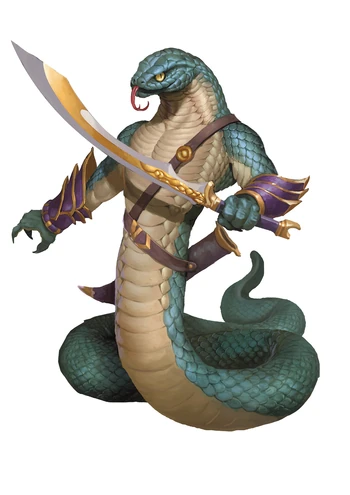
And standing on top of Yuan-ti heiarchy is the Yuan-ti Abomination. I feel like whoever in-universe gave the terms 'Pureblood', 'Malison' and 'Abomination' must not have been a Yuan-ti, since this is the form closest to a snake. Abominations are basically just giant snakes with human torsos and arms marring the pureness of their serpentine form. Abominations are the near-pinnacle of Yuan-ti civilization, forming the top caste that all other Yuan-ti strive to be. They are the masterminds that scheme and try to take over the world, and will willingly sacrifice their minions to achieve this.
Again, I do like the 5.5E artwork for the Abomination, which really gives the snake head more biological accuracy – it makes the snake eyes look a lot less 'human' without making it look less intelligent, if that makes sense? I love the sinister look on the 5E artwork, but his intelligence is something not too alien. Something familiar, something human, is there.
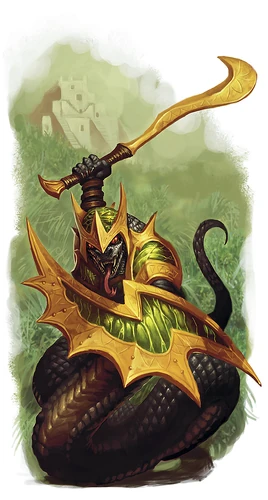


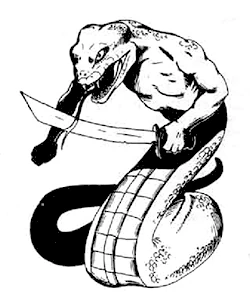
Abominations are powerful warriors, having all of the same abilities that a Malison has, with the addition of a more powerful spell (Fear in 5E, Poison Spray in 5.5E) and the additional note that they are particularly fond of constricting their prey. But as the Manual notes itself, the main threat that Abominations should have isn't in mere combat, but in their schemes and cults. They are the literal 'head of the snake', hiding away from where their conspiracies take place, and even if you reach them, they are highly likely to have contingency plans or knowledge about dark magics that might not be represented in the stat block.
Also, I don't think I've mentioned it in the rest of the coverage, but Yuan-ti technically can 'level up' and rise among the ranks. Volo's establishes that Yuan-ti tend to breed amongst their own caste to maintain the purity of their form, but it makes sense with how the snake-people are presented that there would be a way, even if it's not practical, for the castes to rise through the ranks.
Again, I really enjoy the Yuan-ti a lot. The variety in their forms and the stories you can tell with them are fun, and 5E has done quite a bit to expand upon the variations and the lore of these snake people for quite a bit.
____________________________________________________

Yugoloth (a.k.a. Daemons)
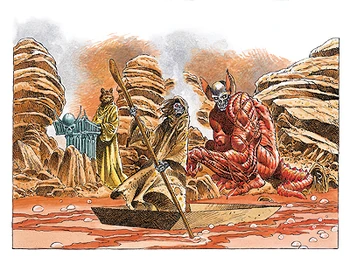
When the Dungeons & Dragons team decided that Demons were going to be 'Chaotic Evil' and Devils were going to be 'Lawful Evil', they realized that they needed someone to fill in the middle ground of 'Neutral Evil'... and designed up the Daemons. With the confusion that Daemons and Demons raised, the Daemons were swiftly renamed into 'Yugoloths' in subsequent editions, and... they are just never quite given as much focus as their two more cooler fiendish cousins. Their name being a made-up word most certainly doesn't help, but the Devils and Demons both have very solid niches in terms of flavour and even visual identity. The Devils tend to be based on Dante's Inferno with more 'winged humanoid' visual cues and the excellent theme of an evil organization and diabolic deals with mortals. Demons, meanwhile, tend to be more monstrous, gory and bestial, and go for the 'mindless destruction' vibe. There are just a lot more of these two, around a dozen each compared to the four Yugoloths in the 5E Monster Manual.
And what's the theme of the Yugoloths, then? As the Neutral Evil fiends, Yugoloths inhabit planes such as Gehenna, Acheron, Hades and Carceri... all the 'smaller' evil hell-analogues. And the flavour that 5E gave the Yugoloths is that they are mercenary fiends, embodying the sin of greed/avarice. Yugoloths always ask for compensation for their services, and the most interesting thing about them is that they are very much willing to aid either Demons or Devils in the Blood War. Being immune to the pesky 'permanent destruction' thing that Demons and Devils fear when they fight in their territories, the Yugoloths are invested to turn tides of battles and keep this stalemate going. For... for purposes of their own, I suppose, as the much-less-numerous Yugoloths try to scheme for power. Unlike Devils, a Yugoloth can and will lie to you, and aren't properly bound by contracts.
The Yugoloths' origin story as given in the 5E Monster Manual is that they were created in the plane of Gehenna by either Night Hags of Asmodeus. Every single Yugoloth was tied to the plane of Gehenna, and their names are recorded in the 'Books of Keeping'... save for one, the General of Gehenna. Infighting over the power of these true names caused the original Night Hag creators to perish in the ensuing fight, and the Yugoloths are now free to be independent contractors, bound only to their General.
Again, on paper, this is a very cool backstory. An army of fiends that grew into independence, and now represent a different aspect of evil – a cold, detached indifference tempered with greed and treachery? That would have been cool. Except in practice, the Yugoloths never really got much of a spotlight. Every other description in the 5E Manual or other bestiaries often just go something along the lines of "Yugoloths are more orderly than Demons, but less regimented than Devils". And this lack of strong flavour really does make them feel a lot more boring compared to either of its two more represented cousins.
All the stuff about the Books of Keeping is nice, but we don't really get a lot of unique, named Yugoloths either whereas we're around a dozen each for Demon Lords and Archdevils in 5E books. We don't exactly have a proper analogue for the likes of Demogorgon, Orcus, Lolth, Asmodeus or Zariel. Even in their role as 'neutral' fiends, the Yugoloths aren't even alone... Night Hags, Rakshasa, Succubi/Incubi all fill that role as well, making the poor Yugoloths struggle to be memorable. 4E even rolls the entire Yugoloth race as just a type of Demon, which is of course reverted... and while I obviously didn't like this change, I can kind of see why someone decided the Yugoloths didn't have enough of an identity.
While visual art isn't everything, the Yugoloths don't really have a proper visual theming going on. To recap the four presented in the Monster Manual, we've got a fox-man, a beetle-man, a pudgy devil guy and a Gray-alien-looking dude. There's not much of a cohesion to them visually, and the general lack of identity really belies how interesting their lore is. It's really such a shame, but with the Yugoloths having such a long history of mismatched visuals – it would be cool, for example, if they were all the animal-people fiends; but with fiends being so haphazardly introduced in the early days of D&D, it's a bit of a shame.
____________________________________________________

Yugoloth - Arcanaloth
- 5.5E/5E: Medium Fiend - Yugoloth; Neutral Evil; CR 12
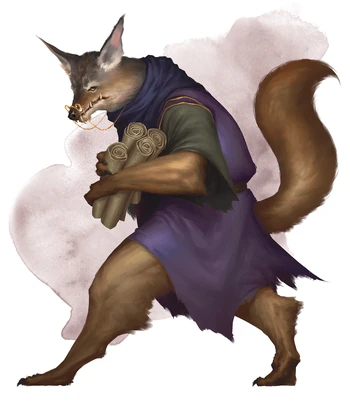
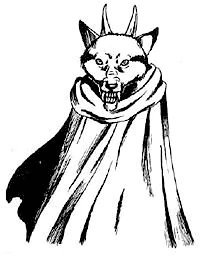
Well, starting off with the individual Yugoloth variants, we're starting off with the second most powerful one, the Arcanaloth (or Arcanadaemon in previous editions... just swap -loth with -daemon) are, as their name implies, spellcasters. They visually are just fox-men. The original 5E art makes them look particularly non-threatening, looking like just a librarian from a fox equivalent of a Tabaxi or Bullywug race. 5.5E gives a somewhat more threatening vibe, and that bone-studded robe is everything. But he is still ultimately 'just' a fox dude, which doesn't really scream 'a monster as strong as adult dragons'. I suppose it makes sense that the Arcanaloth wants to look inconspicuous, but it does make it a lot less memorable above the table.
Arcanaloths are charismatic beings, gaining the trust of creatures that they negotiate with either as a jackal-man or using their 'alter self' spell to take the appearance of other beings. In addition to commanding lesser Yugoloths, Arcanaloths also act as archivists of their kind, all the while scouring the multiverse for other magical artifacts and information. They are so intelligent that they can just 'speak and write all languages', and are happy to sell their services not just as a spellcaster, but as a diplomat... but a slimy one that, if they get a better deal, will very willingly leave their previous employers to a doomed treaty.

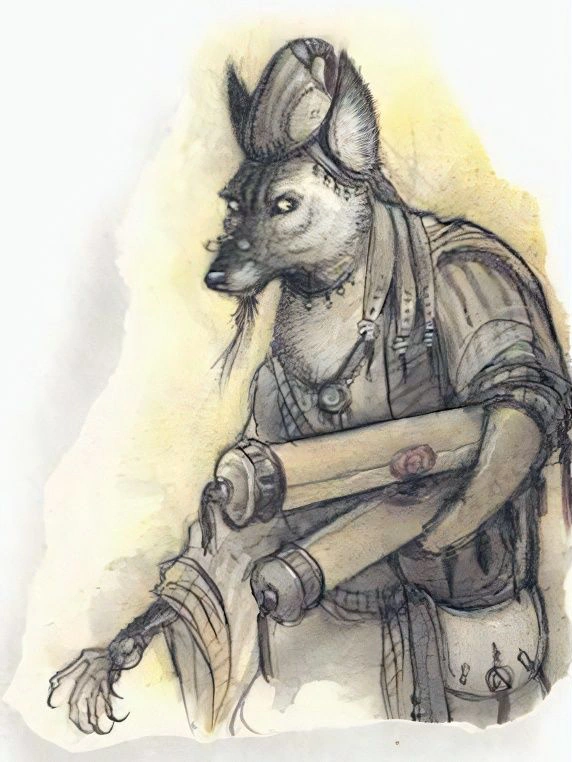
Honestly, the way it's presented, the Arcanaloth does feel like a simple, if rather basic, social encounter. They have their own goals, to hoard and exploit information and secrets of all kind, being manipulators to ensnare and manipulate lesser villains. They feel like they could be the type of 'pulling the strings' character that is manipulating cultists, demons and devils for their own ends, and one that doesn't necessarily care to kill the heroes since their priority is just to gather the magical information and would be happy to escape rather than battle.
If they do fight, Arcanaloths are actually quite powerful, having access to powerful spells like Finger of Death, Chain Lightning, Dimension Door, Counterspell and various others. 5.5E gives a bunch of interesting mechanical changes to the Arcanaloth, tying to its whole 'evil magic librarian' vibe. Arcanaloths now carry Soul Tomes that it casts its version of a Banishment spell with, forcing its prey to be trapped within the demiplane within the pages of the book. The Soul Tome itself can be destroyed, but it does lend a nice little combat flair to the Arcanaloth.
____________________________________________________

Yugoloth - Mezzoloth
- 5.5E/5E: Medium Fiend - Yugoloth; Neutral Evil; CR 5
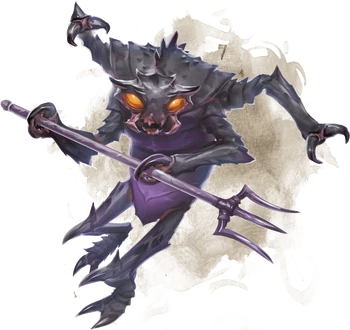
I do like the vibe of the Mezzoloth. At CR 5, The Mezzoloth is the weakest of the Yugoloths, being the simple ground troopers of the Yugoloths. They are bug-men, and in 5E they've got four arms, two legs, a weird trident and a monstrous bug head. They look more compact and beetle-like than the ant/mantis-coded Thri-Kreen. I don't mind them individually, I like me a good bug-man monster. It's just that, again, not to beat a dead horse, it just feels a bit out of place compared to the basically nonexistent visual identity of the Yugoloths.
Anyway, the Mezzoloths looked a lot more manic and monstrous with a fanged mouth in the older editions. They make up the bulk of Yugoloth population as footsoldiers, and one that aren't the most regimented, at least as 5E presents it. They bicker amongst themselves until roused together to fight for a common price, living and fighting for violence and reward. They are more direct than their stronger brethren, but they're also... not very strong or smart. They're more likely than their stronger counterparts to adhere to contracts, but will only agree to the absolute letter of the bargains and contracts. 5.5E gives us a list of potential things that a Mezzoloth might ask in return for its services, like magic artifacts, souls, a lair to summon more yugoloths or the right to loot holy sites.

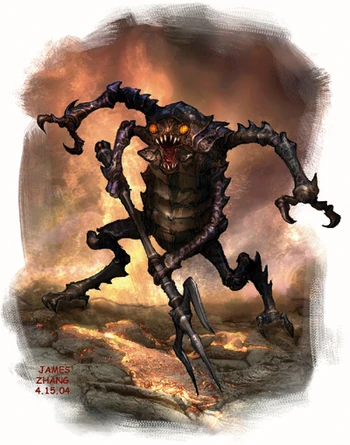

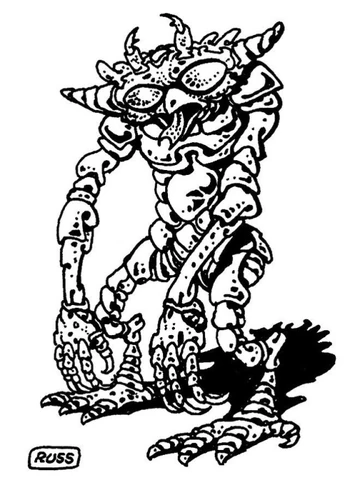
As a combat encounter, Mezzoloths are a fair bit more advanced than the weaker devils and demons. They have the typical fiendish set of resistances, and Mezzoloths are particularly known for their tridents... which looks a lot more impressive in their 5.5E artwork. These tridents are buffed in 5.5E to have the ability to instantly return to the Mezzoloth's hands. The Mezzoloth is also able to teleport, cast magical darkness, and exhale a poisonous fume represented by the surprisingly powerful-for-its-CR-level Cloudkill spell.
Lastly, as I mentioned above, Yugoloths are tied to the plane of Gehenna. Whereas Devils and Demons take time to reform after being killed outside of their plane (and sometimes 'devolve' into weaker variants), Yugoloths killed outside Gehenna just dissolve into ichor and reform essentially instantly.
____________________________________________________

- 5.5E/5E: Large Fiend - Yugoloth; Neutral Evil; CR 9
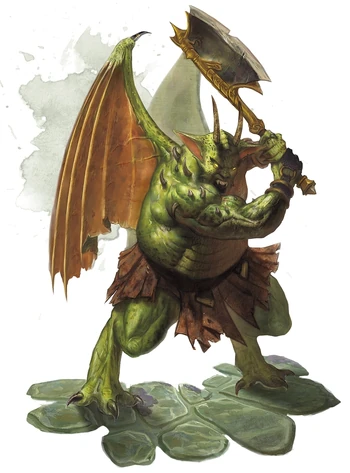
One step above the Mezzoloth is the Nycaloth, which looks... quite 'devil-ish'. Again, show me a picture of a Nycaloth without a name, and I can't really tell you what 'type' of fiend it's supposed to be. This is another reason I didn't like the 5.5E Manual splitting apart the three major fiendish groups apart, which also costed us the basic explanation about the different types of fiends.
Anyway, the Nycaloth is a bit of a pudgier demon-man with green skin, horns and bat-wings. They looked a bit more basic in 5E, while 5.5E gives it some turtle-shell texture on its belly, tiny hands on its wings, and more impressive horns and hair. Oh, and like the Mezzoloth, the Nycaloth has a much fancier, over-the-top hell halberd compared to the basic axe its 5E counterpart got. 4E and 3E notably had their Nycaloths have four arms, which actually would give it a bit of continuity with its Mezzoloth cousins, but other editions just have it be rather basic devil-men.

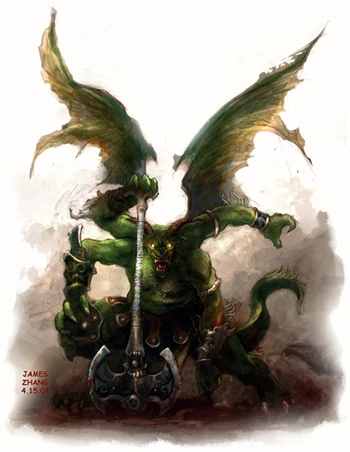

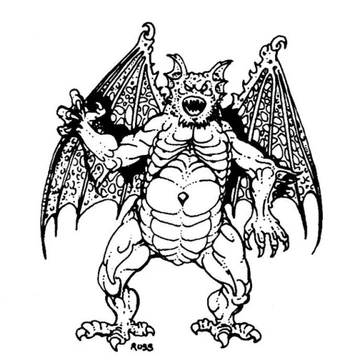
Nycaloths are described as terrifying shock troops, abusing its abilities of flight combined with teleport, illusions and invisibility to harass foes. This is represented by the Nycaloth having access to all these spells in 5E, whereas 5.5E severely simplifies this, removing all of the Nycaloth's other spells (which also includes abilities like Dispel Magic and Detect Magic) and rolling everything into 'Shadowy Teleport', which combines Invisibility and Teleport into a non-spell ability. It's also gotten the 'mercurial' weapon similar to the Mezzoloth that returns back to its hand. It's a bit more boring, I feel, and I thought that the Yugoloths' status as 'elite' mercenary fiends were previously represented by even the weaker, brutish Yugoloths all knowing spells.
It's also notable that 5E characterizes the Nycaloths as being the most 'loyal' yugoloths (out of... four) that are happy to serve a master that treats them well. Which feels a bit weird compared to all the other talk about Yugoloths being very mercenary. 5.5E characterizes the Nycaloths as instead being warmongers that relish conquests, and this 'happiness under a deal' is written more as them being happy to overlook a slightly suboptimal deal if they are allowed to indulge in a bit of bloodlust. This is given a little wrinkle because if their leaders are incompetent and lead the Nycaloth to defeat, these proud Yugoloths are likely to have their vengeance personally.
____________________________________________________

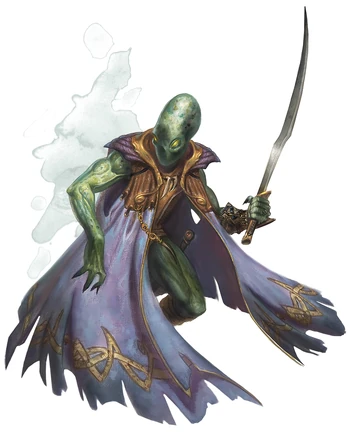
Yugoloth - Ultroloth
- 5.5E/5E: Medium Fiend - Yugoloth; Neutral Evil; CR 13
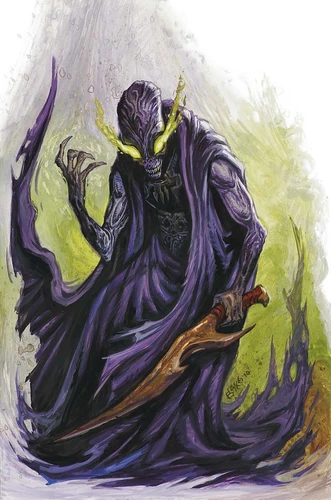
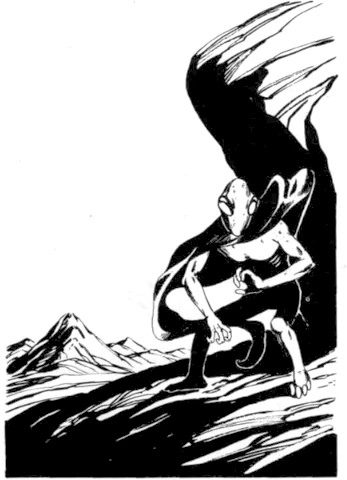
The bosses of the Yugoloths are the Ultroloths, and they perhaps have the most unique design. The Ultroloths resemble tall, monstrous humanoids with oblong 'gray alien' style heads, no mouths, and monstrous claws. They look unique among D&D's other fiends, which is what makes them be particularly cool in my book. Ultroloths are the commanders of the Yugoloth armies, and even the mysterious MIA General of Gehenna is a particularly powerful Ultroloth. The whole idea of an Ultroloth is that they are massive schemers, always at each other's throats whenever they aren't participating in the Blood War. They are happy to be crime bosses, commanders of massive mercenary organizations, and stay in the background while their minions do their work. It's a bit... it's honestly a bit basic and just a bit of a rewrite of the general Yugoloth writeup.
5.5E gives them a bit more of a flair by making them also massive, cunning conspirators and manipulators. 5.5E and Mordenkainen's Tome of Foes both make the division between the 'simple mercenary' weaker beings like Mezzoloths and Nycaloths versus the treacherous, long-game schemes of the Arcanaloths and Ultroloths a bit more distinct. Ultroloths are noted in 5.5E to seek to hoard power and are happy to coerce and manipulate events to gain more allies, achieving plots that span even multiple planes. We get a table of schemes that aren't really meant to be the final endgame for an Ultroloth. We've got plans that are presented in the original 5E, like provoking hostilities between two immortal armies and selling weapons/forces to both sides; or destabilizing nations... but other fun conspiracy plots (which could tie to each other) would include 'convince cultists that their god has forsaken them', 'incite a calamity to hold a world hostage' or 'steal an invention and slay everyone who knows of it'.


The idea of the Yugoloths all being mercenaries that are slowly, insidiously working towards the Ultroloths' mysterious, hyper-complex plans feels a lot more unique, a lot more interesting instead of their original 5E characterization which just paints them as more disorganized, more assholish devils. At the end of the day I do still feel like they could've done a lot more to make the Yugoloths in general a lot more exciting without feeling too derivative of their two more prolofic cousins.
The Ultroloth has a lot of the powers that its lesser brethren has, also being a powerful spellcaster like the Arcanaloth. The Ultroloth's prominent eyes (which glows creepily in its 3E and 4E incarnations) sparkle with sinister light that allows them to charm anyone that makes eye contact with it. They are given a fancy magical chained whip in 5.5E, and a nice selection of spells both destructive (Fireball, mostly) and self-preserving (Dimension Door).
Again, I am a fan of the Yugoloths' flavour, particularly with their expended 5E lore in Mordenkainen's Tome of Foes that highlight a lot of their roles as these strange independent mercenaries that are subtly manipulating the tides of the eternal Blood War between the Demons and Devils. It's just that a combination of their above-table obscurity, lack of focus and lack of thematic/visual cohesion that makes them regrettably a fair bit less memorable than their other cousins.
____________________________________________________


Zombie
- 5.5E/5E: Medium Undead; Neutral Evil; CR 1/4 (Zombie)
- 5.5E/5E: Medium Undead; Neutral Evil; CR 2 (Ogre Zombie)
- 5.5E/5E: Large Undead; Neutral Evil; CR 5 (Beholder Zombie)
And so, we end our regular Monster Manual coverage with the humble 'zombie'. We've covered other forms of undead throughout the Monster Manual, from the terrifyingly sentient Liches, Death Knights and Mummy Lords; to the incorporeal Specters, Wraiths and Ghosts; to the vengeful Revenants, the animalistic Ghouls and the malicious Wights; to the humble Skeleton... but alongside the Skeletons, the poster child for the shambling undead hordes is the humble Zombie.
Thanks to Zombie movies (and the ease of makeup transforming actors into 'Zombies' instead of the work needed to puppeteer skeletons), the trope of a Zombie horde of shambling, reanimated fresh corpses has spawned a whole new genre of fiction. And it translates quite well to fantasy, with Zombies being some of the weakest undead enemies you can fight. Zombies are often times just raised as an after-effect from a stronger undead creature's "aura", and the basic CR 1/4 Zombie is just a simple creature that deals damage with the special ability being 'undead fortitude'... sometimes, a Zombie drops to 1 hit point instead of dying. Not particularly special, and unlike a lot of other fiction, the Zombie does not spread a disease that turns other beings into more Zombies upon a single bite. Or at least, the basic Zombie doesn't... Wights are the ones that do that! Your DM can very easily homebrew stronger variants of Zombies that do have the plague trope (and the 'desire to eat brains' trope as well). But that's besides the point – as presented in the Monster Manual, Zombies are just there to be slain. The horde is a threat to the villagers they are going to descend to, not to the little army of adventurers with magical spells and plate armour.

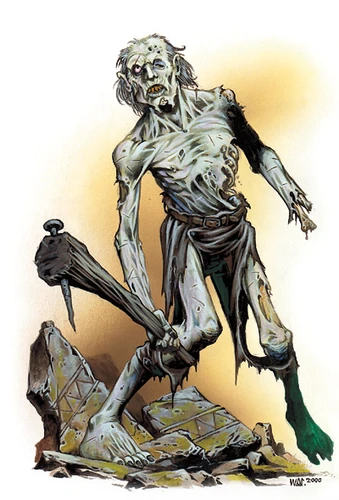

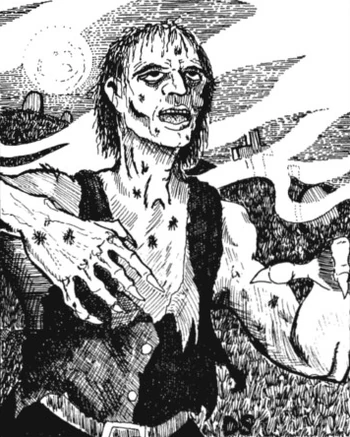
Zombies shamble about, and bereft of orders, Zombies are simply driven by simple 'automatic' instinct of attacking anything living near it. Even when following orders, they are too dumb and take the most direct route, even if it leads them to falling into traps or rivers or stomp over their own allies. They can swing around weapons if it's in their hand when they rise from the graveyards or battlefields, but they won't go out of their way to pick up weaponry. They otherwise just stand and mill about. More importantly, in addition to looking gross and demoralizing enemy troops, anyone that is raised by necromancers or sentient undead as Zombies can't be brought back to life easily.

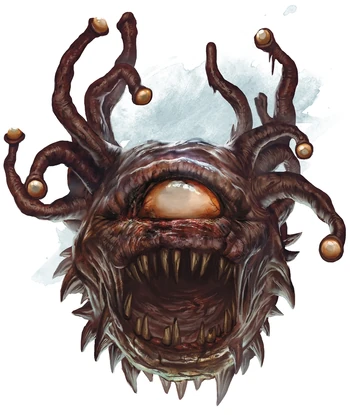


In addition to the basic humanoid Zombie, 5E's Monster Manual gives us some additional stat blocks for the Ogre Zombie and the Beholder Zombie. Technically, any reanimated corpse can just become a zombie; with other adventures showing off a Girallon and a Tyrannosaurus Rex zombie. For the most part, these Zombies are just there for flavour, showing that necromancers can just bring back any sufficiently non-decayed corpse as a mindless, shambling meat-stick of a minion... but sometimes, like a Beholder Zombie, their magical nature persists in a weaker version of the innate magic that a Beholder has.
Again, the Zombie isn't meant to be particularly threatening in-game, especially above level 1 or 2. Alongside the Skeleton, they are just there to overwhelm with numbers, or to threaten non-combatants. The zombie 'template' does allow creative DM's to continually show off new 'flavours' of zombies in an undead-themed campaign, though, which I appreciate a lot!

No comments:
Post a Comment