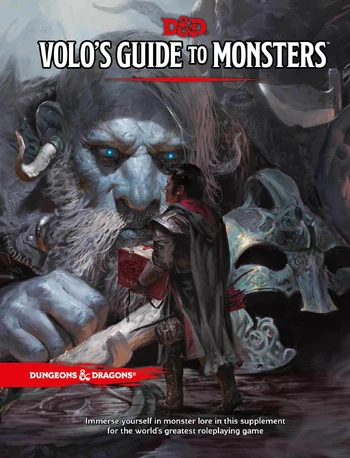

While we didn't really cover many of the 'spotlight' monsters in Volo's this time around -- we will in an appendix that I'll do after Mordenkainen's -- I still really loved the amount of content we got in Volo's in describing the society of the nine creatures they decided to highlight. I'm perhaps not the biggest fan of the Orc segment (which is well-written but very specific to the Forgotten Realm pantheon and roles based on the gods) and the Gnolls are quite samey (admittedly, it's hard to have a lot of depth about a race whose whole point is ultraviolence).
But I really liked getting into the depths of a Beholder's twisted view on reality; the alien life cycle of the psionic Mind Flayers; the ordning of the Giants; chaos regimented into order with the Goblinoid hordes; the twisted deals and extremely personal torment that Hags inflict; the wacky little Kobolds; and the ancient and strange flesh-warping cult of the Yuan-ti. A lot of them expand on what was there in the original Monster Manual in a way that these beings feel so much more interesting.
I have gone a couple of times in noting that Volo's really elevated Hags into being one of my favourite monsters, and gave a fair amount of depth to my least favourite monster subgroup: the Giants. I'm already somewhat aware of Yuan-ti, Beholder and Mind Flayer lore from previous editions, but it's always nice to see a description of them. This is, again, where the 2024 Monster Manual really failed in my opinion, where so much description and flavour text is pared down to almost nothing. Sure, those might be 'iconic' monsters from D&D history, but these flavour text is really what differentiates just another encounter and jumble of statblocks to memorable adversaries with a story, culture and behaviour that make you lose yourself in the game world.
- Click here for the previous part.
- Click here for the next part.
- Click here for the index.
[Originally published in April 2020, revised in March 2026]
____________________________________________________
Spawn of Kyuss
- 5.5E/5E: Medium Undead; Chaotic Evil; CR 5
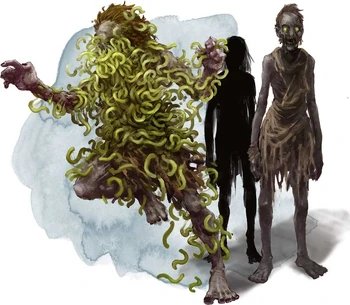
The 'Worm that Walks' Kyuss is a personal favourite of mine, an 'Elder Evil' that is a necromancer-turned-demigod that represents a very unique breed of undeath... that of decay, incorporation, and lots and lots of worms. Kyuss wants to bring to fruition the 'Age of Worms', a writhing mass of decay and rot that would remind the Warhammer 40,000 fans among us of Nurgle. But the most important aspect of Kyuss that's relevant for this monster here is that he doesn't just turn his victims (and minions) into undead, he turns them into a mass of worms wearing a zombie for a husk. This little flair really makes Kyuss a lot more distinctive than just another regular undead apocalypse.
Kyuss himself hasn't really debuted properly in 5th Edition as far as I know, but I am very delighted and surprised that the Spawn of Kyuss (which debuted in 1E's Fiend Folio!) makes its appearance quite early in 5E's release. The statblock in Volo's Guide to Monsters doesn't really give us too much detail on who Kyuss is, which is just nice and well -- this statblock could be utilized without the Kyuss labels as just a particularly nasty mutation of undead, something that I felt was always missing among the lower-tier undead minions.
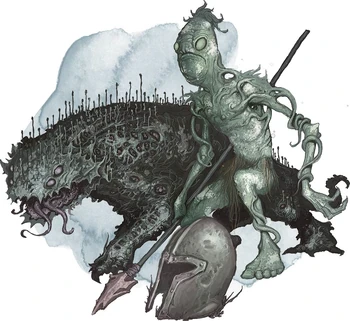
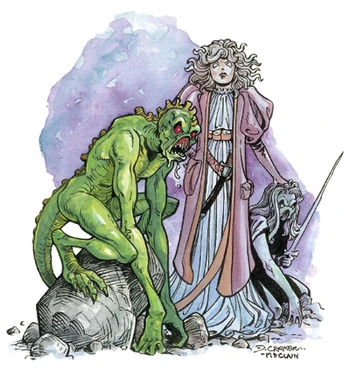
As shown in that picture. Most Spawns of Kyuss look just like a regular zombie (or wight, or revenant, or ghoul, or any other corporeal lesser undead...) with maybe just a bit more worms crawling around its mouth and eyes. Which... considering that zombies are corpses, it's probably the rule rather than the exception when you find a zombie with maggots and worms on it.

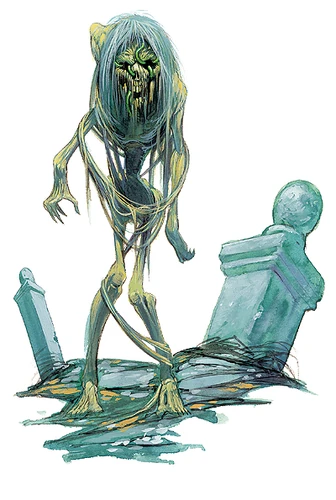

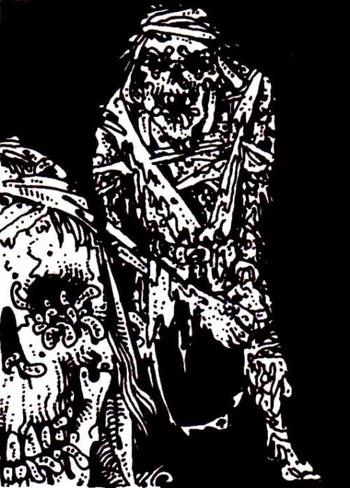
However, get close to a Spawn of Kyuss, and the Spawn erupts in the manner of the far more epic being in the foreground, with worms bursting out of the zombie's flesh. These 'Burrowing Worms' are counted as undead, and similar to the Rot Grubs, will burrow into the flesh of their prey and kill their victims from the inside, burrowing up their brain. Like the 'plague' version of the zombie trope, those killed by a Spawn of Kyuss worm will themselves turn into a Spawn of Kyuss.I do really like this trope, though, and anyone that has read through my Resident Evil reviews will know that I am such a huge fan of the parasitic zombie trope, particularly in Resident Evil 4. The Spawn of Kyuss is that, but with a mass of worms that animates zombies.
Spawns of Kyuss are particularly resistant, too, and unless they are hurt with radiant, acid or fire, they will keep regenerating their health -- flavoured as the worms reproducing and replicating within the body. Interestingly, due to the more supernatural nature of this particular type of parasitic worm, there are a lot more ways that a cleric can purge this disease or curse from a victim's body... and casting a spell that cures disease or removes curse will instantly purge all the worms within the Spawn of Kyuss, freeing the trapped soul within. Overall, I always found that this is a nice way of ratcheting up the horror without going down the route of 'more gore'.
____________________________________________________
Tanarukk
- 5.5E/5E: Medium Fiend - Demon; Chaotic Evil; CR 5
The Orcs are one of the races that get a bunch of special new statblocks, which I'm going to cover in a separate appendix section for 'job' variants. Interestingly, all the other Orc statblocks do not get reprinted in Monsters of the Multiverse, probably because of the soft-reboot of Orcs in 5.5E... but also those statblocks were very tied to the Orcish pantheon of the Forgotten Realms and I've never found them particularly memorable.
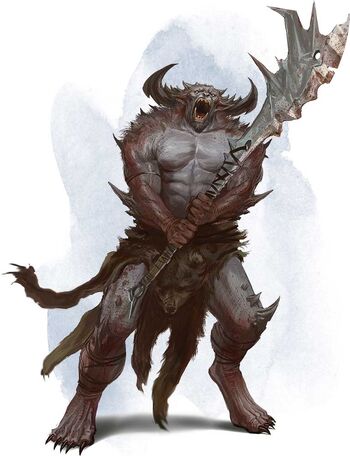
The Orc Tanarukk, however, makes it into both editions, and it's a pretty neat artwork, showing a monstrous demonic orc with extra spikes and horns. Sometimes, Orcs end up worshipping demons (which is a bit more Warcraft-y) and this worship of their demonic masters is rewarded in the creation of Tanarukks. In Volo's, this is only done to unborn babies of the tribe that are transformed upon birth, and in Multiverse, any 'subject' can be morphed into a Tanarukk. Again, a bit of a difference where in Volo's the creation of Tanarukks is associated with the demon prince Baphomet (hence the minotaur horns, I suppose) while Multiverse also adds the Orcs' evil deity Gruumsh as a potential source of Tanarukk powers. Volo's also notes that Tanarukks that breed will always create Tanarukks, leading most Orc tribes to hunt down and slay these demons.

Regardless of what the origins are, Tanarukks are volatile beings. They are fearsome on the battlefield, but they become a threat to their allies off the battlefield and are often kept imprisoned to keep their urges in check. Tanarukks that break free try to take over by force and turn the tribe into one of mindless rage and conquest. The idea, I suppose, is that Tanarukks are 'super-orcs' that are far more violent, bringing them to bear to their traditional 'always chaotic evil' roots compared to the more intelligent spin that most fantasy media portrays them as.
The statblock and artwork of a demon-corrupted Orc is quite cool and a nice trope to represent, but the lore about the Tanarukk bloodlines and heritages is admittedly a bit off due to the simple fact that it is being introduced to a world where Tieflings exist, let alone other types of 'part-demon' lineages like Cambions. It's just a bit odd, and this is a case where I almost wished that they gave us more explanation as to why some 'fiend-corrupted' beings and boodlines lose their minds and turn into Tanarukks, while others would theoretically become just a regular Tiefling.
____________________________________________________

Tlincalli
- 5.5E/5E: Large Monstrosity; Neutral Evil (5E), Neutral (5.5E); CR 5
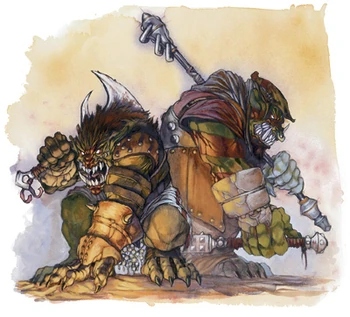
The Tlincalli Scorpionfolk debuted in 2E's Monstrous Manual as the 'Manscorpion' (which I am currently also going through!) and I am very happy to see them updated with such a gorgeous artwork here in Volo's Guide to Monsters. The concept is quite simple, a scorpion-centaur. And the design of the scorpion half is just pretty cool for the simple reason that scorpions are just that visually cool. But the upper body? The Tlincalli's humanoid half is segmented like a knight's body, and its head is a mixture of a helmet shape and buggy mandibles and beady-eyes. That is such a cool visual overall even without counting the Tlincalli's badass chunky sword and spiked flail. A special shout-out goes to 2E Tlincalli, which has a flayed man for the human half, and a vertebra for the scorpion tail. It's not common for 2E to have the grislier design!
Tlincallis in 5E are described as being austere nomads that live, of course, in the desert. They wait out the day's heat and the night's cold, burying themselves in sand or lurking in caves. When the temperature is ideal at dawn and dusk, they emerge to hunt. They settle only as long as prey is plenty, otherwise they move on to a different hunting grounds, returning to settling locations only when it is time for them to lay eggs, which they bury in the ground. Tlincalli are carnivorous, as you might imagine from being giant scorpion-men and being hunters, but they also take the time to poison their prey and drag them towards their nests when they have new mouths to feed.


We don't really learn too much about Tlincalli culture beyond that, with 5E only noting that they do not build and merely scavenge what they can find, knowing enough to melt down metal to create crude weapons and tools. They are also prideful hunters, and when they find a much more powerful hunter (such as a blue dragon... or your adventuring party), the Tlincalli will have to consider whether to fight, move on or become subservient.
The Tlincalli is most certainly very cool as a setpiece, again, thanks to the badass artwork and concept, but as a monster species the lore we get is honestly quite a simple combination of 'beast that brings prey to their young' and 'generic primitive hunter-gatherer tribe' mushed together, and both tropes appear a lot in D&D. It is a bit sad that we didn't get just a bit more about their behaviour and culture.
____________________________________________________

Trapper
- 5.5E/5E: Large Monstrosity; Unaligned; CR 3
Infamous in the original 1st Edition Monster Manual are the 'Trapper' and 'Lurker Above', both beings that are essentially just there to be 'ha ha, gotcha' monsters that are honestly just part of the environment that attacks you. There are quite a lot of these 'parts of the dungeon that attack you' monsters, with their most famous member being the Mimic, while the Cloaker has since gotten more respect after its manta-ray-esque 3E redesign. Rather unnoticed, the rather cool Darkmantle is essentially a rebooted Lurker.
And yes, there is a certain silliness of the old artwork showing parts of the architecture sprouting goofy eyeballs and enveloping knights. But I do enjoy that after so many editions of being absent, the Trapper makes a quiet return in Volo's Guide to Monsters. Its statblock is quite simple, essentially still retaining its lore as 'it hides, then it tries to smother its prey' and I am frankly surprised that they released the Trapper so early in 5E's lifespan.

Equally surprised is the fact that they didn't try to make the Trapper connected to the Mimic, Darkmantle or Cloaker at all, unlike the lore-merging they did for the Roper and Piercer. The Trapper is still described as a 'manta-like creature' that can only alter the colour and texture of its outward-facing side to blend in with its surroundings, while its inwards-facing side clings onto ceilings and walls. They can only transform to stone, earth or wood, however, and cannot mimic, say, snow or grass. They can creep around surfaces, essentially making the 5E Trapper both the 'Lurker' and 'Trapper' monsters rolled into one.
Trappers apparently need to feed once a week, otherwise it enters into a state of hibernation that's only awakened when a prey draws near. I suppose they don't have to always feed on adventurers, but on any local dungeon creature like the odd Grick or Rust Monster that stumbles upon its corridor. Like oozes, Trappers dissolve absorbs the fleshy parts of their victims but leaves bones and treasure behind, and they are intelligent enough to either use them as bait or to cover them up with their bodies.
It is remarkably faithful to the original concept, which I can't fault since I am a champion of both the goofier monsters as much as I like the grislier ones. However I must confess that I have a bit of disappointment that they didn't do more to it in a similar manner of what I have with the Tanarukks above... the setting already has Mimics, Cloakers, Darkmantles and whatnot, so the Trappre feels rather redundant, sadly.
____________________________________________________
Vargouille
- 5.5E/5E: Tiny Fiend; Chaotic Evil; CR 1
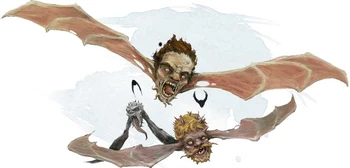
Here comes the Vargouille, one of the more disturbing creatures thanks to their insane reproductive methodologies. Vargouilles bring to mind myths such as the Balinese Leyak or the Malaysian Penanggalan, but as far as I can tell the term 'Vargouille' is original to the earliest days of Dungeons & Dragons. Vargouilles are fiends that resemble disembodied heads with massive bat-like wings instead of ears. Which in itself is already spooky, if a bit goofy. They may have some extra horns or tiny tentacles as well, but it is still ultimately a flying head.
However, each Vargouille carries what is essentially a fiendish disease. A Vargouille itself isn't a particularly powerful being other than being annoying as it flies around your party, and they emit an awful paralyzing shriek. Not an uncommon trait among monsters. However, they reproduce with an accursed kiss, inflicting their curse into their victim. If the curse runs its course, the victim slowly loses their Charisma score (which is how the game depicts a hideous transformation as they grow fiendish aspects like horns or tentacles) until they die... at which point their head twists off, grows wings and becomes a new Vargouille. As Volo's describes, this happens in a 'shower of blood', at which point the newborn Vargouille eagerly laps up the fluids of its past body.
I think that's the creepy little twist (heh, twist) that makes the Vargouille so memorable. The design itself is already distinctive, but the fact that they reproduce by going around, kissing people, and causing their heads to pop off and fly away? That's memorable.
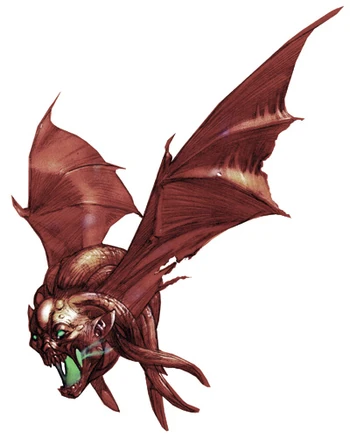

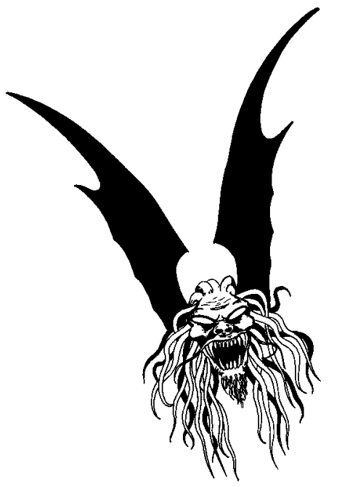
Also, in a fun twist, this Vargouille curse is delayed by sunlight, and of course could be removed by a cleric's spell. I would like to note that older editions (particularly 3E) try to play up the monstrous and grotesque transformations, and those are really cool artwork... but I find the Vargouille to be a lot more unsettling when they are just slightly different heads of their victims flying around.
Lastly, Vargouilles are noted to be beings that are essentially just pests in their home in the Lower Planes, but end up becoming an invasive, uncontrollable species when they cross planes into the Material Plane. The Vargouille in planes like Carceri or the Abyss are so beneath notice and are treated like mosquitoes or flies, since they do even the weakest fiend (like a Dretch) no harm. However, their weakness means that they can latch on to a fiendish summoning, described to arrive 'like a tick' on a much more powerful fiend, which I thought is such a clever and fun twist for this little flying head.
Overall, I love them. I love the presentation, and I love the juxtaposition of horror and campiness in the same breath, and they just present such a fun plot hook, I feel, secondary to a larger fiend or cult-related campaign.
____________________________________________________

Vegepygmy / Moldfolk
- 5.5E/5E: Small Plant; Neutral; CR 1/4 (Vegepygmy), 2 (Chief)
- 5.5E/5E: Medium Plant; Neutral; CR 1 (Thorny)
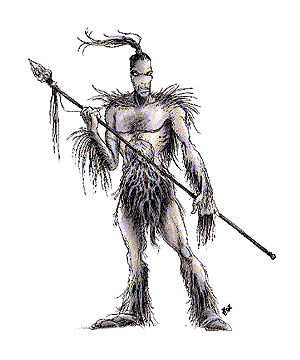
The Vegepygmies are fungal creatures introduced in Adventure to the Barrier Peaks, the same UFO-crash-landing classic adventure that also gave us the Froghemoth. These guys would make their way into 2E's Monstrous Manual and other bestiaries... and while I like the design of the Vegepygmy in 5E (where the head looks more like a wacky turnip), I would like to acknowledge the very... unfortunately stereotypical design of the original designs, let alone the name, with 'pygmy' being considered rather derogatory. I have seen some D&D tables call them by their 2E name (Mold Men), or my personal favourite, Vegemites, which recalls the infamous Australian spread.
Volo's also calls them Moldfolk or Moldies, which is the term that I'll use for the rest of this review. The Moldfolk are fungus creatures that live in simple tribal units, inhabiting locations that are warm and wet where fungi grow. They coexist well with other fungal and plant creatures such as Myconids. Moldfolk can consume nutrients from the soil but prefer to eat flesh. Despite their humanoid shapes, Moldfolk can't speak, only make hissing noises by forcing air out of their 'mouth'. They can sometimes scavenge and use tools in mimicry of humanoids.
The Moldfolk are created from a particular type of mold called Russet Mold, which is reddish-brown in colour and can spread even over metal. If you can't tell, this Russet Mold is the thing that came from the flying saucer from Barrier Peaks. Far more dangerous in older editions, those that come into contact with Russet Mold gets infected continually as the mold grows in their body, and Moldfolk (or Thornies) will arise from their corpse. Russet Mold, uniquely, is difficult to destroy and you need either acid, necrotic... or just plain sunlight. Moldfolk that grow older, the 'Chiefs' of their tribe develop spore clusters that they can utilize to poison foes with the Russet Mold infection.


The very cool four-legged beast behind the Moldfolk is a Thorny, which arises when the Russet Mold infects a quadrupedal beast like a hound or a horse, and I really like the depiction of it in 5E with a wide flat mouth, multiple tongues and at least two pairs of eyes. Really love the mass of tiny stalks across its dorsal section as well.
The Moldfolk's origins and ties to strange UFO's is implied very much by Volo's noting that the origins of the Russet Mold is often associated with strange metal cylinders or meteorite impacts. 5E's Quests from the Infinite Staircase would remake the Barrier Peaks adventure, giving us several additional Moldfolk variations, including a weaker 'Scavenger' and a more powerful 'Moldmaker' that manipulates waves of mold.
Anyway, despite that messy bit of disclaimer, I do like the concept of the Moldfolk a lot, this strange, sci-fi infectious mold from outer space that somehow creates strange fungal mockeries of humanoids and beasts as they are slain.
____________________________________________________
Wood Woad
- 5.5E/5E: Medium Plant; Lawful Neutral; CR 5
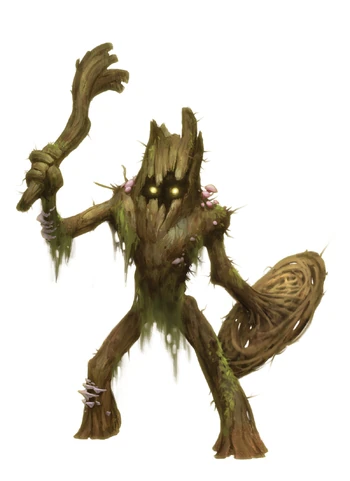
A relatively newer monster that debuted in 3E, the Wood Woad in 5E fills in the niche as a smaller 'tree man' that defends nature with a bit more sense of purpose than something like an Awakened Tree or a Shambling Mound. The Wood Woad is a pretty cute design, too, a tree in the rough shape of a man, with its right hand holding a club, its left hand actually growing into a shield, and the best feature being two glowing eyes staring out of the darkness in the hole in its trunk. A very cute little design, and a stark contrast to the 'man made up of wood' designs of the previous two editions.
Wood Woads are plants that carry the souls of people who gave up their lives to become an eternal guardian of a natural location. The ritual is a secret passed down druid circles, and is noted to not necessarily be an act of evil if the victim, or volunteer, is willing. Their heart is removed; a seed implanted into the heart; and the heart embedded into a tree, with the body buried in the roots of the tree. This ritual will cause a Wood Woad to grow out of the roots in its humanoid form, ready to do whatever the ritual directs it to do.


It's an interesting take on the 'deathless duty', and I imagine that druids that do this would be those that might approach the end of their lives but see the need or desire to defend their glades. The Wood Woads are noted to trade in their sentiment for supernatural strength, and spend most of their time rooted into the ground like a good little tree. They are undying warriors of duty, and are completely immortal. Sometimes, the Wood Woad outlives their original purpose, at which point they roam to find a new place (usually a place strong with natural or fey influences) to watch over.
From an above-table standpoint, Wood Woads, again, fill in the role of thematic, plant-looking warriors as guardians or servitors of Dryads and Treants. The statblocks are simple fighters with some extra regenerative and tree-stride abilities, nothing particularly special for such an elaborate in-universe ritual. But I do like the idea of these long-lived communities of druids being so in tune with nature that they are willing to sacrifice their immortal lives as tree-people that guard their forests.
____________________________________________________
Xvart
- 5.5E/5E: Small Humanoid (5E), Monstrosity (5.5E); Chaotic Evil; CR 1/8 (Xvart), 1 (Warlock of Raxivort)
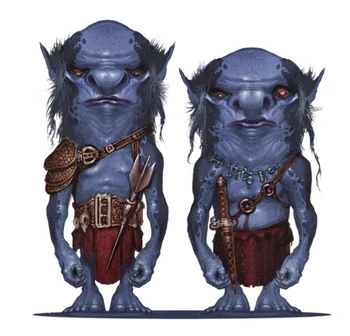
I continually forget that the Xvarts exist, and... for the life of me, I am not sure what the real 'fantasy' of this species is supposed to be. They get more than a whole page's worth of text to them, which is quite surprising. Debuting in the 1E Fiend Folio without much personality beyond 'underground slaver race', the 5E's take on the Xvart tries to combine a lot of the lore they've gotten over the ages. And... I just really don't find them particularly compelling.
As Volo's tell it, Xvarts are humanoids spawned by a cowardly demigod called Raxivort, and mimic their creator's appearance in being blue-skinned and orange-eyes. Raxivort used to serve the demon price Graz'zt as treasurer, but grew greedy and stole a bunch of powerful artifacts from Graz'zt, one of which is an artifact that allowed him to ascend to godhood... but briefly, before Graz'zt unleashed his vengeance, putting news of the powerful artifact in his possession. Raxivort then traveled across the Material Plane, creating the Xvarts in his wake. Xvarts look identical to their creator, and are essentially just dummies that foil any magic used to track the original Raxivort down, as any spell that targets Raxivort just points to the nearest Xvart. Xvarts themselves revere their creator, and everything that happens in their life is treated as an omen that they might have displeased Raxivort sometimes.
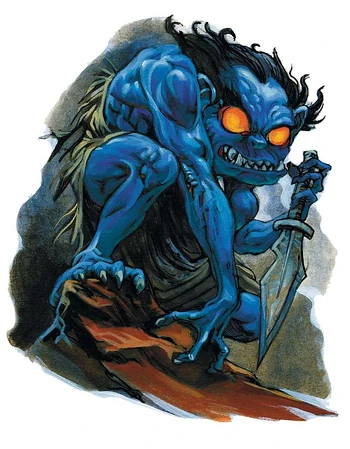

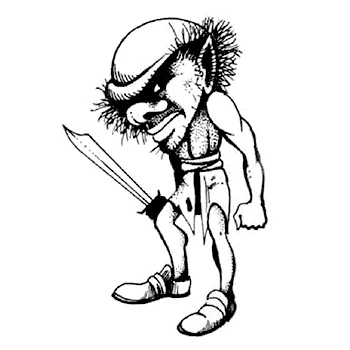
All of this is a large mouthful of lore that I've truncated quite a bit, but none of them really matter to the Xvarts because they themselves aren't all that interesting. Even being split from a god and meant as a decoy just means that... they can't reproduce, because they are all clones of the same deity. They are all greedy, they all know they are flawed, and because of this they end up having a gigantic inferiority complex against most other species.
The Xvart statblock is a relatively simple humanoid (later monstrosity) with the extra trait that helps them to kidnap people. Their leaders are 'Warlocks of Raxivort' with an assortment of spells, who somehow managed to attract the attention of their craven patron and have promised to give Raxivort more treasures. Raxivort is described to sometimes show up, take all their treasures and just teleport away, leaving nothing behind in compensation. Perhaps the only neat aspect of them as enemies is their 'Raxivort's Tongue' ability, which makes them able to communicate with vermin... or, well, bats and rats respectively.
Not a huge fan of them, and despite having a whole lot of lore, so much of it is specific to just Raxivort himself more than the Xvarts themselves. I do find the concept of a whole species that are spawned as clones of the same assholish guy to be a neat one, but they don't really do enough to make the Xvarts particularly memorable in my opinion.
Yeth Hound
- 5.5E/5E: Large Fey; Neutral Evil; CR 4
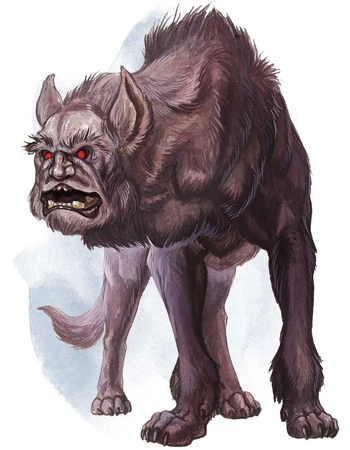
The Yeth Hound is based on the mythological creature of the same name from Devonshire folklore, also sometimes simply known as 'The Black Dog'. Debuting all the way back in 1st Edition, Yeth Hounds are reinterpreted in 5E as Fey, granted by evil, powerful Fey to individuals who please them. The Yeth Hound is another stat entry that feels made to function as a Hag minion.
Yeth Hounds are essentially evil versions of Blink Dogs in terms of flavour. Their appearance is a massive dog with a disturbingly human-like neck and head, glowing red eyes, a body that blends into the darkness, and an odour like smoke. It... it really could be weirder, honestly, especially after this book also features the Leucrotta as another quadrupedal beast with a human head.
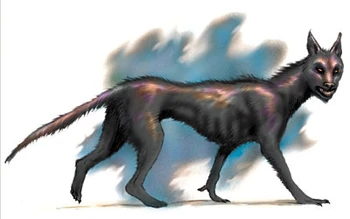

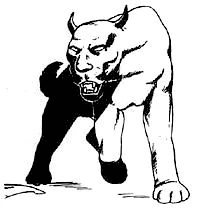
The Yeth Hound is notable in that they must have a master, to whom they are bonded. They can telepathically communicate with their masters from any distance, and behave like sinister hunting dogs. Yeth Hounds make a ghastly 'baleful bay' that can be heard all around, with an insane radius that instills fear in those around them. Yeth Hounds then delight in chasing and tormenting their prey, before going in for the kill. Their fey nature gives them immense durability, as any non-magical, non-silver weapon just passes through them harmlessly. However, the Yeth Hound can't stand sunlight and are repelled by it, with their fear of the sun being the one thing that they will disobey their master for. Yeth Hounds disappear away into the ethereal plane when the sun is up, only retrievable by their master once the sun is set.
To be honest, this is another one that I don't really feel particularly inspired by. Perhaps it's because it did come in a book that already features four other monstrous hounds and hyenas (the Shadow Mastiff, the Barghest, the Leucrotta, the Shoosuva), and I feel like they could have had a bit more to make them a bit creepier. They just feel like Fey versions of the Shadow Mastiff with some abilities swapped around, and I really wished that they had added a bit more to the 'Fey' part beyond being a reward to supplicants, which I feel is a missed opportunity.
____________________________________________________


Yuan-ti Malison Variants
- 5.5E/5E: Medium Monstrosity; Neutral Evil; CR 4 (Mind Whisperer), 4 (Nightmare Speaker), 5 (Pit Master)
We will close off Volo's Guide to Monsters with the Yuan-ti, which are given a lot of love in the book. In addition to a segment about lore and history, the Yuan-ti Pureblood is made available as a playable race. The Yuan-ti segment also adds a table of 'unusual abilities' you can give to the base Pureblood and Malison monster statblocks, which range from abilities like 'chameleon skin', 'shed skin', 'acid slime', 'snake antipathy' (i.e. fear), the ability to turn sticks into snakes, the ability to turn themselves into snakes, and the ability to turn enemies into snakes. Pretty fun stuff.
Not content on just a couple of extra actions, the monster segment gives us three more elite Malisons, each associated with a different snake god (Sseth, Dendar and Merrshaulk respectively). The Yuan-ti Mind Whisperer is shown as a particularly cool reptilian design with a lot of scales on his body, and are those... gills on his shoulders? Mind Whisperers use their spells to befuddle enemies, and are elusive manipulators. With spells like Detect Thoughts, Suggestion and Minor Illusion, the Mind Whisperer is noted to often be manipulators between multiple factions, and not just humanoid factions, but even their Yuan-ti allies. All the elite Malisons have a special move, and the Mind Whisperer can heal itself by slaying enemies.
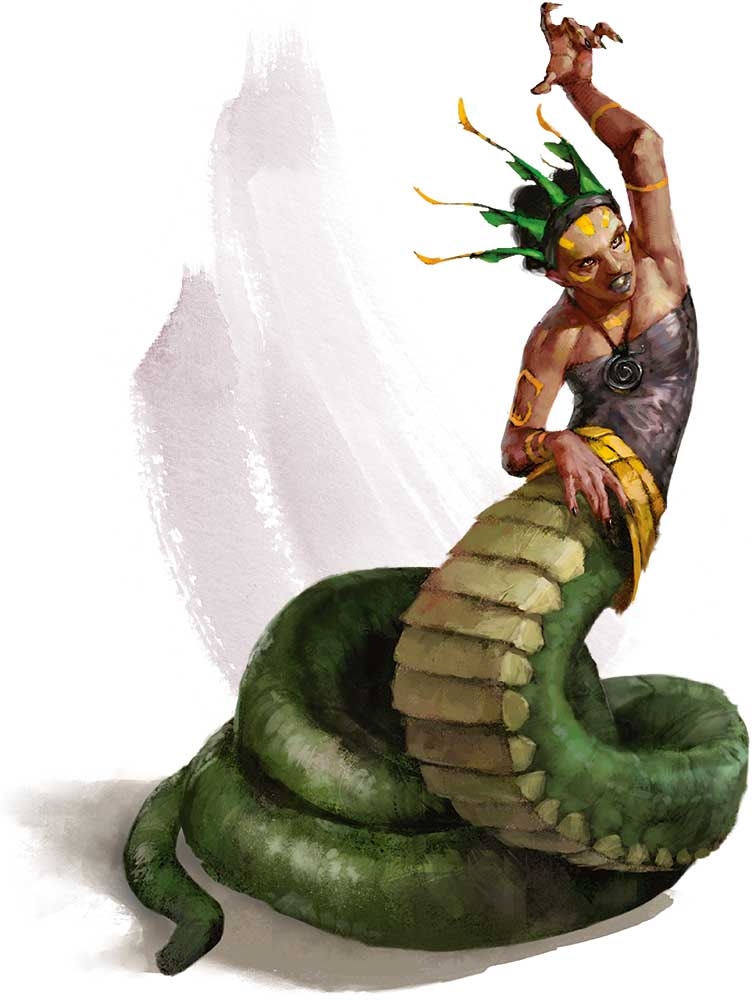
Nightmare Speakers, represented in art by the female Yuan-ti with a serpentine lower body, specialize in fear and nightmares. Their god gives them nightmares, which the Nightmare Speaker interprets as prophecies... and proceed to make these prophecies true by inflicting the nightmares on the world. Not how prophecies are normally defined, but these are crazy snake people. Nightmare Speakers have the ability to inflict fear and nightmares on their victims, and are noted to be particularly sadistic and often employ undead.
Pit Masters are a particularly cool take on the 'snakes for arms' Malison. Instead of their arms ending in snake heads, the Pit Master's two arms ends with a cluster of around a dozen snake tails each, functioning as snake-themed tentacles. I really like the artwork mixing in jewelry and scars into the design, too, making the Pit Master look quite cool. The Pit Masters are more traditionalist ones that are super-into sacrifices to their snake gods, and their special ability is to force their god's slumber onto their foes. This is reflected in their goals for the Yuan-ti people, where they prevent their allies from acting rashly and brashly.
____________________________________________________
Yuan-ti Broodguard
- 5.5E/5E: Medium Monstrosity; Neutral Evil; CR 2
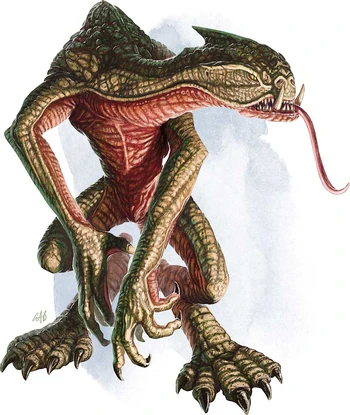
Another 'variant' of Yuan-ti is the Broodguard, which you might note doesn't really look like a proper snake-person. The Broodguard looks more like a hunchbacked Lizardfolk, with massive claws on its arms and legs, and only the long neck and tail marks it as maybe being serpentine. This disjointed visual identity is because the Broodguard stands apart from the primary Yuan-ti variants in that the Broodguards are actually humanoids that are transformed into mockeries of themselves, as their body and mind are warped by hideous processes that turn them into these reptilian beings.
The Yuan-ti forces their captives to ingest their toxic brew that turns them slowly over the next couple of days into these beings. While a Broodguard-to-be can be restored if a cleric gets to them in time, a fully-transformed Broodguard can only be restored by a Wish spell. Also known as 'Histachii' or egg-watchers, the Broodguard is reduced to being a slave race that mindlessly obeys the Yuan-ti and instinctively attacks any non-reptilians.
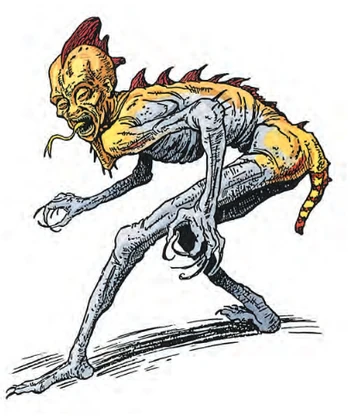
The Broodguard themselves really only serve as a simple brutish minion with simple attacks. There are enough Yuan-ti variants that mechanically, the Broodguard isn't really bringing anything new to the table, but it does add a layer of horror for both the adventurers and the players. I actually like that the Broodguard looks so different from the 'snake cult' vibe of the rest of the Yuan-ti. Considering the Yuan-ti regard the snake form as perfection, it seems like they're deliberately turning the slave race into something that is not 'snakey' at all because they want to make them different from what they view to be perfection.
____________________________________________________
Yuan-ti Anathema
- 5.5E/5E: Huge Monstrosity; Neutral Evil; CR 12
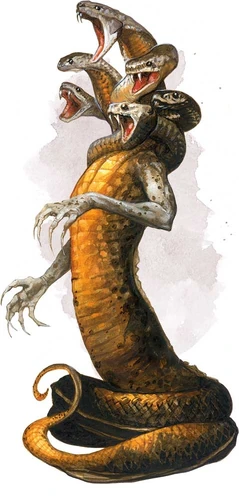
So what is perfection, then? In the Monster Manual, the strongest Yuan-ti variant is the Abomination, which is essentially a giant snake with the only humanoid parts being the arms and the rough shape of a torso. Well, 3E introduces the Anathema, which is like a super Abomination. In 3E and 5E, the Anathema is essentially even more snakes on an Abomination, having the same body layout but with five extra snake heads. 4th Edition's Anathema remains my favourite Yuan-ti art, however, where its entire body and arms are all made up of writhing, undulating snakes.
A Yuan-ti Abomination's quest for godhood often has it perform a ritual that makes it turn into a Yuan-ti Anathema, which requires the sacrifice of hundreds of snakes and the blood of many of its enemies. The transformation is quick, painful... and despite being the most snakey of the snake-people, paradoxically the other Yuan-ti are loathe to see one of their own turn into an Anathema, since Anathemas brutally subjugate the lesser Yuan-ti. Really, Yuan-ti? The whole point of becoming, embodying the serpent is to be as evil and emotionless as they are portrayed to be! Although I suppose the other Yuan-ti are probably jealous that they don't get to be the Anathema. Anathemas don't age and are immortal, giving them ample time to spread their influence over multiple Yuan-ti cities.
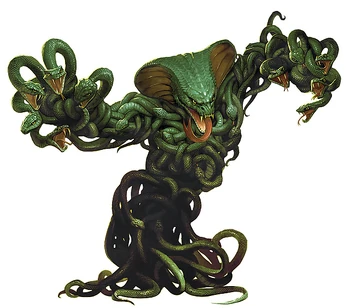
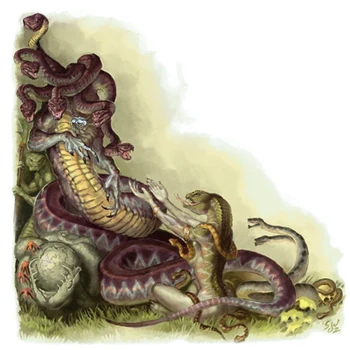
Anathemas consider themselves a demigod that's just on the cusp of divinity, of becoming a proper snake god, which is why they are so brutal and demand so much obedience and sacrifices from their minions. They want more slaves, more sacrifices, more glory, more riches... more resources for the Anathema to achieve divinity. Not all Yuan-ti like the Anathema, but those that are wrapped up in their bosses' divine fervour tend to be extremely fanatical and way more aggressive.
Standing at a respectable CR 12, the Anathema does everything that an Abomination can do, and then some. Its six heads allows it advantage on resisting statuses like fear, blindness or charm. It has an aura that causes ophidiophobia on those around them, giving them irrational fear of snakes. It has a set of more powerful spells, including Darkness, Suggestion, Divine Word and Polymorph. Overall, the extra heads and the god complex does make the Anathema a fun final boss for a Yuan-ti themed dungeon. I feel like the Monster Manual gives us quite a nice batch of varieties, but with how the Yuan-ti flavour hinges so much on their snake grafting and transformation, I love that we get a lot more variations added as an expansion pack.
____________________________________________________
And with this big snek, I bring to a close my revision of Volo's Guide to Monsters, updated to their Monsters of the Multiverse statblocks as part of the switch to 5.5E. I am reasonably happy with the speed that I did this revision, and I always find it a good time to revisit Volo's Guide to Monsters, still one of my favourite books from 5th Edition. As I've mentioned several times throughout this review run, most of the 'job' monster variants will be covered in a Monsters of the Multiverse appendix alongside similar statblocks from Mordenkainen's Tome of Foes, and the removal of those from the monster pool really did galvanize me in blasting through these, since every monster entry ended up being a pleasure to read and talk about.

No comments:
Post a Comment