

Eberron!
Truthfully, writing about Eberron has always been a bit intimidating to me. There is so much written about Eberron, and I really enjoyed what I have found out about it as I've stayed in this fandom. But I haven't really gotten a proper full read of the setting books, and my previous discussion of Eberron back in 2018 dismissed it as "steampunk/clockpunk D&D". Which isn't wrong entirely, because Warforged and steam trains are one of the most iconic aspects of the setting... but there's a bit more to Eberron.
Debuting in 3.5E (and continually supported by its creator's Keith Baker's very active blog), Eberron won a setting contest and has been built upon since its debut. And the steampunk/clockpunk aspects are part of it for sure, but one thing that is important is that in Eberron, there is a 'industrial revolution' vibe about how magic is essentially industrialized into society. It also happens after a massive "Last War", with it influencing much of the world's political tension and instability.
Often compared to the newer Final Fantasy games, Eberron also made it commonplace for magic to be utilized all over the world -- something that interestingly was a novelty at the time but feels something that's the rule rather than the exception in a lot of newer D&D settings or D&D-derived content. That's cool!
A lot of the themes around Eberron's narratives revolve equally around pulp adventure with train heists and ancient ruin delves; but also a lot of political intrigue, drama and noir-esque plotlines. In addition to nations and kingdoms, there are also cross-national organizations with differing priorities. The way Eberron's factions is described to me is that every single faction is designed to subvert being purely good or evil, which does a great job at making the setting particularly rich.
We are focusing on the monster stats here as they are presented in Eberron: Rising from the Last War. Eberron and the artificer class did get an update for 5.5E but that doesn't have any new monsters, so we don't quite have any content from that here.
- Click here for the previous part.
- Click here for the next part.
- Click here for the index.
[Originally reviewed in November 2020; rewritten in November 2026]
___________________________________________________


Changeling

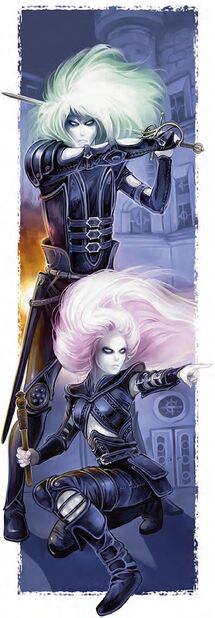

- Medium Humanoid (Changeling, Shapeshifter); Any Alignment; CR 1/2
- Debut: Eberron: Rising from the Last War (2019)
Having these playable races also have an associated monster statblock does help to ‘justify’ me talking about them separately from the big ‘5E playable races’ article that I keep saying I will do… someday. Changelings are just plain cool, though, aren’t they? Where a lot of other sourcebooks really shy away from letting players play the cool races (remember, ‘half-elf’ and ‘half-orc’ are staple because back in the day, you can’t just play the full elf and orc) Eberron decided to look at the popular fantasies and think about how you can play more balanced version of these monsters, and ones that not just make sense mechanically but also narratively.
And the first of these are the Changelings, who are playable Doppelgangers, essentially. The backstory of all these peoples in the plane of Eberron is tied to a bit of history involving the progenitor of the Changelings making a deal with a powerful being, but it’s also simple enough that you can adapt a Changeling into any other edition as ‘just a fey’ or ‘descended from doppelgangers/some other fey’. I like that the ‘true form’ of the Changelings are chalky-white beings with white hair and goth eyeliner. There’s just something really cool about that look as the ‘true form’, evocative but distinct from the Doppelgangers.
And it really is a cool fantasy! As a Changeling, regardless of a Changeling ‘enemy’ or a playable character, they can spend an action to transform and look like any humanoid that the player has seen. It’s something that many spellcasters would be able to do with spells like ‘Disguise Self’ and ‘Minor Illusion’ anyway, and codifying it into a species trait is a fun one. And more than any other race, I do feel like Changelings really do apply to the drama kid in me — D&D at the end of the day is a game about putting on masks and pretending to be someone else, and that’s what Changelings do.
In the lore, Changelings often rely on a ‘few established personas’, which really is practical but also ties to something similar to their Doppelganger ancestors, where they often fall in love with certain identities and the backstories they have crafted or even lived through for each ‘mask’. Eberron describes communities of Changelings, and some communities will even share multiple personas between its members. There are also a lot of suggested plot options that just really sound like fun characters. Perhaps they are nomadic and move from place to place, due to discrimination that are real or imagined. I’ve played on a great table where a Changeling is in full denial and completely doesn’t understand their shapeshifting powers in an X-Men style storyline.
A very fun one! I really can just go on and on about Changelings and how weird and fun they are. I normally don’t talk about my own campaigns or characters, but one of my characters in a more villainous campaign is the ‘Face Stealer’, a Changeling serial killer who kills members of rival mobs and compulsively steals their identities as trophies.
____________________________________________________


Shifter
- Medium Humanoid (Shifter); Any Alignment; CR 1/2
- Debut: Eberron: Rising from the Last War (2019)
Another famous one from Eberron are the Shifters. Shifters are essentially playable Lycanthropes. Despite it being one of the cornerstones of horror fantasy and one of the most iconic monsters in fantasy in general, Werewolves are kind of terribly-implemented in D&D, and infamously so in 5th Edition. Roleplaying a Werewolf curse isn’t particularly fun or well-done, and most people tend to either re-skinning aspects of the Barbarian or Druid class to represent Lycanthropy… or play a Shifter.
Shifters are descendants of lycanthropes, or so the legend goes. Whatever the case, they have a ‘beast within’ that affects them. They resemble regular ‘standard’ humanoids with some additional bestial features (larger eyes, flat noses, pointy ears, fur, etc) and go into a more monstrous, more lycanthrope-y form when they ‘Shift’. The physical transformation isn’t anywhere as drastic as that of a true werewolf or druid, but it’s fun enough. Shifters are one of the more popular lineages/races, and alongside the Changeling, were reprinted in Monsters of the Multiverse as player character race options. They really do feel like a species that could simply exist in any D&D setting, which honestly speaks to how well-conceived they were in the first place -- and indeed, I first met Shifters, Warforged and Changelings in the 4th Edition's bestiaries as opposed to anything specific to Eberron.

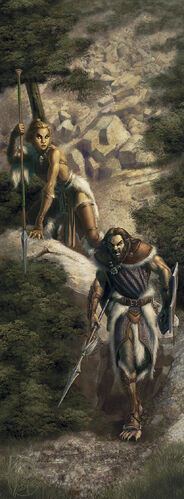
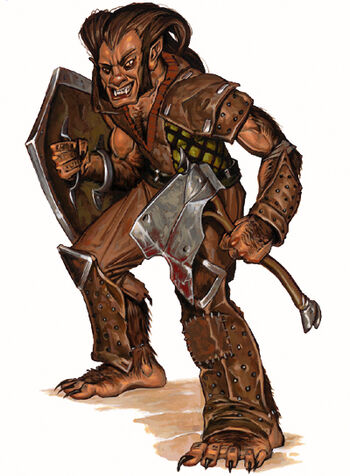
The blurb for the playable Shifter note that they are descendants of people who contracted full or partial lycanthropy, and can’t really ever form fully into a ‘human’ or a ‘beast’ form. Their humanoid form is always a bit more beastly, and they straight-up can’t turn into a full wolf, bear or armadillo.
Shifters as playable characters get some additional animal-themed proficiencies and darkvision, but they are able to go into a ‘shifter’ form where they gain additional hit points, as well as additional abilities based on which specific beast you Shift into — 5E give us ‘Beasthide’ for armoured beast, ‘Longtooth’ for those with powerful fangs and jaws, ‘Swiftstride’ for fast-moving beasts, and ‘Wildhunt’ for hunters that pursue. It isn’t the perfect system since trying to be a Werewolf Shifter would fit on the latter three options, but it’s a nice start.
____________________________________________________


Warforged
- Medium Construct; Any Alignment; CR 1 (Warforged Soldier)
- Huge Construct; Lawful Neutral; CR 8 (Warforged Titan)
- Gargantuan Construct; Unaligned; CR 25 (Warforged Colossus)
- Debut: Eberron: Rising from the Last War (2019)
Eberron’s poster children, the Warforged, are… are actually very, very cool. Like the Shifters and Changelings, they are tied to the setting of Eberron quite well, but there’s also enough in their backstory that they could be ported to other settings really with minimal change. The Warforged are essentially sentient automatons, originally constructed for war as their name implies. Eberron is a setting that takes place after a particularly big war called the ‘Last War’, and the Warforged were magically created to be soldiers. Created out of wood, steel and magic, the process of creating the Warforged would lead to the gaining sentience.
After the war is over, the Warforged struggle to find a place for themselves in the world, and I love that the prose keeps it ambiguous whether this is a typical ‘robot learns about humanity’ storyline, or if there are some nuances to the fact that the entire Warforged people were built for war and being utilized as tools were the foundational memories for almost every Warforged.
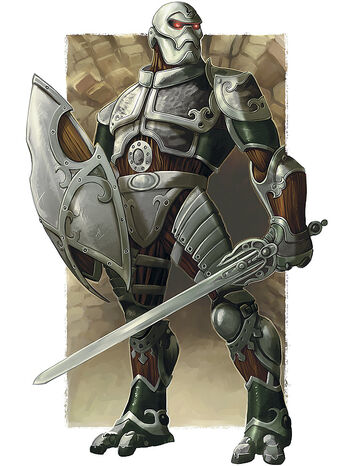

The playable 5E Warforged race is pretty fun, with their construct nature giving them immunity to poison, disease and sleep. Like elves, Warforged only need to trance (or do a ‘sentry’s rest’) during the night. They don’t need to eat, drink or breathe, and may be immortal in terms of aging. Interestingly, due to the uniqueness of Warforged body structures, they need more time to integrate armour onto their body.
Love the idea of playing the Warforged in general. There’s a lot to do with just being a fun sentient metal golem in a fantasy world, but to have all the baggage about being the descendants of a race magically created for war, and one that many people still don’t see as being ‘real’ living things is also neat. I love the older artwork, too, with their stern, stoic robot heads, the more visible wood joints, and their chunky fingers.


In addition to the playable Warforged race, Eberron: Rising from the Last War also gives us statblocks for soldiers, but also for the less-sentient, earlier models of Warforged Titans and the even larger Warforged Colossi. I really do like the look of the Titans, with their massive hunched-over bodies and massive weapons resembling something out of Warhammer 40,000, while the Colossi lay dormant — large robots the size of battleships (and are meant to carry troops, too) that are buried and left inactivated when they proved to be more destructive than the creators thought. Love the idea of a giant monster large enough to be a dungeon, but also completely capable of being utilized as a CR 25 final boss.
____________________________________________________

Tsucora Quori
- Medium Aberration; Lawful Evil; CR 7
- Debut: Eberron: Rising from the Last War (2019)
So let's talk about the Quori first, before anything else. Eberron has a lot of factions. In addition to some standard D&D stuff, the many, many kingdoms and factions, the Overlords, the Daelkyr, the Lord of Blades and many others... we've got the Quori. Which, thanks to our little focus on the bestiary segments of these books, makes them get the bigger focus from me here. The Quori are 'dream beings', classified as extraplanar outsiders in 3.5E and aberrations in 5E.
They hail from Dal Quor, the plane of dreams. Most of the Quori in Dal Quor are aligned with the Dreaming Dark. They move through the dreams of various peoples in Eberron for their own nefarious purposes, wanting to open portals to Dal Quor through their heralds and servants... but for a reason that is more out of self-preservation. Most encounters with the Quori will happen through the Kalashtar and Inspired peoples that we'll cover after the Quori. The Quori themselves are unable to really manifest in the real, waking world (unless something went really wrong), but they do have stat-blocks in case your campaign takes the fight to the dreaming world. Or if your DM just has the Quori be a different type of 'dream aberration' unrelated to the Eberron trappings.

Most numerous of the Quori are the Tscuora, which is easily my favourite design out of the about half-dozen Quori we got in 3.5E. Tsucoras have a serpentine lower body, nicely gross with the pinkish consistency of raw flesh. Its body tapers off to what looks like a headless torso, with two muscular crab-claws covered with black exoskeleton and chitin. Running down the Quori's torso are two pairs of fleshy grabby humanoid arms, and around three pairs of insect legs. The giant lump where the 'chest' would be has a stretched-out mouthless skull with glowing eyes and nose-holes, and pockmarked around the main 'face' are mismatched eyeballs.
Really, really cool. You can just see this thing twitching and moving as it manifests into reality (or into your dream), a nice combination of familiar features and disturbing twists. Tsucora Quoris are noted to be cruel and calculating, enjoying the power they wield over others even as they concoct elaborate schemes to advance their own positions. Each Tsucora hopes to be reincarnated into an even more powerful being -- and this leads to a bit of an infighting as their plans also tend to involve discrediting their rivals as much as it does improving the goals of the Quori in general.
Tsucora are masters at manipulating the 'humanoid chattel', utilizing charm and fear in equal parts whether they're lurking in the dreams or taking over their Inspired minions. It's in the possession of an Inspired that a Quori is most likely to be encountered in an average Eberron campaign, although I suppose the Tsucora itself also needs to be statted as it casts spells 'within' the Inspired.
I do like how the stat block does still have a 'possession' ability, again, in case your party of adventurers somehow encounter these Quori in their own plane, or perhaps while dreaming. In addition to possession and the expected batch of melee abilities, Tsucoris are also able to cast charm person and fear with its psionic powers.
Again... just really, really cool. I've always loved the Quori by their visual designs alone, but the dream-walker alternate plane stories are well-written and quite engaging as well.
____________________________________________________

Hashalaq Quori
- Medium Aberration; Lawful Evil; CR 9
- Debut: Eberron: Rising from the Last War (2019)
Also known as 'Dreamstealers', the Hashalaq Quori serve as loremasters and judges of the Quori. The artwork we see them represented in 5th Edition shows their truest form, where it's a giant ghostly blob with many arms and a glowing 'eye'. The Hashalaq are composed of hundreds of translucent tendrils, however, and can compress and configure these tendrils to form whatever shape they want. In fact, 3.5E artworks for Hashalaq show them in disguise, as hooded humanoid figures with a glowing void where a face should be. This 'sensory organ' moves around the Hashalaq's body, and can be moved around to suit its current shape. A very cool concept in general, but also one that you can justify to be particularly weird because the Hashalaq's tendrils isn't made up of vines or tendrils or whatever -- it's dream-stuff. Dream-stuff can do whatever you want it to.
Where Tsucora rely on fear and charm, Hashalaq have studied their mortal prey for centuries. They understand the power of pleasure and the hedonistic urges of mortals, and have developed ways to control humanoids through pleasure. Interestingly, the flavour text also notes that the Hashalaqs have developed a 'taste for it' themselves. You... you probably don't want to know what the hedonistic tastes of a Hashalaq really is.

In their home plane of Dal Quor, Hashalaqs tend to spend most of their time studying and working their roles as lore-masters. Servings as advisors and judges, the Hashalaq ensure that the rivalries of their lesser Tsucora kin (and other lesser Quori not represented in 5E) do not threaten the Dreaming Dark.
In combat, Hashalaq also has the common possession ability that all Quori share. They also hvae a more psionic 'basic' attack; a way to redirect damage 'empathically' to opponents, and a more robust psionic spell list including Detect Thoughts, Suggestion, Dream and Dominate Person. Oh, and Disguise Self, too, naturally, since it's a mass of dream-tendrils that shapes itself into whatever form it chooses.
Again, while the Eberron lore is a bit more specific, there's nothing stopping any world-builder from placing the Quori as being able to manifest in reality, either temporarily or permanently. And if Quori manifesting into the real world is simpler, that makes the Hashalaq's ability to transform into the shapes of strange hooded figures a bit more useful in combat!
____________________________________________________

Kalaraq Quori
- Medium Aberration; Lawful Evil; CR 19
- Debut: Eberron: Rising from the Last War (2019)
Jumping from single-digit CRs to a whopping CR 19 are the Kalaraq Quori, the 'Eyebinders'. Kalaraqs have a rather interesting look, having the nice serpentine shape common to its two lesser kin, but having a mantis head and forearms, in addition to a bunch of other bug legs. It's also made entirely out of black shadow, and is covered by a nimbus of red energy. Most importantly and explaining its epithet, a host of disembodied eyes whirl around the Kalaraq. Each of these eyeballs is the reflection of a consciousness that the Kalaraq has consumed. Older artworks show the Kalaraq looking a bit different, having a more humanoid form although all the other details (void body, red aura, eyeballs floating around it) are similar. Being dream-monsters, though, I highly doubt that a Kalaraq keeps the same form all the time.
The Kalaraq are the highest-ranked and essentially rulers of the Quori race, being the closest Quori to the Dreaming Dark. They still have their own agenda and want to jockey for the position of the right hand of the Dreaming Dark, and for this internal conflict, they usually stay in Dal Quor to maintain and fight over their positions.

I feel that this would be more impactful if we got maybe one or two more 'lesser' Quori to make the Kalaraq (and to a lesser extent, the Hashalaq) a bit more impactful as some of the Quori to not leave Dal Quor so much.
They are possessing of a pretty hefty stat block. In addition, again, to the ability to possess others, the Kalaraq has a high host of resistances and immunities, has good vision so it can't be surprised, has batch of psionic spells (including arcane eye, eyebite, dream and confusion), can summon eye swarms to attack its enemies psionically, and can phase through objects. Its two special abilities, though, are 'Mind Seed' -- which curses a humanoid with levels of exhaustion, and when they reach maximum exhaustion they just permanently become a minion of the Kalaraq. Another ability is 'Soul Binding', where the victims reduced to zero by the Kalaraq's attacks have their soul imprisoned as one of the floating eyes, preventing resurrection until the quori is destroyed.
Dreams have always been a background plot of Lovecraft's Cthulhu mythos, but I daresay that the execution of the Quori in how they interact with the waking world and how creepy the actual dream/nightmare monsters look are far to my liking. I really do wish that they had given us one or two 'lesser' Quori alongside the Tsucora, but otherwise I'm quite happy with how weird these dream-weirdoes are.
____________________________________________________


Kalashtar and Inspired
- Medium Humanoid (Kalashtar); Any Alignment; CR 1/4 (Kalashtar)
- Medium Humanoid (Human); Lawful Evil; CR 2 (The Inspired)
- Debut: Eberron: Rising from the Last War (2019)
So yeah, it is a bit more important to explain the Quori before these next guys. The Kalashtar serves as the fourth of the Eberron-unique playable races to be available in 5th Edition. The Kalashtar are described as being basically just similar to regular humans, with a slight bit of 'otherworldly beauty'. It's something that I'm a bit dismissive of when I reviewed these guys back in 2020 because a lot of 'Mary-Sue-y' races are basically just really fancy humans or elves.
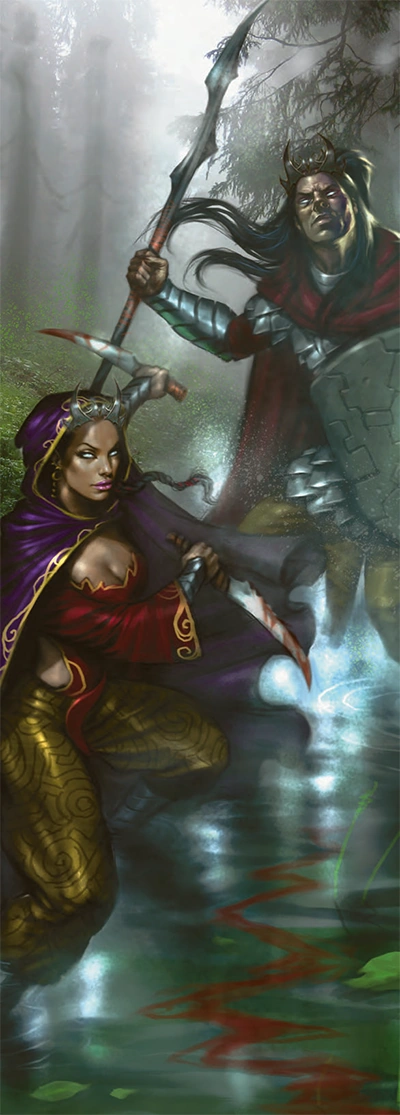

But the backstory really does make them feel neat -- if nothing else, because of their connection to the Quori. The playable Kalashtar are the descendants of the good Quori who are not trying to end the world, and has merged their essences with an ancient group of monks. The descendants of these Quori-monk mind-mergers become the Kalashtar. Each Kalashtar 'inherit' part of their ancestral rogue Quori, a bit of a complex process that makes them have a strange quasi-ancestral bond. It's not quite like a Warlock patron or whatnot, since theoretically a Kalashtar is just accessing fragments of their ancestral Quori.
What this means is that the Kalashtar are natural psions of the setting, able to resist and having advantages in checks revolving around psychic and psinoic abilities. They have innate telepathic abilities, and due to their connection with the Quori, the simply do not dream. They aren't immune to sleep, but are immune to nightmare or dreamwalking spells.


The main body of the Quori of Dal Quor, meanwhile, have been quietly influencing many people all over Eberron with strange, cryptic dreams, creating their own cult and doing a bit of eugenics. These Quori have created the 'Inspired' through careful genetic selection, and with a bit of a brainwashing, these 'Inspired' are the perfect hosts to allow themselves to be possessed by their Quori masters, becoming their vessels in the Material Plane. Due to their lower status, the Tsucora are the ones most often sent to 'host' itself within an Inspired.
I do like this secret war between various descendants of the different factions of dream-beings. This has led to a bit of a secret war, as members of the Inspired are potentially embedded within so many other organizations. And these people with secret ties to dream-planes have a generations-long grudge-match against each other, which may lead to an additional layer of complexity on any other espionage story you may encounter in Eberron.
So still not a big fan of how the Kalashtar and Inspired look -- but I do like the lore. And as much as i roll my eyes at all the Kalasthar/Inspired having this 'ethereal elf' look, I do get that there needs to be some kind of a 'threat' to be able to suspect another NPC as a potential Quori-host.
____________________________________________________

Dolgaunt
- Medium Aberration; Lawful Evil; CR 3
- Debut: Eberron: Rising from the Last War (2019)
Among the many threats that we're not going to cover here because they count as 'named characters' are the Daelkyr, Eberron's local extraplanar 'elder god' style horrors. One of the Daelkyr has captured and transformed a lot of the local people -- goblinoids, mostly -- and transformed them into horrifying beings. While the Daelkyr were defeated in the past, their creations remain, descending and continuing the machinations of their masters.

The Dolgaunt here are aberrations created from Hobgoblins specifically, and they are transformed into Resident-Evil-looking screaming flayed-corpses with hollow eyes, a worm-like tongue and two tongue-like flesh tentacles sprouting from its shoulders. The flavour text identify their body as being covered with 'writhing cilia', which just sound uncomfortable, The Dolgaunt is described as blind, but can perceive its surroundings through the cilia on its skin. Its tentacles allow it to drain vitality and life with touch. From the abilities, Dolgaunts actually appear to be flavoured after monks, with abilities corresponding to those of monks. They favour hand-to-hand combat and unarmoured defenses, just with the addition of tentacles.
Despite their appearance, Dolgaunts are not mindless shambling zombies either. They are still made from Hobgoblins, and are smarter than most of their kin. They study in the cavernous monasteries, training their bodies and dedicating themselves to the mission given to them by their dread masters.
____________________________________________________

Dolgrim
- Small Aberration; Chaotic Evil; CR 1/2
- Debut: Eberron: Rising from the Last War (2019)
The second Daelkyr-minion we get is the Dolgrim, which are described as essentially two goblins crushed into one creature and fused together. It's a very uncomfortable-looking fusion, as the bodies are turned into a hunchbacked lump with two snarling mouths above each other, only one pair of eyes, and four arms. Again, if not for the mouths on top of each other it could just be a four-armed 'Igor' hunchback, but this does really show how these poor things are corrupted goblins. The flavour text consistently note that the Dolgrim has a 'headless torso', so the face sprouts straight out their neckless, lumpy chest.

Like the Hobgoblin/Goblin connection in the basic D&D settings, the Dolgrim are smaller, weaker, and subservient to the Dolgaunt. The transformation that created the Dolgrim has caused them to go really crazy as a Dolgrim would chatter and gibber among itself, able to carry a demented conversation with itself even though it only has a single personality. Their minds are considered separate enough that they have the 'dual consciousness' traits that gives them resistance towards status conditions like frightened or charmed that other multi-headed beings like Ettins have.
While most of the Daelkyr's minions are sealed underground, some small groups of Dolgrims are sent aboveground under the command of the Dolgaunts under strange, inscrutable eldritch missions of their masters. The Bugbear variant was not adapted to 5th Edition, but they are called 'Dolgarr' and just resemble huge, muscular dudes.
____________________________________________________

Eberron Dinosaurs
- Medium Beast; Unaligned; CR 1 (Clawfoot)
- Medium Beast; Unaligned; CR 1/4 (Fastieth)
- Debut: Eberron: Rising from the Last War (2019)
There are reinventions to many classic D&D tropes in Eberron, and one of the fun, subtle ones is that Halflings, instead of riding ponies or large dogs, ride dinosaurs in this plane. That's awesome! Again, this is back when dinosaurs aren't quite as common as they get shoehorned into 'sci-fi' more than 'fantasy', only appearing in stories parodying Lost World or something. Which is a bit silly since a Gallimimus or Apatosaurus or Styracosaurus are a lot less fantastical than an average Bullette or Mimic or Spectator.
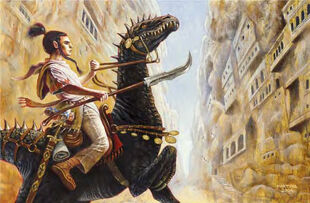
Eberron still gives them made-up names instead of taking their real-world names, but the description of the sickle-toes of the Clawfoot are essentially a large dromaeosaur (like a deinonychus or megaraptor). Clawfoots are pack hunters, and are utilized by the Halflings as their equivalent to warhorses.
Meanwhile, Fastieths are creatures of a similar size, with large eyes, bright colours and strong legs. They are also Halfling mounts, and the descriptions make them essentially be a member of the Ornithomimidae family, like the Gallimimus or Ornithomimus. The Halflings of Eberron use them as essentially regular horses. It's noted that the Fastieths and Clawfoot are unable to bear larger riders, making them perfect for Halflings (or other humanoids of that size).
____________________________________________________

Dusk Hag
- Medium Fey; Neutral Evil; CR 6
- Debut: Eberron: Rising from the Last War (2019)
As a twist on the hag trope, Eberron's Dusk Hags are ones that are particularly obsessed with prophecy and fate. This bleeds in a bit to newer 'Fate Hag' introduced in 5E's Book of Many Things and I wished they had gone with simply canonizing Dusk Hags for the greater D&D multiverse instead.

Dusk Hags are crones with shriveled orange skin, tangled hair and eyes that burn like hot coals. They see visions of the future in their dreams, and their dark magic also allows them to influence the dreams of others. A lot of dream stuff in Eberron, yeah? I do like this twist on Hags. The Dusk Hag isn't always evil or malicious, but it's definitely not nice. And being a creature of prophecy, the Dusk Hag definitely knows the answer (or some aspect of the answer). The question is how much you can trust the Dusk Hag? Dusk Hags are still hags at the end of the day, and they do still enjoy causing strife to those that bargain with them, and find ways to turn promises to their own advantage.
It is a bit more quaint and less unique now -- particularly with 5th Edition's fleshing out of Hags in general -- but I do always appreciate a new hag if nothing else.
____________________________________________________

Homunculi
- Medium Construct; Neutral; CR 1 (Iron Defender)
- Tiny Construct; Neutral; CR 1/8 (Expeditious Messenger)
- Debut: Eberron: Rising from the Last War (2019)
Famous for also bringing us the Artificer subclass (which would then proceed to be ignored after its debut until 5.5E), there are a couple additional specific homunculus sub-types in Eberron. There are a a lot of different artificer sub-types in Eberron, and due to the more common usage of magic, there's also a wide increase in homunculus usage in the setting... any sufficiently magically-empowered construct counts as a Homunculus.
We get two variants, although only the Iron Defender had its original 3.5E artwork reprinted. The Iron Defender doesn't always look like a robot hound, and the description notes that they could look like anything their designers want them to. Different animals, magical beasts, or even just something weird that the creator wizard wants to make them into. I like this versatility, and of course it also allows a lot of customization on the part of the in-universe spellcasters as well as the Dungeon Master designing encounters to modify the Iron Defenders as needed.


Being Homunculi, these beings are still bound to the spellcaster by the similar blood ritual that the base Homunculi from the Monster Manual are, but they are a bit more steampunk-y.
A smaller, weaker version is the Expeditious Messenger, depicted as a cute winged lizard-robot in its original 3.5E artwork. Expeditious Messengers are, as their names imply, used to carry messages like carrier pigeons. They're also described as being 'pretty chatty' and natter as they move.
____________________________________________________
____________________________________________________

Radiant Idol
- Large Celestial; Lawful Evil; CR 11
- Debut: Eberron: Rising from the Last War (2019)
One of the designers' favourite creature concepts is the Radiant Idol, which is a type of 'fallen angel' if you're going to dumb it down to a simple word. The artwork is simple enough -- the typical old-school Deva/Planetar design, but with the wings torn off and reduced to bloody stumps. It's very gothic, very cool, to have a fallen, evil angel... but also not really that fresh in D&D terms.
Radiant Idols doesn't always have bloodied stumps for wings, with alternate descriptions in the flavour text noting that they could also have wings tied up with chains as a symbolism of its punishment, but they always use a spell to disguise themselves and pretend to be shining, beautiful angels. And they still are capable of doing a bunch of the stuff that an equivalent angel (either a Deva or Planetar) can do -- a lot of holy spells (albeit mixed with some sinister ones, like Dominate Person, Mass Suggestion, and the thematically biblical Insect Plague), and even its resistances are against other radiant/holy attacks. It is still an angel, after all.

The idea, though, is that the Radiant Idol doesn't just 'fall' because of a disagreement or because they were evil. They specifically want to be worshipped by mortals. These are angels who crave to be worshipped like the gods they deserve, and were banished from the celestial realms. In the original concept, there's an additional wrinkle to this -- each Radiant Idol is the master of their own domain, similar to clerical domains. An individual Radiant Idol might represent war, or justice, or death, or knowledge... the same normally-depicted-as-good domains that clerics draw their power from. How cool is that? How cool is it that the Radiant Idol gets to explore the excesses or the extremes of these domains?
Unfortunately, the 5E translation does reduce everything to a generic Radiant Idol statblock, with an 'aura of false divinity' causing those around it to be lulled into worshipping it. It just creates a cult that eventually is described to crack and devolve into 'ominous ritualism, hedonistic folly, and fanatical doom'. The 'fallen angel desiring worship' thing is neat enough as a concept, but I think it's nowhere as strong of a concept as a corrupted version of a domain of the gods.
Still, I can see why the Radiant Idol is so popular. I actually really do like the concept of fallen angels, but so rarely see them done well in media where they usually feel... kind of generic. Just a tragic backstory for a demon/devil. But this is a nice twisting of what an angel or a D&D god should be, and I do like that quite a bit! Also, I do think that 'celestials' as a creature group really don't get enough representation as actual monsters and enemies, and this is definitely a good one.
____________________________________________________

Zakya Rakshasa
- Medium Fiend; Lawful Evil; CR 5
- Debut: Eberron: Rising from the Last War (2019)
Eberron has quite a bit Rakshasa culture as part of its lore, being one of the ancient races that had a massive ancient empire before the rise of the humanoids. The Rakshasas in Eberron are trying to free their masters -- originally called the 'Rakshasa Rajahs' (rajah meaning 'king') and later slowly retconned to 'Overlords'. These Overlords lost a great war against dragons and couatls, but their minions remain. Now many, many centuries later, we get a nice twist on the subterfuge and long-running infiltration and manipulation done by the traditional D&D Rakshasas! That's a cool plotline to build into the world, while also giving a reason and motivation to the modus operandi of one of the more iconic D&D monsters.

And with a more robust and diverse culture, the Rakshasas are given additional variants. Only a single one made it into 5E, however, the Zakya -- who are the more martially-inclined footsoldiers of the Rakshasa people. The original concept of the 3.5E idea is that the tiger-headed guys are just the Zakya, and that other Rakshasa would look much more different (which would make it a truer-to-text adaptation of the Rakshasa for once) but eventually most Rakshasa are just variations of the tiger-men and even the Rajahs are renamed Overlords. Shame.
The Zakya have a lower CR than the base Rakshasa, but they have a rather respectable statblock for a CR 5 encounter. Especially with how they are presented in the flavour text, Zakyas are going to be encountered in groups and units, being that they are well-regimented soldiers.
____________________________________________________


Undying
- Medium Undead; Neutral Good; CR 2 (Soldier), 10 (Councilor)
- Debut: Eberron: Rising from the Last War (2019)
A lot of the tone of the undead in Eberron are that of regimented, weaponized armies as opposed to shambling and disorganized zombie apocalypses. Again, this idea is a bit less unique now with major fantasy franchises like World of Warcraft and Magic: The Gathering featuring disciplined undead armies. But while I'm not covering them here, there are statblocks for various undead troops like the Karrnathi Undead Soldiers and Bone Knights.
The Undying, on the other hand, I really find to be a fun twist! The Undying are holy undead. They are guard the temples and mansions, and are adorned with heirloom armour and wield ornate weaponry. The Undying are undead, sure, but they are sustained by positive energy and/or the devotion of their mortal culture. In fact, so strong is the positive energy association that the Undying are actually harmed by traditional necrotic energies, and resist holy energies, making it a nice subversion. It's different from how most other undead like wraiths, ghosts and revenants are created out of powerful negative emotions -- Undying linger because they are cherished, and they seek to protect and guide their descendants and communities.
I really like this vibe, that they are positively-spun undead that are respected as a part of a specific society. Sure, they may look like desiccated corpses, but they stand vigil over their descendants. The most powerful Undying -- the Councilors -- are able to even separate their spirits from their physical forms, and have access to a massive range of powerful spell. It's such a nice twist on regular undead, to make them actually wholesome and be driven by really strong positive and culturally-important emotions and purposes. A nice twist on how the undead work, and even just from this monster entry, I get such a nice, different vibe of people and society. I like them!
____________________________________________________


Valenar Animals
- Tiny Fey; Neutral; CR 1/8 (Valenar Hawk)
- Medium Fey; Neutral; CR 1/2 (Valenar Hound)
- Large Fey; Neutral; CR 1/2 (Valenar Steed)
- Debut: Eberron: Rising from the Last War (2019)
The Valenar beasts are beings tied to the fey and elves of Eberron, which I haven't read about anywhere as much as the research I did for the Quori, Daelkyr or Overlords. But the brief backstory that the flavour text noted an origin of how these Valenar animals are the remnants of the powers of ancient druids who were trapped in their animal forms, and now are able to awaken the power in other animals to aid their successors. Ancestral spirits can awaken an animal and transform them into an intelligent fey, where then they will choose their special Valenar elf as a companion... although some also choose adventurers of another ancestry, which the elves of Valenar also accept.
This is basically what a lot of the flavour of many D&D spells like 'Find Familiar' or 'Spiritual Guardians' would evolve to, especially since the lore behind many spells tend to be a bit more nebulous in earlier editions. The idea that these are transformed or awakened animals by druidic magic is a neat one. In 3.5E, as I understand it, only the Valenar Steed is really highlighted, but it has expanded to other beasts as well.
The book gives statblocks for three variants -- hound, hawk and steed -- and they have pretty basic stats, but there's a table you can roll for the special Valenar ancestral trait, which range from simple abilities like being able to camouflage or teleport, to really fun ones like having lie detection or luck-bestowing abilities.
____________________________________________________

Love the races in Eberron! Two of my favorites in all of dnd are the Changeling and Warforged. My Changeling Izalco got cursed by a Hag so they could never blend in and onky stand out, which they only escaped by making a pact with a sentient cold iron weapon that wanted to be wielded again, and my Warforged Beaker was the result of nation unable to manfacture a powerful mind to guide their troops, until a researcher named (REDACTED) suggested copying the human brain as a base.The nation took a more literal approach to that
ReplyDelete