Showing posts with label Pikmin. Show all posts

Saturday, 29 July 2023

Reviewing Monsters - Pikmin 3, Part 3 (Bosses)

And this will round up my coverage of Pikmin 3, which will involve most of the minibosses and bosses. This has been a fun ride! I'll be back, I think, whenever Pikmin 4 is out and all the bestiary has been uploaded to the fan-wikis. I really did feel like Pikmin 3 pushed a lot of the enemy design to feel a bit more different from the first two games, at least in terms of the new enemy designs. 

Again, it's always fun to see the wacky scientific names assigned to these creatures, as well as the large amount of thought that went into the speculative evolution of these critters. I do really think that there's something a bit missing in Pokemon and especially Zelda's bestiaries because we don't quite have something anywhere as thorough as Olimar's amateur-biology-student observations about these creatures. There's also always the knowledge that the planet PNF-404 is actually a post-apocalyptic Earth, so these creatures are actually descendants of our modern-day critters, giving these monsters an extra 'oomph' of creepiness, whether the designers intended it or not!

It's also always interesting to talk about the bestiary of a game that I have never played as of yet, only seen gameplay footage online. Maybe I'll finally get to playing the franchise with Pikmin 4? With how long it's taken me to complete Persona 5, though, I highly doubt it'll be any time this year...
_________________________________________


Bug-Eyed Crawmad (Camabarus subterranid)
We've had the Hermit Crawmad in the previous game, but this member of the Camabarus genus is instead subterranean, as its name implies. It looks a lot like the Hermit Crawmad, but it's got two gigantic eyeballs with pink eyelids, connected to the main crustacean body with eyestalks. The end result does look like a weirdly modified Spore creature that someone wants to make look as uncanny as possible. Which... actually makes the Bug-Eyed bastard look very creepy when it stalks your characters! Olimar notes that the gigantic, overdeveloped eyes helps it to detect prey in cloudy water or low-visibility mud. Like its partial inspiration, the mantis shrimp, these Bug-Eyed Crawmads allow it to see polarized light, ultraviolet, and infrared light. 

The Bug-Eyed Crawmad will pop in and out of its interconnected underground tunnels, and grab Pikmin and gobble them up. As with any Nintendo enemy, the gigantic eyes are the weak spots, and hitting them enough will cause it to show off its weak underbelly. This guy is quite huge, which Olimar notes is a sign of its repeated shedding and a marker of its age!


Shaggy Long Legs (Pseudoarachnia capillum)
We get a couple more variations of what's still my favourite boss from the franchise, the Beady Long Legs family. A lot of what I said about the original Beady Long Legs still applies here -- what a unique 'spider' the creature is, with the distinctive planet-like orb and four 'sci-fi spider-walker' legs jutting out of it. Lots of spiders are hairy, of course, but they normally manifest in fur-like coverings, and not this... this whatever the hell is going on with Shaggy Long Legs here! Its joints are in puffballs, but the central orb is just a mass of hair that reminds me of Cousin It or Sadako or something. It's so gloriously dorky!

Apparently these hair are actually protective, shielding Shaggy here from the frosty weather as well as the Pikmin attacks, and you have to get rid of the hair to expose the core. The game actually has several coloured variations of the Shaggy Long Legs, and Olimar suspects that this is merely due to 'regional characteristics', and not caused by stress or age.

Baldy Long Legs (Pseudoarachnia calvitium)
Yet another variant that only appears in certain game modes is the Baldy Long Legs, which is... basically the Shaggy Long Legs, but bald. Alph wonders if this is a Shaggy that's born bald, or if it already lost its hair in a previous fight, but its species name marks it as a separate species to the Pseudoarachnia capillum... or is it? Olimar notes that "this is merely a Shaggy Long Legs that has lost its hair", but it's classified as a separate species and classified separately because 'the hair never grows back'. It really does depend on whether the Baldy lost its legs through... the course of evolution over several generations (at which point there's argument in making it a breed or a subspecies) but if it's lost its leg in its current life, then it's just a bald Shaggy! Olimar, just because someone goes bald doesn't mean it's a completely different species!

Armoured Mawdad (Tuberclipeum rex)
Huh! From the name, I assume this is meant to be another monster based on the crawdad, and so probably the big boss versions of the 'Crawmad' enemies? What a much cooler-looking face, though! I think it's those creepy, almost dinosaurian eyes embedded into the side of a much more monstrous head. The base silhouette is really all this thing has in common with an actual crayfish, because everything other than it looks significantly more creepy. Instead of two giant clackety claws, it's got what appears to be tentacles. We've got the aforementioned almost dinosaurian eyes. The mouth looks like it's transplanted from an angry ape. And those legs are like teeny-tiny little creepy legs that the wiki compares to a gecko and knowing what they're supposed to be makes me even more creeped out. And of course, the main body of this critter is enveloped in admittedly a rather natural-looking exoskeleton... but it's so pale and slimy looking. I didn't think much of this design initially when I skimmed through the wiki, going 'cool, lobster boss', but the more I look at it, the more I appreciate how nasty this thing looks. 

The Mawdad is described as being able to scuttle across the ceiling and the walls with its dozens of (ew!) gecko legs, which is honestly something that I wouldn't think too much about if it had regular centipede or lobster legs, but tiny gecko legs! God, I don't know why that little detail bugs me so much. To make this thing feel even weirder, Olimar notes that the Mawdad makes its home inside the 'hollow stumps of enormous trees'. Weirder and weider!

As noted by Alph, the exoskeleton is actually made out of crystal, and it's kind of a common theme through some of the enemies in this game to be weak to the brand-new Rock Pikmin. Olimar even notes that the Mawdad still moults like a regular crustacean, but its crystal shell is so hard that it has to keep slamming itself into rock walls to shatter the exoskeleton before forming a new one. Obviously, the underbelly of this thing is its weak part. 

Vehemoth Phosbat (Tectupervus pteromys)
And this is the adult form of the Phosbat we saw before and... hoo, what a difference! Obviously the same colours and the fuzzy texture is the same, and I guess from a distance this thing could pass as a 'moth' or a 'bat'. But man, that gigantic mouth and the layout of its face looks like they belong more on a Star Wars alien or something! A lot of random features are packed into this thing, and I'm trying to dissect what it is. It's got four fleshy wings and a giant fleshy tail, four stumpy legs, a gigantic screaming-baby mouth, two eyes located on a fuzzy dorsal side, and a mass of what appears to be parasitic/symbiotic stalk-like fungus growing from its top. What a weirdo! 

It's normally perfectly camouflaged in the dark, showing only its fuzzy black upper side, but when approached, it will light up all of its pink extremities that glow brightly, and its primary method of attacking is to inhale really powerfully, sucking in everything in front of it. It's like a fleshy, disturbingly realistic version of Kirby or something. Also, like its near-namesake Venomoth, the Vehemoth Phosbat is able to flap around and unleash toxic dust from its hairs that choke and cause the Pikmin to panic. Olimar identifies this as 'mildly toxic scales' that paralyze small insects and make them vulnerable to the sucking motion... a common misconception that is associated with 'scale dust' from moths, which aren't actually poisonous. 

Interestingly, Olimar's comments notes that the Phosbat is 'forced to live in the darkness' due to its extreme photosensitivity, though I'd say that it's more of a case of the Phosbat being so well-adapted to the darkness. Apparently, the Phosbat doesn't just camouflage, it actually turns transparent by having its chromatophore cells 'absorb faint light sources'. I do like that Olimar notes the irregularity, noting that highly-specialized cave-dwelling creatures are normally troglodytes (they have atrophied eyes and albinism) but presumably the Vehemoth Phosbat's chromatophore adaptations compensated for that. 

Sandbelching Meerslug (Gastropoidae anguilii)
What a name! Sandbelching Meerslug! It's apparently one of the biggest bosses in the series, being a giant fat slug creature. It's got gigantic, disturbingly human lips, spines down its body, and tiny bright-blue beady eyes above those pale-white circular structures that I assume is meant to resemble a slug's pneumostome. Being a homage to the many, many giant sand-worms in fiction, the Meerslug burrows through the ground and causes waves of sand to wreak havoc in the battlefield, while also creating sinkholes like an antlion. It can also spit out balls of sand. 

It's rather interesting -- slugs (and the genus does identify this as a gastropod) aren't really a creature that I'd associate with sand. It's very interesting that they wanted to portray some kind of Dune sandworm but instead of going with a regular worm, they decided to do it with a giant fat slug monster with swollen purple lips? Or, well, lip-butt, because Olimar identifies the main orifice as 'both mouth and anus', which isn't something that applies to slugs (they have regular anuses at the other end of the body) but to some species of sea cucumbers. 

He sure is a different kind of boss than I'd expect, but... I'm not the biggest fan of this one? I'm normally all for giant worms, giant slugs, and giant antlion-style desert bosses, but the Meerslug is a weird combination of all of those that just didn't click for me. 

Scornet Maestro (Spourgitis advenus)
We saw the regular Scornets that this thing commands, and what a weirdo! Unlike the Meerslug, I feel like the Scornet Maestro is a great combination of seemingly random features that work. The whole theme is that this thing is a beehive commanding little bees, but with music instead of pheromones. It's also a bird for some reason, with a giant beak that also doubles as a harp, which it plays with two gigantic hands (which gloriously end in insectoid tarsi!). The general shape of its body also resembles a beehive and simultaneously the plumage of a bird, and the whole package is just such a bizarre, insane creature that would feel at home in a setting like Alice in Wonderland or something. 

The Scornet Maestro is part of the 'huntinpeck family', and Olimar describes its rather interesting life cycle. The Scornet Maestro wanders around and doesn't have a particular nest, waking up from hibernation in the spring and traveling with a male partner towards areas with plentiful food. We never actually see the male, but Olimar describes it with the typical sexual dimorphism that many insects exhibit. According to Olimar, the male is smaller, with a white body and blue extremities, and no wings. It's interesting that while we only really see that the Scornet Maestro uses her music to control the tiny Scornets, Olimar still identifies the Maestro's musical cues as something to 'issue pheromones' to control the sterile workers. 

I really don't have much more to say here beyond the acknowledgement of what an utter weirdo the Maestro is, and yet the design all somehow gels together so well. It's such an abomination of different features that manage to still 'feel' like a fantasy creature, if you get what I mean!

Quaggled Mireclops (Trestripods gigahenum)
Huh? Huh! Every game, we get a weird non-biological weirdo. Discounting final bonus bosses, it was the Mamuta in the first and the Waterwraith in the second one. And now we've got the Quaggled Mireclops here, which looks like something out of Shadow of the Colossus or Dark Souls or something, though knowing the scale of this game the Mireclops is probably the size of my foot. I really do like the design of this thing, being just a rock overgrown with moss, with spidery knobbly legs jutting out on all sides, and a mass of plants that serve as its 'head'. I also appreciate that they didn't quite go for a typical spider or crab layout, making this thing look positively alien.... though I suppose there is room to argue that this thing is mimicking (or is based on?) the Beady Long Legs. It's not just a plant and rock monster, however. Those star-like 'flowers' on the top of the fruit is actually its eyes, and there's a part of the rocky body that opens up like a cartoonish clam mouth, complete with a tongue that it swallows up your buddies with! Click here to see the creepy enemy here!

The titular 'clops' part of the Mireclops is the gigantic fruit-like head, which isn't just a fruiting body but its 'core' of sorts. Again, it's a bit hard to see from this full body shot, but those two flower-like bulbs are actually eyes on eyestalks. Alph identifies it as a 'fruit-like protrusion', and I assume that our heroes probably mistook this thing as a regular fruit (the plot in Pikmin 3 involves them coming to planet 404 to harvest fruit to feed their overpopulated planet). Olimar theorizes that the 'fruit-like growth' is actually a symbiotic parasite that feeds off the nutrients gathered by the giant rock body. Brittany is a bit confused on the true nature of this, whether it's a plant or an animal, but good ol' Louie insists that the fruit part is glorious.

As usual, Olimar's notes are what explains the most about the weirdness of this creature, because the Mireclops is so huge and has to consume a lot of food to support its mass. In addition to its gigantic mouth that presumably just consumes anything that wanders too close like a mollusk or a trapdoor spider or something, those massive legs are actually 'roots' to drain nutrients from the environment. Olimar also notes that the Mireclops hoards so much nutrients within its stony body that it's actually a detriment to the environment around it, and killing the Mireclops will actually transform the in-game terrain and create a small garden. A weirdo! I like him.l 


Mysterious Life-Form / Plasm Wraith
So our final boss is another member of the 'Wraith' family, who we previously saw as the Waterwraith in Pikmin 2. It's first encountered as a Mysterious Life-Form, the amorphous blob-thing on the left, before it transforms into the Plasm Wraith -- explicitly called a nyudo, a type of yokai, in the original Japanese. And... not the most impressed with the Plasm Wraith from a design standpoint. it's a mass of distorted humanoid shape with a single hole in the middle, a pot belly and squiggly legs, as well as nubby limbs sprouting on either side of his head. It sure is a creepy, distorted humanoid, made of gold. Creepy and different, but it doesn't feel any more special than the Smoky Progg, Mamuta or Waterwraith.

The game, however, delivers a great accompanying lore and story that makes this unexplained creature a bit more unsettling than just being an unexplained gold blob baby out of nowhere. The Plasm Wratih has taken a disturbing infatuation with Olimar, constantly trying to 'rescue' Olimar back and having some kind of sick attachment to Olimar. Whether it's love, mistaking Olimar as its young, thinking Olimar is some kind of precious item or pet... there's just an extra bit of creepiness about this very unexplained behaviour compared to if it was just a giant monster that goes rawr and demands you fight it. It's not trying to eat your guys or be territorial, but as Charlie points out, it wants to keep Olimar but not hurt him. 

The Plasm Wraith's whole deal is that it's mutable, and it can morph into whatever it needs to be. In practice, it has a bunch of wacky attack patterns that I won't list, as well as able to bud parts of itself off to create facsimiles of previous enemies you've faced. Olimar compares the Plasm Wraith to the 'ectoplasmic incarnation' that was the Waterwraith, but concludes that Plasm Wraith is different. Olimar doesn't elaborate on what the Plasm Wraith, though he acknowledges that it might be involved with the strange evolution of the creatures of the planet. That's more on the world-building and lore-theory side, but I do appreciate that amount of thought given to a creature in a setting!
_________________________________

And with that, I'm done with Pikmin 3! That has been a wild ride!

Saturday, 15 July 2023

Reviewing Monsters - Pikmin 3, Part 2

My second coverage of the monsters in Pikmin 3! Again, not a whole ton to say. These reviews are a bit slower for me to write because I have no context about a lot of these monsters in the game and how they relate to our heroes and his tiny plant-gremlin sidekicks. This time around, we'll be talking about the rest of the non-boss monsters, as well as the minibosses, and we'll talk about the bosses in a final Pikmin 3 episode.

I'm still undecided if I'll be doing Hey, Pikmin because I still have a lot of other games that I do want to review still (I do want to wrap up the other older Zelda games, and at least do a Metroid game), but whenever Pikmin 4 comes out, I'll definitely be reviewing that!

I guess I'll talk a bit about the two new Pikmin species introduced in Pikmin 3, though I honestly don't have much to say about them without going too deep into mechanics. There is the 'Rock Pikmin', who's made up of rock (or are made up of plant material as hard as rock) and can be thrown towards enemies; as well as the tiny 'Winged Pikmin', who look like little bubblegum fairies. 
____________________________________

Medusal Slurker (Stauromedusae manifoldii)
We'll start off with one hell of a weirdo! Called the 'Medusal Slurker', it's the first of a bunch of enemies that are based on sea life. We've had a couple of jellyfishes in the previous game, the Jellyfloat family, but the Medusal Slurker is a bit weirder! It's got a weird, blobby jellyfish body and a little 'horn' that resembles a white dandelion flower, which it uses to fly around like the Pokemon Jumpluff. It's got two beady eyes outside its dome head. From the almost-transparent outer body, you could see a bunch of internal organs, and a 'tongue' that droops down into a cavity that looks like a mouth. Based on the name, I think it's meant to evoke the Medusozoa clade of jellyfishes? It's identified as part of the 'Umbloda Family', and float around and trap Pikmin with their tongue or uvula-like organ. Weird!

The in-game notes says that the Medusal Slurker floats around on the wind using the 'puffstalk' on its head, and captures the Pikmin below with its adhesive 'manubrium' (handle in latin). While Olimar and Alph's note that there are no saliva, gastric fluid, or even nematocysts, on these organs, the Pikmin captured by these Slurkers will still be considered lost/dead if you don't rescue them fast enough. 

Skeeterskate (Gerridus clavomacula)
Another weirdo, and a creature more explicitly based on the pond-skater than the one that's also a pond-skater and a leaf-insect. Skeeterskate looks like something out of a Dr. Who book or something, though. What a weird, whimsical-looking motherfucker! It's got three legs arranged in the iconic pond-skater look, but its main body has a cartoony vacuum-shaped proboscis attached to a head that's mostly an eyeball and a funnel upwards towards a glass bulb. Which I guess is this thing's abdomen? This glass bulb contains water, and the Skeeterskate uses this as a source of water for them to launch jets of water at the Pikmin. 

As with real pond skaters, the Skeeterskate use the tiny hairs on the tips of its feet to skate on water, and just like real pond skaters, these hairs are coated in a hydrophobic substance. Olimar notes that the Skeeterskate sucks in water with that siphon to have a storage of ammunition to attack its enemies, but also feeds from the plankton in the drained water. It's nice to see that they put some thought into how this weirdly-shaped creature eats!

While the Skeeterskate is a water-surface dwelling creature, I guess we've got underwater zones here, considering the next batch of enemies:

Sputtlefish (Pseudocephalopoda florascens)
Oh! OHHHH! What an adorable creature! It's like someone took a squid (or well, cuttlefish) and one of those large-eyed goldfish and smooshed the two together to create an adorable little buds! The Sputtlefish (what a name!) has a cutely-shaped flowery tail that brings to mind a flattened version of the cuttlefish's shorter legs, as well as the rippling fins they have. The two larger tentacles, meanwhile, wrap around the eyeballs to give the impression of a 'mustache' (like stylized catfishes or arowana) and the cartoon cuttlefish siphon acts as the creature's mouth. Which, of course, naturally spews out ink as it's trying to escape. It's such a weird creature, and the central body is this weird giant orb surrounded by translucent tissue. It really is one of the most interesting things to come out of the Pikmin franchise in general. 
Olimar notes that the Sputtlefish manages to achieve that translucent look without iridophores, which are specific reflective cells in real-life cephalopods. It's really interesting since Olimar also compares the Medusal Slurker above to real jellyfishes, really highlighting that these are supposed to be mutated descendants of the creatures we know in our Earth right now. The Sputtlefish can also regenerate from minor wounds due to 'photosynthesis, through its symbiosis with zooxanthella'. Real-life cephalopods actually can regenerate their lost tentacles, but this instantaneous, same-day quality of regeneration gets a much more fancy sci-fi explanation. I appreciate that!

Puckering Blinnow (Narrolingus piscatum)
The general shape of the Puckering Blinnow actually reminds me of a cuttlefish as well, with that fin and the size of those eyes, but it's not related to the Sputtlefish and is, in fact, a real fish. It's a rather interesting-looking fish enemy, and I do find that it looks pretty interesting even if the lack of dorsal and pectoral fins do kind of make this creature look highly mutated. All the Blinnow has is a long, fused ventral fin that tapers off into a tail. Olimar actually notes that despite the disproportionally large eyes, this is the mature form of the Blinnow. Olimar's notes also talk about how its dorsal and ventral fins are atrophied, though he doesn't give a reason why and for what purpose they atrophied. 

The Blinnow are observed to be pack hunters, and they can even jump out of the water -- either to chomp down on your flying Pikmin units, or to escape the attack of your underwater Pikmins. It's a pretty cool, and it's a tactic done by certain fish -- most infamously the arowana, who can be observed in the natural habitat to leap up to catch insects perching on branches of trees. There's also a nice final detail about how the round blue scales will turn pink in breeding season, which isn't a detail that's relevant for gameplay but a nice little thing to toss in that makes this creature a bit more believable as a living species. 

Waddlepus (Opisteuthidae iaciobulla)
ANOTHER CUTIE. The Waddlepus is a big fat octopus with a gigantic siphon-mouth, and several stumpy legs that might as well be the extremities of a starfish or something. In fact, Olimar actually identifies this creature as a starfish, noting that it resembles the anatomy of a starfish more than an octopus. A starfish octopus! Adorable! It's got the octopus's delightfully weirdly-slitted eyes, which I definitely appreciate! The purple colouration with white borders are really nice, and the design is completed with a bunch of yellow pores on its back. 

When threatened, the Waddlepus will waddle threateningly towards your Pikmin, and then shoot out bubbles from its yellow pores, which trap your Pikmin. The act of doing this inflates its cranium, giving it a more traditionally octopus-shaped bulbous head. That's a cool way of still preserving the original animal inspiration's body shape despite otherwise diverging really wildly from it. Unlike the Sputtlefish, the Waddlepus only shoots out bubbles to trap Pikmin as self-defense, and isn't actually interested in eating the Pikmin. 

It's also notable that the Waddlepus is nocturnal and sleeps during the day, meaning that most of the time you encounter this guy sleeping and it leads more credence into the fact that this guy is just panicking and trying to protect its territory. Olimar also notes that he's done closer research on these Waddlepus, and the bubbles it makes are normally used to protect eggs during spawning season. 


Peckish Aristocrab (Brachyurices esurio)
What a weird looking motherfucker! Its Japanese name calls it an 'onion crab', and I'm hard-pressed to disagree. It's got a gigantic, glistening purple-and-silver giant fiddler crab claw, and a bunch of regular crab legs, but the rest of its body looks so weird! A creepy, yawning mouth and what originally looks like two gigantic beady eyes on its 'cheeks', turns out that the Aristrocrab's true eyes are two tiny eyestalks popping up from the top of the head! So those two giant organs are, what, fake eyes for intimidation? 

It grabs Pikmin with its massive claw and gobbles them up with that disturbing-looking maw... and inside there's an even more disturbing blue tongue! What the hell! As if it's not enough, the Aristrocrab can also blow bubbles, though real-life crabs do blow bubbles as a way to deter predators. The Aristrocrab, of course, only moves sideways, and interestingly enough, its gigantic crystal-encrusted claw makes it vulnerable to Rock Pikmin specifically. 

As Olimar points out, the large claw isn't just used for catching prey and self-defense, but also as a mating call. This is true for real-life fiddler crabs. The Aristrocrab also has great regenerative capabilities, able to regenerate its claw in a single night. Real crabs also have remarkable limb regenerative capabilities, but it usually takes a year, and they get those limbs during moulting. 

Nectarous Dandelfly (Anisopterid ambrosius)
This one is an interesting one! Called the Nectarous Dandelfly (dandelion fly, get it?), its Japanese name is interestingly the much cooler 'antlion nectar-holder', meaning that this creature might be meant to represent an adult antlion? Admittedly, though, the shape of that spiral proboscis and its nectar-eating behaviour does mark it as a member of the lepidopteran family, but then again this is also an Earth where little mandrakes run around and throw each other at mutant bugs. Olimar identifies this creature as having a larval stage underwater, which means that the 'dandelfly' English moniker would fit better with this being an analogue of a damselfly or dragonfly. Those animals don't actually change diets to feed on nectar, though, because anisopterans are all carnivorous as adults. 

The design is pretty cute. A little puffball body with a butterfly head attached to it, and what I see are at least three pairs of wings? I'm only looking at static images but I imagine this thing's wings vibrate around like a damn hummingbird. The big-puffball-body also makes me think this is related to the Spectralids. But obviously the most important detail here are the chains of giant nectar droplets that trail behind him like the segments of a cartoon caterpillar or something. Hitting one of this segments will cause every single segment trailing behind it to fall off to the ground, allowing you to loot them, which means that the most valuable target is the head. Olimar also notes that these Dandelflies require 5 segments before they are properly ready for procreation, and that the proboscis curls upwards to prevent 'nectar reflux'!

The Nectarous Dandelfly is even more harmless than the other 'hazard' enemies, and is apparently our replacement for the Honeywisp. On one hand, while I can appreciate the more biology-inspired design of the Dandelfly, it's also always a sad thing whenever a good design essentially gets 'retired'. 

Arachnode (Clavo fictusphera)
Okay, this one is a weirdo! The Arachnode is our straight-up 'spider' compared to the Beady Long Legs being a psychedelic, bizarre giant spider-walker-monster thing. The Arachnode seen here is its 'full' stage. When it's dormant, the Arachnode's spider legs curl up around it like some kind of seed, which isn't too far off from several types of spiders that actually camouflage themselves nearby their webs to avoid predators while waiting for prey to land on their web.

The actual design of the spread-out member of the (hee hee) Awrapnid (hoo hoo!) family is a delightful design, too, with the eight legs spreading out radially from the spherical main body that has a bunch of golden markings on it. The design is a pretty charming one for a spider monster, I feel. Intersetingly, Olimar notes that the Arachnode is a hermaphrodite, although like most hermaphrodites (like earthworms!) the Arachnodes don't reproduce on their own. There's an interesting theory that Olimar poses that this is actually two creatures fused together, like one of those anglerfishes.

The game mechanics of the Arachnode revolves around its large web, which, of course, traps your Pikmins who quickly become lunch for the monstrous spider. But on the other hand, Brittany notes that you could send other Pikmin to twang a side of the web to lure the Arachnode away, which I thought is a very cool mechanic to do on a spiderweb! I also like that Alph specifies the relative tensile strength of a spiderweb, which are extremely strong for its size. Alph even considers making a suit of armour out of it, which is actually a real-world military application for spiderwebs!

Scornet (Spourgitis advenus)
We get to see a bigger 'Scornet Maestro' later on, although you can encounter a massive swarm of these guys in other areas. These are basically angry hornets, filling in that 'swarm of bees or wasps protecting a nest/queen' trope. Pretty fun designs, too, a simple shuttlecock-looking shape that just brings to mind little guided missiles or something. They've got a very simple face design that's just delightful, with buggy eyes and a little stinger-mouth. 

The main body of the Scornet also looks rather interesting, with what seems like bird feathers (which probably what led me to think of its resemblance to a shuttlecock!). They will pick your Pikmins up and fly away with them. Olimar's notes are relatively similar to real life members of hymenopterans, where these Scornets are adult worker females, each with a unique role in the colony. Like most ants, bees and wasps, the adult worker females that go around foraging for food or protecting the colony are actually sterile females that spend their lives working for the good of the colony. Real-world 'queen' insects don't actually issue commands to the rest of her colony (though they will protect her, since she's a very valuable and often irreplaceable asset to the colony) but the Scornets here are portrayde as being literally subservient to the 'commands made by their queen.


Calcified Crushblat (Durotesta longuscrus)
And our last non-boss enemy is the hilariously named 'Calcified Crushblat', which... what is this thing? This looks like something out of a whimsical children's book, and I love it. It's just a giant head with an adorable mouth (it's not actually a mouth), and two stick-like slender feet that look like they're wearing funny socks. These legs can extend in and out of their bodies like accordions, which means that in its full 'retracted' stage, the Crushblat just looks like a snot-covered rock.

Their eyes are also gloriously pickled-looking, with massive eyelashes. It also normally has a layer of... of mucus? No, of silica, as the descriptions point out. The function is rather obvious as a video-game enemy -- it's an extra shield that you need specific Rock Pikmin to break. 

We've heard of the Crushblat mentioned before in the description of the Skutterchuck, who use the crystals shed by this thing as they grow as weapons. And... no, other than the fact that this bizarre Crushblat creature does create silica crystal rocks organically, I'm not really sure what this thing is. It's goofy-looking! Olimar actually tells us that these creatures used to be water-based mollusks, before some severe adaptation allowed them to grow bizarre bird-legs and... and that weird mouth. Apparently, their hard shell allows them to live on land, safe from predators, but it feeds by absorbing nutrients from its skin... something that's extremely inefficient for anything larger than a bug. I love that this is something that they point out, and as a result the Crushblat is actually mostly sedentary until, of course, your marauding Pikmin explorers encounter it.

Tuesday, 11 July 2023

Reviewing Monsters - Pikmin 3, Part 1

So it took me almost until Pikmn 4 is out before I actually finish this, huh? 

Anyway, I first reviewed the monsters for the first Pikmin game in... jeez, 2020? Where has all the time gone? Special thanks to one of our comnentors RJ, who basically reminded me that I needed to do this. And so here's the review for the creatures of Pikmin 3! I had planned to do this after I finished the game, but I severely underestimated the amount of time it would take for me to finish Persona 5 and Final Fantasy XII (I haven't even gotten started on FFXII!)

I reread my own reviews of Pikmin and Pikmin 2 to re-familiarize myself with the designs in this game and fell in love all over again with the wacky bestiary. Honestly, the fact that they all have latin scientific names is easily my favourite part of this franchise!

The story of Pikimn 3 has a couple of paths. The main story follows the three (get it, Pikmin 3) explorers Alph, Brittany and Charlie to find a food source to help solve a food famine. The three have to work together with their respective Pikmin buddies to fix their starship. We also get the return of the gastronomically hungry Louie from Pikmin 2, as well as Olimar himself. 

And while it's already apparent in the first two games that these 'encyclopedia' entries in-game are actually written in-character by Olimar and Louie, I do really like that even with five protagonists, they still find a way to make the descriptions match their personalities. Olimar returns with the more wordy, full-Pokedex-entry speech, and Louie still wants to cook and eat everything. Alph, meanwhile, is more pragmatic and lists their weaknesses, weights and their defense mechanisms. Brittany's a bit more focused on their physical appearance, and Charlie's a hot-blooded lunatic. I have no idea who these characters are, but I do like that their comments do give a fair amount of personality to them!
______________________

Since we covered them before, we'll acknowledge but not cover these monsters: Bulborb, Dwarf Bulborb, Orange Bulborb, Dwarf Orange Bulborb, Spotty Bulbear, Dwarf Bulbear, Fiery Blowhog, Watery Blowhog, Skitter Leaf, Armored Cannon Larva, Female Sheargrub, Male Sheargrub, Shearwig, Swooping Snitchbug, Iridiscent Flint Beetle, Burrowing Snagret, Yellow Wollywog, Wogpole, Water Dumple, Toady Bloyster, Hermit Crawmad, Puffy Blowhog, 


Whiptongue Bulborb (Oculus longolingua)
It is inevitable that a Pikmin game gives us another Bulborb variation, yes? The Whiptongue Bulborb (you know it's a 'true' Bulborb and not a Breadbug 'dwarf' mimic by its genus name, Oculus) has a pretty standard-looking body plan for one of these things, with a butt that has spotted markings. Instead of a giant maw, the Whiptongue has a snout and it's especially clear in that one art that this Whiptongue Bulborb is meant to be some sort of an animal that preys on our poor Pikmin buddies like an anteater. It's a pretty interesting variation, and even the in-game lore notes that the Whiptongue has only recently been properly classified as part of the Oculus genus. 

Interestingly, one of the main characters Brittany expresses confusion that there isn't a 'smaller version' of this guy -- referring to the Dwarf Bulborbs that the game's flavour text tells us are mimic creatures from other genuses... and my guess is that the Pansarus genus simply isn't able to evolve enough to mimic the whip-tongue properly. According to Olimar's notes (we'll be referring to his more speculative-evolution remarks the most, I think) the Whiptongue has evolved its long tongue to snatch prey that are drawn to high-blooming flowers. 

Desiccated Skitter Leaf (Rus mortifeuillea)
We met the regular 'Skitter Leaf' in Pikmin 2, where it's a fusion between the aesthetics of a leaf insect and the behaviour and movements of a pond-skater -- a fact that's made much more explicit by its Japanese name. What a great look, with the mottled and bug-eaten main body leaf, and it's clear that those giant arms function like the raptorial legs of a praying mantis. There's also the colouration -- the autumn colours and the red bug-eyes really do make this guy look pretty threatening!

The Desiccated Skitter Leaf hides around in areas infested with leaves that resemble them, and gobble up your Pikmin. This makes the behaviour of camouflage be more in line with carnivorous ones like the flower praying mantis as opposed to real leaf insects that use camouflage to hide from predators. Olimar notes that the camouflage is twofold, however -- the leaf litter camouflage also causes scavengers to accidentally carry its eggs, allowing the species to spread its population over a larger terrain. Phoresis! 

According to Alph, "When you see a lone green leaf on the ground, that's suspicious. But a lone dead leaf? Nobody looks twice at those. Very well thought out.” ...which technically is true? I mean, I see a lot of green and dead leaves on the ground all the time when I walk near trees, but I guess a dead leaf is less suspicious? As Charlie notes, "the only defense is to treat every dead leaf you see as a mortal threat!"


Arctic Cannon Larva (Granitus frostitum)
We saw the Armoured Cannon Larva in Pikmin 2, and they are the larval stage of one of the bosses in the first Pikmin game. This one is an ice-themed variant that shoots snowballs instead of rock balls, and because of cartoon physics, instead of squishing Pikmin flat, the snowballs will roll them around, Looney Tunes style, and pick up any other Pikmin on its way. The game explains that the Arctic Cannon Larva's internal bacteria and pressurized internal fluids are specialized to transform moisture into ice compounds, which explains how these creatures are able to create snowballs despite the lack of outside cold temperatures. 

It's ultimately just a reskin, but our captains are rather taken with this. Alph is excited at the design of the 'nonlethal weapon', Brittany tried to have fun with being stuck in the snowball, Charlie practices fancy footwork to avoid the snowballs, and Louie, of course, makes some raw meat sashimi with the bug's flesh and dessert with the snowballs. 

White Spectralids (Fenestari albaprismatus)
Pikmin 2 features Unmarked Spectralids as 'flavour' animals, but they all graduated into being adversaries in this game. What a fun little design, too! The typical butterfly wings are maintained, but the body is such a fun deviation from what we'd normally consider a butterfly! These guys are called the 'Flutterbie' family, and are part of the genus 'Fenestari'. A massive, fuzzy central body isn't too out of place with some moths, but instead of a regular lepidopteran head, the Spectralid's got two gigantic snail-like eyestalks, and it's got little bird-talons! Fun! Olimar notes that the White Spectralids often just sticks around to its own habitat, only moving out to forage or to escape from predators.

Most of our captains are actually taken to this otherwise non-harmless creature, and even gung-ho Charlie doesn't have the heart to use his steely-fists to punch it. Except for Louie, of course, who cooks the bodies and seems to make tempura out of the thing. 

Yellow Spectralid (Fenestari jaunoprismatus)
We've got a couple more Spectralids, with this pretty yellow one. I don't know too much about butterfly identification, but the markings on all three Spectralids in this game do look like they're directly inspired by real-world butterflies! It is a pretty yellow critter, and it's got those eye-spots so commonly found on many real-life butterflies. 

Interestingly, Olimar notes that the yellow and red spectralids can crossbreed, with a 25% chance of inheriting the yellow spectralids' spots on orange wings. Olimar wonders if it counts as a new 'subspecies', but since the two spectralids can interbreed it really would count more of expressed phenotypes or like dog breeds or something instead of a proper 'subspecies', wouldn't it?


Red Spectralids (Fenestrati russoprismatus)
Our last Spectralid is the Red Spectralid, which are bright red with multiple little spots. Again, not much to say that I haven't spoken with the previous two entries. It looks like a fun crossbreed between a butterfly, a snail and a bird, but it still looks like a 'butterfly' at the end of the day. Apparently it carries 'ultra spicy' nectar, however the heck that works! Nectar is supposed to be sweet, right? 

Olimar does provide an explanation, however! He explains that the butterfly's wing scales contains ultra-spicy flakes, which are mixed into the nectar that it's sucking up from flower. The combination of saliva, nectar and these flakes end up transforming into Ultra-Spicy Nectar, which the Red Spectralid uses for growth supplements for its eggs. Unfortunately, like what happens with a lot of real-world creatures, this unique behaviour ends up causing the Red Spectralids and its ultra-spicy nectar to fetch a high price among collectors. 

Joustmite (Trilobitins reversa)
A relative of the Trilobitins genus, the 'Cloaking Burrow-nit', the Joustmite works more similarly to Zelda's Hiploops -- with a heavily-armoured frontal section and an exposed rear segment. If you need a refresher, the Burrow-nit is an interesting creature where its back is protected by a heavy shell and its front is an exposed blood-sucking mouthpart. Get it? It's a Trilobitins reversa, since the shell is reversed! I'm struggling to think of an insect that behaves similarly to this, normally these carapaces cover up the insect's entire dorsal side. I do like the design, though. The Joustmite retains its Burrow-nit cousins' giant eyespots on the colourful carapace, while you can see the little blood-sucking proboscis poking out of the 'head' of the front end of the creature. 

Olimar notes that these parts are more like 'shells' than strictly carapaces, since the Joustmite can 'wear' these shells. Do these things function more like hermit crabs instead, then? The Joustmite also apparently has atrophied wings, causing them to burrow into the ground and acting as ambush predators to stab and suck fluids from its prey. The larval stage apparently remain underground for years and decades, something that many insects like cicadas and beetles do! The mention about wings is a foreshadowing to the next species. 

Flighty Joustmite (Trilobitins reversa volanti)
With a slightly altered shell that has a much more contrasting eyespot, the Flighty Joustmite is able to fly! And... I love just how comical this thing looks. It's just got a pair of tiny little wings jutting out from the end of its rather large visible thorax (?) that is somehow able to support its entire body weight, shell and all! 

Like the regular Joustmite, this thing has an impenetrable front, and a weak grubby abdomen. Like many flying enemies in video games, however, the Flighty Joustmite will do a charge attack and get stuck when it charges in and misses. Olimar notes that despite being able to fly, it still makes its habitat below ground and still acts as an ambush predator. It makes sense if it still has the adaptations that the regular Joustmite and Burrow-nits have, though, since presumably it's just a species that hasn't bred out the usage of wings, but are otherwise entirely adapted to the ecological niche that the regular Joustmite has. Apparently, the helmet of these Trilobitins are hard due to waxy secretions that can absorb and redirect any shock. Is that how it works? 

Swarming Sheargrub (Himeagea turba)
A variant of another classic enemy, the Swarming Sheargrub is a variation of the Female Sheargrub that has red eyes and a greener skin. The game explicitly identifies this as a different species than the Male and Female Sheargrubs, though, which are Himeagea mandibulosa. Olimar explicitly classifies them as a completely different creature whose entire life cycle is aboveground, and they are pack hunters. The Swarmers move around at a high speed, and while they don't physically attack Pikmin, they move around in such great numbers and speed that sometimes bowl and carry Pikmin away with them. They also grow quickly if they manage to feed, and there's a game mechanic that causes them to slow down your Pikmin depending on how fat they are. 

Our heroes note that these Swarming Sheargrubs are very weak, but their sheer number as they forage for fruit and nectar (things you need!) will cause your Pikmin army to get separated as they chase the tiny little bugs. Charlie likens this to 'cutting off an enemy's supply lines', and this is what the Swarming Sheargrubs do -- they just cause a lot of chaos for your supply lines, sucking up your nectar, weighing down your items, and causing the clueless Pikmin to get lost. 

Skutterchuck (Hierodeciderit crystallosum)
Oh! An adorable one, even if I'm not sure how the anatomy of this works. The texturing on this one looks pretty cool, reminding me of a scorpion's claws, and in fact this guy's entire body looks like the claws of a scorpion held together. Except it's actually the whole thing's body, which is somehow, thanks to evolution, turned into the shape of a catapult or something. There are some bits of anatomy that marks this as being an arthropod, like the antennae and those hairy legs, but it is really bizarre to look at how it's balancing itself like that with the legs pointing backwards. Identified as a member of the 'heavil' family, I guess it's meant to be a 'weevil'? Even though we already have those Dweevils in Pikmin 2 (none of which make a reappearance here, surprisingly), and there really isn't much to make this look like a weevil. 

It's notable that other than launching the crystals on its back, this thing is apparently completely defenseless and is otherwise a moss-grazing herbivore, and only does its rock-chucking behaviour if it's in danger. Interestingly, in a bit of a symbiosis, the Skutterchuck ends up sharing habitat with the larva of the Calcified Crushblat, which we'll talk about later on -- that symbiosis is what makes the fact that this thing is somehow adapted to throw identical calcified rock all the time believable, to to speak. Charlie and Alph's comments both note some sort of strategy to beat it, with Charlie being particularly enthusiastic about getting Skutterchucks to chuck their crystal loads at each other. 

Phosbat (Tectupervus pteromys)
Huh! When I first saw the image for this one, I thought it's another Bulborb variant, and it does have a somewhat similar silhouette... but it's actually a 'Phosbat'! It's kind of weird, but I do see that this thing has rudimentary wing-looking structures on its back, and the raggedy black fur does bring to mind a bat or a rat of some sort. Those bulging eyes really doesn't look comfortable smack-dab inside that mass of spiky hair, though! The game classifies them under the 'Aerodentia' family, which is such a great punny name that describes a bat perfectly!

The Phosbat will only live in dark environments, and like vampires, they will take damage if they are exposed to light -- including if your Pikmin manage to activate some of the luminescent fungi in the cave. This creature turns out to be the juvenile stage of the actual adult -- which acts as a boss that we'll cover much later on. Olimar and Alph are both surprised at just how light-sensitive these creatures are that even glowing mushrooms can blow it up. Olimar notes that the chromatophore excretions that they use for camouflage are extremely overwhelming on the young infant form, and causes apoptosis (cell destruction) in excessive amounts. Olimar also notes that his own lamps do not cause this cell destruction on the poor bat babies, theorizing that only specific wavelengths can cause these strange chemicals to rupture. 

Phosbat Pod (Tectupervus pteromys)
A pretty typical video game monster trope, the Phosbats 'spawn' from Phosbat Pods, which do get their own entry so I'll talk about them here. The Pods are obviously static and do not move, and are also weak to light -- closing up if you manage to shine a light on it. These pods are described by the in-game characters as something more like 'egg sacs', and will cause the eggs within to hatch... but will stop the birthing of new Phosbats if there is a certain density of Phosbat pheromones in the air, which would deter an effective sustainable level of Phosbats running around. That's... that's actually pretty cool! I don't think any specific eggs in real life do that (though I'm happy to be proven wrong), but I do know that there are some types of aphids that will release pheromones for the next generation to grow wings if the population density is a bit too high or if the conditions are not favourable, allowing the next generation to fly off elsewhere. 

Pyroclasmic Slooch (Sulucina vulcanis)
Okay, a slug made entirely of a substance that resembles rippling, half-cooled magma. The black-and-bright-yellow going down in ripples do make for a pretty cool visual image, and you can see certain bits of anatomy -- two 'tendril'-like whiskers and a rather interesting head that brings to mind a volcano, but is more of a single eyestalk that splits into two at the terminal end. 

What a name, too. Pyroclasmic Slooch! It slooches around and leaves behind a trail of burning slime, a neat gag on how slugs and snails in real life leave behind icky secretions. I don't think these guys do have a proper explanation about how it creates fire, and Olimar explains more about how it's not hurt by its own fire -- there's a constant secretion of mucus that separates the fire aura and its own skin, but... but where does the fire come from? The Slooches also have an instinctive ability to apparently avoid causing forest fires, since it knows how to avoid plants. 

Bearded Amprat (Porcellus barbavolta)
And our last creature on this page is going to be the Bearded Amprat. I don't really remember seeing a 'common' enemy that's explicitly a mammal? I don't know why I'm so weirded out by having a guy that's 90% just a rat, and the remaining 10% is the big-ass smashing mustache that takes up almost the entirety of its face. It's also got no ears, which I think is what makes this design feel so off to me compared to a regular rodent. What a creepy set of feet, too, when you really look at it. The rest of the Amprat has a typical, classic white-and-brown guinea pig colouration, but the tips of his legs are mottled green. 

We've had electricity-generating ladybugs in the previous games, but now we've got a creepy shaggy rat that can generate electricity, which Olimar notes is through the massive chunk of hair on its face acting as a 'capacitor'. It basically generates electricity via static electricity from the hair, which is kind of some ridiculous video-game logic, but then again the Pikmin, the captains and all the other monsters are tiny enough that the static electricity generated by this thing might just be realistically zappy for them? I guess this is a more 'speculative biology' electric rat than Pikachu is? 

And also, yes, Olimar notes just how weird the Amprat is, with 'qualities unique to this ecosystem', which is explicitly noted as 'breastfeeding its young'. I love that so much of this game's bestiary (other than the utter weirdoes like the Mamuta) have been invertebrates. Even the few vertebrates that we've seen have been the taxonomically-weird Bulborbs and Breadbugs, as well as the snake-bird that is the Snagret. This 'Numbouse' is our first real mammal, and our heroes are baffled by it!
__________________________________

...and yeah, this is the first of probably three monster reviews about the bestiary of Pikmin 3. Again, I reiterate... I've never played a Pikmin game in my life, and have only seen playthroughs of it. Yet I am charmed by its bestiary nonetheless!

Sunday, 11 October 2020

Reviewing Monsters - Pikmin 2: Frogs and Bosses

The second part of our coverage of Pikmin monsters! It's been pretty fun (if slow) going through all the monsters here, although I do really like the fact that the second Pikmin game has, well, the Piklopedia that really easily summarizes a lot of the monster's features for me.

Again, the same disclaimer returns here -- unlike most of the video game monster reviews, I've not played or even seen someone play through Pikmin, so most of my knowledge of this game comes entirely from me going through the bestiary on the Wiki and just completely talking about the franchise's wacky creatures from what they tell me there. It's the only 'reviewing monsters' segment in this blog that I've done in this way and I feel like it's kind of fun!

Click here and here for the first Pikmin game, and here for the first part of Pikmin 2. 

As with the previous review, I'm not going to talk about 'repeat' enemies from the first game, and for this segment of the Piklopedia, that includes: Yellow Wollywog, Wollywog, Wogpole, Honeywisp, Mamuta, Breadbug, Burrowing Snagret, Beady Long Legs and Emperor Bulblax. 

Lesser Spotted Jellyfloat (Cephalus dottalium) & Greater Spotted Jellyfloat (Cephalus vortexia)
This is a new one! The idea of fantasy jellyfish that float in the air isn't anything new -- it's always an image that I feel that we find surreal how jellyfishes themselves sort of float peacefully in the water, an image that's comparable to man-made balloons. The Lesser Spotted Jellyfloat is airborne, floats around and... inhales your poor Pikmin and digests them! Oh no! Apparently, the Lesser Spotted Jellyfloat is noted by Olimar to be endangered, because its habitat is being taken over by 'hostile immigrant species'. The Dirigibug, perhaps? Or is it its similar-looking pink cousin?

The Greater Spotted Jellyfloat is apparently larger and can suck up multiple Pikmin at once. Not a whole ton to really say here, it's neat that there's a variation with slightly different mechanics. The Piklopedia notes that they aren't native to this region, having been brought in by winds, but doesn't really elaborate on whether they are the immigrant species that are driving their lesser cousins to become endangered. Design-wise, both jellyfloats would've just been fine being airborne jellyfishes with giant balloon 'heads', but the addition of those two slug-like eyestalks just makes the design feel so much neater. 

Fiery Dweevil (Mandarachnia napalmens) & Anode Dweevil (Mandarachnia volticula)
We've got four different variants of the "Dweevil", which isn't based on a weevil at all but obviously on a spider, but the pun of 'devil' and 'weevil' is just so Nintendo that I'm going to let this one slide. It's... it's an interesting looking spider-monster, for sure. Four giant gangly legs, multiple chibi-looking eyes... and two weird hands that jut out of where the mouth should be. Huh! Apparently, Dweevils as a whole love to pick up either treasures or defeated Pikmin and put them on their bodies. We don't exactly know what they use it for, whether it's to build their nests or something, but Olimar notes that apparently the Dweevils will 'mimic them'? Okay, then. These creatures are also noted to apparently be relatively gentle, which is pretty refreshing considering how nearly every spider monster in fantasy tend to be portrayed as aggressive monsters. I'm not 100% sure if this behaviour is based on any real insect or arthropod behaviour, unless it's meant to be one of those assassin bugs that carry corpses of their prey on top of their body. 

And depending on the Dweevil, they have different elemental attacks. The Fiery Dweevil is, obviously, fire-breathing and the Anode Dweevil shoots lightning. Olimar's notes tell us that the Fiery Dweevil generates flammable gas from within its body. Louie tells us that it tastes like bacon. 

Caustic Dweevil (Mandarachnia sulfurnid) & Munge Dweevil (Mandarachnia pungetis)
The next couple of Dweevils are also basically the same design, but with different colours and elements. I'm not sure why I don't really find much to talk about here, I really do like spider monsters and Dweevils are neat-looking, but ultimately I just can't find much to say here. The Caustic Dweevil shoots out corrosive fluids that will burn a hole through your space suit, but will merely drown Pikmin. The Munge Dweevil shoots out gas that's just pungent to humans, but is toxic to Pikmin. Okay!

These two Dweevels are some of the few enemies that Louie can't find any way to cook, and apparently the side-effect of consuming it includes... 'enthusiastic dishwashing'? That's funny. 

Volatile Dweevil (Mandarachnia explodus)
Our final common Dweevil are Dweevils that have picked up 'bomb rocks', which are apparently a thing that exists as a hazard or something in the Pikmin world. Unlike the other Dweevils, these are one of those Pokemon-style questions where a species of creature is always seen with something that seems unnatural. But every single Volatile Dweevil has that bomb-rock on their body, so. It's one of those kamikaze enemies, running down at your dudes and blowing them up. Not sure how they reproduce to sustain a sufficient amount of their species, but maybe it's just Olimar mis-identifying all of the Dweevils with a bomb rock on its back as its own separate species. 

Toady Bloyster (Molluschid minionicus)
Oh, this is a new one! I like this guy, he looks like his anatomy and general, flatter body shape is based on a sea slug... but it's a terrestrial creature that goops around like a real slug! I like the slimy texture they've got on him, I like that he's got a little flower-like 'tail' (presumably for camouflage, but a fun 'land' equivalent of the coral-like protrusions that sea slugs have), I like the differently-coloured eyeballs, and they make moo-moo noises. And best of all, it feeds on Pikmin via a mass of tentacles from its mouth! Pretty nasty! Not much to say here, I just kind of really like this one -- moving the sea slug to land and then swapping out the details to 'fit' a terrestrial version of its kind is a neat concept. 

Creeping Chrysanthemum (Taraxacum rovinia)
At this point in the Piklopedia is a massive amount of plants like the Candylop Buds, the Dandelions, the Horsetail, the Glowstem (actually Christmas lights but shhh Olimar doesn't know that), the Pellet Posies... and a bunch of plant monsters! As seen on the image to the right, the Creeping Chrysanthemum tends to have most of its body underground, and only the flowers jut out. Sort of like a plant-style anglerfish. Except this guy has two adorable eyeballs in the middle of the flowers! That's cute. 

Its true body is also kind of fun, being a giant fat bulb-body resembling Totoro or one of those Kingdom Hearts bosses (we should review that game's monsters at some point too), the flower-eyes are arranged more like eyestalks, and its central flower has morphed into a giant Piranha Plant fang! A very interesting take on a plant monster. They could've had the flower merely turn into the Audrey II ripoff flytrap monster and called it a day, but giving it a huge fat central body (which the game identifies as a 'root bulb') makes it just that more unique looking. Olimar himself notes that the Creeping Chrysanthemum is sort of like a Pikmin in that regard (their humanoid bodies are also a root system, like a fantasy mandrake) and is called a 'mimic'... but it is actually a plant. Apparently this unique plant monster is so bizarrely different that Olimar has to go on a bit of a talk on how different the food chain of Planet 404 is. 

Skitter Leaf (Rus pseudoarbicans)
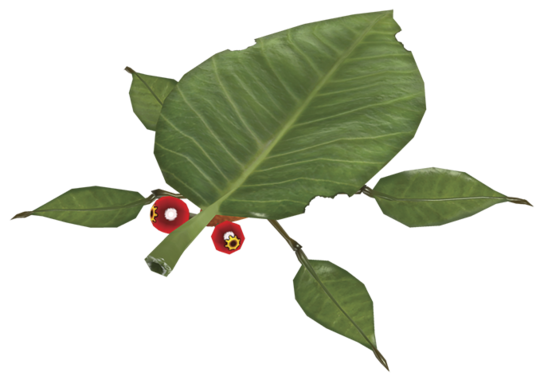
Oh, this one is cute! It's a leaf insect, except instead of an insect whose abdomen and legs had markings resembling a leaf, this is straight-up a leaf insect made out of leaves. Look at that 'mouth' that's just the cut-off stem of the leaf! Pokemon would do another elaborate plant-monster-that-resembles-an-insect in Fomantis and Lurantis, but the Skitter Leaf here communicates that it's actually a sentient plant that just looks like an insect much, much better than its cross-game cousins. Olimar himself even notes that the Skitter Leaf is apparently a mutated form of the real-life pond skater, which is... not what I expected this creature would be based on, but I can kind of see the anatomy. In-game, the Skitter Leaf seems to be there just as an extra ambience, since it is neither hostile nor a 'loot' enemy like a Honeywisp. 
______________________

Bosses;
And here we are, with the bosses of the game! There is a bunch of plants and the "Unmarked Spectralid", which are just straight-up butterflies, and a bunch of returning bosses from Pikmin 1, but here we go with the new bosses. 

Empress Bulblax (Oculus matriarcha)
The Emperor Bulblax is the final boss of the previous game (and shows up again here), but we've got the Empress Bulblax! And... yeah, the design is kind of obvious, taking a queen termite's iconic giant ovipositor abdomen. I suppose this is the big part of the Bulblaxes being grub-dogs, huh? The design is appropriately comical like most Bulblaxes, with the Empress's face and tiny legs looking just like a regular Bulblax whose butt just ballooned up into that giant termite butt.

I do like that Olimar notes that most people researching these monsters don't think that the grub-dogs are able to support an ant or bee-like eusocial structure... but then we get to see the Empress Bulblax, which apparently is only formed from the largest female in any given group in response to changes in the environment, like a lack of prey. So these Bulblaxes only enter a hive-style mentality when conditions are right, somewhat similar to grasshoppers transforming into locusts or something. And apparently it's Olimar's "enlightening" of the Pikmin that's implied to be why the Bulblaxes ran out of easy prey to hunt down! That's a fun little backstory. 

Giant Breadbug (Pansarus gigantus)
Okay, I get it. The regular Breadbug looks like a bread roll. Their boss, the Giant Breadbug, looks like a full loaf of white bread. I get the joke! Are there going to be bun or breadstick Breadbugs in Pikmin III? It basically behaves identically to a regular Breadbug but is bigger, and Olimar even lampshades that its body looks like "it was formed in a mold". I do like that we get a description of how juvenile species will compete for food with smaller Breadbugs, but will journey out in search of larger prey as it reaches maturity. Hilariously, despite looking like food, Louie bemoans the utter tastelessness of the Giant Breadbug's abundant meat.

Pileated Snagret (Shiropedes ambulatria)
We've had the Burrowing Snagret in the first game, and that creature also shows up here. The Pileated Snagret is honestly the same sort of weird snake-bird crossbreed, albeit with a head based on a different bird compared to the Burrowing Snagret. It's cool that they added a stronger boss version, but it doesn't really give me much to say here. I like that it's only got one tiny bird leg. Honestly, the Snagrets are just so utterly weird as fantasy enemies. I really want to know what the original inspiration beyond this boss's anatomy really is. 

Man-at-Legs (Pseudoarachnia navaronia)
Coming from the same Pseudoarachnia genus with the previous game's Beady Long Legs, the Man-at-Legs looks pretty similar, albeit it has a more generic-looking 'legs sprouting from the lower sides of the body' compared to the Beady Long Legs utterly alien-looking 'body suspended by legs' look. The Man-at-Legs is noted to be actually bio-mechanical, and the central 'orb' is noted to be mechanical with little steam-emitting exhaust vents. One of its four legs is even a steampunk robot leg. Apparently, in combat, the Man-at-Legs will open panels to unleash tiny machineguns to murder your little plant fairy friends. Oh no!

If Olimar's notes are to be believed, this isn't even an artificially transformed being, but that this species of Pseudoarcahnia will straight-up look for machinery and fuse with them at a crucial point during maturation, and that the 'machinery approached the arachnorb species and offered the symbiosis'. Bizarre! Apparently, the Man-at-Legs itself isn't even in control of the weapon, and it's automated. 

Raging Long Legs (Pseudoarachnia furiendis)
Ah, here we have something that's basically yet another variant on the Beady Long Legs, only this one's got a very cool, inky black-and-purple texture all around it and larger stompy-stomp legs. Olimar and the Piklopedia doesn't really offer us too much new information about this one, noting to the fact that not much is known about the Arachnorbs at all because they blow up when they are dissected. Interestingly, this creature is noted to be 'levelling terrain for no discernible reason'. Coupled with the cyborg symbiote Man-at-Legs, are they working to do something?

Ranging Bloyster (Molluschid predatoria)
The first real new boss here is related to the common Toady Bloyster up above, and it's basically the same slug/sea-slug monster, but much larger. The flower is also a lot more elaborate, and just like the flower-like organs in real-life sea slugs, they function as the Bloyster's gills. Interestingly, the Ranging Bloyster is noted to be particularly interested in shiny, flashing objects. Again, most of what I said with the Toady Bloyster applies here, I really like this thing from the way it adapts a real-life animal, and i absolutely love its open mouth and multi-tentacle attack thing. 

Waterwraith (Amphibio sapiens)
Okay what? The Waterwraith is an 'Amphibio sapiens', and it's... it is such a goddamn strange creature to behold especially comparing it to the rest of Pikmin's "weird mutant animals and plant" bestiary. Is it related to the amoeba-like Goolix or the enigmatic Progg from the previous game? What a freaking bizarre creature, looking like a crouching human made entirely out of water, but it's also wrapped its arms and legs around two cylindrical chunks of rock that allows it to move around like a bizarre car. Adding to its bizarreness, Olimar's Hocotate ship notes that 'it can be seen, but the sensors detect nothing'. So it's actually a projection of a creature from another dimension or something. 

Olimar himself notes that it's theorized to be the 'ectoplasmic incarnation of a kind of psychic phenomenon', so it's like, a g-g-g-ghost, zoinks! Everyone that sees this becomes afraid, panicked and sometimes go crazy. This is how you do a bizarre, sinister otherworldly being without going over the top with gore or fleshy mutations. Sometimes all the 'cute but unsettling' can be so much more creepy than all the Cthulhus and Satans out there. 

Segmented Crawbster (Parastacoidea reptantia)
Oooh, what the hell? This is a Crawbster? One of those cute hermit crabs that burry underground? It sure is a big, scary monsters whose face kind of looks like a butt I'm sorry that's my first impression and I cannot really unsee it. Its anatomy is sure interesting, having a shrimp's body and the fiddler crab's iconic 'one arm is larger than the other' thing that we see so often in fantasy bestiaries based on crustaceans. But instead of a regular claw, the Segmented Crawbster's huge claw is a giant chunk of flesh with blades jutting out of it.

If we're being honest, I don't really quite care for this one, but maybe like so many other video game bosses in Resident Evil or Zelda or whatever, maybe its in-game role or boss fight would make me like it a whole lot more? Design wise I feel it's serviceable as a giant crab-lobster creature. It's just that I can't get past that butt face, I'm sorry. It's probably meant to look like a crab shell or something, I know. 

Titan Dweevil (Mandarachnia gargantium)
And the final boss of Pikmin 2 and the final boss in the Piklopedia... is a giant dweevil. This one's actually got a pretty different body, with two claw-tipped 'arms' that dangle from its sides in addition to the four giant spider legs and the same two brush-esque mandible-hands that the regular Dweevils have. It's a pretty neat 'final boss', I suppose, and apparently it's got 'weapons' like that thing that is totally not a padlock and that thing that is totally not a tap tacked on to its main body. Apparently, the chemicals from the objects it acquires have caused some genetic changes that makes them far more deadly and aggressive.  That's what makes the Titan Dweevil danegrous, that it's using these tools from the race that once lived in LNP-404 (humans, but we're bigger!) as weapons. Honestly, nowhere quite as impactful as the Smoky Progg or Emperor Bulblax from the previous game, but still a pretty dang badass looking boss. 

And that's Pikmin 2 done! I don't really have much to say here, it's been a blast going through Pikmin's utterly creative bestiary!