
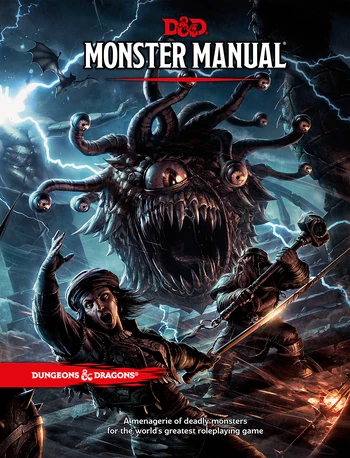
Most Monster Manuals since the 3rd Edition has always had an appendix at the back with lists of common animals and 'class' enemy templates. A lot of the space in each entry tends to be taken up by a description of what the monster is and what they do, which is important when you're talking about made-up monsters like Bulettes and Xvarts and Chasmes and Shoosuvas and Uvuudaums. You don't exactly need a paragraph explaining what a bear or a sheep or a rat is, but you do need to include them in the Monster Manual for druid shapeshifting, for ranger companions, or simply if a DM just wants some regular animals.
And for the humanoid NPCs, titles such as 'Berserker' or 'Evil Cultist' is enough, and the stat block is what's important. So for presentation's sake, the more mundane enemies have been pushed to the back of the Monster Manual. The original 5E Monster Manual contains a lot of regular animals and humans, but also some debatable ones that should have shown up as a proper entry. Axe Beaks and Winter Wolves might be handwaved for being 'just' a weird animal, but I don't think it's an excuse to put the Blink Dogs and Death Dogs and Phase Spiders and Awakened Trees in the appendix.
_________________________________________________________________
5.5E has really pulled out anything remotely fantastical out of the appendix and given them a proper entry in the body of the book. They also moved all the humanoid monsters into the main part of the book, like Nobles and Guards and Assassins and whatnot. On one hand, I'm incensed that these are taking huge chunks of the book since each monster must take at least one page; and spending half a page on splash art of, say, the Scout is likely to be the reason why some entries like the Lizardfolk or Azer had to be pared down to two sentences.
It is also a subtle, quiet way for them to shuffle the old Orc, Drow and Duergar stat-blocks and pretend they still exist in some way or form in the Monster Manual, which feels like a sneaky legal thing more than anything. But I do think I've spoken enough of this particular change to 5.5E that it's beating a dead horse at this point.
What is good is that the index is now filled almost exclusively with beasts, making familiar and druid wildshape indexing to be way, way smoother than ever before. And almost all of them have artwork now in D&D Beyond. This is going to be a special thing that I will deign to do only for the Monster Manual (and maybe Mordenkainen's) becuase every entry has a nice art and enough of a 'general fantasy' trope for me to talk about... but in future adventure modules, my rule is that I will not touch any 'humanoid with a job' statblock as a proper monster. Dragon cultists and setting-specific classes are cool and all, but I will not find anything cool to say about them. This will, hopefully, streamline a lot of the earlier 5E adventure coverage, which will be happening in a couple of months once I get through the Monsters of the Multiverse two-fer.
And, with that, I have quite exhaustively completed my coverage of both 2014 and 2024 5th Edition Dungeons & Dragons Monster Manual. This is a massively fun undertaking, and honestly has been a blast considering my own experiences with D&D over the last almost-decade. It's also going to be a great reference for me to point back to when I do the AD&D Monstrous Manual and when I finally dive through the various different 5th Edition adventure modules too!
_________________________________________________________________
- Click here for the next part
- Click here for the previous part.
- Click here for the index.
We'll start off with what was originally 'Appendix B: Nonplayer Characters' in the 5E Monster Manual, which contains humanoids.

Assassin


- 5.5E/5E: Medium humanoid (any); any alignment; CR 8
I actually really like the art here. An assassin lady with leather armour, a hood, a metal mask and a crossbow smoking with arcane magic? Pretty cool artwork! Honestly, while I question the need to give every single humanoid NPC a page with art as opposed to, say, extending a bit more on some of the monster ecology, the artwork is at least pretty cool and can be an additional inspiration for PCs or NPCS. The 2024 Manual (which is where most of anything I talk about here will draw from) gives a little table you can roll to see what quirk the assassin is known for, ranging from mundane (specific types of poison) to morbid (arranging victims in tableaux) or hilarious (they like to hide in furnishings and suits of armour).
Bandit

- 5.5E/5E: Medium humanoid (any); any alignment; CR 1/8 (Regular), CR 2 (Captain)
- 5.5E: Medium/small humanoid (any); neutral; CR 7 (Deceiver), CR 11 (Crime Lord)
I really don't like the 5E artwork, which doesn't exactly scream 'bandit' to me. He looks more like a weird confused pirate. But 5.5E gives us a medieval cowboy gang threatening a tavern, which is a bit anachronistic perhaps? Very valid interpretation of bandits, of course. I do like the little nod to tropes of bandits, and not all of them are assholes. Some of them are just desperate, or bullied by evil bandit bosses, or are driven to banditry by unjust laws.
The 5.5E really likes to add stronger 'variants' of these guys, with the Bandit having four variations in the new Monster Manual. It's a principle they did with a lot of the entries, and while I'd have added variations of, like, the Ankheg or Hamatula or whatever, sometimes you just need a bandit gang in your adventure.
Berserker
- 5.5E/5E: Medium humanoid (any); any alignment; CR 2 (regular)
- 5.5E: Medium/small humanoid (any); any alignment; CR 8 (Commander)
A lot of these statblocks, of course, are meant to be as generic-sounding as possible. Yes, a 'Berserker' could be like a barbarian in an army, or a particularly frenzied pit fighter, or even just a particularly barbaric member of the aforementioned bandit gang. These guys, of course, get faster and stronger as they get more wounded.

Commoner
- 5.5E/5E: Medium humanoid (any); any alignment; CR 0
It is important to note that not every person in the world has a 'class' attached to them. Most of the NPCs you meet in dungeons? Maybe. But in towns? It is important to note that in a general fantasy setting, most of the people live like... well, like this nice art of a random town with a lot of D&D species wandering around. But sometimes you need a stat block in gameplay to see how a commoner behaves (or to modify for your own NPCs).
The 5.5E Manual gives us a list of commoner jobs. Ready? Here we go: artist, baker, bartender, blacksmith, butcher, captive, carpenter, castaway, cobbler, cook, dyer, farmer, fisher, fletcher, flimflam artist (hee hee!), gossip, hermit, hooligan, hunter, innkeeper, laborer, lamplighter, mason, merchant, miner, mud lark, patient, pilgrim, resurrectionist, rioter, scribe, servant, shepherd, student, tailor, tanner, town crier, weaver and youngster. Did you get all that? 'Mud lark' (a scavenger) and 'resurrectionist' (a body snatcher) are new to me!
Also, note that while 5E uses 'medium humanoid' for every single one here, to accommodate for gnomes, halflings, goblins and all other short kings and queens, the 5.5E Manual uses "medium or small humanoid" to describe all of these. I'm just way too lazy to put the annotations.


Cultist


- 5.5E/5E: Medium humanoid (any); any alignment; CR 1/8 (Regular), 2 (Fanatic)
- 5.5E: Medium/small humanoid (any); neutral; CR 10 (Hierophant), CR 8 (Aberrant), CR 8 (Death), CR 8 (Elemental), CR 8 (Fiend)
You got to have these guys in any fantasy setting. Whether they're the standard demon-worshipping fanatics, or if they're in service of an evil god, an elemental, deities, or even incomprehensible beings beyond the continuum of space-time, they have differing agendas and are single-mindedly bound by a purpose. Pretty simple enemies that, I feel.
5.5E gave us a lot of cultists, one for each possible 'faction' to worship. We even get some really great art, with one shot of a bunch of death cultists doing a ritual while Orcus himself slowly steps out of a fiery portal in the background; while another art showcases an aberrant and elemental cultists fighting each other. A fiery Bigby's Hand is expected enough, but the aberrant cultist is summoning a bunch of glowing centipedes! That's so cool. All of them, really, they really do feel like what warlocks should be doing! We also get individual art of some of the cultists, with the Fiend Cultist getting a cool golden helmet, but nothing can beat the creepiness of the Aberrant Cultist having worms poke out of his mask.
And, yeah, 5E just gives us two weak Cultists, while a lot of the early adventures filled their little appendices with variations of dragon, elemental and fiend themed cultists. 5.5E just straight up gave us five new variants of cultists as stat blocks, which I did find to be a bit overkill... but the art's cool!
Druid


- 5.5E/5E: Medium humanoid (druid); any alignment; CR 2
Druids! You're reading a D&D article, you know what druids are all about; they protect the nature, speak to plants and animals, and sometimes turn to plants and animals if you try and kill the real plants and animals. I feel there's probably not a lot of 'twists' to do with a Druid. It is interesting that not all the classic classes keep their names when turned into enemies. Rangers get turned into scouts, warlocks into cultists... but druids are just druids.
Gladiator
- 5.5E/5E: Medium humanoid (any); any alignment; CR 5
Gladiators are specifically trained professional fighters who pit themselves in combat. It's a common enough trope in fantasy, isn't it? 5.5E actually gives a pretty nice writeup explaining the difference between Gladiators and like, Warriors or Berserkers, noting that they also are skilled in theatrics to keep the audience excited. We get probably one of the more useful roll tables (far more useful than the druid's) about what theatrics, specifically, your Maximus Decimus Meridius expy is going to do. Do they rile up the crowd like a wrestling match? Do they dedicate their victory to a god every battle like a football player? Do they interact with the crowd to take advice from them?
5.5E actually gave us a triton gladiator (or maybe a sea elf, it's hard to tell) winning in an underwater coliseum against a giant squid. That's a nice little twist instead of just making it fantasy Rome!

Guard
- 5.5E/5E: Medium humanoid (any); any alignment; CR 1/8
- 5.5E: Medium/small humanoid (any); neutral; CR 4 (Guard Captain)
"Stop right there, criminal scum! Nobody breaks the law on my watch!" "I used to be an adventurer like you, then I took an arrow to the knee." City guards are like, a staple in many fantasy video games, not just for the meme-y lines they say but also because a functional police force is usually the main reason you can't just skip the storyline your DM has laid out, at least not without significant effort. Original guards are laughably bad at a CR of 1/8. I get it, they're guards, not soldiers or knights, but it's nice that 5.5E gave us a 'Guard Captain' statblock at a more reasonable level.

Knight
- 5.5E/5E: Medium humanoid (any); any alignment; CR 3
- 5.5E: Medium/small humanoid (any); any alignment; CR 12 (Questing Knight)
Standing at a higher level, Knights are actual soldiers that would actually have the fighting skills to fight. Regular Knights have crossbows and the ability to parry, while the stronger Questing Knight variant has an aura around him and can even do some spells that indicate that this is meant to be an 'NPC' version of a Paladin. I don't have much to say here, they're definitely a useful statblock to have.


Mage


- 5.5E/5E: Medium humanoid (wizard); any alignment; CR 6 (Mage), CR 12 (Archmage)
- 5.5E: Medium/small humanoid (wizard); any alignment; CR 2 (Apprentice)
The Wizard 'enemy' is the Mage, who, of course, fights with spells. Almost consistently, the 5th Edition Monster Manuals use the Red Wizards of Thay as the artwork for their 'Mage' and 'Archmage' stat blocks, even in the original 5E where not all the humanoid enemies receive one. They, of course, have a bunch of spells under their belt! While the artworks display evil wizards, the 5.5E Monster Manual gives a table showcasing various versions of mage. Essentially anyone who studies magic and uses spells, and interestingly this number also includes witches, magical engineers and occult authors!
Noble


- 5.5E/5E: Medium humanoid (any); any alignment; CR 1/8
- 5.5E: Medium/small humanoid (any); neutral; CR 10 (Noble Prodigy)
Pompous, dipshit and punchable nobles are always a trope in any fantasy setting, or honestly any medieval setting. Or honestly, even in real life, if you swap out 'noble' with 'rich asshole'. I actually think the original 5E art looks believably formidable enough that he could be a knight, which, of course, Nobles can be. But these are CR 1/8, so clearly their bark is much, much stronger than their bite. They can parry you with their rapier, but there's not much combat moves beyond that, and in fact the Noble has extra skills like deception, insight and persuasion.
I love the 5.5E art with that particularly smug-looking orc noble, who most certainly dresses well although he does still look smug as all hell. The new 5.5E variant, the Noble Prodigy, stands at a surprising CR 10, being described as a noble with an actual powerful lineage that traces to a sorcerer or a dragon or a demigod, allowing them some spells to cast. Which just makes it more satisfying when you show them what-for!
Performer
- 5.5E: Medium/small humanoid; neutral; CR 1/2 (regular), CR 6 (Maestro), CR 10 (Legend)
A brand-new set of statblocks given to us by the 5.5E book are the Performers, because the original Monster Manual didn't exactly have a equivalent for bards. Pretty great artwork showing a bunch of people performing, from musicians to acrobats to a ringmaster. I also like that fantasy-rock lady with a fantasy guitar, too. Too much of these modern tropes aren't always good, but I feel the artist here made some effort to try and make this artpiece feel like someone who used items from a magic-medieval setting to set up the popstar outfit.
The Maestro and Legend variants are able to cast Bard spells, and I do like that the prose talks about the increasing popularity of each successfully powerful Performer. And, just like the Commoner, a Performer can be a... acrobat, actor, aerialist, animal trainer, athlete, burlesque artist, busker, circus performer, comedian, contortionist, dancer, daredevil, jester, juggler, magician (not a mage, though!), mentalist, mime (can he cast verbal spells?), minstrel, mourner, oral historian, poet, puppeteer, ritualist, stage fighter, storyteller, throatsinger, town crier (again?), trick rider, vocalist or wrestler. Wrestler! Such disrespect, I will have you know wrestlers should be gladiators!


Pirate
- 5.5E: Medium/small humanoid; neutral; CR 1 (regular), CR 6 (Captain), CR 12 (Admiral)
Yarrrr, me hearties. Another new one to the 5.5E Monster Manual is the Pirate stat-block, although we've had a pirate statblock in the appendix to Volo's Guide to Monsters as the 'Swashbuckler'. Pirates are a pretty core part of fantasy and I appreciate that these scallywags are counted as being distinct enough to deserve a spot separate than boring ol' Bandits.
I also like that while real-world Pirates are most assuredly all raiders, the Pirate statblock talks more about your One Piece and Pirates of the Caribbean romanticized treasure hunters and rebels from oppressive societies. I also like the brief writeup about the differences of pirate crews, how some pirate captains keep their crew in line with theatrics while others use simple fear or gold. And, of course, pirate fleets led by a Pirate Admiral also exist. I really like that both the Captain and Admiral can be so charismatic that their antics and swashbuckling can actually cause the charmed condition.


Priest
- 5.5E/5E: Medium humanoid (any); any alignment; CR 1/4 (Acolyte), CR 2 (Priest)
- 5.5E: Medium/small humanoid; neutral; CR 12 (Archpriest)
The NPC equivalent of a Cleric, we also get a table for the various types of Priests ranging from healers in churches to exorcists to lone followers to obscure gods to shamans to zealots. They draw power from faith to heal and cast holy spells. Again, you all know what priests are. 5.5E adds the 'Archpriest' as a more powerful version of the Priest.


Scout

- 5.5E/5E: Medium humanoid (any); any alignment; CR 1/2
- 5.5E: Medium/small humanoid; neutral; CR 3 (Scout Captain)
The Scouts are those that hunt and track in the wild, and the book also notes that the stat-block could also be used to represent archers, bounty hunters or outriders. That's fine and dandy, but you're just representing the 'archer' part of the Ranger flavour, though. Even with the new 'Scout Captain', where is my Beastmaster enemy? That's the coolest of the Ranger subclases! Although I suppose killing a Ranger and his/her pet bear or wolf or dire weasel is kind of a dick move, so okay.
Spy
- 5.5E/5E: Medium humanoid (any); any alignment; CR 1
- 5.5E: Medium/small humanoid; neutral; CR 10 (Spy Master)
Very cool artwork of a couple of spies infiltrating a fancy party. Really gives me Dishonored or Assassin's Creed vibes as these two are trying to get information, charm adversaries or steal something. They have a lot of skills in stealthy tricks, and the Spy Master even has a smoke bomb to do that Batman trick to escape!


Tough (a.k.a. Thug)
- 5.5E/5E: Medium humanoid (any); any alignment; CR 1/2
- 5.5E: Medium/small humanoid; neutral; CR 4 (Tough Boss)
Not the most inspiring stat block or artwork, 'Tough' seems to just be the most boring one of these. Yeah, I guess they're meant to be the 'big burly thug' trope, either a bodyguard or street gangs or whatnot, but that's just... that's just a Bandit or a Guard, right? 5E calls this stat block 'Thug', which has a bit more flavour, but 5.5E renames it to 'Tough'. I don't know. I just find this to be kind of redundant, but I'm not going to spend much energy talking about it.

Warrior
- 5.5E/5E: Medium humanoid (any); any alignment; CR 1/8 (Warrior Infantry in 5.5E, Tribal Warrior in 5E)
- 5.5E/5E: Medium humanoid (any); any alignment; CR 3 (Warrior Veteran in 5.5E, Veteran in 5E)
- 5.5E: Medium/small humanoid; neutral; CR 10 (Warrior Commander)
And finally we have 'Warrior' as a catch-all term for any professional who make a living in battle. They're not Knights, I guess, as they're more 'Fighter' than 'Paladin'. The Original 5E provided the original stats for Veteran and the very unfortunately named Tribal Warrior, and they're just all renamed to various versions of Warrior now. The artwork also shows off a Warrior Commander, represented here by an Aasimar spreading his wings.
Anyway, there's not much to say here... wait, did they not have a NPC-enemy version for the Monk? Man, poor Monks.
_________________________________________________________________
And now, we've got the animals! Which... again, this is probably the only time I'll ever go in-depth into a Monster Manual's 'regular animals' segment, and that's mostly because 5.5E actually provides art online for every single entry. Which is important for tokens, I suppose. And having animal stats like this is important because of how multiple classes and some monsters interact with animals. Rangers tame them, and Druids can turn into them. Thus having a quick 'this is close enough' stat block for most animals is a rather important if underappreciated part of any fantasy RPG.
Or you can just toss wolves and bears at your adventurers, like the beginning of practically every 'realistic' RPG out there. But why would you, when giant centipedes and toads are an option?

Allosaurus
- 5.5E/5E: Large beast (dinosaur); unaligned; CR 2
In the original 5E Monster Manual, dinosaurs got their own entry in the 'main' part of the book, while some obviously magical creatures like Phase Spiders, Death Dogs and Blink Dogs were relegated to the appendix. More people -- significantly more people -- would know what dinosaurs are by dint of them being real world animals that have enjoyed mainstream popularity due to just fiction in general. So as much as I do love dinosaurs, I do also admit that they belong in the appendix since their stat blocks essentially amount to 'big beast'.
We do get an Allosaurus as a 'large' carnivorous dinosaur, compared to the larger T-rex which, of course, is also in the Monster Manual. Sure, the T-rex might be bigger, but the Allosaurus has functional hands. Appreciate the Allosaurus! It's purple, which I also love.

Ankylosaurus
- 5.5E/5E: Huge beast (dinosaur); unaligned; CR 3
5E gives us a bunch of dinosaur options, a couple for each major dinosaur family. The Ankylosaurus looks pretty cool here, and it honestly really does look more bizarre than some of the fictional magical beasts in these D&D books, yeah?
Some editions of D&D, particularly the more 'super-serious' 4th Edition, actually try to tone down dinosaurs entirely, giving them a 'fantasy name' of Behemoth. And I do find it a bit surprising and strange that dinosaurs is where they draw the line? Really? Real world creatures that are basically big lizards is where things become 'unrealistic' for you? But brain-eating squid-faced men, half-spider elf women and winged snake angels aren't? Let the Ankylosaurus have their entry, man, they actually spent centuries evolving these adaptations.


Ape
- 5.5E/5E: Medium beast; unaligned; CR 1/2 (Ape)
- 5.5E/5E: Huge beast; unaligned; CR 7 (Giant Ape)
Many of these creatures do have stats for a regular version and a giant version. Which I will cover together because while I'm insane for doing this, I'm not that insane. For the Ape, we've got a regular damn dirty ape at CR 1/2, and a Giant Ape at a whopping CR 7. The artwork given is a gigantic gorilla standing on a pile of human bones fighting a bunch of giant bats. It's King Kong. It's just King Kong! I appreciate it. The relative size of the 'giant animals' vary very wildly and it's most often just whatever springs to mind due to popular media, but animals that are already dangerous (or sometimes those that aren't dangerous) being larger and aggressive is an absolutely valid monster concept!

Archelon

- 5.5E: Huge beast (dinosaur); unaligned; CR 4
Inexplicably, 5.5E adds a brand-new prehistoric animal to the Monster Manual, the Archelon. I love these guys, they are 4.6-meter long sea turtles that lived during the age of the dinosaurs in the real life. And they are just straight-up ancient sea turtles, but the Monster Manual insists on slapping the '(dinosaur)' label on any large prehistoric animal, which isn't exactly accurate. I can kind of shrug it with things like pterosaurs and plesiosaurs, since it can get a bit pedantic with these ancient creatures, but the Archelon is just a big sea turtle. Come on!
Baboon
- 5.5E/5E: Small beast; unaligned; CR 0
Why does the baboon get a separate stat block compared to the ape? Remember that the Monster Manual, try as it might, doesn't actually cover all of the animal families. And understandably, representing a sea lion or a kangaroo or a bull isn't as important to a roleplaying game as having stats for, like, wolves and lions. But you have an ape and a baboon stat block? ...but not a gorilla? Like, a regular, non-king-kong gorilla?


Badger
- 5.5E/5E: Tiny beast; unaligned; CR 0 (Badger)
- 5.5E/5E: Medium beast; unaligned; CR 1/4 (Giant Badger)
A lot of these stats are mostly smaller animals for familiars and companions, but a regularly small animal can be also thrown in as an interesting opponent (or a fun ranger companion) when they are a 'Giant Badger' or a 'Dire Badger'. Anyway, I don't have much to say about badgers, but again, the Monster Manual notes for equivalent statblocks -- you could use the badger statblock for, like, a wolverine or a beaver or something, and maybe modify one or two attributes. Or you could take a look at the rest of the 300-page tome and use one of the monsters in there, maybe!


Bat
- 5.5E/5E: Tiny beast; unaligned; CR 0 (Bat)
- 5.5E/5E: Medium beast; unaligned; CR 1/4 (Giant Bat)
- 5.5E/5E: Large swarm of tiny beasts; unaligned; CR 1/4 (Swarm of Bats)
Bats are always a staple of fantasy, I think. I think it's also because of their association with vampires in general, but fighting a giant bat is a pretty cool mental image too, isn't it? As I mentioned with the Ankylosaurus, sometimes real world animals are cool enough to be a bit of a great visual sight for fantasy enemies. Or if you prefer, swarms. D&D has a bunch of rules about 'swarm' enemies that consist of a horde of the same animal acting together, which isn't exactly how a lot of these real-world swarms behave, but the fantasy is there.

Black Bear
- 5.5E/5E: Medium beast; unaligned; CR 1/2
It's a black bear! Bears, alongside wolves and boars, appear in almost every fantasy RPG out there as 'mundane' beasts. Particularly RPGs that try a bit to be more down-to-earth and build up towards more fantastical monsters. It's neat; some of these large carnivores just communicate 'danger' quickly as a starter enemy.

Blood Hawk
- 5.5E/5E: Small beast; unaligned; CR 1/8
Blood Hawks are actually a fictional type of animal original to D&D, and they are hawks with razor sharp beaks and talons that flock together and employ pack tactics to attack their prey. Most hawks and birds of prey are solitary hunters in real life. It's neat to have a fictional raptor do that, but with a name like 'Blood Hawk' I wished they did something a bit more interesting.

Boar
- 5.5E/5E: Medium beast; unaligned; CR 1/4 (Boar)
- 5.5E/5E: Large beast; unaligned; CR 2 (Giant Boar)
It's a boar! Boars can actually cause a fair amount of damage to a person if they manage to catch you unawares and gore or trample you. It sure is a boar! Sometimes they're giant boars, and they're the size of a horse or something! Which... which are just prehistoric pigs, really. I know we're talking about D&D, but one of the most charming thing about its step-sister of a game, Pathfinder, is that their take on a 'dire animal' or a 'giant animal' is actually just importing the name of a prehistoric megafauna from real life. That is adorable, I tell you!

Brown Bear
- 5.5E/5E: Large beast; unaligned; CR 1
It's a bear, but brown! Totally different from the black one, and deserves a completely different stat block!
I mean, I know I'm being an asshole and brown and black bears are different. But this is also a book that's supposed to give us a variety of animal groups, and we wouldn't get something like a bull or a giraffe or a giant mantis or a giant ant or a capybara or a salmon or a tiny puppy dog. And yes, you could argue that none of those are important for a D&D campaign, and with the limited amount of space in a Monster Manual, you shouldn't waste space on those. You are absolutely right! Neither are Bear #2 or Bear #3!

Camel
- 5.5E/5E: Large beast; unaligned; CR 1/8
Camels! Indispensable for your desert campaigns. They bite you! The oldest Monster Manuals, particularly 1E and 2E, would actually have entire chunks talking about riding animals and how to take care of them and feed them and all that stuff. But my favourite has to be 4E, which had pages for most of the prominent 'fantasy' animals, featuring a regular camel, and, like, a larger elemental fire camel.

Cat

- 5.5E/5E: Tiny beast; unaligned; CR 0
Kitty! Probably one of the more popular familiar choices out there, I would think? I'm not a cat person, but cats are cute. These stat blocks have been the source of some running jokes. A shorter one is that cats in 5E did not have Darkvision, and people joked that the entire D&D design team never owned a cat. Another joke in older edition was that the cat statblock was actually stronger than an average commoner. And these aren't meant to represent like, wildcats or lynxes or whatever. It's just a housecat! They can also kill your local blacksmith!
Constrictor Snake
- 5.5E/5E: Large beast; unaligned; CR 1/4 (Constrictor Snake)
- 5.5E/5E: Huge beast; unaligned; CR 2 (Giant Constrictor Snake)
We get a couple of variants of snakes, but as long as there is art for them I find it funny to talk about them separately. Constrictor snakes are like real-world Anacondas or Boas, who wrap around their prey and squish them until they're dead before eating their prey. They're not venomous, which is why there needs to be two different statblocks. Or more like four, since we have giant versions of both snakes. I kind of feel we have to let it slide, since snakes are another one of the archetypical 'evil animal'.

Crab
- 5.5E/5E: Tiny beast; unaligned; CR 0 (Crab)
- 5.5E/5E: Medium beast; unaligned; CR 1/8 (Giant Crab)
There's just something fun about crabs, aren't they? Whether as allies or as giant monsters fighting you, there's something simultaneously comedic and threatening about crabs in general. Crabs are one of those things that are cool to fight, even if the 'Giant Crab' isn't that threatening and is apparently as threatening as a camel despite those giant claws. The Giant Crab is only merely a 'medium' creature, making it the size of a big human at best. I have been traumatized enough by the giant crab monsters in Elden Ring and Skyrim to know that they should really be bigger!

Crocodile
- 5.5E/5E: Large beast; unaligned; CR 1/2 (Crocodile)
- 5.5E/5E: Huge beast; unaligned; CR 5 (Giant Crocodile)
Crocodiles are another one of those large predatory animals that can conceivably kill humans. And having one as an enemy is pretty neat! They can even grapple you if they successfully bite you, likely a nod to the famous 'crocodile death roll'. The stat block also includes a 'giant crocodile', which is like, a prehistoric Sarcosuchus or something if we're doing the Pathfinder thing.

Deer
- 5.5E/5E: Medium beast; unaligned; CR 0
It sure is a deer! It's Bambi. It's cute.


Dire Wolf
- 5.5E/5E: Medium beast; unaligned; CR 1
D&D and other fantasy games based on D&D have had a bit of a habit of using the adjective 'dire' to describe a 'bigger, scarier, more aggressive' version of a regular animal. Dire bears, dire boars, dire hyenas... and it's kind of a cool word, too, so I can't blame them. The problem is that 'Dire Wolf' is an actual animal, a larger prehistoric wolf from the Pleistocene era. No, Game of Thrones and D&D didn't make it up!
Anyway, Dire Wolves, like all wolves, have 'pack tactics'. Wolves are one of those animals that always show up in these settings as a basic beast monster. I actually kind of miss the days where D&D used 'Dire' as just a handwave for any regular animal that's just a bit more dangerous and feral, as the 'boss' of the animals, so to speak. Dire Bears, Dire Giant Spiders, Dire Saber-Toothed Tigers... it is such a cool sounding word, isn't it?

Draft Horse
- 5.5E/5E: Large beast; unaligned; CR 1/4
I actually won't bitch about them having multiple horse statblocks. In a make-believe tabletop game, it actually is somewhat important to note down the different types of horses since it's very likely that they encounter all the different functions of horses in the medieval world. Draft horses would be the breed pulling carriages or plowing farms.

Eagle
- 5.5E/5E: Small beast; unaligned; CR 0 (Eagle)
- 5.5E/5E: Large celestial; neutral good; CR 1 (Giant Eagle)
See, the Eagle, I get. A typical 'cool' animal, even if they're not realistically going to do much but peck and claw at your adventurer.
But the Eagle is notable for its Giant Eagle variant, which, unlike most of the other giant animals, is classified as a large celestial, with resistances to necrotic and radiant damage, and the ability to speak celestial. They don't do much else but fly around and rend enemies, but this is just one gigantic reference to the Great Eagles from Lord of the Rings, who are a sentient species.

Elephant
- 5.5E/5E: Huge beast; unaligned; CR 4
It's a big boy! It sure is an elephant. Elephants do really look threatening and quite cool, aren't they? Speaking of Lord of the Rings, that series also basically guarantees elephants to show up in a lot of fantasy works, yeah? Older D&D material even features LOTR's oliphaunts as a larger variation of the elephant!

Elk

- 5.5E/5E: Large beast; unaligned; CR 1/4 (Elk)
- 5.5E/5E: Huge celestial; neutral good; CR 2 (Giant Elk)
It's an elk, which is less cute than a deer. More reasonable for this to be an enemy, and I suppose any large-enough ungulates that headbutt you can use this stat blocks. Elks and moose can be quite creepy if done right, so I don't mind this.
And the giant elk is... another celestial, what the heck? I don't... I don't get the joke. What? Giant Eagles are from Lord of the Rings, I know. but why are the giant elks sentient celestials when the giant spider or the giant ape are just regular animals? I don't know. It just feels bizarre.
Flying Snake

- 5.5E/5E: Tiny monstrosity; unaligned; CR 1/8
Probably one of the few 'not real' animals to not get a proper page of its own is the Flying Snake. No, not the Couatl, that is a celestial messenger. This is just a cute little snake with cute little bat wings. Ain't nothing wrong with that, sometimes you don't want a boring bat or eagle or imp as a familiar, you want a flying snake. Sure. The Flying Snake is kind of a cute hold-over from older editions, where the Monster Manuals were insanely detailed enough due to being less concerned about hard statblocks, and is kind of a staple in Forgotten Realms lore. With so many other monsters not making the cut, I do appreciate that the winged noodles made it into the 'core' Monster Manual.
Frog
- 5.5E/5E: Tiny beast; unaligned; CR 0 (Frog)
- 5.5E/5E: Medium beast; unaligned; CR 1/4 (Giant Frog)
It's a froggo. The Giant Frog is a fun one, and another creature that brings a delightful mental image to think up of. It's 'merely' a medium size, but it does come with an attack that lets it swallow any being smaller than it. So gnomes, halflings, goblins...

Giant Centipede
- 5.5E/5E: Small beast; unaligned; CR 1/4
Fuck yeah, centipedes. Centipedes terrify me. Not the House Centipedes with the long legs, they're pussies. No, these tropical scolopendra motherfuckers are aggressive little bitey shits. I don't get why they don't see the same popularity in media as scorpions and spiders for 'giant arthropod' enemies in video games! But we get a marvelous artwork for it. They really do look quite impressive, even if I don't agree with the size category. What's the point of making it a 'Giant Centipede' if it doesn't tower over your heroes? Giant bug monsters are scary because we become like small bugs to them! What's the point when they're just as big as a dachshund?

Giant Fire Beetle
- 5.5E/5E: Small beast; unaligned; CR 0
For the longest time, I've always thought that the Giant Fire Beetle was a beetle that breathed fire. Or maybe an adaptation of the real-world bombardier beetle, which is able to shoot boiling acid. A real world animal that does 'acid damage'. That's cool! It's not helped by the 4th Edition Bestiary, one of the earliest bestiaries I've seen, having a full page just for different types of giant beetles.
And what does this motherfucker do, with its col artwork showing a glowing, magma-like neck and abdomen? It... it just glows. It doesn't breathe fire, it doesn't shoot fire, it's only resistant to fire. That's so lame. That is absolutely lame.

Giant Toad
- 5.5E/5E: Large beast; unaligned; CR 1
We have a 'Giant Toad' stat, even though we already have the 'Giant Frog' stat. They do basically the same thing of jumping and swallowing. There's not even the justification of the constrictor vs. the venomous snake! I like toads, sure, but in a book that made a big deal of 'only representing some animals and not those whose stat blocks could be swapped', this entry could have been -- and I'm even just drawing from other 5th Edition books -- a whale, or a dolphin, or a rabbit, or a fox...

Giant Wasp
- 5.5E/5E: Medium beast; unaligned; CR 1/2
On the other hand, giant wasps are cool. There's always something inherently cool about the very bright black and yellow colours of the vespidae, and the artwork shows a very cool oversized wasp... a wasp swarm, actually, hunting that dipshit gnome that's stolen... did he steal a wasp grub? That gnome deserves everything that the giant wasps are going to d oto him.

Giant Wolf Spider


- 5.5E/5E: Medium beast; unaligned; CR 1/4
Speaking of animals that hunt with different tactics, the giant wolf spider hunts by running at its prey. And that's what differentiates the giant wolf spider from the regular spider, which is a more web-themed enemy. They've also got better senses than their regular giant spider variants. I mean... at the end of the day I'd probably rather have like a giant dragonfly or a giant earthworm or giant ant or something to have a wider diversity and variety of giant bugs, but I can't say I'm complaining much about having more spiders.
Goat
- 5.5E/5E: Medium beast; unaligned; CR 0 (Goat)
- 5.5E/5E: Large beast; unaligned; CR 1/2 (Giant Goat)
It's a goat, and a giant goat! I... I don't have anything to add here. Baa!

Hawk
- 5.5E/5E: Tiny beast; unaligned; CR 0
It sure is a regular Hawk, not to be confused with the entirely fictional Blood Hawks! This one feels particularly made to 'just' be a companion or a familiar, dangerous enough to harangue an opponent for some extra damage. Not sure why we need this when it's essentially the same statblock as the regular Eagle.

Hippopotamus
- 5.5E: Large beast; unaligned; CR 4
One of the brand-new statblocks for the 5.5E Monster Manual, good ol' hippos make it into the base book! One of the things that seem to go through WOTC's mind when they design these appendices is whether a different statblock could substitute for the animal. So the Panther stat block can stand in for a Jaguar or a Cheetah; and a Wolf stat block can stand in for a particularly aggressive large dog. One of the horses or the deer can stand in if you really need zebras or antelopes in your game, and the giant beetle statblock is usable for a giant weevil or a giant pill-bug. Not quite so for the hippopotamus, who ranks third in the world for deaths caused by animals that aren't insects (who mostly just spread disease anyway). That's after dogs and crocodiles! Real-life hippos can be deceptively territorial, and you can't exactly get away with substituting like, a rhinoceros or an elephant stat-block for a hippo. I mean, hippos aren't exactly the most threatening thing in a world with Tarrasques, Balhannoths and Glabrezus, but they can still ruin someone's day for sure.

Hunter Shark
- 5.5E/5E: Large beast; unaligned; CR 2
Hunter sharks are large beasts, so presumably this is meant to represent great white sharks or something. Underwater combat isn't the most common thing to happen, but if it does and you're fighting real fish instead of fish-people, sharks are probably what you're going to see.

Hyena
- 5.5E/5E: Medium beast; unaligned; CR 0 (Hyena)
- 5.5E/5E: Large beast; unaligned; CR 1 (Giant Hyena)
How is a regular hyena 'CR 0'? I know the CR is calculated based on the level of a party, not a single adventurer, but surely with how D&D embraces the 'savage, opportunistic pack hunter' depictions of hyena shown in media, they would've given them a stat-block closer to the wolf or something? Anyway, hyenas are significant because of the gnolls, whose lore dictates that they tend to and are usually followed around by packs of hyenas.

Jackal
- 5.5E/5E: Small beast; unaligned; CR 0
We've also got a jackal. Which... really could've been rolled into one of the wolves or the hyena, right? They all have generic 'bite' attacks. I guess they're also here for the Jackalweres in the main Monster Manual, but I constantly forget the Jackalweres exist, so...

Killer Whale
- 5.5E/5E: Huge beast; unaligned; CR 3
And if not a shark, then a killer whale. I do like that the game designers respect that the killer whales are called killer whales for a reason; they are probably one of the apex predators of the ocean, as friendly as they tend to be depicted.

Lion
- 5.5E/5E: Large beast; unaligned; CR 1
The King of the Jungle! Or, er, of the plains. This is our first 'big cat', and big predatory felines are a bit less commonly depicted as enemies in video games or fantasy, I think? It's always wolves and bears that get the bad rap. In addition to the expected pack tactics ability, they are also able to unleash a roar that causes targets to get the frightened condition.

Lizard

Mammoth
- 5.5E/5E: Tiny beast; unaligned; CR 0 (Lizard)
- 5.5E/5E: Large beast; unaligned; CR 1/4 (Giant Lizard)
It sure is a big gecko! The 'bite' tactic does mean that the giant lizard is a nice little catch-all stat block for any large lizard smaller than a crocodile, like a particularly feral monitor lizard or a dire iguana or something. They also walk on walls! Not much to say here, again, a lot of these stat blocks do seem to be here for creative druids and shapeshifting wizards.
Mammoth
- 5.5E/5E: Huge beast; unaligned; CR 6
When an elephant is not big enough, and you need a mammoth! Big boy elephant!

Mastiff
- 5.5E/5E: Medium beast; unaligned; CR 1/8
It is interesting that the specific 'guard dog' stat block they pick is a mastiff. A very good boy at the looks of it, too, complete with doggy barding and whatnot. I do wonder why mastiffs specifically and not like, 'hunting dog' or 'war dog' or something along those lines, since mastiffs are a somewhat specific type of dog and there are lots of dogs that would be around in the medieval era.
Also, needless to say, if you kill a dog, even a pretend dog, you clearly fall on a certain side of the alignment axis.

Mule

- 5.5E/5E: Medium beast; unaligned; CR 1/8
Like real-life mules, D&D mules are just there to be beasts of burden, specifically counting as 'one size larger' for the purpose of calculating its carrying capacity. That little bit does help it stand out just a bit from its other horsey friends.
Octopus
- 5.5E/5E: Small beast; unaligned; CR 0 (Octopus)
- 5.5E/5E: Large beast; unaligned; CR 1 (Giant Octopus)
Oh, heck yeah. I am quite surprised they included a regular octopus, although, again, shapeshifting, I suppose. But a giant octopus is both realistic and a very nice 'mini kraken' enemy for any underwater-y campaign. In addition to the expected ink cloud and tentacle attacks, the octopus also has the 'compression' ability allowing itself to squeeze through things, something real octopuses can do. Unfortunately, they didn't do the cool thing and give the octopus a camouflage ability! Fuck chameleons, octopus are the real shapeshifters of nature -- look up videos of them changing their texture in addition to their body shape and colour if you don't believe me.


Owl
- 5.5E/5E: Tiny beast; unaligned; CR 0 (Owl)
- 5.5E/5E: Large celestial; neutral; CR 1/4 (Giant Owl)
I like that the different artworks show off a very stern-looking eagle owl, and a very sad, morose barn owl. Barn owls' faces creep me the fuck out. And... wait, this Giant Owl is also a large celestial? And it has spellcasting, able to cast detect good and evil, clairvoyance and detect magic? I... I guess it's a play on owls and ravens being familiars of witches. Some Harry Potter tropes might be in play here. Pretty sure Hedwig wasn't a celestial, though.

Panther

- 5.5E/5E: Medium beast; unaligned; CR 1/4
Technically, this should be 'leopard' since panthers are just melanistic panthers, but oh well. This one fits the 'stealthy big cat' predatory felines, which is basically most of them that aren't lions, tigers and smilodons.
Piranha / Quipper
- 5.5E/5E: Tiny beast; unaligned; CR 0 (Quippers)
- 5.5E/5E: Medium swarm of tiny beasts; unaligned; CR 1 (Swarm of Quippers)
A school of piranhas attacking and rending flesh from someone who fell into a river is a pretty common trope in fiction. And for the longest time, the Piranhas in D&D have been called 'Quippers'. I like this, it's a neat bit of world-building and uniqueness in the D&D-world, and I thought it was a nice nod to how real piranhas don't actually shred a living thing down to bones that quickly. But I suppose recognizability to a crowd that is newer to the game and would be searching for 'Piranha' in the book trumps out over flavour.

Plesiosaurus
- 5.5E/5E: Large beast (dinosaur); unaligned; CR 2
Another giant sea creature, you can just transform into the long-necked Plesiosaurus. A pretty fun creature! I mean, I can talk a bit more about dinosaurs and dinosaur-adjacent creatures (archosaur, that's the proper term), but then we'll be here all day. You can tell, by the way, that the original 5E Monster Manual was published before the release of Jurassic World, otherwise I can bet it'll be the Mosasaurus that would be the aquatic archosaur they would've included.

Polar Bear
- 5.5E/5E: Large beast; unaligned; CR 2
It bear, but ice. It has ice resistance.

Pony
- 5.5E/5E: Medium beast; unaligned; CR 1/8
It horse, but small.
The pony having a stat-block is more forgivable since thanks to Lord of the Rings, we have established that the halflings need to ride ponies. Now why there's a pony block and a mule block...

Pteranodon
- 5.5E/5E: Medium beast (dinosaur); unaligned; CR 1/4
And of course, just like the plesiosaurus is an obligatory sea archosaur, we get the obligatory sky archosaur. And the Pteranodon was, for the longest time when I was a small kid looking at dinosaurs in a dinosaur book instead of fictional monsters in a Monster Manual, my favourite-st thing ever. Honestly, the ability to turn into dinosaurs specifically might be one of the few reasons for me to ever play a druid.
(I don't agree that the Pteranodon would be classified as 'medium', by the way. It might be light, sure, but it's got a huge wingspan!)

Rat


- 5.5E/5E: Tiny beast; unaligned; CR 0 (Rat)
- 5.5E/5E: Small beast; unaligned; CR 1/8 (Giant Rat)
- 5.5E/5E: Medium swarm of tiny beasts; unaligned; CR 1/4 (Swarm of Rats)
Now, rats need to absolutely have a stat-block. Fighting giant rats in a sewer is like, a meme at this point. And giant rats are just that; rats the size of dogs with a bite attack. The rat is also a creature that's given the 'Swarm' variant, illustrated amazingly with an artpiece of some hapless level-1 adventurer being surrounded at all sides by mean-looking rats with glowing red eyes. Man, that has got to be one of the worst ways to go out, being torn apart by a horde of skittering vermin.
Raven
- 5.5E/5E: Tiny beast; unaligned; CR 0 (Raven)
- 5.5E/5E: Medium swarm of tiny beasts; unaligned; CR 1/4 (Swarm of Ravens)
A singular raven is absolutely needed as a statblock, yeah. Even if the Raven Queen wasn't a major godlike character in some of the D&D settings, the idea of ravens being some kind of a witch familiar or a messenger of the gods have been around for a long time.
And, of course, we also have a Swarm of Ravens as an enemy. Very Hitchcock. And anyone who scoffs at 'it's just a bunch of birds' have clearly never met the absurdly bloodthirsty magpies in Australia. Or geese. Geese are assholes, and I would absolutely remove one of the redundant equine statblocks for like, a goose. A dire goose.

Reef Shark

- 5.5E/5E: Medium beast; unaligned; CR 1/2 (Reef Shark)
- 5.5E/5E: Huge beast; unaligned; CR 5 (Giant Shark)
...or this guy. I love sharks as the next guy, but really? A reef shark and a hunter shark? And also a bigger Giant Shark? Which I guess is a Megalodon or something? I don't know. I feel like this could just bet the Hunter and the Giant Shark, since I really don't think you're going to be creating shark encounters for your campaign and use the tiny reef shark for the same reason there's not a statblock in this book for like, a Chihuahua or something.
Rhinoceros
- 5.5E/5E: Large beast; unaligned; CR 2
Hell yeah, rhinoceroses are cool and can't exactly be substituted by a different animal. I don't really have much to say, you guys all know what rhinos are.


Riding Horse
- 5.5E/5E: Large beast; unaligned; CR 1/4
Another horse! Unlike the draft horse, this one is for you to ride. And race with. Again, I grudgingly admit the horse variants are a bit more necessary since you're likely to be playing traveling adventurers.

Saber-Toothed Tiger
- 5.5E/5E: Large beast; unaligned; CR 2
It's a saber-toothed tiger! A smilodon, or something! It's only slightly stronger than a regular lion or tiger, but I suppose those giant fangs and being a bit bigger isn't exactly going to make a smilodon that much more dangerous to seasoned adventurers. I like another prehistoric beast representation.

Scorpion
- 5.5E/5E: Tiny beast; unaligned; CR 0 (Scorpion)
- 5.5E/5E: Large beast; unaligned; CR 3 (Giant Scorpion)
Oh yeah, of course the scorpion gets a little piece here. At least the venomous arthropods get properly represented as giant specimens that tower over humans. You can replicate the scorpion part of Clash of the Titans (also known as the best part of Clash of the Titans) and have large, dinosaur-sized scorpions scuttle around, trying to grab you with their pincers and sting you with that massive venomous tail.
I always found scorpions to be some of the coolest animals on earth, and I'm happy the game lets me fight or train one.

Seahorse
- 5.5E/5E: Tiny beast; unaligned; CR 0 (Seahorse)
- 5.5E/5E: Large beast; unaligned; CR 1/2 (Giant Seahorse)
...Seahorses? Okay, not what I'd expect from the fish representation in the game. Sharks, sure. Piranhas? I get that. But out of all the fishies you'd pick to represent a not-so-violent one, it's the seahorse you pick? Interesting choice. I guess the idea is for the Giant Seahorse to serve as mounts for the aquatic races like the Triton or Sea Elves, but those don't even come to 5E until later. And besides, who'd sit on a seahorse when clearly a shark is right there, available for the armies of the ocean to ride on? Seahorses aren't even that fast for a fish its size. But okay. Why not.


Spider
- 5.5E/5E: Tiny beast; unaligned; CR 0 (Spider)
- 5.5E/5E: Large beast; unaligned; CR 1 (Giant Spider)
Here we go with the giant spider, one of the few movie monsters that actually traumatized me as a kid, giving me a mild case of arachnophobia until I underwent some exposure therapy. Now I am endlessly fascinated by spiders! Anyway, the 'giant spider' or 'spider' statblock is a venomous, web-weaving spider with a moveset focused more on trapping and wrapping up its prey as opposed to the 'giant wolf spider' above.
The original 5E art for the spider is a very plump specimen which looks more like a 'spider monster' than a spider. I'm not sure if I'm explaining it properly, but the segment where the cephalothorax meets the abdomen isn't as demarcated as it should. The 5.5E artwork shows off two different depictions of giant spiders, with the top being a red hairy tarantula-esque spider and the bottom one being a spindlier, larger abdomen one that I would get would be from the family Theridiidae, which includes black widows.
Anyway, giant spiders are cool.

Swarm of Insects
- 5.5E/5E: Medium swarm of tiny beasts; unaligned; CR 1/2
We get a generic 'swarm of insects' stat block, represented in the 5.5E artwork as a bunch of generic beetles that have just freshly reduced a humanoid into skeletons. It's a pretty common trope, actually, isn't it? I don't know if The Mummy was the one that first popularized it, but that movie had a swarm of scarab beetles (which doesn't even eat meat!) reduce a human into bones. Moreso than a swarm of ravens or bats or rats, I feel like a swarm of insects is something that actually properly exists in real life, as many insects work as a pack -- not to maliciously hurt big mammals that are exponentially larger than them, but to drive them away from their nest. Bees and ants, mostly. But of course, in fantasy land, you're not expected to follow the laws of entomology... unless, like me, you are a big bug dork.

Tiger
- 5.5E/5E: Large beast; unaligned; CR 1
It's a tiger! It's a big bigger and sturdier than the panther, but not as much as the lion or the smilodon. It sure is a big cat!

Triceratops
- 5.5E/5E: Huge beast (dinosaur); unaligned; CR 5
Another dinosaur that actually looks quite cool to fight (or to ride as a mount) is a Triceratops, which also looks like it's a fantasy creature, come to think of it. A shield around its neck, lance-like horns, a beak and a body like a charging rhinoceros? Heck yeah.


Tyrannosaurus Rex
- 5.5E/5E: Huge beast (dinosaur); unaligned; CR 8
Of course, we've got big ol' T-rex as the big show-stopper of the dinosaurs, being a much larger version of the allosaurus. I'm not sure why the 5E art gave it such a... fleshy, muscular look that reminds me of the Colossal Titan from Attack on Titan, but I'm also not quite sure why it's sprouted random horns and chin-spikes in the 5.5E artwork.
It is a huge dinosaur, and... well, I'll reiterate how I think it's perfectly fine for dinosaurs to hang around in a fantasy setting. Even if you want it to be 'mostly' Tolkien-y, having dinosaurs be the regular beasts in a deep jungle or something works wonders!

Venomous Snake
- 5.5E/5E: Tiny beast; unaligned; CR 1/8 (Venomous Snake)
- 5.5E/5E: Medium beast; unaligned; CR 1/4 (Giant Venomous Snake)
- 5.5E/5E: Medium swarm of tiny beasts; unaligned; CR 2 (Swarm of Venomous Snake)
These stat-blocks are erroneously printed as 'Poisonous Snake'. Any self-respecting geek like myself will tell you that snakes are venomous, not poisonous. Venomous things kill you by chomping down and injecting venom, like a venomous stingray or a venomous snake. Poisonous things kill you if you kill them, like a poisonous mushroom!
Anyway, we get a nice representation of the other way that snakes kill their prey, with venom. Things like cobras and vipers and rattlesnakes. I do like that D&D gave us a couple different variations, with a regular venomous snake, a giant venomous snake, and a swarm of venomous snakes working together to inject as much poison as they can to you.

Vulture
- 5.5E/5E: Medium beast; unaligned; CR 0 (Vulture)
- 5.5E/5E: Large monstrosity; neutral evil; CR 1 (Giant Vulture)
I'm not sure vultures are significant enough to deserve two stat blocks, or why they couldn't be rolled up with hawks or owls or something, but sure? Vultures, I suppose, get a bit of a bad rap as well for being 'evil' scavengers and carrion-eating animals, but that's just like, the circle of life, man. Anyway, it sure is a vulture.

Warhorse
- 5.5E/5E: Large beast; unaligned; CR 1/2
And our final horse is the warhorse, who's a bit more brutal since it's trained for war and to carry knights into a war. Again, understandable that they'd have one of these being slightly more different than a riding horse or a draft horse or a mule.

Weasel
- 5.5E/5E: Tiny beast; unaligned; CR 0 (Weasel)
- 5.5E/5E: Medium beast; unaligned; CR 1/8 (Giant Weasel)
It sure is a weasel! It bites stuff and sneaks into things. I feel like them picking a weasel instead of any other mustelid is just due to the developers' love for the weasel over, say, otters or something. I respect that. I would also be remiss not to mention Critical Role's extremely tortured squirrel familiar Sprinkle, which is a cute joke about how some players can just forget entirely about their pets or familiars and bring them through heaven and hell and somehow that plucky little weasel is fortunate (or unfortunate) enough to survive.

Wolf
- 5.5E/5E: Medium beast; unaligned; CR 1/4
And we end the 5E Monster Manual appendix with the humble wolf. You all know what wolves are! The big bad wolf is a very typical enemy creature in any self-respecting fantasy genre. And I suppose ending on the classic monster that shows up everywhere is a nice nod to reflect on monsters in general, how our stories went from warnings of the humble wolf to fantastical dragons, gryphons, basilisks, oni, chupacabras, strigoi, manananggals, and all sorts of other creatures initially created to be warning stories to children and tribes of what not to do. At the end of the day, after all, in these stories, it doesn't matter whether it's a wolf or a vampire that 'gets' you, the point of the stories is not to go out into the jungle when it's dark and foggy. So yeah, we end here at the humble wolf to close off the Monster Manual.
...and, wow, yeah, I thank you and appreciate you if you made it all the way down here and actually read through everything I wrote. This is also a bit of a reminder for me not to devote too much time to talking about monsters that 'don't really matter' in a given D&D monster review, because there's really only so much you can talk about regular animals without being overly specific.

No comments:
Post a Comment