

This is part four of my coverage of Dungeons & Dragon’s 5th Edition Monster Manual. In almost any given edition of a D&D bestiary, the ‘D’ segment tends to run abnormally long due to ‘Demons’, ‘Devils’, ‘Dragons’ and sometimes ‘Daemons’ being grouped together, usually with a nice backstory to explain the fiends in a given D&D setting.
I amended that original opening to this article to say ‘almost’, because in a move I find rather counterintuitive, every single sub-type is split up alphabetically in the 2024 Monster Manual. It is admittedly done in the service of “it’s easier to search for the names we made up”, but that also comes with losing a huge chunk of introduction to what Demons/Devils (or ‘Fiends’, as the term for all these hell-dwelling villains) or even Dragons or Giants are as a whole before describing the sub-types. I don’t know. I mean, I’ve read enough D&D Bestiaries to tell you what the difference between a Barlgura and a Osyluth is, so it doesn’t affect me at all, but it doesn’t really do a particularly good job at highlighting how special some of these monster groups are, surely?
But that’s beside the point, because you’re not here to see me bitch about the indexing choices of a revision to a core sourcebook, you’re here to see me talk about monsters! Originally I had wanted both Demons and Devils to be on the same page as it had been before, but… it ran long. It ran really long, since I was also comparing designs between the two 5th Edition books. So I figured why not split it up? And we’re starting off with the chaotic Demons first in this article.
____________________________________________________
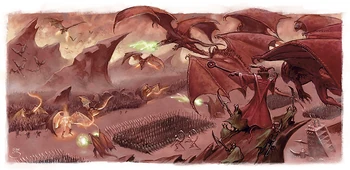
So D&D has quite a bit of fiends running around their setting. Quite a fair bit! The ones included in the Monster Manual tend to just be the ‘basic’, most common types that an adventurer is likely to encounter, but believe me when I say there’s a lot of these in the greater franchise. Demons and devils tend to be the biggest, worst, most irredeemable bad guys in the D&D cosmology, for good reason. Depending on the backstory, they are either born out of the collective energies of evil in the world; or created only by the worst mortals who found themselves rising through the ranks of the Lower Planes after they die. There are multiple different factions and the biggest two, the Demons and the Devils, are diametrically opposed against each other and fight each other probably much more than they do the forces of good.
So yeah, you could see why there’s a lot of parents going a bit crazy during the ‘satanic panic’ era of D&D with such detailed descriptions about demons in a children’s book!
Again, the primary two types of fiends are Demons (or ‘Tanar’ri’, as the fancy in-universe name is called) and the Devils (Baatezu). And the main difference is that they represent different ideas of evil. Demons are chaotic evil, Devils are lawful evil, and Yugoloths are neutral evil. We are only talking about Demons in this segment, though.
The Demons of the Abyss represent the ‘Chaotic Evil’ side of things, and that makes them the easiest to make into villains – if probably the most boring as characters. Demons just want to destroy, kill, maim, murder, conquer and do all of the basic evil stuff for the sake of pure, undiluted evil. They are not stupid or nonsapient; they just… don’t care about anything else. Most commonly, you see descriptions of how demons will even turn against each other because they’re just… evil! And chief among these Demons are the Demon Princes – characters and ancient evils like Orcus, Demogorgon and Lolth that we’ll cover outside of the Monster Manual.
But without further ado, let us go to:
__________________________________________________________________

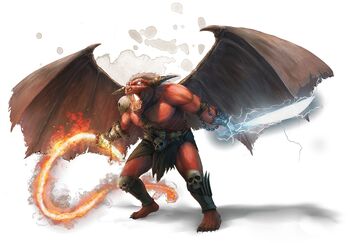
Balor
- 5.5E/5E: Huge Fiend (Demon); Chaotic Evil; CR 19
Going alphabetically, we’re actually starting with the most powerful of the demons! This is the Balor, originally named the ‘Balrog’ in the very first editions of D&D until the Tolkien estate stepped in. The name ‘Balor’ is borrowed from a one-eyed giant from Celtic mythology, but it’s still quite obvious what they were going for here.
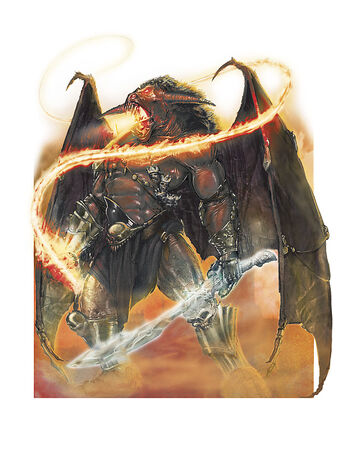
When we’re not dealing with the named Demon Princes, the most powerful demons are the Balors. They rule as the generals of the demonic armies, wielding a lightning sword and a flaming whip. Their weapons, of course, inspired by LOTR’s Balrog. It’s got a fiery aura, and they explode upon death – again, likely to be inspired by the whole bringing-down-Gandalf-with-him act that the Balrog did.
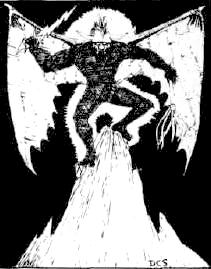
The design of the Balor has mostly been consistently Tolkien-esque – a giant red muscular humanoid with horns and giant bat-wings. Older versions of the Balor like to go for a more skull-like head, but the original 5E Monster manual design gave the Balor a head that reminds me more of a minotaur. It is nice, but as we’ll see, there are a lot of demons in D&D that are just ‘big red winged horny guys’. I think I much like the 5.5E version, which interprets the Balor as being a bit more… volcanic? It does admittedly lean a bit into looking like an elemental of sorts, but the four massive wings, the demonic lower jaw and the general vibe of it being under a volcano does in some ways make it a bit more faithful to the Lord of the Rings inspiration.


There is nothing wrong with the Balor being a staple enemy, of course. It’s a pretty classic image of a big monstrous demon guy that you have to fight, which is what the ‘Demon’ side of Dungeons & Dragons are. Balors don’t really have much lore other than that, unfortunately, due to being kind of the ur-example for a D&D demon. They’re destructive, chaotic, cruel, and did we mention they are also destructive?
Also, in a way to make these guys even more impressive, more powerful demons and devils (and in some D&D material, all demons and devils, even the weaker ones, which I thought was a bit much) don’t actually die if you reduce their health to zero in any plane but their own – they just get sent back, and now an evil immortal being is back in a plane you can’t access with a grudge against you. It is a nice way to make them a bit more intimidating narratively; and to show that it’s not quite that simple to get rid of these demons.
____________________________________________________

Barlgura
- 5.5E/5E: Large Fiend (Demon); Chaotic Evil; CR 5
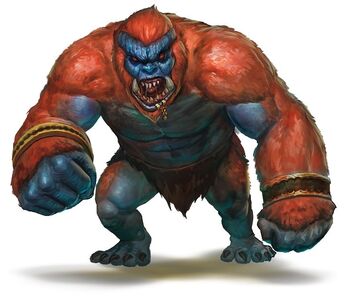
I’ve always found the Barlgura (or Bar-lgura in older editions) to be one of the less impressive demons design-wise. It’s meant to be a big demon orangutan or gorilla… but that really doesn’t scream ‘demonic’, you know? Particularly some of the older edition artwork, which could have had ‘Dire Gorilla’ under its name and would have the same impact.
And to be fair, the Barlgura’s stats is basically what you’d expect a big, elephant-sized gorilla to be able to do. The one thing that does make the Barlgura special is that in addition to having the little package of demon resistances, Barlguras are able to cast spells. Not a lot, but their favourite one is invisibility. Which is probably the thing that makes it stand out as being an actually intelligent and cruel fiend instead of just being a big angry monkey. The Barlgura gather in packs (so packs of invisible giant apes) and keep trophies from the victims they slew.

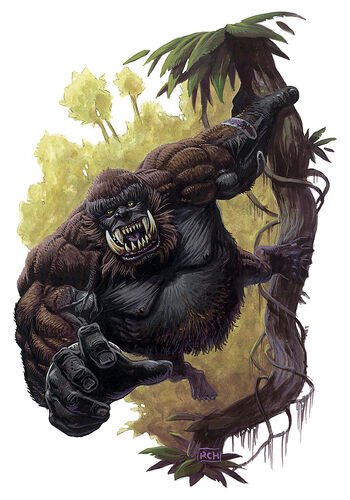

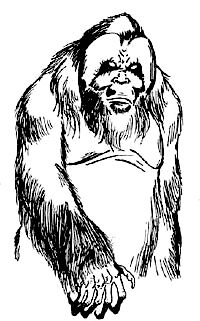
The 4th and original 4th Edition artwork just gives us a large red-furred giant gorilla with some extra fangs, eyebrow ridges and bracelets. Which… the artwork looks good and impressively intimidating, but it’s still a giant monster ape instead of a giant demon that looks like an ape. 5.5E, I think, reinvents the Barlgura a lot and makes it actually look far more demonic. The base looks like a shaggy orangutan, the ones with those fleshy cheeks, but it’s also got a couple of extra features on its face that marks it as being something a bit more unnatural. The two giant demonic horns are a nice start, but the mouth being arranged in an almost circular shape is a lot more threatening than the more natural mouth of the 5E Barlgura. And, of course, it’s got clusters of red, beady eyes. Just adding more eyes does help to make the Barlgura feel a lot more weird and more fiendish. I thought this was a really good redesign, keeping the basic silhouette and concept of being a ‘big demon ape’ while not actually being just that.
____________________________________________________

Chasme
- 5.5E/5E: Large Fiend (Demon); Chaotic Evil; CR 6
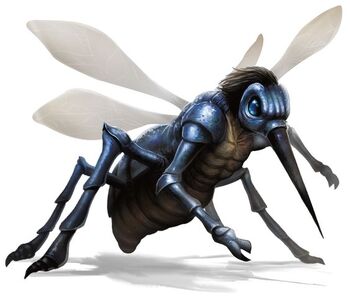
Another one of the ‘mid-tier’ demons is the Chasme, who’s just a big bug guy! 5E’s Chasme isn’t really the most interesting bug-man, but I do respect what they’re going for there. It’s a giant mix of like, fly and mosquito and wasp, but with the head noticeably more humanoid, it’s got a clump of human-looking hair and it’s got arms that have more primate-looking shoulders. 5.5E does not reinvent the design, but the simple addition of blood-red colour for the Chasme’s eyes does make it look a lot more threatening and a lot less ‘buggy’.
The 5.5E artwork also makes it a bit more clear that this is a big bug, the size of a horse instead of the somewhat human-sized look that the 5E seems to imply. The Chasme fights with its proboscis to steal health from its prey, but it’s also able to unleash a droning from its wings that causes lethargy. Being somewhat weaker demons, the two 5E Monster Manuals give them different roles in the demonic ecosystem. 5E treats them as interrogators and taskmasters, capturing and grabbing any demons that have betrayed more powerful ones just for an excuse to torture them; while 5.5E gives them a more sycophantic streak and has them be on the hunt for recruiters to force to join into demonic hordes. This was their ‘thing’ in older editions, where the Chasme were particularly unpopular among other demons due to them snitching to more powerful ones about any treachery or desertion going on.
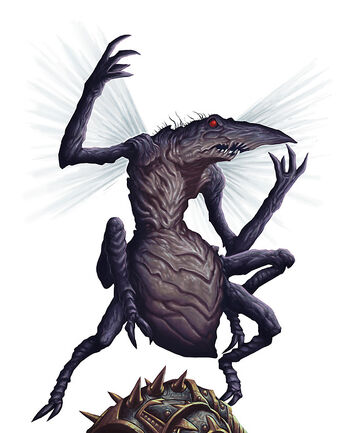


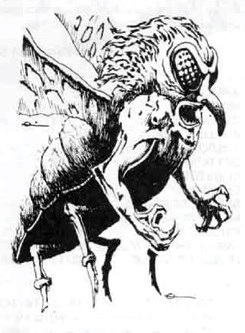
Insects have long been associated with hell (particularly the Judeo-Christian demonic figure Beelzebub) so having a demon based on insects is kind of expected. I just really am not the biggest fan of the 5E Chasme, which felt so… so basic. 1E and 2E gives their Chasmes old-men heads, which might look goofier but also gives them a somewhat Boschian vibe to them. 3E and 4E goes for a grislier and edgier look, making the stinger into something blade-like or shark-like, but keeping the bug anatomy. As much as I appreciate the contrast of the mosquito-faced 5E Chasme from the rest of the demons and devils, I also find the other interpretations of the Chasme quite charming.
____________________________________________________

Dretch
- 5.5E/5E: Small Fiend (Demon); Chaotic Evil; CR 1/4 (regular)
- 5.5E: Large Swarm of Small Fiend (Demon); Chaotic Evil; CR 4 (Swarm)
Both the Demons and Devils have two ‘loser’ variants that stand at the very bottom of the rung, the absolute worst of the worst of the ‘evolutionary ladder’ of the fiends. For the demonkind, the Dretches are the weakest, being barely more powerful than a human commoner and only being able to do basic attacks and unleash a fetid, smelly cloud. Functionally, they are there more as a story flavour thing – to describe how the stronger demons are oppressing weaker ones of their kind; as disposable goons for the enemy forces to labour for them; or as simple roadblocks in your campaign through the Abyss. You need to fill your hellscape with suffering beings, after all, and the Dretches are there for that purpose.
The Dretches are described to absolutely be pathetic, and even their name almost elicits a sense of pity. They are described as repulsive, self-loathing, and will ‘spend eternity in a state of perpetual discontent’. But they’re mean, and they just gather around ‘voicing their displeasure as an unsettling din of hoots, snarls and grunts’. 5.5E gives them a bit more of a lore, noting that dretches are embodiments of petty instincts, chaotic impulses and violent urges.
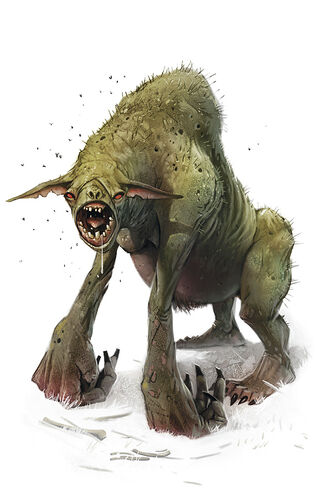

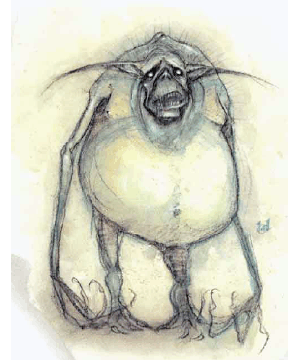

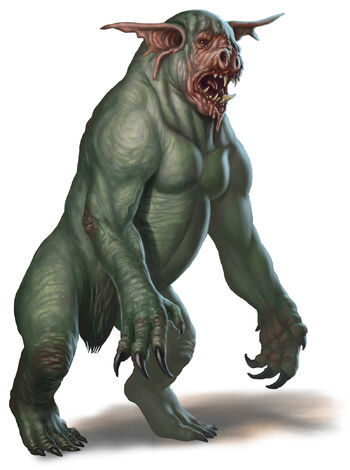
This is another one that goes through a fair bit of revision. I actually am not a fan of the original 5E Dretch, which looks more like a weird decayed-muppet face on an ape’s body. Which still looks somewhat threatening. 5.5E does a better job of taking the 5E design, compressing it, and putting a lot of mean-looking sores and making the face a bit more demonic. The 5.5E Manual giving us a ‘Swarm of Dretchs’ stat block, which is a nice nod to how the demonic hordes probably utilize these little guys.
But I do really like the older Dretches as well. 1E and 2E has their Dretches just be big pot-bellied men with very thin hands, which also adds to the sometimes-lore that these weak demons are a form of punishment that powerful demons who have failed or defeated are ‘demoted’ into. But I do like the 3E and 4E Dretches for looking so pathetic, with the deformed knuckle-arms and the particularly wretched-looking face. As much as I do like the 5E artwork, I felt the older ones catch the essence of the ‘loser fodder demons’ a lot better. With a name like 'Dretch', I felt like they should look misshapen and pathetic instead of the actually somewhat-threatening look that 5E went for. The loss of those distinctive arms is kind of a shame, in my opinion!
___________________________________________________


Glabrezu
- 5.5E/5E: Large Fiend (Demon); Chaotic Evil; CR 9
Out of all the ‘base’ demons that always gets reprinted in the first Monster Manuals of all D&D editions, my favourite has always been the Glabrezu. I felt it struck a nice balance between being a big red-skinned humanoid-with-some-animal-parts, while also having a unique silhouette that makes it unmistakable from other fantasy demons.
The Glabrezu’s original concept has remained somewhat consistent through the various editions, although it has grown more and more menacing from the four-armed dog-man it started off as. 2E in particular gave us an adorable Glabrezu! The idea is that the Glabrezu is a large, muscular red-skinned demonic man (how much the face is dog-like or just generically demonic depends on the edition) but with two giant crab-like claws for arms, and two smaller arms jutting out from the base of its torso. I felt like the juxtaposition between the giant spiky crab claws and the smaller human hands beneath give a nice sense of both balance and slightly goofy vibe of the design.
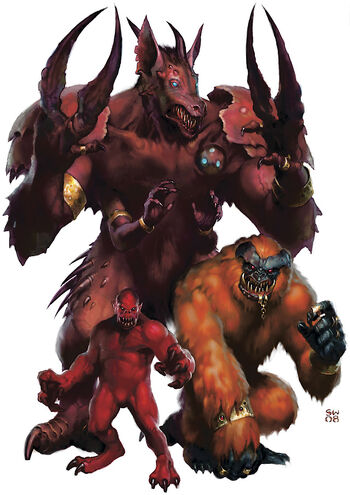


Glabrezus are also a bit more narratively interesting, because they are one of the very few demons whose mind isn’t on a one-track path towards ‘let me destroy everything’. They described as ‘demons of delusion and entrapment’ in the 5.5E Manual, and despite their brutish, giant crab-dog-man look, Glabrezus like to use guile, trickery and flattery to tempt victims to ruin. Which tends to be a more ‘devil’ thing to do, except the Glabrezu is not at all bound to the letter of the deal like devils are. Other demons summoned by aspiring cultists and warlocks either are cowed by their summoner’s power or struggling to break free. Glabrezus see this as a way to manipulate and bring even more ruin, patiently waiting and influencing their masters to betray their allies, do even more evil stuff… and then finally murder its summoner once they’ve been bad enough that their soul will be claimed by the Abyss.
There’s something to be said about how all the other demons are big scary rampaging monsters, but I’ve always found there to be a bit more to be interested about a smart villain. Not that the Glabrezu can’t fight, mind you! Once it gets tired of its mind games (or if said games are foiled), Glabrezus are happy to tear plucky adventurers apart with its gigantic claws and spells, being probably the Demon with the most spells in the base Monster Manual.
____________________________________________________

Goristro
- 5.5E/5E: Huge Fiend (Demon); Chaotic Evil; CR 17
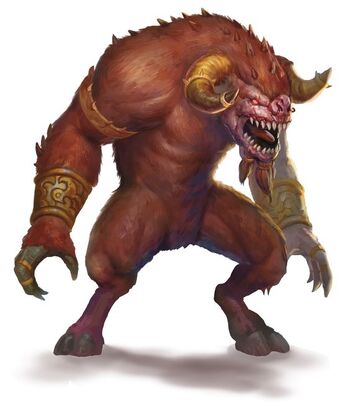
I keep forgetting how impressive Goristros are supposed to be, since they are actually classified as a ‘type 6’ demon in the original Monster Manual – on par or slightly weaker than the Balor! I think it’s because the design of the Goristro just looks fairly mundane, coming off as just a big, burly enemy like the Barlgura. The Goristro is classified as a ‘huge’ being, though, noted to be more than 20 feet tall, and is so large that they are classified as a ‘siege monster’.
The idea of the Goristro is that they are descended from the demon prince Baphomet, who also made the Minotaurs of these setting. So the Goristro is, in effect, a giant demonic cow… except I’ve honestly felt like the design deviates so much from a cow (or even a minotaur) that only the basic idea of a muscular humanoid with hooves and horns remain… and they are such common features among fiends that it takes a bit of time for me to realize that the Goristro is specifically channeling a minotaur god. The design is pretty much similar in 5E and 5.5E – a big red-furred muscular demon with claws, fangs and cow horns. Older editions are more explicitly a giant minotaur, though I found that even more boring.

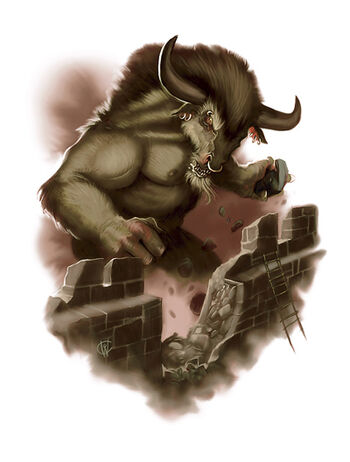
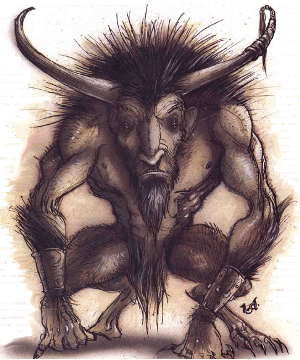
I do like the little detail that the Goristro are particularly good in navigating labyrinths and shifting corridors, a trait that minotaurs in D&D also have as a nod to the original Greek myth of the labyrinth. 5E notes that Goristros often carry a palanquin with smaller demons on its back, making it kind of like a troop carrier of sorts? 5.5E gives us a bit of a cute detail that the Goristro ‘take special offense at creatures or structures that rival them in size’. I feel like the Goristro do fill a niche and a trope in a big demon army, but I also thought they could be a bit more interesting.
____________________________________________________

Hezrou
- 5.5E/5E: Large Fiend (Demon); Chaotic Evil; CR 8
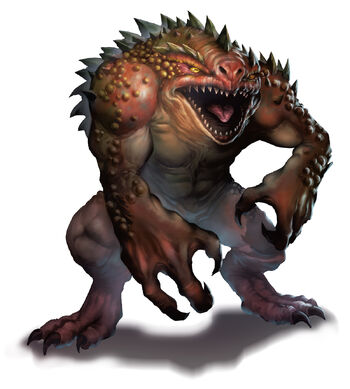
On the other side of the spectrum is the Hezrou, one of the weakest demons that are still able to fight. They’re toad-people, probably inspired by the toad-demons from the Book of Revelations in the Bible. And I actually severely dislike their portrayal in original 5E. Not that it’s a bad art or anything, mind you – the artwork is really great, a muscular toad-men with a lot of spikes down the Hezrou’s back and fangs in the mouth… but it also makes the Hezrou look a lot like the Slaadi, a different breed of extradimensional toad-people that also tend to be on the lean-and-muscular side. The Hezrous didn’t get much in the original 5E entry, being noted to be dumb, used as shock-troops and also have a smelly aura.
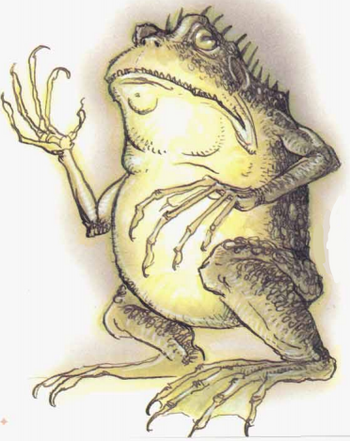
5.5E goes for a lot more of an artistic deviation, giving us a nicely corpulent Hezrou, making the Hezrou’s arms a lot chunkier and giving him clearly demonic horns and massive snaggle-teeth. This draws on the more monstrous, more burlier Hezrous from the 3rd and 4th Edition, which perhaps are a bit too threatening-looking for what’s supposed to be a mere goon. The 3E Hezrou in particular has lost what made it 'toad like'. I actually think the 5.5E version is a nice compromise in having a balance between the frogginess of 1E and 2E, the demonic burliness of 3E to 5E, but without just being a spikier Slaad.


The writeup for 5.5E Hezrou is also expanded by quite a bit, making sure we know that the Hezrou is actually quite large (ogre-sized) and giving them a ‘gluttony’ gimmick. Which I do like! The artwork actually shows the Hezrou standing atop a mountain of skeletons, and he’s even got little Sarlacc mouths with blue tongues sticking out of his shoulders and back. These little mouths are apparently ‘manifestations of embodied sins’, and they don’t always manifest in mouths, but sometimes fungal growths or half-formed features, and they just keep bubbling up on the Hezrou’s skin before disappearing.
In my original review for the Hezrou, I noted that the Hezrou felt like they were there to provide context. In that they were actual fighters unlike the Dretches and Manes, but way below everything else in hierarchy. And so they aren’t boring, they’re smelly frogs because why not? They felt like accessories without much stories of their own. What 5.5E gave them is a nice little expansion, while also keeping their role as the thugs of the demon world.
____________________________________________________

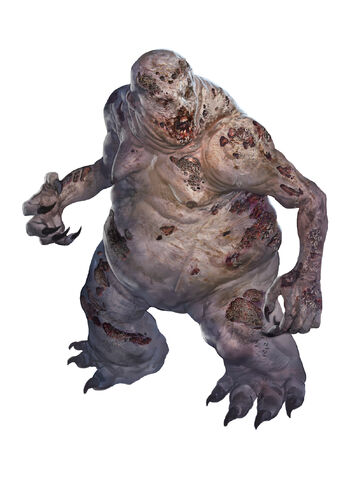
Manes
- 5.5E/5E: Small Fiend (Demon); Chaotic Evil; CR 1/8 (regular)
- 5.5E: Medium Fiend (Demon); Chaotic Evil; CR 1 (Manes Vaporspawn)
Both the Demons and Devils have a ‘super pathetic’ minion equivalent for both sides of their species. Standing even below the Dretch (which at least has would overwhelm commoners, or be a threat to wounded adventurers. Manes are the absolute lowest of the low, and narratively they function to show a ‘horrible fate’. The 5E Manual gives the backstory of the Manes as evil beings that descended into the Abyss, and was transformed into Manes as a result. More powerful death knights and warlocks might get away in keeping their identity and personality, but just a generic murderer would be turned into a Manes. It the ‘punishment’ side of things of the Lower Realms.
The Manes are utter wretches, shown off in both 5E and 5.5E as stumpy, deformed humanoids with long clawed hands and their flesh rotting off and covered in ‘abyssal parasites’. In my opinion it’s a bit less horrible than the fate of the unfortunate people cursed to be the lowest form of devilkind, the Lemures, but we’ll talk about that next time. But the Manes essentially only exist to suffer. Orcus turns them into other undead creatures like ghouls, other demon lords eat them and destroying them utterly, and in older editions they were even bartered around as living ‘soul currency’. They are just scuttling around in panic and terror through most of their immortal lives, lashing out at anything non-demonic… but considering they’re likely to be horrible people, it’s an actual karmic fate for them instead of being essentially reincarnated into a powerful demonic form.
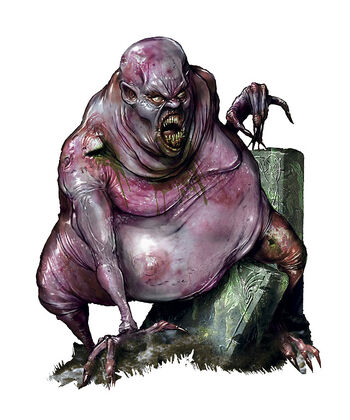


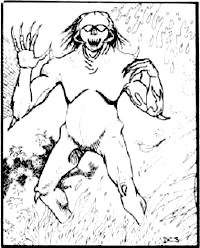
5.5E threw the Manes a bone by giving them a slightly more powerful variation, the Manes Vaporspawn. Sitting at a whopping CR 1, it’s not that much more challenging, but they are at least something to threaten your party with. Vaporspawns arise whenever a demon tortures an evil soul (whether this is a Manes or one they ‘captured’ from the Material Plane is not specified) and breaks their soul so much that they ‘undergo endless, painful contortions’. The artwork shows off the Vaporspawn as being lankier, wreathed in shadow, and having a yawning, gaping mouth. It's a pretty simple horror trope, but being that the Vaporspawn is still meant to be one of the weaker demons, it’s nothing too special.
The term ‘Vaporspawn’ is a bit of a weird misnomer since the stat block and writeup seem to imply that they’re just constantly doing contortionist movements – presumably similar to what the iconic Exorcist movie did – but it’s painful and uncomfortable, and the Vaporspawn wants you, yes you, to also experience it. It’s a variant that steers a bit too closely to feeling and looking like an undead instead of a demon for me, but it’s nice that the Manes are given a nice little stronger variant to work with.
____________________________________________________


Marilith
- 5.5E/5E: Large Fiend (Demon); Chaotic Evil; CR 16
Another one of the stronger demons, the original Marilith designs felt like the token ‘sexy girl’ demons – being six-armed, topless women with snake lower bodies. Later editions would keep most of the base features, making them as ‘just’ sexy six-armed snake-women. She was given actual armour in 5th Edition! I actually like the 3rd Edition Marilith the most for actually feeling like a snake-woman demon, with more exaggerated proportions instead of just being an honestly rather mundane-looking lady with some parts swapped out. I’ve always liked the visuals of a humanoid with a snakey lower body, but I’ve always felt the Marilith didn’t feel any more demonic or monstrous than, say, a Yuan-Ti or a Mermaid. Much less so, in fact.
Interestingly, 5.5E gave us the wildest departure ever by going full-on monster. The 5.5E Marilith’s head is a scowling demon’s head with a lot of horns, and the ‘humanoid’ body part is covered entirely with snake scales. It’s also not obviously feminine anymore (though we’re back to being naked) though that’s also part of 5.5E cutting down on ‘gender-specific monsters’ and this might represent a male Marilith? I am honestly quite indifferent to that choice. I can’t say I’m the biggest fan of the 5.5E Marilith either, although I appreciate the attempt to make the Marilith feel a bit more unique.


I do like how Mariliths were always classified as ‘Type 5’ demons using the older editions’ terminology, only below the Balor and Goristro in the hierarchy of classic D&D Demons. Mariliths are characterized as being tacticians and generals, being able to unite demonic hordes and lead them to battle. They’re still cruel and vicious, they just do so at the head of an army. It does make sense, again, that there are some layers of organization upon the thronging hordes of a Chaotic Evil army.
____________________________________________________

Nalfeshnee
- 5.5E/5E: Large Fiend (Demon); Chaotic Evil; CR 13
Like the Mariliths and Chasmes representing snakes and pest insects – animals classically associated with evil in Western culture – we’ve of course got a demon based on the pig. I’ve always appreciated how the Nalfeshnee’s design isn’t quite as simple as ‘big fat pig man’, which would be the obvious way to design a pig demon. It’s also not a dumb demon of gluttony, which, again, I appreciate! 5E does highlight how, yes, they do keep larders of food – including humanoid ones – but they also highlight just how cunning these demons are. Nalfeshnees are able to fly, teleport, communicate with minions via telepathy, and unleash a ‘horror nimbus’ from their body that infects their victims with visions of horror.
5E notes how Nalfeshnees dine in a grotesque imitation of high culture, dining on humanoids in elaborate feasts despite the horrific and stained conditions of their cutlery and lair. 5.5E elaborates on this a bit, noting that Nalfeshnees are driven by domination, which fits with their ‘horror nimbus’ abilities as a way to threaten and force a minion to obeying them. Nalfeshnees are noted to view themselves as prospective demon lords, they want to conquer realms, and they use promises of power to tempt foolish mortals. Again, taking both lores together, we do get a nice twisted mirror of the corrupt noble trope in real life.


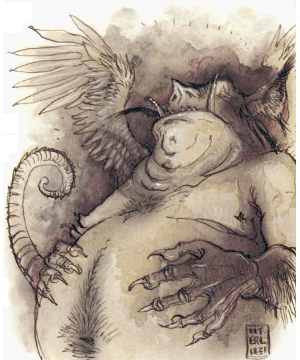
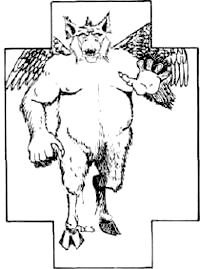
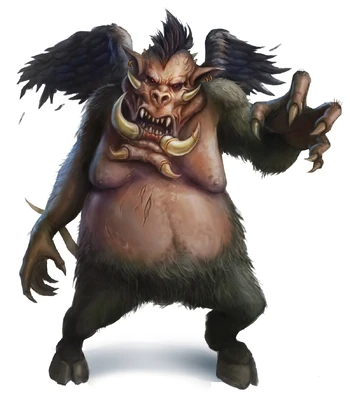
The design of the Nalfeshnee crystalized into an ‘winged gorilla-pig-man’ since around 3E. The original 5E design gives us a naked, pot-bellied brute with wings that are too small for its body, but most distinct is its head – the three pairs of tusks look a bit too unnatural for that demonic head, and you get the feeling that the ‘pig’ description was applied loosely to something that only superficially resembles a boar. The 5.5E Nalfeshnee is an interesting update, where it looks way more threatening. Apparently in the gap between editions, the Nalfeshnee really hit the gym, since this is a very muscular pig-demon! This Nalfeshnee also wears pants studded with trophies, and it’s got bigger bat-wings. But I think the head update is what makes the Nalfeshnee actually feel a lot more threatening. The obvious pig-nose is a bit too on-the-nose (heh), but I like that they kept the unnatural amount of tusks on the original 5E design, giving the Nalfeshnee two crown-like ridged horns on the sides of his head, and a mass of other smaller horns jutting all around its jaws and mouth.
On one hand, I do like that the 5.5E design made him a lot more threatening looking and badass, and makes the Nalfeshnee look a lot more like a ‘demon noble’. But there’s also the interesting subversion in the original design of a demon that you might underestimate as being something dumb and brutish. I’m glad he got pants, though, for sure.
____________________________________________________

Quasit
- 5.5E/5E: Tiny Fiend (Demon); Chaotic Evil; CR 1
Both the demons and devils also have a ‘tiny little imp buddy’ minion. Again, the trope of a literal ‘devil on your shoulder’ is a common one in fantasy, and these tiny little demon sidekicks are a great way for any fiend-related Warlock character to show off their connection with the lower planes without having a much stronger fiend run around and waylay the entire adventure. And, of course, while the Quasits themselves look weak, they’re acting as spies and little saboteurs, reporting to their masters about what’s going on with this snotty little warlock who thinks he could control the powers of the Abyss, while also goading him to do evil things.
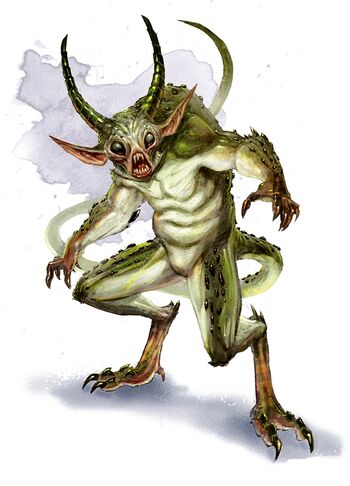
They also really look like little dipshits, which I adore. I love the really chaotic, bug-eyed face of the original 5E Quasit, and 5.5E keeps the energy despite the art-style giving him a much smoother skin that makes it look a bit friendlier. I think that buck-tooth really makes the 5.5E Quasit look cuter! They’re just little guys with claws and dinosaur feet, large horns, green skin and a tail. They’re tiny enough to ride on your shoulder or your pack, and their entire idea is to have them run around and spy on things. Quasits can turn invisible, and they can shapeshift. Specifically, their shapeshifted forms are a bat, a centipede and a toad – a different pool from their devilish cousins, the imp. In combat, their claws deal poison.
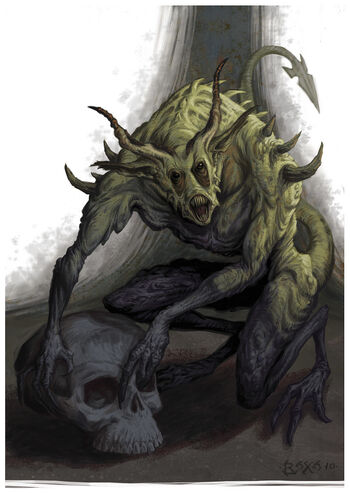


Both core sets in 5E and 5.5E do nudge these Quasits and Imps as being tailor-made for being familiars, either for player characters or for NPCs, which, again, is the narrative role that they fulfill. But it also does make sense that the more powerful demons and devils would employ these weak chittering gremlins to go around and spy on people on interest. For their part, Quasits are happy to be an obsequious servant, but it’s going to always goad their masters to acts of chaos and evil. Being little demons of chaos, 5.5E adds an extra layer to them being insanely destructive in pranks, taking delight in sabotage missions, or to cause jumpscares when they are not. I like these guys – little gremlin-demons!
____________________________________________________

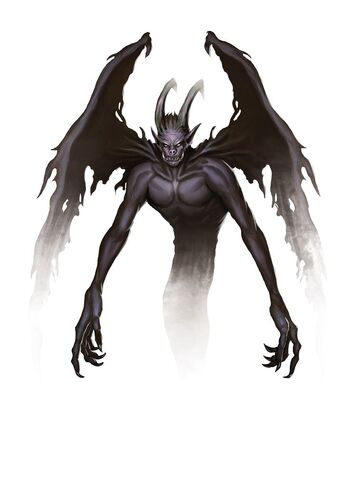
Shadow Demon
- 5.5E/5E: Medium Fiend (Demon); Chaotic Evil; CR 4
The Shadow Demons don’t get a fancy made-up fantasy name like all the others, which I really wished it did. The lore for these guys have changed over the years, but in 5E they are the souls of demons who are in mid-reforming. As I mentioned before, when they are destroyed in any plane that’s not their own, a demon’s essence will coalesce and reform in the Abyss (sometimes in a weaker form, but they will return). But sometimes through strange interactions with mortal magic – or the way they are destroyed – a demon’s essence transforms into a Shadow Demon.
5.5E note that Shadow Demons are specifically created as the incorporeal remnants of a powerful demons’ evil, meaning that they’re not made up from an entire demon that failed to reform, but from fragments bled off from a powerful demon. I guess that makes more sense if we want to explain a larger quantity of these existing in the world.


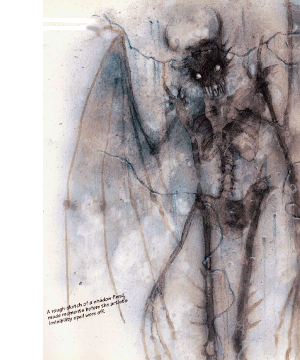
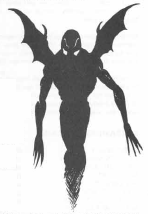
They are… well, all editions show them as shadowy silhouettes, usually legless and with horns and bat-wings. A rather familiar trope on portraying demons. As you’d expect from a being made up of shadow, they hide in the shadows, they slink around and can pass through objects, and they fear the light (which ‘forces’ them into a more corporeal form). They attack with their claws to ‘feed on memories and fears’. Ultimately they are a nice trope, even if I’m not the biggest fan of their origin story I do like that there’s at least one fiend variant that goes around as an invisible specter.
___________________________________________________

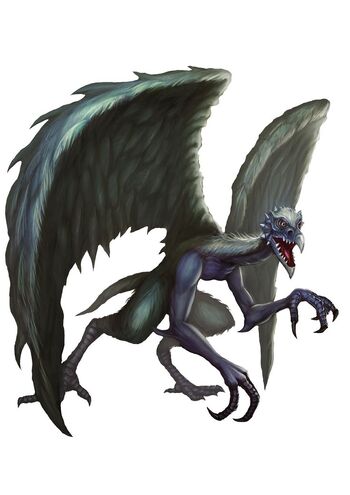
Vrock
- 5.5E/5E: Large Fiend (Demon); Chaotic Evil; CR 6
We’ve got another one of the lower-ranking footsoldiers, and the Vrock is a pretty cool concept that I think is looks particularly cool and probably my second-favourite of the classic D&D Demons. The idea of a ‘vulture demon’ isn’t particularly fresh; the basic flying demon enemy was either going to be some variation of a bug, bat or carrion bird. Some typical animals associated with demons in Western culture. But art evolution has made the Vrock from just being a monster bird to a rather grisly being, and a good chunk of what sets the Vrock apart is its gangliness, I feel. Those long limbs, and the fangs nestled unnaturally in a bird beak, sets the Vrock apart from the many, many other bird-people in D&D’s roster.
Vrocks are described to be dull-witted demons that live only to unleash pain, carnage and ruin. The 5E art already describes how the Vrock’s gnarled, bestial body reeks of offal… but the 5.5E artwork goes even further by giving us a positively decayed-looking Vrock. Those completely blank eyes and tendrils of flesh connecting the two beak halves are a great update on the 5E Vrock design, but the Vrock’s back gets the bulk of how creepy it is. It’s got tendrils of flesh and purulent growths, spikes and thorns and random ragged feathers, and even a random vestigial wing growing out of the base of its main wings. This truly looks like a half-rotting demon from hell instead of just a creepy man-bird.

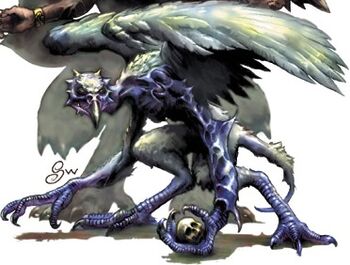

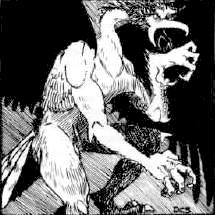
In addition to being a large bird-demon (I keep forgetting that Vrocks are a whole size class larger than most humanoids) Vrocks also have an ear-splitting screech you’d expect from a bird. In a bit of a random detail, Vrocks also can shed poisonous spores from its wings, which just felt random with all of the previous artwork… but with the nasty bulbs showcased in the 5.5E artwork, I can totally see it. I can actually remember and associate Vrocks with being disease-spreading vulture demons now!
When they are not spreading disease and suffering, Vrock fight with each other for jewellery and shiny stones, which is kind of cute. I also find the detail that they can’t actually be bargained with to be cute, since Vrocks are likely to kill you to get your shiny thing instead of bargaining with you.
____________________________________________________

Yochlol
- 5.5E/5E: Medium Fiend (Demon); Chaotic Evil; CR 10
Another favourite of mine is the Yochlol, which stands outside the ‘hierarchy’ of regular demons, such as it is. Yochlol serve the powerful demon lord known as Lolth the Spider Queen, the evil queen of the Drow. The Yochlol are handmaidens of Lolth, and are dispatched to the Material Plane as Lolth’s taskmasters and spies – sometimes to aid her devout followers but also sometimes to punish them. I normally am not the biggest fan of monsters that are so intrinsically tied to a specific part in a specific setting, but I do like the Yochlol’s design and lore.
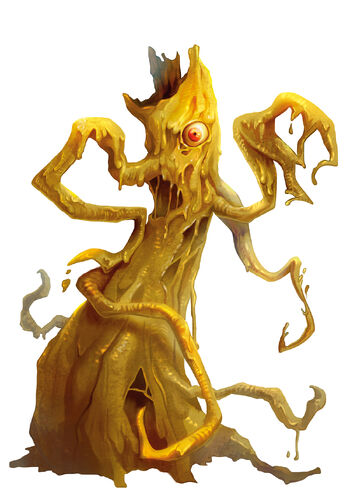
Yochlols are almost always shown to be an amorphous, pillar-like yellow glob with one eyeball and tentacles. Depending on the art, they look like mutant trees or, in the case of 5E’s Yochlol, melted wax. It’s a distinctive look overall. It isn’t the most ‘spidery’ look to a demon god known as the Spider Queen, but I also think it’s a neat way to make Lolth not so one-dimensional.

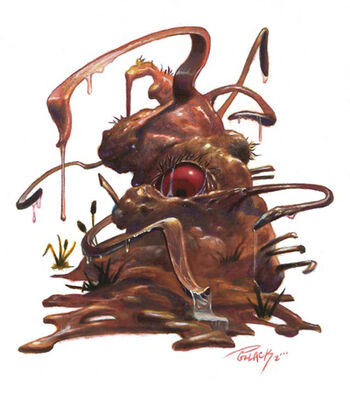

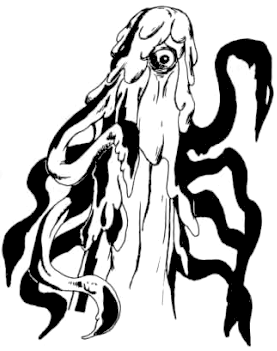
Yochlols assume the guise of either a Drow or a monstrous spider, and it interacts with Drow societies in that way. Again, it is quite interesting that neither of these aspects associated with Lolth are its true form, but a giant blob of poisonous slime. 5E notes that all Yochlols are created by Lolth, while 5.5E note that most Yochlols serve Lolth, and Lolth will destroy any of the rare Yochlols that refuse to submit to her. It is admittedly a bit interesting that Lolth and the Yochlols are characterized under the ‘chaotic evil’ banner when they are so clearly schemers and whatnot. It’s a bit of a holdover from the 1st Edition when the whole lawful/chaotic dichotomy wasn’t properly defined, but eh.
5.5E gives us a slight redesign to the Yochlol. It still looks like slime, albeit more mucus-y and with way more tendrils compared to the waxy look of the 5E Yochlol. One very notable change in appearance is what looks to be a gigantic mass of organs visible underneath the slime-tendrils in the main body. No explanation is given about this bit in the prose or abilities, but being shapeshifters, I don’t really think any is necessary. 2E and 3E also gives us some interesting variations on the design, with the 2E Yochlol looking like a phallic mass of flesh, and 3E looking kind of turd-like.
____________________________________________________
And with that, we close our coverage of the 5E/5.5E Demons of the Abyss. The original version of this article covered both Demons and Devils, which led to very truncated reviews for all the entries. I’ve decided to split it into two as I probably should have originally… I think back then I was a bit too concerned with formatting. Nowadays I’ll just allocate as much space as I think I want to talk about a particular monster.

Gonna be honest, when I saw the Hezrou my immediate thought was wondering if he was smoking a cigar
ReplyDeleteI'd see a Hezrou smoking a cigar! He could've eaten a bunch of humans, and he's just relaxing afterwards!
Delete