

We continue on with the coverage of the Monster Manual, and this page is a bit interesting because it contains not one, but two different ‘tribes’ of a creature type – the genies and the giants – which are grouped together in the original 5E Monster Manual. I have spoken a bit at length in the other reviews how much I don’t care for the 5.5E manual breaking all of these larger groups up.
The original version of this article has me talk about both giants and genies in the same article, by the way, which… which was a bit much! I barely talk about any of the sub-types of these beings, and those articles also required me to talk about a bunch of D&D staples like Gith and Goblins as well. So yeah, this revision is a nice excuse for me to split that original 'Fungi to Goblins' article to two articles.
[originally published in October 2019; revised in September 2025]
____________________________________________________

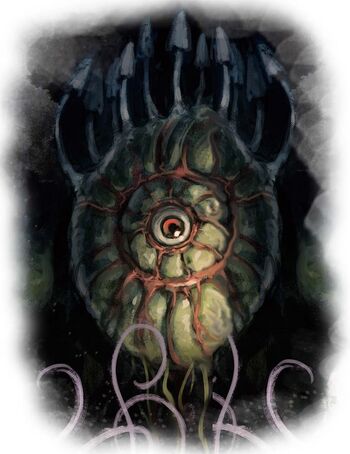
Fungus – Gas Spore
- 5.5E/5E: Large Plant; Unaligned; CR 1/2
I will preface this series of entries by acknowledging that, yes, I am fully aware that fungi are very much a different type of organism than ‘plant’. I am also fully aware that there isn’t too many fungal enemies in D&D for ‘fungus’ it be its own creature type. While the obvious solution is for D&D to print more fungal creatures, I suppose it would be impractical form a gameplay perspective – particularly since ‘plant’ itself is already a more obscure type.
The 5th Edition Monster Manual has elevated several creatures that used to be mere ‘dungeon hazards’ into getting monster entries, which I absolutely appreciate. The first among the three fungi that we are talking about is probably my favourite, thanks to its humble origins in the earlier editions of the game as a bit of a ‘haha, gotcha’ moment against the players. The original games really took the dungeon-dwelling nature seriously, leading to a lot of thought on just what kind of fantastical creatures would inhabit a dungeon… and of course, just as in real life, any building or cave abandoned for a sufficiently long amount of time will be filled with fungi.
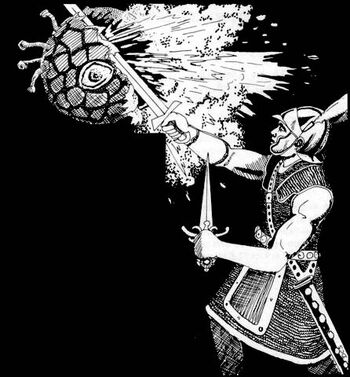
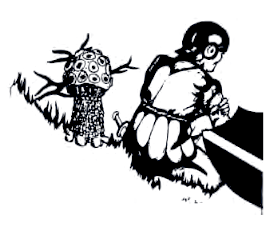
The Gas Spore is a silly little thing where it’s a fungi that is noted to look exactly like a Beholder, is explicitly easy to miss as a Beholder… but is NOT a Beholder. It’s a puffball balloon that just mimics the Beholder! And anyone who foolishly strikes this thing ends up with a face full of toxic spores. In the original 1st Edition, there was no explanation to it, other than ‘magic’, although I suppose one could make an argument about this being some kind of twisted batesian mimicry, where the fungus mimics the shape of a much more threatening species like the Beholder to keep away predators – or, since it explodes into spores, as a way to entice contact with other species to help it reproduce. Something some real-life fungi and plants actually do, like those orchids that resemble bees to increase the chances of pollination.

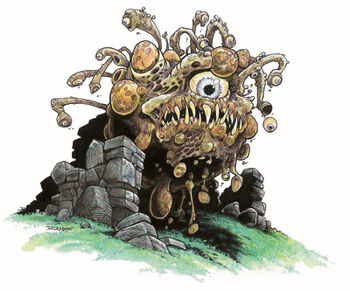
The Gas Spores in 5th Edition are given a ‘maybe’ origin story, noted to be born from dead Beholders. The fungi that grew on the corpses of the Beholder absorbs the Beholder’s reality-warping magic, and transformed to a unique species. It’s a fun design, primarily a green orb with orange ridges and an eyeball at the centre… which the manual notes as being completely non-functional, and only exists for the purposes of mimicry. Most fun are the crown of rhizomes that look like the mockery of a Beholder’s tentacle-eyes. It’s a design that is distinct enough from a Beholder, but also one that you would believably mistake as a Beholder in the darkness of a subterranean cave.
The Gas Spore floats in the air with, well, gas, as its name indicates. The Gas Spore will burst upon the slightest contact, unleashing spores onto those near enough. And these unfortunate new hosts are poisoned and will die unless cured – it’s just a matter of when. And when they die, their corpses will ‘birth’ new tiny Gas Spores. Again, this really feels like a fun twist on a magical, fantastical parasitic life cycle. The Gas Spore really only does this thing, but it does this thing so well and fits perfectly into the magical fantasy setting. I like the other two fungi presented in the book, but it’s really hard to beat a parasitic fungus that relies on mimicry to reproduce.
____________________________________________________

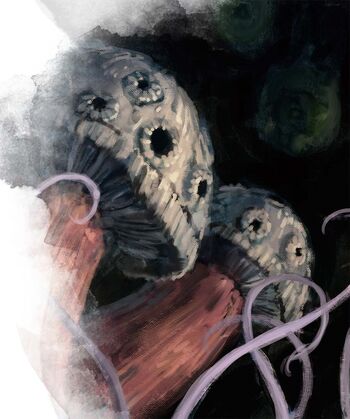
Fungus – Shrieker
- 5.5E/5E: Medium Plant; Unaligned; CR 0
Our second fungus is called the Shrieker, which is a giant mushroom… as in, it’s a ‘human-sized mushroom’. The artwork shown in the 5.5E art does show it ‘merely’ being as larger than a human head… though since it’s growing from a non-rotting corpse, this could just be a younger specimen. Shriekers in 5th Edition look like classic toadstools, but its cap is riddled with holes.

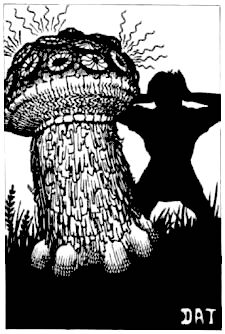
And what does the Shrieker do? Well, surprise, surprise, the Shrieker… shrieks. Loudly. That’s all it does, with not even a customary 1d4 basic attack. No, the Shrieker is just a biological alarm system that screams really loudly. This has the effect of the Shrieker being cultivated by Underdark races as literal alarm systems. The Doylist explanation is, of course, for the Shrieker to function as a trap in a dungeon run. The Watsonian explanation, though, is that in ‘the wild’, before being domesticated, Shriekers would shriek out and call in larger predators, which would kill the unfortunate fools that passed through the Shrieker’s territory. This would cause a fresh new corpse that new Shriekers could grow out from!
In 5E the two fungi are visually very different, but in the very first editions, the Shrieker actually is a mimic, and specifically noted to be indistinguishable with the next entry we’ll be covering:
____________________________________________________

Fungus – Violet Fungus
- 5.5E/5E: Medium Plant; Unaligned; CR 1/4
- 5.5E: Large Plant; Neutral Evil; CR 7 (Violet Fungus Necrohulk)
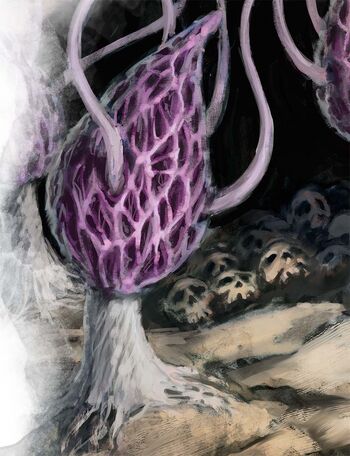
The Violet Fungus! In the very earliest editions, you can’t tell a Violet Fungus from the otherwise harmless Seeker, not until they start attacking. Violet Fungi now look visually distinct, eschewing the toadstool look for a reverse-teardrop shape pockmarked with holes. The result brings to mind something like the real-life basket stinkhorn… except the Violet Fungus is coloured violet, something that isn’t impossible in nature but not the most common colour for fungi.
From within the holes, tendrils will lash out. Simple enough… except these tendrils can rot flesh upon touch. This translates to just necrotic damage and isn’t particularly threatening in 5E, although they used to be (at least per my understanding) quite deadly in older editions. 5.5E removes the most interesting detail, which is a shame, but 5E notes that anything killed by a Violet Fungus just rapidly decays thanks to the poison, and a new Violet Fungus sprouts almost immediately. This extremely rapid and brutal reproduction is something quite cool.

With the 5th Edition nerfing the sudden death aspects of these trap monsters, I do like the solution of keeping the ‘nerfed’ regular Violet Fungus, but also adding in a much more powerful variant that works with the rules a bit better. This is, I think, a much better solution than replacing the base Violet Fungus altogether. And it even makes sense, and gives the fungus a nice ‘big boss’ to fight. Violet Fungus Necrohulks are formed when a colony of Violet Fungi grows on top of a mound of decay, and transforms into a giant Resident-Evil-esque monster. The artwork given to us is a gloriously grody mass of purple and white mycelia, arranged in the rough shape of a humanoid… except it doesn’t really have a clear ‘head’, just a mass of skulls and ribcages clustered around where its ‘chest’ is. Sprouting from its right side are two approximations of arms, and you can see ribcages and random bones littered all over the Necrohulk’s body. I also like how its mycelium root-like organs are spreading out from its feet, which is a nice showcase of how this is still technically a fungus colony that’s just stomping around temporarily.
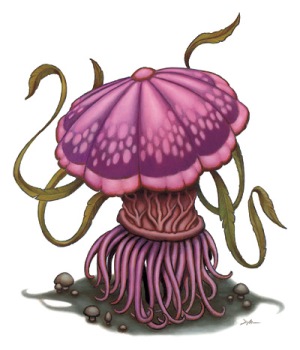
The Necrohulk mostly attacks with its ‘rotting slam’ and ‘spore bomb’ attacks, which are variations of the Violet Fungus’s regular spore attacks. Which makes sense, since the lore does briefly note that the Necrohulk ‘spreads fungal spores for the colony’, meaning that it’s kind of a more proactive version of a normal plant or fungi’s reproductive tactics. The Necrohulk can also ‘graft’ a target enemy, grabbing someone and pulling them into its body, and the Necrohulk will be healed if the trapped person is killed. You can actually see a limp, non-skeletal body on the ‘chest’ of the Necrohulk art. All you can do while being grabbed as such is to struggle and hope you break free.
Overall, the Necrohulk is a nice and very cool giant fungus monster. I honestly kind of wish we had a bit more lore instead of the two short sentences we got, and that it could have been creepier, effects-wise, compared to what we got.
____________________________________________________

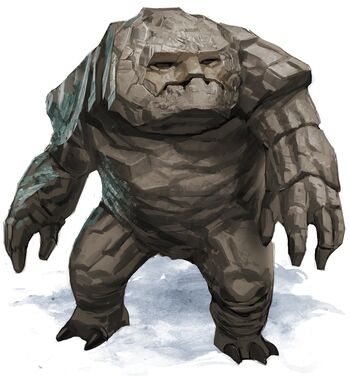
Galeb Duhr
- 5.5E/5E: Medium Elemental; Neutral; CR 6
The ‘basic’ Elementals we see in the Elemental folder tend to be just forces of nature. Sentient, at best, but not sapient. But there are many other elemental beings that exist and are also intelligent. Galeb Duhrs are one of the few such beings that appear in every edition. Originally debuting as a giant rock head with feet sticking at the bottom, subsequent editions have basically turned him into a little rock dude. The 5E Galeb Duhr looks more like a carved, stilted statue, whereas the 5.5E looks more like a cartoon rock-man with a more humanoid face and rounded proportions. I really feel like these guys could be more variable instead of having an almost standardized ‘rock human’ look. Why couldn’t we have more varied anatomy?
Galeb Duhr can come from the Plane of Earth, or just rise naturally from places where the elemental energy is strong. And if they do rise from the Material Plane, they don’t return to the elemental planes. Okay! They can hide as rocks and are indistinguishable from rocks if they are still, but they can animate rocks to fight for them and launch themselves at the enemy with the force of a catapult projectile.

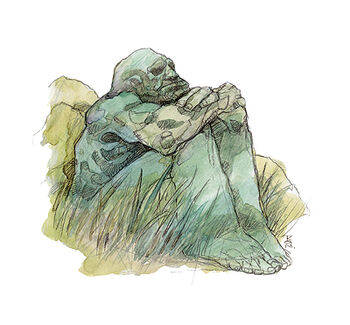

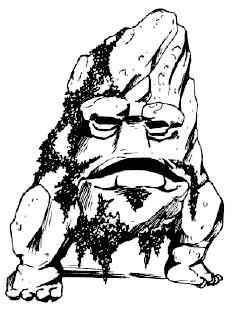
The essentially immortal Galeb Duhr also has a long memory, and will be happy to share information about its surroundings… as long as you can stand to wait and deal with its unique way of talking to people – as the 5.5E Manual describes, they speak very ponderously because of their much longer view of time. The newer writeup talks about Galeb Duhr as having its own culture of their own, as living creatures that are always there for generations next to a nearby shorter-lived society, singing their songs which can influence volcanoes and earthquakes. These smaller details, in my opinion, are much more interesting than 5E’s description of wizards or druids creating the Galeb Duhrs to protect a location… something that all the golems in the Monster Manual already do.
I still really wish that the Galeb Duhr kept some of their original 1E-2E designs where they are weird rock-faces with legs. The fact that they're almost always just little rock-people, I feel, makes them feel a bit less alien than they could be.
____________________________________________________

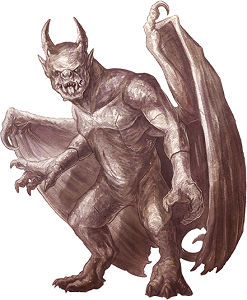

Gargoyle
- 5.5E/5E: Medium Elemental; Chaotic Evil; CR 2
Another creature of the Earth Elemental Plane is the Gargoyle, which is always something that I personally have a hard time remembering. Gargoyles being a staple in the Monster Manual is easy enough to remember, but other than the common fantasy trope of a gargoyle atop a church building revealing itself to be not just a carved stone demon but a living carved stone demon is basically the entire point of the encounter. Which is fair enough; what more do you want out of a gargoyle enemy? 5E gives us one that’s more statue, while 5.5E gives us a far more fearsome demon-looking one.
5.5E gives us a lot of ‘custom’ gargoyle features as well, which is something I appreciate a lot more as I started seeing these tables being used by my GM. Instead of going ‘Gargoyle A’ and ‘Gargoyle B’ and ‘Gargoyle C’, we instead get the ‘smiling cherubic gargoyle’, ‘gothic-devil gargoyle’ and ‘seemingly damaged, moss-covered gargoyle’. This allows the DM to more easily turn any of these NPC enemies into actual NPC characters as well!

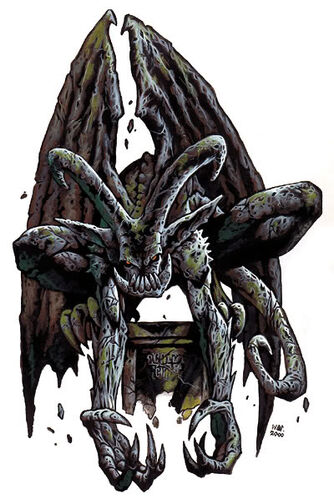

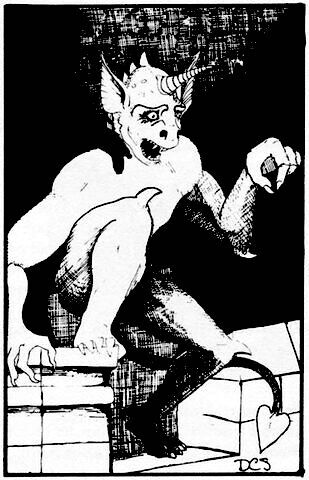
Gargoyles are noted to be able to actually hold the pose of a statue for years, making them ideal sentries and guards. They also particularly love the chance given to jumpscare adventurers or any interlopers to their territory. They’re easily swayed by any cruel master, and will obey their orders as long as they get a chance to harm enemies. According to 5E, this fearsome reputation of the gargoyles has led humanoid sculptors to create statues carved into the likenesses of gargoyles in churches and castles to deter trespassers… but it also allows the real living gargoyles to have a nice, new nesting spot that conveniently allow them to hide.
5E gives the Gargoyles some backstory as well. Ogrémoch, the Evil Prince of Elemental Earth, is credited to creating the gargoyles. Ogrémoch despises the air elementals, and in his anger and cruelty, he infused the shards of rock that are blown away into the skies in his wake with the power – making the Gargoyles a strange oxymoronic being that’s as heavy of stone but able capable of flight. 5.5E gives a less-specific origin story, noting that they’re just “sculptures inhabited by elemental spirits”. I find neither of these origin stories particularly interesting, nowhere as fun as the strange evolution of gargoyle mimicry inspiring statues that in turn allow the gargoyles to hide within those statues.
____________________________________________________
Genies
We’re going into another ‘set’ of monsters, and this time it’s the genies. Which… is an interesting topic. Jinn (often romanized as djinn or genie in English) is a term equivalent to just ‘spirits’ in Arabic mythology, and they aren’t always evil. Thanks to the particularly popular adaptations of Aladdin, however, the idea of what a ‘genie’ should be has been diluted into just a specific lamp-bound, wish-granting genie.
Interestingly, D&D decided to adapt the Jinn into a completely different niche, taking the ‘they’re neither good nor evil’ and combining it with the theme of the Elemental Realm and making all their Jinn (or ‘genies’, as the group name is called in D&D) as the sentient royalty inhabiting the Elemental Planes. Of course there are a lot of real-world discussions on how respectful or accurate they are, but I feel – especially considering the time period where D&D’s first editions were created – this is a better solution than reducing every single genie into just a wish-granting lamp-man or just ‘evil spirits’.
They have almost always been tied to the Elemental Planes, but their specific origins may differ between editions. In 5E, D&D Genies are the mightiest and haughtiest nobility of the Elemental Planes, ruling from their palaces in the Elemental Planes. They are born when ‘the soul of a sentient living creature melds with the primordial matter of an elemental plane’, which is a rare enough occasion in theory but it has happened often enough for entire civilizations of different genie types has sprung up in the D&D settings.
An aspect of genie culture that was emphasized in 5E is that genies all want to take slaves… which is a bit odd, since my brief glance through the previous editions’ Monster Manual doesn’t really emphasize this aspect. It’s especially odd since there has always been a division of ‘good genie’ and ‘bad genie’ throughout the franchise’s history, so this random slavery focus feels bizarre. 5.5E drops this, as with any mention of slavery practically anywhere, but with the genies I felt like it’s not a huge loss.

Genie - Dao
- 5.5E/5E: Large Elemental; Neutral Evil (5E)/Neutral (5.5E); CR 11
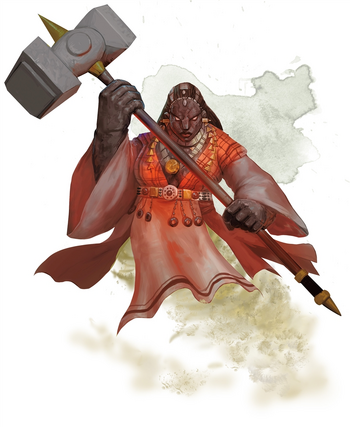
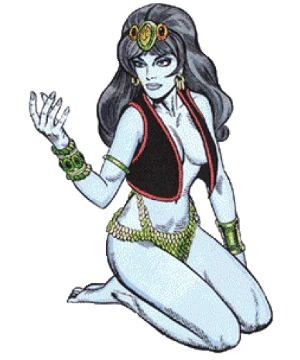
The ‘Dao’ is the Elemental Genie representing Earth, and I would also like to note that its name is not drawn from a mythological genie (or even an Arabic word) like the other genies. Bit of a shame in terms of thematic cohesion. Pathfinder renames the Earth Genie into ‘Shaitan’, which I thought is a much more appropriate term! The Dao are depicted as stone-skinned humanoids adorned in elaborate clothing and jewellery – all of the excesses and treasures associated with the Plane of Earth. The original 5E art depicts the Dao as being in flight, with her lower body transforming into a column of sand-tornado. The 5.5E depicts the Dao in her full bipedal form, and emphasizes the ‘earth elemental’ aspects by having gemstones and crystals grow out of her shoulders, legs and have an ‘aura’ of sand rising out of her head and maul. This is a lot more impressive looking, I feel, and makes it instantly know that the Dao is associated with rocks and jewels.
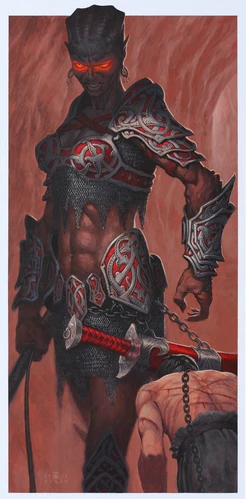
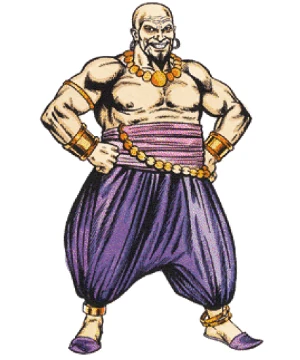
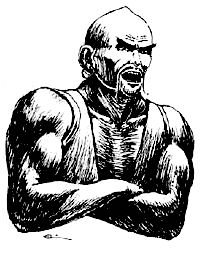
The Dao is one of the genies that are assigned an ‘evil’ alignment – something that newer books like the 5.5E manual is edging towards using wording like ‘typically’. Dao culture is apparently predicated on envy and greed. They won’t help mortals unless promised some form of treasure or slaves – but their greed makes them easy to fool and entice. Throughout the various editions, there has been some attempt at making a bit of a dynamic between the four elementals. In 5E, Daos are friendly with the Fire-aligned Efreeti, but not with the other two types of genies. In their Earth Elemental Plane, they have massive labyrinthine cities cut into the rocks of the plane which glitter with treasure.
5.5E highlights a bit more of the Dao’s abilities in their writeup. All four genies are essentially ‘spellcaster’ type enemies, with many access to thematic spells. The Dao, for example, has access to spells like Wall of Stone, Conjure Earth Elemental, Gaseous Form, Stone Shape and Move Earth; among others. Like lesser Earth Elementals, they can also move throughout the earth itself, something that they use to explore the depths of earthen planes as they look for gemstones.
____________________________________________________

Genie – Djinni
- 5.5E/5E: Large Elemental; Chaotic Good (5E)/Neutral (5.5E); CR 11
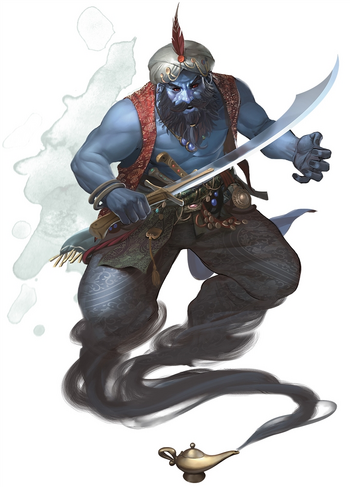
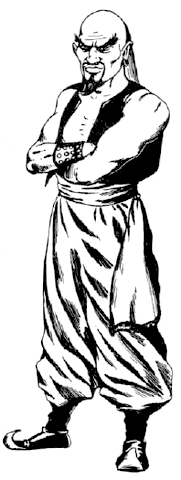
The archetypical ‘Aladdin genie’ is assigned to the Elemental Plane of Air, and is given the name Djinni. As you can see from the original 5E artwork, it’s probably the most stereotypically ‘One Thousand and One Nights’ of the four primary D&D genies, with blue skin, traditional Arabic-coded clothing, a scimitar, and having his lower body trail off into a smoky tail. 5.5E decides to just depict a purple lady with wind blowing around her, which I feel kind of loses some of this flavour.
Djinnis are noted to be ‘airy aesthetes’, where they enjoy a lot of the luxuries and opulence. The Dao might like to collect gemstones and treasures to show off, but the Djinni know how to live. Pavilions, courtyard, fountains, lots of great fruits and wine and music all around, the Djinni are the most ‘good’ of the four genies and are very favourable towards mortals. Even their ‘slaves’ are treated as members of a court more than anything – which does bear the question as to why we need to call them slaves in the first place. Again, the Djinni are meant to embody the trope of a helpful ally, so they are neutral or hostile towards all the other genies.
5.5E adds a bit more of a theme to the Djinn instead of just opulence, noting that in their many travels throughout the different planes, they also collect lore and stories, and are willing to trade them to mortals. They would get along well with Brass Dragons!


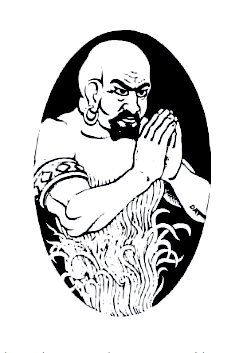
Djinni are slow to anger and even treat temporary servitude as the ‘hand of fate’. But forced imprisonment – like in a bottle or a lamp – is another thing entirely, and djinns will exact deadly vengeance to those that trap them such. After all, they are Air Elementals – the most free to fly around. Their powers and spells revolve around manipulating weather, with Djinnis being able to summon whirlwinds and thunder-waves. When they fly, of course, their lower body turns into a cute tiny little tornado – giving the classic appearance of a genie in pop culture.
It's in the Djinni entry in the 5E Monster Manual that we get the sub-bar about how to play a stronger Noble Genie, noting that powerful individuals have abilities similar to polymorph and – most importantly – wishes. Just like in the real world, all genies (not just djinn!) are able to grant cosmic-warping wishes if they are powerful enough. These are called Noble Genies; but not all genies are able to do it (which actually, again, fits with the real mythology). Noble Genies have a chance of having the ability to grant one to three wishes per year, with a cosmic law that binds and prevents a Noble Genie from doing the same wish-granting service to the same individual. That’s neat! 5.5E adds this wish granting boon on all four Genie types to emphasize that Nobles can appear in any type of Genie, not just the friendlier Djinn.
____________________________________________________

Genie – Efreeti
- 5.5E/5E: Large Elemental; Lawful Evil (5E)/Neutral (5.5E); CR 11
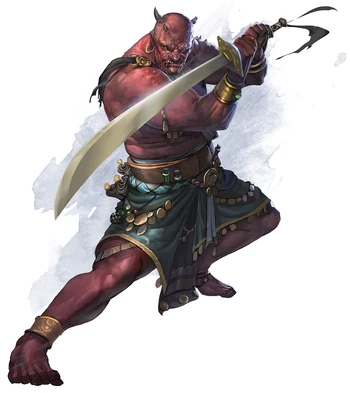
The large fire genies called the Efreeti look like hulking, muscular horned demon-men – with a somewhat oni-like look in 5E and going full-on devilish in 5.5E… which is objectively cool but also makes the Efreeti a bit harder to tell apart from actual devils and Tieflings.
The Efreeti are the designated villains of the genies, appearing in all editions even when the other genies don’t. The Efreeti are the most mechanically simple of the four genies, with the shortest spell list and having abilities that are all variations of ‘swing sword’ and ‘shoot flame’. But that’s how Efreeti are meant to be depicted, as the simple villains of the Elemental Plane. They are haughty, cruel and every edition notes how much they hate being enslaved or forced into servitude. They will raid and subjugate other creatures, and acting as tyrants to them from their fortresses in the Elemental Plane of Fire – most famous of them being the City of Brass.
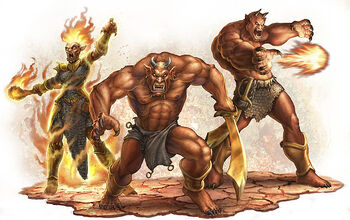

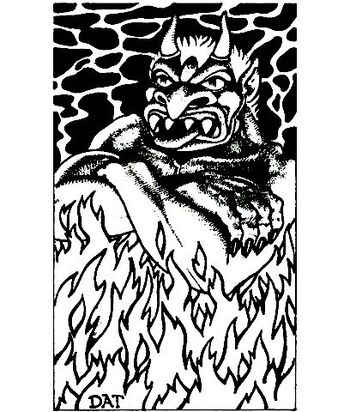
5E portrays the Efreeti as an organized army that goes for slave-hunting raids through the various planes. 5.5E tries to give a bit more variety to the people, noting that while the majority do deserve their wicked reputations, the fickleness of fire means that others are happy enough to enjoy the beauty of fireworks or even aiding mortals in missions that involve liberation of elementals. Again, while the execution isn’t perfect, I do feel like this is a nice way to deal with the ‘always chaotic evil’ labels – note that, yes, while there is a reason this reputation exists, it doesn’t mean that this is the only way that Efreeti or Orcs or Hobgoblins or Drow can behave in a world.
I don’t really have much to say about the Efreeti; they tend to be the simplest of the main Genies and take the most outright antagonistic role most of the time.
____________________________________________________

Genie – Marid
- 5.5E/5E: Large Elemental; Chaotic Neutral; CR 11
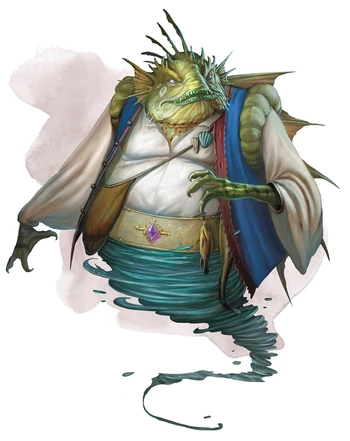
The most visually interesting of the four elemental genies is the Marid, because 5E reinvents the Marid into a pudgy fish/frog man. It’s a very striking design, and alongside the Efreeti really does do a lot to make them feel more like ‘elemental lords’. I get that they don’t want to just make another human out of water or fire because that wouldn’t be that distinctive from the regular elementals, but I like the visual difference instead of just another “dude with a swirling lower body, but with X element”.
The Marid have a bit of an ego problem, seeing themselves as more wondrous than the other three genies, but that’s probably because they’re the one with the most unique design! They really like to tell aggrandizing tales, and interrupting one such self-congratulating story is sure to earn you a Marid’s fishy wrath. They can control water with a large amount of water-themed spells, in addition to the innate ability to swim, walk and breathe underwater, or even turn into water.
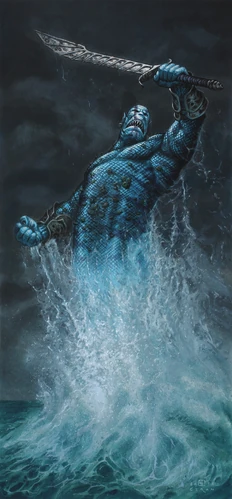

In 5E, Marids are noted to be particular about the skill of the slaves they want, as an extension of their superiority complex. However, this has also caused them to underestimate humanoid wizards, leading to Marids apparently being more easily trapped in lamps and conch shells compared to the other three genies. In 5.5E, the description removes any mention of these in favour of noting the different ways that Marids manifest through different bodies of water, and how their bodies can be as variable as the sealife itself – and they appreciate anything to do with rare oceanic treasures or mortals that defend watery realms.
Overall, as we close off this little rundown on the genies, it is kind of interesting to see how they have developed over time. Older editions, once they’ve finished talking about the elemental thing and the wish thing, tend to just forcibly insert a lot of random trivia about Arabic courts and hierarchy into the culture of the genies. 5E replacing them with the different kinds of slaves they keep feel a bit unfortunate. But I also think that there’s not a whole lot of lore or personality or encounter quirks for the four primary genies, which is a bit of a shame – they really could have done with a bit more writeups to them.
____________________________________________________

Ghost
- 5.5E/5E: Medium Undead; Any Alignment; CR 4
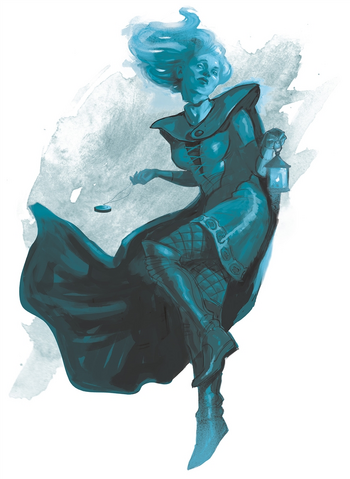
Among the many different undead types, each Monster Manual entry tries its best to embody a certain ‘trope’ in horror fiction with its monsters. The ‘Ghost’ is a bit different from something like the Poltergeist, Shadow or Banshee through some interesting mechanics. The Ghost does have some typical abilities that you’d expect from a ghost – intangibility, passing through walls and being ethereal… and it attacks you with a withering touch and a ‘horrific visage’ that deals psychic damage. But its signature ability is Possession, where the Ghost will take over a nearby person. The unfortunate possessed soul will still be fully conscious, but have no way to do anything – and only spells and abilities that can specifically target Undead can strike the Ghost instead of the possessed being. This makes the ‘CR 4’ attached to the Ghost a bit of a misnomer, especially if you meet a swarm of them – a party of four can dwindle very quickly, especially if you don’t have Clerics in the group!
The backstory behind the Ghost is as ambiguous as the general backstory for ghosts in mythology in general – it is the soul of a once-living creature, and it’s usually haunting a certain location or being that has some kind of significance. Some Ghosts are straight-up malicious and spiteful, driven by hatred, but some Ghosts tend to have some unresolved task to finish. These Ghosts that are bound to the living world by unresolved businesses might want to avenge his own death, fulfill an oath or relay a message – which also makes it a possibility for the party to negotiate with the Ghost and help it pass on.

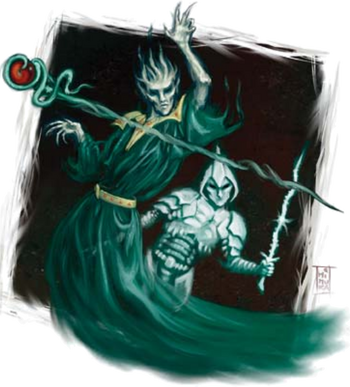

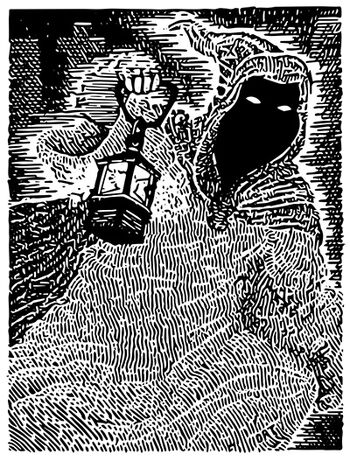
The 5E Manual gives us some rather interesting tidbits that isn’t actually reflected in the mechanics – ghosts can be ‘destroyed more easily by invoking a weakness tied to its former life’. So someone killed by, like, a farming rake would be vulnerable to being attacked by a rake; or someone who was a perfumer in life might be stunned when exposed to a familiar scent. 5.5E gives a bit more of a twist, telling us that Ghosts will have an ‘extreme reaction’. So our rake ghost might keel over in panic at the sight of the rake… or just go ballistic and become more powerful. Fun!
All of this are great ways to customize an encounter and make it feel a bit like a ‘puzzle’ to make the Ghost easier to deal with, which makes this otherwise classic and simple fantasy enemy a lot more exciting to fight. Lastly, while they’re not identified as ‘lairs’ exactly, the presence of a Ghost will warp the location they’re haunting similar to what you’d expect in a horror movie. Strange sounds, an unexplained chill, a strange decaying stench, moving objects… none of these actually ‘affect’ the battlefield like a dragon or beholder’s lair actions, but it adds a lot of nice flavour!
____________________________________________________


Ghoul
- 5.5E/5E: Medium Undead; Chaotic Evil; CR 1 (Ghoul)
- 5.5E: Medium Undead; Chaotic Evil; CR 1 (Lacedon)
We have another iconic undead, and Ghouls are one of those terms that have been so different throughout the different histories and mythologies. Originally coming from Arabic mythology, the ‘modern’ pop culture Ghoul is codified by Lovecraftian myths. There tend to be some variation to it, but Ghouls in fantasy – including D&D – tend to be some kind of undead associated with cannibalism of both the living and the dead. They’re not ‘quite’ zombies, but not quite the type of intelligent undead like a mummy or a lich.

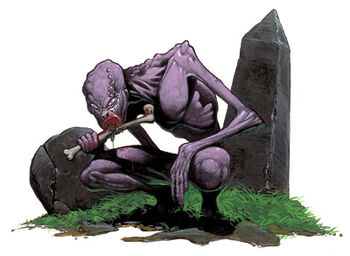


D&D’s version of a Ghoul are pale, feral humanoids that scuttle around graveyards, battlefields and any location where it can gorge on the dead humanoid flesh it desires. They also have unnaturally long tongues and claws, the latter having paralytic poison. If a Ghoul runs out of corpses to eat, Ghouls will hunt down the living and manually make corpses by killing those living things. Ghouls don’t actually need to feed to gain nourishment, being already undead, but they are gripped with such unending hunger that they need to just consume. Their undead flesh doesn’t rot, unlike zombies, allowing Ghouls to continue to just survive in whatever crypt or gravesite they’re in.
5E gives us a bit of a more elaborate backstory, noting that Ghouls are created by an elf worshipper of the Demon Lord of Undeath, Orcus. That elf cultist, Doresain, created the first ghouls through a debased ritual of cannibalism. The elven origins of Doresain is the reason why in D&D elves are specifically immune to a ghoul’s paralytic touch. 5.5E gives us a more non-specific origin story for Ghouls, noting that they can just rise from the bodies of any cannibal or any villains ‘with depraved hungers’.


5.5E restores a variant of Ghouls that are mentioned in older books, the Lacedon, which are aquatic ghouls. They get an artwork in D&D Beyond, which I appreciate! They look like creepy drowned corpses. The Lacedons are able to swim and have an icy attack. The Manual notes that they can rise from the corpses of greed-obsessed pirates, or those who starved to death on deserted islands.
____________________________________________________


Ghoul – Ghast
- 5.5E/5E: Medium Undead; Chaotic Evil; CR 2 (Ghast)
- 5.5E: Medium Undead; Chaotic Evil; CR 6 (Ghast Gravecaller)
The original 5E Monster Manual has ‘Ghast’ as just an extra entry in the Ghoul page, identifying it as a stronger version of a Ghoul. Ghasts are created when Orcus infuses a Ghoul with more power from the Abyss, granting the Ghast sentience and intelligence, making it a leader of lesser Ghouls. Ghasts have some additional abilities like a stench aura and an immunity to the ‘Turn Undead’ spell, but otherwise presumably just looks like a regular Ghoul.
5.5E gives the Ghast its own entry – albeit said entry appears before the Ghost and the Ghoul. It’s a bit of a word salad! The Ghast is shown to be teetering a bit between civilized and feral, having the same deranged expression and long tongue of a ghoul, but he at least wears clothes! Ghasts are noted to also hunger for ‘other vices’ in life instead of just hunger; such as the greed for wealth. An even stronger variant called the ‘Ghast Gravecaller’ has access to necrotic magic, making it the strongest Ghoul in the Monster Manual. Apparently, Gravecallers are smart enough to pose as a much stronger undead being like a lich or a vampire, which is something I find to be kind of a cute little detail. He’s a poser!

Love the variants they introduced, especially the Necrohulk and Poser Gahst
ReplyDeleteThings like the various Blights, the Manes Vaporspawn or the Fungus Necrohulk are how they should include variants. I think the 4th Edition manuals got a lot of hate for having 2-5 variations for every single different type of monster, but it's important to make the variants actually feel different instead of 'the tank guy, the mage guy, the sword guy' which is 90% of 4E's output.
Delete