

The big 'group' we're going to talk about here are the Giants, which is a creature type I have a bit of a love-hate relationship with. I believe that any fantasy setting should have giants in some way or form, and D&D in particular has a nice lore system called 'the Ordning' that gives these humans-but-big enemies a nice culture that explains the differences in their flavour, habitat and abilities. To use a slightly more unkind comparison, it explains their 'Pokemon types'.
It's also quite clear that Wizards of the Coast really likes the Giants, having devoted a small chunk of one of its first bestiaries, Volo's Guide to Monsters, to explaining the giants... and then a whole new book, Bigby Presents - Glory of the Giants, just entirely about giants and only giants. And I've always thought that was a bit much, especially when there are so many more interesting creatures in D&D's repertoire that deserves more of a breakdown. And out of the monsters to devote so much content to, it's the giants and not the aberrations, or fey, or undead, or celestials? Really? But I do respect that dedication on the designers' side, at the very least.
During my original run through the Monster Manual, I was really dismissive about Giants, Golems and Genies. Three subgroups that came one after the other, and that wasn't the most fair. I think I was really intent on just blazing through the Monster Manual as fast as I could. Part of me also wanted each 'reviewing D&D' portion to start and end at an iconic monster, which doesn't really matter if it ends up causing me to either rush or ramble through my reviews. Rereading my older work is a good reason why I decided to make this more thorough rewrite of the D&D reviews... and besides, as it turns out, I can manage to talk quite a bit about these monsters if I slow down and smell the flowers, er, review the giants.
Click here for the previous part
Click here for the next part
Click here for the index
[originally published in November 2019; revised in October 2025]
____________________________________________________
Giants
So, we all know what giants are. ‘Big guys’. It’s probably one of the most simple villain in and society’s mythology, where the big threat in a story is just… a bigger version of you. And with so many different giants to choose from different mythologies, D&D has gotten a lot of giants over its history. But as I impressed upon you guys in the intro, there is at least someone in charge of the Monster Manuals who really loves giants, and are intent on giving us lore about them in every iteration of the franchise. Heck, even the cover of the Player’s Handbook has a big Fire Giant on its cover!
I must admit that the idea of Giants have never really excited me all that much, and that I haven’t really paid much attention to their history in the franchise. In 5th Edition, there are six primary Giant types, who all trace their lineage back to an ancient empire of Giants who once ruled the world. Indeed, in the Forgotten Realms setting at least, the Giants fill the ‘ancient civilization’ trope. Their numbers are fewer and far between after a devastating war against the Dragons, but all Giants remember their ancestors’ place as once-rulers of the world. It’s something that’s somewhat based on the Titans of Greek myth, and indeed in at least 4th Edition, Titans are just the elder forms of Giants.
The six Giant sub-species are very clearly demarcated by a strict hierarchy and clans, followed by a caste structure called the Ordning. This Ordning, in theory, keeps Giant-on-Giant conflict to a minimum by making sure everyone knows their place. In practice, of course, individual Giant characters may have different viewpoints to the Ordning, and different clans may have a more relaxed or regimented view of it. It’s a nice little comment on a lot of the extant traditions in real-life cultures, and especially so since every culture in the world has evolved from its origins.
The order of the Ordning also coincidentally follows the average power of these Giants. The order from highest to lowest are Storm, Cloud, Fire, Frost, Stone and Hill; and with the exception of the reclusive Stone Giants, there is a marked decrease in civilized and specialized behaviour. But even the most barbarous Hill Giant is still a Giant, and still kin. (Fomorians, Cyclopes and Ogres, by the way, are considered beneath Hill Giants). There is a lot of discussion about the specific history of the Giants and their connection to their god Annam, a whole pantheon of giant gods, and a lot more in-depth talk of their culture in books like Volo’s Guide to Monsters and Glory to the Giants, but we won’t go anywhere that deep.
_________________________________________________________________


Cloud Giant
- 5.5E/5E: Huge Giant; Neutral; CR 9
I’ll go by alphabetical order, and we’ll be starting with the second-highest giant in the Ordning – Cloud Giants. A lot of the Giant mythos in D&D melds Greek and Nordic themes and visuals together, and Cloud Giants have a vaguely Olympian vibe to them – it’s not quite as clear in their original 5E art, but subsequent books and 5.5E would eschew closer to having them wear long flowing robes and sitting in huge structures with pillars. They visually have pale skin, wispy cloud-like hair… and little fake vampire fangs for some reason.
In combat, the Giants do get divided by an Avatar/Pokemon-style methodology, although not quite as blatantly copy-pasted as the various dragons. Cloud Giants share the ‘control weather’ aspect with their bigger Storm Giant brothers, but not to the destructive level of the Storm Giants and rely more on obscuring hazes, or moving around the battlefield with Gaseous Form or Misty Step. I found that pretty cool, that this giant 24-foot-tall warrior can turn into a roiling bank of mist that zips around.

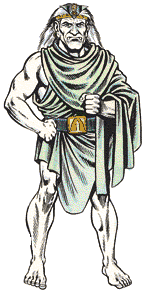

Cloud Giant society is defined by two things, which would be heavily expanded upon in future books – aristocratic lifestyles and gambling. The former is honestly quite expected for a lot of the ancient monsters. They’ve got extraordinary kingdoms and riches (including various 5E books noting Cloud Giants having great gardens with gigantic plants – a rather cute nod to Jack and the Giant Beanstalk). Out of all the giants, Cloud Giants also have giant ‘cloud cities’ and ‘sky cities’ which sound so much cooler to explore than just another dungeon in a mountain.
In addition, Cloud Giants worship the god Memnor the Trickster. Now I don’t really care to go too deep into all the gods of all the giants, but Memnor is rather unsubtly based on Loki of Norse mythological fame. Yes, I know, the Cloud Giants are one of the more Greek-inspired giants, but such is how the adaptation turns them into. But Cloud Giants seek to emulate Memnor, and while the most evil of them are deceitful schemers, even the nicest Cloud Giants are intent on emulating Memnor’s deception. Which plays into their desire for gambling – Cloud Giants are notorious on wanting to bet for anything that has high risk and high reward. Which in theory just speaks to their capriciousness, but being a whole people that worship a trickster god, you just know that the Cloud Giants are trying to sabotage the events that they are betting on – cheating is only cheating if it’s caught, and otherwise the Cloud Giants are merely displaying the cleverness of Memnor.
_______________________________________________________________


Fire Giant
- 5.5E/5E: Huge Giant; Lawful Evil; CR 9
Being at the midway point of the Ordning, the Fire Giants are just below the Cloud and Storm, making them the most powerful of the more ‘brutish’ Giants. And this is because the Fire Giants have a function in a productive medieval era society – they are the blacksmiths and crafters of giantskind. The Fire Giants are essentially oversized versions of a lot of the tropes that fantasy associate with dwarves, but, y’know, gigantic. And since 5E, they’ve been given the skin and hair colours of Ganondorf of Legend of Zelda fame, most explicit in the Fire Giant’s original 5th Edition art.
The Fire Giants live in volcanoes and rocky mountains, but despite their name, the Fire Giants are purely melee fighters in 5th Edition – only gaining the fire element on its attacks with supplementary Fire Giant variants, until 5.5E just shrugged and gave the basic Fire Giant statblock a flaming sword. They also throw rocks, but every single giant has a ‘rock’ attack.
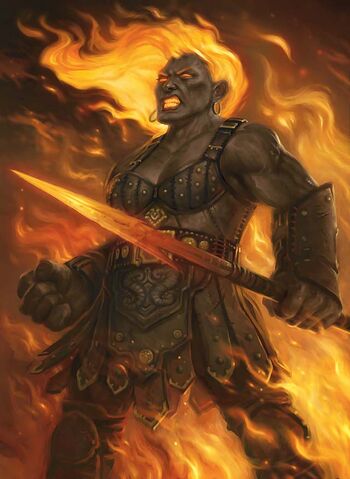


Fire Giant society revolves around war – both the crafting of the tools and the usage of said tools. They live near volcanoes to channel heat from the magma, and from young they are taught the art of violence and war. They are a culture of discipline and training, and not at all angry brutes like their Frost and Hill cousins. Fire Giants also often take slaves to work in their mines… which, again, is an aspect that gets played down in 5.5E, in favour of emphasizing ‘just’ their warlike tendencies. I do like the brief mention of Fire Giants in 5.5E that are super-obsessed with the art of creation, like a very grumpy artisan that hates being interrupted.
Overall, not the most exciting of the giants, but still my favourite of the more war-like big dudes.
_________________________________________________________________


Frost Giant
- 5.5E/5E: Huge Giant; Neutral Evil; CR 8
While there is an argument that the Fire Giants are based on Surtr from Norse mythology, there’s no doubt that the Frost Giants are based on the Jotunn. Taking all of the common tropes associated with them in popular culture, the Frost Giants in D&D are depicted with Viking-like armour. Scale armour, giant horned helmets, longboats, giant axes, and a culture of raiding.
A lot of their culture and their attacking abilities are rather obvious – they stay in the frosty mountains and tundras, and they fight with frost-enchanted weapons. 5.5E makes them a bit more fun by giving them bows and a ‘war cry’ ability to play to their raiding party theme, but it really does come to stark clarity to me why the giants – despite their immense lore – are pretty boring in-game. You really do need to import some of the more elaborate giant variants from the supplementary books for the 5E giants to shine.


Frost Giants don’t really give me much to talk about. The description in the original 5E is extremely flowery and I live for this kind of flowery dialogue, but at the end of the day they’re just really brawny warriors. 5.5E, again, tries to make the Frost Giant culture a bit less one-dimensional, by introducing examples of more peaceful Frost Giants that work as guards for ice fey or Fire Giants… but they’re otherwise still quite simple – something that a lot of the ‘they do war’ Giants are reduced to, really.
_________________________________________________________________


Hill Giant
- 5.5E/5E: Huge Giant; Chaotic Evil; CR 5
Hill Giants are just big dudes! Big fat oafish dudes, sometimes wearing ragged animal furs. And somehow they get more than half a page of lore in the original 5E Monster Manual – that’s the same space afforded to 6-7 of the Demons! Again, it really is such a shame that for the writers’ passion in writing for the giants… they’re just big guys at the end of the day. It’s always cool to find out more lore about any monster, but at the end of the day I want this kind of elaboration done for something a bit more… weird. Like, tell me more about the Yuan-Ti, or the Elementals, or the Hydras, or the Vampires, you know? It’s particularly bad because Hill Giants also share a same world with Ogres, Ettins, Trolls, Cyclopes, Fomorians and five other Giants of the Ordning, and that’s not counting other ‘big dudes’ like Empyreans, Colossi, and so many more.
Anyway, the whole point is that Hill Giants are… big hungry brutes. The ‘hook’ that they have is that they forage and raid in search for anything to eat, relying on nothing but brute strength to bully smaller creatures. They are lazy, dirty and smelly, with no attempt at culture or innovation. They try to mimic other cultures they see and get confused because they just copy without understanding. They continue to eat and eat, and ‘eating a lot’ does lend itself to some interesting Hill Giant ‘bosses’ in supplementary material that are gluttony-themed, but that makes the original Hill Giant itself extremely dull.
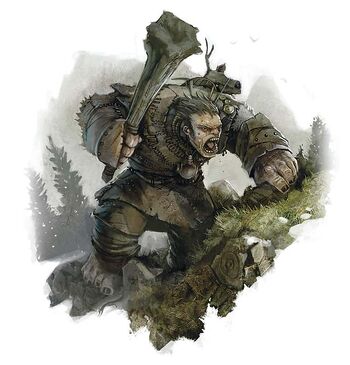


Their simple minds means that they’re too stupid to understand the Ordning, only following the other types of Giants because they are simply stronger. Which, I think, is a bit of a shame – there is a vague hint that the Ordning is a way for the Giant society to function based on their skills (the Fire Giants forge because they are resistant to heat; the Frost Giants are hunter-gatherers who can get them resources; the Stone Giants keep their culture and history…) and there could be something with the Hill Giants and their gluttony, or their ability to resist disease and poison… but no. They’re just idiots.
Again… the trope itself wouldn’t be that bad if the Hill Giant doesn’t already share the role of ‘big dumb smelly ugly guy’ with other giants that do the same thing, but with much more interesting hooks. Take the Ettin, for example, who is all of that, but just gives a lot of interesting interaction opportunities with the two heads. Or the Fomorian, who is also wretched and terrible, but also have the backstory of being afflicted by an ancient curse. The biggest curse for a monster that’s part of a world is being so boring and indistinguishable from anything else.
_________________________________________________________________


Stone Giant
- 5.5E/5E: Huge Giant; Neutral; CR 7
The Stone Giants are technically the second-lowest member of the Ordning, but I find them to be one of the more fascinating ones and one that stands a bit apart from the traditional Ordning. Stone Giants are tall, lanky dudes with skin of stone – or as the 5.5E art showcases, geographical formations. They have a literally statuesque face, with sunken eyes and a stern countenance. With some vague indigenous-coded vibe to the art direction, Stone Giants focus on a more mystical aspect of culture.
Stone Giants hide in secluded caves and underground caverns, focused on their art in places literally covered with all stone. They are masters of isolation, and they spend their ancient livespans quietly carving elaborate pieces of artwork, taking the idea of ‘stone being immortal’ to its great extreme. Their only companions are the sounds of the caves, and their art is a way to commune with their god; which rewards them with visions and prophecy. So much is this culture tied around their stonecarving culture that they actually view the world outside their homes as ‘the Dreaming’, where nothing is true nor real due to how easily they change. This leads to Stone Giants behaving strangely odd, because what happens in dreams are inconsequential to them – after all, why keep deals made when you’re sleeping, or care if you accidentally destroy a tiny village in your dream? It is, after all, ‘not real’. Only the weakest Stone Giants are sent to the surface as guards, and those that spend too much time will actually go mad.

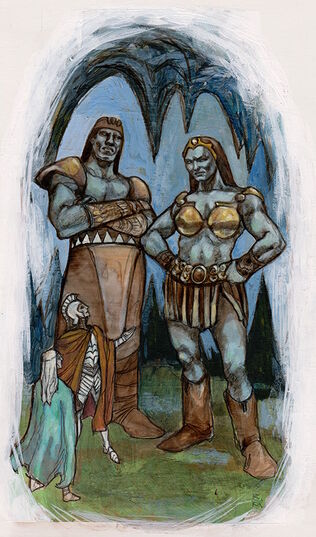


This is where the long, flowery description actually does its job at showcasing the culture and what the monster’s society is all about, something that the Hill and Frost entries really didn’t do a particularly good job of in my opinion. 5.5E does update it a bit into noting that the ‘dreaming’ thing only extends to Stone Giants in the Underdark, allowing other Stone Giants to interact with other true Giants, but I still find all the lore given to them to be weird but interesting.
Rather nicely, Stone Giants are also athletes. Specifically in rock-throwing. In the original 5E Manual, every single Giant has a ‘Rock’ attack, allowing the giants to have a ranged attack but I think it gets into too much detail when they commissioned art for the different rocks that the giants would throw. The Stone Giants throw gigantic boulders at each other for sport, in a showcase of athleticism and control, translating not only to a rock-throwing ability but also a rock-catching ability that allows Stone Giants to grab projectiles.
_________________________________________________________________




Storm Giant
- 5.5E/5E: Huge Giant; Chaotic Good; CR 13
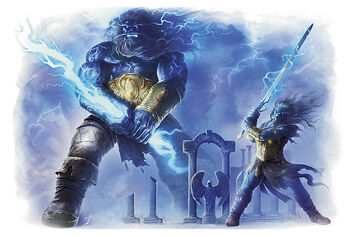
Last but certainly not the least of the True Giants is the Storm Giant, based on tropes of lightning and thunder themed gods like Zeus and Thor; and depending on the artist, mixes and matches the Greco-Roman and Nordic inspirations equally. Storm Giants are the tallest of the giants, and like their fellow high-ranked weather giants, the Cloud Giants, stay in high-altitude places removed from mortal civilization. Storm Giants have blue to purple skin, and features that crackle with lightning. Unlike the more capricious Cloud Giants, the Storm Giants act as the ‘big good’ for the Giants, being benevolent unless angered, at which point they’ll rather predictably unleash lightning storms with their swords and magic.
Storm Giants embody both aspects of a storm – both the sky and sea – so while they might be found in mountaintops and cloud castles, they can also live in the depths of the oceans, being amphibious and doing double duty as a ‘sea giant’. I just really love the mental image of one of these ancient beings slowly rising up of the ocean, an armoured warrior with water dripping off his armour, his fingers crackling with lightning as stormclouds and thunderbolts obey his will…
Storm Giants also seclude themselves, but instead of just contemplation with the earth, they seek to restore what was lost when the ancient Giant Empires fell. They study the world and mystical, prophetic signs, waiting for ‘that right moment’. And while the two base Monster Manuals do not elaborate too much, this allows a DM to essentially craft a D&D Storm Giant to do whatever they want. Perhaps the prophecies have caused a Storm Giant to start to act, allowing them to serve as an ally to a party by imparting a quest of great importance… or perhaps in their attempt to obey what they see is a sign from Annam, they have to reluctantly devastate a human city.
This blue-and-orange morality of the Storm Giants, I feel, is successful on exactly three of the True Giants – Storm, Cloud and Stone – while the other three just feel rather simplistic.
_________________________________________________________________

Gibbering Mouther
- 5.5E/5E: Medium Aberration; Neutral; CR 2
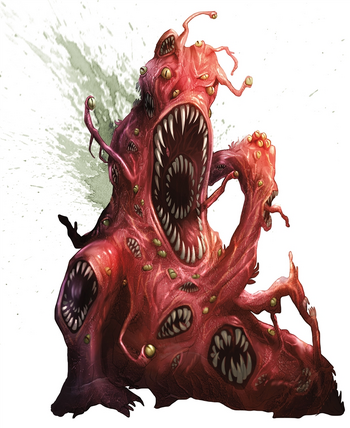
We’re away from the Giants to something completely different – one of my all-time favourite monsters, the Gibbering Mouther. I must say that none of the artworks done for the Gibbering Mouthers across the long history of D&D has ever been bad. It’s just one of those designs that looks so gross and weird that you can just pull it in different directions – making it a bit more comical like 2E, going for a grodier look like the 3E art, or going full-on over the top with mouths within mouths within mouths as both 5E artworks. I particularly like just how many layers of mouths there are in the new 5.5E artwork, with eyes and fangs that are not at all consistent.
To describe a Gibbering Mouther is a bit difficult. It’s a blob of… flesh? Slime? Blood? Of flesh-coloured substance that’s filled with eyes, fangs, mouths and tentacles. They’re described as amoeboid, and glops around, driven mostly by instinct than anything. Constantly undulating, constantly sprouting new eyes and mouths, and as its name implies, it’s constantly ‘gibbering’ – spouting noises and meaningless words that drives people around it to either flee or straight-up fall into insanity. Mechanically, this is decided by a random-effects dice roll which will cause those who are affected by the gibbering to either stand still and do nothing, run away, or get so crazy they start attacking the Gibbering Mouther’s allies.
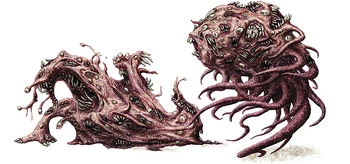
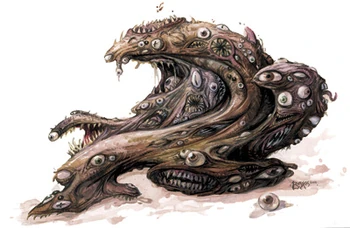
Of course, as a Gibbering Mouther consumes its victims, their eyes and mouths will rise up somewhere on the Gibbering Mouther’s body, lending their voice to join this unholy chorus. This is a nice explanation as to why the Gibbering Mouther’s noises can be a combination of unholy screeching and strangely familiar voices. This, by the way, is delightfully noted in the abilities. Anyone killed by a Gibbering Mouther’s bite attack gets their flesh absorbed into the monster.
Classified as ‘aberrations’, the 5E Manual remains somewhat ambiguous on what the Gibbering Mouthers’ origins are beyond ‘foul magic’ and ‘they were once human victims’, while 5.5E just straight up gives us a choose-your-own-adventure origin story for the Gibbering Mouthers. They might be the result of a magical experiment gone wrong, a cursed human, a shapeshifter that lost control of its powers, a mere limb of an Elder God, or part of the life cycle of some other Aberration. While giving multiple origin stories might feel inconsistent and lazy, for the Gibbering Mouthers I feel like “all of the above” being ways that Gibbering Mouthers can come into existence is delightfully appropriate, that something, somehow, about these Far Realm elder-gods is causing things to turn into Gibbering Mouthers.

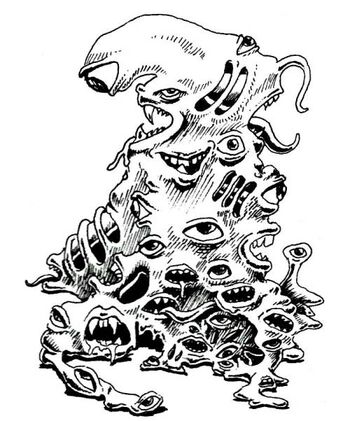
And despite all this, the Gibbering Mouther is sadly a mere CR 2 creature. Out of all the monsters that 5.5E was going to give a bonus ‘stronger’ stat block for, I really wished it was the Gibbering Mouther! As one of my favourite monsters due to how utterly weird they are, and the constantly awesome artworks they receive, I am a huge fan of these gross things.
_________________________________________________________________

Githyanki
- 5.5E/5E: Medium Humanoid – Gith; Lawful Evil; CR 3 (Warrior), 8 (Knight)
Right. These guys. I must preface the next couple of sections by saying that I’ve never been a fan of the Gith, and I am constantly bamboozled by how much entire sections in every single Monster Manual have been taken up by them. Over the years I have mellowed out on these more iconic members of D&D’s pantheon, but I still don’t find them the most interesting.
The Gith were first introduced in the original Fiend Folio, the second monster book for D&D. They are D&D’s attempts at bringing in something that’s a bit ‘sci-fi fantasy’, and there was a bit of a plot point where it’s implied that the Gith are time-traveling future humans who have been mutated by Mind Flayers, and have evolved into a psionic race. This entire plot point – which is a delightful nod to old-school sci-fi stories – has been mostly dropped in modern D&D, at most turned into a mere ‘rumoured’ origin story.
But their conflict with the Mind Flayers still remain in all of the Gith’s iterations. They were a single unnamed race originally that were enslaved by the Mind Flayers… and broke free after developing psionic abilities. They took on the name of their revolutionary, Gith, but upon overthrowing the Mind Flayers the society splintered into two factions. There are a lot of names involved, but essentially, their society is split into the mostly-evil dragon-riding space pirates called the Githyanki, and the mostly-good isolationist space monks called the Githzerai. They fight each other, are unwilling to cooperate with humanoids, and really, really loathe Mind Flayers.
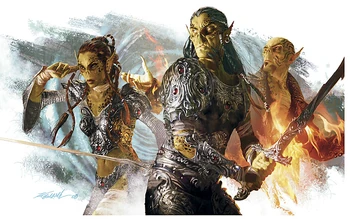


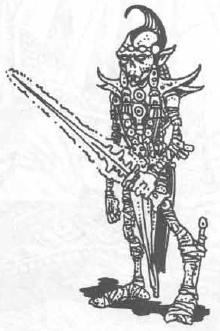
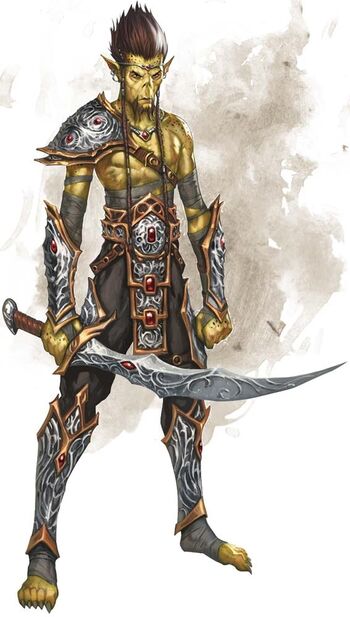
Visually? The Gith are depicted as slender, yellow or green-skinned humanoids with pointy ears, no nose and splotches on their skin. The more martial-minded evil Githyanki (the yankees are the evil one… okay?) tend to wear armour and wield silver swords, and they patrol the Astral Sea – D&D’s magical version of space, which I cover in more detail in my Spelljammer reviews – on top of their red dragon mounts. Because of course they ride red dragons, a completely sentient species that is normal;y characterized by their sense of superiority to all other beings. Which I’ve always found to be a bit of a silly extra detail just seemingly there to make the Githyankis to look even cooler.
They fight with a combination of martial arts and psionic powers. The Warriors wield silver swords that are extremely prized, and Githyanki will make it a point to recover these Silver Swords at all costs. Psionic powers have been a thorn in D&D’s side for quite a while, often working under its own rules as a system separate to magic… but in 5E it gets simplified into just dealing psychic damage, and being treated as abilities instead of spells.
Again, nowadays I view the Githyanki as an obvious ‘hook’ and a default civilization to do a more Astral Sea or psionic-inspired aspect of your adventure. I’ve never been to keen on either one of those until recently, when I discovered how weirdly fun Spelljammer is. Baldur’s Gate III very prominently featuring a Githyanki as a party member is also probably a good reason as to why they’ve been a bit more popularized nowadays.

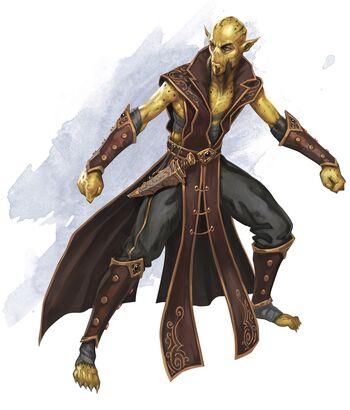
Githzerai
- 5.5E/5E: Medium Humanoid – Gith; Lawful Neutral; CR 2 (Monk), 6 (Zerth)
The lawful neutral Githzerai follow their own leader, Zerthimon, who view Gith as becoming no different from the Illithid tyrants that she deposed. Githzerai are like a psionic, extradimensional space-monk race, undoubtedly inspired by either Star Wars or East Asian martial arts movies. They wear flowing robes and focus fully on monk-like psionic arts, secluding themselves in a plane of chaos called Limbo as a way to train their own abilities, immersing themselves in rigid monk training.
Despite being opposed to the clearly evil Githyanki, the Githzerai aren’t nice to other races. They’re isolationists by nature, only interacting with other races in their ‘rrakkma’ rituals, where they send out Githzerai raiding parties to wipe out Mind Flayers in other planes. Apparently, they also set up monasteries in other locations for other races to find, but only the best monks can compete with the Githzerai because they are oh-so-super-special.
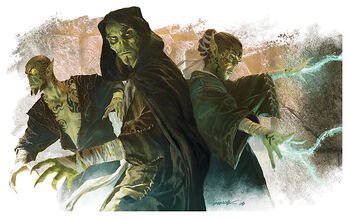


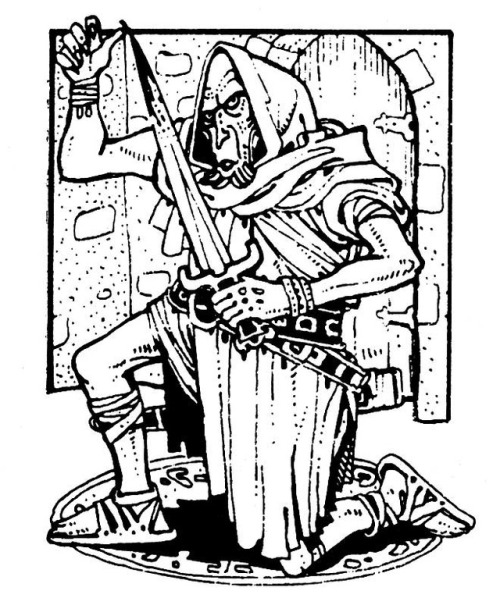
Rather interestingly, 5.5E retcons the Gith from being humanoids into aberrations. I suppose after being mutated by the Mind Flayers, they do count as one, but I personally don’t like this change – the Gith are just weird psychic space people, they’re nowhere weird enough to stand on the same level as Aboleths or Gibbering Mouthers.
Again, I think it comes off from my tone that I’m not the most interested in talking about the Gith. I could go in-depth about the variations introduced here, but they’re just essentially variations of the base theme. There are a fair amount of lore about them, so I do appreciate that about the Gith. I guess it’s just their status as being such a ‘super special’ advanced psionic race that rubs me the wrong way? I do feel like that’s me being harsh, and their space opera backstory can serve for a really good backstory for individual characters – like Baldur’s Gate III has proven. Ultimately… they’re all right.
________________________________________________________________

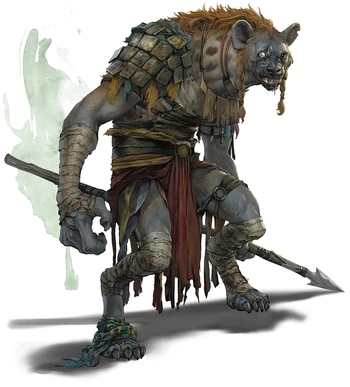
Gnoll
- 5.5E/5E: Medium Humanoid (5E, except Fang) / Fiend (5.5E); Chaotic Evil; CR 1/2 (Gnoll), CR 2 (Pack Lord), CR 4 (Fang of Yeenoghu)
- 5.5E: Medium Fiend; Chaotic Evil; CR 8 (Demoniac)
Yeah, Gnolls! Gnolls are a rather easy concept – they’re savage hyena-men. Unlike the somewhat uncomfortable ‘always chaotic evil’ slapped on Orcs or Drow, the Gnolls in D&D do have a somewhat interesting backstory that justifies this somewhat. So the history in D&D lore is that Gnolls aren’t a natural race, but are born from the spilled blood from the demon lord Yeenoghu during an ancient war. Hyenas, being scavengers, began feeding on what is left in Yeenoghu’s rampage, and are transformed into Gnolls – vessels of Yeenoghu’s rabid hunger. The Gnolls being actually tied and created, albeit accidentally, by a most chaotic demon lord makes sense because the raiding culture of the Gnolls are not really sustainable for a society.
Gnolls are devoted on one thing and one thing only – feeding. They attack villagers not to loot, or out of conquer, or anything that a human or orc raiding party would do. No, they stalk and attack to destroy and to feed, devouring all in its path and fouling everything in its wake. They do not build or craft, simply wanting to move from one easy target to the next. What equipment or armour they use, they scavenge – like they hyenas they are. What ‘culture’ they have is devoted to Yeenoghu and his worship… and the worship of Yeenoghu tends to involve consuming the flesh of sentient species.
While I understand the need to offer a lot more options for not always-evil members of goblins or orcs or drow, I do appreciate that 5.5E keeps around the Gnolls as being still utterly savage and depraved. In addition to regular Gnolls and Gnoll Pack Lords, there are also special leaders called the ‘Fang of Yeenoghu’, which are beings appointed by the demon lord himself. Fangs are able to create more Gnolls, and hyenas that feed upon the foes slain by a Fang turn into regular Gnolls.

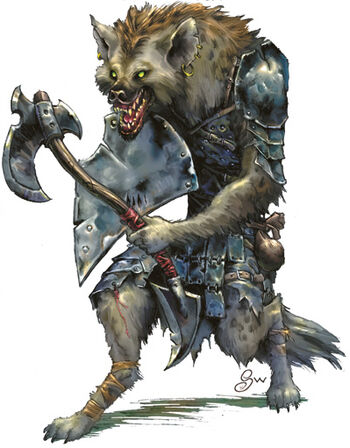

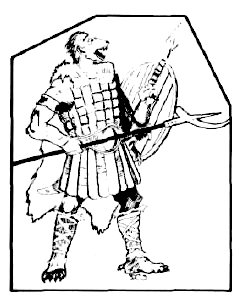
5.5E adds another variant, the Demoniac, which is created when a Gnoll feeds on flesh corrupted by the Abyss. This corrupts the Gnoll even further, turning it into a consuming machine that can designate an area before him as its feeding ground that it can take bites out of. The Demoniac is noted to be ravenous enough to consume other Gnolls, but older 5E Material have already established that – Gnoll packs that aren’t ‘stimulated’ enough by rampages will turn upon itself.
Another great, if somewhat subtle, change in the direction is that Gnolls in 5.5E use weapons scavenged from their prey. So even the weaker Gnolls use bone whips and bone javelins, which plays a lot to the themes of the Gnolls’ depraved despoiling of the dead.
A ‘classification’ change that does make sense are the Gnolls. In D&D, the Gnolls have always been tied to Yeenoghu and turning them from humanoids to straight-up Fiends is a change that I can understand… though I also like the original 5E having all the Gnolls count as humanoid, but the Fang of Yeenoghu, the most powerful type, is a Fiend. The ‘evolution’ of a Gnoll as it becomes more violent and more like Yeenoghu and turning fully into a Fiend feels like a more interesting story! Overall, I really like the Gnolls. The idea of a band of ravenous, savage intelligent beasts is definitely a cool monster concept, and the hyena-man silhouette is a distinctive one.
_________________________________________________________________

Deep Gnome/Svirfneblin
- 5E: Small Humanoid – Gnome; Neutral Good; CR 1/2
The Deep Gnomes are placed here because it’s listed under ‘Gnome, Deep’ in the original 5E Monster Manual. Like most variations of the playable races, 5.5E removes the Deep Gnomes… although to be fair, there’s honestly not been much attempt to make the Deep Gnomes into ‘evil gnomes’ the way the Duergar or Grimlock or Drow were. The Deep Gnomes do have a lot of the traits of these ‘Underdarkified’ races, but instead of being bitter and evil, Deep Gnomes just become… dour.


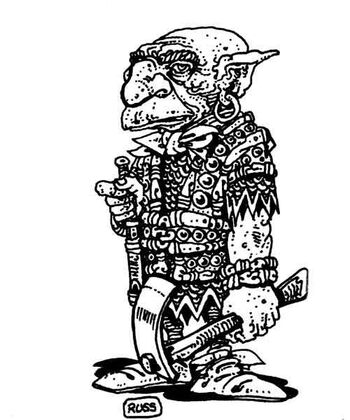
Also known as Svirfneblin (a term I’ve never seen anyone spell right on the first go), Deep Gnomes have lost most of their surface gnome brethren’s joy and curiousity. Their grey, stone-like skin allow them to blend more easily with the terrain, and all their abilities allow them to either avoid detection or escape from enemies. Deep Gnomes live in secret enclaves in the Underdark, and… that’s honestly it. They’re there to give adventurers a civilization to interact with, but other than being suspicious of outsiders there really isn’t quite a ‘hook’ for the Deep Gnomes. I do appreciate a truer-to-text adaptation of Gnomes as being associated with the earth (which D&D and modern fantasy has very strongly deviated from nowadays), but I really wish they put some more work into making the Deep Gnomes feeling a bit more distinctive other than ‘being underground’.
So yeah. I really forget these guys exist most of the time. I guess the whole point of their race is that it’s a subversion of the ‘evil angry Underdark race variant’ trope, but unlike the Flumphs they don't do anything interesting about it.
_________________________________________________________________


Goblin
- 5E: Small Humanoid – Goblinoid; Neutral Evil; CR 1/4 (Goblin), CR 1 (Boss)
- 5.5E: Small Fey – Goblinoid; Chaotic Neutral; CR 1/8 (Minion), CR 1/4 (Warrior), CR 1 (Boss), CR 4 (Hexer)
And now, I would like to come and talk to you about goblins, my favourite evil race in all of fantasy. In the ur-example of the fantasy genre, Lord of the Rings, ‘goblins’ and ‘orcs’ were essentially used interchangeably for the evil humanoid race, but most fantasy media depicts the two as completely different. Goblins in particular have morphed into a role in popular fantasy culture as tiny, sneaky, manic bastards that are cowardly and weak individually, but rely on traps, ambushes and numbers for an advantage against the bigger humanoids. Goblins are known to be comedic as well, balancing out their evilness with some slapstick shenanigans.
It is interesting that while D&D follows a lot of these common tropes for the fantasy Goblin – and helped popularize a lot of those in its long history – the 5E Goblin actually tries its best to be different? Perhaps in an attempt to distinguish itself from the ‘chaotic murder bunny’ trope that so infuses the Goblins in D&D’s rivals Pathfinder and Warhammer, Goblins have been portrayed as being yellow or flesh-skinned since 5E instead of their much more iconic green. It’s a conscious choice made by Wizards of the Coast… one that I feel is just silly, since most of their other iconic fantasy monsters do bow quite intensively to the most popular visual tropes.
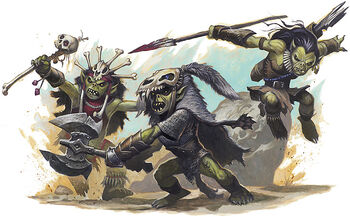

5.5E would go a bit further in trying to distinguish itself, retconning all three goblinoid races (Goblins, Hobgoblins and Bugbears) into being ‘Fey’… something that isn’t really reflected in the lore. I do like the little detail that their transformation into ‘Fey of ruin and wreckage’ fits into the idea that Goblins just run around being little shits for the sake of it, and not out of any grand master plan.
Which I suppose that ‘goblinoid’ thing bears a bit of a mention. I alluded to it during my Bugbear review, but three races fall under the banner of ‘Goblinoids’, even though they don’t really look that similar. 5E lore would have it that this is because the whole idea of what makes a goblinoid a goblinoid is tied to their religion and pantheon, because their chief deity Maglubiyet is tied to conquest and dominating the weak, and Maglubiyet, in ages past, has dominated the gods of the goblin, hobgoblin and bugbear people. Volo’s Guide to Monsters goes deep into this discussion of pantheons and whatnot, but I personally like to keep it surface-level.


This hierarchy does translate to the poor Goblins being the smallest and the weakest of the three goblinoids, and they often find themselves bullied into being minions for their larger and smarter cousins. When operating on their own, Goblins like to live in subterranean caves or warrens, relying on the smaller tunnels, traps and animals like wolves and giant rats. All Goblins have the ‘Nimble Escape’ trait, and they are understandably rather simple enemies in 5E due to their role of being an introductory iconic sapient/sentient opponent.
5.5E does add a ‘Hexer’ variant, which is something that was hinted by a lot of material in books like Volo’s Guide to Monsters – establishing that Goblins view any kind of magic under the term ‘booyahg’. The Hexer, unlike the booyahg-casters mentioned in that book that focuses on causing destructive spells, instead is more of a disruptor. They cast spells that blind, deafen, summon grease to trip you over, and jinx you to miss your attacks.
The actual official material admittedly never really has much to say about the Goblins themselves, relying more on pop culture and the actual Goblin characters and adversaries seen in the adventures to carry the trope. But I do feel that there are so many ways to play around with this race of tiny underdogs. Portray them as a tiny warren of sneaky bastards menacing a village? Minions to orcs or hobgoblins, whether willing or not? An underdog tribe or individual trying its best to survive? Just a group of manic pyromaniacs? There’s just a lot that a DM can do with a group of Goblins! I do not exaggerate that I could write entire articles just yapping about Goblins, so I'll stop here for now.
_________________________________________________________________
Golems
And we’ll cap this off with Golems. I know this article’s run a bit long already, but I feel I wouldn’t be too wordy with Golems and I don’t want to keep cutting up articles. Based on Jewish mythology, D&D is noted to be the trope codifier for fantasy Golems as essentially being magical automatons. Golems in D&D are created from a certain type of material, and are essentially robots in all but name – they have no thoughts, need no sustenance, feels no pain, have no emotion, and does nothing but follow commands… all the words you use to describe a Terminator. Being essentially immortal guardians, Golem end up being a nice, easy thing to put inside a dungeon to guard sacred sites and treasures.
What does make a Golem different from something like a Gargoyle or Animated Broom, then? It’s the method of creation, its adherence to orders, and several facets mechanically… due to the magics involved in its creation Golems have a large amount of resistances, most famously its Magic Resistance. They also count as magical themselves, so even a Clay Golem punching you counts as magical damage.
In 5E, there’s a bit of a note where the construction of a Golem binds an Earth Elemental Spirit to the Golem, but that spirit is conveniently non-sapient… which is a bit of a non-sequitur that really raises more questions than anything and has been mostly ignored in the rest of the edition. Depending on the edition or your DM, Golems are bound to special amulets (essentially remote controls) that allows whoever possesses it to control the Golem. This is a fun note that might work in designing a ‘puzzle’ Golem encounter.
5th Edition gives us four basic Golem types based on what was introduced in the 1st Edition Monster Manual, but previous editions have introduced many, many different types of Golems. Theoretically, any material you can mould a humanoid figure out of can count as a Golem!
_________________________________________________________________

Clay Golem
- 5.5E/5E: Large Construct; Unaligned; CR 9
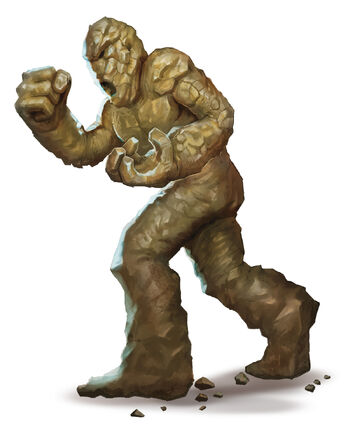
Clay Golems are humanoid figures sculpted from gross-looking clay, and apparently their proportions always look a bit off. Due to the inferior nature of clay as a medium for the Golem process, the Clay Golem at some point will have the rituals that create it start to break down and it goes berserk.


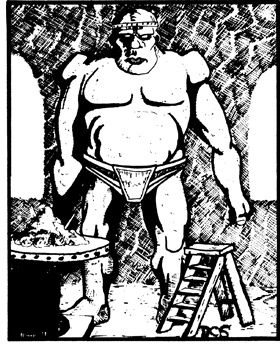
5.5E gives us a bit of a more positive spin on the Clay Golem, noting that some Clay Golems are created from the mud and clay of a community or location that the Golem is meant to protect. It also notes how some wizards that really care actually masterfully sculpt their Clay Golems, but most of them just do a vaguely humanoid form. I do like this idea – that perhaps Clay Golems are just the easy, mass-produced version of Golems.
The 5.5E art shows a Clay Golem with broad shoulders and huge fists that’s clearly meant for intimidation, but 5E and 3E just show lumpy humanoids that makes me feel like the wizard creating them just didn’t have good sculpting skills or just didn’t care to make the Golem look intimidating or cool. And 2E is the best, having its iteration of Clay Golem be based by actual terracotta soldiers of Chinese culture.
_________________________________________________________________

Flesh Golem
- 5.5E/5E: Medium Construct; Neutral; CR 5
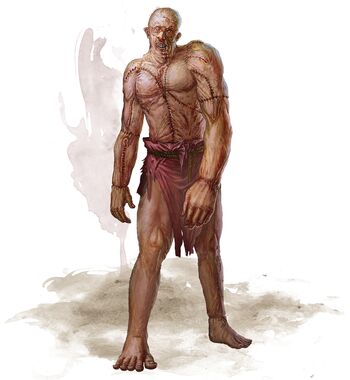
The weakest of the four Golem types is the Flesh Golem, but it’s arguably the one that might take more effort to make, right? The Flesh Golem is very obviously based on Frankenstein’s Monster, a classic horror fixture. In all editions, Flesh Golems are created from stitched-up corpse parts. Hey, if you’re a wizard with no sense of sculpting arts, might as well use pre-made humanoid parts, right?
I like the slight mismatch in arm sizes on the 5E art, and 4E also likewise has a very grisly Flesh Golem with the proportions being all off. They don’t quite go full-in with the Frankenstein’s Monster visual elements, but I suppose there’s only so much they can do under the banner of homage. Nicely shown by the 5.5E art, Flesh Golems can absorb lightning damage and gets restored by it. They’re weakened by fire, however, and also are imperfect enough that they have the same ‘berserk’ mechanic as the Clay Golem.


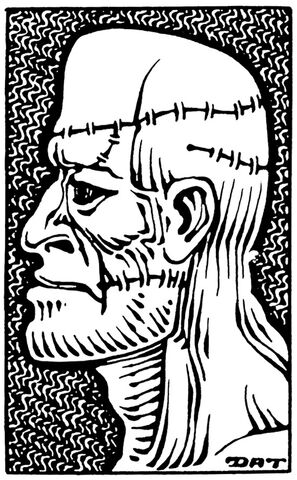
One of the interesting things about the Flesh Golem is also how despite being a reanimated jumble of corpses, it is not an undead. No necromantic energy is used in bringing it back to not-life, and the way the dead body parts move is entirely ‘scientifical’. Or, well, powered by runes and electricity and bound elemental spirits.
Just to make things extra confusing, due to a brain being one of the parts of a human body, some electrical impulses can cause disjointed memories to rise up from it (which might be your explanation for the ‘Berserk’ ability instead of the bound elemental spirit one). 5.5E is keen on helping you customize your monsters, and I can’t think of a better one to have a table of appearances than the Flesh Golem. Which, incidentally, can be an excuse for a DM to make a stronger or weaker Flesh Golem variant. Among the short table, the book notes that Flesh Golems can be variable by having animal parts among the human pieces; show off exposed insides; be made entirely of hands; have visible mechanical parts... or be utterly pristine.
That last one is utterly intriguing to me and seems to really tell a story. I think our minds – and Flesh Golems in other fantasy-horror games like Warcraft or Dark Souls – can already fill in the gaps for the more horrifying Flesh Golems. Flesh Golems that have perfect features that are accented by beautiful stitching shows a golem-creating wizard that really cares where the face came from, and that just feels like a nice story hook. Are they reviving a dead loved one, but can't bear to turn them into an undead? Is it a villain replacing members of a mansion with Flesh Golems one by one?
_________________________________________________________________
Iron Golem
- 5.5E/5E: Large Construct; Unaligned; CR 16
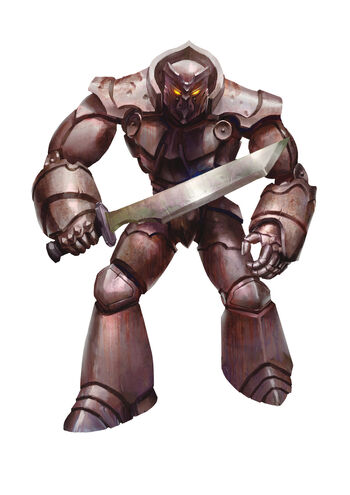
The strongest Golem in the 5E Monster Manual is the Iron Golem. It is interesting that the Iron Golem originally started off in 1st Edition as a giant animated Greek statue, but morphed into what’s essentially an armoured fantasy robot in 3rd Edition… and never changed. The exaggerated anatomy, massive WoW shoulderpads and giant blade remains, and I do find this to be visually distinctive. They do feel a bit more ‘modern’ fantasy anyway compared to the more ‘mythological’ Stone Golems below, I feel.


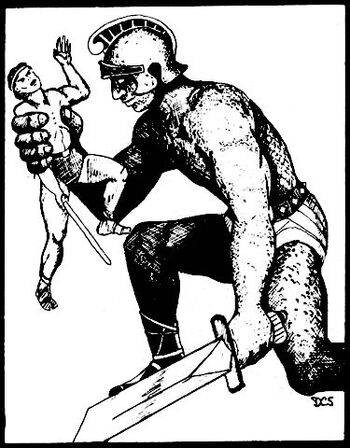
Both 5E and 5.5E do note that just like all other golems, Iron Golems can be worked by metal to look like any form… but giant suits of armour are just what’s the most intimidating. Playing into their ‘robots of war’ theme, Iron Golems in D&D can also breathe clouds of poison gas, and they get healed by flame. I suppose there’s a bit there about Iron Golems being walking furnaces or something, but that flame absorption does feel like a bit of a non-sequitur.
Again, how much technology or more sci-fi-leaning tropes a D&D setting should have really depends on your DM, but I feel like the Iron Golem is a nice way to have a lore-friendly giant robot in any setting. That's nice!
_________________________________________________________________

Stone Golem
- 5.5E/5E: Large Construct; Unaligned; CR 10
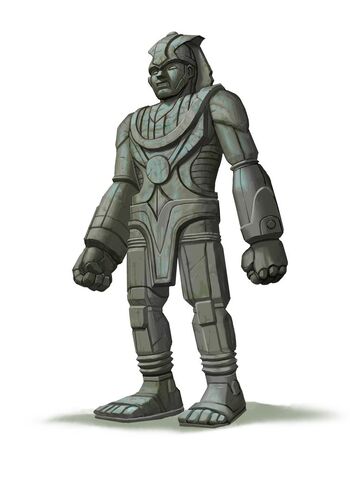
Our last Golem is the Stone Golem, with almost all of its artwork really making it like just a statue you would see in an ancient palace or temple. Which makes perfect sense, since the Stone Golem fills in the trope of a statue coming to life and attacking the heroes – similar to what we discussed with the Gargoyle a while back. Real-world statues tend to be so lifelike that this trope was likely born the moment our ancestors invented sculpting.


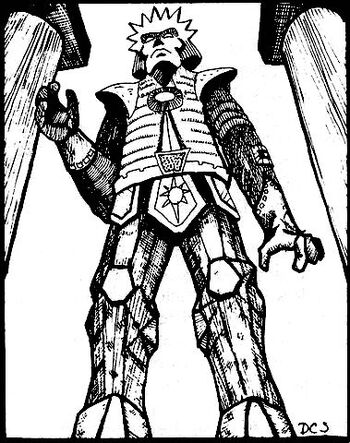
It is notable that the Manual says that Stone Golems doesn’t need to be humanoid, with the examples being given in the 5E Monster Manual having tomb guardians shaped like beasts. Rather surprisingly, the 5.5E table for the Stone Golem isn’t about appearances, but about the orders it’s given. In addition to all the fancy resistances that all Golems have, Stone Golems have an additional ‘Slow’ spell. This is explained as the Stone Golem causing its opponents to feel like they are turning into stone themselves.
Ultimately, I do think that the Golems are perhaps a monster that I feel is perfectly designed as a 'block of stats'. By design both in- and out-of-universe, they do not have any personality, culture or motivations. It's purely something that's meant to be taken with its visuals and its abilities. Some monsters being like this is all right, but the length of these monster review articles will show just how much the creatures that the designers put in effort for really stand out to me. As much as I did moan about them, I really do appreciate that the Gith and the Giants exist, that someone cared enough about these monsters to write books' worth of lore for them.
_________________________________________________________________

One thing I like about the golems is that they seem uniquely able to counteract dragons, for the most part. Fitting for a party trapped in a tomb and activates the ancient guardian to protect them from the dragon that made it's lair there
ReplyDeleteI never noticed that! Golems seem to be made to counter magic-users in general rather than specifically dragons, though, I would say -- the fact that the Golems can't fly does mean that it's got a significant disadvantage against the dragons, surely?
DeleteFor clay and flesh yes. Though stone and iron seem to have ranged attacks to deal with them.
DeleteTrue, true, and the Stone and Iron Golems seem to be the ones that blend in the best with any given dungeon or temple.
Delete