

We are officially beyond the halfway mark now, and I'm quite pleased that I'm able to actually churn this rewrite series out in a weekly basis. I was initially worried about this Monster Manual rewrite project being a bit too under-stimulating since I've already talked about a lot of these monsters before... but turns out that the 2024 Monster Manual did give me quite a fair amount of new material to ap about, and the chances given to me to fix my previous sub-par work has been quite great.
This segment is going to feature a monster type that I went from being indifferent towards to really loving, which are the Hags... which I end up talking a lot about below. Oops! But the Hags do deserve it! So sorry, not sorry, I wrote a lot about the Hags.
Beyond that, I've recently came into acquisition of some older D&D books, most notably the 2nd Edition Monstrous Manual. The fact that I own it now does mean that I'm obligated to talk and review the monsters! But on the other hand, I have gone through the 'base set' of D&D monsters... probably four or five times now. That has been one of the big reasons why I was hesitant at doing Pathfinder or previous-edition D&D content, since a lot of the talk will be the same. I would still like to cover this AD&D book since I don't think I've ever shown 2E the love it deserves, but I think it'll be in a slightly different format. It's not likely to happen until after I finish the Monster Manual project (and maybe powering through Volo's and Mordenkainen's as well) but I am thinking more of a 'let's read' format where I do go through every entry... but the comments I make will depend on whether I've spoken about the monster in my 5E reviews or not.
[originally published in November 2019; revised in October 2025]
______________________________
______________________________

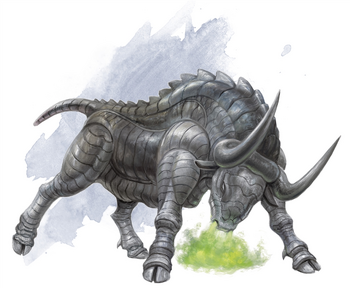
Gorgon
- 5.5E/5E: Large Construct (5.5E) / Monstrosity (5E); Unaligned; CR 5 (Gorgon)
- 5.5E: Large Construct; Unaligned; CR 9 (Brazen Gorgon)
The D&D Gorgon has always been a little pet peeve of me. There are a lot of monsters early on in D&D’s history that are only vaguely inspired by their mythological basis – the genies and rakshasa being two that spring to mind – but there were always some effort in trying to give them features or aspects of their mythological counterparts. Gorgons are the species name of the Greek sisters of whom Medusa is part of. Mythological Gorgons do exist in D&D, under the name ‘Medusas’, while Gorgons are a different creature that’s… a metal bull that spews petrifying gas. What? I would have shrugged off the oddness if they did something with the major character named Demogorgon, but this Gorgon is just a weird metal bull for no real reason. It’s not even like ‘petrifying monster’ is particularly hard to come by in D&D.
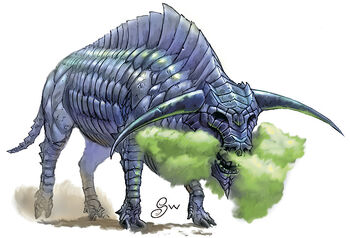

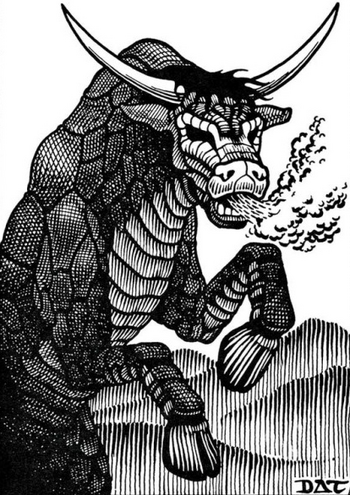
Just what a Gorgon is has also changed around even within 5th Edition. It’s always been consistently featured as a metallic-plated bull-creature but 5E classifies it as a Monstrosity; meaning that it’s a living creature with really weird biology. The 5E writeup does have some bits of biology, noting that the Gorgon feeds on the flesh of its victims after charging and petrifying it, and even notes how sick Gorgons have rust grow on them like mange would on a flesh-and-blood animal. As little as they got in 5E, I at least can appreciate them as just a weird race of magical bulls that somehow developed the same petrification abilities that Basilisks, Cockatrices and Medusas did.
5.5E retcons this into them just being lifelike automatons created by a magical ritual that involves the corpse of a bull, the brain of a Basilisk and the blood of a Medusa. The retcon also notes that some Gorgons outlive their masters, leading to the misconception that they are natural magical creatures. These automaton Gorgons revolve around following beings with a ‘command key’, making them a weird puzzle boss like some of the Golem puzzles. The command keys can be obscure stuff like saying someone’s name backwards or offer the Gorgon some wine.

5.5E also introduces a stronger variant called the Brazen Gorgon, associated with the archdevil Moloch. Brazen Gorgons blaze like Ghost Rider, being hollow and having its internals glowing with heat. They breathe fire instead of petrification gas, and when they charge, their ‘ribs’ open up to ensnare enemies and cook them within. It’s cool, I suppose, although I find that a fiery furnace monster feels a bit more mundane than a petrification gas spewing one.
Anyway, I like the Gorgon a bit more when it was just a weird mutant magic bull than when it got reduced to merely an automaton. It’s not really going to be a favourite monster of mine, but I suppose I can appreciate the D&D team considering the Gorgon iconic enough to keep printing it in their first Monster Manuals.
_________________________________________________________________

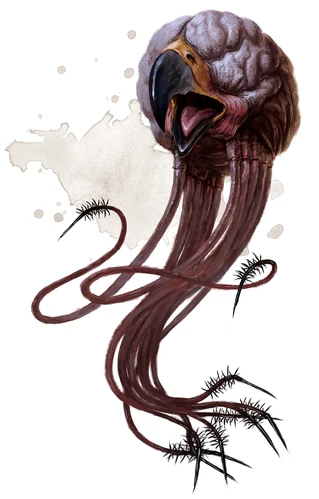
Grell
- 5.5E/5E: Medium Aberration; Neutral Evil; CR 3
The Grell! One of the weirder monsters introduced in the 1st Edition’s Fiend Folio, the Grell has been a mainstay in D&D since then. It’s never quite enjoyed the widespread popularity of something like the Beholder or Flumph, unfortunately, but the Grell is one of my all-time favourite monsters.
The concept is just so weird. As we’ll see in a couple of entries down the line, D&D really likes the idea of brains as monsters. And Grells are basically that – a giant brain with a very beak and thorn-tipped paralytic tentacles. I suppose the general anatomy is meant to resemble a jellyfish, albeit with an octopus’s beak. And they do float around, but they changed enough things to make this feel so weirdly unnatural, like it’s working off of a different world’s logic. I suppose that’s an aberration for you. The Grell is assigned the category ‘aberration’ as soon as the term was introduced to D&D, and it stuck.
There are a lot of weird aspects about the Grell biology that the Monster Manual lightly touches upon. They navigate the world by their hearing, because, uh, that’s what… that’s what brains do, right? They… hear? Not something I’d expect from a flying jellyfish-bird-brain! They also absorb electricity, which kind of makes sense somewhat because nerve impulses in the brain are electrical in nature.

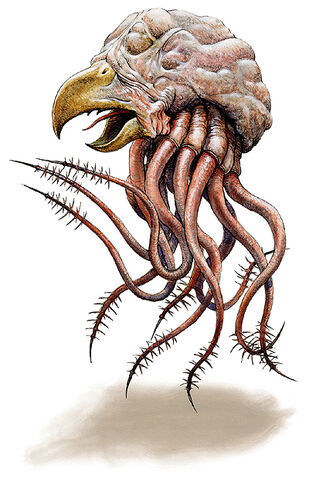
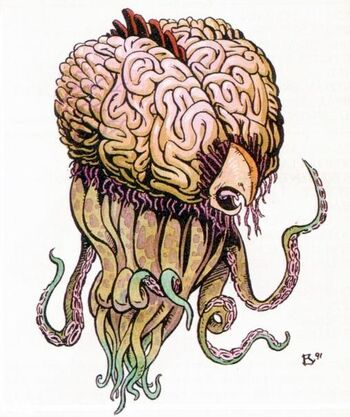
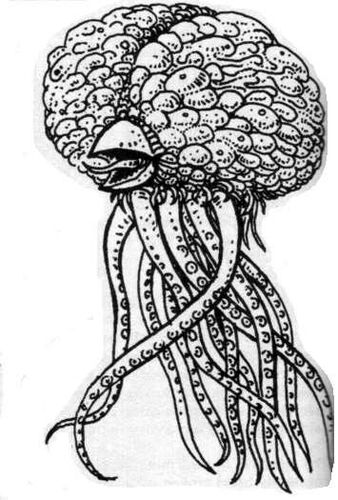
Oh, and these guys are intelligent beings, not just weird mindless beasts. I mean, I guess they are literal floating brains, so they have to be smart, right? Grells are intelligent, and they have a simple classification of the world: ‘edibles’, ‘inedibles’ and ‘predators’ (or ‘Great Eaters’). Grells view most humanoids as being edible, and that’s a relatively simple concept for a dungeon enemy. Grells will float around silently, waiting for you to pass through and then descending and attacking you with paralytic tentacles.
While the original 5E Manual notes their sapience, it downplays how intelligent they are. As restored by newer material, some Grell are even intelligent enough to travel through dimensions and planes. 5.5E and its beloved tables brings up a nice list of Grell motivations, some of which are similar to Grell entries in previous editions. We’ve got simple ones like ‘seeking to escape a greater terror in the depths’, ‘vestiges of an ancient evil that will return after the Grell consume enough creatures’, ‘Grell are the larva of a greater creature’, and ‘Grells are without souls, and believe they can get souls by eating other beings’… to gloriously outlandish ones like ‘Grells are advanced viruses, each clones of each other and they live to spread’ and ‘they are the feeding appendages supernaturally connected to elder beings’.
All of these still doesn’t change the fundamental ‘hook’ that a Grell’s primary motivation is to feed. Whether they are giant viruses, appendages of Cthulhu or trying to gain souls, they’re still driven by the compunction to feed. I do like this fact that they didn’t actually rewrite how a Grell would behave, but just gave a multiple-choice past to these strange, floating bird-brains.
_________________________________________________________________

Grick
- 5.5E/5E: Medium Monstrosity; Neutral; CR 2 (regular), CR 7 (Alpha/Ancient)
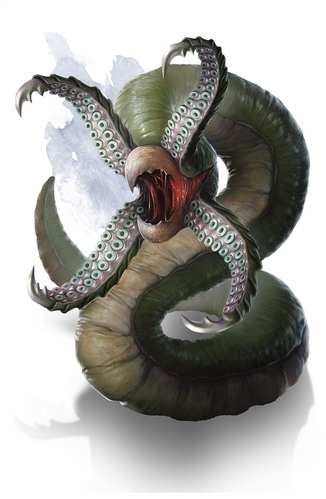
Another delightful weirdo is the Grick, introduced a bit later in the 3rd Edition but quickly making its place as a core monster staple. The second ‘beaks and tentacles don’t belong there’ monster in a row, a Grick isn’t quite as exotic as the Grell… but worms do not typically end in a giant bird-beak covered by four octopus tentacles. Gricks are giant worms that typically lurk in caves and dungeons, specifically highlighted to be camouflaged against the rock. When prey comes near it, the Grick attacks and grapples them with its tentacles, drawing it close to the beak. They’re simple ambush predators in that way, just worming their way and hiding somewhere convenient until prey passes by. Like most ‘non real world’ creatures, the Monster Manual makes a bit of an effort to point out that the Grick isn’t a good member of an ecosystem, often overhunting their territory and venturing out when all prey have either been wiped out or know to avoid their lairs.
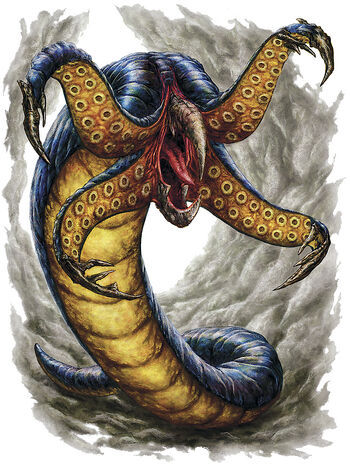
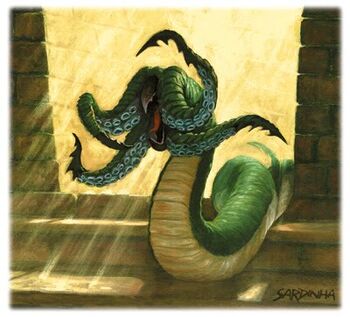
5.5E notes that a Grick’s origin isn’t clear, with suggestions that they are worms or worm-like invertebrates mutated by magical phenomena, and apparently the presence of Gricks in a region is often evidence of nearby magical portals or artifacts. I do like the bit of separation if this is the case, where monstrosities like Gricks are ‘merely’ unnatural mutations of existing wildlife, while actual aberrations like Grell, Aboleths and Foulspawn actually come from the planes beyond.
The Grick entry in the 5E Monster Manual does have a nice little nod to how ‘loot’ is supposed to work with non-sentient monsters, noting that the cast-off possessions of intelligent humanoids that fell victim to a Grick pile up in their lair. That’s why all the monsters in the dungeons have a chance to drop equipment!
_________________________________________________________________
Griffon
- 5.5E/5E: Large Monstrosity; Unaligned; CR 2
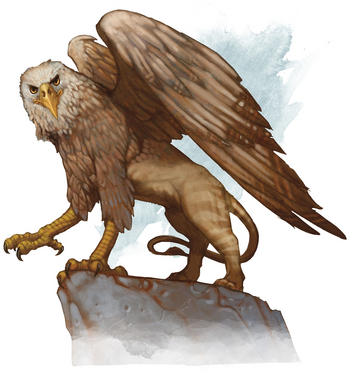
We go now to a relatively more mundane mythological creature in the Griffon. I always spell the creature name as ‘Gryphon’, but both are basically the same thing. Griffons are one of the more common Greek mythological creatures to pop up in fantasy culture, being half-lion, half-eagle creatures. Understandably, with both lions and eagles being super popular as noble and heroic heraldry, Griffons are often afforded the same exaggerated heroic qualities as its component animals.
D&D’s Griffons are rather simple beasts (or monstrosities, technically) that fly and can maul you. They do carry over some qualities of their mythological inspirations, and particularly highlighted is a Griffon’s hatred towards horses and their instinct to kill horses – though it’s framed as more of a favoured diet in this case. It’s a unique thing that leads to Griffon packs ignoring the riders in favour of maiming the horse. This horse-hatred is going to be important to contextualize the Hippogriff, which comes a bit after in the Monster Manual!

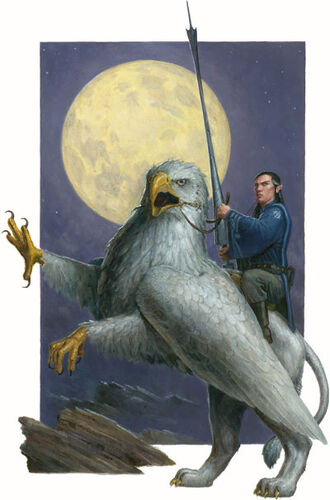

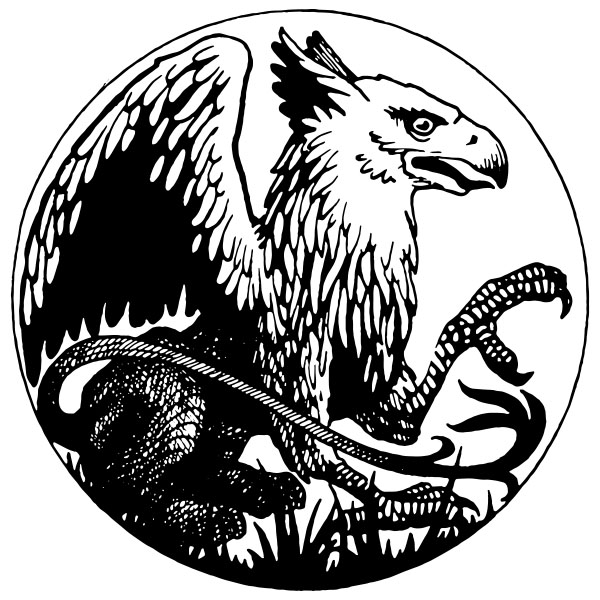
Being a fusion of two apex predators, Griffons are extremely aggressive and territorial in defending their aeries. However, they can also be trained to serve as mounts if properly domesticated… albeit it’s something that takes a lot of time and danger. Successfully trained Griffons are extremely loyal and bond exclusively to a single rider, which is the kind of fantasy that these kinds of noble beasts are meant to fulfill.
It’s a bit of a bland monster, and 5.5E seems to realize it. 5.5E notes that while the eagle-and-lion type of griffon is the most common, other breeds have features of other birds of prey and large cats. You could have a vulture-panther Griffon, or a condor-tiger Griffon, or a owl-lynx Griffon! This kind of customization instantly makes Griffons a bit more interesting to me as a world-building tool. Being associated with nobility, you could easily flavour different clans of nobles in a kingdom of having different lineages of Griffons that they breed selectively like purebred dogs. There are even a couple of extra legends (which may or may not be true) about Griffons in 5.5E, which distils all of the features we’ve discussed above, but also adds a couple of interesting additions as potential things Griffons can do – curse their killers to be hated by all other animals; and not attacking those with royal blood.
_________________________________________________________________

Grimlock
- 5.5E/5E: Medium Aberration (5.5E) / Humanoid (5E); Neutral Evil; CR 1/4
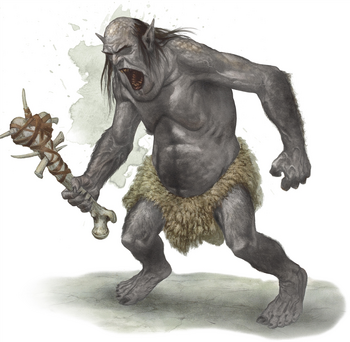
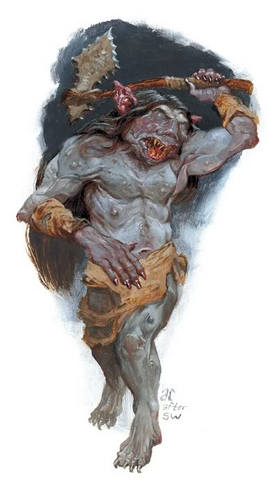
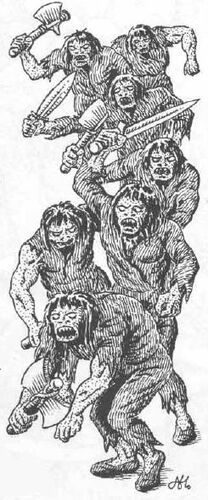
Grimlocks are a ‘let’s change this a bit to avoid a copyright strike’ adaptation of the Morlocks from the classic sci-fi novel, H.G. Wells’ The Time Machine. Morlocks in that novel are one of the offshoots of humans in the far-flung future, having devolved into degenerate, sinister beings that live in underground tunnels. Instead of being more skittish like the novel’s Morlocks, D&D’s Grimlocks are huge, pale cavemen with troglodytic features. No, not the Troglodytes, those are a different enemy down the line – troglodytic adaptations are how evolution goes for creatures that adapt to live in a cave, with one of the more extreme ones being the loss of eyes that have previously developed.
I really like the 3E and 4E interpretations of the Grimlock for that reason, where the eyes have actually glazed over and been covered by a fleshy tarp, which also gives the Grimlock a bit of a more distinctive look. 5E’s design of the Grimlock is so… boring. It’s just a big angry caveman, with a caveman club and caveman pants. 5.5E tries a bit better, highlighting the pale skin and the blind eyes, but it’s still ultimately just a feral caveman. There is something that’s a bit interesting in that they’re completely blind and rely on sounds… but that really is the only thing they’ve got going for them.


They do have a backstory, where they were once humans but were corrupted by – who else – the Mind Flayers. The Grimlocks were not born out of Mind Flayer experimentation, however, but of something a bit more unintentional. As Mind Flayer plans infiltrate human society, this led to cults that worship the Mind Flayers… and this worship ends up turning into psychotic cannibal cult that began eating brains in worship of the Mind Flayers. The Mind Flayers just looked at this, shrugged, and gang-pressed the happy cultists into minions to help them abduct other sentient creatures, gradually and ultimately mutating them all into the Grimlocks.
5.5E changes this a bit, that Mind Flayers can just create more Grimlocks by ‘Underdark radiation’, not tying the Grimlocks to a very specific cult origin. This retcon turns the Grimlocks into Aberrations instead of Humanoids, and the 5.5E Grimlock gets a brief, minor psychic bonus damage to their club; and several directives that a Mind Flayer villain could send their Grimlock minions to do.
Ultimately, while the backstory is somewhat interesting, the Grimlocks themselves really aren’t. I feel this is compounded even worse in that even in the base D&D Monster Manual, we already have quite a bit of a surplus of underground races that all tend to be way more interesting than these guys, and even the hook of being Mind Flayer victims isn’t unique to them.
_________________________________________________________________
Hags
I love hags, and they are probably one of my favourite monster groups in D&D. I would admit that at first, I didn’t think much of them – creepy old women? That’s not the most creative monster prompt, and it feels almost juvenile, almost story-book-y. But Hags’ resemblance to old women is merely skin deep, and the more I read about them – particularly in the excellent Volo’s Guide to Monsters – the more I realize that the Hags deliver a part of fantasy that 5th Edition has somewhat failed to deliver until very recently… the Fair Folk.
There are always a lot of hints here and there about things like the Seelie Court or the Archfeys, but there is always a lack of clarity about what they are… but the Hags, on the other hand, have always existed from the oldest D&D material as monsters. As the ‘Feywild’ became one of the most popular things to come out of the otherwise-maligned 4E, it remained woefully underdeveloped, with many of the Fey that came out of it being very simple, bland affairs… other than the Hags.

The Hags fall very much under the ‘rules of society are twisted’ blue and orange morality that the Fey are supposed to represent. A bad world-builder would just translate this into ‘lol faeries are so random’, but actual 5E material would note that the Fey just have rules… they just don’t make sense for us humans. Wild Beyond the Witchlight, an adventure set in the Feywild, explains some absolute rules that the Fey in a certain part of the Feywild would observe with absolute care, and this mindset does come through with the Hags.
Because yes, most Hags are evil and cruel, and they want to torment those around them… but they also explicitly do NOT go into villages and shoot spells everywhere. No, instead they live in huts in secluded areas, and do twisted bargains. They corrupt those who come seeking their aid, acting as twisted genies and devils… and the price they ask will always be something screwed-up. It’s never something so simple and abstract as ‘your soul’, but something that delights the Hag, something that you don’t realize is such a huge price, until the Hags take it. On paper, a being that can rip out and manipulate aspects of reality like one’s ability to feel a certain emotion, or your age, or your memory, would be much more unstoppable… but there’s always this vibe that the Hags can only engage in such reality-warping abilities only if deals have been struck.
Hags also really like taking whimsical names like ‘Granny Sticks’ or ‘Auntie Hagatha’ which makes it even more twisted when they reveal themselves inevitably to be a supremely powerful faerie witch. They also delight in what normal society finds disgusting or repulsive, and it’s just something in their faerie nature that makes them appreciate the morbid. Again, it’s something that crops up a lot in a lot of traditional tales that feature ‘witches’ as villains, and Hags would do stuff like cut up humans to cook them into pies, or decorate their lair with dismembered elf organs turned into cute little grandma decorations.
An aspect in 5E that was dropped quietly in 5.5E is the Hag’s reproductive methods, where they kidnap (or more thematically, win them in bargains) and devour human babies – very much based on faerie myths. These devoured babies will be somehow transformed into a baby that the Hag gives birth to, which will then grow a as a regular human child before transforming into a Hag upon their 13th birthday.

There’s also a fair amount of lore about the Hags in D&D as well, including one of the more interesting ones – hag covens. There are always three, no more, no less. The three are equal, and arguments between two can be settled by a third. Any less and it will dissolve into a rivalry; and any more and it will be too many voices and opinions. This also brings to mind very cleverly the iconic image of three witches around a cauldron popularized by Greek and European mythology. Hags that gather in covens have access to more powerful spells, and can create powerful items like a Hag Eye (which is based on the Fates of Greek myth).
Hags also have a bit of a society. They dislike each other, but also contact each other through their twisted magic to gloat and compare their newfound trinkets and accomplishments. It’s like all the nastiest bits of old-people gathering, exaggerated to eleven. Again, the description about this ‘dark sorority’ gives us a bunch more hints about the rules that the Hags seem to have that dictate their society. Hags will always, without fail, announce themselves and bring gifts when they enter another hag’s territory… but the rules that Hags observe for themselves, or even with other Fey, might not apply to mortals.
Again, the Hags feel so fun because they are so weird. The types of rules that Hags may have, and these ancient ‘codes of conduct’ and dark bargains can differ very easily between world to world, and between each individual Hag. The statblocks of the three basic hags shown to us in 5E are honestly quite bland, being rather simple spellcasters with maybe one or two extra shapeshifting abilities… but I feel like Hags serve the best roles in a campaign as roleplay antagonists, with special powers that trigger depending on the things that the players do. Having dismissed them due to their rather bland visual designs, I’ve grown to truly appreciate the Hags.
________________________________________________________________

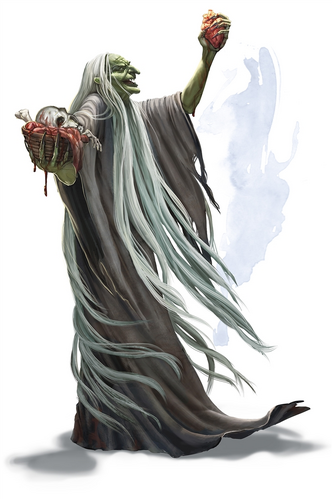
Green Hag
- 5.5E/5E: Medium Fey; Neutral Evil; CR 3 (Green Hag), 5 (Coven)
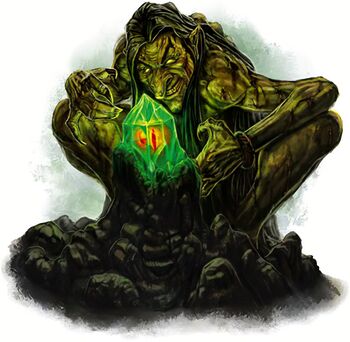
The Green Hag is the most basic hag that the others (and 5E would give us a couple more variants) would draw from. She is just an old woman with nasty green skin, a grotesque face straight out of a storybook villain, long ratty hair and clawed arms. She’s like an evil witch from Snow White or Hansel & Gretel, and that resemblance seems to be rather purposeful from the art department.
Green Hags dwell in swamps, dark forests and caves, and often use their ability to mimic voices to attract nearby wanderers, at which point they start to manipulate them to do their bidding or enter deals with them. Green Hags are sadists that like to see tragedies and failures in other creatures, wanting to ‘befoul all that is beautiful and pure’.
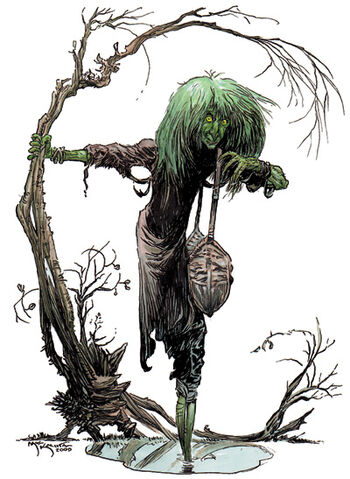

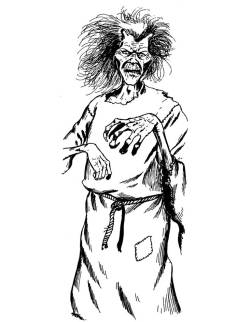
A lot of what I said above in the Hags-in-general sidebar applies to the Green Hag. They are sadistic and morbid, they know a lot of forbidden lore, and they love to bargain. It is just such a shame that their CR and their stats are so abysmally low, at a CR 3 (or 5 in a coven), with their spells mostly being ones that befuddle and confuse. It’s not exactly something that you would be afraid to break a deal with, and I’ve always been of mind that with how much the flavour text and descriptions hype them up that Hags really should be a lot more powerful.
Again, while in all previous editions Hags have always explicitly been female, 5.5E made some ugly old grandpas show up in most of the Hag artworks. I am honestly rather indifferent about this, with the Fey in particular I do really feel like their outward appearance is something they manifest in just to screw with mortals anyway.
_________________________________________________________________
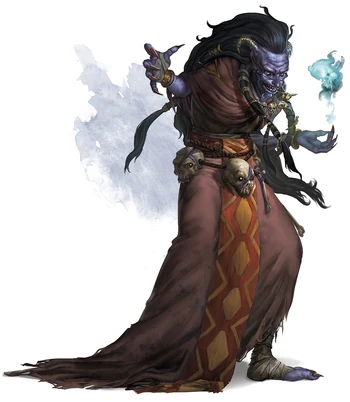
Night Hag
- 5.5E/5E: Medium Fiend; Neutral Evil; CR 5 (Night Hag), 7 (Coven)
The Night Hag… already breaks the mould, since they are usually the weirdest of the Hags. In 3E and 4E, they even sit in a completely different space separate from all the other Hags! And the most distinct difference is that they are considered fiends instead of fey. Indeed, in 5E, Night Hags have been exiled from the Feywild to Hades, and this has transformed them into fiends that find a niche in the lower planes. Their skin have transformed into a bluish-purple shade, and they often have devilish horns sprouting out of their heads.
Night Hags are particularly intent on corrupting good mortals and values, like warping love into obsession, cautiousness into paranoia, or frugality turned into stinginess. In a feature based on mythological incubi/succubi (who we’ll talk about later), Night Hags can stalk a sleeping humanoid, ‘straddle’ them ethereally and intrude into their dreams. This is how a Night Hag corrupts their victims, giving them nightmares to influence and warp their behaviour in the waking world. That’s where the ‘night’ part comes, I suppose!
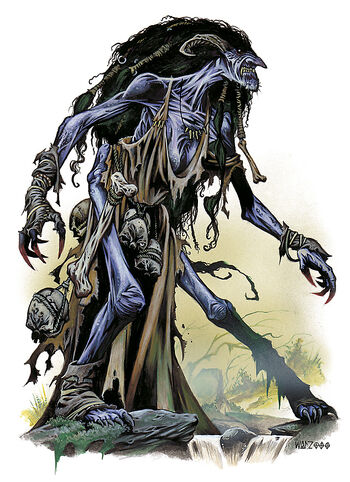

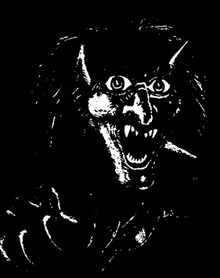
Night Hags are particularly associated with two items in 5E, a Heartstone and a Soul Bag. The Heartstone allows the Night Hag to transform into her ethereal form, which allows her to do the whole ‘night-straddling’ thing. The Soul Bag is where the souls that a Night Hag has corrupted will be trapped in. Of course, it is made from stitched flesh, and it will only resonate specifically with a soul that did corrupted acts as a result from the Night Hag’s influence. The Night Hag will then slip within planes and barter these souls with other fiends that care about them, probably mostly devils.
The Night Hag is the most different from the basic idea of a Feywild Hag that the other 5E Hags – the Green, Sea, Bheur and Annis Hags – draw from, but I think that’s on purpose due to their fiendish nature. Not the biggest fan of them, to be fair, but mostly because they feel a lot more ‘devil-y’.
________________________________________________________________

Sea Hag
- 5.5E/5E: Medium Fey; Chaotic Evil; CR 2 (Sea Hag), 4 (Coven)
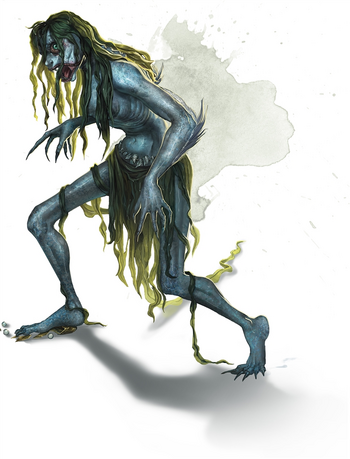
Sea Hags look like drowned corpses, with ragged hair that look like seaweed and a generally horrifying nautical appearance. I would assume that their prominence is also based on another famous fairytale, Hans Christian Andersen’s The Little Mermaid. Sea Hags live in caves near the sea or shipwrecks, surrounded by aquatic minions. Compared to other Hags, Sea Hags are particularly repulsed by beauty, and they really love twisting whatever is outwardly pleasing to inspire an opposite emotion.
It is interesting to note that Sea Hags are apparently cursed to ‘always be ugly’, and even though they have the ability to cast illusions, there is always something off about their false forms. Unlike the Green Hag that relies more on actual spells, the statblock for the Sea Hag focuses a lot on her ability to horrify you with her appearance and death-glares, which isn’t something I’ve noticed before. While all the 5E Hags are statted as disappointingly low-CR monsters, the Sea Hag, being the weakest at CR 2, is easily the least threatening with most of her powers being close combat oriented.
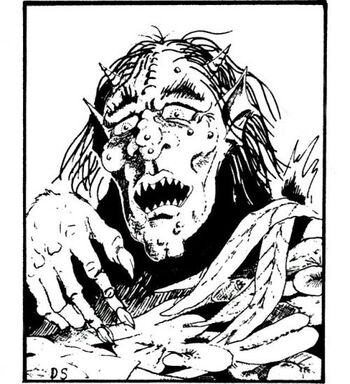
Again, I feel like this causes a lot of the interesting stuff they mentioned about Hags in the opening bar in the 5E Monster Manual to be rather disappointingly missing within the actual monster stat-blocks. The prose promises powerful beings that beguile and can cast powerful curses, not an ugly angry sea-witch that can’t even cast any spells.
_________________________________________________________________

Arch-Hag
- 5.5E: Medium Fey; Neutral Evil; CR 21
…which is why I am very happy at 5.5E for adding an Arch-Hag. As mentioned before, the Hags have had a fair amount of love from the publishers of D&D, getting a whole segment and two variants in Volo’s Guide to Monsters, and having some Archfey-level Hags be the villains in their Feywild adventure. But we actually get a statblock, for the first time, for an Arch-Hag in the 5.5E Monster Manual, giving us an endgame-level threat for the Fey category. This is awesome!
The artwork for the Arch-Hag just shows three of them surrounding a cauldron, and they look like rather stereotypical evil witches. Horns, ragged clothes, pointed features, and a clothing style filled with dangling skulls, scattered jewellery and pointy hats. Arch-Hags are immortal and unpredictable, and they hoard much more secrets and do more bargains than their lesser kin. We now have a proper ‘face’ to all the Hag lore that we’ve been getting in the 5E books, as the supreme Hags that are fascinated about trading secrets while also secretly trying to screw over anyone that deals with them.
It's also noted here that Arch-Hags often avoid battle, since their main goal is to hoard secrets and to torment others, but they can unleash a lot of dangerous magic. Again, this is definitely more like it for a powerful fey, with abilities like spectral claws, lightning blasts and witch-bolts, and a spell list that allow it to befuddle (Modify Memory, Detect Thoughts) or escape (Dimension Door, Plane Shift, and its ‘Spiteful Escape’). My favourite Arch-Hag ability is probably Tongue Twister, which is its version of Counterspell. In addition to countering an opponent’s spell, however, the Arch-Hag causes whatever that caster to say to come off as the opposite, which is such a ‘hag’ thing to do.
While a lot of their abilities seem to just be an extension of what the Green Hag promises but didn’t exactly deliver, the Arch-Hag has an extra little gimmick tied to it. Being such a powerful being, every Arch-Hag ends up having a unique weakness tied to a fateful encounter, or ‘the antithesis of the hag’s magic’. So powerful is an Arch-Hag that they can only be destroyed with the weakness nearby, even if that item can’t actually kill the Hag. It’s a nice variation of the ‘they always reform in their home plane’ weakness of fiends. The Arch-Hag’s weakness table is gloriously whimsical and weird, going from things that are difficult to find (‘the bones of the arch-hag’s first love’, ‘a tear from a devil’, ‘one of the hag’s missing teeth’) to something more metaphysical like ‘the multiverse’s worst pun’ or ‘a star pulled from the sky’.
Arch-Hags tend to live in magical homes, with D&D’s iconic Baba Yaga from the Curse of Strahd story being highlighted as living atop a hut on chicken legs… something taken straight from real-life Slavic folklore. Of course, the interiors of these lairs are often different and larger from what it looks like outside, and creatures approaching the lair are often hit with bouts of incompetency and confusion.
The Hags have always been one of 5E D&D’s biggest disconnect between the impressive lore that tell their story and the rather sorry statblocks. As a huge fan of their creepy backstories and lore, I am very much happy that this update brings a properly powerful ‘boss’ hag as one of the monsters in the basic bestiary.
_________________________________________________________________

Half-Dragon
- 5.5E/5E: Medium Humanoid (5E) / Dragon (5.5E); Neutral; CR 5
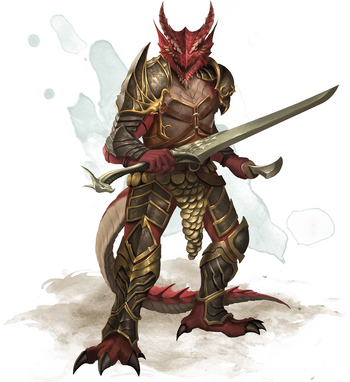
Before we talk about the Half-Dragon, I want to talk about ‘template’ monsters. Back in the day, particularly in 3E, you could modify a basic monster with a ‘template’ to convert it into a different type of monsters. Theoretically, any living creature can turn into an undead like a vampire, and any living creature can technically have a Dragon as a parent… hence, Half-Dragon. Dragons in D&D can polymorph themselves into any creature, and sometimes in the process of polymorphing, mating occurs. While this feels odd to me, I also have to admit that I’m not the expert in dragon genetics or how genes work with magical polymorphing. In this case, it produces a Half-Dragon creature. Who inherit traits from their draconic parent, and are also sterile. In 5E, this can be anything from a humanoid to a beast to a monstrosity because dragons are, how shall we say… very adventurous.
Again, it’s a ‘template’ that can theoretically be applies to any creature, with the statblock in the 5E Manual technically being a ‘Red Half-Dragon Veteran’. You pick the colour of the dragon parent, and the original ‘base’ of the creature to create. Again, depending on the style of the DM, this is either a really cool way to create unique, potentially min-maxed encounters within the rules… or just a question as to why we don’t just make up our own statblocks for whatever Half-Dragon character we need.
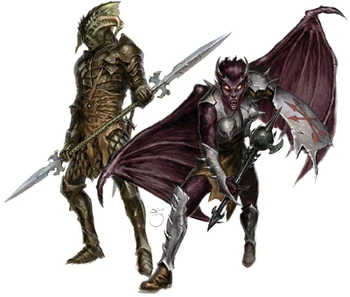

The design of the Half-Dragon is a bit odd, too, since we already have a humanoid race of dragons in the playable Dragonborn race. What really differentiates a Dragonborn and a Half-Dragon created from a humanoid? They both look like bipedal dudes with dragon head and skin, with whatever elemental breath weapon their draconic parent gives them. Tails, I guess, but that’s always been a point of contention in the D&D community. The origin is different, sure, but the 5E Manual also shrugs and goes that Half-Dragons could be created by dark rituals or the good old staple of ‘a mad wizard did it’.
5.5E goes for a bit of a more extreme design when they republished the Half-Dragon. The ambiguous origins are still there (though the cross-species breeding is merely alluded to instead of explicitly stated) but the purpose of the Half-Dragon creation is now noted to be the creation of servants. This makes the Half-Dragons more in line with something like the Dragonspawn of 4E, where they were the results of dragons creating a brood of ‘lesser’ dragons. They are also classified as Dragons now instead of Humanoids (or whatever their non-draconic side is) which brings a bit more of a distinction from the Dragonborn.
But more distinctive is the artwork. Where the 5E Half-Dragon is in essence indistinguishable from a Dragonborn, the 5.5E Half-Dragon is feral, bulkier, and looks like a proper mutant. Its body is almost gorilla-like with how large those arms are, and the head looks a lot more feral. This makes them a lot more distinctive than, again, the more prominent Dragonborn race. It’s okay to have variation, but I feel it’s important to communicate that both visually and through lore.
_________________________________________________________________

Harpy
- 5.5E/5E: Medium Monstrosity; Chaotic Evil; CR 1
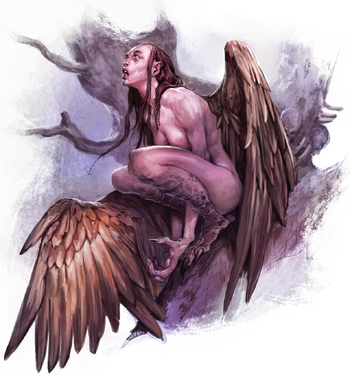
We get yet another classic Greek-myth monster, the Harpy. It is quite interesting that throughout all five editions, the Harpy has remained consistent in having the body of a woman, vulture wings sprouting from their backs, and regular arms and legs that end in bird talons. How pretty or monstrous their facial appearance tends to vary from being hideous hags to ‘cute monster girl’ in 4E. I’ve personally had the mental image of what a Harpy is kind of stuck as a bird-woman with their arms and wings merged together – which is how harpies are depicted in the Yu-Gi-Oh and Warcraft franchises, which I thought always gave the harpies a bit of a unique silhouette and makes them very distinct from the typical angel/devil body shape.
Anyway, harpies are sadistic, cruel bird-women! I think realizing that they needed an extra twist to make the harpies different from so many other ‘giant bird’ enemies, 5E gave harpies a ‘luring song’ ability that tends to be more associated with Sirens in the original Greco-Roman myths. When charmed by a Harpy, the targets just blindly walk in the direction of the song, even if it leads them into hazardous locations. Harpies stay in cliffsides and locations hazardous to non-flying creatures, and they will always try to lure enemies into ambushes with their song, and take days to torture and dismember their victims. Like cute birds, they also steal shiny trinkets from their victims.

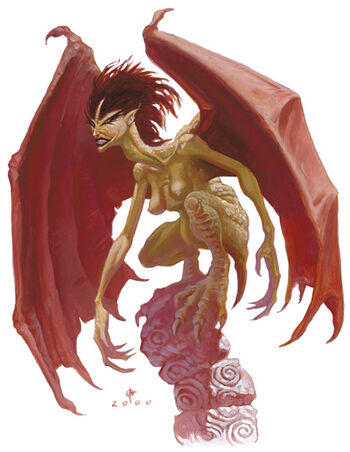

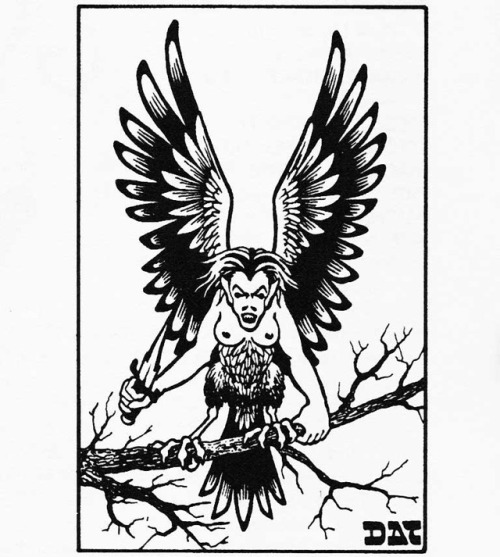
5E actually gives a fairly lengthy backstory for the harpies, which is tied to an elf woman obsessed with the glorious song of an elven god she glimpsed in the woods. This obsession turned ugly, and she ended up cursing the gods, and be cursed by it. In some older editions, Harpies are always depicted to be female and this curse has been the reason why – and in older editions they reproduce by, um, forcefully abducting males for mating. Newer editions kind of have ignored this completely, and in its effort to discreetly tone down ‘single-gender race’, 5.5E sneakily puts in a bearded male Harpy in the background.
I’ve always felt like the Harpy was a bit more of an ‘obligatory’ inclusion due to its iconic nature as one of the more prominent Greco-Roman monsters… D&D’s writers seem to be much more invested in writing and developing the bird-people races that it made up for its own franchise like the Aarakocra or Kenku, leaving the poor Harpies just a weird curio.
_________________________________________________________________

Hell Hound
- 5.5E/5E: Medium Fiend; Chaotic Evil; CR 3
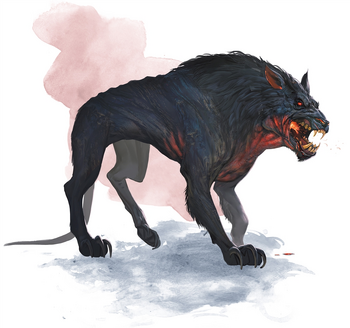
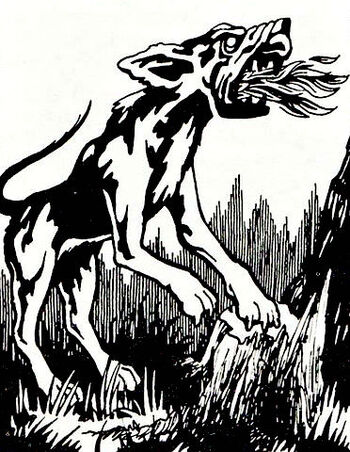
Another classic fantasy trope is the Hellhound! While the hells of the D&D world are filled mainly with Demons, Devils and Yugoloths, there are also unaligned fiends like Hell Hounds. In 5th Edition, Hell Hounds essentially act as the hunting dogs and guard dogs of the denizens of the Lower Planes, and they breathe fire. While they’re good at following orders like most puppies, the Hell Hounds are intelligent enough to abandon and betray masters that don’t let them indulge in their desire for violence. The 5E Manual notes that whenever they feed, the flesh they consume ‘stokes the infernal fire within them’, which is a nod to the fact that they don’t follow any rules of biology. And when they die, said flame consumes the Hell Hound’s body whole that only ashes remain.
The 5.5E goes for a bit of a direction I felt was surprisingly lacking in the original 5E writeup – by basically assigning the role of mythology’s most famous pooch of the underworld, Greece’s Cerberus, to the Hell Hounds. In 5.5E, Hell Hounds are noted to be utilized by demons and devils to ensure that souls don’t escape from whatever torment they are delivering to them. 5E talks a lot about what Hell Hounds summoned to the Material Plane does, but I do feel this discussion of what they do in their ‘natural’ realm is much-needed!


In fact, I am surprised that D&D has very, very seldom adapted the Cerberus for… for no real reason at all. It’s a bit of a surprise for a franchise that have plumbed very obscure Greco-Roman mythology for monster concepts, but so far my search for any officially-published D&D Cerberus stat block has been for a crossover with the Greek-inspired Theros from Magic: The Gathering. It is a genuine surprise to see that with 5.5E’s love for monster variants that they didn’t add in a Cerberus variation for the Hell Hound!
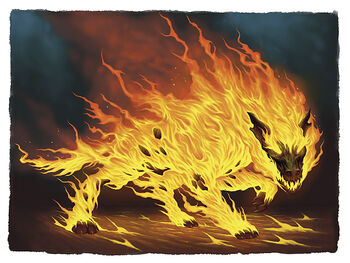
It is also interesting to note the evolution of the Hell Hound over the various editions. It’s just another creepy-looking dog in 1E and 2E, and gains an almost human-like head in 3E (something more associated with a different evil dog, the Yeth Hound, in modern editions). 4E goes all-in for a hound completely on fire, which I actually like. I think I like the original 5E art the most, showing a mangy-looking hound with a glowing furnace belly and a really rabid/feral-looking head. The 5.5E update is cool, but I think it’s ‘too’ cool and not wretched enough, if that makes sense. I do still feel like they could’ve done more in highlighting the ‘hell’-ness of these things, but for what we got, I suppose it’s okay.
_________________________________________________________________

Helmed Horror
- 5.5E/5E: Medium Construct; Neutral; CR 4
The Helmed Horror (or ‘Spirit Armor’, or ‘Doom Guard’) is one of those ‘classic’ D&D monsters that, I’m sorry, I always forget about. The fantasy trope of a suit of armour coming to life is one that’s already represented with several different creatures in D&D – with the Iron Golem and Animated Armour specifically being tied to much more memorable monster groups. And the trope of the ‘magic robot’ tends to default to the much more memorable Warforged race from Eberron. I think there’s also the fact that ‘Helmed Horror’ just inherently isn’t a catchy name.
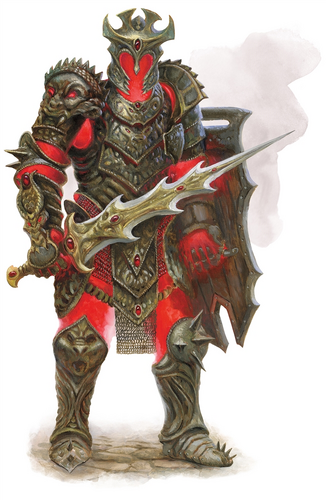
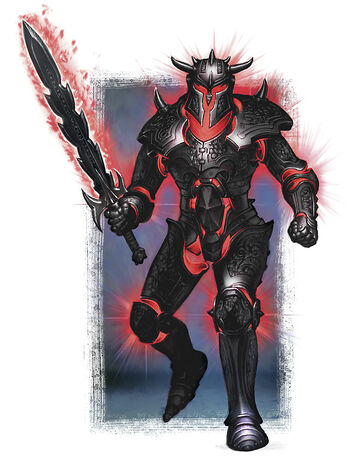
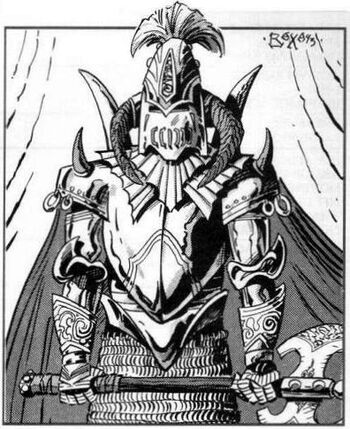
And I really wish there’s some hidden gem I could say about the Helmed Horror, but it really is just a moving suit of armour with some magical resistances… again, not too different from a Golem. It can also fly, which is probably one of the few things that might cause a party of players to get surprised. The artwork in 5E and 5.5E are cool enough, I suppose, showing magical flames taking the form of a somewhat-fiery spectral body within the armour.

The Helmed Horror’s whole deal is that it’s a construct created by a wizard… but the Helmed Horror is intelligent enough to adjust tactics and have utmost loyalty to its creator. The name itself is even a misnomer, since the Helmed Horror is more of a guard. The Manuals point out that the Helmed Horrors are smart enough to understand the meaning of the order instead of just the wording… again, making it ‘just’ a smarter Golem, because both 5E and 5.5E note that there are limitations to it that prevents them from having actual personalities or sentience. I really struggle to find much to say about this one.
_________________________________________________________________

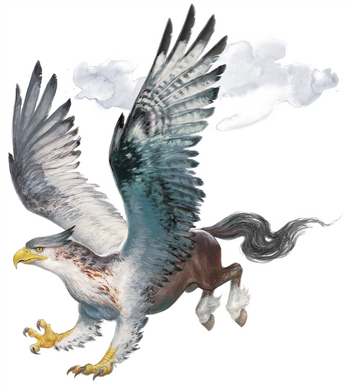
Hippogriff
- 5.5E/5E: Medium Monstrosity; Unaligned; CR 1
I am absolutely happy that the Hippogriff (or Hippogryph) gets an entry as well. Coming from the same myths that gave us the Griffon, the Hippogriff takes forbidden interspecies love one step further. Remember all the emphasis above about how Griffons instinctively hate horses? Well, Hippogriffs are the union of two species that should never be – a horse and a griffon. So that adds the rear end of the horse to the creature’s look… a similar silhouette, but different enough. In-universe most people (and all griffons) treat this as a bit of an abomination, but to real-world players it doesn’t look any more weirder than other ‘fusion’ animals like Owlbears or Tressyms.
Combat-wise, the Hippogriff is just a weaker Griffon, which makes sense since it’s got a less-savage herbivore tossed into the mix. Hippogriffs are noted to be extremely loyal as mounts, but are much rarer. This also comes with being the target of Griffons and other large predators. The 5E Manual doesn’t give us much to work with, just noting how Hippogriff mating pairs protect their territory.
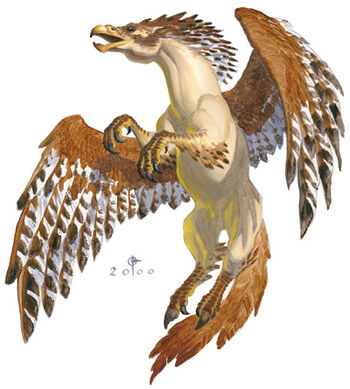

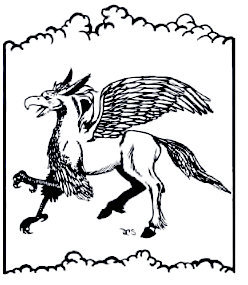
5.5E brings up a new facet of Hippogriff ecology, noting that the species often undergoes migrations, and gives us a table to pull for a potential plot hook, with Hippogriff migrations apparently often leading to locations that might be mundane like a massive nesting ground… or lost ruins in the clouds, a portal to the Feywild, or just straight-up a low-hanging planetary body. It does speak to how some of “real” mythological beasts are comparatively much more mundane when translated into D&D, but I do appreciate them still doing so.
_________________________________________________________________

Hobgoblin
- 5.5E/5E: Medium Humanoid (5E) / Fey (5.5E); Lawful Evil; CR 1/2 (Warrior), 3 (Captain), 6 (Warlord)
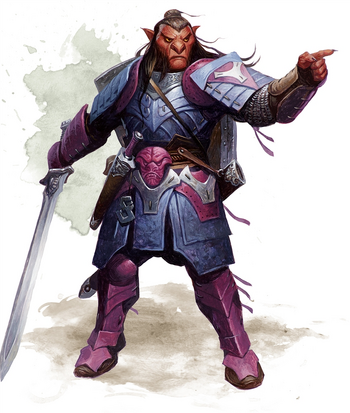
Hobgoblins are the third and final member of the goblinoids in D&D, after regular Goblins and Bugbears. Where the Goblins are skittish, fragile idiots and the Bugbears are big brutes, the Hobgoblins fulfill the role as the competent soldiers. Hobgoblins stand much taller than Goblins, wear armour and have a culture revolving all around military might. 5E has visually reinvented them to a race of human-sized warriors with red or orange skin, weird noses and pointy ears. They also have a distinct East Asian-themed vibe to their armour, which is… interesting. Volo’s Guide to Monsters gives us a bunch of specialized Hobgoblin variants that are a lot more ninja-y. The artwork tends to look cool, although they don’t really feel ‘goblin-like’ to me the way their 3E, 4E or Pathfinder counterparts do.
Hobgoblins charge in as organized military legions, and lore in both Monster Manuals and Volo’s Guide to Monsters spend a lot of time talking about how the Hobgoblins are dour and view conquest as almost something akin to a religion. They believe that their god Maglubiyet has placed them on the world to conquer, and they will do so first with their other goblinoid kin, whipping goblins and bugbears into shape, and then sending them off into battle. As 5.5E describes them, they ‘embody the primal urge to grow and spread’, which leads to their culture of endless expansionism.


In older editions, the Hobgoblins are essentially the ‘lawful evil’ version of Orcs, as an organized humanoid army – but one that functions with ordered legions instead of a slavering horde. Indeed, Hobgoblins are noted to be exceptionally smart in tactics and discipline, and they understand the importance of recon and scouting, very much willing to lay a siege or to starve out an enemy village if that would allow them victory without casualties.
With 5th Edition, this was expanded a bit more, talking about how Hobgoblin legions and units tend to have a strong rivalry with each other, but they also respect the code of war enough to only bring that rivalry through achievements in war. They are disciplined and are trained at the art of warfare and tactics since young, and their ideal is to become a warlord that commands troops and not have to wade into battle. Even if they fall in battle, Hobgoblins are happy to go to their afterlife of Acheron, where they will battle forevermore in the legions of Maglubiyet.

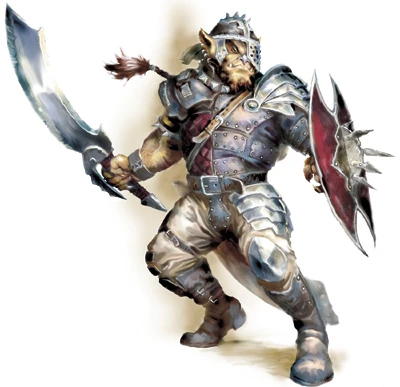

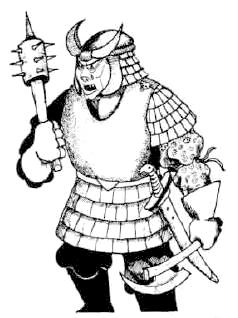
Again, the Hobgoblins fill a rather interesting niche as antagonists – an organized, intelligent army. But ultimately, I tend to not have too much to say once we’ve reached these tropes, since at this point there’s not much differentiating a Hobgoblin from, say, an Elf or a Dwarf.
Anyway, I’ve always found the Hogboblins to be interesting specifically because of their contrast to the Goblins (and to a lesser extent, Bugbears), and the intersection of these races is what makes the goblinoid gang interesting as a package. I do wish there was more to the Hobgoblins than just ‘they like the army life’, to be fair.

Hags are great fun. A Green Hag is actually a part of one of my character's backstory.
ReplyDeleteAlso hobgoblins. Something fun I did was have them be soldiers of fortune, attempting to restore order to their war-torn homeland
Always a huge fan of Hags, and there's just so much to work with. The deals, the twisted fairy-tale aesthetic, the potential of not actually being an enemy, general creepy stuff they do to the local village... the Hag is just such a great wildcard that I feel gets overlooked due to their visual design of 'ugly grandmas'. It's a bit of a shame!
DeleteDefinitely a shame. By the way, the one in my OC's backstory is named Granny Jinglebones
DeleteThat's an awesome name! And honestly, in keeping with the D&D Hag naming conventions, where it's stated in the Monster Manual and Volo's, and even some older Manuals too, that Hags love to pervert what is cute and sacred to humans -- titles of affection (Granny, Auntie, Mother) and something that would sound whimsical.
DeleteAnd it can even be doubly funny when the Hag turns out to be a nice (or, well, nicer) Hag!