

It is kind of surprising the amount of entries I stuffed into certain articles back in the past. At this point I'm just breaking them up by an approximately similar amount of length, but I really did breeze through a lot of the monsters back in 2019 without giving them the time of the day. I thought it would really be fast once I got through the giant mass of demons, devils and dragons, but I am quite pleased to talk about a lot more monsters now.
This one contains a couple of very iconic monsters. Sure, we've got the Merfolk, the Lizardfolk and the many Werebeasts... but most importantly we've reached two of D&D's most famous original IP monsters... the Mind Flayers and the Mimics! The Mimics have basically became an iconic piece of fantasy and gaming media nowadays, and the Mind Flayers are probably one of the 'faces' of D&D alongside the Beholder as far as monsters go.
I was sorting out the entries in the Monster Manual, and assuming I do a couple of entries for the appendix and the playable races/classes, I do think we'll hit a nice even 20 with the volumes. Afterwards, I am debating a bit on whether I'll do some newer material and adventures first, or if I'll jump straight into the two bestiaries merged into Monsters of the Multiverse. I did really think a lot of the older adventure modules could really use a lot of tightening. I don't mind doing a bunch of what's essentially 'NPC' statblocks when I review the appendices for the Monster Manual or Mordenkainen's Tome of Foes, but I don't think that's what's most interesting about the adventure books.
Click here for the index.
[originally published in December 2019; revised in October 2025]
____________________________________________________


Lizardfolk
- 5E: Medium Humanoid; Neutral; CR 1/2
- 5E/5.5E: Medium Elemental; Neutral; CR 2 (Shaman/Geomancer), 4 (Lizard King or Queen/Sovereign)
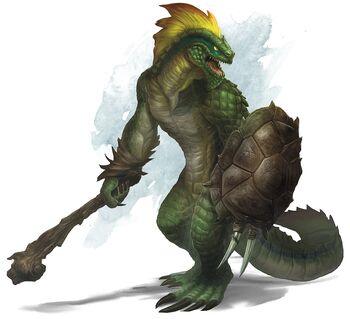
Another favourite race is the Lizardfolk. Previously ‘Lizardmen’ in older material, any whatever-men species have been rather consistently turned into -folk, which I think makes quite a bit of sense. As their name implies, the Lizardfolk are just… huge, bipedal lizards! This allows for quite a bit of variety in looks, with various editions going for more threatening and scalier crocodilian aesthetics. Other takes might go for something more colourful, or dinosaur-inspired. It is quite necessary to distinguish them a bit from the Kobolds that take up the more fragile-looking reptilian niche, and the Lizardfolk tend to be portrayed as being bulkier and more feral. 5E doesn’t go full-in on being crocodilian, but they do look nicely bulky with some prominent colourful fins.
In 5E, particularly in the supplement of Volo’s Guide to Monsters, much emphasis is placed on the Lizardfolk being primitive folk with a completely alien sense of culture towards most of the world, not caring much about money or property. Their view of morality and even death is different, and they tend to be content on just maintaining their swamps and jungles. A lot of a Lizardfolk’s world-view tends to revolve around what it views as its clan or pack, and they are fiercely territorial not out of hate for other races but out of protectiveness. While the wording used for some of these might be a bit more… shall we say ‘outdated’, I feel like the idea of a culture with very alien values is very valid to put in any RPG world.

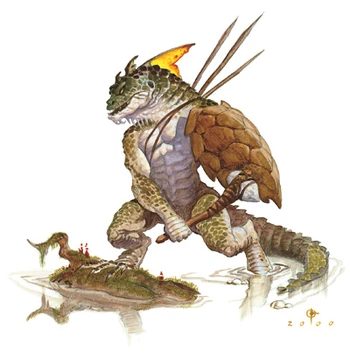

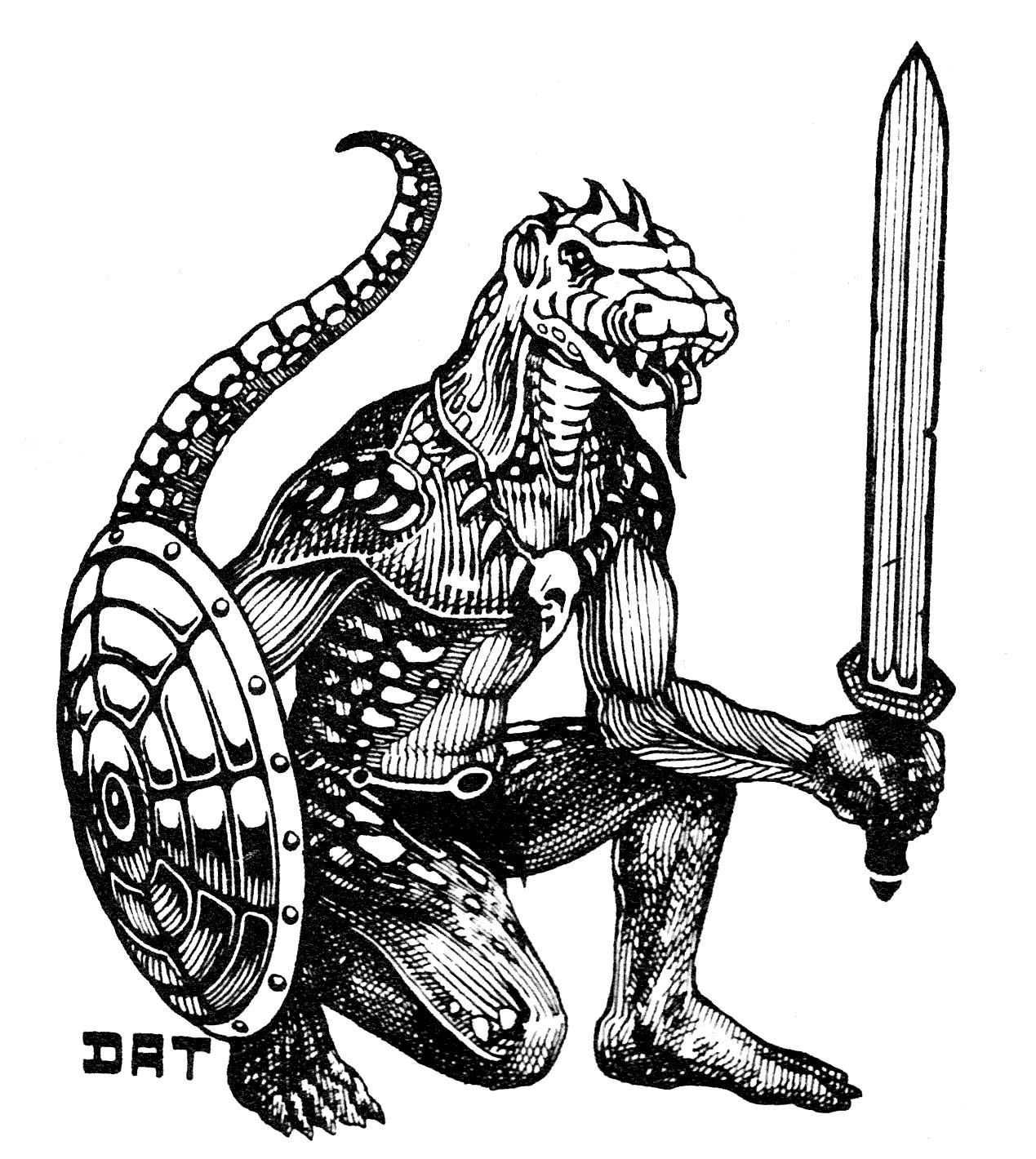
And it’s not like the Lizardfolk is always portrayed as primitive either, because even in 5E it’s noted that any Lizardfolk that was forced into alliance with nearby kingdoms or settlements of non-Lizardfolk will become the most steadfast allies. It’s just this initial bout of diplomacy that tends to be difficult.
Lizardfolk do bear the brunt of a lot of unfortunate ‘tribal primitives’ stereotypes, but… again, I feel that there are ways to rework this instead of reducing them into statblocks with two sentences in 5.5E. Much worse, I think, is that the 5.5E Monster Manual retcons the Lizardfolk into Elementals, which makes absolutely no sense. I can see why some of the categorization changes were done, and in some I could see it going either way. But there is absolutely no explanation as to why the Lizardfolk – which has never been associated with any of the elemental planes, or be more associated with elemental magic than any other humanoid species, is suddenly considered ‘elementals’. There is only a vague ‘some of them forge pacts with the Elemental Earth’, which… humans and elves and dwarves do that too, but they’re not all considered elementals suddenly.
There is also a bit of backstory towards the most powerful Lizardfolk variant – either the ‘Lizard King/Lizard Queen’ in 5E and pre-5E material, or ‘Lizard Sovereign’ in 5.5E. Normally, Lizardfolk worship a pantheon of gods led by the lizard god Semuanya; but sometimes the touch of the demon lord Sess’ienk will corrupt individuals to turn them into Lizard Kings/Queens, usurping their traditional shamanistic leadership and driving the tribe into aggressive frenzy.
Again, I do agree that some of the wordings and maybe some specific aspects (like the ‘human sacrifice religion’) might need to be toned down as D&D reaches an even bigger audience. But to eliminate everything and reduce Lizardfolk, Drow and Orc into just pictures with no context is not much better, I feel.
____________________________________________________

Lycanthrope
I’ve always found the Lycanthropes to be quite interesting in how it’s handled in D&D. They never, I feel, get quite the same amount of love like a lot of other iconic horror monsters – especially compared to their opposite number, the Vampire. With the Lycanthrope, there’s always a half-dozen of Lycanhtrope options in any edition’s main Monster Manual… but it all ends up just being a choice of what animal you’re feeling like turning into. This feels a lot less special, by the way, when the Druid class already allows you to transform into any other animal you’ve seen and not locking you to a single one; and there are many playable races like the Tabaxi, Kenku, Lizardfolk, Minotaur and many others that let you play as a straight-up half-beast humanoid.
The idea for a Lycanthrope and what makes them different, I suppose, is that it’s borne by a curse, and it’s something that most of its bearers have to struggle with. Lycanthrope can transform – similar to the Jackalweres we covered earlier – from a regular human, to version of their animal form, to the infamous were-animal form where they are a bipedal version of their chosen animal. They often transform in animal or hybrid form at night, especially under the full moon… but isn’t locked specifically to that. Which I suppose in gameplay perspective does make sense practically; it’s not fun for the gimmick of either the villains or the player characters be stymied because it’s the wrong time of the night.
5E describes two variations of the curse. A ‘natural-born’ Lycanthrope is born out of two Lycanthrope parents; while an ‘afflicted’ Lycanthrope is one who was bitten or wounded by a Lycanthrope. And these Lycanthropes can either resist the curse, where they often have to fight against their base urges but are forced to transform under a full moon. And just like the most famous Wolfman movies, sometimes they aren’t aware that they have even transformed. Those that accept the curse can master their shapechanging, and can do so at will… which might be cool, but again, without much mechanical rules it makes it not that much different from a barbarian’s rage or a druid’s wild shape.
The original 5E Monster Manual does have a whole sidebar about changing a player character or NPC into one of the five basic Lycanthrope variants introduced in the book, but to be frank it’s basically just a lot of stat adjustments. I think they really should’ve committed to some kind of mechanic to make the Lycanthropic curse actually feel like something cool to overcome and eventually master, but it overall just feels like a bit of an afterthought. I really did feel like the Lycanthrope stuff should’ve been reworked into an actual Class or Species/Race instead of an afterthought, which would allow the players to properly engage with more involved mechanics. As it is, the best you could do to roleplay a Lycanthrope would be to flavour a Barbarian. In a setting like D&D, it is also a lot less special to turn into an animal with druids walking around everywhere, or even being a half-animal person with so many animal-people races around. Perhaps they should have integrated the werewolf-vs-vampire popular media trope, and make Lycanthropy grant immunities to mind control or undeath, or something along those lines? As it is, it really isn't much of a benefit to the Lycanthropy curse other than the 'coolness' factor, which I mention is a fair bit diluted in this world.
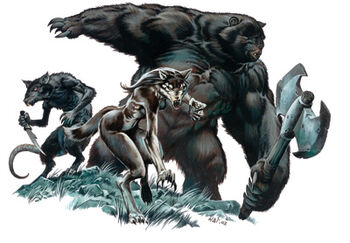
As a side-note, 5.5E combines the artworks for the Werebear, Wereboar and Wererat above. Normally I would place all the 5th Edition artwork together above the individual monster entry, but in this case it's really a bit hard to extricate them.
____________________________________________________
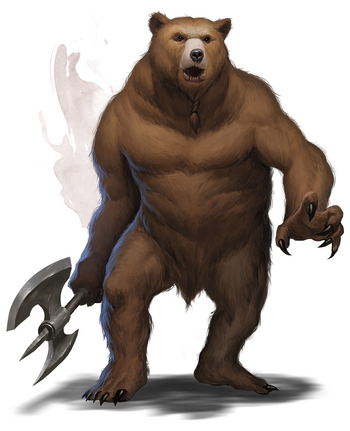
Lycanthrope - Werebear
- 5.5E/5E: Medium or Small Humanoid; Neutral Good; CR 5
I do quite appreciate that even from the earliest days of the 1st Edition, the designers wanted there to be various types of Lycanthropes based on different animals. Some editions (particularly 3E) go a bit too wild by having essentially the entire zoo be available as a were-beast option, while 5E limits it to around a half-dozen. How innately ‘good’ or ‘bad’ the Lycanthrope is tends to be governed by the stereotypical image of the beast.
Which is why one of the most strongest Lycanthropes, the Werebear, is counted as a ‘neutral good’ creature. Which is most likely a reference to the Skin-Changer Beorn of The Hobbit fame... a character that doesn't really get talked about a lot in discussion of LOTR works due to his minimal role, but one that does fit a lot of the characteristics assigned to the Werebear, particularly in earlier editions. Werebears tend to be loners, keeping to remote jungles and mountains so they don’t accidentally injure innocent beings around it. 5.5E adds a bit of a different twist, giving Werebears an association with druids and the feywild and how some individuals gladly accept the Werebear 'curse' because of it -- likely a nod to The Hobbit's Beorn having a small community of intelligent animals that may or may not be skin-changers themselves. Oh, as usual, in a nice little bit of customization, 5.5E notes that Werebears often take the form of whatever bear is local to their chosen area – brown bears, polar bears, black bears…


5E also gives us a bit of lore, noting that Werebears passes on its lycanthropic curse to those that it views as companions or apprentices, and tends to avoid biting in combat to prevent an epidemic of Werebears. Again, it is an interesting take on the Lycanthropy angle… it’s just such a shame that the actual statblocks are honestly not very interesting. A Werebear, transformed into a bear or its full hybrid form, is just a big ball of melee attacks. Which, to be fair, is something you expect from a half-man, half-bear… but at the same time I feel like there could be a lot more mechanics that revolve around all the lycanthropes’ curse-passing or transformation.
With all my ranting, you would think that I don’t like the Lycanthropes. But I do! I really do. I just wished they were executed a lot better, instead of being reduced as a weird afterthought hidden in the Monster Manual.
____________________________________________________
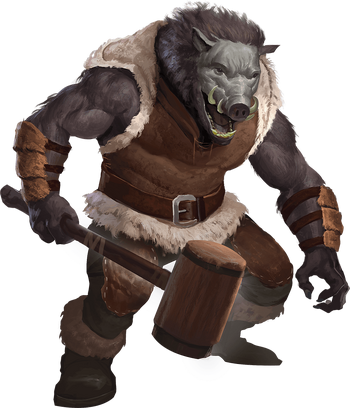
Lycanthrope - Wereboar
- 5.5E/5E: Medium or Small Humanoid; Neutral Evil; CR 4
Yep, boars, wolves and bears tend to be the ‘holy trinity’ of early-game beasts in a fantasy video game, so I suppose it tracks that the Wereboar represents the porcine beasts among the Lycanthropes. The Wereboar is noted to be ill-tempered and vulgar, and are classified as evil. Their design, again, isn’t much to write home about – all the artwork are competent, but at the end of the day it’s juts a portly pig-man.
Wereboars are noted to inflict creatures indiscriminately as it charges through crowds and goring all they can. I don’t know if this little detail is meant to be applicable to all Lycanthropic curses or just the Wereboar curse specifically, but they relish the fact that “the more the victims resist the cures, the more savage and bestial they become.” Interestingly, the Wereboars apparently have a unique society where they live in small family groups in remote areas, unlike the loner Werebears.

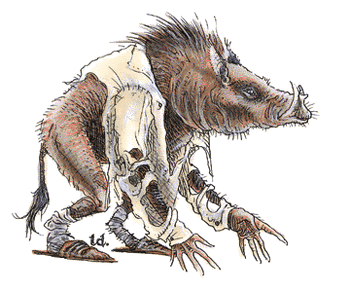

5.5E gives us a short blurb but one that has a rather interesting little gem, noting that some Wereboars involuntarily transform any time they perform a greedy or selfish act. I feel like the various Lycanthropes really could have benefited and be more memorable with these kinds of differentiators. The idea that ALL Werebears are quiet nature-loving loners, and ALL Wereboars are chaotic bastards charging through crowds to spread their curse feels a bit weird since theoretically anyone that’s injured can get the curse. Something that’s tied to aspects of their biology and behaviour, like transforming due to emotional states, feels like they would distinguish the different Lycanthropes a lot more than just ‘choose which cartoon animal you want to be’.
____________________________________________________
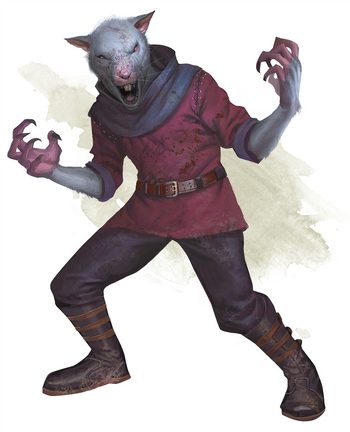
Lycanthrope - Wererat
- 5.5E/5E: Medium or Small Humanoid; Lawful Evil; CR 2
Probably my favourite out of the five ‘basic’ Lycanthropes in terms of design is the skittish Wererat. The weakest of the five Lycanthropes due to the fact that rats are much smaller than bears or wolves; Wererats have the personality associated with rats in popular media. They are sly, greedy, and often sneak around and ambush their enemies. I also should note that D&D Lycanthropes have some tics in their human forms that might give them away as Lycanthropes, and for the Wererat they tend to have thin hair, darting eyes and look wirier than a regular specimen of their humanoid species.
Wererat clans operate like a thieves’ guild, lurking in the fringes of society and within their sewers and back-alleys. Wererats sneak around and use their ability to turn into rats as a way to ambush, steal and assassinate. I didn’t quite realize that the ability to shrink to the size of a rat would be particularly useful for a sneaky organization. And just like the Werebear, apparently the Wererats tend to transmit this curse only to new recruits of their clan, and they hunt down and kill traitors as well as anyone who have contracted the Wererat curse accidentally. I feel like this a much more believable way to have an entire species of monsters always be in a similar society – if they had such a strict, cult-like code.
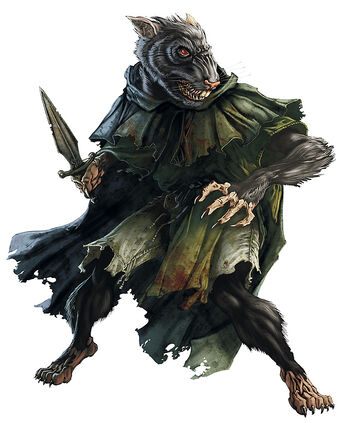


Again, 5.5E adds a bit of a little condition that distinguishes the Wererat from other Lycanthropes. Wererats sometimes are compelled to shapeshift when they are exposed to complete darkness, or specifically nights of a new moon. It’s a nice twist on the classic full moon of a Werewolf, and again I really did wish that they had put a bit more thought to the differences beyond just whatever animal trope comes to mind first.
____________________________________________________

Lycanthrope: Weretiger
- 5.5E/5E: Medium or Small Humanoid; Neutral; CR 4
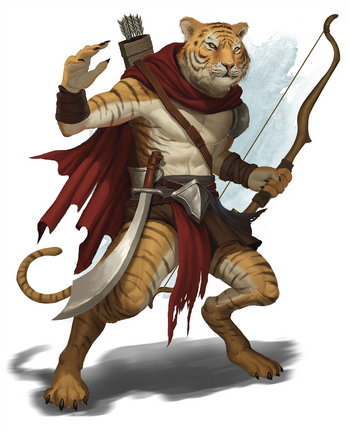
The Weretigers, I feel, are extra weird to be included in the main Monster Manual since they share the same ‘core’ book as a different and more interesting race of tiger-men, the Rakshasa. They did really look a bit too 'soft' in their 5E art, too. Weretigers are noted to be ferocious and haughty, focusing on the hunt. They live in jungles where they can hunt, and tend to not like to spread their curse for fear of competition in their territory… which… sure? Their penchant for hunting translates to a bunch of bonuses to their stealthing and tracking.
In 5.5E, Weretigers are noted to be tied to ‘the crescent moon, seasons or momentous events’. Very ambiguous, isn’t it? And they were doing so well with the last two Lycanthropes! I do like the added context that some Weretigers view their abilities as a family honour, and they are often defending something of historic importance like a legendary weapon or a sacred proving grounds. It’s not much, but it’s something, I suppose?
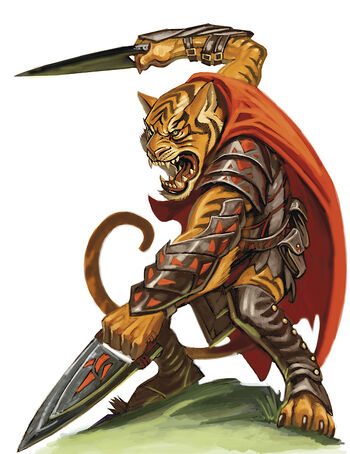

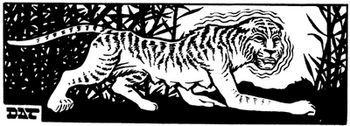
Again, I feel like they really could have done a lot more to distinguish these Lycanthropes instead of just relying on the animal they turn into. The Wererat stuff feels probably the most fleshed-out, but I would really like to know why the Weretiger curse is specifically tied to guarding things. Was it invented by some royal family? Where do these curses come from, anyway? As much as I was uninterested in talking about the Giants, at least they gave me a lot of material to work with.
As a side-note... yeah, that 1st Edition artwork for the Weretiger is... is certainly... something.
____________________________________________________

Lycanthrope: Werewolf
- 5.5E/5E: Medium or Small Humanoid; Chaotic Evil; CR 3
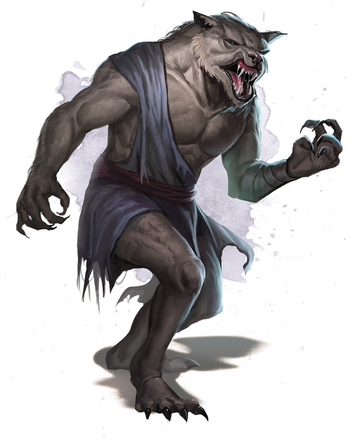
And now we end the Lycanthrope segment with the most iconic creature, the one that everyone in pop culture knows… the Werewolf. Everyone knows what a Werewolf looks like. Head of a wolf; a furry muscular body; claws; doggy legs; and a compulsion to transform at a full moon. And the Werewolf in 5E is noted to have everything associated with the Werewolf in popular media. They have a fiery temper, prefer to rend their foes apart, and are driven by pure instinct.
Werewolves often flee civilized lands after being cursed, fearing what they will do if they remain among friends and family. Even those that embrace the curse try to use their transformation as a way to hide their murderous acts. And… and in the wild, they also form packs with wolves and direwolves, which allows it to use its ‘pack tactics’.
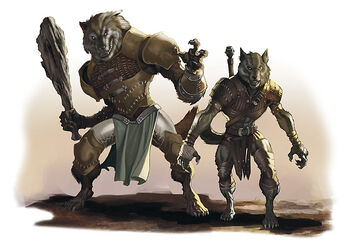


That’s about it for the Werewolf itself, and part of it is because all the Lycanthropes do share a lot of the features from the long opening ‘Lycanthropes’ section that apply to all of them. A lot of the werewolf/lycanthrope tropes were all kind of piled up on top of each other in that rather long one-pager, but it's at least something that allows you to draw ideas to run your Were-beasts. 5.5E's Monster Manual doesn't even have all of those... but I digress. I think I've complained about the 5.5E Manual's organization enough in this review series.
Again, I really do feel like the poor Lycanthropes really could have used a lot more attention and even abilities. The fact is, they just don’t really feel particularly special when any random Barbarian is likely to also be dealing with rage-control issues; when Druids and beast-men races cover the part-animal vibe; and there are a lot of more interesting avenues to roleplay curses or a split personality. They did list a lot of tropes related to Werewolves but not much mechanically that’s interesting. Where Vampires or Hags receive so much powers due to the designers drawing from a lot of different sources, the Werewolves are ultimately just slightly-stronger beasts that can sometimes use weapons, and are perhaps one of the poster boys for D&D monsters that rely more on the audience and DM’s familiarity with the tropes more than anything.
____________________________________________________

Magmin
- 5.5E/5E: Small Elemental; Chaotic Neutral; CR 1/2
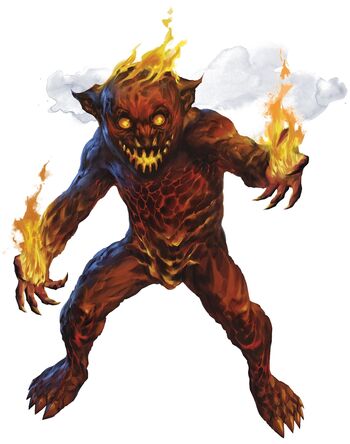
The Magmin is an interesting one. It is a bit neat to have more ‘lesser’ elementals to fight just from a dungeon master standpoint, and the Magmin fills the role of a tiny little creature to fight. Magmins are essentially little grinning gremlins made of magma, and you can see flames rising up from its head and hands. The backstory is that Magmins are fire elemental spirits that are bound into physical forms after being summoned, so they kind of fall into that ‘specialized elemental’ that I mentioned before with Invisible Stalkers.
The Magmin itself has a very simple personality. As the 5.5E Manual notes: “Magmins divide all things into two categories: things that are on fire and things that should be on fire.” I can respect that! With the manic jack-o-lantern grins that the 5E artwork gives it, you can honestly guess their personality quite easily, yeah? Being simple happy elemental beings, they don’t even necessarily care for the destruction of it all, they just are incapable of viewing other things as anything other than kindling. Explaining these concepts to them is futile, due to their completely different outlook on life.
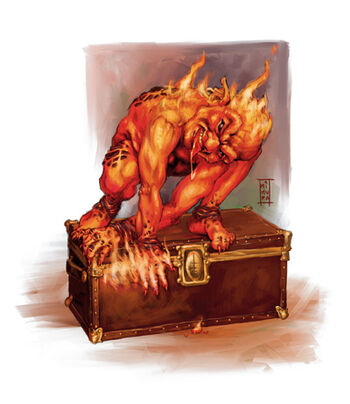

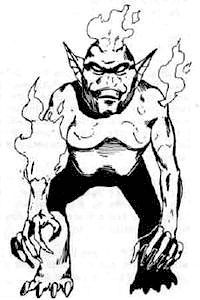
A Magmin’s behaviour is simple – they set themselves on fire, run around and set everything else on fire, and if they die… they explode into even more fire. Interestingly, their rocky-magma outer shell does limit the extent of its pyromania, since the idea is that summoners would not want to use the Magmin as a more directed attack dog.
One little side-note is that the Magmin (or sometimes ‘Magmen’) have shown up in most editions, but never in particularly ‘main’ bestiaries. In past editions they have merely been weird little dudes on fire, looking particularly fleshy and not too elemental-y in their first two incarnations. I do really like their 5E redesign quite a bit. I think it’s that face.
____________________________________________________

Manticore
- 5.5E/5E: Large Monstrosity; Lawful Evil; CR 3
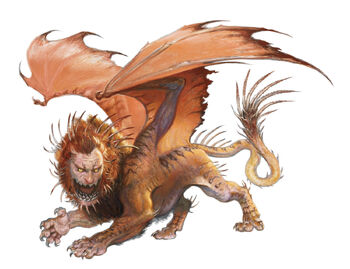
Always the subject of rather impressive artworks is the Manticore, with both of its 5th Edition artworks looking very impressive compared to its surprisingly low challenge rating. The Manticore hails from Persian legends, and they are giant lions with draconic wings (the wings are a D&D addition), the head of a human, and thorns all around its mane and tail. I say ‘head of a human’, but that honestly looks quite monstrous with a mouth that looks disproportionately too large for the face. The text doesn't mention it, but 5E actually does seem to adapt the 'three rows of teeth' that the classical Manticore would have, which does make that head look particularly monstrous. I would also like to take note of the rather disturbing 3E Manticore as well, whose ‘human’ head looks so malformed next to the emaciated leopard body that it really does dip into uncanny valley territory.
In combat, the Manticore is delightfully simple, just flying around as the giant lion-dragon that it is, and showing tail spikes from its tail to impale people at range. Because yes, those spikes on the Manticore’s tail are detachable and meant to be used as projectiles. But I also feel like it’s something meant to be a cool visual spectacle than anything.


The Manticore’s lore isn’t particularly fancy. The are fierce killers that hunt prey, and can work in packs to bring down larger enemies. They are territorial and fight against other winged beasts like chimeras, griffons and wyverns. Oh, they also have a high preference for eating humans over other species. In a fantasy world with multiple humanoid races/species, this distinction may actually be quite important! It’s also noted that they are sapient enough to converse, and in the course of attacking, it will mock its foes and offer to kill them swiftly if they would beg for their lives. Again, being an intelligent creature does mean that there is room for negotiation, particularly if you could appease the Manticore with favours or gifts.
Pretty cool classic mythological creature, and I do find it a bit of a shame that the Manticore flies under the radar a bit.
____________________________________________________


Medusa
- 5.5E/5E: Medium Monstrosity; Lawful Evil; CR 6
I have gone on the rant on the ‘Gorgon vs. Medusa’ thing when I talked about D&D’s Gorgon before, but I will reiterate it quickly – in Greek myth, Medusa is the name of a single individual, a member of the Gorgon Sisters. D&D has elected to use the Medusa as the name of the species instead.
And the adaptation is more or less straightforward, Medusas are women with snake hair and the ability to petrify with a gaze. We’ve already had a couple of other monsters with petrification abilities, but the Medusa might prove to be dangerous for the reason that they are sentient beings. And in case they are unable to catch you with their gaze, they also have the ability to conjure poison blasts.
Whereas the classical Medusa causes anyone that gazes upon its visage to turn into stone, it’s a bit more impractical in D&D on the poor monster’s side so it’s changed to the Medusa cursing whatever she looks at. It is notable that this doesn’t change the Medusa’s classic weakness, since looking at a mirror still causes the Medusa to turn itself to stone since she would be gazing upon herself. Also, I am quite happy that they gave the Medusa a fully humanoid body, since thanks to the movie ‘Clash of the Titans’, so many modern depiction of Medusas give it the lower body of a snake.

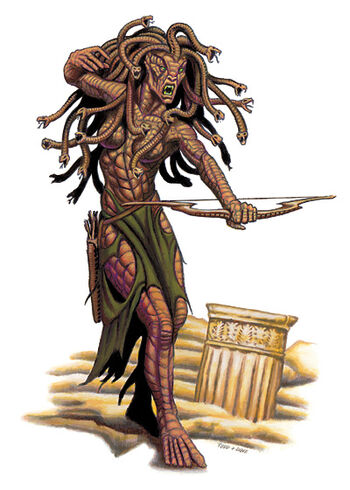

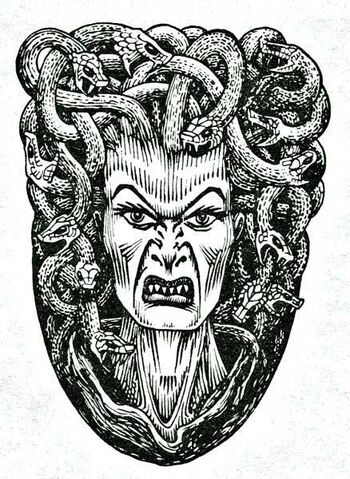
The relative beauty of the Medusa is also subject to change from edition to edition, with 3E and 4E giving her a monstrous look, 2E being near-indistinguishable from a human, and 5E doing an ‘otherworldly beauty’ vibe by giving the Medusae a statue-like countenance. I actually really like this, newest redesign, and I particularly like the 5.5E one with the far more prominent snake-hair. Having a statue-like stony body also allows the Medusa to hide amongst the petrified statues of her victims, which is a nice, creepy little bonus.
Just like their Greek myth inspirations, it is noted that the Medusae are transformed from an immortal curse related to their vanity… whoever causes it, be it a god, a devil, or anything else. 5.5E expands this a bit, giving a bunch of other potential origin stories like a cursed treasure in a ruin, created whole-cloth by a god, a bite from a magical serpent, or simply being born a Medusa for no reason. I do like the origin stories that tie to vanity, though, which feels a lot more on-brand for these beings who want the world to look at them, but will turn those that do into stone.
As a side-note, while the Medusa join a lot of other ‘previously single-gender species’ monsters to get both genders represented, male Medusae have always been an obscure variant in older editions – called the Maedar, they’re just more rare and less combative than the female. Even the first 5E manual has already noted that the Medusa curse could affect anyone vain enough, and it doesn’t have to be a woman. So this one actually fits a lot neater into older edition lore!
____________________________________________________

Mephits
- 5.5E/5E: Small Elemental; Neutral Evil; CR 1/2 (Dust), 1/2 (Ice), 1/2 (Magma), 1/4 (Mud), 1/4 (Smoke), 1/4 (Steam)
It is admittedly a bit vexing that the relatively uninteresting Mephits always get multiple pages in the 5th Edition Monster Manuals when entries like Faerie Dragons and Lizardfolk are reduced to barely more than three sentences. I am sorry, but the Mephits just aren’t that interesting either visually, lore-wise or even mechanically to justify taking up multiple pages.
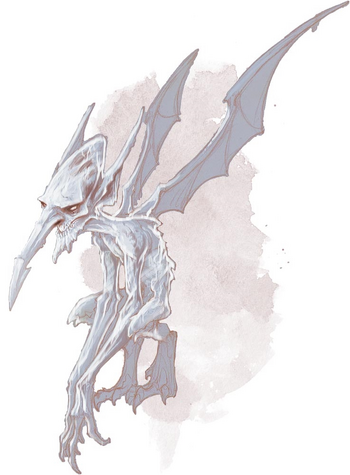
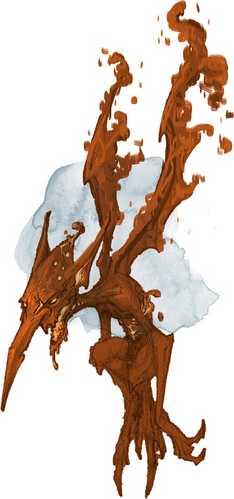
Originally classified as ‘elemental imps’ in the earliest days of D&D before the lore about the different planes were more defined, that is exactly what a Mephit is. They are tiny little guys with sharp, dagger-like noses and heads, wings, and a body made up of their corresponding element. As the 5.5E artwork shows, Mephits are just chaotic little tricksters that go around causing havoc and breaking everything in their path. When not associated with a stronger summoner, they tend to indulge in their overblown senses of ego and twisted humour.
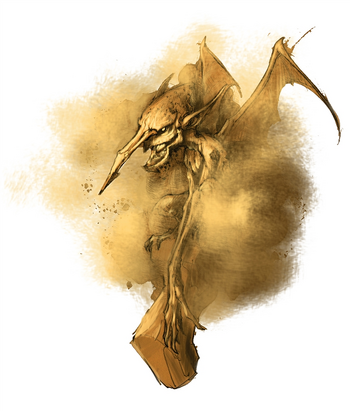
The idea is that Mephits represent the ‘para-elemental’ planes, borders where two of the main elemental planes clash with each other to create a brand new element. So the Dust Mephit is a Mephit made up of dust, which is the combination of earth and air. The Dust Mephit has a bit of an interesting note where they are drawn to catacombs and find death morbidly fascinating… which, I suppose, is a pun on the ‘dust to dust’ phrase people say in funerals.
The Ice Mephit (air and water) is pretty much what you’d expect, though. They like the cold, their personality is equally cold, and they are aloof and play cruel pranks. So cruel, like dropping ice down someone’s clothes! The Magma Mephit (fire and earth) is interestingly not a pyromaniac like the Magmin, but rather is slow and dim-witted. It’s an unexpected reference to how slow magma actually moves, which is kind of an interesting thread to pull since normally any magma-themed monster tend to be saddled with explosive anger. 5.5E actually adds a new bit of lore that says that Magma Mephits hate Magmins, and the two will attack each other on sight. Huh!
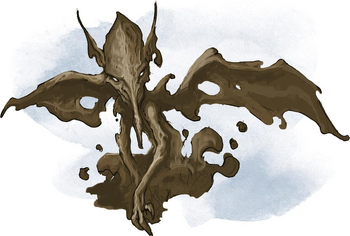
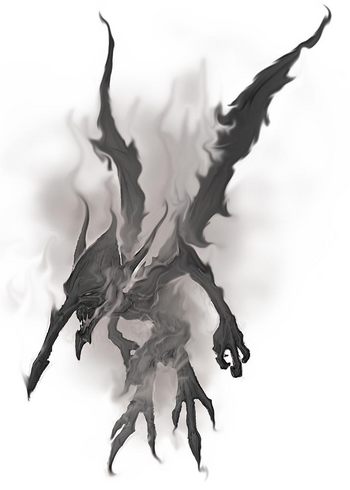
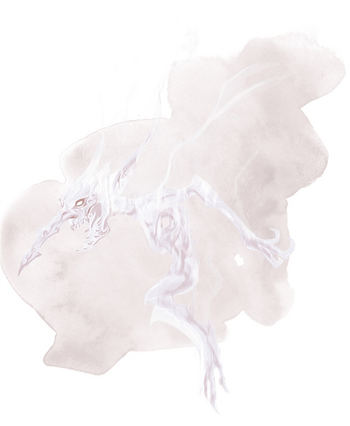
Mud Mephits (earth and water) look the most gross, and they just have a nasty personality of attention-seeking and constant complaining. They also like to pollute food and water that they see. Smoke Mephits (air and fire) have a personality that feel a bit less tied to their element, being noted to be lazy liars who mock others. Steam Mephits (fire and water) are bossy and hyper-sensitive, and apparently leave noisy hisses of steam as they move. The Steam Mephit is the one that might be a bit more malicious, often actively tricking other creatures into deals and reneging on rewards. They also appoint themselves as the ‘overlords of the Mephits’,a totally grandiose title that I assume the other Mephits don't care about. It is a bit funny because even the 5E Manuals puts the Steam Mephit at a lower CR compared to half of the gang. .

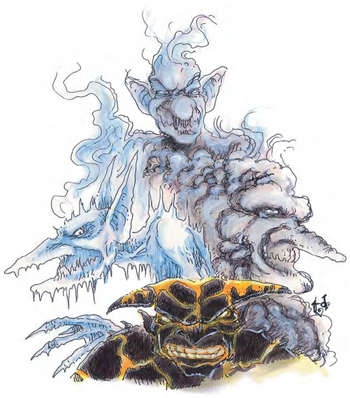
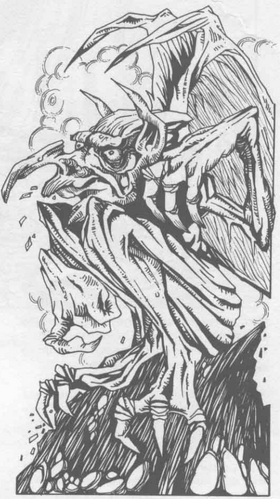
All the Mephits have more or less the same set of ability – a breath weapon (sometimes with an extra debilitating effect), a claw attack, maybe an extra weak spell and the ability to explode upon death. Some Mephits are able to disguise themselves as just a clump of mud. Okay. I must admit that I tend to gloss over the Mephits and just enjoy the admittedly cool artwork during most of my reading through the Monster Manual. I definitely appreciate them slightly more thanks to actually sitting down and properly reading the personalities assigned to them… but they’re still not my favourite creatures in this manual.
____________________________________________________

Merfolk
- 5.5E/5E: Medium Humanoid (5E), Elemental (5.5E); Neutral; CR 1/8 (Skirmisher)
- 5.5E: Medium Elemental; Neutral; CR 6 (Wavebender)
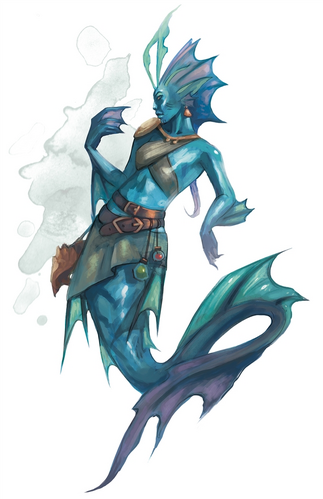
Merfolk – somewhat more commonly known as ‘Merman’ or ‘Mermaids’ in pop culture and in older editions – are another staple in fantasy, although probably not as iconic as a lot of the other classic fantasy races. Hans Christian Anderssen’s The Little Mermaid is a seminal and iconic piece of literature, but I must confess that I haven’t really paid that much attention to Merfolk in D&D. A Merfolk’s visual design is relatively obvious – human upper body, but a long fish tail instead of legs. 5E tends to go for a design that gives the human half blue skin and a bunch of fins and fishy elements to make the Merfolk a bit more interesting, which I am all for. I’m not sure when I first saw Merfolk that had these kinds of adornments instead of being the upper body of a human superglued to a fish… it would probably be Magic: The Gathering?
The lore given in 5E is that Merfolk are essentially the ‘humans’ of the sea, being extremely diverse and having kingdoms that span the entire ocean floor. I suppose this is to make them contrast against the Sea Elves, Tritons, and the other dozen fish-people races. Merfolk are described to be quite variable, so you can have your fishy-looking Merpeople as shown in the 5E art, or you can have the more classical, very human-looking Disney Mermaids.


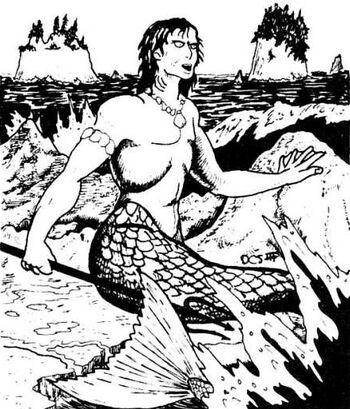
Merfolk are another victim of 5.5E reducing their lore into basically almost nothing in favour for a second, stronger stat-block. Literally, their lore is reduced to ‘Some are curious about land dwellers, while others view them with suspicion.’ Like the Lizardfolk, they also get retconned into being elementals, though it’s a bit easier to swallow with a species that spends most of its life underwater. The Merfolk’s 5E entry, meanwhile, almost takes up its entire page. The Merfolk are essentially portrayed as existing in two kinds of societies – some of them are just capricious and maybe sometimes fall in love with humans; while others form massive settlements in underwater cities, where they have a society of farming coral and shepherding schools of fish. They tend not to venture too deep into the oceans, and even if they do, they tame powerful aquatic beasts to aid them.
Overall, I’ve always found that D&D’s 5th Edition have really tried to push some aquatic races, but for some reason kept introducing similar ones instead of trying to go deep on any one of theirs. I am frankly surprised that the Merfolk didn’t get a playable variant that features the mythological ability of an older Mermaid to transform her fish-legs into regular human feet! Again, while I personally am not chomping at the bit for the Merfolk as a concept, I really felt like they could’ve done a lot more with them instead of ‘Atlantis and the Little Mermaid tropes, idk’.
____________________________________________________

Merrow
- 5.5E/5E: Large Monstrosity; Chaotic Evil; CR 2
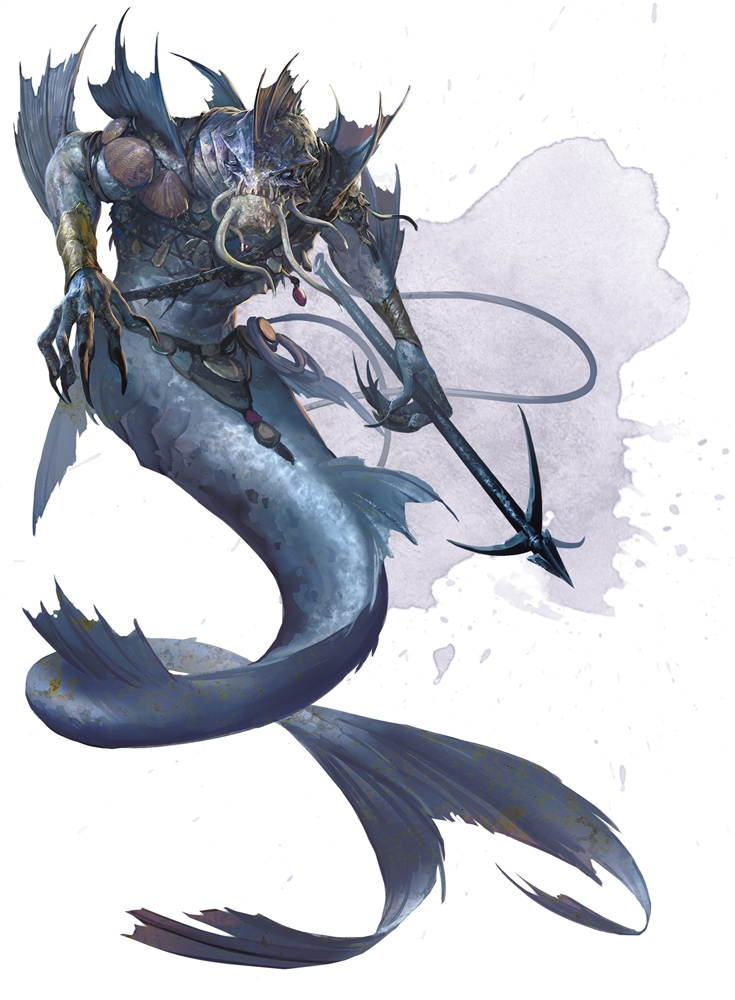
We do also have evil Merfolk in the Merrow, which is mostly a 5E invention. The term ‘Merrow’ did appear in 2E before, but as an underwater ogre. The 5th Edition Merrow keeps the size of the Ogre, but has a really cool design of a monstrous, rabid giant Merfolk. In fact, both manuals emphasize the Merrow's resemblance to an Ogre quite a fair bit. I like the depiction on both the 5E and 5.5E artwork, with mean-looking fins all over the ‘humanoid’ part of the Merrow’s body, a massive set of fangs, beady eyes and tentacles lashing as a makeshift beard. It’s a very cool design all around!
The Merrow haunt waters where there are plenty of sentient species. They will look for merfolk, fishermen, and frankly anyone foolish enough to cross their path. They drag their prey down as captives in their larders, storing them for food. The 5E Monster Manual gives an origin story of the Merrow, informing us that they are a tribe of Merfolk who has been transformed by contact with an idol of Demogorgon – which decimated their society and transformed them and their descendants into Merrow. It is interesting that even with the 5.5E update that they’re not retconned into Fiends, when a lot of other monsters have been for far less connections to the Lower Planes.
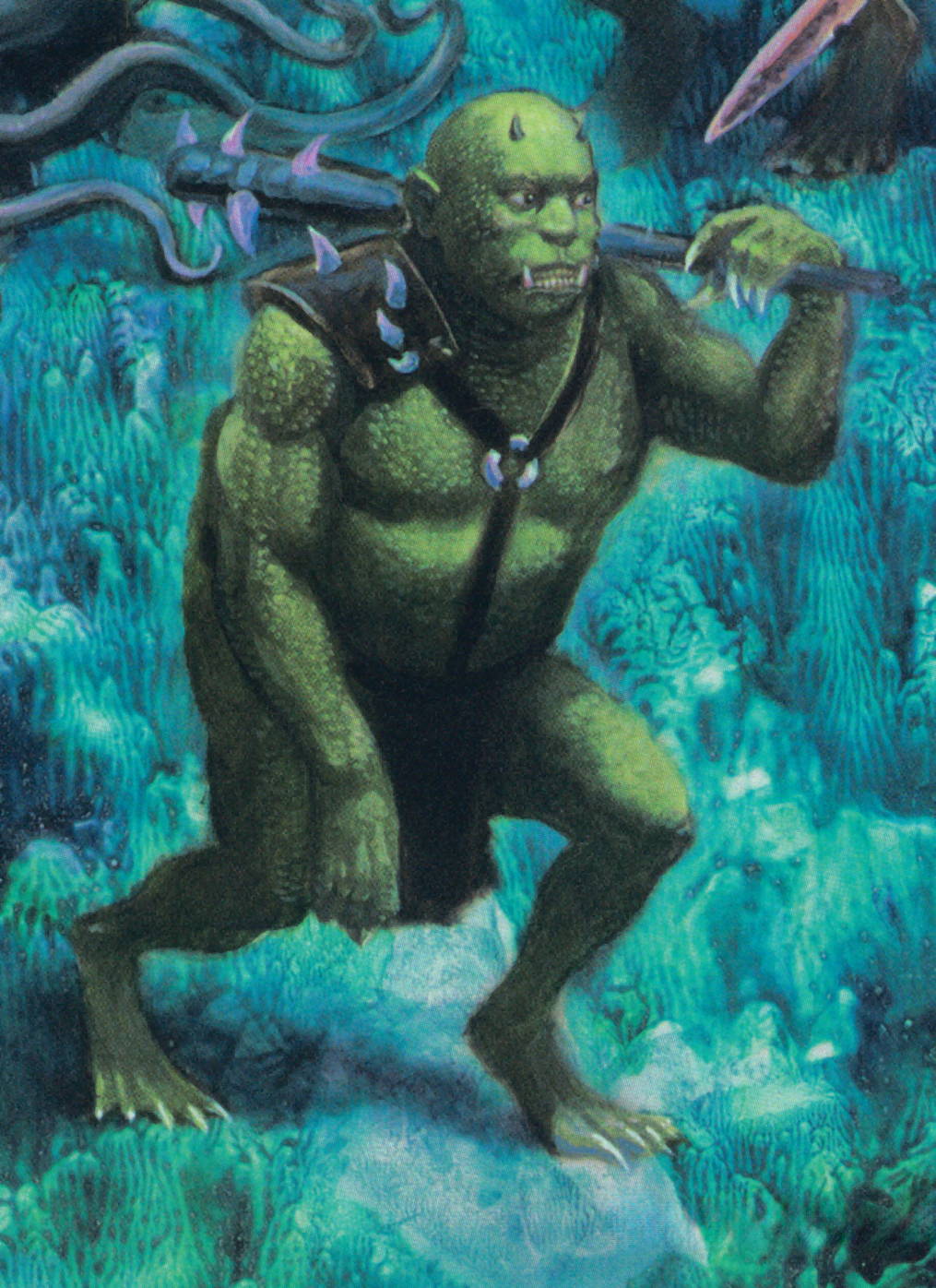
Other than the cool design, however, there isn’t really much to distinguish the Merrow from their fellow aquatic, fish-based raider race, the Sahuagin. Combat-wise the Merrow is also nothing particularly special, just having a bunch of generic attacks. With the Merfolk being updated to having a bunch of water spells, I really felt like the Merrow should have had a similar update as well, and might deserve it a bit more as they are more likely to be an antagonistic force.
5.5E does note an interesting tidbit with the Merrow… they do resemble the Merfolk, and for sailors running for their lives from these fish-people, Merrow attacks often end up causing misunderstandings and conflicts with land-based humanoids who blame the local Merfolk kingdom for the raids on their people. And if nothing else, I really do like the art direction for the Merrow, which is probably one of the straight-up coolest sea monsters in this series.
____________________________________________________

Mimic
- 5.5E/5E: Medium Monstrosity; Neutral; CR 2
Perhaps one of the most significant contributions that Dungeons & Dragons did towards the world of fantasy gaming is the concept of a Mimic. The original D&D Monster Manual – which itself has been aped by so many other famous video games and tabletop RPGs – had a lot of creatures that were simply… just there, disguised as some aspect of the dungeon as a ‘gotcha’ to unassuming players. We’ve seen some of the remnants of these ‘gotcha’ enemies, like the Animated Objects, Stone Golem, Gas Spore, Cloakers and Darkmantles. But none are as iconic as the Mimic.
Now, theoretically, even from its first appearance, the Mimic is a shapeshifter that can look like absolutely anything. But the most memorable artwork from the 1st Edition was a treasure chest sprouting a gooey arm to punch an adventurer in the face. And I think there’s just something so hilarious about having a treasure chest – something that promises reward, something that looks so wondrous and tantalizing… and it turns out to be something that sucker-punches you.
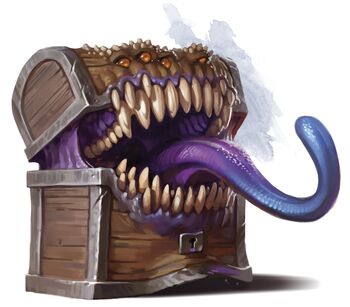
From 2E onwards, the visual appearance of the Mimic has stuck to be a treasure chest that sprouts a massive fanged mouth on where the chest should be. It’s a rather cute bit of anthropomorphizing, where the hinges of a chest already look like a pair of jaws. 5E’s Mimic is particularly neat, with multiple rows of different-sized teeth, a massive tongue, and at least six eyes on the upper side of its face.
Unlike an Animated Object, however, a Mimic is fully a living creature. A ‘monstrosity’, specifically. The wooden and metal texture it has are all just perfect mimicry! It is noted to attack with pseudopods, and it is noted to take the forms of inanimate objects that specifically can lure creatures to them. And what lures silly adventurers more than treasure chests? It’s a very valid predatory method used by many predators, like the anglerfish or the orchid mantis, and when the prey gets close enough the Mimic will reveal its true form and attempt to grapple the adventurer with its sticky pseudopods and consume them. The entirety of the inner side of its mouth is just fleshy muscle, which I thought was perfectly depicted in the recent D&D: Honor Among Thieves movie.


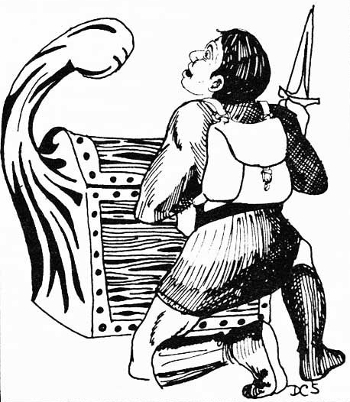
All in all, it is a very iconic monster – I love when the mechanics and gimmickry of a monster is actually justified with a fair bit of lore, and I just find it adorable that the reason a Mimic is the way it is can be traced to what’s essentially evolution and adaptation. The fact that the Mimic is canonically a shapeshifter also allows it to look quite a bit different depending on your preference, meaning that you could also give your Mimic pseudopod fists or claws like the artworks from previous editions.
Now 5.5E expands a bit more on the Mimic lore, acknowledging perhaps for one of the few times outside of text that Mimics can mimic absolutely anything. The artwork for the 5.5E Mimic shows the iconic treasure chest Mimic, yes, but everything in that treasure room – from the barrel of gems, to the regal chair, to the helmet on the chair, and even a tiara on the corner of the picture – are all Mimics. 5.5E even notes that a Mimic’s natural form are ‘little more than roaming stomachs’, which is an interesting mental image. 5.5E gives a list of some 35 different options for a Mimic’s form, going from the classic chest to mundane items like mats, chandeliers and gravestones… to hilarious ones like ‘oversized cake’. Nothing can beat the classic chest, but I love the subversion, particularly when you are utilizing multiple Mimics in an encounter!
____________________________________________________

Mind Flayer / Illithid
- 5.5E/5E: Medium Aberration; Lawful Evil; CR 7 (Mind Flayer), CR 11 (Mind Flayer Arcanist)
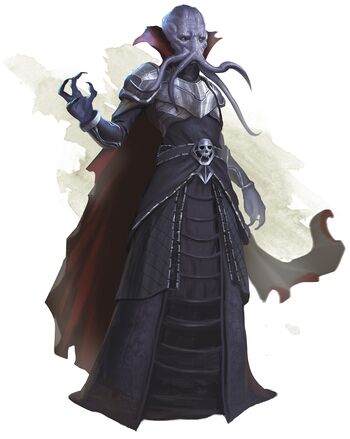
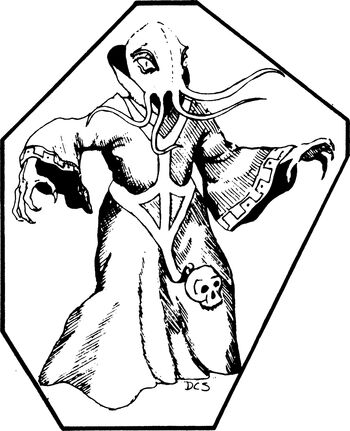
And here we are, ending this segment with the Mind Flayer. Also known by their proper species name of the Illithid, The Mind Flayers are one of D&D's most iconic monsters. I feel they do a good job at presenting a relatively unique concept but in a lot of simple ways, that in turn are just all begging to be easily expanded upon. The Mind Flayers are squid-headed humanoids, they have weird psychic powers, and they feed on brains. All in all, the first impression of a Mind Flayer is a pretty simple, if slightly goofy, monster. The Cthulhu influence, particularly the squid head, is definitely not lost on people... and I feel like that specific visual look does make the Mind Flayer – and Cthulhu, for that matter – both simultaneously alien but also somewhat 'cool' or even 'cute' enough.
In addition to the visual appearances, Mind Flayers also share a fair amount of tropes with other Lovecraftian monsters. They are most commonly found in the Underdark, the winding network of underground caverns, but almost all material tend to hint that the Mind Flayer are strange aberrations that are simply... just not natural. Even their psionic powers are a step removed from regular magic. Depending on the edition, Mind Flayers could have come from the esoteric Far Realm, time-traveled from the future, and in 5E, from space. Indeed, many 5E adventures have featured the Mind Flayers' Nautiloid Ships that allow them to warp through space... as explored in our Spelljammer coverage. The 'time travel' bit has been dropped since 2E, but the idea of the Mind Flayers trying to restore a massive, once world-spanning empire, is still around.
Mind Flayers aren't content to just eat brains, however. Mind Flayers have long plans that are often incomprehensible to humanoids, but they are also masters of experimentation. Just within the Monster Manual alone, the Mind Flayers are responsible for the creation of the Gith, the Duergar, the Intellect Devourer, the Grimlock, and maybe the Kuo-toa. All of these beings tend to come out of the Mind Flayers' experiments either utterly crazy, or vengeful with psionic powers. All of this ties to the fact that Mind Flayers are exceptionally poor physical fighters, which is why they are happy to enslave hordes of lesser 'grunt' species to fight and die for them.


Mind Flayers have quite a bit written about their biology and society, particularly, again, in Volo's Guide to Monsters. Mind Flayers live in colonies interconnected with hive-minds, and they all commune to the Elder Brain. Elder Brains are part of the Mind Flayer life cycle, being both a central hub and also a repository for the minds of an Illithid when they die. Being connected in this twisted hivemind, this causes most Mind Flayer to not fear death as much since their minds can be absorbed by the Elder Brain as a form of immortality. I do really like this hive-mind thing, and it all ties to the theme of a species that revolves so much around mental and psychic powers.
Speaking of the life cycle, Mind Flayers reproduce by ceremorphosis. Inspired undoubtedly by things like the Alien franchise and real-life parasites, Mind Flayers will capture humanoids, and instead of consuming their brain, they will implant a Mind Flayer tadpole that will burrow into the minds of the victim and eventually transform them into a fully grown Mind Flayer. The cool high-collared gothic outfits come later on, I would assume. This, by the way, is the main plot of the seminal game Baldur's Gate 3, where the game's D&D party wakes up with these Mind Flayer tadpoles implanted in their bodies. (Which, by the way, the Lycans above wished they had been given the amount of care that D&D gave to the ceremorphosis!) Being a species that reproduces by essentially parasitizing other creatures and transforming their bodies, some of the newer 5E books have taken that advantage by giving us a lot of Mind-Flayer-corrupted monsters.
Again, there are a lot that's been written about the Mind Flayers. Some interesting aspects include their language, called 'Qualith'... which they do by carving Braille-like runes and infusing them with psionic power. The Mind Flayers actually talk to each other with psychic powers, and they only really speak vocally when communicating with other species like us. Both the Monster Manual and Volo's also describe how rogue Mind Flayers that are disconnected from an Elder Brain exist, and they are often outcasts or exiles due to some radical ideas. That doesn't mean that the Mind Flayer will be automatically friendly to your party, however, due to their strange morality.

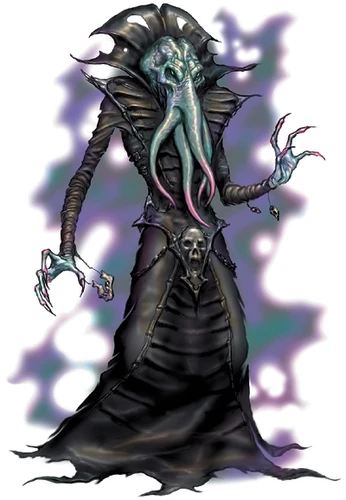

Volo's Guide to Monsters adds a lot more Mind Flayer variants, but the original 5E Manual briefly mentions the 'Arcanist' variant, which is expanded a bit by the 5.5E remaster. The regular Mind Flayer's spell list is quite short, which are Detect Thoughts, Dominate Monster and a variation of Plane Shift. All of these are honestly flavoured to be natural abilities of the Mind Flayer's biology. Indeed, Mind Flayers actually tend to not like arcane spells, which makes the Mind Flayer Arcanist often a bit of a pariah since they have learned actual regular magic like Lightning Bolt, Disguise Self, Mage Hand and of course, Fireball. Again, the existence of these Arcanists are interesting. Perhaps they are kept as pariahs in reserve of a colony, or perhaps the study of magic causes the colony to exile them.
Being perhaps one of the main marquee enemies of Dungeons & Dragons as a whole, I do really see so many plot thread options with the Mind Flayers. Even 5.5E's table seems to just be scratching the surface. Creating a brand-new fused atrocity to serve as minions? Makes sense, they are already making Intellect Devourers and whatnot. Forge a psionic network between all local Illithid communities? Sure, makes sense. Restore their Nautiloid Ships to travel back to space? Sounds logical, but maybe you want them to just be out of your neck of the woods. Replace the world leaders with Intellect Devourers? That sounds hilarious, but also funny at the same time. Sacrifice the mental energy of an entire planet for a nefarious plan? Blot out the sun so their Underdark minions can conquer the surface? Some pretty neat 'end of the world' plans.
The general package of the Mind Flayer just feels so complete, and I can honestly see why the D&D writing teams put so much effort into making their most iconic monster have a lot of stories to pull from. Overall, these xenophobic, gothic brain-eating psychic octopus-men are quite cool!

90% likely for there to be no Reviewing Monsters next week, but we'll return to our regularly scheduled monster talk the following week.
ReplyDeleteExcited to see more of these chapters! Will say my favorites are the Medusa jojo posing in the 5.5e artwork.
DeleteAnd honestly, it even makes sense! Considering the Medusas are canonically presented as being able to hide among their petrified victims, and those victims are likely to *not* be in a standard pose. So their JoJo pose isn't just stylish, it's practical!
Delete