

Anyway, we have another batch of monsters here... and I do think I have so
Click here for the previous part.
Click here for the next part.
Click here for the index.






____________________________________________________









 Shambling Mound



Skeleton




 Slaad - Red Slaad














Click here for the next part.
Click here for the index.
[Originally published on December 2019; Updated in November 2025]
____________________________________________________
Sahuagin
- 5.5E/5E: Medium Humanoid (5E) / Fiend (5.5E); Lawful Evil; CR 1/2 (Warrior), 2 (Priestess)
- 5.5E/5E: Large Humanoid (5E) / Fiend (5.5E); Lawful Evil; CR 5 (Baron)
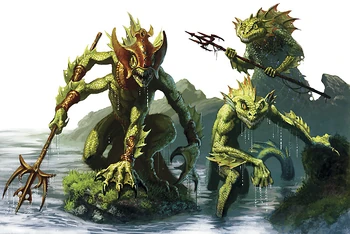
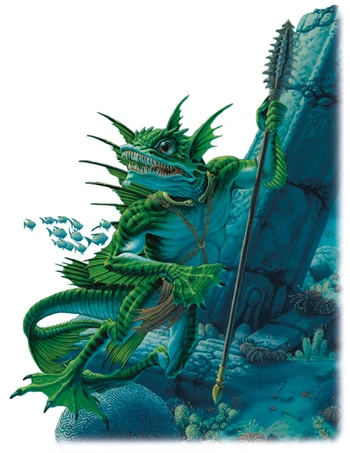
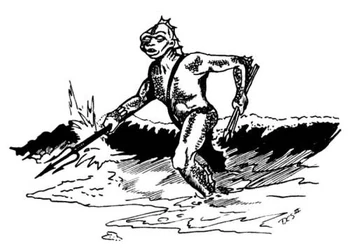
We’ve got another aquatic fish-men, making this the fourth in the Monster Manual. Again, sometimes there is a fair bit of redundancy in monsters derived from a similar theme. The Sahuagin are fish-people that are bipedal with heads of snarling, monstrous fishes and fishy features on their body. With the Merfolk gaining more fish-like features over the various editions, and the Merrow being more prominent in 5E, the Sahuagin kind of fell into being the ‘default’ violent fish-man raiders. Which… which honestly makes them essentially less-interesting Kuo-toa. Sahuagin are an organized group of raiders instead of a disorganized mad fish-cult, which is an identity somewhat separated from the others, but it also causes the poor Sahuagin to be one the least interesting of the fish-people… and that’s before we add all the other underwater people introduced in supplements. On top of my head, 5E has Locathah, Triton, Sea Elves, Deep Scions, Sea Spawns… and that’s just the ones I remember.
And the thing is, flipping through 2E's Monstrous Manual, there was a significant difference between the two 'evil fish-people' races, with the Kuo-toa looking rather comical with a 'realistic fish head', and the Sahuagin looking more fearsome with a head full of fangs. But as a lot of the monsters got art updates to be more serious in 3E, they both become 'sharp-toothed evil fish people'. Kuo-toa also narratively grew out of their initial exclusively-Underdark associations and became portrayed to attack from the sea now, so the Sahuagin ended up being essentially 'just the serious Kuo-toa'. Which can kind of translate to being the boring Kuo-toa.
And their lore is honestly quite simple. Sahuagin, or ‘Sea Devils’, are raiders with extreme savagery. They rise from the depths of the ocean to slaughter ship crews and coastal villages, viewing the ocean as their realm and everything that ventures into it as something they can hunt as legal bloodsport. They worship the shark god Sekolah, and are noted to have a special kinship and ability to innately control sharks. All Sahuagin have a ‘blood frenzy’ trait that makes them more brutal and powerful in combat towards an enemy that’s bleeding.
In 5E the most powerful Sahuagin women become priestesses that channel the god’s power while the most powerful men mutate into Barons with a second set of arms. As with most gender-locked roles, 5.5E drops this. Another variation mentioned in the 5E Manual that is not represented in a stat block is the Malenti – a Sahuagin that is born with the resemblance of a Sea Elf, who act as spies to their ancient enemies, infiltrating Sea Elf courts to destabilize their kingdoms. I do like the Monster Manual questioning if the rise of Malenti mutations are the result of an evolutionary arms race… or if it was somehow the cause of this ancient conflict. This is lore that I forgot made it all the way to 5E, but no one really brings it up.
5.5E seems to agree with my assessment that the Sahuagin needed a bit more work to make them interesting, because they got a bit of an overhaul. They are now straight-up fiends to match the ‘Sea Devil’ nickname, although we don’t really get an explanation to how they are related to the Lower Planes... just some vague 'their blood is fiendish' line, which I thought is a missed opportunity. If you are going to do a spin on the Sahuagin, go all in, man!
More interesting is their visual redesign, which goes for a less-uniform look and the 5.5E Sahuagin artwork feature more varied colours and fish inspirations for these fish-men. I have gone on record in the previous iteration of this article that I found the Sahuagin redesign from 3E to 5E to be very boring since they look like weird Lizardmen instead of actual fish-people. This redesign is a lot more memorable, and leaning to the fishiness really does help the Sahuagin carve a bit more of a distinct niche compared to the other fish-peoples.
____________________________________________________
Salamander
- 5.5E/5E: Large Elemental; Neutral Evil; CR 5 (Salamander)
- 5.5E: Large Elemental; Neutral Evil; CR 15 (Inferno Master)
So when the designers of the D&D planes were designing the Elementals, they decided that there should be more things living in these planes that aren’t just mindless elementals or genies. And so, 2nd Edition gave us the ‘Elemental-kin’, which were other kinds of sentient beings made up of fire, earth, air and water. Out of these, only the Salamanders really show up as a major fixture in every single primary Monster Manual – probably because the Fire Elemental plane is admittedly the one that is the most readily hostile. (The fact that World of Warcraft adapted the D&D Salamanders as an iconic fixture to their original ‘Molten Core’ raid probably didn’t hurt the popularity of these beings).
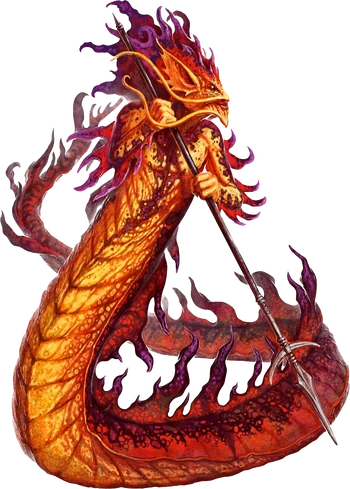
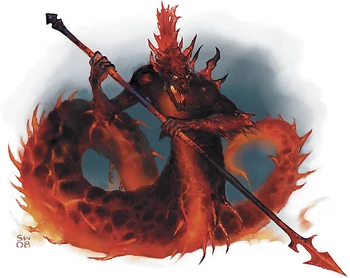
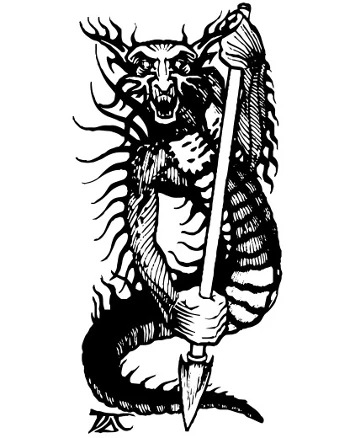
Salamanders draw their names from the mythological Salamander, where the amphibian became associated with the element of fire – likely because they were observed escaping from campfires and people thought that they were ‘born’ out of it. Salamanders in D&D are essentially fire-snake people, with the lower body of snakes that nicely segue into a humanoid upper torso, and a rather elaborate reptilian head with fiery hair and frills. 5E added a bunch of wispy beards similar to Eastern dragons. Older editions tended to try and go for a more ‘demonic’ feel, which makes the Salamander feel kind of samey with the dozens and dozens of other fiery demons in D&D, so it’s nice that the 5E art team focuses more on the fire part.
Salamanders, being sentient beings living from the Fire Elemental Plane, love setting things on fire. They themselves are not fire, but their body glows with heat and any weapon they hold can be superheated by their natural talent. 5.5E upgrades all Salamanders to just innately have a ‘fire aura’, and adds a more powerful ‘Inferno Master’ variant that has fire spells.
And, in the purest essence, the love watching things burn. This isn’t really given too much of a focus in their original 5E writeup, which focuses on their history of conflict against the Azers and Efreeti... and I do appreciate a good world-building, but it doesn't really tell me much about the Salamanders themselves beyond 'they take slaves'. Which isn't something I personally have a problem with for an evil species, but it does make them extremely bland. In contrast, I find the 5.5E rewrite extremely fun and fascinating. This is the sort of replacement lore that I would want if you’re going to remove mentions of slavery and whatnot, you know? Give me something more to play with when I run or encounter Salamanders in my D&D game.
5.5E tells us that Salamanders believe that flames ‘expose the purest form of things’, and they live by this credo. Heck, random Salamanders that are burning things will very eagerly explain to passersby about their wonderful work... I like that! It’s a little fanatical focus that all Salamanders have, and this is why they want to burn everything – they want to know what happens when you burn even impossible terrain like arctic glaciers. They are conflagration connoisseurs! They don’t have malice, they just have a completely insane sense of priority. It’s just that in their pursuit of new blazes, sometimes volcanoes erupt and wipe out a village… but that’s okay, right? After all, the people that got killed are just ‘ashes in disguise’, an actual term from the Monster Manual.
Wanting to burn everything is a simple motivation, yes. A bit of an anime-arc-villain motivation. But it honestly makes the Salamanders a lot more charming than the vague handwave of ‘they were enslaved, and now they want to enslave’. Because the original 5E Manual did have its long writeup to be about this history. After failing to conquer the Azer, the Efreeti enslaved the Salamanders. And in enslavement, Salamanders ended up having a grudge against both the Efreeti and the Azer… and the freed Salamanders ended up learning from their former Efreeti masters to enact a domination-based society. Not the most interesting storyline, and even among ‘slaver history’ races in D&D, it’s kind of bland! I do really like the twist back towards an obsession of fire, something that feels particularly on-brand for a race that lives in the Fire Plane.
Salamander - Fire Snake
- 5.5E/5E: Medium Elemental; Neutral Evil; CR 1 (Fire Snake)
But wait! There's more! Also within the entry for Salamander are 'Fire Snakes', which are established to be the younger, juvenile form of Salamanders. Salamanders reproduce by egg-laying, and when a Salamander egg hatches melts (the eggshells melt, that's such a cool detail), they appear in the form of Fire Snakes. They literally are just snakes on fire before, but 5E redesigns them to have the same vaguely bird-like beak that adult Salamanders have, with a whole mass of fiery frills. Pretty cool!
5.5E also establishes that Fire Snakes have to expose themselves to fiery extremes and bask in fire to grow to proper Salamanders. Again, a nice little showcase of how their biology and culture revolve so much around flame.
Originally, the writing for the Fire Snakes in older editions just handwave their status as larval Salamanders as a 'rumour', but I am happy to see this relationship canonized. I honestly really do wish that there were a bit more interconnectivity between some of the species, like the Salamander and Fire Snakes, or the Roper and Piercer. Not everything has to be connected, but some would be nice!
___________________________________________________
Satyr
- 5.5E/5E: Medium Fey; Chaotic Neutral; CR 1/2
- 5.5E; Medium Fey; Chaotic Neutral; CR 6 (Revelmaster)
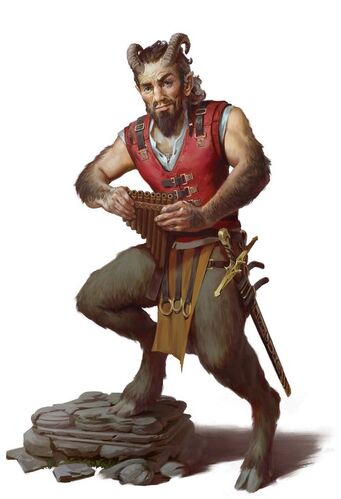
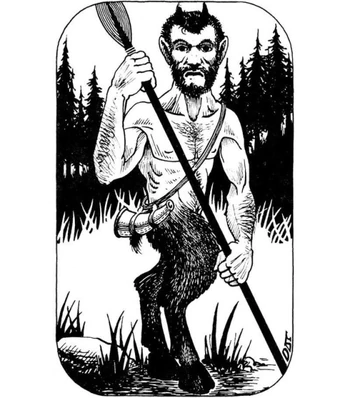
Another being primarily from Greco-Roman mythology, the Satyr as it was shown in the original 5E Monster Manual feels more like a simple NPC encounter. I honestly feel like Satyrs show up in 5th Edition more as a playable race than an enemy. But Satyrs are another example of a Fey enemy in 5E, and they behave similarly to how you’d expect a Satyr to behave. They’ve got horns and the lower bodies of goats, a hairy body, and they frolic and is all about hedonistic parties.
The Monster Manual notes that Satyrs are really crazy about hedonism, and sometimes might cause mischief when they can’t control their desire for festivity and gate-crash parties, steal food, or kidnap bards to listen to songs. The Manual is careful enough to make the Satyr not do anything distasteful that the original mythological Satyr most certainly did, which is definitely the right move to adapt it. They just want to party, get everyone else to party with them, and leave while the people left behind are nursing their hangovers.
5E gives us a variant with ‘Satyr Pipes’, which gives the Satyr some additional magic done through music. 5.5E just formalizes this into a stronger Satyr variant called the Revelmaster, noting that the function of their fey melodies is to ward off people who would disturb their parties. Oh, and we also get a female Satyr in the artwork as well, although I do believe this isn’t new to 5E specifically.
My original review of the Satyr had me be disappointed because there's not much to it beyond the 'party' stuff, but that's the whole point of what the Satyr is about, right? Or rather, the flavour of the Fey? They are beings driven by emotion and impulse, and the Satyr is a nice 'starter' version of this. They're not malicious, not actively, but their actions might harm us folk from a more civilized society. It's something that's a bit more built as a social encounter, which I adore. And I much prefer the party-guys from 5E compared to the 3E and 4E variants, who just wanted to make them yet another 'cool badass forest folk' race.
____________________________________________________
Scarecrow
- 5.5E/5E: Medium Construct; Chaotic Evil; CR 1
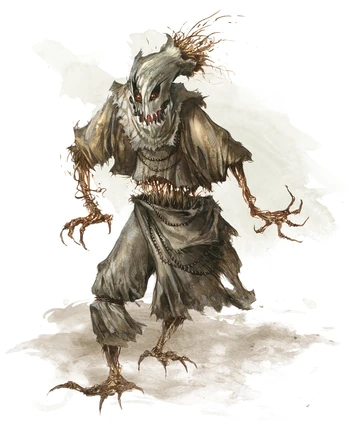
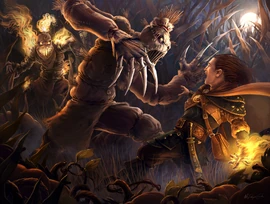
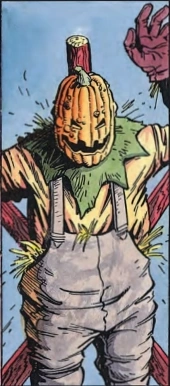
I love Scarecrows. Out of all the traditional Halloween monsters, I found the concept of a living Scarecrow to be the coolest thing ever, hands down. I believe my love for Scarecrows comes from the DC comics / Batman villain, but it soon extended to general monster Scarecrows in fantasy as well. There is just something eerie about a being constructed to strike fear in birds actually coming to life and attacking the humans that constructed them, and there tends to be some kind of association between Scarecrows and the harvest season… which is also often associated with death.
D&D’s Scarecrows, meanwhile, are treated as constructs. Which is all well and good, bringing variety to a creature type that very often gets handwaved as just ‘golems and mechas’. It’s a nice reminder that constructs can absolutely be creepy. Being associated with fear, Scarecrows have an ability to cause a ‘terrifying glare’… which… can you blame people from freezing when they see these things?
5E and 5.5E end up giving Scarecrows a bit of a multiple-choice origin. 5E is a bit inconsistent in saying that Scarecrows come to life when harvest season and twilight comes; but also notes that hags and witches bind evil spirits to the Scarecrows as essentially creepy golems. 5.5E gives us a nice list of potential origins – folk magic, prayers of desperate commoners, or restless spirits that took the Scarecrow as a convenient thing to possess. This means that Scarecrows could very well be a guardian of a farm or village, as easily as it could be a creepy serial killer hounding said village.
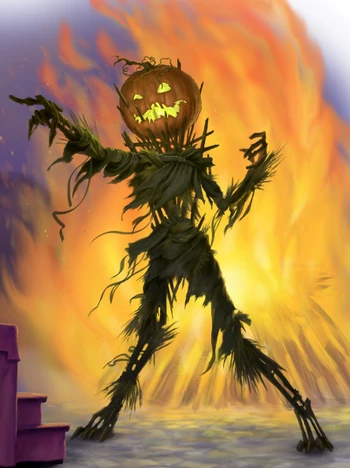
5.5E gives us a table of potential Scarecrow appearances, which makes absolute sense since real-life Scarecrows look very different. Their designs have varied over the years as well, with the original 5E artwork giving it a burlap sack head, and the 4E art featuring sharp blades for hands. 5.5E and 3E has my favourite trope when designing Scarecrows, which, of course, is a giant supernaturally blazing Halloween Jack’o’lantern head. Other options given in the table include Scarecrows built out of animal parts (very ‘creepy village rituals’), consisting of rusty armour and torture devices (very Dark Souls), you could go gothic and use wedding clothes or mannequins, or my favourite… ‘beehives over a wicker frame’. That’s… that’s terrifying in a completely different way!
Honestly, this might be a bit of an underrated monster, but I'm happy it's in the basic Monster Manual, and I'm happy that someone in the design team thought that Scarecrows are 'iconic' enough to be included alongside ghosts, vampires, werewolves and mummies.
____________________________________________________
Shadow
- 5.5E/5E: Medium Undead; Chaotic Evil; CR 1/2
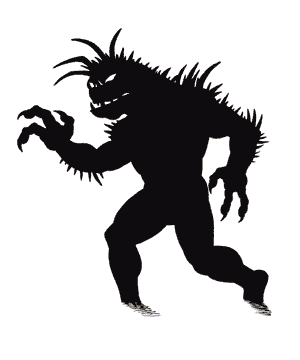
The primordial fear of darkness that humanity has, of course, extends to the fact that everything in the world casts a shadow thanks to physics… and we fear what we can’t really see and define. This of course works wonders when our ancestors were hunter-gatherers that have to be alert at predators that could ambush you at night, but it also means that a shadowy figure is a perfect representation of something sinister, something terrifying.
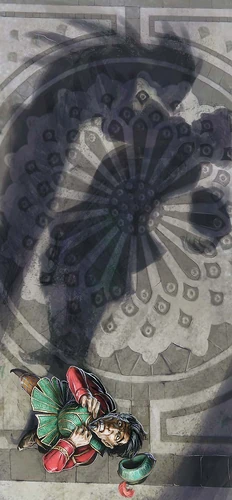
In D&D, Shadows are a type of incorporeal undead that… well, are just shadowy humanoids. There’s not much to be said beyond that, since you know what a Shadow is, look down at your feet and unless you’re reading this in a completely dark room, you’ll have a shadow there. It’s probably not an undead monster. Most D&D interpretations of Shadows are just… well, shadowy figures, but 5.5E gave us a rather terrifying artwork of so many glowing eyes and shadowy hands reaching out and dragging a poor adventurer down some stairs. It really does feel like something out of a horror movie… although as much as I love that artwork, my favourite Shadow artwork is still that 4E artwork where a Shadow is choking a noble’s shadow, which in turn chokes the noble himself.
5.5E actually gives a table on how to make Shadows ‘scarier’, most of which are just generic horror tropes (it’s a stalker in the woods! Oh no! It looks like the victim! Gasp!) but I especially like ‘a grim storybook character that follows those who speak its name’, which feels like a nice nod to a lot of urban supernatural monsters like the Candyman.
Shadows consume the vitality of living things, and are especially drawn towards good-aligned creatures that hasn’t been corrupted by evil. The Shadow can move around like, well, an incorporeal shadow as it attacks and saps the victim’s strength, growing darker and darker. Upon the victim’s death, their shadow actually detaches and becomes a brand-new Shadow, which I thought was a surprisingly nice bit of undead propagation. I love this little bit, showing that there are more to undead than just ‘dead body rises up’ and ‘dead spirit does not move on’. It gives the implication that the Shadows are some kind of self-propagating being, a ‘natural’ undead – as much as the undead can be considered natural.
I also love the little quest hook that states that Shadows can sense when their ‘parent’ living being is resurrected back to life, and the Shadow is driven by a compulsion to hunt down their original owner and kill him or her, leading to the strangest vengeful showdown. Said resurrected owner will not cast a Shadow until his or her corresponding Shadow has been slain. It's a cute, almost whimsical Peter Pan-y story, and in fact Fey Shadow that specifically follow this trope actually make minor appearances in The Wild Beyond the Witchlight.
In 5th Edition, the Shadow is also somewhat notorious as ‘the deadliest CR ½ monster out there’, due to having the ‘Strength Drain’ attack that has the chance to drain a player’s Strength score. It is a mechanic more common in older editions, and is something that a 5E player isn’t going to expect. It can be insanely lethal, and since Shadows literally propagate as they kill, it's very likely to snowball into a TPK. Oops!
____________________________________________________
- 5.5E/5E: Large Plant; Unaligned; CR 5
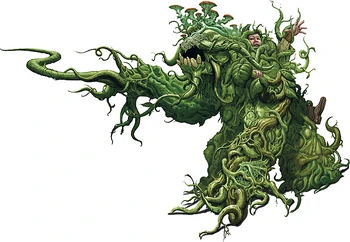
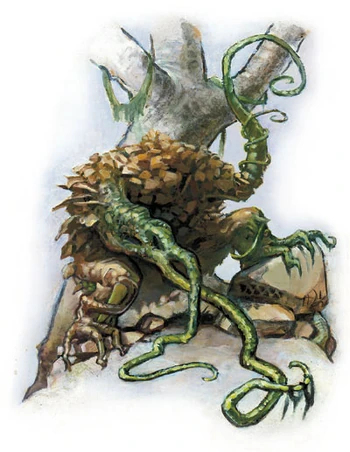
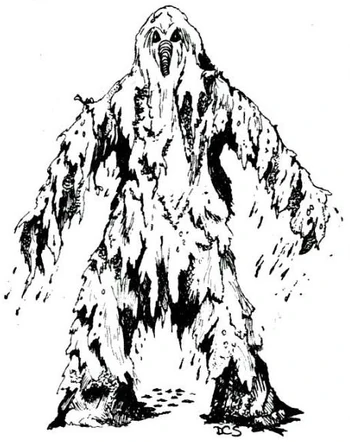
I love the Shambling Mound. The Plant monster type has always been under-represented in D&D, but the Shambling Mound (or ‘Shambler’) often makes it into the ‘base’ Monster Manuals of each edition. It is a trope popularized by characters like DC’s Swamp Thing and Marvel’s Man-Thing – giant humanoids made up of clumps of vines, leaves and random rotting swamp detritus. 2nd Edition notwithstanding, D&D’s Shambling Mounds tend to go for a more abstract, more monstrous vibe – clumps of plant matter arranged in the rough shape of a bipedal or quadrupedal beast. I like the original 5th Edition art showing a gorilla-like body layout, with some mushrooms and stones giving the impression of ‘horns’ and ‘lower fang’, but not quite a face. 5.5E brings the aforementioned Man-Thing/Swamp-Thing comparisons even closer, by having the faceless head be a mass of tentacles with glowing, almost eye-like organs.
Shambling Mounds just shamble through swamps and rainforests, and consumes organic matter in its path. They are slow, they sometimes hide as piles of plant matter, but are otherwise effective predators. And this, of course, includes any humanoid creature foolish enough to get in its path. In addition to the expected vine-whip attacks, Shambling Mounds have an ‘engulf’ trick where it tries to constrict and consume things in its path. Both 5E artwork shows them engulfing adventurers in differing degrees of success.
5E establishes Shambling Mounds to be an unnatural creature, tearing through natural environs and consuming all animal and plant life in its path, leaving the swamps haunted by Shambling Mounds to be particularly lifeless. (This is in notably contrast to its inspirations, which are both ‘protector of nature’ type characters) They are also noted to be ‘rotting’, which adds to the generally unpleasant vibe they have.
So how do these beings come about? 5E notes that Shambling Mounds result whenever lightning or fey magic strikes a swamp life and magically mutates it to slowly consume the plants around it, turning them into mulch and slowly growing roots that give it locomotion. It is this ‘central root-stem’ organ that is the core of the Shambling Mound, while everything else is just a giant rotting heap it wears as a giant body. This isn’t reflected in the game statistics as any kind of resurrection mechanic, but 5E notes that it could be an adventure hook where a party thinks they have dealt with the Shambling Mound, only to come back later on and realize that they haven’t fully killed the monster. Some Shambling Mounds even feign death until the threat has gone!
What is reflected in the Shambling Mound’s stats, however, is its ability to absorb lightning and actually heal damage from it; something tied to its origin. This is extremely cromulent sci-fi, I like it. Also, defying Pokemon expectations, a Shambling Mound’s dense and wet body actually gives it resistance to both cold and fire, the latter being something you wouldn’t think when fighting a big plant clump.
Lastly, 5.5E again gives alternate origin stories to the Shambling Mound – including the ‘created by nature as a force to defend it’ that Swamp/Man-Thing is associated with. My favourite, though, is the list of visual flairs for the Shambling Mound, which is absolutely appropriate for a monster that canonically always looks different depending on what vegetation is assimilates into its body. Vibrant feywild flowers; incorporating a rune-etched menhir in its body (which might fool players to thinking it’s the ‘core’!), having remains of skeletons, incorporating treant remains, or just straight-up mutated and leaking glowing pollution.
____________________________________________________
Shield Guardian
- 5.5E/5E: Large Construct; Unaligned; CR 7
D&D has had a bit of a… complicated history with ‘fantasy robots’. Some note that anything more complex than a golem or animated armour breaks immersion for the setting, while others argue that as long as it’s magical and not powered by circuits and electricity, it’s all right. Shield Guardian stride that border, I think. It’s not quite the ‘Clockwork’ creature that tends to be associated with steampunk settings, neither is it a sentient AI magic-robot race like the extremely popular Warforged.
But on the same token, Shield Guardians also just feel like it’s trying to play to certain tropes and not quite filling any niche. It’s not quite a magical construct like a Golem, and it doesn’t fill a specific trope like Clockwork or Warforged, so it’s just… a robot that doesn’t quite count as a ‘Iron Golem’ because of reasons. They are traded around between wizards as a bit of a status symbol, and sometimes passed down among magic-using families.
Shield Guardians are still created by wizards to guard them (which overlaps with Helmed Horrors and Golems) and specifically are meant to be walking shields, absorbing damage to keep its squishy master alive. It magically absorbs part of the damage that its master takes as long as he or she wears a magical amulet; and the Shield Guardian is also able to store one of its master’s spells up to fourth level. Those two gimmicks alone are really the only thing that stops me from griping too much about this being a ‘redundant’ enemy – something that I feel is something that 5th Edition’s basic Monster Manual tends to be good about avoiding.
The artwork is neat, at least, and I do like the exaggerated, chunky lower limbs contrasted against the slender upper limbs. 5.5E gives a glowing cyclopean eye to its version of the Shield Guardian. Surprisingly, we don't get a table with customization ideas for the Shield Guardian, which I thought would be obvious!
____________________________________________________
Skeleton
- 5.5E/5E: Medium Undead; Lawful Evil; CR 1/4 (Skeleton)
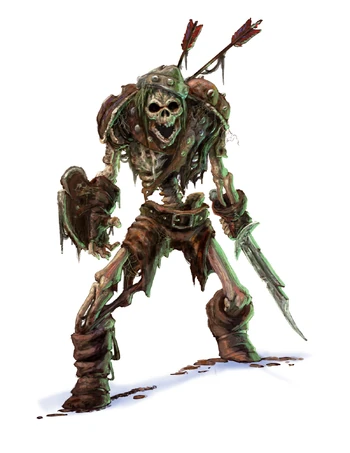
Spooky, scary skeletons! We get a classic undead monster here with the Skeleton – and it’s essentially one of the two types of revived dead everyone defaults to when writing fantasy. It’s either a Skeleton or a Zombie! Skeletons are awesome, aren’t they? I mean, you, dear reader, are technically a Skeleton wearing a skin-suit! There’s something both simultaneously horrifying and charming about a skull, really. Something both wrong but also hilarious to see a Skeleton shamble about literally bereft of skin and muscle.
In D&D, Skeletons arise when animated by dark, necromantic magic. These Skeletons move and clatter about as a pale imitation of how they behaved in life, but otherwise retains no connection to its past. The ones raised to undeath by necromancers or stronger undead usually just bow to the will of the creator, following orders heedless of their consequences. They aren’t intelligent, but with enough orders are capable enough to do actions like patrol, scale siege ladders or load trebuchets. Being undead, they are compelled to instantly attack living beings, and have no sense of self-preservation. It is noted that they have better agility than zombies, and can at least avoid obvious barriers.
Sometimes, Skeletons also rise independently from places which is infused with death, loss, or just a lot of necromantic magic. These independent Skeletons pantomime actions from their past lives, without actually having any actual soul or comprehension of what they are doing. 5.5E also notes that this happens when necromancers animate loads of Skeletons and doesn’t bother to give out orders to all of them, giving a table of things that Skeletons might do – like mimic what it does its life, mindlessly ‘train’ so hard that their bones splinter and break; or repeat the final moments of its life over and over.
A quick tangent here to other games, if you would let me – in D&D, Skeletons are fragile, being one of the weakest types of undead that fall apart with a single bow. This is in contrast with other settings, like Dark Souls, the 3D The Legend of Zelda games, or older Magic: The Gathering, where Skeletons are actually associated with the ability to ‘reassemble’ itself and requires specific tricks to take down. And I do actually agree with that. Logically, zombies should still be able to move around since they still have muscle. Dead muscles, yes, but it would be able to mimic movement. Anyone who’s worked with skeletons, however, would know that skeletons can’t actually move, or even stick to each other. Ergo, if a skeleton is reanimated without any of the connective tissue, it should be stronger! That’s just a bit of a little tangent from my end, because I think way too much about fantasy monsters.
The ‘real’ reason, of course, is that D&D actually has a lot of skeletal undead. The Lich and Death Knight used to be a lot more skeletal; and while not all of them have made it into 5E yet, we’ve got Skull Lords, Huecuvas, Mohrgs, and many more ‘advanced skeleton’. Thus the basic Skeleton ends up fulfilling the role of the fragile-looking dumb minion that your heroes can bash aside en masse.
____________________________________________________
Skeleton Variants
- 5.5E/5E: Large Undead; Lawful Evil; CR 1/4 (Warhorse Skeleton)
- 5.5E/5E: Large Undead; Lawful Evil; CR 2 (Minotaur Skeleton)
- 5.5E: Medium Undead; Lawful Evil; CR 3 (Burning Skeleton)
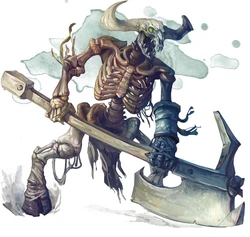
A lot of animals have skeletons within them, and so it is a monster type that is a bit ripe at being turned into just variant, elite Skeletons! 5th Edition gives us two sample monsters, with a Warhorse Skeleton representing the bones of a horse – which is also convenient for your regular Skeleton boys and girls to ride on. A different, much more threatening species turned into a Skeleton is also given to us in the Minotaur Skeleton. The writeup also mentions a Dragon Skeleton – though no stat blocks for that one, so as probably not to confuse readers with Dracoliches.
Again, theoretically any vertebrate creature can be turned into a Skeleton by a creative necromancer. 5.5E gives us a slightly stronger variant called the ‘Flaming Skeleton’, which has fiery attacks and burns with so much necromantic energy that they are a bit more capable of commanding other Skeletons.
You could go overboard with Skeleton (and, in the same vein, Zombie) enemies and just pick and choose easily half of the D&D bestiary and turn them into skeletons for an aspiring necromancer. It is a nice way to spice up encounters for your party while also simultaneously giving a cute spin on some of the other monsters in the book. These variants are what make this monster for me, in my opinion.
____________________________________________________
Slaad
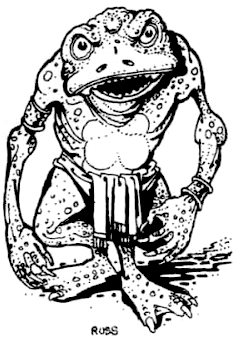
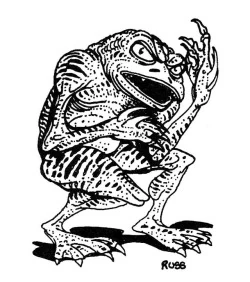
And here we have the Slaad! I think I have gone on record during my first review of D&D Monsters in 2019 that I really like the Slaad… and surprisingly, my opinions have actually changed on them! Now, now, I still like the Slaad as enemies, as weird parasites, and as a bunch of interdimensional frog-people with different roles in their different castes and evolutionary levels.
But what I feel that the Slaadi did not do well is to be the ‘embodiment of Chaos’. See, the Slaad were introduced as the counterpart to the rigid, lawful order of Modrons and the Mechanus, and even their origin story was tied to it. Modrons representing law makes sense; they are mechanical, based on numbers and regimented roles, and have a very strict hierarchy as they go up the numbers and transform into vastly different-looking, more advanced forms.
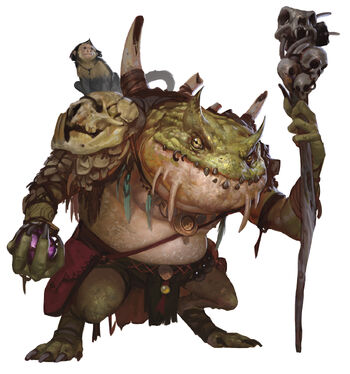
The Slaadi are from the ever-changing chaotic realms of Limbo, and so they are… highly regimented, with a strict hierarchy, and roles given to each type of Slaad? Huh? They ‘obey no master’… but stronger Slaadi still rule over weaker Slaadi? That really doesn’t seem particularly ‘chaotic’ to me, not in the way that, say, a Beholder’s random eye-beams are chaotic! The whole joke here is that ‘what is the most chaotic thing out there’, and the answer is ‘frogs, it’s always frogs’. Which could be cute… if D&D didn’t already have multiple different frog-people already – the Bullywug, Grung, Grippli and if we count demons, the Hezrou. There is the argument that frogs metamorphosize, and therefore is chaotic… and there could be an argument made about this if they actually went a bit all-in with it. As it is, the Slaad’s reproductive methods are creepy... but ultimately not that much different from the Mind Flayer or the Violet Fungus if we get down to it. Perhaps if there's an aspect of chaos, or, like, randomness to their effects, it would be something more special, but as it is, parasites are cool but not as weird as they probably wanted the Slaadi to be.
That’s not to say that I dislike the Slaad, of course. I find them fun! But I also find them rather disappointing as the so-called ‘ultimate beings of Chaos’.
Anyway, both Monster Manuals give us the origin of the Slaad. Originally, Primus, the most powerful of the Modrons, created a geometrically complex stone imbued with the power of law and cast it into Limbo, thinking that it would bring order to the plane of chaos. As with all well-intentioned fantasy plot device, this item ended up being influenced by the chaotic energies of the plane and the Slaadi were born, and now rule over Limbo. Mentioned in older editions and the 5.5E Manual are the Slaad Lords, like Ssendam the golden amoebid terror and Ygorl the winged skeleton. Okay!
We’ll get through the Slaad biological cycle in the individual monster entries, but as each Slaad emerges from the Spawning Stone, a fragment of the stone is implanted in the Slaad’s brain called a control gem. Another creature that manages to get its hand on the stone can use it to subjugate the Slaad. Slaad born not of the Spawning Stone does not get the brain-gem, but if they ever go into Limbo they’ll be drawn to the Spawning Stone and be embedded with one such control gem.
____________________________________________________
Slaad - Slaad Tadpole
- 5.5E/5E: Tiny Aberration; Chaotic Neutral; CR 1/8 (Tadpole)
Newborn Slaadi take the form of tadpoles that are rather obviously influenced by the ‘Chestburster’ larval form of the Xenomorphs from the Alien franchise. The Tadpoles are numerous in Limbo, but when Slaadi enter the Material Plane, they are created from eggs implanted into living host. If the host is a regular dude, the Slaad Tadpole just grows, Alien style, and bursts out of the chest of the poor commoner.
This Tadpole will continue consuming flesh until it reaches adulthood, at which point it becomes a Blue Slaad. If the person is a magic-caster, however, the Tadpole would specifically transform into a Green Slaad after erupting out. I do like that little bit of requirement, which feels like something right at home in a magical setting.
___________________________________________________
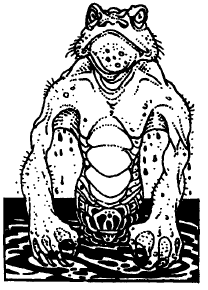
- 5.5E/5E: Large Aberration; Chaotic Neutral; CR 5 (Red Slaad)
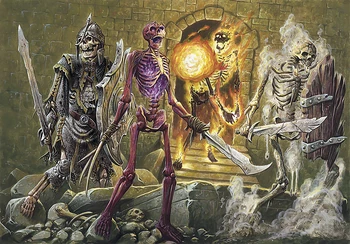
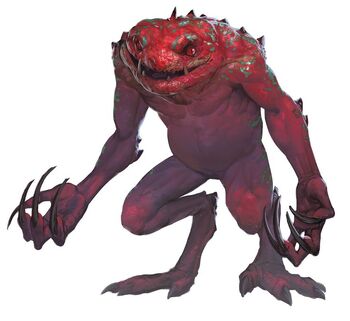
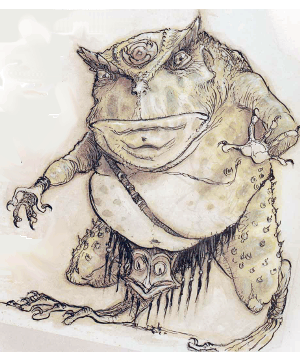
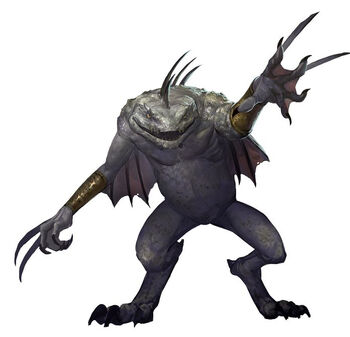
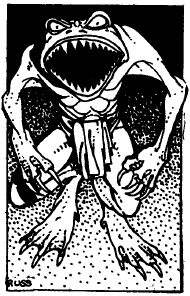
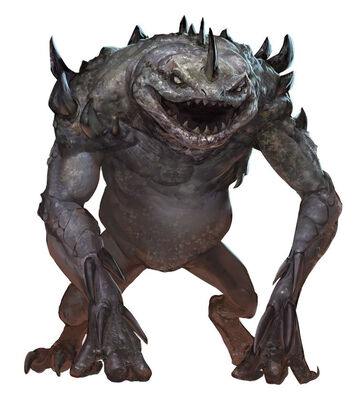
The weakest and most basic of the Slaad is the Red Slaad, and they are gaunt toad-men with long, tapering claws and a wide, toothy grin. I do really like the Slaad’s aesthetic, where they changed the idea of a normally lumpy-looking frog and made it out into something almost reptilian… it’s just not what screams to mind as a ‘frog person’.
All Slaadi have magic resistance and a limited ability to regenerate, but they all also have ways to reproduce. A Red Slaad’s whole thing is that those long claws actually contain eggs within glands, and they inject eggs into their prey. These eggs will gestate and turn into Tadpoles inside the poor victim’s body, before bursting out of the host’s chest. Red Slaadi will instinctively avoid harming those that already have eggs injected into them, which probably leads to some strange moments where the hostile frog-alien suddenly stops attacking you and just hops off. Ominous!
5.5E gives us a bit more of a description of what Slaadi do outside of reproducing. Red Slaads amass in vast throngs and wrestle and croak-sing, and endlessly dismantle and rebuild the drifting islands in Limbo. In a nicer display of their chaotic nature, it is highlighted that Red Slaadi don’t always go immediately for attempting to inject eggs. They might want to play, or converse (they have telepathy), or devour the creature. In a nice little twist of a lot of the more magical monsters, Slaadi are actually more difficult to take down as a spellcaster due to their resistance to magic, but physical attacks can chop up the frog-people as fine as regular humanoids.
It should be noted that while the various Slaadi artwork really only shows them gathered around others of their kind, the Red, Blue and Green Slaadi are all in the large size class, meaning that they are around Ogre-sized. That does make them feel a bit more impressive!
____________________________________________________
Slaad: Blue Slaad
- 5.5E/5E: Large Aberration; Chaotic Neutral; CR 7
Second in line is the Blue Slaad, which has a stouter, chunkier look with a head that looks like some kind of dinosaur. The most prominent feature are two bone-like blades that jut out of a Slaad’s wrists, which contain a different kind of reproductive method – it’s an infection called a ‘chaos phage’, which is also injected into the prey. Like the Red Slaad, the Blue Slaad is able to detect if Chaos Phage or a Slaad Tadpole is gestating within a humanoid, and avoid harming them.
The chaos phage transforms its victim into a Red Slaad… or, again, a Green Slaad if they are a powerful enough spellcaster. I do appreciate the attempt of having the Red and Blue Slaadi create more of the other kind through a different means… but they really aren’t that different, are they? Both are curses spread through contact with claws, and both would create Green Slaadi if the host has magic. I felt like they could’ve done a bit more with this. As it is, the Blue Slaad is just the Prometheus to the Red Slaad's Alien.
Again, I don't want to be down on them! I find the idea of the parasitic frog-people to be cool, I just felt like for both a parasitic race and the embodiments of chaos, they really could have been weirder! One suggestion I've seen people say is to mix up the Slaadi reproduction methods a little, or give them access to anything that lets the DM roll on a random table. The Sorcerer's Wild Magic would be easy enough, but if I was running a Slaad on a table I'd probably have their spells and effects have a randomness tint to them.
____________________________________________________
Green Slaad
- 5.5E/5E: Large Aberration; Chaotic Neutral; CR 8
We mentioned Green Slaad in the previous three entries, but basically they are born whenever the reproductive processes of Red or Blue Slaadi infect someone who can cast powerful enough spells. The Green Slaad perhaps looks the most ‘toad-like’, particularly in its original 5E artwork that doesn’t show its more monstrous fangs. He could definitely pass off as a ‘regular’ frog-person like a Bullywug!
But Green Slaad are smart spellcasters, and they are able to shapeshift into a humanoid. If they are born of a Blue Slaad, they like to take their original host body’s form, but otherwise is its own distinct species. 5.5E establish that a Green Slaad’s enhanced intelligence causes it to be the director and commander of Red and Blue brethren to portals and invasion points.
A Green Slaad would, in life, will ‘magically, instantly and permanently’ transform into a Gray Slaad, but this point is unpredictable and may or may not occur. Okay, but that always happens, apparently, and never goes the other way around? Seems pretty ordered to me… Also notable that the Green Slaad's appearance has really drastically changed over the various editions, with the 3E version looking like a psittacosaurus more than a frog or toad.
I do think that it is a great crime that a Green Slaad’s spellcasting list is so utterly mundane. Fireball? Invisibility? Mage Hand? Detect Magic? Any random wizard can do that. Where are my random-effect spells like Chaos Bolt or Prismatic Spray? 5.5E fixes this by giving the Green Slaad a unique ‘Chaos Staff’ attack that deals a random status condition, which at least plays to the species’ theme of chaos.
____________________________________________________
Gray Slaad
- 5.5E/5E: Medium Aberration; Chaotic Neutral; CR 9
The anatomy of the Gray Slaad is particularly clear in its original 5E artwork, but they are the spontaneous evolutions of the Green Slaadi, and command said Green Slaadi. The Gray Slaad is actually a medium-sized creature, so it’s shrunk down. It’s got a more sinister, more reptilian smile; two X-23 claws from its wrists, and a pair of tiny wings. In 5E, Green Slaad evolve into Gray Slaad spontaneously; whereas in 5.5E it requires the power of the Slaad-Lords or the Spawning Stones.
For all of this transformation, the Gray Slaad is essentially just a souped-up Green Slaad, swapping the ‘chaos staff’ for a ‘chaos claw’, and adding a bunch of extra spells to its spell list. Again, I would still like to say that I really appreciate the monster concept of a race of alien frog-people that constantly evolve like Pokemon/Digimon, and reproduce similarly to the Aliens. They just don’t scream ‘chaotic’ and ‘disordered’ enough to me. The Gray Slaadi are sinister villains, sure, and they seek out humanoid communities to invade and unleash their minions. Very cool, but sounds very orderly to me!
(As a side-note, 5E highlights that the Gray Slaad uses a greatsword, but that just feels weird for the frog-people and no artwork ever shows it, so 5.5E just ignores that whole thing).
____________________________________________________
Death Slaad
- 5.5E/5E: Medium Aberration; Chaotic Evil; CR 10
And finally, at the end of the evolution line, we have the Death Slaadi. In 5E, Death Slaadi are created when a Gray Slaadi feeds on the corpse of a Death Slaad. In 5.5E, it is again tied to the mysterious Slaad Lords. Death Slaadi are sadistic, infused by evil negative energies and are very directed in their plans in controlling the lesser Slaadi… which sounds like I’m just repeating what I said for the Gray Slaadi, doesn’t it?
Even visually the Death Slaad feels like not much of a variant, just a Red Slaad, coloured ashen-gray, with dead-looking eyes and some rocky spikes on its back and arms. It’s not really all that impressive. 5.5E moves the greatsword (now a ‘Chaos Blade’) to the Death Slaad, but I really wished they had made him look a lot more distinct to the Gray Slaad.
While I like the artistic consistency between the five Slaadi… I do feel like the Death Slaad, as the ‘special’ one that isn’t named after a colour and the closest to their masters, really should have been visually a bit more different. The ‘Void Slaad’ of 4E is painted all black with creepy glowing eyes, and 3E’s Death Slaad actually becomes more humanoid with clothes and weapons. I don’t exactly want that specifically for the ultimate chaos-frog-people, but there’s nothing really making the Death Slaad feel particularly special compared to its kin.
All of these reviews might make it sound like I don't like the Slaadi, but that's absolutely not true! I love the Slaadi. I always have. I'm just a bit disappointed that for having so many variants, a lot of them really feel same-y, and other than the neatness of the Alien reproductive methods with the Red and Blue, they are all just... toad spellcasters. They have a lot of themes going on: interdimensional invaders, agents of chaos, parasitic life forms... but I don't feel like either the 5E lore nor their stat blocks really capture the chaotic nature of these froggies. I still like them for what they are, and I can't hate these rainbow frog-aliens, but they really could've been much better.
