Tuesday, 30 December 2025

Let's Play Pokemon Legends Z-A, Part 24: Property Values and Seed Money

And now... it's time for plot! Delicious, delicious plot, as we rocket into the endgame of this, well, game. 

After that whole mess with dealing with the sociopath that is Jacinthe, AZ starts muttering some ominous things. Lumiose is trembling, and he can feel the 'unease' spilling from Prism Tower. AZ also very casually drops that the only thing that could deal with the power from Prism Tower is... Mega Floette? Which, uh... I had a visceral reaction towards, but at least the game actually gives us a reason to Mega Floette's existence. There is still a vague 'you need to reach the pinnacle of the Z-A Tournament to become the strongest, which really is still something I find to be quite hollow-sounding considering what a narrative handwave everything around the Z-A Royale has been, but okay. There is a brief discussion as Taunie also resolves to climb up the ranks, but then we get summoned to Quasartico.

Vinnie and Jett meet us at Quasartico Inc, and Jett finally gets to be a bit more relevant now. Jett absolutely denies the fact that the Pokemon are flocking to Lumiose due to some plot by the company, which... again, considering Pokemon's track record, huge doubt on that. Jett notes that the holo-tech barriers are the main thing that Quasartico has been doing to prevent wild Pokemon from damaging the surroundings, and specifically Rogue Mega Evolution.

Hilariously, Jett notes that after the Ultimate Weapon incident in Pokemon XY, Lumiose City was 'hemorrhaging people and property values were in free fall'. Right! We need to save the property investments in Poke-Paris! That is such an unexpected line to see in a Pokemon game. But Jett and Quasartico were the only ones that stepped up to help with the urban development project, with Quasartico wanting to create a city where Pokemon and humans could live in harmony. 

Which... yeah, wild Pokemon is a bit suspect. I mean, Legends Arceus and so many dex entries have proven that. I honestly wished there were a bit more sidequests in this game that showcases this dichotomy between the 'harmonious living' and 'wild Pokemon can behave unexpectedly in urban settings' in this game, instead of just boring 'bring me an Inkay' nonsense. 

Anyway, Jett continues to tell us that when they began to renovate Prism Tower, the tower was emitting a peculiar energy, Mega Power, which is both drawing Pokemon to the city and triggering Rogue Mega Evolution. I find that that is a much more pressing matter to solve than Jett's concluding remarks about how people will leave the city once more, but I suppose she is just a dedicated businesswoman or something. 

As we leave Quasartico, Jett asks Taunie about her jacket, apparently that jacket reminding her of something. Taunie says that it's the only thing she has to remember her mom by, and Jett finds it curious. 

We get another trio of rogue mega evolutions, which I'll kind of breeze through. A Dragonite, a Tyranitar and a Starmie are about to rampage, and Naveen notes that all three are difficult to tackle even without mega evolution. You're telling me, there's two pseudo legendaries there. 

I go for Tyranitar first and it's Naveen on the field with me. Naveen notes how defensive Tyranitar is (is it? I thought they're like, sweepers) but notes that his Scrafty would be powerful against a Tyranitar. Type-matchup wise, sure, but I dunno, Naveen, maybe mega evolve that fucking lizard. Mega Tyranitar is quite defensive, but between Hawlucha's Flying Presses and Meganium's Giga Drain/Dazzling Gleam combo, I do have two counters towards big ol' Poke-zilla. Some really cool explosions and effects as Tyranitar unleashes giant walls of Stone Edge throughout the battlefield, and shockwaves of... Sand Tomb, I think? Mega Meganium is a tank of her own with Giga Drain, though, thankfully. 

The next one I go for is Dragonite, and I have to admit that the way to get up to where Dragonite was lurking is... much more annoying than I expected to, with him lurking on top of a building. Taunie is with me for this one. And Mega Dragonite, despite being new, is one of the more promoted new Mega Evolutions, so that's not the biggest surprise. 

What's a surprise, however, is how cool this battle is. Mega Dragonite is fast and brutal, teleporting (or Bouncing/Flying) down onto my trainer very specifically. But its little gimmick, other than Hurricanes and Dragonbreaths, is to charge up its attack. You can interrupt it and it'll 'merely' fly off the stage and unleash several beams of Hyper Beams...  but fail to interrupt it with mega attacks, and it'll fly off, charge the mother of all Hyper Beams, and the Hyper Beam erupts, anime-style, on the center of the battlefield to hit everyone in an unavoidable attack. 

That is awesome. Again, it is a bit of a bare minimum if we're talking about Dark Souls or something, but this isn't Dark Souls. This is Pokemon. And I love that they did so much for Dragonite's fight. 

The Mega Starmie fight is a bit more involved, because another party got there before us... the Rust Syndicate! A grunt blocks our way, but lets us through once he realizes who we are. Philippe is also there, this brick shithouse of a man, being quite upset that the grunts let some civilians through, but is happy that we are there. Lida gives some context to what the rogue mega evolution is. Unfortunately, Philippe is honour-bound to take on the Rogue Mega Starmie under Corbeau's orders, and he totally can't bend the rules. 

It's a bit silly, though. ALL of us could take on the Mega Starmie together, there's no rule saying only one team can fight a rogue mega at a time! And even then, if Philippe wants to take on the Mega Starmie... be my guest, you know? He's got a Mega Skarmory of his own, and even if he can't take down Mega Starmie on his own, we could mop things up for him. 

But no, of course this leads to a battle. Everything is solved with battle in the Pokemon world. It's fine, we've only fought Philippe once and I do appreciate Mega Skarmory. My Chandelure burns his entire steelworks team to the ground. Philippe acknowledges our strength, noting that there are bigger fish in the pond than him and Corbeau. Philippe gives us an expanded version of the Rust Syndicate backstory, which is unexpected. Philippe was the local gang leader who kept all the local thugs in control, but didn't know how to do anything but be strong -- it didn't 'put food on the table', and they had to rely on philantrophists like Lysandre. In come little Corbeau and his Venipede.

Corbeau was smart enough to negotiate, and convince Lysandre to... give him seed money for his ventures. I am sorry, what? I love that Pokemon has been using a bit more business terms in this game. It does, I suppose, fit the urban setting. Anyway, with the venture capital seed money, Corbeau started businesses like security services (for drug jobs, probably), Pokemon couriers (for drugs, probably), and "even some things that perhaps weren't entirely aboveboard" (drugs).

Philippe's gang chased around Corbeau, seeing him as an upstart rival, but Corbeau outwitted them all the time, and managed to outdo everyone in areas not relating to Pokemon battles. Okay. And at some point, he gained Philippe's respect and became his boss. Philippe realizes he babbled on for a bit too much, and in exchange for our silence gives us a Water Stone. Philippe leaves with some encouraging words for us. 

There is a short moment as Lida muses whether to evolve her Staryu and shrugs and does it. After all the hullaballoo that the previous scenes had about Lida's evolution problem, this was definitely a bit anticlimactic. 

And Mega Starmie... well, you know what it looks like. I know what it looks like. Memed to hell and back ever since the debut of its game, Mega Starmie just becomes longer, and I think the idea is for it to look like a starfish tokusatsu alien monster or something. It look so stupid. So stupid, but in all of the good ways. I still would've preferred a more epic Mega Starmie, of course, but it is something that's a bit more wackier than I expected in motion, seeing how Mega Starmie runs around like a wacky little dude, and its special attack is just a super-speed blitz run towards me. 

Comparatively to Tyranitar and Dragonite, the Mega Starmie fight isn't particularly difficult, and I think I spent most of my time just giggling at the absurdity of this thing. Again, Lida... doesn't really have much of a comment on either her own partner's evolution or the Mega Starmie, a huge, huge, huge missed opportunity. 

Anyway, we return to the hotel and Taunie asks AZ about something, about what the definition of the 'strongest mega evolution user' is. AZ says that it's up to Floette to decide, and then brushes it off. Huh. Naveen instantly shrugs and notes that it's me, but Taunie takes a bit of an umbrage to that. At this point, my next promotion match comes up... and it's not actually a character I met before, but a silhouetted image of someone called 'Grisham'. 

Lida and Naveen lampshade the oddity of someone managing to make it all the way up to Rank B without showing off their face. Taunie handwaves this with 'some people prefer not to show their faces', which really does highlight the huge logistical gaps in the Z-A Royale that I brought up during the Canari segment as well. Without the organizers forcing the competitors to meet, it is a bit silly for the competition to be organized in such a way, doesn't it? Although I suppose it does make sense considering Quasartico only held the Z-A Royale as essentially a front for recruitment. 

After a discussion about who to ask for help (we have the mafia on speed dial!) we decide on talking to our friendly local detective, Emma. As we go off, Naveen grumbles about the rudeness of people who would join the Z-A Royale under false names, while AZ bemoans that this should have been his duty, and he is unable to accomplish it. 

Going to talk to Emma (and Mimi!), Emma notes that she's been narrowing a list of candidates for Taunie's case -- which is basically all but confirmed to be a search for her mother or father. But we bring up the Grisham situation, and Emma says that she could give us the name... but it's information that could potentially bring danger. Seriously, the Z-A Royale is poorly organized. 

Emma then decides to solve this dilemma with... a Pokemon battle! Emma leads us outside, and Taunie tells me that Emma is a great Pokemon battler, she just doesn't participate in the Z-A Royale due to her work keeping her busy. Emma introduces her team as Pokemon that were given by a man who played an important part in her life. Which is... well, her Pokemon are technically given to her by Xerosic, but he's, uh, not the best mentor. I guess Emma still finds him as a surrogate father-figure, I suppose.

Emma opens up with her Ampharos, which was who she demonstrated Mega Evolution with. Every single one of Emma's Pokemon can actually Mega Evolve! Just like mine! The Ampharos gets Earthquake'd and put in the ground. She then sends out Lopunny with all the elemental punches, which gets Brick Break'd by my Hawlucha. A Mawile suffers the same fate slightly less quickly afterwards. Her fourth Pokemon is a Lucairo, who gets Brave Bird'd by Hawlucha. 

And of course, Emma's final Pokemon is her own final Pokemon in Pokemon XY... Malamar. 


The Mega Malamar trailer was one I watched, was a great little online campaign, and one that really does fit into the manipulative, cruel character of Malamar. My own non-mega-evolved Malamar got actually taken out, and I had to bring in my Meganium to take down the brainy squid. But I really do like Mega Malamar. Love how the proportions still looks like a squid (even if a different one), how the exaggerated proportions are made up of existing anatomy -- the 'brain' made up of tentacles is a great one. The Mega Stone for my own Malamar doesn't actually become available right after this battle, but soon

Emma congratulates me for the battle, chuckles that 'those old guys' aren't here to see her defeat, and then asks us if we knew about Team Flare. I played XY, so I do, of course, but I do like the way this is framed to also be a nice recap for anyone jumping into Kalos for the first time. Emma recaps Team Flare and Lysandre, and gives the muted conclusion that, hey, 'L' is just a kooky old man who isn't up to anything nefarious at the moment. So it isn't the old guard we have to be worried about... but the new

Apparently there's a brand new team flare. Emma notes that she had ties with Team Flare before via Xerosic (who she doesn't name), and noted that Team Flare had 'made moves to ensure their legacy'. Which I suppose Emma was also one of them, being a young woman they captured and brainwashed to be a pawn. But a different project trained up a new generation to carry on their ideals, and Grisham, our mysterious B-ranked trainer, is one of them. 

Emma and Taunie speculate a bit about Grisham's motivations, before directing us towards Mable in the Pokemon Research Lab. Which... yeah, I, the player, know about Mable's ties to Team Flare in XY, but I'd imagine that it would be a nice little plot twist. We'll explore all this Team Flare stuff in the next go, though I am absolutely much more excited about this after the whole Jacinthe thing. 

Random Notes:
  • These blog posts are published in the blog as I turn my notes (which I take as I'm playing) into proper paragraphs. But as a little behind-the-scenes as to how much the Jacinthe stuff soured me, I actually ended up ignoring the main story and went side-questing and evolving Pokemon and farming money in the game instead of continuing because the main plot had left such a foul taste in my mouth. In contrast, I was in the zone for all this Team Flare stuff, and while it's going to be split in 2-3 posts, I did most of it in a single, very happy, sitting. 
  • Again, a lot of Ryme City vibes. Wouldn't be surprised if Detective Pikachu, out of all the side-games, would be the one to be integrated to the main canon first. 
  • Meganium doesn't learn Moonblast? A travesty, a crime. 
  • Love that we do get the traditional generation I sound effect for Hyper Beam, too. 
  • I found it funny that the grunt blocking the way to Mega Starmie looked at us and went 'It's [name] and... the other one!",  with none of them remembering Lida. But Lida doesn't really comment on that, boo.
  • The little weird not-quite-pool area that the Mega Starmie spawns in is actually filled with a moat that has a ton of Staryu hanging out in it. The game does really want to highlight the creepier side of Staryu/Starmie, and I love that they're actually zooming in on the 'weirdo maybe-alien' aspect of this Pokemon. 
  • In the mad rush to get the challenger's ticket, I've been doing the nightly Z-A Royales as well. Mega Evolutions are starting to spice up these battles. They're still sadly underleveled to prove much of a challenge, but it is cool to see random trainers with Mega Aerodactyls and Mega Audinos. 
  • Emma's final team in Pokemon XY consists of a Crobat and a Malamar (both also used by Xerosic in his battle); and one of her earlier teams is a Fairy-type-themed one that also has a Mawile. Other than Malamar and Mawile, though, all of Emma's team is original to this game. 
  • I have been doing side-quests throughout both this part of the game as well as the Grisham arc, but at this part of the game they surprisingly have became a bit more weightier for me to talk, so I'll wait until I'm a bit done with main plot stuff before doing the side quests in another go. 

Sunday, 28 December 2025

One Piece 1169-1170 Review: Ratatoskr

One Piece, Chapter 1169: My Death Cannot Come Soon Enough; 1170: Contradictions


I couldn't get the review to 1169 in time, but to be honest it's just a bit of a remix of chapter 1152 (where we saw the event from Loki and Jarul's POV). 1169 tells it more from Shanks/Gyaban and Harald's perspectives respectively. 

It starts off with Shanks and Gyaban discussing the existence of Portgas D. Ace, so they at least knew that Roger's son exists... but Gyaban also notes that Ace and Buggy were 'more' of the Roger Pirates' children than the bloodline son. And it's a nice nod to the themes explored with Ace, with Gyaban telling Shanks that the King of Pirates isn't a position tied to bloodline. It's a nice little nod, even if Gyaban's line about those who have greatness expected of them fail to achieve that expectation. 

Harald spends a couple of pages reflecting on the Deep Sea Covenant, even as he slowly loses his mind to it... and also falls into despair as he realizes that a huge chunk of his life is now essentially all for nothing as every sacrifice he has made is doomed to go down the drain as he is soon to be nothing but Imu's mindless puppet. He keeps yelling and asking the guards to kill him, and for their credit the guards actually do -- it's the scene we see in 1152 with like twenty guards impaling Harald... but Harald just regenerates, and bashes all the guards aside with his swords, alternating between yelling for help and fully being transformed into Imu's minion. It's less mind-control and more 'mind-warping', since Harald ends up being turned into an evil version of himself instead of merely being a mindless zombie or an extension of Imu. 

While all of this is going on, Shanks explains to Gyaban about the contracts. Apparently at some point Shanks did talk to Harald away from Marie Geoise, because the Shallow-Sea Covenant is something that only has real effect when one is close to Imu... while each succeeding covenant giving powers. Shanks confirms that the second level, Deep-Sea, gives the superhuman strength, the undying body and the ability to use the Abyss teleportation... at the exchange of being able to hear Imu's voice over distances. 

Ultimately, this is when Shanks and Gyaban feels the giant Conqueror's Haki clashes from the castle as Loki and Harald clash. Loki and Jarul are completely confused, while guards are being slain (and we do know they die) left and right. Harald, in the throes of lucidity, tells Loki and Jarul to inform everyone in Elbaph about what has happened in the royal throne room, essentially happy to take the blame for everything and go down as the worst king in Elbaph history, one who nearly sold the giants to the World Government as slaves. Of course, we know how the story goes in the present day and this particular official stance of history was never written down, so it's curious whether Jarul and especially Loki decided to keep 'Harald as the wise old king' story willingly or unwillingly. 

Harald asks Loki to eat the sacred devil fruit of Elbaph, and to kill him and take the throne. The only thing that matters to Harald is Elbaph's future, not his own reputation. Some really great artwork of Loki's expressions as he considers the lengths that his father would go for Elbaph... and a particularly great panel as Harald breaks free and starts tossing guards around. Harald starts killing guards and regenerating and we get some really nice action panels. In the midst of this, Jarul fights Harald but gets overpowered and has his own sword stuck into his head (as we know was going to happen) while Loki runs off, confused at everything that's going on -- particularly Harald's sudden change in personality. 

As Harald goes to pursue Loki... Shanks and Gyaban swoop in and start slashing Harald, drawing blood and delaying Harald for a bit. Shanks and Gyaban quickly figure out what's going on and connect the dots. 1169 ends with Loki reaching the treasure room, seeing the treasure chest with the legendary devil fruit... and get attacked by a flying hammer!
_____________________________________

1170 has Loki confront the hammer... which, of course, is sentient and is the true form of Ragnir; Loki's present-day hammer that Harald was yelling at Loki to 'wield'. Ragnir, like the hammer Mjolnir from real-world mythology-Thor, is a flying hammer and one that can move around independently. In the One Piece world, of course, this means that Ragnir... is an object that has consumed a devil fruit. In this case, it turns into a squirrel!

This squirrel, by the way, is a homage to one of my favourite aspects of Nordic mythology, Ratatoskr, the squirrel that runs up and down the World Tree Yggdrasil in Nordic mythology, ferrying gossip between the eagles on top of the tree and the dragon-serpent in the roots. Now whether the actual devil fruit consumed by Ragnir is a legendary fruit or just a 'regular' squirrel-squirrel fruit... or if Ragnir is a squirrel that consumed a legendary hammer fruit, I don't exactly know... but he sure is a cute squirrel!

Ragnir in hammer mode also has some powers of its own, and dialogue from Harald in 1169 implies that Ragnir itself is a different kind of treasure, and as Loki tries to figure out what's going on, Ragnir as a hammer embedded on the floor is able to cause the floor around it to crack. Harald claims that Ragnir is a being that 'deems people worthy' on whether they could eat the fruit or not, which by implication also includes him. 

Gyaban and Shanks continue to attack Harald, dismembering his leg mid-monologue, and Gyaban notes that people with regenerative powers are weak to Conqueror's Haki Coating. It is kind of a random bit of revelation from Gyaban, but apparently the Knights of God did fight and harass the Roger Pirates, specifically to hunt down Shanks. Gyaban notes that they would just simply 'cut them up' and send them packing. It's... it's a bit of an interesting revelation, but I suppose having a bunch of off-screen fights would explain why the Celestial Dragons apparently just never made a move to get Child Shanks back, particularly with the amount of information network that they have. It's not the cleanest retcon, but it does make sense. Shanks and Gyaban talk a bit about 'fate' as they dodge around Harald's attacks. Apparently, Gyaban finds it particularly difficult to fight a Knight of God that has Conqueror's Haki, which is an interesting wrinkle. 

Loki, meanwhile, gets chased around by Ragnir before standing up to face off against Ragnir, slamming his previous hammer onto the sentient Ragnir and shattering it. The clash wounds Ragnir enough to force it to turn into its squirrel mode, where he cries... and nods and acknowledges Loki. 

Loki eats the fruit... and it seems to be some kind of Zoan? His fingers turn into claws, and we see spikes grow out of his hair or something... but we don't see the full form... but it's implied to be something vaguely wolf-like, making it probably the Fenrir fruit, if we're going by Nordic mythology again? We see the giant glowing eyes of Loki's beast mode, before he charges in and starts fighting Harald, although we never see the full transformed form of Loki with his new devil fruit, as he just goes into blur-lines and clashes with Harald and keeps rending chunks off of his father as Harald continues to regenerate. There's a panel where he seems to be a wolf-man... but then Loki reverts to his giant form. 

When the part of his arm with the Deep-Sea Mark is blown off, Harald comes back to his senses long enough to acknowledge Loki's Conqueror's Haki. Loki begs at Harald to reconsider, but Harald says that he's not being controlled, but that the mark is starting to influence his thoughts as he considered himself a god. As the flesh around his left arm starts reforming, Harald starts telling Loki to get along better with his brother, that he has the ability to lead Elbaph... and Loki starts yelling at Harald for being 'the worst', forcing a son to take his father's life, about being 'forced to do the dirty work. Raging and crying in grief, Loki swings the hammer and a thunderbolt slams down onto the castle and also strikes Harald. 

And as Loki swings it, Harald thanks Loki for being a good son to Ida... and to him. We get a gloriously-drawn scene of Loki slamming the hammer and shattering Harald like a ripped-apart glass painting, and Loki cries through his bandages and screams in rage. And so ends the reign of King Harald, the 'worst king of Elbaph', the 'best king of Elbaph'. One of the more fascinating characters in One Piece and one that ties very well to Loki's story while also being a commentary about so many things. Good intentions. Preserving tradition versus boldly changing the direction of culture. Being roped into a religion, a cause, a cult without realizing the full extent of it. Lots of things to talk about Harald... but also interesting in how it relates to poor, poor Loki. His relationship with his father might not be the best, and 'estranged' is probably a nice word to describe it... but he doesn't hate his father. And he most certainly did respect him. And being forced to end his father and to see everything Harald worked to far get perverted by his enemies... yeah, I'm looking forward to see what Loki does in the present day. 

Random Notes:
  • 1169 came with a two-page colour spread of the entire Rocks Pirates as we know them, with all their official colour schemes. My favourite detail is Wang Zhi flipping off Barbell. 
  • When Shanks actually did meet Ace for the first time in the Ace novel, Shanks treats Ace fully as his own person -- the position that he introduced himself as: 'Luffy's brother'; not 'Roger's son'. 
  • There has been discussion about how Shanks had met Harald away from the Knights of God prior to this, but never warned Harald about the demonic contract... but with how gullible and desperate Harald is, I don't really think that it's something that he would've listened to anyway, since he didn't listen to Rocks either. 
  • Also people are angry at Shanks for taking time lazing about and taking a bath at Gyaban's house, but to be fair to Shanks... while he was urgent, he didn't know it was 'drop everything right now' urgent until he sensed the Haki explosions from the castle. 
  • Jarul isn't unconscious, neither did he get amnesia from the sword in his head. He's conscious enough to talk to Shanks and Gyaban and remember that they need to stop Harald from reaching Loki... so in the present day, there is a high likelihood that Jarul, in fact, is in cahoots with Loki. In 1170, we even get a couple of panels where Jarul explicitly summons more soldiers to attack Harald and slow him down to buy time for Loki.  
  • I know Ratatoskr from Nordic myths, but also from Magic: The Gathering and Marvel comics where Ratatoskr hails from the 'Thor' corner of that universe... but menaces the superheroine Squirrel Girl. Which is genius and kind of hilarious. 
  • It's in these clashes that Gyaban and Summers presumably clashed with each other, and Gyaban notes that the Knights of God are surprisingly good fighters despite being Celestial Dragons... the same sentiment that most of the fandom made when we first found out about the Knights of Gods' existence. 

Saturday, 27 December 2025

Reviewing D&D Monsters - 5E Monster Manual, Pt 18 (Unicorn to Wyvern)


Click here for the previous part
Click here for the next part
Click here for the index

The monsters in this page actually were shafted the worst during my original review batch, with me barely acknowledging any of the monsters. Not even the Vampire! Why did I do that? Why did I not sit down and talk a bit more about the Wraith and Will-O-Wisp and Yeti and assumed everyone knew what they are? And even if they do, the whole point of reviewing a basic Dungeons & Dragons Monster Manual is to sit down and look at the tropes that D&D is drawing for the iconic-mythology monsters.

I do realize that this article actually runs a bit longer, but we actually only cover eight 'entries' here. The length is fully because of me giving the Vampire its due, and I talk a lot about the new Vampire variants introduced in the 5.5E Monster Manual. Between 2019 and 2025, I have grown to really, really appreciate Vampires a lot after experiencing a lot of how they are used in fantasy beyond just Dracula. Fiction like Penny Dreadful, Skyrim: Dawnguard, The Witcher III: Blood and Wine, re-experiencing Innistrad, and, yes, D&D's own Curse of Strahd have really gotten me to appreciate these vampire tropes, and I am quite delighted at the large expansion we've gotten in 5.5E. 

So yeah, it is a bit of a bulkier article, but consider that this, the next article and parts of the previous part were all stuffed into a single big article where I rushed through all the monsters. Honestly, the original version of this and the original version of the demons/devil page was what convinced me to do a full rewrite of my old Monster Manual reviews.

[Originally published on December 2019; Updated in December 2025]

____________________________________________________

5e
Unicorn
  • 5.5E/5E: Large Celestial; Lawful Good; CR 5
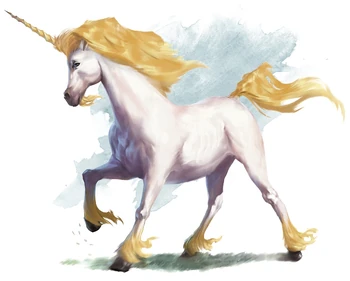
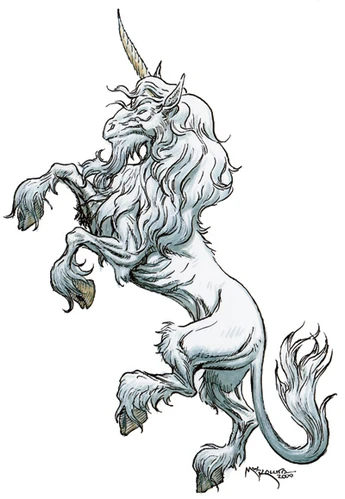
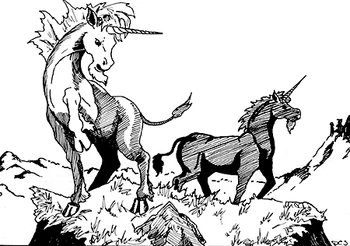
We get another good 'fantasy horse', this time the Unicorn. Where the Pegasus is portrayed as just a flying horse, the Unicorn is considered a full Celestial, tying with the Middle-Eastern mythologies and heraldry depicting the Unicorn as a near-holy animal associated with purity and goodness. D&D 5E's Unicorns might not be the most powerful beings at CR 5, but the writeup really does make them feel like badass. 

A Unicorn's power, of course, is tied to its horn. Its horn has the ability to heal the sick and injured, and they have the supernatural ability to sense the goodness and pure-hearted. They allow good creatures or beasts to enter the woods they dwell in, but evil creatures are driven out or slaughtered by the Unicorn itself. It is quite interesting where a lot of the real-world legends surrounding the Unicorn does paint it with language that resemble a lot of the themes that D&D's Fey explore... but the Unicorn itself is considered a 'Celestial', a remnant from when the game didn't really codify the Fey all that much. 5E handwaves this by noting that Unicorns were placed by the gods, but they hang out naturally with fey due to their duties of guarding locations.

Most commonly, these Unicorn Forests grant the celestial equine has supreme knowledge. Unicorns inherently know every single thing that transpires beneath the trees that it resides in, every creature and every plant. This translates beautifully to the 'regional effects' mechanic, where the Unicorn transforming the region around the Unicorn and causing nonmagical flames to instantly extinguish, its allies to be obscured by foliage, curses on good beings to fail and healing effects cast in its domain always triggering the maximum possible effect. In a Unicorn's forest, the beasts feel more tame, and many of the non-hostile Fey find it a capricious haven to keep to themselves, away from both industrial civilization as well as evil. 

3e1e
As it is with real-world myths, a Unicorn's horn is a font of divine magic that contain powerful magic, making the horns a potential for plot hooks. A Unicorn might be targeted by much more powerful evil horses who want to use the Unicorn's horn for some dark ritual, or simply to use it as a crafting tool for a powerful magical item. Or perhaps this choice is granted to the adventurers, who have to decide whether to slaughter this majestic and very sentient being for its horn just for the chance to get a powerful artifact. Even ground unicorn horns are potent magical catalysts.

The Unicorn is another creature that was absolutely wrecked by the 5.5E Monster Manual's random truncations, going from having a full page's worth of behaviour, habits and legends detailed to two short sentences that really give you nothing other than "they are good horsies that like nature". Shame. 

The Unicorn feels like a well-crafted creature to be a NPC, or at least an early-game boss that turns out to be benevolent. They themselves are a type of spellcaster enemy, but a lot of the description in the 5E Manual description really hints at a creature capable of doing much more than the dozen spells it knows is able to do. I've never really honestly cared about Unicorns in general until D&D made them pretty cool mysterious celestial-fey patrons and even potentially coming with its own ready-made 'dungeon'. 
___________________________________________________

4e
1e
Vampire
  • 5.5E/5E: Medium Undead; Lawful Evil; CR 13 (Vampire)
  • 5.5E/5E: Medium Undead; Neutral Evil: CR 5 (Vampire Spawn)
  • 5.5E: Small or Medium Humanoid; Neutral Evil; CR 3 (Familiar)
  • 5.5E: Small or Medium Undead; Neutral Evil; CR 8 (Nightbringer)
  • 5.5E: Small or Medium Undead; Lawful Evil; CR 15 (Umbral Lord)
I love vampires. You could make an entire bestiary just on vampires alone, and the idea of what a vampire is has evolved so much within the fantasy culture that you've got entire games and settings revolving around vampires only, without the rest of the 370 pages of the Monster Manual. And in Dungeons & Dragons, vampires have been identified as one of the premier monsters for quite a while, with one of the most iconic villains (particularly in 5th Edition) being Count Strahd von Zarovich, of Curse of Strahd fame. 

A lot of the basic lore about Vampires are shared with all the common tropes for everyone's favourite gothic undead bloodsuckers. Vampires are immortal, they are charming and can look like regular humans, and they feed on the blood of the living. They hide in the day in coffins or similar resting places, and roam in the night, and when needed, they can turn more lesser mortals into their own.

The original 5E Manual gave us quite a significant chunk of writeup for just a regular 'Vampire', the minions, the 'Vampire Spawn', and even some nice tidbits on making your player characters into vampires (which are kind of bare-bones, similar to the lycanthrope one). But the 5.5E Manual expanded this heavily by giving us three new Vampire variants, meant to represent different levels in a Vampire's 'growth' and 'evolution', so to speak. And since we've got that distinction going on, we'll talk about it from the weakest to the strongest...

The absolute weakest minion of a Vampire isn’t even a ‘proper’ Vampire yet, the CR 3 Vampire Familiar being actually just regular, living humanoids that serve vampires. It’s most definitely a nice little lore gap that is usually filled with stat blocks like ‘cultist’ in previous 5E work, but I like that we’re actually filling in this little niche in vampire stories, of servile butlers and maids that work under the vampiric aristocracy. 

Depending on the story you are telling, these Familiars are either fanatics who serve with the hopes of receiving the gift of immortality from their vampire lords, or are scared, cowering and pitiable people for our heroes to rescue. As the 5.5E art and the prose notes, Vampire Familiars show signs of their vampiric corruption, such as evidence of feedings (look at the puncture wounds on her neck!) and a more corpse-like complexion.

This also translates to greater power than an average humanoid, too. Familiars are still ‘regular’ humans, but they are tied supernaturally to their Vampire lords (who can perceive through their Familiar’s senses, just like wizards and their own familiars) but also possess enhanced reflexes.

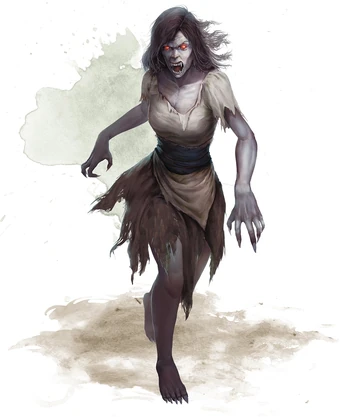
Described in both Monster Manuals are the Vampire Spawn, standing at a CR 5, and are meant to represent newly-created vampires that are still a bit more feral and consumed by their thirst for blood. Both versions show their respective Spawns to have glowing eyes and a more feral expression, and again, this serves a nice little piece in fantasy vampire lore, of the new convert – not quite human, not quite a lesser undead like a ghoul, but slowly transforming into the intelligent monster that is the full Vampire. In 5E, Spawns are still under a control of their 'parent' Vampire, and only by drawing blood from the parent can the Spawn transform into a fully-fledged Vampire. This is something that is noted to be rare, due to the fact that the parent Vampire would relinquish control. 

It's at this point that I think I can start talking about abilities. Vampire Spawns have most of the abilities that a Vampire has. They have the ‘bite’ attack that allows them to drain blood from the living and restore their own health. They can scuttle and climb on walls, and in 5E they are able to slowly regenerate as long as they are not in the sunlight. 

The keystone of many vampire media is that despite all of the badass strength, intelligence, charm and magic that vampires have, they all have weaknesses. In D&D, ‘all myths are true’ and the Spawns are harmed by all of these weaknesses: they burned by the sunlight; they take damage if they cross running water; they are destroyed if any piercing weapon is driven through their heart; and they cannot enter a home uninvited. 

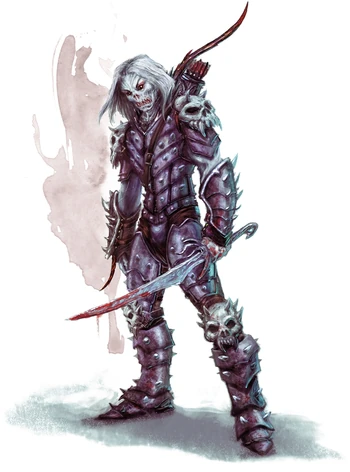
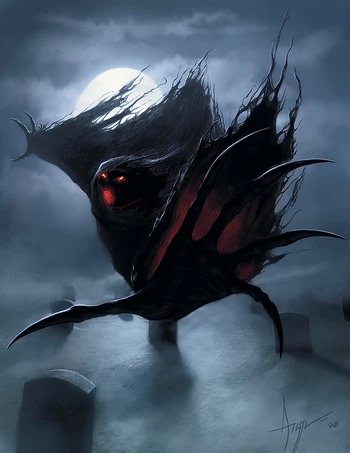
5.5E adds a slightly stronger ‘lesser’ vampire, the CR 8 Vampire Nightbringer. Between Dracula and Nosferatu, there is always a bit of a demand on two different kinds of vampires – the ones that parade around in noble clothes, or the near-feral blood-guzzling bat-monsters. The Nightbringer’s art is a nice representation of that latter bit. He’s still an intelligent being, showcased by knowing how to accessorize himself with golden accessories, but the hunched-over state and that excellently drawn set of eyes and fangs really does imply a vampire that doesn’t really care to hide amongst nobility and cares only to feed. 

5.5E’s lore is a bit minimal, noting that Nightbringers are ‘born of necromantic rituals and planes of existence suffused with negative energy’. Are they not connected to the ‘regular’ Vampire hierarchy, then? Can a Vampire Spawn become a Nightbringer, or can a regular Vampire ‘devolve’ into a Nightbringer if it’s obsessed with just feeding and dark energies? Are the Nightbringer more primal, more natural variants? 

Notably, the Nightbringer doesn’t have much of the ‘classic’ weaknesses that the Spawn or even regular Vampire has. It can enter your house uninvited! The only thing the Nightbringer fears is the sunlight. I do like this little change, showing that there’s a lot more variety among Vampirekind. It really reminds me of the more monstrous, more animalistic lesser vampires from Witcher III

5e
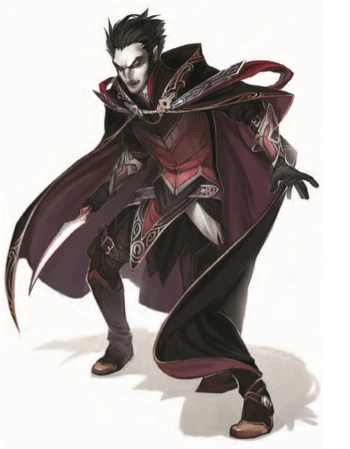
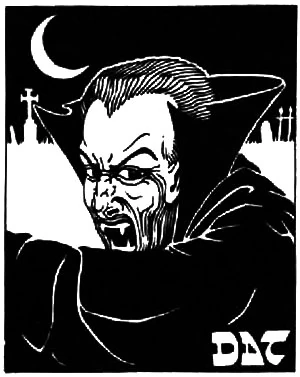
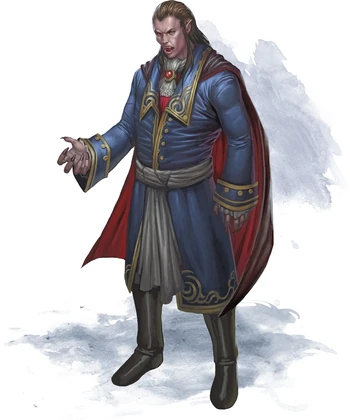
And of course, we come to the main course, the ‘Vampire’, standing at a respectable CR 13. Vampires are portrayed as pale humanoids dressed in fancy regalia, with prominent fangs and glowing eyes. A lot of the tropes that matter in more ‘social’ interactions with the Vampires also come into play here. They do not cast shadows or reflections, and combined with their sensitivity to sunlight (which damages them, not annihilates them) makes them prefer dark, dismal castles and remote locations. 

Vampires can retain memories from their past life, but any that do tend to be a bit twisted by undeath. Love turns into obsession; and emotions turn into fixations of physical symbols… and in D&D’s lore, none, perhaps, embody this better than Count Strahd mentioned above, whose eternal torment was caused by unrequited love. That bit of tragedy and twisted romance is what makes Vampires so enduring and sets them apart from a lot of other horror monsters. 

All Vampires are also chained to a location, where they rest in the day. It is often a coffin or a crypt; but 5.5E notes that other locations could be a suit of armour, a stagnant pool, the roots of a great tree, a space accessible by shapeshifting… something that connects it to its nature of undeath. I love the little description of how some Vampires have set up multiple resting places by just… moving huge chunks of their grave dirt to new locations. That’s fun. 

Vampires, of course, are one of those powerful monsters with a ‘Lair’, which tends to be a grand-but-well-defensible location. It’s a castle or a manor, it’s always a castle or manor. Around a Vampire’s lair, there is an increase in the populations of bats, rats and wolves. Plants become twisted and thorny, shadows are unnaturally gaunt, and there is an unnatural fog around it. In other words, it becomes the setting of Dracula. 

What can a Vampire do? Full Vampires still have the weaknesses of their Spawn, but they have a much more significant power boost. In addition to the classic vampire bite, they are able to shape-shift into either bats or mist, particularly using the latter to escape. They can also summon swarms of bats or rats, which isn’t very useful in actual gameplay but the vibes are definitely awesome. Vampires regenerate health while not in sunlight, and are able to temporarily charm their enemies to fight for them.  


5E has a little sidebar that I completely forgot about talking about ‘Warrior Vampire’ and ‘Spellcaster Vampire’. Which is fair enough; some Vampires are formed out of powerful individuals in life. But this sidebar was fully translated to a proper statblock, the CR 15 Vampire Umbral Lord, which adapts the spellcaster variant. Umbral Lords are able to cast powerful spells like Sickening Ray and Hunger of Hadar, only requiring no spell slots or components. 

A bit more dangerously, similar to Liches and Mummy Lords, Vampire Umbral Lords will teleport to their resting place instantly upon being reduced to zero where it can recuperate. It’s basically the climax of Dracula, isn’t it? So you need to either trap the Vampire Umbral Lord in sunlight or running water, or get ready to hunt down the coffin and be ready to take down the Umbral Lord permanently there. 

I really like Vampires. I loved the parts of Witcher III that deals with Vampires, and Innistrad is my all-time favourite Magic: The Gathering setting. I really like that the expansion to vampires has catered quite a bit to various tropes of Vampires in fantasy... cool, badass, immortal covens of vampire nobles are as valid of a vampire story to tell as the ones of a feral vampire who lurks and picks off prey like a beast. Quite happy to talk about them, as you can see from the length of this Vampire segment. 
____________________________________________________

5e
Water Weird
  • 5.5E/5E: Large Elemental; Neutral; CR 3
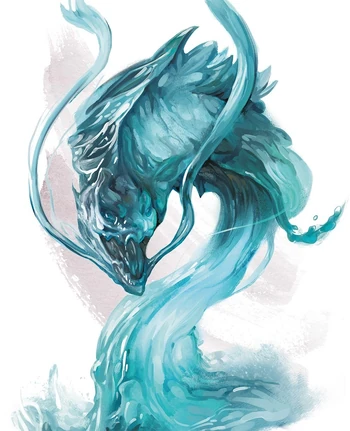
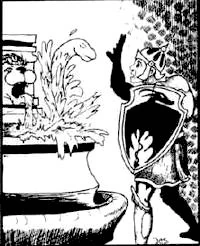
Water Weirds are kind of weird! 'Weird' is an archaic term for fate or soothsayer, before it morphed into the meaning that modern English uses it for. 5th Edition have severely trimmed down a lot of the variants of the basic elementals, but there are still some classics that remained, like the Invisible Stalker and Water Weird. Water Weirds are almost always depicted as being serpentine, with 5E's versions being particularly chunky and looking more moray-eel-like or even draconic instead of the water snakes the older editions depicted them as. The two trailing Chinese dragon mustaches also give them a nicely distinct look, too. 

Water Weirds are bound to a specific watery location such as pools and fountains (and I love the koi fish and lilypads being drawn into the Water Weird's body in its 5E art). It's invisible when it's immersed in water... probably because... it is water? But when someone tries to come and disturb it, the Water Weird rises up, coils around the unfortunate interloper and tries to crush and/or drown them. Water Weirds are then essentially a more limited and weaker version of the Water Elemental, having a lot less tricks and are used mostly for ambush purposes, like a wet, serpentine guard dog. 

1e
How sentient these Weirds are vary from edition to edition. 5.5E mentions that they are 'nature spirits' that protect a site for generations and are sentient/sapient enough to learn from their surroundings; and can even be respected as oracles... even though they can't speak and communicate through pantomimes or water tricks. 5E seems to focus on Weirds more as beings summoned by wizards, and notes that Water Weirds often adopt the alignment of the source of water it's bound to, whether it's good or evil. Hilariously the Monster Manual sees the need to emphasize that 'Purify Food and Water' works to purify the evil of a corrupted Water Weird. 

I would like to note that 3E briefly reimagines 'Weird' as just a classification of all four basic elementals who take the form of naked women made up of the corresponding element. This feels utterly redundant since these editions also already have beings like Nereids and Sylphs, who are also women made up of the elements... 2E's Water Weird, actually, poses alongside the 2E Nereid, both known as part of the 'elemental water-kin'. 
____________________________________________________

5e
Wight
  • 5.5E/5E: Medium Undead; Neutral Evil; CR 3
Wights are this game's answer to the 'replicating zombie plague' style of undead. Actual zombies and skeletons fulfill the role of weak undead minions that are raised immediately and are likely to shatter as easily; but Wights are a slightly more powerful than that. Wights as according to 5E are evildoers who were consumed by dark desires and wickedness in life, and is resurrected by a dark power to be granted a second chance at undeath. This means that Wights are a fair bit more intelligent than something like a ghoul, and a lot less tied to a single mission like a revenant. 

Wights fully possess all the memories they had in life, although they will also serve whatever dark god or powerful necromancer that brought them to life. They are, in a sense, the perfect place to be a 'smarter minion', independent enough to not be driven merely by base instincts, but also without grand ambitions as to fight its masters. 5.5E gives a bunch of other potential Wight motivations that caused them to rise from the dead, including obeying the cult it served in life, seeking its stolen treasure, prove that it's the greatest warrior, continue the crimes it was executed for... all nice little variations of the theme. 

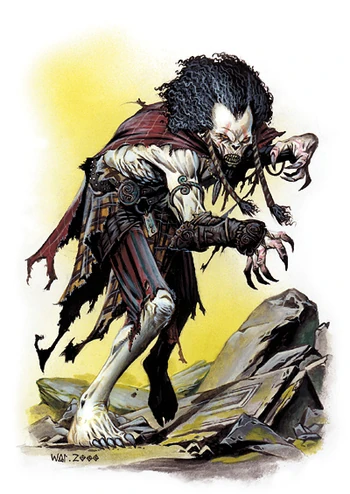
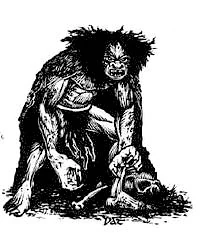
Visually, Wights have been inconsistent over the various editions, being portrayed as essentially 'ghouls with clothes' in older editions, with constantly wild hair. 5E gives the Wight a redesign that keeps it more in line with the 'elite zombie/elite skeleton', with 5E seemingly having a thin skin stretched over the skull; while 5.5E just has it be a glowing skull with hair. They are always armoured and clothed, however, able to fight better than the lesser, brainless undead zombies and skeletons. Either way, I feel like 'Wight' is defined more by the circumstances of its undeath more than anything.

3e1e
In combat, Wights are driven by a 'hunger for the spark of life', being able to drain life and restore itself with its attacks. More importantly, humanoids killed by a Wight will actually be transformed into Zombies! This is where the zombie plague is... but the transformation takes 24 hours, and so isn't actually that useful in the middle of a fight. It would be a fun twist for role-play, though, where a Wight attacks some random townsfolk and retreats, for them to rise from the cemetery as zombies the following night to sow chaos. Wights are also sensitive to sunlight, another mark as to why they can't hang out with the truly powerful undead like the Mummy Lords, Liches and Death Knights. 

As a side-note, the 5E entry opens with a note that says that 'wight' used to mean 'person' in the olden days. That is true for real life, by the way. Wight used to just mean an unfortunate person in old English, but then Tolkien used 'Barrow-Wight' to describe his version of undead, and the term stuck – and more recently Game of Thrones used it for its own version of undead. I've grown to appreciate Wights quite a bit after dismissing them as 'yet another undead' in my original monster reviews; I really do appreciate the need for different 'tropes' of undead horror being represented. 
____________________________________________________

Will-o'-Wisp
  • 5.5E/5E: Tiny Undead; Chaotic Evil; CR 2
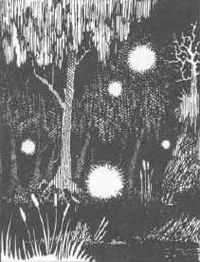
I love the Will-O'-Wisps. Part of European mythology, real-life Will-O'-Wisps are essentially just a natural phenomenon caused by swamp gas, but are associated with evil spirits or fey that lead people to their doom. In the real world, of course, these Will-O'-the-Wisps being located in swamps probably caused curious, jumpy travelers to pay less attention to their surroundings as they rush to investigate or flee the creepy shining light, and fall to the hazards of your average swamp. 

This is D&D, though, so the Will-O'-Wisps are actually undead spirits. 
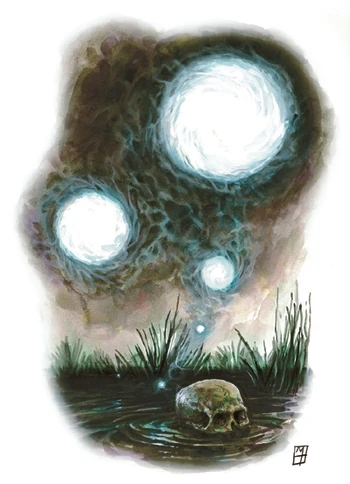
Will-O'-Wisps are portrayed to be balls of light, and it's only until 5.5E that we get a little twists of faces either crude or fully-formed appearing within the wispy smoky light. Will-O'-Wisps are noted to haunt lonely places and former battlefields, and are able to become invisible or turn into light at a whim. Hey, it's a friendly light, after all! Perhaps it's a friendly fairy, offering hope and safety. But Will-O'-Wisps lure fools to hazardous locations. Quicksand, monster lairs, a cursed ruin, patches of hazardous fungi... all to feed. 

3e1e
See, Will-O'-Wisps feed on suffering and death screams as whatever hazard they bring you to causes you to die. The Will-O'-Wisp itself can't really fight back that well, with a minor 'shock' attack and being able to slowly drain life... but it's not there to kill you. It's there to bring you to the things that will kill you, like a pack of ghouls or the nest of an owlbear or the ruins haunted by a banshee. 

The 5E Manual notes that Will-O'-Wisps are fully sentient, they just prefer not to speak, probably to maintain that illusion that they are just floating cute light blobs. When they do, their voices sound like distant whispers. The Will-O'-Wisps form symbiotic relationships with stronger, intelligent beings like hags, oni or black dragons, happily bringing these victims to their partners because all the Will-O'-Wisp needs is to drain the suffering and pain from their tormented victim. 

All of this, by the way, is fun and fascinating to me. Most undead creatures either run the gamut of 'mindless being', 'being driven by a single obsession' or 'intelligent powerful person, just dead'. And that's fine, since all undead by definition are raised unnaturally from living things. But Will-O'-Wisps behave in a manner that reminds me of some strange animal that lives through a weird, dependent symbiosis with larger, more powerful partners; wholly dependent. It's similar to how some clownfish would draw larger fish to swim into the deadly stingers of its anemone partner. I really have grown to like them in this regard.
____________________________________________________


Winter Wolf
  • 5.5E/5E: Large Monstrosity; Neutral Evil; CR 3
The Winter Wolf is another creature that was previously stuffed onto the appendix of the original 2014 5th Edition Monster Manual, but was given a full page now. Winter Wolves are horse-sized supernatural predators with... well, general Ice-type Pokemon abilities, to be blunt. Immunities to cold, an aura of frost from their mouth, and they live in the icy terrains of the world. Older editions have just drawn white wolves, but 4th Edition onwards have really emphasized the difference in size of the Winter Wolf, and 5E gave it increasingly supernatural ice features such as an ice mist, glowing blue eyes and ice fangs. It makes them feel a lot less boring, as compared to the many, many 'just a regular animal but big and maybe an extra attack' dire beasts that older editions like so much.

Also, not instantly apparent but very much highlighted in 5.5E is that Winter Wolves are intelligent enough to speak. They still only have an intelligence score of 7, lower than all humanoids (which tend to be around 10) but that's enough for adventurers to try and negotiate with them. Winter Wolves also know the Giant tongue and some of them serve Frost Giants.

And... that's it, really. There's not much to note with this one, it's just a beast with some extra features to make them fantastical. Not much more you need than that, but it sure is a bit more interesting than just a pack of regular wolves. 
____________________________________________________

Worg

  • 5.5E/5E: Large Monstrosity (5E), Fey (5.5E); Neutral Evil; CR 1/2 (Worg)
  • 5.5E: Huge Fey; Neutral Evil; CR 10 (Dire Worg)
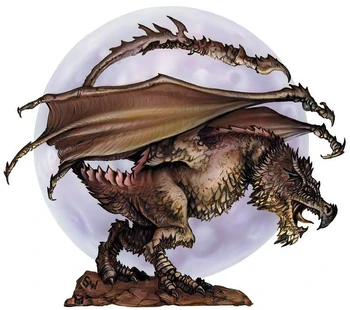
The Worg are, of course, the copyright-friendly versions of Lord of the Rings' Wargs, the giant demon wolves ridden by the orcs of the setting. The Worgs take a lot from the Wargs, including the fact that they are fully sentient and can talk with prey, taunting the weaklings they hunt and coordinating attacks with their goblin or orc riders. The appearance of the Worg across D&D's history has thus changed quite a bit, from looking like just weird, malformed wolves in the first couple of editions (with a dash of that 'disturbingly human features on a beast face' in 1E)... but 5E decided to take a page out of the Lord of the Rings movies and tried to take the idea of a 'monstrous, larger wolf' and give it a somewhat unique design. 

Like the Winter Wolf and Death Dog, the Worg was just stuffed with most of the animals and humanoid stat blocks in the appendix of the original 5EMonster Manual, but was given a full page for itself, as well as the more powerful 'Dire Worg' variant who gets a frightened-inducing howl and a teleportation ability. 

5E's basic Worg has the main body of a wolf, but the face that I think can be most charitably described as a skinless, elongated feral baboon. 5.5E then gives both its Worg and the new Dire Worg stat block a bit of a revamp, making the fur spikier but also concentrating it on the front end of the beast, giving it a lion-like mane. I do like the weird, sinister faces of the original 5E Worg, though, which marks it as something a bit different from 'just' a talking wolf.

Rather interestingly, while classified as monstrosities before, 5.5E also retcons the Worg into being Fey, probably to tie-in with their slow moving of the goblinoids towards being Fey-oriented as well. I'm still of conflicting opinions about this; while I can see the goblinoids having Fey descent, I'm not quite feeling it for their sentient talking wolf-companions. 
____________________________________________________

5e
Wraith
  • 5.5E/5E: Medium Undead; Neutral Evil; CR 5
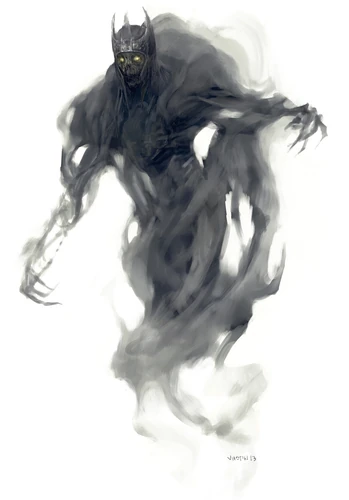
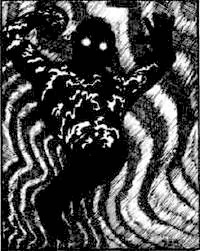
This is turning into an undead-heavy segment, yeah? Whereas the Wight is the 'middle of the road' smarter cousin of the Zombie, the Wraith fills in that slot for the incorporeal undead like the Specter. The various versions of the game have never been consistent with what the Wraith looks like, other than 'dark ghostly figure' and 'glowing eyes'. I am particularly a fan of the 3rd Edition's more wretched-looking affair, looking like ragged, animated clothes. 5E and 5.5E goes for beings made up of shadow, their lower bodies and arms trailing into smoke while they have aspects of the crowns and armours they wear in life still present. 

Wraiths are noted by the 5E Manual to be 'malice incarnate', negative energy and emotions concentrated into an incorporeal form that seeks to quench all life. Passing through the world causes fires to go out, animals to flee, and plants to be blackened. The original 5E origin for the Wratihs is metal as shit for a mere CR 5 monster. Sometimes, souls that are supposed to be consigned to hell 'is so suffused with negative energy that it collapses in on itself and ceases to exist the instant before it can shuffle off to some horrible afterlife'. You're so evil that you collapse into a singularity of negativeness in the shape of the form you had in life? How metal is that? And the description of their abilities are Wraiths leading entire legions of the dead, and even if they are forced to retreat, the lands they attempted to conquer would be so blasted and devoid of life. Awesome

4e
1e
But as mentioned, the Wraith itself is ultimately a 'mere' CR 5 creature. A tough fight, to be sure, for lower-level adventurers, but not exactly deserving of the epic origin it has. 5.5E gives us a bunch more options on how Wraiths can be formed, although the 'single very powerful soul' origin is still there. Other options include some regular standbys like 'a cursed location' or 'a powerful necromancer', and of course the Lovecraftian 'the dreams of a vile slumbering god'. But I absolutely love some of these potential origins for wraiths. 'The exorcised soul of a redeemed villain', which sounds very anime, and fits with the origin of a whole mass of negative emotions that needed to go somewhere. 'The memory of tragedy', 'locals' fear of a superstition' and 'a profane piece of lore' also implies that Wraiths don't even need to be formed out of a soul, but just enough negative emotions to coalesce into a hideous smoky ghost-man. This ties to negative emotions really does help to differentiate the Wraith from the half-dozen other 'ghost made up of someone's soul'. 

That said, other than being incorporeal, Wraiths are able to drain life from their prey, and their special ability is to create Specters, which we've covered before. I suppose being killed by a mass of negative emotions would count as a traumatic death! 

But anyway, I do think that the writeup in the original 5E Monster Manual and even the tables of potential origins in the 5.5E Manual are terrific examples of how a monster can really feel a lot more impressive than they actually are. This is a similar problem I mentioned with the lesser Hags, where the description really does imply a much more powerful creature. I do find them a lot more interesting thanks to that writeup, even if stat-wise they aren't the most impressive. 
____________________________________________________

5e
Wyvern
  • 5.5E/5E: Large Dragon; Unaligned; CR 6
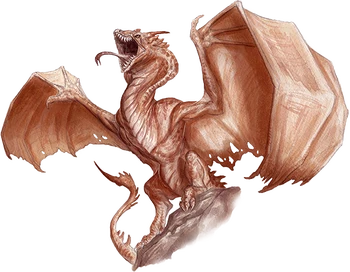
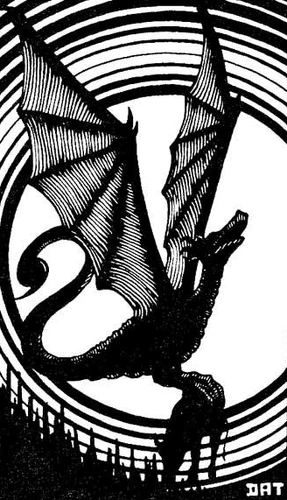
Speaking of monster tropes, there is always the trope of dragons as 'just' a large, monstrous beast without all of that intelligent, immortal spellcasting schemers that the 'true' Dragons are. And there are many words for Dragons throughout various mythology, and so some of them have been utilized in D&D to represent lesser dragons. Of those, 'Wyvern' has stood the test of time as the most enduring. Wyverns have the intelligence of beasts compared to the fully-sentient dragons, essentially being the 'chimpanzee' equivalent to a human. 

In D&D, all Dragons have four legs and two wings (other than the excellent new redesign for the Gold Dragon), but Wyverns are always depicted with two wings, two legs, and a tail. It's somewhat similar to that of a bird, and media that needs technical sophistication to depict less-complex dragons (like Skyrim and Game of Thrones) moving like a natural beast tend to utilize this body plan as it's easier to model. But we're not talking about how dragons are depicted in other media, we're talking about Wyverns!

3e1e
Wyverns are very simple fighters, with their resemblance to dragons honestly just being superficial. They fly and bite you, and D&D Wyverns have a scorpion-like stinger on its tail (a lot more obviously scorpion-like in older art) to deal poison. This is something that the Pseudodragon also has, and I really wonder what made the older D&D designers decide that scorpion tails are something that many lesser dragons just have? Again, notably Wyverns do not have the breath weapons that True Dragons are so famous for. 

Wyvern behaviour is honestly quite typical of other large predators, where despite their might,, they tend to be opportunistic hunters that attack primarily livestock and undefended travelers, taking advantage of strafing attacks and their poison tail to finish off enemies. Notably, though, a Wyvern's venom is actually highly valuable for alchemists, making Wyvern-hunting a potential aspect of society in a setting. Wyverns are noted to be smart enough to take advantage of their flight when harassing prey, but are no more intelligent than that. It is kind of boring as other than the visual (or theater-of-the-mind 'visual') spectacle there's not much to a Wyvern other than being a wild animal, but I do appreciate its existence.